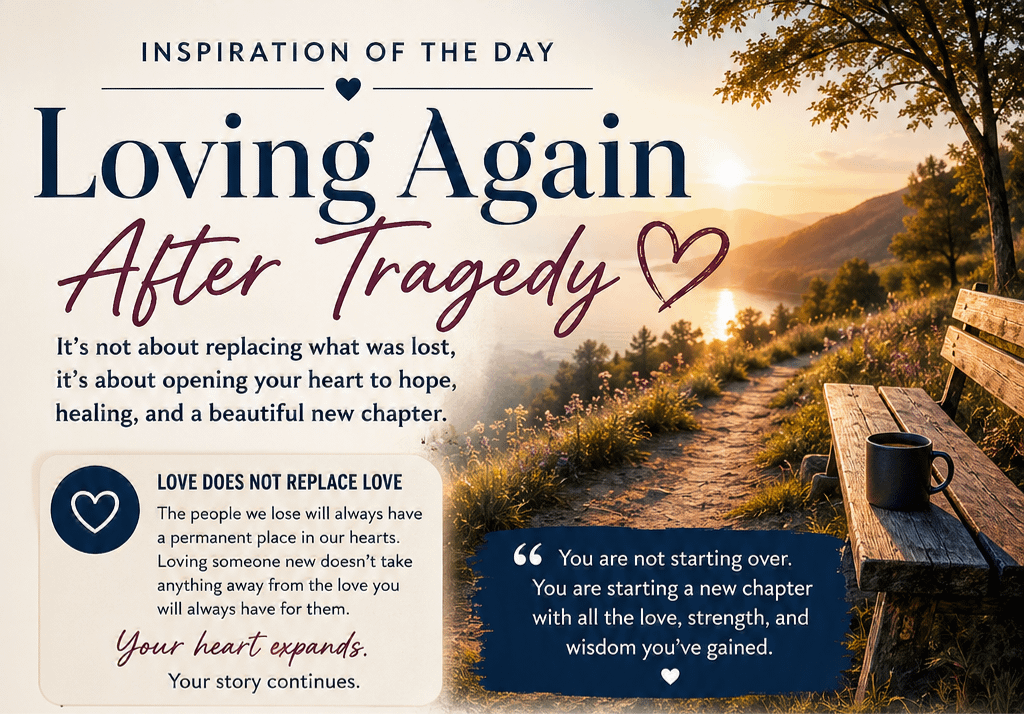
There are moments in life that divide our story into two parts: before and after. Tragedy has a way of changing us forever. Whether it is the loss of a child, a spouse, a parent, a close friend, or another life-altering event, the person we were before the tragedy no longer exists. We carry scars that cannot be seen, memories that never fade, and a heart that may wonder if it will ever truly feel whole again.
For many people, one of the greatest fears after tragedy isn’t facing another difficult day—it’s the thought of loving again.
Can you love again without betraying the one you lost?
Can you trust someone after life has shown you how deeply pain can cut?
Can your heart survive another heartbreak?
These questions are normal. They are honest. They are part of healing.
The truth is this: loving again is not forgetting. It is not replacing. It is not moving on from someone you loved. Loving again is choosing life when grief has taught you about death. It is allowing hope to exist beside sorrow.
That takes incredible courage.
Grief Changes the Way We Love
After tragedy, love feels different.
You become more aware of how fragile life truly is. You understand that every goodbye matters. Every hug may be the last. Every conversation becomes precious.
The innocence of love is replaced by appreciation.
Instead of taking people for granted, you begin valuing the ordinary moments:
- A quiet dinner together.
- A morning text.
- Holding someone’s hand.
- Laughing until your stomach hurts.
- Sitting together in comfortable silence.
Pain teaches us what truly matters.
Your Heart Isn’t Broken Beyond Repair
Many people convince themselves that their heart is too damaged to love again.
They say things like:
“I already gave everything I had.”
“I don’t want to lose someone again.”
“Nobody could ever understand me.”
“It’s safer to stay alone.”
Those feelings make sense.
When tragedy steals someone you love, your heart naturally wants to protect itself from ever experiencing that kind of pain again.
But protecting your heart can slowly become imprisoning your heart.
There is a difference between healing and hiding.
Healing allows you to grow stronger.
Hiding keeps you from living.
Love Does Not Replace Love
One of the greatest misconceptions is believing that loving someone new somehow diminishes the love you have for the person you lost.
Love doesn’t work that way.
Parents who have multiple children don’t love one child less because another is born.
Your heart expands.
The same is true after tragedy.
If you’ve lost someone deeply important to you, their place in your heart is permanent.
No one can replace them.
No one should.
The people who enter your life later are not replacements.
They are new chapters.
Your story continues without erasing earlier pages.
Let Go of Guilt
Many grieving people carry guilt when they begin smiling again.
They feel guilty enjoying vacations.
They feel guilty laughing.
They feel guilty dating.
They feel guilty imagining a future.
But guilt is one of grief’s greatest lies.
The people we love rarely want us to spend the rest of our lives trapped in sadness.
If they loved us, they wanted us to live.
To smile.
To experience joy.
To find peace.
To continue writing our story.
Honoring someone isn’t measured by how long you remain miserable.
Sometimes honoring them means becoming the person they always believed you could be.
Love Requires Vulnerability
Opening your heart after tragedy feels terrifying because you know exactly what’s at stake.
You understand loss in a way many people never will.
You know people aren’t guaranteed tomorrow.
You know forever isn’t promised.
Ironically, that understanding can make love even more meaningful.
You stop chasing perfection.
You start appreciating presence.
Real love isn’t about guarantees.
It’s about showing up today.
The Right Person Won’t Ask You to Forget
Someone who truly loves you won’t compete with your past.
They won’t ask you to erase your memories.
They won’t become jealous of someone who is no longer here.
Instead, they will understand that your past helped shape who you are today.
They’ll respect your scars.
They’ll listen to your stories.
They’ll recognize that your grief isn’t a weakness.
It’s evidence that you loved deeply.
And someone capable of loving that deeply can love again.
Healing Doesn’t Follow a Schedule
There is no calendar for grief.
Some people begin dating after a year.
Others wait several years.
Some never pursue another relationship.
Every journey is different.
Don’t allow others to tell you when you should or shouldn’t move forward.
Only you know your heart.
The important question isn’t:
“Has enough time passed?”
The better question is:
“Am I emotionally ready to allow someone into my life?”
Healing isn’t measured by time.
It’s measured by growth.
Fear Will Always Whisper
Fear may never disappear completely.
It will whisper:
“What if this ends too?”
“What if you’re hurt again?”
“What if you’re disappointed?”
Those fears are understandable.
But remember something important:
Everything worthwhile requires vulnerability.
Love has always involved risk.
Before tragedy.
After tragedy.
Always.
The possibility of pain has never stopped love from being one of life’s greatest gifts.
Loving Again Honors the Life You Were Given
If tragedy teaches us anything, it is that tomorrow is never guaranteed.
Life is precious because it is temporary.
That truth shouldn’t make us love less.
It should inspire us to love more.
More honestly.
More openly.
More intentionally.
More courageously.
The greatest tribute we can give to those we’ve lost is not refusing to live.
It is living well.
Give Yourself Permission
You don’t need permission from society.
You don’t need permission from strangers.
You don’t need permission from people who don’t understand your journey.
Give yourself permission.
Permission to smile.
Permission to laugh.
Permission to dream.
Permission to hope.
Permission to trust again.
Permission to love again.
Because surviving tragedy wasn’t the end of your story.
It was the beginning of a different one.
Final Thoughts
Love after tragedy isn’t about pretending the pain never happened.
It’s about carrying both grief and gratitude in the same heart.
It is about believing that memories can coexist with new experiences.
It is about understanding that healing doesn’t erase loss—it teaches us how to live alongside it.
If your heart has been shattered by tragedy, know this:
Your capacity to love was not destroyed.
It was transformed.
And when the time is right, that transformed heart may become even more compassionate, patient, appreciative, and genuine than it was before.
Never believe that tragedy has stolen your chance to love.
Sometimes, after walking through unimaginable darkness, we discover that love shines even brighter.
Because the bravest hearts are not the ones that have never been broken.
They are the ones that choose to love anyway.
Share this:
- Share on X (Opens in new window) X
- Share on Facebook (Opens in new window) Facebook
- Share on LinkedIn (Opens in new window) LinkedIn
- Share on Reddit (Opens in new window) Reddit
- Share on Tumblr (Opens in new window) Tumblr
- Share on Pinterest (Opens in new window) Pinterest
- Share on Telegram (Opens in new window) Telegram
- Share on Threads (Opens in new window) Threads
- Share on Bluesky (Opens in new window) Bluesky
Leave a Reply