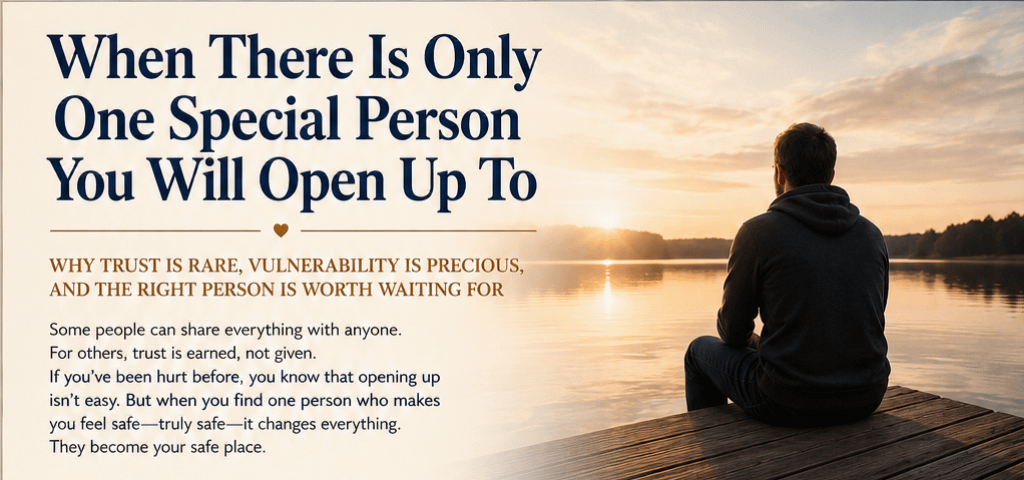
Why Trust Is Rare, Vulnerability Is Precious, and the Right Person Is Worth Waiting For
There comes a point in many people’s lives when they stop sharing everything with everyone.
Life has a way of changing us.
Childhood teaches us to trust easily. We tell our secrets without fear. We laugh without worrying about judgment. We believe people mean what they say because we’ve not yet experienced enough disappointment to think otherwise.
Then life happens.
Someone lies.
Someone leaves.
Someone betrays us.
Someone dies.
Someone promises forever but disappears when life becomes difficult.
Piece by piece, the walls around our hearts begin to rise—not because we hate people, but because we’ve learned that not everyone deserves unrestricted access to the most fragile parts of us.
For some, those walls become so strong that only one person will ever truly make it inside.
Not because they are perfect.
Not because they’re the only person who has ever cared.
But because they’re the only one who earned the privilege of seeing who we really are.
If you’ve ever found yourself thinking, “There is only one person I can truly talk to,” you’re far from alone.
In fact, for many people who have experienced profound grief, trauma, heartbreak, or disappointment, that one person becomes more than a relationship.
They become home.
Why Most People Stop Opening Up
Opening up sounds simple.
People often say things like:
“Just tell me what’s wrong.”
“You should talk about your feelings.”
“Communication solves everything.”
If only it were that easy.
Opening up requires one thing before anything else:
Safety.
Without emotional safety, honesty feels dangerous.
Every painful experience teaches us a lesson.
Sometimes those lessons are healthy.
Sometimes they’re not.
A person who has repeatedly been criticized may learn to keep opinions to themselves.
Someone betrayed by a partner may struggle to trust again.
Someone who has lost a child may discover that very few people understand the depth of their pain.
Eventually, silence becomes easier than explaining.
Not because there is nothing to say.
Because explaining hurts.
Some Wounds Change the Way You Trust Forever
Certain experiences permanently alter how we connect with people.
The death of someone you love.
Divorce.
Infidelity.
Abandonment.
Emotional abuse.
Years of feeling ignored.
Being mocked for expressing emotion.
These experiences don’t simply create sadness.
They reshape your understanding of human connection.
You stop asking:
“Who likes me?”
Instead you begin asking:
“Who is actually safe?”
That question changes everything.
Trust Is Earned in Small Moments
Movies often portray trust as something that happens overnight.
Real life rarely works that way.
Trust grows quietly.
It develops through hundreds of ordinary moments.
Someone remembers what matters to you.
Someone shows up when they said they would.
Someone checks on you without being asked.
Someone keeps your private conversations private.
Someone stays during uncomfortable conversations instead of walking away.
Every small act says the same thing:
“You are safe with me.”
Eventually, one day, you find yourself saying something you’ve never told anyone else.
Not because you planned to.
Because your heart finally felt safe enough.
Why Vulnerability Feels Terrifying
People often mistake vulnerability for weakness.
In reality, vulnerability requires extraordinary courage.
When you open your heart, you surrender control.
You cannot control whether someone understands.
You cannot control whether they stay.
You cannot control whether they judge you.
You simply choose honesty despite the uncertainty.
That is bravery.
Many people would rather carry pain alone than risk another disappointment.
Unfortunately, isolation often creates its own suffering.
The One Person Who Sees Behind the Mask
Most of us wear masks.
The strong one.
The funny one.
The successful one.
The dependable one.
The one who always has everything together.
But masks become exhausting.
Eventually everyone longs for a place where pretending is unnecessary.
That special person becomes the place where the mask finally comes off.
You don’t have to explain every silence.
You don’t have to fake happiness.
You don’t have to apologize for crying.
You don’t have to pretend you’ve healed when you haven’t.
That kind of acceptance is incredibly rare.
Why Grief Makes Trust More Difficult
Grief changes conversations.
People stop asking how you’re doing after a few weeks.
Meanwhile, you’re still grieving months or years later.
You quickly learn that many people are uncomfortable with pain.
Some disappear.
Others offer clichés.
A few genuinely stay.
Those few become unforgettable.
If you’ve experienced profound loss, you may discover that only one person truly listens without trying to fix you.
That person becomes priceless.
Being Someone’s Safe Place Is a Responsibility
If someone chooses to trust you with their deepest fears, they are giving you something fragile.
Handle it carefully.
Listen without interrupting.
Don’t minimize their pain.
Don’t compare their experience to someone else’s.
Don’t tell others what they shared in confidence.
Never use their vulnerability as ammunition during an argument.
Trust can take years to build.
One careless moment can destroy it.
Why Some People Never Fully Open Up Again
People often judge those who remain emotionally guarded.
They say they’re cold.
Detached.
Emotionally unavailable.
What they rarely ask is:
“What happened to make them this way?”
Many guarded people weren’t born distant.
They learned distance after repeated disappointment.
Sometimes, what appears to be emotional unavailability is actually emotional self-protection.
The Difference Between Privacy and Emotional Walls
Healthy privacy says:
“You’ll know me as trust develops.”
Emotional walls say:
“No one will ever know me.”
One protects your peace.
The other isolates your heart.
Healing isn’t about telling everyone everything.
Healing is allowing the right people to know the real you.
How the Right Person Earns Your Trust
Trust isn’t built through grand romantic gestures.
It’s built through consistency.
The right person:
- Keeps their promises.
- Speaks honestly.
- Respects boundaries.
- Doesn’t disappear during conflict.
- Makes you feel heard instead of judged.
- Gives reassurance without making you beg for it.
- Accepts your past without defining you by it.
- Celebrates your victories and sits beside you during your losses.
These ordinary acts slowly create extraordinary trust.
What Happens When That One Person Leaves
One of the deepest emotional pains is losing the only person you felt safe enough to be yourself around.
Whether through death, divorce, separation, or simply growing apart, it can feel as though part of your identity disappears.
You don’t only lose a companion.
You lose your emotional sanctuary.
That’s why healing often takes much longer than outsiders expect.
You’re not simply grieving a relationship.
You’re grieving the loss of safety.
Learning to Trust Again
Healing doesn’t require trusting everyone.
It requires remaining open to the possibility that trustworthy people still exist.
Start slowly.
Allow relationships to develop naturally.
Watch actions more than words.
Notice consistency.
Pay attention to how people respond when you’re struggling.
Trust should never be rushed.
But neither should it be permanently abandoned.
If You Are Still Waiting
Maybe you’ve never found that one special person.
Maybe you once had them and lost them.
Maybe you’re wondering whether you’ll ever feel that kind of connection again.
Don’t lose hope.
The world often celebrates quantity.
Hundreds of friends.
Thousands of followers.
Countless acquaintances.
But a meaningful life has never been measured by how many people know your name.
It is measured by how many truly know your heart.
Even if that number is only one.
How to Become a Safe Person for Others
If you hope someone will trust you deeply, become someone worthy of trust.
Practice listening more than speaking.
Respect confidentiality.
Choose compassion over criticism.
Stay present during difficult conversations.
Be patient with healing.
Don’t pressure someone to open up before they’re ready.
Trust grows where patience lives.
Faith and the Courage to Be Known
For people of faith, there is another source of comfort.
Even when no one fully understands our hearts, God does.
He knows every tear we’ve cried in silence.
Every unanswered question.
Every fear we’ve hidden.
Every memory we cannot let go.
Human relationships matter deeply, but God’s love reminds us that we are never completely alone.
Sometimes His greatest gift is placing one trustworthy person in our lives at exactly the moment we need them most.
Final Thoughts
There is nothing wrong with being selective about who you trust.
Not everyone deserves unrestricted access to your heart.
Some people are meant to know your name.
Others are meant to know your story.
A very small number are meant to know your soul.
If you have found someone who allows you to be completely yourself, treasure that relationship.
Protect it.
Nurture it.
Never take it for granted.
And if you are still searching, don’t settle for someone who only loves the easy parts of you.
Wait for the person who stays through the difficult conversations.
The one who listens without judgment.
The one who treats your vulnerability as a gift instead of a weakness.
Because when there is only one special person you will open up to, you’ve discovered something that many people spend a lifetime searching for:
A place where your heart finally feels safe enough to rest.
Key Takeaways
- Emotional openness begins with emotional safety, not pressure.
- Deep trust is built through consistency, honesty, and patience.
- Past loss and betrayal often make vulnerability much harder.
- One genuine, trustworthy relationship can be more valuable than dozens of superficial ones.
- Becoming a safe person for others starts with empathy, reliability, and respect.
- Whether you’ve already found that person or are still waiting, never underestimate the value of authentic connection. It has the power to change a life.
Read More Of Love & Relationships
Leave a Reply