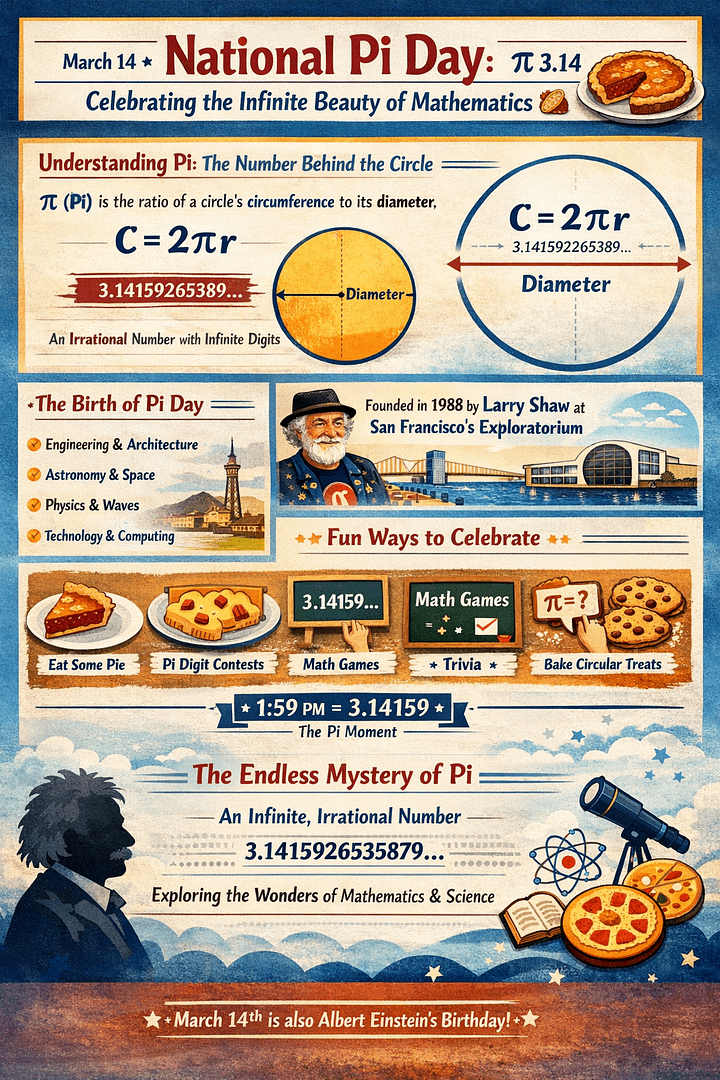
Every year on March 14, people across the globe celebrate Pi Day, a unique holiday dedicated to one of mathematics’ most fascinating numbers: Pi. The date—3/14—corresponds with the first three digits of Pi (3.14), making it the perfect day to honor a number that has intrigued mathematicians, scientists, and thinkers for thousands of years.
What began as a playful celebration among math enthusiasts has grown into an international event that highlights the beauty of mathematics, the importance of scientific curiosity, and the joy of learning. From classrooms to science museums, Pi Day inspires people to explore the wonders hidden within numbers and patterns that shape our world.
Understanding Pi: The Number Behind the Circle
Pi, represented by the Greek letter π, is the ratio of a circle’s circumference to its diameter. No matter how large or small a circle is, this ratio always remains the same.
This relationship is shown in the fundamental circle equation:
C=2πr
Here, C represents the circumference of the circle and r represents the radius. Pi connects these measurements, allowing mathematicians and scientists to calculate distances, areas, and curves involving circles and spheres.
The decimal representation of Pi begins as:
3.141592653589793238…
What makes Pi extraordinary is that it is an irrational number, meaning its decimal digits continue infinitely without repeating in any predictable pattern. Despite centuries of study and modern supercomputers calculating trillions of digits, Pi continues endlessly.
In many ways, Pi symbolizes the infinite curiosity of human knowledge—there is always more to discover.
Ancient Origins of Pi
Although Pi Day itself is modern, the study of Pi stretches back thousands of years. Ancient civilizations discovered that circles followed a consistent mathematical relationship long before modern notation existed.
One of the earliest recorded approximations of Pi came from Archimedes, the brilliant Greek mathematician who lived in the third century BCE. Archimedes used geometric methods involving polygons to estimate Pi, calculating that its value was somewhere between 3.1408 and 3.1429, remarkably close to the value we know today.
Other ancient cultures also explored the constant:
The Babylonians approximated Pi as 3.125.
Ancient Egyptians used a value close to 3.16 in their calculations.
Chinese mathematicians later refined Pi to several decimal places.
These discoveries demonstrate that the fascination with circles and their mathematical properties has existed for millennia.
The Birth of Pi Day
The celebration of Pi Day itself began in 1988 thanks to physicist Larry Shaw at the Exploratorium science museum in San Francisco.
Shaw and his colleagues organized a lighthearted event where participants walked in circles and enjoyed slices of pie while discussing mathematics. The clever combination of science and humor quickly caught the attention of educators and students.
Over time, the celebration spread far beyond the museum. Schools began hosting math competitions and classroom activities, while science enthusiasts embraced the holiday as a fun way to highlight the importance of mathematics.
In 2009, the United States House of Representatives officially recognized March 14 as National Pi Day. The recognition helped solidify the holiday’s place in American culture and encouraged educational institutions to celebrate mathematics in engaging ways.
Interestingly, March 14 is also the birthday of one of history’s most famous scientists, Albert Einstein, whose groundbreaking work revolutionized physics and our understanding of the universe.
Why Pi Matters in the Real World
While Pi might appear to be just another number in a math textbook, it is actually essential to countless fields of science and technology.
Engineering and Architecture
Engineers use Pi when designing structures that involve curves or circular shapes, such as bridges, tunnels, and domes. Accurate measurements ensure that these structures remain stable and safe.
Astronomy
Astronomers rely on Pi when calculating the motion of planets, orbits, and the shapes of galaxies. Without Pi, understanding the mechanics of our solar system would be far more difficult.
Physics
Many physical equations involving waves, motion, and energy include Pi. It appears in formulas describing everything from sound waves to the motion of pendulums.
Technology and Computing
Modern technology also uses Pi in algorithms, simulations, and digital signal processing. Even graphics engines that render curved shapes on computer screens depend on the mathematics involving Pi.
Simply put, Pi is woven deeply into the fabric of science and engineering.
Fun Ways People Celebrate Pi Day
Part of the charm of Pi Day is that it combines education with creativity and fun. Around the world, celebrations often include a variety of activities:
Eating pie:
The classic Pi Day tradition is enjoying a slice of pie—apple, cherry, pumpkin, or any favorite flavor. The pun between “Pi” and “pie” has become an iconic part of the celebration.
Math competitions:
Schools and universities host challenges where students compete to solve mathematical problems or recite as many digits of Pi as possible.
Memorization contests:
Some enthusiasts dedicate themselves to memorizing thousands of digits of Pi. The current world records reach astonishing lengths.
Educational events:
Teachers use Pi Day as an opportunity to make math engaging, often through games, puzzles, and hands-on experiments.
Circular foods:
Pizza, cookies, pancakes, and donuts also appear at Pi Day gatherings, reinforcing the theme of circles.
Some celebrations even occur at 1:59 PM, representing the sequence 3.14159, the first six digits of Pi.
Pi in Popular Culture
Beyond the classroom, Pi has found a place in popular culture as well. It appears in puzzles, books, and films that explore the mysteries of mathematics.
One notable example is the film Pi, directed by Darren Aronofsky, which tells the story of a mathematician obsessed with discovering hidden patterns in numbers.
Pi has also inspired art, music, and poetry, proving that mathematics can be both logical and deeply creative.
The Endless Nature of Pi
Perhaps the most fascinating aspect of Pi is its infinite nature. Unlike most numbers we use in daily life, Pi never truly ends. Its digits stretch on forever, without repetition.
For mathematicians, this endless sequence represents a kind of intellectual frontier. Even with advanced technology, we continue exploring new digits and studying the patterns that might exist within them.
Pi reminds us that even the simplest shapes—like a circle—can hold mysteries that challenge human understanding.
More Than Just a Number
At its heart, National Pi Day celebrates more than mathematics. It celebrates curiosity, learning, and the human desire to understand the world.
Numbers like Pi remind us that patterns exist everywhere—in nature, science, art, and the universe itself. By studying these patterns, we uncover new knowledge and deepen our appreciation for the world around us.
So whether you spend March 14 solving equations, teaching students about geometry, or simply enjoying a slice of pie, Pi Day offers a moment to celebrate the beauty of discovery.
After all, Pi may be infinite—but so is our capacity to learn.
Read More Holidays & National Days
Leave a Reply