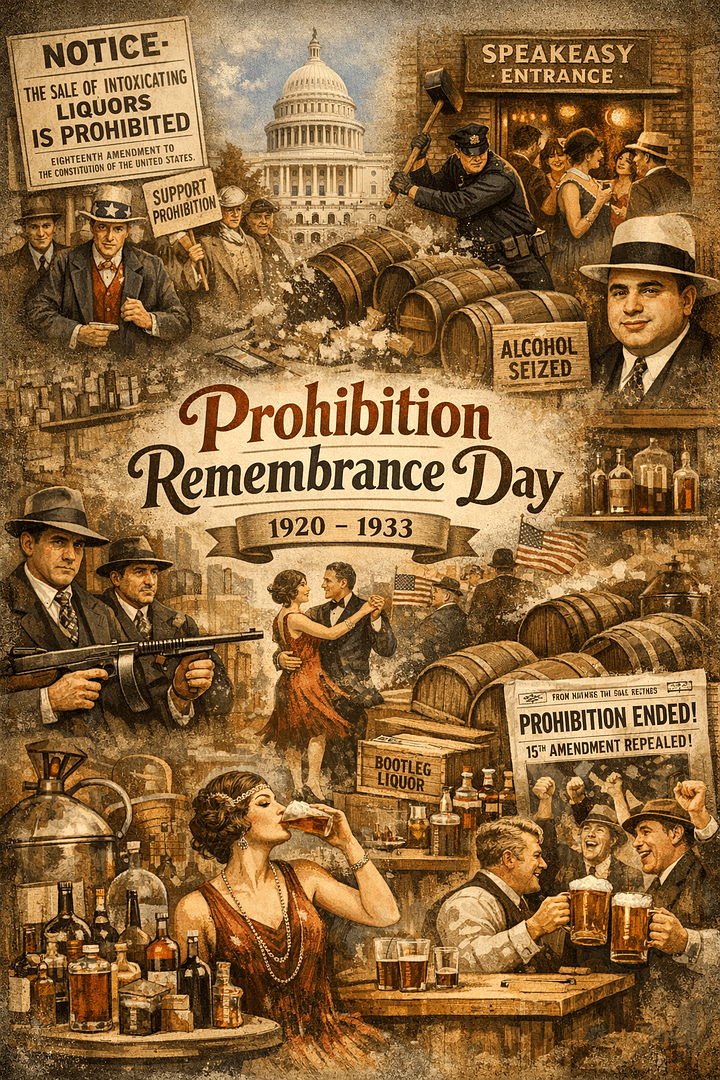
Each year, Prohibition Remembrance Day invites us to reflect on one of the most ambitious and controversial social experiments in American history—the nationwide ban on alcohol. More than a footnote in the past, Prohibition reshaped politics, culture, crime, and everyday life in ways that still echo today.
From 1920 to 1933, the manufacture, sale, and transportation of alcoholic beverages were outlawed under the 18th Amendment to the U.S. Constitution. What began as a moral and social reform effort became a defining lesson in the limits of legislation and the resilience of human behavior.
Why Prohibition Began
The movement for Prohibition did not arise overnight. For decades, temperance advocates, religious groups, and social reformers argued that alcohol was responsible for poverty, domestic violence, workplace accidents, and moral decline. Saloons were seen as breeding grounds for corruption, especially in working-class communities.
By the early 20th century, these concerns had gained powerful political backing. World War I further fueled support, as conserving grain and promoting discipline were framed as patriotic duties. In 1919, the 18th Amendment was ratified, and in January 1920, Prohibition officially went into effect.
Life Under the Ban
While lawmakers hoped Prohibition would create a healthier, more orderly society, the reality proved far more complex.
Alcohol did not disappear—it went underground. Speakeasies flourished in cities, bootleggers smuggled liquor across borders, and homemade spirits became common. What was once a regulated industry transformed into an illicit economy controlled by criminal organizations.
Perhaps most famously, organized crime expanded rapidly during this era. Figures like Al Capone built empires on illegal alcohol, fueling violence and corruption. Law enforcement agencies were overwhelmed, underfunded, and often compromised. Instead of reducing crime, Prohibition unintentionally made it more profitable.
Cultural and Social Impact
Prohibition also reshaped American culture. The Jazz Age, with its defiance of traditional norms, was intertwined with secret clubs, coded passwords, and a rebellious spirit. Women, newly empowered by the right to vote, became visible participants in nightlife, challenging long-standing social expectations.
At the same time, many families and communities felt the strain of the law. Ordinary citizens who once enjoyed alcohol legally were suddenly criminals for maintaining familiar customs. Respect for the law eroded as millions ignored or openly violated the ban.
The End of an Era
By the early 1930s, public opinion had shifted dramatically. The Great Depression added urgency, as Americans recognized that legalizing alcohol could generate tax revenue and create jobs. In 1933, the 21st Amendment was ratified, repealing Prohibition and restoring the legal sale of alcohol.
It remains the only time in U.S. history that a constitutional amendment has been repealed.
Why We Remember
Prohibition Remembrance Day is not about celebrating alcohol, but about honoring history—and learning from it. The era stands as a powerful reminder that well-intentioned laws can produce unintended consequences when they clash with deeply rooted human behavior.
It also highlights enduring questions that still shape public policy today:
How much should government regulate personal choices?
What happens when legislation moves faster than cultural change?
Can morality be enforced by law?
By remembering Prohibition, we remember the importance of balance—between reform and freedom, idealism and realism.
A Lesson for the Future
More than ninety years after its repeal, Prohibition continues to shape discussions around drug policy, public health, and personal liberty. It teaches us that social progress requires not only good intentions, but also practical understanding of human nature and society.
Prohibition Remembrance Day invites us to look back—not with nostalgia or judgment, but with clarity. History’s most ambitious experiments often leave the strongest lessons behind.
What lessons do you think modern society can still learn from the era of Prohibition?
Read More Holidays & National Days
Leave a Reply