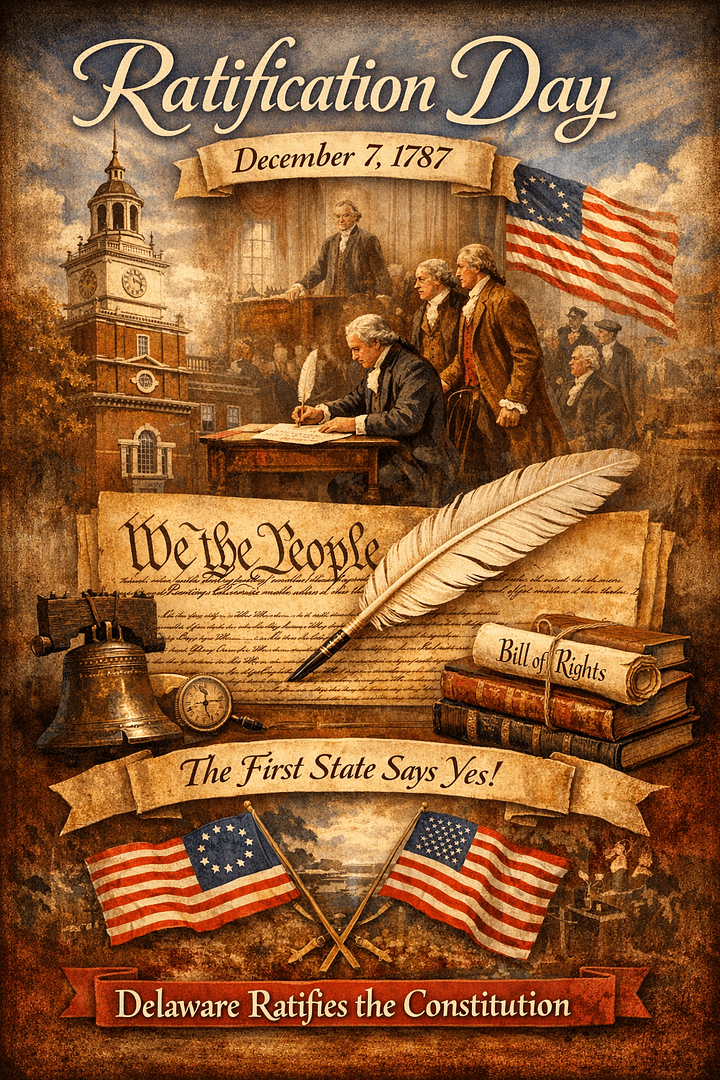
Every year on December 7, the United States quietly marks a moment that forever shaped its identity—Ratification Day. On this date in 1787, Delaware became the first state to ratify the U.S. Constitution, setting in motion the legal and political foundation of the nation we know today. While not as widely celebrated as Independence Day or Constitution Day, Ratification Day represents the moment when the idea of America officially became a governing reality.
From Revolution to Framework
After winning independence from Great Britain, the newly formed states faced a daunting challenge: how to govern themselves as a unified nation. The Articles of Confederation, the country’s first attempt at national government, proved too weak to manage economic instability, interstate disputes, and national defense.
In 1787, delegates from across the states gathered in Philadelphia for what became the Constitutional Convention. Their goal was bold—design a system that balanced federal authority with states’ rights, individual liberty with collective security, and democratic participation with stable governance.
The result was the U.S. Constitution, but writing it was only half the battle. For it to take effect, at least nine of the thirteen states had to formally approve—or ratify—the document.
December 7, 1787: The First Yes
On Ratification Day, Delaware became the first state to ratify the Constitution unanimously. Eager to secure its place in the new republic and strengthen the fragile union, Delaware proudly earned the nickname “The First State.”
Other states soon followed. By June 21, 1788, New Hampshire became the ninth state to ratify, officially establishing the Constitution as the supreme law of the land. By 1790, all thirteen original states had ratified, fully uniting under the new system of government.
Why Ratification Matters
Ratification Day is not just a historical footnote—it symbolizes:
-
The birth of American democracy in action
Citizens and state conventions debated, challenged, and ultimately chose their governing framework. -
The power of compromise
The Constitution exists because people with different interests found common ground. -
The foundation of individual rights
Ratification led to the addition of the Bill of Rights, protecting freedoms such as speech, religion, and due process.
Without ratification, the Constitution would have remained a proposal rather than the living document that continues to guide the nation.
A Living Legacy
More than two centuries later, the Constitution remains one of the oldest written national constitutions still in use. While it has been amended to reflect social progress and changing values, its core principles—liberty, justice, and representative government—remain intact.
Ratification Day reminds us that democracy is not something handed down effortlessly. It is built through participation, debate, and the courage to believe in a shared future.
How to Observe Ratification Day
You can honor this day in meaningful ways:
-
Read the Constitution or explore the Federalist Papers
-
Discuss the importance of civic responsibility with students or family
-
Reflect on the rights and responsibilities you hold as a citizen
-
Visit a historic site or watch a documentary about America’s founding
A Moment Worth Remembering
Ratification Day is the day a bold experiment in self-governance became real. It marks the moment when thirteen diverse states chose unity over division and laid the groundwork for a nation still striving to live up to its founding ideals.
In remembering Ratification Day, we are reminded that the strength of democracy lies not only in its documents—but in the people who continue to uphold them.
Share this:
- Share on X (Opens in new window) X
- Share on Facebook (Opens in new window) Facebook
- Share on LinkedIn (Opens in new window) LinkedIn
- Share on Reddit (Opens in new window) Reddit
- Share on Tumblr (Opens in new window) Tumblr
- Share on Pinterest (Opens in new window) Pinterest
- Share on Telegram (Opens in new window) Telegram
- Share on Threads (Opens in new window) Threads
- Share on Bluesky (Opens in new window) Bluesky
Leave a Reply