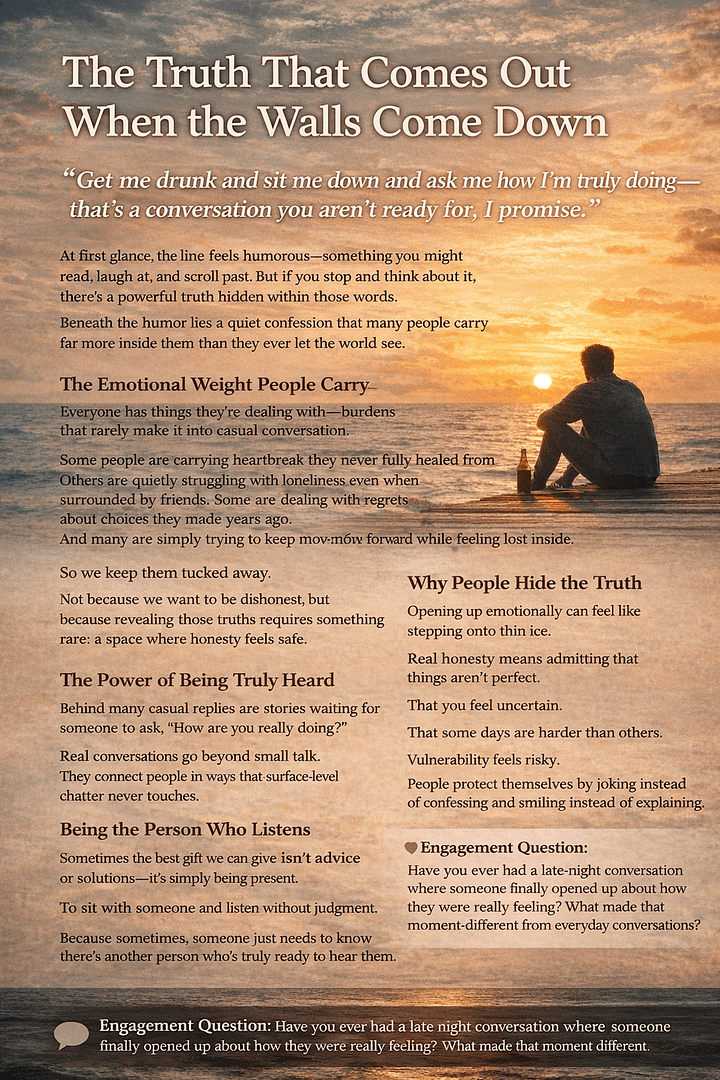
“Get me drunk and sit me down and ask me how I’m truly doing—that’s a conversation you aren’t ready for, I promise.”
At first glance, the line feels humorous—something you might read, laugh at, and scroll past. But if you stop and think about it, there’s a powerful truth hidden within those words. Beneath the humor lies a quiet confession that many people carry far more inside them than they ever let the world see.
Most of us have become masters of the polite response. When someone asks, “How are you?” the answer almost always comes automatically.
“I’m good.”
“Doing fine.”
“Can’t complain.”
These phrases have become social shorthand—quick, simple replies designed to keep conversations moving and emotions neatly tucked away. They allow us to navigate daily interactions without revealing the deeper layers of what we’re actually feeling.
But the truth is, those answers are rarely the full story.
The Emotional Weight People Carry
Everyone has things they’re dealing with—burdens that rarely make it into casual conversation.
Some people are carrying heartbreak they never fully healed from.
Others are quietly struggling with loneliness even when surrounded by friends.
Some are dealing with regrets about choices they made years ago.
And many are simply trying to keep moving forward while feeling lost inside.
Life has a way of layering experiences on top of each other. Over time, those layers become stories we carry within us—stories that are often too complex, too vulnerable, or too painful to casually share.
So we keep them tucked away.
Not because we want to be dishonest, but because revealing those truths requires something rare: a space where honesty feels safe.
Why People Hide the Truth
Opening up emotionally can feel like stepping onto thin ice. When someone asks how you’re really doing, answering honestly means exposing parts of yourself that you usually keep guarded.
It means admitting that things aren’t perfect.
That you feel uncertain.
That some days are harder than others.
For many people, vulnerability feels dangerous because they’ve learned—through experience—that not everyone is prepared for it. Sometimes when people open up, the response they receive is awkward silence, quick advice, or someone trying to change the subject.
So over time, people learn to protect themselves by keeping things light.
They joke instead of confessing.
They smile instead of explaining.
They say they’re fine even when they’re anything but.
The Role of Lowered Defenses
That’s where the quote’s reference to alcohol comes in—not as encouragement, but as symbolism.
When people relax or let their guard down, the walls they’ve carefully built around their emotions can begin to soften. The things they normally keep hidden suddenly feel easier to say.
Late-night conversations often have this effect. The world quiets down, distractions fade, and people begin speaking more honestly than they would during the day.
In those moments, you sometimes hear the real answers:
“I’m actually struggling more than people realize.”
“I miss someone I can’t talk to anymore.”
“I’m not sure where my life is going.”
These are the truths that rarely appear in casual daytime conversation.
The Power of Being Truly Heard
At its core, the quote reveals something deeply human: many people are waiting for someone who genuinely wants to hear the truth.
Not someone who asks out of politeness.
Not someone looking for a quick answer.
But someone willing to sit through the real conversation.
Real conversations can be messy. They might involve sadness, frustration, confusion, or unresolved emotions. But they also create something incredibly valuable: connection.
When someone finally speaks honestly about what they’re carrying, they’re not just sharing their struggles—they’re sharing trust.
And being heard without judgment can be one of the most healing experiences a person can have.
Why Deep Conversations Matter
In a world filled with constant noise, real conversations have become rare. Social media highlights the best moments of people’s lives, while everyday interactions often stay at surface level.
But beneath those surfaces, people are craving authenticity.
They want conversations that go deeper than small talk.
They want moments where they can put down the emotional armor they wear every day.
Those moments remind us that we’re not alone in our struggles. They remind us that everyone is navigating their own complicated story.
And sometimes, simply knowing someone is willing to listen can lighten a burden that’s been carried for far too long.
Learning to Ask the Right Question
The deeper message behind the quote isn’t really about alcohol or dramatic confessions. It’s about the courage required to ask—and answer—a simple question honestly.
“How are you really doing?”
It’s a question that invites truth instead of routine. But asking it means being prepared for the possibility that the answer might be complicated.
It might take time.
It might involve emotions.
It might reveal things you didn’t expect.
But those are often the conversations that matter the most.
Being the Person Who Listens
Sometimes the greatest gift we can give someone isn’t advice, solutions, or perfectly chosen words. Sometimes it’s simply our presence.
To sit with someone.
To listen without rushing them.
To let them say what they’ve been holding inside.
Because behind many quiet smiles and casual replies are stories waiting to be told.
And every once in a while, someone just needs another person who’s truly ready to hear them.
Leave a Reply