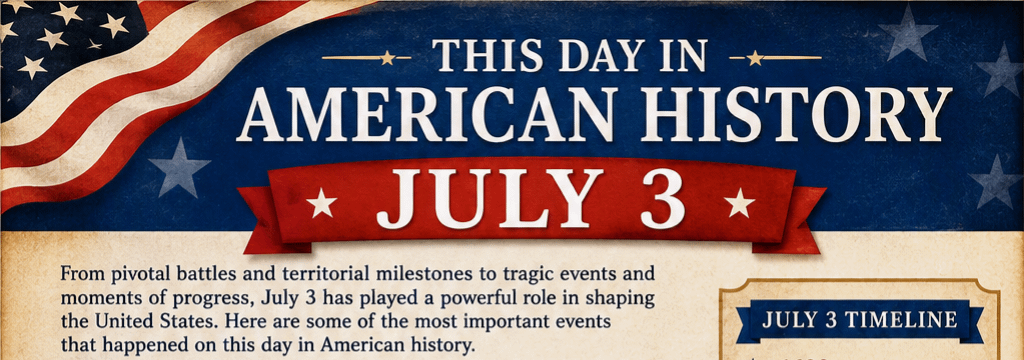
Every day in American history has its own stories of courage, innovation, sacrifice, and determination. July 3 is no exception. From one of the most decisive battles of the Civil War to the admission of new states and groundbreaking moments in exploration and technology, this date reminds us how countless events have helped shape the nation we know today.
Let’s take a look at some of the most important events that happened on July 3.
1608 – Samuel de Champlain Explores the Northeast
Although long before the United States became a nation, French explorer Samuel de Champlain established the settlement of Quebec on July 3, 1608. His explorations throughout northeastern North America significantly influenced the future development of the region that would eventually border the United States.
Champlain mapped rivers, formed alliances with Native American tribes, and opened trade routes that would later affect colonial competition between France and Britain throughout North America.
1775 – George Washington Takes Command Near Boston
During the early months of the American Revolutionary War, General George Washington arrived near Boston to assume command of the newly formed Continental Army. While his formal appointment had occurred in June, the first days of July marked the beginning of his leadership over America’s fight for independence.
Washington immediately focused on organizing an inexperienced militia into a disciplined fighting force, laying the foundation for what would become the United States Army.
1778 – Wyoming Valley Massacre
One of the darkest episodes of the Revolutionary War occurred on July 3, 1778, when Loyalist forces and their Native American allies attacked settlers in Pennsylvania’s Wyoming Valley.
The battle resulted in heavy casualties among Patriot militia and civilians. While accounts of the massacre have sometimes been exaggerated over the centuries, it became a powerful symbol of the brutal frontier fighting that characterized much of the Revolutionary War.
1844 – The Last Pair of Great Auks Is Killed
On July 3, 1844, the last confirmed breeding pair of Great Auks was killed off the coast of Iceland. Although this event occurred outside the United States, it profoundly influenced future American conservation efforts.
The extinction became an early warning about the consequences of overhunting and eventually inspired stronger wildlife protection movements in America.
1863 – The Battle of Gettysburg Reaches Its Climax
Perhaps no event on July 3 is more significant than the final day of the Battle of Gettysburg during the American Civil War.
After two days of fierce fighting, Confederate General Robert E. Lee launched what became known as Pickett’s Charge, ordering approximately 12,500 soldiers to march nearly a mile across open fields toward entrenched Union positions.
The assault was devastating.
Union forces under General George G. Meade repelled the attack with overwhelming artillery and rifle fire. Thousands of Confederate soldiers were killed, wounded, or captured in less than an hour.
The failure of Pickett’s Charge forced Lee to retreat back into Virginia, ending his second invasion of the North.
Why Gettysburg Matters
The Battle of Gettysburg became one of the greatest turning points in American history.
Its significance includes:
- Ending Confederate hopes of winning foreign recognition.
- Preventing a possible invasion of Northern cities.
- Boosting Union morale.
- Weakening the Confederate Army permanently.
- Leading to President Abraham Lincoln’s Gettysburg Address later that year.
The three-day battle resulted in more than 50,000 casualties, making it the bloodiest battle ever fought on American soil.
1890 – Idaho Becomes the 43rd State
On July 3, 1890, Idaho officially joined the Union as the 43rd state.
Known today for its mountains, rivers, forests, agriculture, and famous potatoes, Idaho played an important role in western expansion during the late nineteenth century.
Mining, ranching, and railroad construction fueled rapid growth, transforming the territory into a thriving new state.
1938 – The Mallard Sets a World Speed Record
Although Britain’s steam locomotive Mallard set the world speed record for steam trains on July 3, 1938, American railroad engineers closely followed this achievement.
The event inspired continued advancements in locomotive technology and highlighted the importance of railroads, which had been instrumental in connecting the United States during the nineteenth century.
1944 – American Forces Continue the Normandy Campaign
Following the D-Day invasion, American troops continued advancing through Normandy on July 3, 1944.
The difficult fighting through the dense hedgerows of France tested Allied forces, but each mile gained brought them closer to liberating Europe from Nazi occupation.
Thousands of American soldiers displayed extraordinary courage during these operations.
1950 – U.S. Forces Fight in the Korean War
Early in the Korean War, American troops continued arriving in South Korea to help stop the North Korean invasion.
July 3 marked the growing involvement of the United States in what would become a three-year conflict that shaped American foreign policy throughout the Cold War.
1988 – USS Vincennes Shoots Down Iran Air Flight 655
One of the most tragic military incidents involving the United States occurred on July 3, 1988.
The guided missile cruiser USS Vincennes mistakenly identified Iran Air Flight 655 as a hostile aircraft and fired two missiles, destroying the civilian Airbus over the Persian Gulf.
All 290 people aboard lost their lives.
The incident remains one of the most controversial events in modern U.S. naval history and led to changes in military procedures and aircraft identification systems.
Other Notable July 3 Moments
- The days leading into Independence Day have historically seen military parades, presidential speeches, and patriotic celebrations across America.
- Communities nationwide prepare for July 4 festivities with concerts, historical reenactments, fireworks, and remembrance ceremonies honoring veterans.
- Gettysburg National Military Park hosts annual commemorations remembering the sacrifices made during the Civil War.
July 3 Timeline
| Year | Event |
|---|---|
| 1608 | Samuel de Champlain establishes Quebec. |
| 1775 | George Washington begins organizing the Continental Army near Boston. |
| 1778 | Wyoming Valley Massacre occurs in Pennsylvania. |
| 1844 | Last Great Auk breeding pair is killed. |
| 1863 | Pickett’s Charge fails during the Battle of Gettysburg. |
| 1890 | Idaho becomes the 43rd U.S. state. |
| 1938 | Mallard sets world steam locomotive speed record. |
| 1944 | American troops continue advancing through Normandy. |
| 1950 | U.S. forces expand involvement in the Korean War. |
| 1988 | USS Vincennes mistakenly shoots down Iran Air Flight 655. |
Remembering July 3
July 3 stands as one of the most consequential dates in American history, largely because of the dramatic conclusion of the Battle of Gettysburg. The Union victory helped preserve the nation during its greatest internal conflict and altered the course of the Civil War.
At the same time, July 3 reflects America’s broader story—one of exploration, expansion, military service, technological achievement, and lessons learned through both triumph and tragedy. As the nation prepares to celebrate Independence Day, this date offers an opportunity to reflect on the sacrifices and decisions that have shaped the United States across the centuries.
Leave a Reply