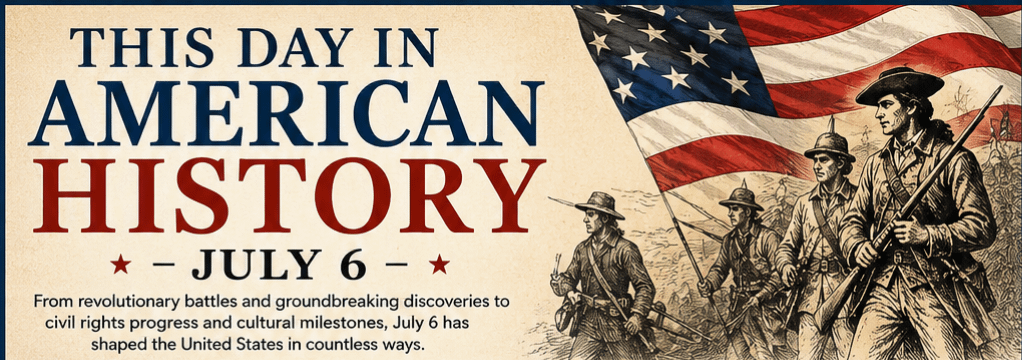
July 6 is a date marked by military victories, diplomatic achievements, technological milestones, and moments that helped shape the United States. From the founding era through the Space Age, July 6 reminds us that history is often built through perseverance, innovation, and determination.
Here are some of the most notable events that occurred on this day in American history.
1777 – The Siege of Fort Ticonderoga Begins
During the American Revolutionary War, British General John Burgoyne forced American troops under General Arthur St. Clair to abandon Fort Ticonderoga in New York. Although the loss was a disappointment for the Continental Army, it prevented the Americans from becoming trapped and allowed them to regroup for future battles.
Burgoyne’s campaign initially appeared successful, but his advance eventually ended in defeat at the Battle of Saratoga later that year. That American victory convinced France to formally ally with the United States, dramatically changing the course of the Revolutionary War.
Why it matters:
Sometimes a tactical retreat creates the opportunity for a greater victory. The events that began on July 6 ultimately helped lead to American independence.
1785 – The Dollar Is Chosen as America’s Currency
On July 6, 1785, the Confederation Congress officially adopted the United States dollar as the nation’s monetary unit. The United States became one of the first countries in the world to base its currency on a decimal system rather than pounds, shillings, and pence.
This decision simplified trade and commerce while establishing a financial identity for the young nation.
Why it matters:
More than two centuries later, the U.S. dollar remains one of the world’s strongest and most influential currencies.
1885 – Louis Pasteur Successfully Tests the Rabies Vaccine
Although the breakthrough occurred in France, its impact on American medicine was enormous. On July 6, 1885, scientist Louis Pasteur administered the first successful rabies vaccination to a young boy who had been bitten by a rabid dog.
American doctors quickly adopted Pasteur’s discoveries, leading to the establishment of Pasteur Institutes throughout the United States and saving countless American lives.
Why it matters:
Medical advances around the world often become life-saving innovations for Americans and people everywhere.
1917 – American Forces Continue Arriving in Europe
Following America’s entry into World War I earlier that year, thousands of U.S. soldiers continued arriving in France throughout July 1917. These early deployments marked the beginning of America’s emergence as a major military power on the world stage.
The arrival of fresh American troops boosted Allied morale and helped shift momentum against Germany.
Why it matters:
World War I transformed the United States into an influential global leader both militarily and diplomatically.
1933 – Major League Baseball’s First All-Star Game Inspires a Tradition
Although played in Chicago, the inaugural Major League Baseball All-Star Game represented America’s growing love for its national pastime. The exhibition showcased the game’s greatest stars and became an annual celebration enjoyed by millions of fans.
The tradition continues today, honoring baseball’s rich history while bringing together players from across the country.
Why it matters:
Sports have long served as a source of national pride and shared American culture.
1942 – Anne Frank and Her Family Go Into Hiding
On July 6, 1942, Anne Frank’s family entered the Secret Annex in Amsterdam to escape Nazi persecution. While this event occurred overseas, her diary would later become one of the most widely read books in American schools.
Generations of American students have learned about the Holocaust through Anne’s powerful words.
Why it matters:
Remembering history helps protect future generations from repeating humanity’s darkest chapters.
1945 – President Truman Prepares for the Final Phase of World War II
As World War II entered its final weeks, President Harry S. Truman received crucial military updates concerning Japan and the newly completed Manhattan Project.
The decisions made during this period would shape the end of the war and the beginning of the Atomic Age.
Why it matters:
Leadership during moments of crisis can alter the course of world history for generations.
1947 – The AK-47 Begins Its Legacy
On July 6, 1947, Mikhail Kalashnikov began work that would lead to the development of the AK-47 rifle. Although created in the Soviet Union, the weapon would later influence American military strategy, foreign policy, and decades of international conflicts involving U.S. forces.
Why it matters:
Global technological developments often have lasting consequences for American national security.
1957 – Althea Gibson Wins Wimbledon
Althea Gibson became the first African American to win the Wimbledon singles championship on July 6, 1957.
Her historic victory broke racial barriers in international sports and inspired future generations of athletes, including many who would become legends themselves.
Why it matters:
Her achievement represented both athletic excellence and significant progress in the struggle for equal opportunity.
1964 – Civil Rights Act Implementation Begins
Just days after being signed into law, federal agencies began implementing the landmark Civil Rights Act throughout the United States.
Businesses, schools, and government institutions started adapting to one of the most important civil rights laws in American history, prohibiting discrimination based on race, color, religion, sex, or national origin.
Why it matters:
The Civil Rights Act fundamentally reshaped American society and expanded equal protections under the law.
1994 – Forrest Gump Opens in Theaters
Forrest Gump premiered nationwide on July 6, 1994, becoming one of America’s most beloved films.
Blending humor, history, and heartfelt storytelling, the movie follows one man’s remarkable journey through many defining moments of American history. It went on to win multiple Academy Awards and remains a cultural favorite.
Why it matters:
The film introduced millions of viewers to major historical events through an unforgettable story of kindness, perseverance, and hope.
Quote of the Day
“The history of America is the history of ordinary people doing extraordinary things when called upon.”
Whether through courage in battle, groundbreaking scientific discoveries, or the pursuit of equality and justice, July 6 reminds us that progress is made one decision, one breakthrough, and one act of determination at a time.
Final Thoughts
History is more than a collection of dates—it is the story of people who faced uncertainty with courage, embraced innovation, and worked toward a better future. July 6 reflects many of the qualities that have shaped the American experience: resilience, leadership, discovery, and hope.
As we remember these moments, we are reminded that today’s actions may become tomorrow’s history. Each generation has the opportunity to contribute something meaningful to the American story, just as countless others have done before us.
Leave a Reply