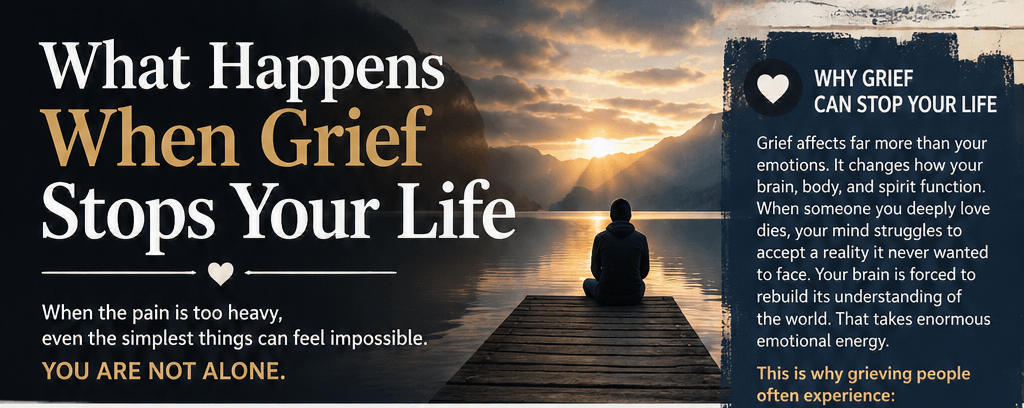
There are moments when grief doesn’t simply make life difficult—it brings it to a complete stop.
You wake up, but you don’t want to get out of bed. The goals you once had no longer seem important. Hobbies lose their appeal. Friendships fade into the background. Even simple tasks like cooking dinner, answering a text message, or paying a bill can feel overwhelming.
If this sounds familiar, you are not alone.
Grief has the power to pause life in ways few people understand unless they’ve experienced a devastating loss themselves. Whether you’ve lost a child, spouse, parent, sibling, or close friend, grief can leave you feeling frozen while the rest of the world keeps moving.
The hardest part is that many people expect you to “move on” long before your heart is ready.
The truth is that grief doesn’t follow a schedule.
Why Grief Can Stop Your Life
Grief affects far more than your emotions. It changes how your brain, body, and spirit function.
When someone you deeply love dies, your mind struggles to accept a reality it never wanted to face. The routines you shared disappear overnight. The future you imagined is suddenly gone.
Your brain is forced to rebuild its understanding of the world.
That takes enormous emotional energy.
This is why grieving people often experience:
- Mental exhaustion
- Difficulty concentrating
- Memory problems
- Physical fatigue
- Lack of motivation
- Social withdrawal
- Anxiety
- Depression
- Trouble making decisions
You’re not lazy.
You’re grieving.
Every Day Can Feel Like Survival
For many people, grief changes the definition of success.
Before loss, success may have meant:
- Building a career
- Raising a family
- Traveling
- Reaching goals
- Growing financially
After profound loss, success sometimes becomes:
- Taking a shower.
- Eating breakfast.
- Going outside.
- Making it through another day.
That may seem small to others.
But when grief has stopped your life, these become incredible victories.
The World Doesn’t Pause With You
One of the loneliest parts of grief is watching everyone else continue living.
Birthdays are celebrated.
Vacations are planned.
People laugh.
Children grow.
Life keeps moving.
Meanwhile, you feel trapped in the day everything changed.
It can feel unfair.
Sometimes it feels like the entire world has forgotten the person you lost while you cannot go five minutes without thinking about them.
That isolation can make grief even heavier.
Losing Your Sense of Identity
Many grieving people don’t just lose someone they love.
They lose part of who they are.
A father who loses his son is no longer simply “Dad.”
A husband who loses his wife may wonder who he is without her.
A daughter who loses her mother may feel untethered.
Part of your identity was built around that relationship.
When the relationship changes through death, it can leave you asking:
- Who am I now?
- What is my purpose?
- Why should I keep going?
- Will I ever feel like myself again?
These questions are painful—but they are also common.
When You Feel Guilty for Living
Many people experience survivor’s guilt after losing someone they love.
You may feel guilty for:
- Smiling
- Laughing
- Taking a vacation
- Starting a new relationship
- Celebrating holidays
- Finding happiness again
It may feel like moving forward means leaving your loved one behind.
But healing isn’t forgetting.
Love doesn’t disappear because life continues.
You carry them with you every day.
You Don’t Have to “Get Over It”
One of the biggest misconceptions about grief is that it has an ending.
People often say things like:
- “You’ll get over it.”
- “Everything happens for a reason.”
- “Time heals all wounds.”
Those words often hurt more than they help.
You don’t get over losing someone you deeply love.
Instead, you slowly learn how to carry the weight.
Some days it feels lighter.
Other days it feels almost unbearable again.
Both are normal.
Small Steps Matter
When grief has stopped your life, don’t focus on rebuilding everything overnight.
Focus on the next small step.
That might mean:
- Drinking a glass of water.
- Walking outside for five minutes.
- Calling one trusted friend.
- Reading a favorite Bible verse.
- Cooking one healthy meal.
- Writing in a journal.
- Looking through happy photographs instead of only remembering the final moments.
Healing is rarely dramatic.
It’s usually built from hundreds of tiny decisions.
For Parents Who Have Lost a Child
The loss of a child changes every part of life.
Many bereaved parents describe feeling like time stopped on the day their child died.
The dreams you had disappear.
Future milestones become painful reminders of what should have been.
People often ask when you’ll “recover.”
The honest answer is that many parents don’t recover in the way others expect.
Instead, they learn to build a different life while carrying an unbreakable love for their child.
Your child will always matter.
Their memory deserves to live on.
Living your life does not erase your love for them.
In many ways, choosing to keep living becomes one of the greatest ways to honor them.
Faith During the Darkness
For people of faith, grief often brings difficult questions.
Why did God allow this?
Why wasn’t my loved one healed?
Why does the pain continue?
These questions don’t make your faith weak.
They make it honest.
Throughout Scripture, we see people crying out to God in confusion, sorrow, and heartbreak. God is not threatened by our tears or our questions.
Even when you cannot feel His presence, He remains near to those who are brokenhearted.
Sometimes faith isn’t about having all the answers.
Sometimes faith is simply taking one more step when your heart is shattered.
Hope Doesn’t Arrive All at Once
Healing isn’t a single moment.
It doesn’t happen because someone gives the perfect advice.
It doesn’t happen because enough time has passed.
Hope often returns quietly.
One smile.
One peaceful morning.
One meaningful conversation.
One memory that brings gratitude instead of only tears.
Little by little, life begins to move again.
Not because the loss mattered less.
But because love continues to shape who you are.
Final Thoughts
If grief has stopped your life, know this:
You are not weak.
You are not failing.
You are carrying one of life’s heaviest burdens.
There is no timeline for healing, and there is no right or wrong way to miss someone you love.
Take today one breath, one prayer, and one step at a time.
Your story did not end the day your loved one died.
Their love became part of your story, and as you continue living, you carry that love forward in the kindness you show, the memories you share, and the hope you slowly reclaim.
One day, the life that grief paused may begin to move again—not because you’ve forgotten, but because you’ve learned that love and sorrow can exist together, and that even after unimaginable loss, it is still possible to find purpose, peace, and moments of joy.
Share this:
- Share on X (Opens in new window) X
- Share on Facebook (Opens in new window) Facebook
- Share on LinkedIn (Opens in new window) LinkedIn
- Share on Reddit (Opens in new window) Reddit
- Share on Tumblr (Opens in new window) Tumblr
- Share on Pinterest (Opens in new window) Pinterest
- Share on Telegram (Opens in new window) Telegram
- Share on Threads (Opens in new window) Threads
- Share on Bluesky (Opens in new window) Bluesky
Leave a Reply