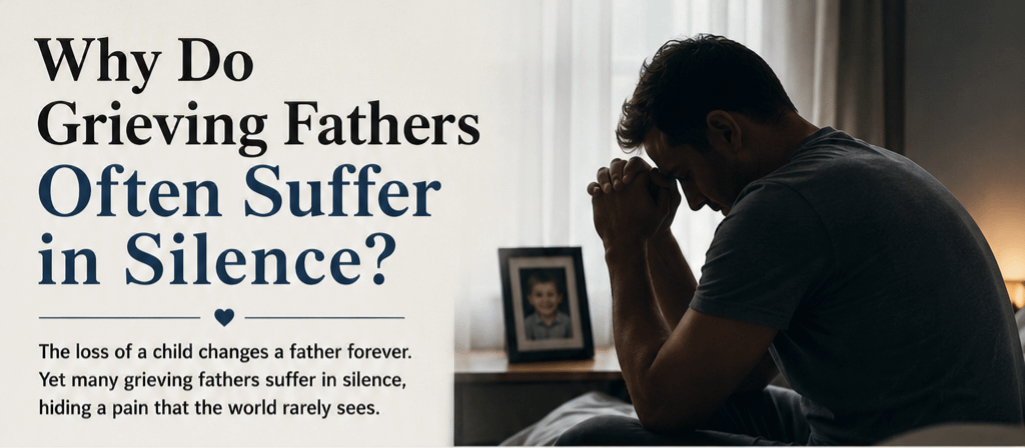
The Hidden Side of Child Loss
The loss of a child is one of the most devastating experiences a person can endure. It shatters dreams, changes identities, and leaves a wound that never fully heals. While both mothers and fathers experience profound grief, society often pays less attention to the pain fathers carry.
Many grieving fathers suffer in silence. They continue working, taking care of responsibilities, and appearing strong on the outside while privately carrying unimaginable heartbreak. Their tears are often unseen, their struggles unheard, and their grief misunderstood.
The silence is not because fathers love less. It is often because they feel they have no choice.
Society Teaches Men to Be Strong
From a young age, many boys are taught messages such as:
- Be tough.
- Don’t cry.
- Handle your problems.
- Stay strong for others.
While resilience can be a valuable trait, these messages often become harmful when a father experiences the death of a child.
Many grieving fathers feel pressure to suppress their emotions because they believe showing pain is a sign of weakness. Instead of expressing their grief openly, they bury it deep inside.
The result is not less pain.
The result is hidden pain.
A father may appear calm while internally struggling with overwhelming sadness, guilt, anger, confusion, and despair.
Fathers Often Feel Responsible
One of the most common emotions grieving fathers experience is guilt.
They may ask themselves:
- Could I have prevented this?
- What should I have done differently?
- Why wasn’t I there?
- Why couldn’t I protect my child?
Even when the loss was completely beyond their control, many fathers carry an enormous burden of responsibility.
Fathers are often viewed as protectors. When a child dies, some fathers feel they have failed in the very role they were meant to fulfill.
This guilt can become so heavy that they stop talking about it altogether.
They Feel They Must Protect Their Family
Many grieving fathers instinctively shift into protector mode after a loss.
Instead of focusing on their own pain, they focus on:
- Supporting their spouse.
- Caring for surviving children.
- Managing finances.
- Handling funeral arrangements.
- Returning to work.
They become the person everyone leans on.
Unfortunately, when everyone depends on the father for strength, few people stop to ask how he is doing.
The father becomes the support system while having no support system himself.
Over time, this can create intense loneliness.
People Check on Mothers More Often
After a child dies, support often naturally flows toward the mother.
Friends and family may call, send cards, offer hugs, and ask how she is coping.
This support is important and deserved.
However, fathers are frequently overlooked.
People may assume:
- Dad is handling it.
- He’s staying busy.
- He’s the strong one.
- He doesn’t want to talk.
As a result, fathers may receive significantly less emotional support.
The silence around their grief can make them feel invisible.
Fathers and Mothers Often Grieve Differently
Another reason fathers suffer in silence is that their grief may look different than a mother’s.
Many mothers process grief through conversation, emotional expression, and sharing memories.
Many fathers process grief through action.
They may:
- Work longer hours.
- Take on projects.
- Exercise excessively.
- Stay constantly busy.
- Focus on helping others.
These activities are not necessarily avoidance. Sometimes they are simply how fathers cope.
The problem occurs when others mistake these behaviors for healing.
Just because a father is functioning does not mean he is okay.
Many grieving fathers are surviving, not healing.
Fear of Breaking Down
Some fathers remain silent because they fear what might happen if they allow themselves to fully feel their grief.
They worry:
- If I start crying, I won’t stop.
- If I let myself feel this pain, it will destroy me.
- If I fall apart, who will hold everyone else together?
This fear causes many fathers to build emotional walls.
Unfortunately, grief does not disappear behind those walls.
It waits.
Often it resurfaces later through depression, anxiety, anger, physical illness, sleep problems, or emotional exhaustion.
The Workplace Offers Little Space for Grief
Many fathers return to work quickly after losing a child.
Financial responsibilities often leave them little choice.
Within days or weeks, they may find themselves back at their jobs while still in shock.
Coworkers may avoid the subject entirely.
Others may offer brief condolences before expecting normal productivity.
Meanwhile, the father is trying to function while carrying unimaginable pain.
Work can become another place where grief remains hidden.
Men Often Lack Emotional Support Networks
Many women maintain close friendships where emotional conversations are common.
Many men do not.
A grieving father may have plenty of acquaintances but very few people he feels comfortable calling at midnight when the pain becomes overwhelming.
Without trusted outlets, grief becomes isolated.
The father suffers alone even when surrounded by people.
The Pain Never Leaves
One of the greatest misconceptions about grief is that it eventually disappears.
For grieving fathers, the loss remains part of them forever.
Years later, a song, a photograph, a birthday, or an empty chair can bring the pain rushing back.
Many fathers continue carrying conversations with their child in their hearts.
They continue wondering what their child would look like today, what milestones they would have reached, and what life would have been like.
The grief changes over time, but the love remains.
And where love remains, grief often follows.
Why Fathers Need Permission to Speak
Grieving fathers need something many have never been given:
Permission.
Permission to cry.
Permission to talk.
Permission to admit they are struggling.
Permission to seek counseling.
Permission to say they are not okay.
Permission to grieve differently.
Strength is not the absence of tears.
Strength is having the courage to face pain honestly.
The strongest thing a grieving father can do is acknowledge what he is carrying.
A Message to Every Grieving Father
If you are grieving the loss of a child, know this:
Your pain matters.
Your tears matter.
Your story matters.
You do not have to carry this burden alone.
You are not weak because you miss your child.
You are not weak because you cry.
You are not weak because some days feel impossible.
You are a father whose love continues beyond loss.
The world may not always see your grief, but it is real.
And so is your love.
Your child mattered.
Your child still matters.
And your grief is simply the evidence of a love that death could never take away.
Final Thoughts
Grieving fathers often suffer in silence because society expects strength, responsibility, and emotional control. They feel pressure to protect others while privately carrying unimaginable pain.
Yet healing begins when silence is broken.
When fathers are given permission to share their stories, express their emotions, and seek support, they discover something important:
They are not alone.
Behind every grieving father is a heart that loved deeply, still loves deeply, and always will.
That love deserves to be heard.
A Father’s Guide to Surviving the Loss of a Child
Leave a Reply