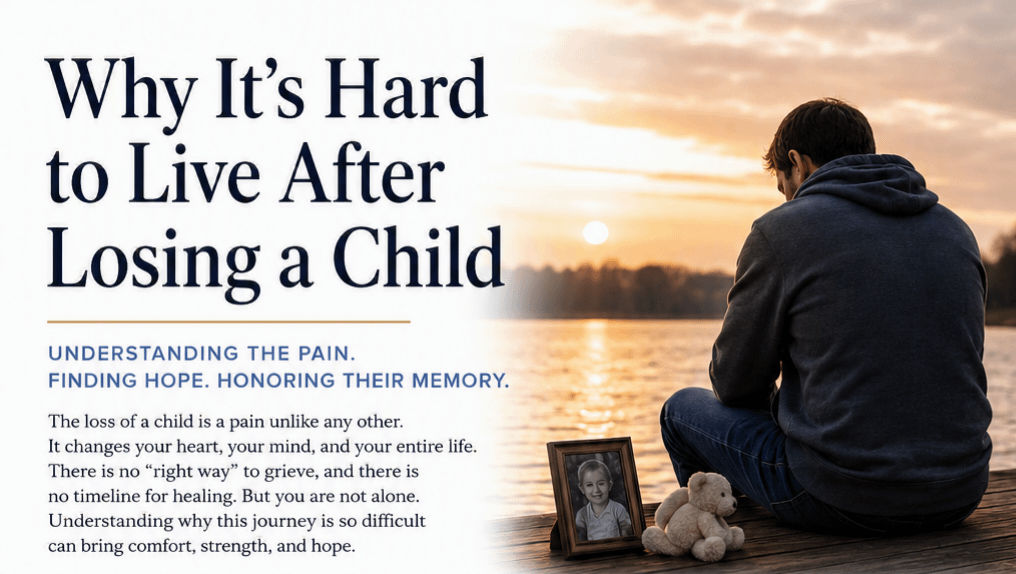
There is no pain quite like the loss of a child.
It is a grief that defies explanation, ignores timelines, and forever changes the heart of every parent who experiences it. The death of a child isn’t simply another tragedy to overcome. It is the loss of a piece of yourself—a love so deep that words often fail to describe it.
People often say that losing a parent is part of life. Losing a spouse is heartbreaking. Losing a close friend is devastating. While each of those losses carries tremendous pain, the death of a child feels different because it goes against the natural order of life. Parents expect to leave this world before their children. We spend years protecting them, teaching them, encouraging them, and dreaming about the future they will have.
When that future is suddenly taken away, something inside a parent breaks.
Many grieving parents quietly ask themselves a question they never imagined asking:
“How am I supposed to keep living after this?”
The answer isn’t simple.
The truth is that life after losing a child isn’t about finding happiness again overnight. It’s about learning to carry unimaginable pain while slowly discovering that life can still hold purpose, even though it will never look the same again.
Your Entire Identity Changes
Before your child died, you probably knew exactly who you were.
You were Mom.
You were Dad.
Your daily routines often revolved around your child.
Helping with homework.
Attending games.
Cooking favorite meals.
Giving advice.
Celebrating birthdays.
Planning vacations.
Making memories.
Whether your child was five years old or fifty, being their parent was woven into your identity.
Then suddenly…
Silence.
The phone no longer rings.
Their bedroom remains untouched.
Their laughter becomes a memory.
The role you treasured most suddenly feels as though it has nowhere to go.
Many parents describe feeling lost because they no longer recognize themselves.
You aren’t just grieving your child.
You’re grieving the person you were when they were alive.
Every Dream Dies With Them
Most parents begin imagining their child’s future long before that child becomes an adult.
You picture graduations.
Weddings.
Careers.
Children of their own.
Family traditions.
Holiday dinners surrounded by generations.
You imagine growing older while watching them build their own lives.
Those dreams become part of your emotional investment as a parent.
When your child dies, every one of those dreams disappears in an instant.
You’re not simply mourning someone who is gone.
You’re mourning thousands of moments that will never happen.
That invisible grief often hurts as much as the loss itself.
Life Feels Meaningless
After child loss, many parents struggle to understand why anything matters anymore.
The job that once felt important now seems insignificant.
Household chores feel pointless.
Vacations feel empty.
Goals disappear.
Even hobbies lose their appeal.
People may encourage you to stay busy, but staying busy doesn’t replace purpose.
Purpose often disappears because the person who gave your life so much meaning is gone.
This doesn’t mean your life no longer has value.
It simply means your heart must slowly rediscover why you’re still here.
That takes time.
Sometimes years.
The Pain Never Takes a Day Off
Many people assume grief slowly fades away.
Parents know differently.
Child loss becomes something you carry every day.
Some mornings begin with tears before your feet touch the floor.
Certain songs suddenly become unbearable.
A random scent can instantly transport you back to memories you weren’t prepared to revisit.
You may be laughing with friends one moment and fighting back tears the next.
Grief doesn’t ask permission before it arrives.
It simply shows up.
And it often arrives when you least expect it.
People Slowly Stop Asking
Immediately after your child’s death, support often pours in.
Meals arrive.
Cards fill the mailbox.
Friends call.
Family checks in.
Then something changes.
Weeks become months.
Months become years.
The phone grows quiet.
People assume you’ve “moved on.”
The reality is that you’ve simply become better at hiding your pain.
Many grieving parents feel abandoned—not because people stopped caring entirely, but because they stopped remembering that grief never truly leaves.
One of the loneliest moments is realizing you’re still grieving as deeply as ever while everyone else has returned to normal life.
Fathers Often Grieve Alone
While every parent grieves differently, fathers frequently face unique challenges.
Many men were raised to believe that showing emotion is weakness.
They become the organizer.
The provider.
The protector.
The one who comforts everyone else.
Meanwhile, their own heartbreak remains hidden beneath responsibility.
A father may cry in the shower where no one can hear.
He may sit alone in his truck after work.
He may bury himself in overtime because staying busy hurts less than sitting quietly with his thoughts.
People often ask mothers how they’re doing.
Many fathers are never asked at all.
That silence can become one of the greatest burdens a grieving father carries.
Your Marriage May Be Tested
Few experiences challenge a marriage like the loss of a child.
Not because love disappears.
Because grief changes both people differently.
One parent may want to talk constantly.
The other may withdraw into silence.
One may cry openly.
The other may appear emotionally numb.
Neither response is wrong.
They’re simply different.
Problems begin when each partner mistakes different grief for a lack of love.
Patience becomes essential.
Communication becomes essential.
Grace becomes essential.
Remember that you’re both climbing the same mountain, even if you’re taking different paths.
Guilt Becomes a Constant Companion
Almost every grieving parent asks impossible questions.
“Could I have prevented this?”
“Should I have noticed something sooner?”
“Why wasn’t it me instead?”
These thoughts appear even when logic says there was nothing you could have done.
Parents are wired to protect.
When protection becomes impossible, the mind searches desperately for control.
Unfortunately, guilt often fills that space.
The painful truth is this:
You cannot rewrite yesterday.
You can only decide how you honor your child’s memory today.
Holidays Become Emotional Minefields
Christmas isn’t Christmas anymore.
Birthdays become heartbreaking.
Mother’s Day and Father’s Day hurt differently.
Even simple family gatherings become reminders of the empty chair.
Many parents dread holidays more than ordinary days.
Others continue celebrating because they know their child loved those traditions.
There is no right way.
Some years you’ll decorate.
Other years you’ll barely get through the day.
Give yourself permission to grieve differently each season.
You Fear Forgetting
One of the greatest fears grieving parents carry is forgetting.
Forgetting the sound of their voice.
The way they laughed.
The smell of their hair.
Their favorite sayings.
The little details only a parent remembers.
This fear causes many parents to hold tightly to photographs, videos, clothing, journals, and keepsakes.
These aren’t signs of refusing to heal.
They’re expressions of enduring love.
Love naturally fights to preserve memory.
Happiness Can Feel Like Betrayal
One of grief’s cruelest lies is convincing you that healing somehow dishonors your child.
You begin feeling guilty when you laugh.
When you enjoy dinner.
When you smile at a joke.
When you go on vacation.
Part of you wonders…
“Should I be happy if my child isn’t here?”
But love doesn’t require lifelong misery.
Your child loved your smile long before they died.
That love didn’t disappear.
Choosing moments of joy isn’t forgetting them.
It’s allowing their love to continue influencing your life.
Faith May Be Shaken
Many parents wrestle with God after losing a child.
Questions pour out.
Why did this happen?
Why didn’t You stop it?
Why my family?
Why my child?
These questions aren’t signs of weak faith.
They’re signs of deep pain.
Throughout the Bible, people cried out honestly to God.
David.
Job.
Jeremiah.
Even Jesus wept.
Faith isn’t pretending everything makes sense.
Faith is continuing to seek God when nothing makes sense.
Sometimes the holiest prayer is simply:
“Lord…I don’t understand.”
You Wonder If Life Will Ever Feel Worth Living Again
Perhaps the hardest question grieving parents face is this:
“Will I ever truly live again?”
At first, the answer feels impossible.
You’re surviving.
Not living.
Existing.
Not thriving.
But slowly…
Very slowly…
Healing begins to make room for something unexpected.
Not the absence of grief.
But the presence of purpose.
You begin helping others.
Sharing your story.
Supporting grieving parents.
Honoring your child’s legacy through acts of kindness.
Speaking their name with more smiles than tears.
Your child becomes part of the reason you continue living instead of the reason you stop.
Living Doesn’t Mean Leaving Them Behind
This is one of the greatest misconceptions about healing.
Many parents fear moving forward because it feels like moving on.
Those are not the same thing.
Moving on suggests leaving someone behind.
Moving forward means carrying them with you.
You carry their lessons.
Their laughter.
Their values.
Their love.
Every act of kindness inspired by them keeps their legacy alive.
Your relationship changes after death.
It does not end.
Love refuses to die.
What Healing Really Looks Like
Healing after child loss is rarely dramatic.
It happens quietly.
The first day you laugh without guilt.
The first time you sleep through the night.
The first family gathering you survive.
The first vacation where you smile again.
The first conversation where you speak your child’s name without immediately breaking down.
Healing isn’t forgetting.
Healing is learning that your broken heart can still beat with love.
You will always miss your child.
You will always wish they were here.
That longing is the price of extraordinary love.
Your Child’s Legacy Can Become Your Purpose
Many bereaved parents eventually discover that their greatest source of healing comes from helping others.
Some start charities.
Some mentor grieving parents.
Some volunteer.
Some write.
Some simply become more compassionate people because they understand suffering in a way few others ever will.
Your child’s life mattered.
Their influence didn’t end the day they died.
Every life you touch because of them becomes another chapter in their legacy.
Final Thoughts
If you are reading this while carrying the unbearable weight of losing your son or daughter, please know this:
You are not weak.
You are not broken beyond repair.
You are carrying a burden that very few people can truly understand.
There will always be days when grief feels overwhelming.
There will be birthdays that hurt.
Anniversaries that reopen old wounds.
Ordinary moments that unexpectedly bring tears.
That is not failure.
That is love continuing to exist.
Your child will always be part of who you are.
Nothing—not even death—can erase the bond between a parent and child.
Although your life has been forever changed, it is still possible to discover hope again. It is still possible to laugh without guilt, to love without fear, and to honor your child’s memory by living a life filled with compassion, purpose, and faith.
The pain may never completely disappear.
But neither will the love.
And sometimes, that love becomes the light that helps guide you through even the darkest nights.
A Father’s Guide to Surviving the Loss of a Child
Leave a Reply