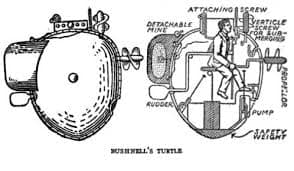
The history of naval warfare changed forever during the American Revolutionary War when the world witnessed the first documented submarine attack. On September 6, 1776, in New York Harbor, a small, hand-powered vessel called the Turtle attempted to strike a British warship. Although the mission did not succeed, it marked the beginning of a new era in maritime combat.
The Invention of the Turtle
The Turtle was the brainchild of David Bushnell, a Yale-educated inventor from Connecticut. Designed in 1775, the vessel was shaped somewhat like a large oak barrel and built to be operated by a single person. It was powered by hand-cranked propellers and featured a primitive ballast system for submerging and resurfacing. Its weapon—a timed explosive charge—was intended to be attached to the hull of an enemy ship.
The idea was revolutionary: a stealth craft capable of slipping beneath the waves, unseen, to strike a blow against the seemingly invincible British Royal Navy.
The Target: HMS Eagle
The mission was carried out by Sergeant Ezra Lee of the Continental Army. His task was to pilot the Turtle through the waters of New York Harbor and attach an explosive device to the underside of the British flagship, HMS Eagle. If successful, it could have disrupted British control of the harbor and demonstrated the colonists’ ingenuity in asymmetrical warfare.
The Attempt
In the early hours of September 6, 1776, Lee maneuvered the Turtle toward the Eagle. He managed to reach the ship undetected, but when he attempted to drill into the copper-sheathed hull to attach the explosive, the drill failed to penetrate. After several attempts, Lee was forced to abandon the mission. Pursued by British patrol boats, he released the timed charge into the water, where it exploded harmlessly but caused great alarm among the British fleet.
Legacy of the Attack
Though the mission failed to damage the Eagle, the attempt demonstrated the potential of underwater warfare. The British Navy now had to consider the unsettling possibility that their dominance could be challenged by unseen threats beneath the surface.
The Turtle never succeeded in sinking a ship, but its legacy was profound. It inspired future inventors and laid the groundwork for the development of modern submarines. By the 19th and 20th centuries, submarines had become powerful weapons, forever changing naval strategy.
Conclusion
The world’s first submarine attack, carried out in 1776 with the tiny Turtle, was an act of daring innovation. Though it failed in its immediate objective, it marked the dawn of a new dimension of warfare—one fought not just on the seas, but beneath them. What began as a bold experiment during the American Revolution would evolve into a decisive force in global conflicts centuries later.
Read More Holidays & National Days
Leave a Reply