Author: Brett Murphy

  • How Lonely Life Becomes After Your Child Passes Away

    How Lonely Life Becomes After Your Child Passes Away

    There is a loneliness that comes with losing a child that few people can truly understand. It is not the loneliness of being physically alone. It is the loneliness of carrying a pain so deep that even when surrounded by family, friends, and coworkers, you can still feel completely isolated.

    When your child dies, a part of your world dies with them. The person you worried about, prayed for, laughed with, and loved unconditionally is suddenly gone. The phone stops ringing. The conversations stop. The daily routines disappear. What remains is a silence that can feel overwhelming.

    For many grieving parents, the loneliness after the loss of a child is one of the hardest parts of the journey. Research has found that loneliness is a common and significant challenge for bereaved parents, often affecting their emotional well-being long after the initial loss.

    The World Keeps Moving

    One of the most painful realities is discovering that life continues for everyone else.

    People go back to work. They celebrate birthdays. They post family pictures. They talk about vacations, graduations, and future plans.

    Meanwhile, you are trying to figure out how to survive another day without your child.

    At first, there is often an outpouring of support. Friends call. Family members check in. Meals are delivered. But as weeks become months and months become years, many people assume you are doing better.

    The truth is that grief does not operate on a schedule.

    While others may return to normal life, your heart is still trying to understand a loss that changed everything.

    Nobody Knows What to Say

    Another reason loneliness grows after the death of a child is that many people become uncomfortable around grief.

    Some avoid mentioning your child because they fear upsetting you.

    Others stop asking how you are doing because they assume bringing up the loss will make things worse.

    Unfortunately, their silence often creates even more pain.

    Many bereaved parents report feeling ignored or forgotten as they try to re-enter daily life after their child’s death. Friends and coworkers often do not know what to say, leaving parents feeling isolated and alone.

    What grieving parents usually want is simple:

    They want their child to be remembered.

    They want someone to say their child’s name.

    They want acknowledgment that their child mattered and still matters.

    The Empty Chair Never Leaves

    There are reminders everywhere.

    A favorite song.

    A birthday.

    A holiday.

    An old photograph.

    A restaurant your child loved.

    A milestone they should have reached.

    Every reminder can reopen the wound.

    You may find yourself sitting in a room full of people while feeling as though you are the only person carrying this burden.

    That is because grief is often invisible.

    Others see you functioning.

    They do not see the tears that come when you are alone.

    They do not hear the conversations you still have with your child in your heart.

    They do not feel the ache that follows you everywhere you go.

    Even Relationships Can Feel Different

    The loss of a child changes relationships.

    Friends may drift away.

    Family members may grieve differently.

    Even marriages and partnerships can be strained under the weight of such profound sorrow.

    You may discover that the people you expected to support you the most are not always the ones who show up.

    At the same time, complete strangers who have experienced similar losses may become some of your strongest sources of support.

    This is why many bereaved parents find comfort in connecting with other grieving parents who truly understand the pain. Shared experiences often reduce feelings of isolation and provide a sense of connection that others cannot fully offer.

    Missing Your Best Friend

    For some parents, their child was not only their son or daughter.

    They were also their best friend.

    They were the person you called first.

    The person who made you laugh.

    The person who gave your life purpose.

    When they are gone, it can feel as though nobody else understands you the way they did.

    The absence becomes more than grief.

    It becomes a daily loneliness that follows you into every room.

    You miss their voice.

    You miss their smile.

    You miss their presence.

    Most of all, you miss being their parent.

    Learning to Carry the Loneliness

    The loneliness of losing a child may never completely disappear.

    But over time, many parents learn ways to carry it.

    Some find comfort in faith.

    Some honor their child’s memory through service to others.

    Some write, speak, or share their story.

    Others find healing through support groups and friendships with fellow bereaved parents.

    The goal is not to forget.

    The goal is not to “move on.”

    The goal is to learn how to move forward while carrying the love you will always have for your child.

    Because love does not end when life ends.

    The bond between parent and child remains.

    Even in death.

    Even in silence.

    Even in the loneliest moments.

    Final Thoughts

    If you have lost a child and feel alone, know that your feelings are valid. The loneliness that follows child loss is one of the most difficult aspects of grief, and many parents experience it. You are not weak for feeling isolated. You are carrying one of life’s heaviest burdens.

    There will be days when the silence feels overwhelming.

    There will be moments when you wonder if anyone understands.

    But there are others walking this same road.

    Others who know the heartbreak.

    Others who understand the emptiness.

    And while nothing can replace the child you lost, connection, faith, and support can help remind you that you do not have to carry this grief entirely by yourself.

    Your child’s life mattered.

    Your grief matters.

    And so do you.

    A Father’s Guide to Surviving the Loss of a Child
  • Why It Is Important to Check On People Who Have Lost a Child

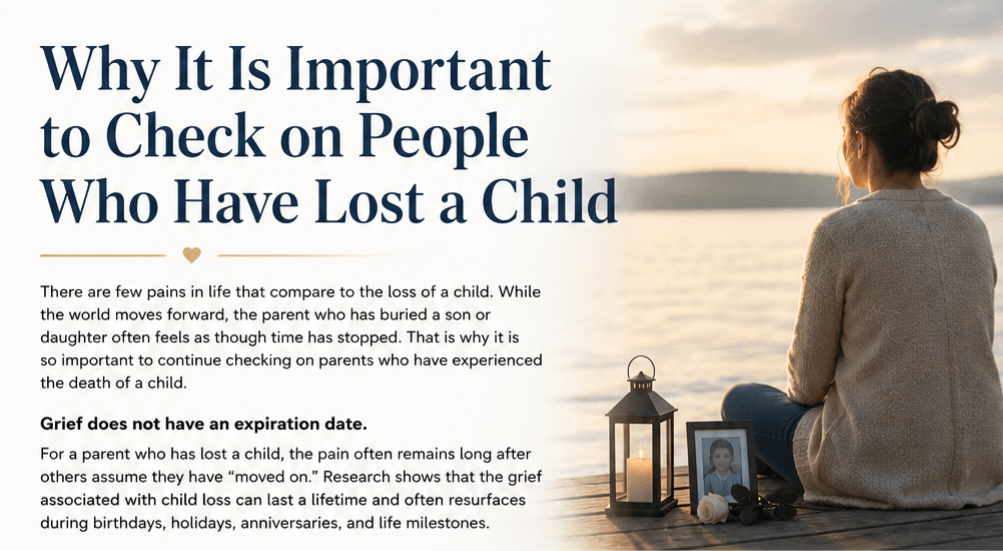
    Why It Is Important to Check On People Who Have Lost a Child

    There are few pains in life that compare to the loss of a child. It is a grief that changes a parent forever. While the world continues to move forward, the parent who has buried a son or daughter often feels as though time has stopped. The loss becomes a permanent part of their life, and although they may learn how to carry it, they never truly stop grieving. That is why it is so important to continue checking on parents who have experienced the death of a child.

    Many people offer support immediately after a loss. They send cards, flowers, messages, and prayers. Family and friends gather around during the funeral and the weeks that follow. However, as time passes, the phone calls become less frequent, the visits become rare, and life returns to normal for everyone except the grieving parent.

    The truth is that grief does not have an expiration date.

    For a parent who has lost a child, the pain often remains long after others assume they have “moved on.” Research consistently shows that the grief associated with child loss can last a lifetime and often resurfaces during birthdays, holidays, anniversaries, and significant life milestones.

    The Loneliness That Follows

    One of the most difficult parts of losing a child is the loneliness that follows.

    People often stop mentioning the child because they are afraid of causing pain. They worry they might say the wrong thing. In reality, many grieving parents desperately want to hear their child’s name spoken. They want to know their child has not been forgotten.

    When nobody asks how they are doing, it can feel as though the world has forgotten both their child and their grief. Months and years after the loss, many bereaved parents describe feeling isolated as support fades while their pain remains.

    A simple text message can make a tremendous difference:

    “I was thinking about you today.”

    “How are you doing?”

    “I remembered your son today and wanted you to know.”

    These small gestures remind grieving parents that they are not alone.

    Grief Doesn’t Follow a Schedule

    One of the biggest misconceptions about grief is that it follows a timeline. Many people assume that after a year or two, a parent should be doing better.

    The reality is very different.

    Grief can intensify unexpectedly. A song, a photograph, a graduation season, or seeing other families together can trigger powerful emotions. Parents may appear strong on the outside while privately struggling with overwhelming sadness, guilt, anger, or loneliness. There is no “normal” timeline for losing a child.

    Checking in regularly lets grieving parents know they do not have to hide their pain.

    Sometimes They Won’t Ask for Help

    Many grieving parents become experts at saying, “I’m fine.”

    Not because they are fine, but because they do not want to burden others.

    The emotional weight of child loss can be exhausting. Some parents feel guilty asking for support. Others believe nobody could truly understand what they are experiencing. As a result, they often suffer in silence.

    That is why checking on them matters.

    Do not wait for them to reach out. Reach out first.

    Ask how they are doing. Listen without trying to fix their pain. Sometimes the greatest gift you can give someone is simply your presence.

    Remember the Important Dates

    One of the most meaningful ways to support a grieving parent is to remember their child.

    Remember birthdays.

    Remember anniversaries.

    Remember holidays.

    Remember the day their child passed away.

    These dates can be incredibly difficult. While everyone else is focused on celebrations and daily life, parents are often reliving memories and feeling the weight of their loss all over again.

    A message that says, “I’m thinking about you and your child today,” can bring comfort during an otherwise painful day.

    You Don’t Have to Have the Perfect Words

    Many people avoid grieving parents because they are afraid of saying the wrong thing.

    The truth is that perfection is not required.

    You do not need a speech.

    You do not need answers.

    You simply need compassion.

    Often, the most meaningful words are the simplest:

    “I’m here for you.”

    “I can’t imagine what you’re going through, but I care.”

    “Tell me about your child.”

    The willingness to listen is far more valuable than finding the perfect words.

    Faith, Hope, and Healing

    For many parents, faith becomes an important source of strength after the loss of a child. While it may not remove the pain, it can provide hope during the darkest moments. It reminds them that love does not end with death and that the bond they share with their child continues.

    Yet even with faith, grief remains a heavy burden.

    No parent should have to carry that burden alone.

    Final Thoughts

    If you know someone who has lost a child, do not assume they are okay simply because time has passed.

    Check on them.

    Call them.

    Send a message.

    Invite them to lunch.

    Remember their child.

    Remember their pain.

    Most importantly, remind them that they are not forgotten.

    Your simple act of kindness may not take away their grief, but it can make the journey a little less lonely. Sometimes the greatest gift you can give a grieving parent is letting them know that both they and their child still matter.

    A Father’s Guide to Surviving the Loss of a Child

  • When You Are Struggling With Your Mental Health

    When You Are Struggling With Your Mental Health

    There are moments in life when simply making it through the day feels exhausting. You may smile for others, go to work, handle responsibilities, and appear fine on the outside while silently fighting battles no one can see. Mental health struggles often hide beneath the surface, making people feel isolated even when surrounded by others.

    If you are currently struggling with your mental health, the most important thing to know is this: you are not alone, and you are not weak.

    The Silent Weight Many People Carry

    Mental health challenges affect millions of people from every walk of life. They do not discriminate based on age, gender, income, faith, or success. Some people experience anxiety that keeps their minds racing day and night. Others battle depression that drains their energy and steals their motivation. Some feel overwhelmed by stress, grief, loneliness, or emotional exhaustion.

    What makes mental health struggles especially difficult is that they are often invisible. A broken bone can be seen on an X-ray. Emotional pain frequently goes unnoticed by everyone except the person experiencing it.

    Because of this, many people suffer in silence.

    Recognizing the Signs

    Mental health struggles can look different for everyone, but common signs include:

    • Constant feelings of sadness or hopelessness
    • Excessive worry or anxiety
    • Difficulty concentrating
    • Changes in sleeping habits
    • Loss of interest in activities once enjoyed
    • Increased irritability or anger
    • Feeling emotionally numb
    • Withdrawal from friends and family
    • Low energy and fatigue
    • Feeling overwhelmed by everyday tasks

    These symptoms can develop gradually or appear suddenly after a major life event such as the loss of a loved one, financial hardship, relationship problems, health issues, or traumatic experiences.

    It’s Okay to Admit You’re Not Okay

    One of the greatest obstacles to healing is the belief that we should always be strong. Society often encourages people to hide their struggles and push through their pain. Unfortunately, ignoring emotional wounds rarely makes them disappear.

    Strength is not pretending everything is fine.

    Strength is acknowledging when you are hurting and being willing to seek help.

    Everyone faces difficult seasons. Struggling does not mean you have failed. It means you are human.

    Give Yourself Grace

    When mental health becomes difficult, many people become their own harshest critics. They judge themselves for not being productive enough, happy enough, or strong enough.

    Instead of criticizing yourself, practice self-compassion.

    Ask yourself:

    • Would I speak this way to a friend who was struggling?
    • Am I expecting perfection from myself?
    • Have I given myself permission to rest and heal?

    Healing requires patience. Some days progress may be obvious. Other days simply getting out of bed may be your biggest accomplishment. Both deserve recognition.

    Small Steps Matter

    When you’re overwhelmed, thinking about fixing everything at once can make things worse. Instead, focus on small, manageable actions.

    You might:

    • Drink a glass of water.
    • Take a short walk outside.
    • Spend a few minutes in prayer or meditation.
    • Write your thoughts in a journal.
    • Call someone you trust.
    • Listen to uplifting music.
    • Take a shower and get dressed.

    These simple actions may seem insignificant, but they create momentum and remind you that progress often happens one step at a time.

    Don’t Isolate Yourself

    Mental health struggles often convince people to withdraw from others. While solitude can sometimes be helpful, prolonged isolation often deepens feelings of loneliness and hopelessness.

    Reach out to someone you trust.

    You don’t need to have all the answers. You don’t even need to explain everything perfectly. Simply telling someone, “I’m having a hard time right now,” can open the door to support and understanding.

    The people who care about you would rather listen than lose you.

    Seek Professional Support

    There is no shame in seeking professional help. Therapists, counselors, support groups, and mental health professionals are trained to help people navigate emotional challenges and develop healthy coping strategies.

    Just as you would see a doctor for a physical illness, it’s perfectly reasonable to seek treatment for emotional and mental health concerns. Professional support can provide guidance, tools, and hope when things feel overwhelming.

    Hold Onto Hope

    Mental health struggles can make it feel like things will never improve. In your darkest moments, hope may seem distant. Yet countless people who once felt completely overwhelmed have found healing, strength, and renewed purpose.

    Your current struggle is part of your story, but it is not the end of your story.

    There are better days ahead.

    There are people who care.

    There is help available.

    And there is hope, even when you cannot see it right now.

    Final Thoughts

    If you are struggling with your mental health today, be gentle with yourself. Take a deep breath. Focus on the next step instead of the entire journey. Allow yourself the same compassion you would offer someone you love.

    You are valuable.

    You are needed.

    You are worthy of support.

    Most importantly, remember that asking for help is not a sign of weakness—it is often the first step toward healing.

    If you are in immediate emotional distress or having thoughts of self-harm, contact the 988 Suicide & Crisis Lifeline by calling or texting 988. Confidential support is available 24 hours a day, seven days a week.

    Read More Health & Wellness

  • What To Do When You Are Grieving And The Other Parent Is Not Supporting You

    What To Do When You Are Grieving And The Other Parent Is Not Supporting You

    Few things are more painful than grieving a devastating loss and realizing that the person you expected to lean on is unable—or unwilling—to support you.

    Whether you have lost a child, a parent, a spouse, or another loved one, grief has a way of exposing the strengths and weaknesses within every relationship. During times of profound sorrow, many people discover that the other parent is grieving differently, emotionally unavailable, withdrawn, angry, or seemingly unaffected. This can leave you feeling abandoned at the very moment you need comfort the most.

    If you are grieving and the other parent is not providing the support you need, it is important to understand that their response does not invalidate your pain. Your grief is real, your needs are legitimate, and your healing matters.

    When Grief Creates Distance Instead of Connection

    Many people assume that shared grief automatically brings parents closer together. Unfortunately, that is not always the case.

    Loss affects people differently. One parent may want to talk openly about their feelings, while the other may avoid every conversation about the loss. One may cry daily, while the other throws themselves into work, household projects, or distractions.

    These differences can create resentment and misunderstanding.

    You may find yourself asking:

    • Why don’t they seem to care?
    • Why won’t they talk about it?
    • How can they move on so quickly?
    • Why am I carrying all of this pain alone?

    The truth is that people cope with grief in different ways, and some individuals lack the emotional tools necessary to support others while they are struggling themselves. Different grieving styles are common, and emotional withdrawal is often a coping mechanism rather than a sign that the loss does not matter.

    That understanding does not erase the hurt, but it can help you avoid blaming yourself.

    Stop Expecting Someone to Give What They Cannot Give

    One of the hardest lessons in grief is accepting that some people simply cannot provide the support we desperately need.

    This does not mean they are bad people.

    It means they may be emotionally overwhelmed, emotionally immature, deeply wounded themselves, or unable to process grief in a healthy way.

    When we continue expecting support from someone who repeatedly shows they cannot provide it, we often experience a second layer of pain—disappointment.

    Sometimes healing begins when we stop chasing support from the wrong person and begin seeking it from people who are capable of showing up for us.

    Communicate Your Needs Clearly

    Many grieving parents silently hope their partner or co-parent will recognize what they need.

    Unfortunately, grief often clouds communication.

    Instead of assuming they know what you need, try being direct:

    • “I need someone to listen to me.”
    • “I need help with the kids this week.”
    • “I need to talk about our child.”
    • “I need you to sit with me for a while.”

    Specific requests are often more effective than general statements like “I need more support.”

    Even if they cannot meet every need, expressing yourself honestly prevents resentment from building inside you. Clear communication can sometimes improve understanding, especially when grief has made both people feel isolated.

    Find Support Beyond the Other Parent

    No single person should be responsible for carrying your entire grief journey.

    If the other parent is unavailable emotionally, it becomes even more important to build a support network.

    Consider reaching out to:

    • Trusted friends
    • Family members
    • Church communities
    • Bereavement groups
    • Grief counselors
    • Other bereaved parents

    Many grieving parents report that connecting with people who have experienced similar losses provides a level of understanding that even close family members cannot offer. Organizations that support bereaved parents often emphasize that grieving in isolation can feel overwhelming and lonely.

    You deserve support, even if it comes from someone other than the other parent.

    Protect Yourself from Emotional Neglect

    When grief is ignored or dismissed by those closest to us, the experience can become even more painful.

    You may hear comments such as:

    • “You need to move on.”
    • “You should be over this by now.”
    • “Dwelling on it won’t help.”
    • “At least you still have…”

    Statements like these can make you feel unseen and misunderstood.

    Researchers often describe this experience as a form of unsupported or unrecognized grief, where the mourner feels their pain is not acknowledged by those around them. Lack of emotional support can intensify feelings of isolation.

    If someone continually dismisses your grief, it may be necessary to establish emotional boundaries. Protecting your mental health is not selfish—it is essential.

    Focus on What You Can Control

    One of the most frustrating parts of grief is realizing how little control we have.

    You cannot control:

    • How another person grieves
    • How quickly they heal
    • Their willingness to communicate
    • Their emotional availability

    You can control:

    • How you care for yourself
    • Who you allow into your support circle
    • Whether you seek counseling
    • How you honor your loved one’s memory
    • The steps you take toward healing

    Recovery often begins when we shift our focus away from changing someone else and toward caring for ourselves.

    If You Lost a Child

    For bereaved parents, this issue often becomes even more painful.

    The death of a child places enormous strain on relationships. Mothers and fathers frequently grieve differently, and those differences can create conflict during an already unbearable time.

    You may desperately need to talk about your child every day while the other parent avoids mentioning their name.

    You may want to share memories while they retreat into silence.

    Neither approach is necessarily right or wrong.

    The important thing to remember is this:

    You are allowed to remember your child.

    You are allowed to speak their name.

    You are allowed to cry.

    You are allowed to grieve for as long as it takes.

    And you do not need permission from anyone else to love and remember your child.

    Give Yourself Grace

    There will be days when the loneliness feels overwhelming.

    Days when you wish the other parent would simply ask how you’re doing.

    Days when you feel angry, abandoned, and exhausted.

    Those feelings are normal.

    Grief is already heavy enough. Do not add self-judgment to the burden.

    Treat yourself with the same compassion you would offer a friend facing the same situation.

    Healing is not about becoming who you were before the loss.

    It is about learning how to carry the love, the memories, and the pain while continuing to move forward.

    Final Thoughts

    Grieving without support from the other parent can feel incredibly lonely. It may leave you questioning your relationship, your strength, and your ability to keep going.

    But their inability to support you does not determine your ability to heal.

    You are not weak because you need support.

    You are not failing because you are struggling.

    And you are not alone, even when it feels that way.

    Reach out to people who understand. Speak openly about your pain. Allow yourself to grieve honestly. Take one day at a time.

    The road may be difficult, but healing remains possible—even when the person you hoped would walk beside you cannot.

    A Father’s Guide to Surviving the Loss of a Child

  • How to Take Care of Someone Who Has Lost a Child

    How to Take Care of Someone Who Has Lost a Child

    There are few tragedies in life more devastating than the loss of a child. It is a pain that reaches beyond words, beyond logic, and beyond what most people can imagine. For a parent, losing a child is not simply the loss of a loved one—it is the loss of hopes, dreams, memories yet to be made, and a piece of their own heart.

    If someone you care about has experienced the death of a child, you may feel helpless. You may desperately want to ease their pain but have no idea what to say or do. The truth is that you cannot fix their grief, and you cannot make the pain disappear. What you can do is walk beside them through one of the darkest journeys they will ever face.

    Your presence, patience, and compassion can become a lifeline when everything else feels broken.

    Understand That Their World Has Changed Forever

    One of the most important things to remember is that a parent who loses a child is not simply going through a difficult season. Their life has been permanently altered.

    People often speak about “getting over” grief, but parents who lose a child do not get over it. Instead, they learn how to carry it. They learn how to survive while living with a loss that never completely leaves them.

    Avoid placing expectations on how quickly they should heal. There is no timeline for child loss. What may seem like progress one day can feel like a setback the next. Grief is unpredictable, and every parent experiences it differently.

    Don’t Be Afraid to Say Their Child’s Name

    One of the greatest fears bereaved parents have is that their child will be forgotten.

    Many people avoid mentioning the child because they worry it will cause pain. The reality is that parents are already thinking about their child every single day. Speaking their child’s name does not remind them of the loss—it reminds them that their child mattered and is remembered.

    Simple statements can mean the world:

    • “I was thinking about Paul today.”
    • “I remember the way he made everyone laugh.”
    • “Your daughter had such a beautiful smile.”
    • “I haven’t forgotten your child.”

    These words tell grieving parents that their child’s life continues to have meaning in the hearts of others. Many bereaved parents say that hearing their child’s name is one of the greatest gifts someone can give them.

    Listen More Than You Speak

    When someone is grieving, they rarely need advice.

    What they often need most is someone willing to listen.

    You do not need perfect words. In fact, there are no perfect words.

    Sometimes the most meaningful response is:

    “I don’t know what to say, but I’m here for you.”

    Allow them to talk about their child. Allow them to cry. Allow them to share memories, fears, regrets, or anger without trying to solve anything.

    Your willingness to simply listen can provide more comfort than any speech ever could. Many grieving parents describe consistent presence and listening as more helpful than attempts to provide explanations or solutions.

    Help With Practical Needs

    Grief can make ordinary tasks feel impossible.

    Simple responsibilities such as cooking, cleaning, grocery shopping, paying bills, or answering messages can become overwhelming.

    Instead of saying:

    “Let me know if you need anything.”

    Offer specific help:

    • Bring dinner.
    • Mow the lawn.
    • Wash dishes.
    • Pick up groceries.
    • Walk the dog.
    • Drive them to appointments.
    • Help organize paperwork.

    Specific offers are often easier for grieving parents to accept because they may not have the energy to ask for help themselves. Practical support is frequently cited by bereaved parents as one of the most valuable forms of care.

    Remember the Difficult Dates

    Support is often abundant during the first few weeks after a child’s death.

    Then life moves on for everyone else.

    But not for the parents.

    Mark important dates on your calendar:

    • The child’s birthday
    • The anniversary of their passing
    • Holidays
    • Mother’s Day
    • Father’s Day
    • Graduation dates
    • Other significant milestones

    A simple message can mean everything:

    “Thinking about Paul today.”

    “I know today may be difficult. I’m remembering your son with you.”

    Many grieving parents say that support months and years later often means more than support during the initial tragedy because it reminds them their child has not been forgotten.

    Avoid Harmful Clichés

    Even well-intentioned comments can cause additional pain.

    Try to avoid phrases such as:

    • “Everything happens for a reason.”
    • “God needed another angel.”
    • “At least you have other children.”
    • “They’re in a better place.”
    • “You need to be strong.”
    • “Time heals all wounds.”

    While these statements may be intended to comfort, they often minimize the depth of the parent’s loss.

    Instead, focus on empathy:

    • “I’m so sorry.”
    • “This is heartbreaking.”
    • “I wish I could take this pain away.”
    • “I’m here whenever you need me.”

    Accept Their Grief Without Judgment

    Some parents cry every day.

    Others become quiet.

    Some want to talk constantly.

    Others withdraw.

    Some seek comfort in faith.

    Others wrestle with anger and doubt.

    There is no right way to grieve.

    Allow them the freedom to experience their emotions without criticism or pressure. Grief is deeply personal, and every parent’s journey will look different.

    Continue Showing Up

    The most meaningful support often comes long after everyone else has disappeared.

    Months later.

    A year later.

    Five years later.

    The grief of losing a child does not have an expiration date.

    Continue sending messages.

    Continue checking in.

    Continue remembering their child.

    Continue being present.

    You don’t need grand gestures. A simple text saying, “Thinking about you today,” can provide comfort beyond what you may ever realize.

    The Greatest Gift You Can Give

    When someone loses a child, you cannot fix their broken heart.

    You cannot erase their sorrow.

    You cannot bring back what has been lost.

    But you can offer something incredibly valuable: your presence.

    Sit with them in silence.

    Listen to their stories.

    Speak their child’s name.

    Remember the important dates.

    Help carry the burdens of everyday life.

    Most importantly, keep showing up.

    Because while grief may last a lifetime, no parent should have to carry it alone.

    A Father’s Guide to Surviving the Loss of a Child

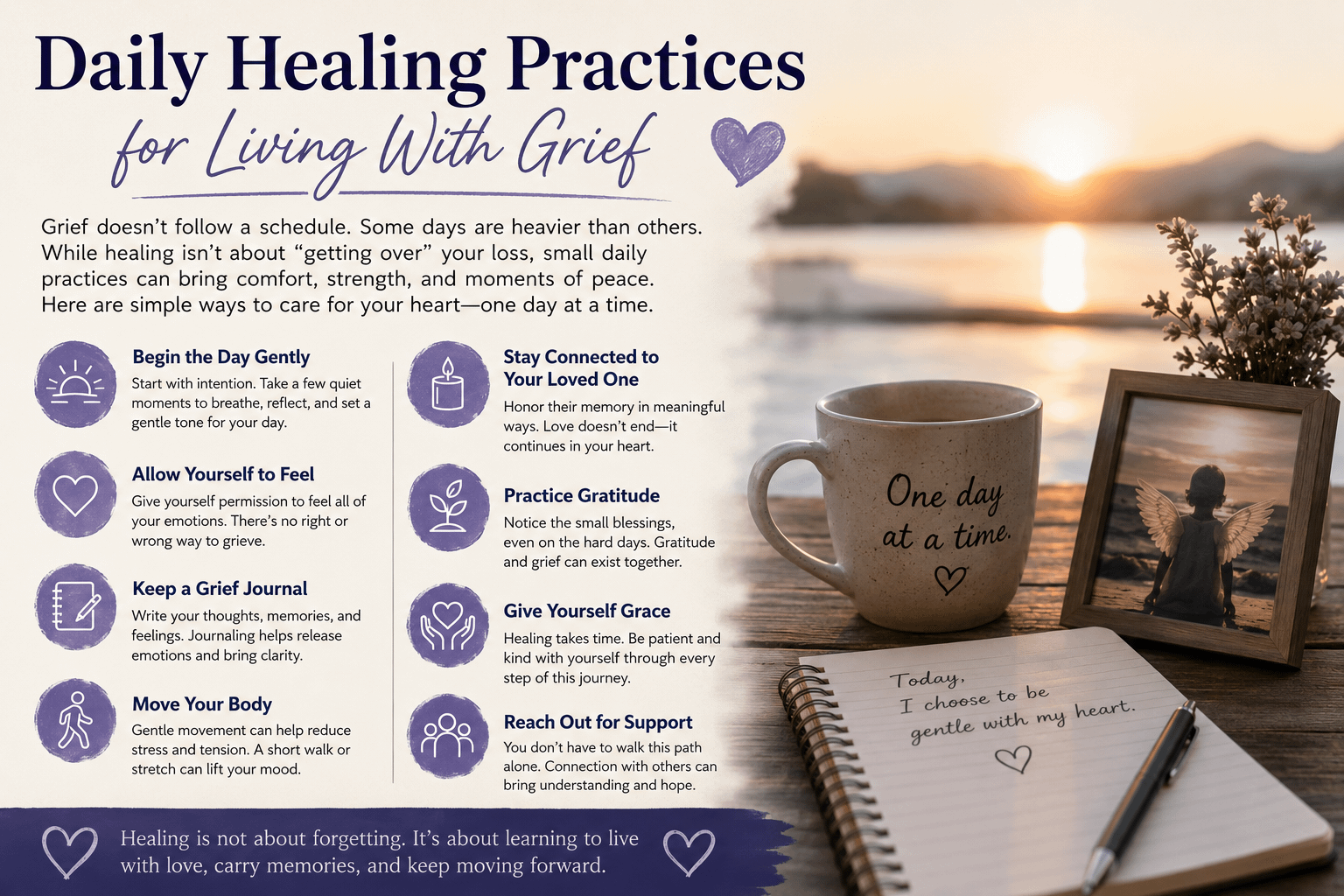
  • Daily Healing Practices For Grief

    Daily Healing Practices For Grief

    Grief changes everything.

    Whether your loss happened recently or years ago, grief has a way of showing up when you least expect it. Some days it arrives quietly, like a distant ache. Other days it crashes into your life without warning, making even the simplest tasks feel impossible.

    Many people believe healing from grief means finding a way to leave it behind. The truth is quite different. Healing isn’t about forgetting your loved one or moving on from them. Healing is about learning how to carry your loss while continuing to live your life.

    The small choices you make each day can have a profound impact on your emotional well-being. While no daily routine can erase the pain of loss, healthy habits can provide stability, comfort, and moments of peace during difficult seasons.

    Here are several daily healing practices that can help you navigate your grief journey one day at a time.

    Begin the Day Gently

    For many grieving people, mornings can be the hardest part of the day.

    There is often a painful moment immediately after waking when reality returns. The loss becomes real all over again, and the weight of another day can feel overwhelming.

    Creating a gentle morning routine can help ease that transition.

    Instead of immediately reaching for your phone or rushing into responsibilities, take a few moments to simply breathe. Sit quietly with a cup of coffee or tea. Watch the sunrise. Read a favorite scripture, devotional, or inspirational quote.

    You might choose to light a candle in memory of your loved one or spend a few moments reflecting on a favorite memory.

    The goal is not to force happiness. The goal is to begin the day with intention rather than allowing grief to immediately take control.

    Allow Yourself to Feel

    One of the biggest mistakes people make is trying to avoid grief.

    We live in a culture that often encourages us to stay busy, stay strong, and push through our emotions. Unfortunately, buried grief rarely stays buried. It often resurfaces later through anxiety, depression, anger, or emotional exhaustion.

    Give yourself permission to feel whatever emotions arise.

    Some days you may feel sadness.

    Some days you may feel anger.

    Some days you may even feel moments of joy followed by guilt.

    All of these emotions are normal.

    Healing begins when we stop judging our feelings and start acknowledging them.

    Keep a Grief Journal

    Writing can be one of the most powerful tools for emotional healing.

    A journal provides a safe place to express thoughts that may be difficult to share with others. It allows you to release emotions rather than carrying them inside.

    You don’t have to be a writer to benefit from journaling.

    Simply write about:

    • What you’re feeling today
    • What you miss most
    • Memories that came to mind
    • Things you wish you could say
    • Lessons you’ve learned through loss

    Many grieving parents find comfort in writing letters to their child. Others write daily reflections or prayers.

    There is no right or wrong way to journal. The purpose is simply to give your grief a voice.

    Move Your Body

    Grief affects more than your emotions.

    It impacts your body as well.

    Many people experience fatigue, muscle tension, headaches, disrupted sleep, and physical exhaustion after a significant loss.

    Gentle movement can help release some of that emotional and physical tension.

    This doesn’t mean you need an intense workout.

    Consider:

    • Taking a short walk
    • Stretching for ten minutes
    • Practicing yoga
    • Riding a bicycle
    • Working in the garden
    • Spending time outdoors

    Movement reminds your body that it is still alive, still capable, and still deserving of care.

    Even five or ten minutes can make a difference.

    Stay Connected to Your Loved One

    One of the greatest fears after a loss is the fear of forgetting.

    Many people worry that as time passes, memories will fade.

    Creating a daily remembrance practice can help maintain a healthy connection with your loved one.

    You might:

    • Display photos
    • Light a candle
    • Visit a special place
    • Wear a meaningful piece of jewelry
    • Listen to their favorite music
    • Prepare a favorite meal
    • Share stories about them

    Love does not end when someone dies.

    Continuing to honor their memory allows that love to remain part of your life.

    Practice Gratitude Without Ignoring Pain

    Gratitude and grief can exist together.

    Being grateful does not mean you’re no longer hurting.

    It simply means you’re allowing yourself to notice moments of goodness alongside the pain.

    At the end of each day, try identifying one thing for which you’re grateful.

    It might be:

    • A supportive friend
    • A comforting conversation
    • A beautiful sunset
    • A warm meal
    • A peaceful moment

    On particularly difficult days, your gratitude might simply be:

    “I made it through today.”

    And sometimes, that’s enough.

    Give Yourself Grace

    Grief is not a straight path.

    There will be good days.

    There will be difficult days.

    There will be setbacks, emotional triggers, anniversaries, birthdays, holidays, and unexpected reminders.

    None of these moments mean you’re failing.

    Healing is not measured by how little you cry or how quickly you recover.

    Healing is measured by your willingness to keep going despite the pain.

    Be patient with yourself.

    Speak to yourself with the same kindness you would offer a close friend facing the same loss.

    Reach Out When You Need Support

    Grief can feel incredibly isolating.

    Many people around you may not understand what you’re experiencing. Some may even expect you to “move on” long before you’re ready.

    You do not have to carry this burden alone.

    Consider connecting with:

    • A grief support group
    • A counselor or therapist
    • Trusted friends
    • Family members
    • Faith communities
    • Online grief communities

    Sometimes healing begins simply by realizing someone else understands.

    Final Thoughts

    There is no timetable for grief.

    There is no finish line.

    There is no moment when you suddenly stop missing the person you love.

    What healing offers is something different. It offers the ability to carry your grief with greater strength, greater compassion, and greater hope.

    The small choices you make each day matter.

    A walk.

    A prayer.

    A journal entry.

    A memory.

    A moment of gratitude.

    These simple practices won’t erase your loss, but they can help you build a life that honors both your loved one and your own journey forward.

    One day at a time.

    One step at a time.

    One breath at a time.

    A Father’s Guide to Surviving the Loss of a Child
  • Men Need to Know It’s Okay to Talk About Mental Health

    Men Need to Know It’s Okay to Talk About Mental Health

    For generations, men have been taught a dangerous lesson: stay strong, keep your emotions to yourself, and never let anyone see you struggle. Many boys grow up hearing phrases like “man up,” “be tough,” “don’t cry,” or “handle it yourself.” While these messages may be intended to encourage resilience, they often create a culture where men feel ashamed to admit when they are hurting.

    The truth is simple: men experience emotional pain just like everyone else. They face anxiety, depression, grief, loneliness, stress, trauma, and heartbreak. Yet countless men suffer in silence because they fear being judged, misunderstood, or viewed as weak.

    It’s time to change that conversation.

    The Silent Battle Many Men Fight

    Mental health challenges do not discriminate. They affect men from every walk of life—fathers, sons, husbands, veterans, business owners, athletes, laborers, and professionals. On the outside, a man may appear successful and confident while privately fighting battles nobody can see.

    Many men become experts at hiding their pain.

    They go to work.

    They pay the bills.

    They take care of their families.

    They smile when asked how they’re doing.

    And when someone asks if everything is okay, they often respond with the same two words:

    “I’m fine.”

    But beneath those words may be overwhelming stress, grief, depression, fear, or emotional exhaustion.

    Research continues to show that many men are willing to discuss their mental health when they feel safe, supported, and free from judgment, yet societal expectations often discourage those conversations.

    Why Men Often Stay Silent

    Many men learn early in life that vulnerability carries consequences.

    Perhaps they were teased for crying.

    Perhaps they were told to toughen up.

    Perhaps they grew up believing that strength meant handling everything alone.

    As adults, these lessons can become deeply ingrained beliefs:

    • Asking for help is weakness.
    • Talking about emotions is uncomfortable.
    • Other people have bigger problems.
    • Nobody will understand anyway.
    • I should be able to fix this myself.

    These beliefs create emotional walls that become harder to break down over time.

    Unfortunately, silence doesn’t make pain disappear.

    It simply allows it to grow.

    The Cost of Carrying Everything Alone

    When mental health struggles go unaddressed, they often affect every area of life.

    Relationships may suffer.

    Sleep becomes difficult.

    Work performance declines.

    Physical health can deteriorate.

    Many men turn to unhealthy coping mechanisms such as excessive work, alcohol, isolation, anger, or emotional withdrawal.

    What starts as stress can slowly become burnout.

    What begins as sadness can develop into depression.

    What feels like loneliness can become overwhelming isolation.

    The longer emotional pain remains hidden, the heavier it becomes.

    Strength and Vulnerability Can Exist Together

    One of the biggest misconceptions about masculinity is that vulnerability and strength are opposites.

    They are not.

    In fact, some of the strongest moments in a man’s life involve vulnerability.

    It takes courage to admit you’re struggling.

    It takes courage to ask for help.

    It takes courage to tell a friend, “I’m not doing okay.”

    Real strength is not pretending everything is fine.

    Real strength is facing reality honestly.

    A man who talks about his mental health is not weak.

    He is brave enough to confront what many others try to avoid.

    Breaking the Stigma

    The stigma surrounding men’s mental health is slowly changing.

    More athletes, actors, military veterans, and public figures are openly discussing their experiences with depression, anxiety, grief, and therapy. These conversations are helping redefine what strength looks like.

    But cultural change doesn’t happen through celebrities alone.

    It happens in everyday conversations.

    It happens when a father tells his son it’s okay to cry.

    It happens when friends check in on one another.

    It happens when a husband tells his wife he’s overwhelmed.

    It happens when a grieving father admits that losing his child still hurts every day.

    Every honest conversation chips away at the stigma.

    Grief and Men’s Mental Health

    For many men, grief is one of the most misunderstood emotional experiences.

    Society often expects men to be the strong one during tragedy. They are expected to hold everything together for their family while suppressing their own pain.

    But grief doesn’t disappear because it’s hidden.

    Whether it’s the loss of a child, spouse, parent, sibling, or friend, grief affects men deeply.

    Many grieving fathers, in particular, suffer in silence because they feel responsible for supporting everyone else.

    The reality is that healing begins when grief is acknowledged rather than buried.

    Talking about loss does not make a man weak.

    It honors the love that still exists.

    How Men Can Begin Opening Up

    If you’re struggling, you don’t need to share your entire life story today.

    Start small.

    Talk to one trusted friend.

    Speak with a family member.

    Join a support group.

    Write your thoughts in a journal.

    Schedule a conversation with a counselor or therapist.

    One honest conversation can become the first step toward healing.

    You don’t have to have all the answers.

    You don’t have to explain everything perfectly.

    You simply have to begin.

    How We Can Support the Men in Our Lives

    If you know a man who may be struggling, don’t wait for him to ask for help.

    Reach out.

    Ask how he’s doing.

    Listen without immediately trying to fix the problem.

    Avoid judgment.

    Avoid telling him to “get over it.”

    Sometimes the most powerful thing you can do is simply sit beside someone and let them know they are not alone. Supportive conversations often work best when they occur naturally during shared activities rather than formal confrontations.

    A New Definition of Strength

    The old definition of masculinity told men to suffer silently.

    A healthier definition recognizes that courage includes honesty.

    Strong men cry.

    Strong men grieve.

    Strong men ask for help.

    Strong men talk about their mental health.

    Strong men heal.

    No man should feel ashamed for experiencing emotions that are part of being human.

    You are not weak because you struggle.

    You are not broken because you hurt.

    You are not less of a man because you need support.

    Your mental health matters.

    Your story matters.

    And your voice deserves to be heard.

    If you’re carrying a burden today, remember this:

    You don’t have to carry it alone.

    Read More Health & Wellness

  • What It Means To Lose A Child

    What It Means To Lose A Child

    There are losses in life that leave scars. There are losses that change our routines, alter our plans, and challenge our hearts.

    Then there is the loss of a child.

    Losing a child is not simply another form of grief. It is a life-altering event that changes a parent forever. It reshapes the way you see the world, the way you view yourself, and the way you imagine the future. It is a pain so profound that many parents struggle to find words that adequately describe it.

    The death of a child is often called one of the most devastating experiences a human being can endure. Whether the child was young or grown, whether the loss came suddenly or after a long illness, the heartbreak reaches into every corner of a parent’s life.

    To lose a child is to lose a piece of your own heart.

    The Loss of a Future

    When a child dies, parents do not only grieve the life that was lived.

    They grieve the life that was supposed to be.

    Every parent carries dreams for their child. They imagine birthdays, graduations, careers, marriages, grandchildren, and countless milestones yet to come. They envision family gatherings years into the future and moments that have not yet happened.

    When a child dies, those dreams disappear in an instant.

    Parents find themselves mourning not only memories but possibilities.

    The future they expected is suddenly gone.

    The chair at the holiday table remains empty.

    The phone no longer rings.

    The milestones never arrive.

    The silence becomes one of the loudest reminders of all.

    A Pain Unlike Any Other

    Many grieving parents describe the loss of a child as a physical pain.

    Their chest feels heavy.

    Their stomach knots with anxiety.

    Their body aches from carrying the emotional weight of the loss.

    Simple tasks become difficult.

    Concentration disappears.

    Sleep becomes elusive.

    Food loses its taste.

    Laughter feels distant.

    The pain of child loss often affects every aspect of life—emotionally, mentally, physically, and spiritually.

    Even years later, parents can find themselves overwhelmed by memories triggered by a photograph, a song, a familiar scent, or a special date.

    Grief does not disappear because time passes.

    Love does not disappear either.

    The World Keeps Moving

    One of the hardest realities after losing a child is watching the world continue as if nothing happened.

    People return to work.

    Neighbors continue their routines.

    Friends celebrate birthdays and anniversaries.

    Children play in parks.

    Life moves forward.

    For grieving parents, this can feel confusing and painful.

    How can the world continue when their world has stopped?

    Many parents feel isolated during this time. They may withdraw from social events, avoid conversations, or struggle to relate to people whose lives seem untouched by tragedy.

    The loneliness of child loss is often one of the most difficult burdens to carry.

    The Fear of Forgetting

    Many bereaved parents live with a fear that few people talk about openly.

    They fear forgetting.

    They worry that one day their child’s voice will become harder to remember.

    They fear losing small details—the sound of their laugh, the way they smiled, the expressions they made, the little habits that made them unique.

    Because of this, many parents hold tightly to photographs, videos, text messages, letters, clothing, and keepsakes.

    These items become treasures.

    Not because parents are unable to move forward, but because they are determined to preserve the memory of someone they love deeply.

    A parent’s greatest fear is often not their own grief.

    It is the possibility that their child could be forgotten.

    The Guilt Many Parents Carry

    After losing a child, many parents wrestle with guilt.

    They replay events repeatedly in their minds.

    They ask impossible questions:

    • What if I had done something differently?
    • What if I had called?
    • What if I had noticed something sooner?
    • What if I had been there?

    The mind searches endlessly for answers because answers feel easier than accepting a painful reality.

    Yet most grieving parents are carrying responsibility for things they could never have controlled.

    The truth is simple:

    If love alone could have saved a child, no parent would ever experience this loss.

    Parents love with everything they have.

    The fact that tragedy occurred does not mean they failed.

    It means they are human.

    How Child Loss Changes a Parent

    The death of a child changes a parent forever.

    It changes priorities.

    It changes relationships.

    It changes perspectives.

    Many parents discover they no longer worry about the same things they once did. Problems that once seemed significant suddenly feel trivial.

    Life takes on a different meaning.

    Some parents become quieter.

    Others become more compassionate.

    Many develop a deeper appreciation for time, family, and meaningful relationships.

    The grief never fully leaves, but it often transforms the person carrying it.

    Loss has a way of teaching lessons no one wants to learn.

    The Relationship Never Ends

    One of the biggest misconceptions about grief is the belief that death ends a relationship.

    It does not.

    Parents continue loving their children long after death.

    They continue talking about them.

    They continue celebrating birthdays.

    They continue honoring anniversaries.

    They continue carrying their child’s memory wherever they go.

    Love does not end because a life ends.

    The relationship changes, but it remains.

    Many parents speak their child’s name often because it keeps their memory alive.

    Others volunteer, donate, advocate, or help others in their child’s honor.

    Every act of remembrance becomes a way of continuing that bond.

    Learning to Live Again

    Perhaps the greatest challenge after losing a child is learning how to live in a world without them.

    At first, survival becomes the goal.

    Simply making it through another day feels impossible.

    Over time, many parents begin discovering something unexpected.

    The heart can hold grief and joy at the same time.

    They can miss their child and still smile.

    They can cry and still laugh.

    They can carry sorrow while also experiencing moments of gratitude.

    This does not mean they have forgotten.

    It does not mean the pain is gone.

    It means they are learning how to carry both love and loss together.

    Healing is not about moving on from a child.

    Healing is about moving forward while keeping that child forever in your heart.

    What It Truly Means to Lose a Child

    To lose a child means carrying a love that has nowhere to go.

    It means waking up each day missing someone who should still be here.

    It means grieving both memories and dreams.

    It means learning to survive the unimaginable.

    But it also means discovering the incredible depth of a parent’s love.

    A love so powerful that even death cannot erase it.

    A love that continues through memories, stories, traditions, and acts of kindness.

    A love that remains long after the funeral flowers have faded.

    The loss of a child changes everything.

    Yet the love for that child remains one of the strongest forces a parent will ever know.

    And that love, no matter how much time passes, never dies.

    A Father’s Guide to Surviving the Loss of a Child

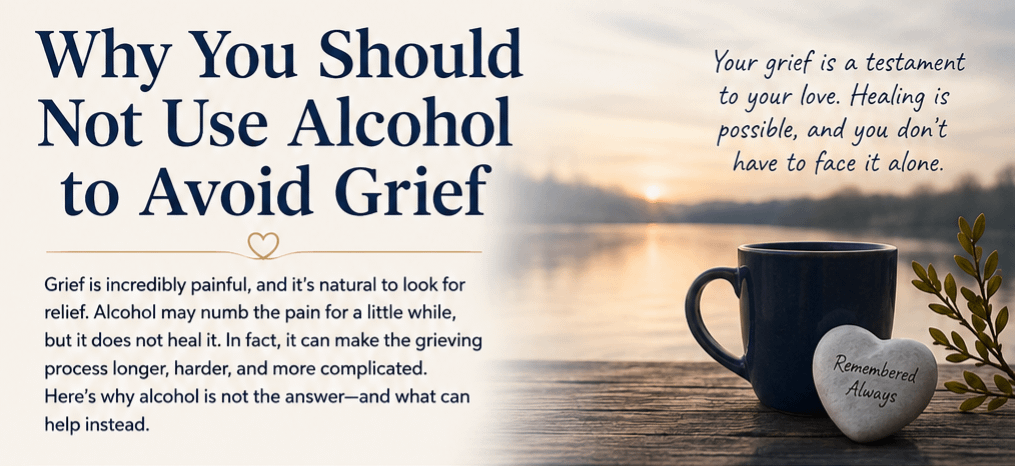
  • Why You Should Not Use Alcohol To Avoid Grief

    Why You Should Not Use Alcohol To Avoid Grief

    Grief is one of the most painful experiences a person can endure. Whether you have lost a child, spouse, parent, sibling, friend, or someone who played a significant role in your life, the emotional weight can feel overwhelming. In the aftermath of loss, many people search for anything that might provide temporary relief from the sadness, loneliness, anger, or emptiness they feel.

    For some, alcohol becomes that temporary escape.

    A drink may seem harmless at first. It may appear to take the edge off the pain, quiet the racing thoughts, or provide a few hours of numbness from the reality of loss. But while alcohol may temporarily dull emotional pain, it does not heal grief. In fact, it often makes the grieving process more difficult, more complicated, and much longer. Research and grief experts have consistently found that alcohol can interfere with healthy emotional processing and increase the risk of depression, substance misuse, and prolonged grief.

    Grief Cannot Be Escaped

    One of the hardest truths about grief is that there is no shortcut through it.

    When someone we love dies, our hearts and minds must slowly learn how to live in a world that has been permanently changed. This process takes time. It requires us to experience the emotions that come with loss, even when those emotions are uncomfortable or heartbreaking.

    Alcohol may temporarily mask those feelings, but it does not remove them. The sadness, longing, guilt, anger, and heartbreak are still there waiting when the effects wear off. Many grieving people discover that the emotions they tried to avoid return even stronger the next day.

    Grief is not something that can be buried indefinitely. It must be acknowledged and processed in order to heal. Experts note that avoiding grief-related emotions can contribute to complications in the grieving process and delay emotional adaptation to loss.

    Alcohol Is a Depressant

    Many grieving individuals already struggle with depression, hopelessness, anxiety, and emotional exhaustion after a significant loss.

    Alcohol is a depressant. While it may initially create feelings of relaxation, it can worsen sadness and emotional distress over time. What feels like relief in the moment often becomes deeper emotional pain afterward. Grief specialists frequently warn that drinking can intensify depressive symptoms and make emotional recovery more difficult.

    You may find yourself trapped in a cycle:

    • Feel grief.
    • Drink to numb the grief.
    • Feel worse emotionally afterward.
    • Drink again to escape the worsening emotions.

    Over time, this cycle can become difficult to break.

    Alcohol Delays Healing

    Healing from grief does not mean forgetting the person you lost.

    Healing means learning how to carry their memory while continuing to live your life.

    That process requires emotional work. It requires crying, remembering, talking, reflecting, and sometimes simply sitting with painful emotions. When alcohol becomes the primary coping mechanism, those important steps often get postponed.

    Instead of processing grief, you may find yourself avoiding it.

    Unfortunately, avoided grief does not disappear. It often resurfaces months or years later through depression, anxiety, anger, relationship problems, or substance dependence. Experts note that emotional avoidance is one factor associated with more complicated grief reactions.

    Alcohol Can Increase Risk-Taking Behaviors

    Grief already affects judgment, concentration, and decision-making.

    Adding alcohol to the equation can make those challenges even greater.

    Many people who drink heavily while grieving report:

    • Increased impulsive decisions
    • Financial problems
    • Relationship conflicts
    • Poor sleep
    • Increased feelings of isolation
    • Dangerous driving
    • Health complications

    Instead of helping you cope, alcohol may create additional problems during a time when you are already struggling emotionally.

    The Danger of Dependence

    What starts as “just a few drinks to get through the evening” can slowly become something much more serious.

    When alcohol becomes the primary way to manage emotional pain, dependence can develop before you realize it. Studies have found links between bereavement-related distress and problematic alcohol use, particularly when drinking is used as a coping strategy.

    Many grieving people are not looking to become addicted.

    They are simply trying to survive.

    But emotional pain can make alcohol seem more effective than it actually is, leading people to rely on it more frequently and in larger amounts over time.

    What to Do Instead

    If alcohol is not the answer, what can help?

    While nothing removes grief entirely, healthier coping strategies can support healing:

    Talk About Your Loss

    Speak with trusted friends, family members, grief counselors, or support groups. Sharing your story can reduce feelings of isolation and remind you that you do not have to carry your grief alone.

    Write Your Feelings Down

    Journaling allows you to express thoughts and emotions that may be difficult to say out loud. Many bereaved parents and grieving individuals find comfort in writing letters to their loved one.

    Stay Connected

    Grief often makes people want to withdraw from others. While solitude can be helpful at times, complete isolation usually worsens emotional suffering.

    Take Care of Your Body

    Sleep, nutrition, hydration, and physical activity may seem insignificant when your heart is broken, but they play an important role in emotional recovery.

    Seek Professional Help

    There is no shame in asking for help. Grief counselors, therapists, and support groups are specifically trained to help people navigate loss and develop healthy coping skills.

    A Message for Bereaved Parents

    For parents who have lost a child, the temptation to numb the pain can be especially strong.

    The loss of a child creates a level of heartbreak that is difficult to describe and impossible to fully understand unless you have lived it yourself. There may be days when the pain feels unbearable and nights when sleep refuses to come.

    If that is where you are today, know this:

    Your grief deserves to be felt.

    Your child deserves to be remembered clearly.

    Your healing deserves a chance.

    Alcohol may promise temporary relief, but it cannot give you the peace you seek. The path through grief is difficult, but facing it honestly allows you to honor both your loss and your love.

    Final Thoughts

    Grief is not a problem to be solved. It is a journey to be lived.

    While alcohol may seem like a way to escape the pain for a few hours, it often makes the burden heavier in the long run. True healing comes from allowing yourself to experience grief, seek support, and gradually learn how to carry your loss forward.

    You do not have to numb your pain to survive it.

    You can face it one day, one breath, and one step at a time.

    And even in your darkest moments, healing remains possible.

    A Father’s Guide to Surviving the Loss of a Child

  • Dealing With Grief When It Hits You Hard

    Dealing With Grief When It Hits You Hard

    Grief has a way of showing up when you least expect it. One moment you may be managing your day, completing tasks, talking with friends, or even laughing at something on television. The next moment, a memory, a song, a photograph, or a random thought can knock the wind out of you. Suddenly, the pain is back, and it feels as if the loss happened all over again.

    If you are experiencing grief that hits hard and unexpectedly, you are not alone. One of the most misunderstood parts of grief is its unpredictability. Many people assume healing follows a straight line, becoming easier with each passing day. In reality, grief often moves in waves. Some days are calm. Other days feel like a storm. This is a normal part of the grieving process.

    When Grief Takes Your Breath Away

    There are moments when grief feels manageable. Then there are moments when it feels impossible.

    You may wake up with a heavy heart and no clear reason why. You may suddenly break down while driving, shopping, or sitting alone in your living room. You may feel an overwhelming ache in your chest that reminds you of everything you have lost.

    For parents who have lost a child, these moments can be especially devastating. A birthday, graduation season, a holiday, or simply seeing someone the same age as your child can trigger a wave of emotions that feels unbearable.

    The truth is that grief is not something you “get over.” Instead, you learn how to carry it. The love you have for the person you lost does not disappear, and neither does the impact they had on your life.

    Why Grief Comes in Waves

    Many grief experts describe grief as a series of waves. Sometimes the water is calm. Sometimes it crashes over you without warning.

    These waves can be triggered by:

    • Anniversaries and special dates
    • Holidays and family gatherings
    • Familiar songs
    • Certain smells
    • Places you visited together
    • Photographs and videos
    • Unexpected memories
    • Stress or exhaustion

    Sometimes there is no obvious trigger at all. Your heart simply remembers.

    Grief is deeply connected to love. The stronger the bond, the deeper the loss can feel. What often surprises people is that grief can intensify months or even years after the loss because certain experiences awaken memories that have been quietly resting beneath the surface.

    Give Yourself Permission to Feel

    One of the worst things you can do when grief hits hard is convince yourself that you should not be feeling this way.

    People often tell themselves:

    • “I should be over this by now.”
    • “I need to be stronger.”
    • “I shouldn’t still be crying.”
    • “Everyone else has moved on.”

    Grief does not follow a schedule.

    Your pain is not a sign of weakness. It is evidence of love.

    Allow yourself to cry if you need to cry. Allow yourself to be angry if anger surfaces. Allow yourself to feel whatever emotions arise without judging them.

    Healing begins when we stop fighting our emotions and start acknowledging them.

    The Physical Side of Grief

    Many people do not realize that grief affects the body as much as it affects the mind.

    When grief hits hard, you may experience:

    • Fatigue
    • Trouble sleeping
    • Loss of appetite
    • Changes in weight
    • Headaches
    • Muscle tension
    • Difficulty concentrating
    • Anxiety
    • Physical exhaustion

    Some people feel emotionally numb. Others feel emotionally overwhelmed. Both reactions are normal.

    Grief is not just sadness. It can involve anger, guilt, loneliness, fear, confusion, regret, and even moments of relief. These emotions can appear separately or all at once.

    What To Do When Grief Becomes Overwhelming

    When a powerful wave of grief arrives, try not to panic.

    Instead:

    Pause

    Stop what you are doing for a moment. Take a few deep breaths.

    Ground Yourself

    Look around the room.

    Name five things you can see.

    Name four things you can touch.

    Bring yourself back to the present moment.

    Let the Emotion Pass Through

    Instead of resisting the pain, acknowledge it.

    Say to yourself:

    “I miss them.”

    “This hurts.”

    “This is grief.”

    Naming your emotions can reduce their intensity and help you process them more effectively.

    Reach Out

    Call someone you trust.

    Send a text.

    Join a support group.

    Sometimes the most healing thing we can do is allow someone else to sit beside us in our pain. Community and connection can make difficult moments more bearable.

    The Loneliness That Comes With Grief

    One of the hardest parts of grief is how isolating it can feel.

    The world continues moving forward while your heart feels stuck in a moment that changed everything.

    Friends return to their routines.

    Coworkers move on.

    Life continues around you.

    Meanwhile, you may still be trying to understand how to live without someone who meant so much to you.

    This loneliness can be especially painful after the loss of a child. Many grieving parents find that others eventually stop mentioning their child because they are afraid of causing pain.

    What they do not realize is that your child is already on your mind every single day.

    You do not need people to forget your child.

    You need people to remember them with you.

    Finding Ways to Honor Their Memory

    One of the healthiest ways to navigate grief is finding meaningful ways to stay connected to your loved one’s memory.

    You might:

    • Write letters to them
    • Keep a journal
    • Create a photo album
    • Celebrate their birthday
    • Support a cause they cared about
    • Share stories about them
    • Continue traditions they loved

    Honoring someone does not prevent healing.

    In many ways, it becomes part of healing.

    Love does not end because someone is no longer physically present.

    When You Need Professional Help

    Grief is normal.

    However, if you find yourself unable to function for an extended period, withdrawing completely from life, or struggling with thoughts of harming yourself, it is important to seek professional support.

    A grief counselor, therapist, or support group can provide tools and guidance that help you navigate the darkest moments.

    Seeking help is not a sign of weakness.

    It is a sign that you value your well-being enough to accept support.

    Moving Forward Without Moving On

    Many grieving people fear that healing means forgetting.

    It doesn’t.

    Moving forward does not mean leaving your loved one behind.

    It means learning how to carry their memory while continuing to live your life.

    You will always miss them.

    There will always be moments when grief hits hard.

    But there will also be moments when you smile because of a memory.

    Moments when gratitude outweighs pain.

    Moments when you realize that although your loved one is gone, the love remains.

    And sometimes, on the hardest days, that love is what carries you through.

    Final Thoughts

    If grief is hitting you hard today, be gentle with yourself.

    You do not have to have all the answers.

    You do not have to be strong every minute.

    You do not have to pretend you are okay.

    Take one breath.

    Then another.

    Take one step forward.

    Then another.

    Healing is not about forgetting what you lost.

    It is about learning how to live while carrying the love, memories, and lessons that remain.

    And even when grief feels overwhelming, remember this:

    You have survived every difficult day so far.

    You can survive this one too.

    A Father’s Guide to Surviving the Loss of a Child