Author: Brett Murphy

  • When You Feel Like Just a Background Character in Everyone Else’s Life

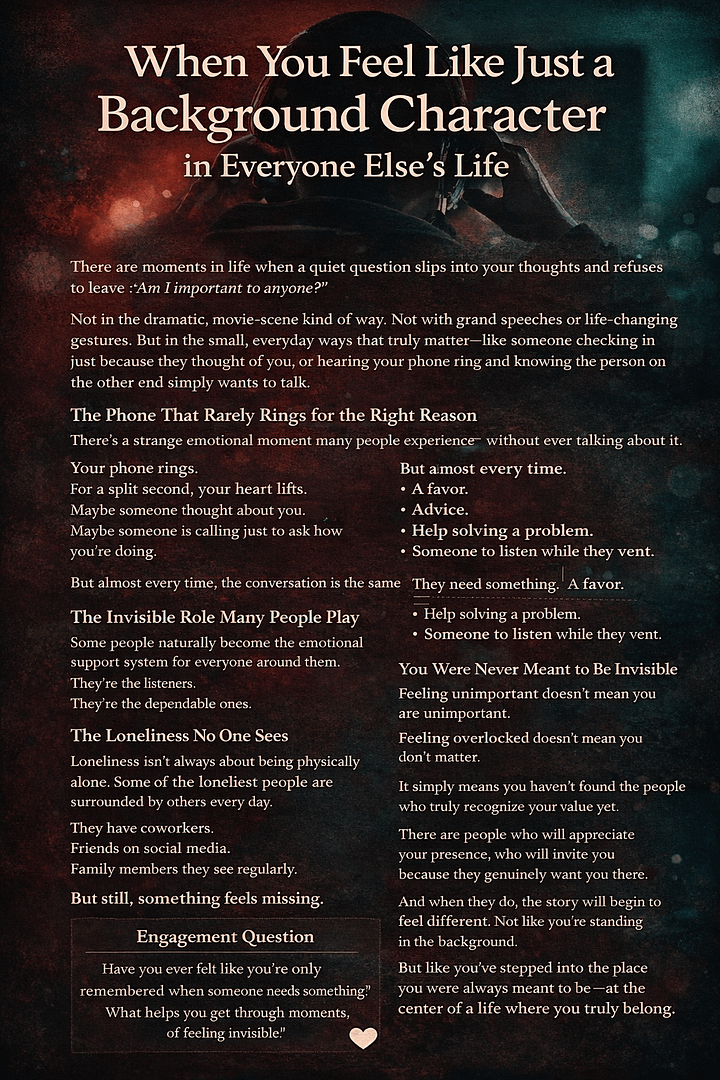
    When You Feel Like Just a Background Character in Everyone Else’s Life

    There are moments in life when a quiet question slips into your thoughts and refuses to leave:

    Am I important to anyone?

    Not in the dramatic, movie-scene kind of way. Not with grand speeches or life-changing gestures. But in the small, everyday ways that truly matter—like someone checking in just because they thought of you, or hearing your phone ring and knowing the person on the other end simply wants to talk.

    For many people, life can begin to feel like they are nothing more than a background character in everyone else’s story. They are present, but not central. Helpful, but not sought after. Reliable, but rarely remembered when there’s no need involved.

    You exist in the background—supporting others, listening to their problems, offering help when they ask—but when the noise fades and the day becomes quiet, you start to realize something painful.

    No one seems to check in on you.

    The Phone That Rarely Rings for the Right Reason

    There’s a strange emotional moment many people experience without ever talking about it.

    Your phone rings.

    For a split second, your heart lifts. A spark of hope appears. Maybe someone thought about you. Maybe someone wanted to hear your voice. Maybe someone is calling just to ask how you’re doing.

    But the conversation almost always follows the same pattern.

    They need something.

    A favor.
    Advice.
    Help solving a problem.
    Someone to listen while they vent.

    And because you’re the kind of person who cares, you answer. You help. You listen. You give your time.

    But after the call ends, a quiet realization lingers.

    If you hadn’t been useful in that moment… would they have called at all?

    The Invisible Role Many People Play

    There are people in the world who naturally become the emotional support system for everyone around them.

    They’re the listeners.

    They’re the dependable ones.

    They’re the people others turn to when life gets difficult.

    But those same people often carry a silent burden. Because while they are always there for others, they rarely feel like anyone is there for them.

    They become the safe place for everyone else, yet have nowhere to place their own worries.

    They’re the strong one.
    The understanding one.
    The one who always says, “It’s okay.”

    But sometimes, even the strongest person wishes someone would simply ask:

    “Are you okay?”

    The Loneliness No One Sees

    Loneliness isn’t always about being physically alone. Some of the loneliest people are surrounded by others every day.

    They have coworkers.
    Friends on social media.
    Family members they see regularly.

    But still, something feels missing.

    The absence of genuine connection can leave a person feeling invisible. Like they exist in people’s lives only when needed.

    Days go by without messages.

    Weekends pass without invitations.

    And slowly, a quiet narrative begins forming in the back of the mind:

    Maybe I’m just not that important.

    This kind of loneliness doesn’t scream for attention. It whispers.

    And because it whispers, it often goes unnoticed.

    The Painful Cycle of Hope

    Despite the disappointment, hope rarely disappears completely.

    Every notification brings a moment of curiosity.

    Every ringing phone creates a brief surge of anticipation.

    Maybe this time someone just wants to talk.
    Maybe someone thought about me today.
    Maybe someone wants to spend time together.

    Hope can feel foolish after being disappointed so many times. But the truth is, hope is not weakness.

    Hope is the heart refusing to give up on connection.

    It’s the quiet belief that somewhere, someone will value you for more than what you can do for them.

    Why This Happens More Than People Realize

    Modern life has created a strange kind of distance between people.

    Everyone is busy.

    Everyone is distracted.

    Everyone assumes everyone else is doing fine.

    Social media can create the illusion that people are constantly connected, but real connection—the kind where someone genuinely checks in, listens, and cares—is often much rarer than it appears.

    Many people don’t intentionally overlook others. Sometimes they simply get caught in their own struggles.

    But that doesn’t make the feeling of being forgotten any less real.

    The People Who Feel This Way the Most

    Ironically, the people most likely to feel like background characters are often the ones who matter deeply to others.

    They’re compassionate.

    They’re thoughtful.

    They’re the people who remember birthdays, send encouraging messages, and show up when someone needs help.

    But because they give so much of themselves, others begin to rely on them without realizing they also need support.

    When you are the person who always shows up, people sometimes assume you don’t need anyone to show up for you.

    You Were Never Meant to Be Invisible

    Feeling unimportant doesn’t mean you are unimportant.

    Feeling overlooked doesn’t mean you don’t matter.

    Sometimes it simply means you haven’t found the people who truly recognize your value yet.

    There are people in the world who will appreciate your presence—not just your help.

    People who will call simply because they enjoy talking with you.

    People who will invite you not because they need something, but because they genuinely want you there.

    Those connections might take time to find, but they exist.

    And when they arrive in your life, something shifts.

    You realize the problem was never that you were a background character.

    It was that you were surrounded by people who didn’t know how to recognize the importance of someone like you.

    The Truth About Your Story

    Every life is a story.

    And in your story, you are not the extra standing quietly in the corner.

    You are not the supporting role that no one notices.

    You are the main character.

    Your experiences matter.
    Your feelings matter.
    Your presence matters.

    Even if the world around you hasn’t fully acknowledged it yet.

    Because somewhere out there are people who will see you, value you, and appreciate the quiet strength you carry every day.

    And when they do, the story will finally begin to feel different.

    Not like you’re standing in the background.

    But like you’ve stepped into the place you were always meant to be—at the center of a life where you truly belong.

    Read More Health & Wellness

  • Friday the 13th: The History, Legends, and Superstitions Behind the World’s Most Infamous Date

    Friday the 13th: The History, Legends, and Superstitions Behind the World’s Most Infamous Date

    Few dates on the calendar carry the same chilling reputation as Friday the 13th. For generations, this day has been surrounded by mystery, superstition, and a lingering sense of unease. Many people associate it with bad luck, strange accidents, or unfortunate events, while others see it as nothing more than an entertaining myth.

    Despite its eerie reputation, Friday the 13th is not tied to a single origin story. Instead, its legend developed slowly over centuries, blending religious symbolism, ancient mythology, historical events, and cultural storytelling. The result is one of the most widely recognized superstitions in the modern world.

    Whether someone fears the date or laughs it off, the mystique of Friday the 13th continues to capture imaginations across cultures.

    The Fear of the Number 13

    Long before the date Friday the 13th gained its dark reputation, the number 13 itself had already been viewed with suspicion. The fear of the number is known as triskaidekaphobia, a term used to describe the irrational fear or avoidance of the number.

    Many scholars believe the superstition stems from the idea that 12 represents completeness or harmony, while 13 disrupts that balance. Throughout history and across cultures, the number 12 appears repeatedly as a symbol of order:

    12 months in a year

    12 zodiac signs

    12 Olympian gods in Greek mythology

    12 tribes of Israel

    12 apostles in Christian tradition

    12 hours on a clock face

    When the number 13 appears after this symbolic completeness, it seems to break the pattern, creating a sense of imbalance.

    One of the most frequently cited examples comes from Christian tradition. During the Last Supper, there were thirteen people at the table: Jesus and his twelve disciples. Judas Iscariot, the disciple who later betrayed Jesus, is often described as the 13th guest. Over time, this story fueled the belief that gathering thirteen people together would bring bad luck or tragedy.

    Another myth originates from Norse mythology. In the story, twelve gods gathered for a feast in Valhalla. Loki, the mischievous trickster god, arrived as the uninvited 13th guest. His presence led to deception and ultimately to the death of the beloved god Balder. This story reinforced the symbolic danger of the number thirteen.

    Because of these traditions, the number has long been treated cautiously. Even today, many buildings skip the 13th floor, hospitals avoid room number 13, and some airlines omit row 13 entirely.

    Why Friday Was Considered Unlucky

    Just as the number 13 had its own negative associations, Friday itself was once considered an unlucky day in many Western traditions.

    In Christian belief, Good Friday, the day Jesus was crucified, was a day of sorrow and sacrifice. Because of this association, Friday gradually became linked with misfortune in folklore.

    During the Middle Ages, a variety of superstitions developed around the day. Many believed it was unlucky to begin a journey, start a business venture, or hold an important event on a Friday. Sailors were said to be particularly wary of setting sail on that day, fearing storms or disaster.

    Some legends even claimed that major biblical events occurred on Fridays, including:

    Eve giving Adam the forbidden fruit

    Cain killing Abel

    The Great Flood beginning

    While historians debate the accuracy of these claims, the stories helped cement Friday’s reputation as a day when things might go wrong.

    When this already suspicious day eventually combined with the feared number 13, it created a superstition that seemed doubly ominous.

    The Knights Templar and Friday the 13th

    One historical event often associated with the superstition took place on Friday, October 13, 1307.

    On that day, King Philip IV of France ordered the mass arrest of the Knights Templar, a powerful religious military order that had gained immense wealth and influence during the Crusades. The king, deeply in debt to the order, accused the Templars of heresy, blasphemy, and other crimes.

    Hundreds of knights were arrested across France in a coordinated raid. Many were imprisoned, tortured into confessions, and eventually executed. The order was later dissolved by the Church.

    Because the arrests occurred on a Friday the 13th, some historians believe this tragic event helped fuel the superstition. However, there is little evidence that people at the time viewed the date as cursed. The connection between the event and the superstition appears to have been emphasized much later in history.

    Nevertheless, the dramatic story of betrayal, secrecy, and persecution fits perfectly into the mythology surrounding the infamous date.

    The Birth of the Modern Friday the 13th Legend

    Interestingly, the widespread fear of Friday the 13th as a specific date did not become common until relatively recently.

    One major influence came in 1907 with the publication of the novel Friday, the Thirteenth by Thomas W. Lawson. The book tells the story of a stockbroker who exploits public superstition about the date to manipulate the stock market and cause financial panic. The novel was widely read and helped popularize the idea that the day itself carried special misfortune.

    In the late 20th century, the superstition gained even more visibility through entertainment. The Friday the 13th horror film series, beginning in 1980, turned the date into a symbol of terror for an entire generation. The iconic hockey mask worn by the villain Jason Voorhees became one of the most recognizable images in horror history.

    These films did not create the superstition, but they amplified it in popular culture.

    Friday the 13th Around the World

    Interestingly, not every culture fears Friday the 13th.

    In some countries, other dates carry the unlucky reputation:

    In Spain and Greece, the unlucky day is Tuesday the 13th

    In Italy, the feared date is often Friday the 17th

    In parts of East Asia, the number 4 is considered unlucky because its pronunciation is similar to the word for death

    These variations show how superstition is shaped by cultural traditions rather than universal truths.

    Real-World Effects of the Superstition

    Even though there is no scientific evidence that Friday the 13th brings bad luck, the superstition still has measurable effects.

    Studies have shown that on Friday the 13th:

    Some people avoid flying or traveling

    Fewer weddings and major events are scheduled

    Businesses occasionally experience lower sales

    Anxiety increases among those who believe in the superstition

    Economists have even estimated that fear of the date costs businesses hundreds of millions of dollars in lost productivity and travel each year.

    Ironically, some researchers suggest that accidents may slightly increase on the day—not because it is cursed, but because anxious people behave differently when they expect bad luck.

    Turning Fear Into Celebration

    In recent years, many people have begun embracing Friday the 13th rather than fearing it.

    Tattoo shops around the world often hold Friday the 13th tattoo events, offering small themed tattoos at discounted prices. These gatherings attract long lines of customers eager to celebrate the day’s rebellious spirit.

    Others treat the date as a chance to challenge superstition by doing things they might normally avoid. For them, Friday the 13th becomes a reminder that fear often comes from stories rather than reality.

    In this way, the once-feared date has slowly transformed into a cultural phenomenon—part spooky tradition, part playful myth.

    The Power of Superstition

    The enduring legend of Friday the 13th reveals something powerful about human nature. People have always searched for patterns and meaning in the events around them. When misfortune happens on a certain day, it is easy to connect the two, even when the link may not exist.

    Over centuries, scattered myths about the number 13, the symbolism of Friday, historical tragedies, and modern storytelling combined into one unforgettable superstition.

    Yet for all its mystery, Friday the 13th ultimately reminds us that sometimes the scariest things in life are the stories we pass down from generation to generation.

    Read More History & Culture

  • National Good Samaritan Day: A Celebration of Kindness in Action

    National Good Samaritan Day: A Celebration of Kindness in Action

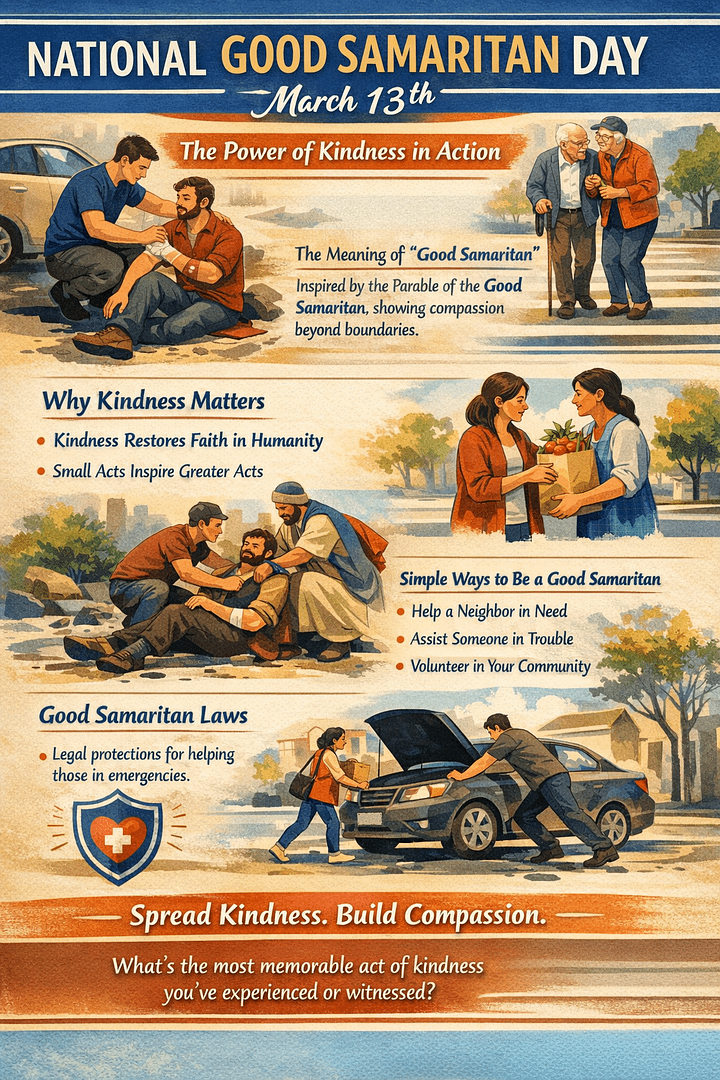
    Every year on March 13, people across the United States observe National Good Samaritan Day, a day dedicated to celebrating kindness, compassion, and the simple yet powerful act of helping someone in need. While it may not be as widely recognized as some other holidays, its message is one of the most meaningful: humanity is at its best when people care for one another.

    National Good Samaritan Day reminds us that the world is not only shaped by major events or famous individuals, but also by the quiet, everyday acts of kindness performed by ordinary people. A small gesture—a helping hand, a comforting word, or a moment of empathy—can change someone’s day and sometimes even change the course of their life.

    The Story Behind the Good Samaritan

    The phrase “Good Samaritan” comes from the well-known Parable of the Good Samaritan, a story found in the Christian Bible. In the parable, a traveler is attacked by thieves, robbed, and left injured on the side of the road. As he lies helpless, several people pass by without offering assistance. Finally, a Samaritan—a person from a group often viewed with prejudice during that time—stops to help.

    The Samaritan tends to the wounded man, bandages his injuries, transports him to safety, and even pays for his care. The message of the story is profound: compassion should not be limited by differences, judgments, or social boundaries.

    Helping others is not about who they are, where they come from, or what they believe. It is about recognizing someone’s humanity and choosing kindness.

    Over time, the phrase “Good Samaritan” became a universal term used to describe anyone who helps a stranger in need.

    The Importance of Kindness in a Busy World

    Modern life often moves at a relentless pace. People rush between work, responsibilities, and personal challenges, sometimes becoming so focused on their own lives that they overlook those around them. National Good Samaritan Day encourages everyone to slow down and recognize the opportunities to help others that exist in everyday moments.

    Acts of kindness can restore faith in humanity. When someone receives help during a difficult moment—whether it is a stranger offering assistance after a car breakdown or a neighbor bringing food during a hard time—it reminds them that they are not alone.

    Kindness also has a ripple effect. Research and human experience both show that when people witness generosity, they are more likely to perform acts of kindness themselves. One compassionate action can inspire many others.

    Everyday Ways to Be a Good Samaritan

    Being a Good Samaritan does not require dramatic heroism or grand gestures. In fact, the spirit of the day is rooted in the belief that small acts of kindness matter deeply.

    Examples of simple ways to embody this spirit include:

    Helping someone carry heavy bags or groceries

    Checking on an elderly neighbor who may feel isolated

    Offering encouragement to someone who seems discouraged

    Volunteering time at a local shelter or community organization

    Helping someone who has a flat tire or car trouble

    Donating food, clothing, or supplies to those in need

    Paying for a stranger’s coffee or meal

    Taking the time to truly listen to someone who needs support

    Sometimes, even a smile or a kind word can make a difference in someone’s day. Kindness is not measured by the size of the action but by the intention behind it.

    The Role of Courage in Compassion

    While many acts of kindness are simple, some moments require courage. Helping someone in need may mean stepping forward when others hesitate or speaking up when someone is being treated unfairly.

    True compassion often involves putting aside fear, inconvenience, or indifference. It means choosing to care even when it would be easier to walk away.

    History is filled with stories of Good Samaritans who stepped forward during difficult situations—people who helped strangers during accidents, disasters, or personal crises. Many of these individuals never seek recognition. They simply act because they believe helping others is the right thing to do.

    Good Samaritan Laws

    In many places, there are even laws designed to encourage people to help others in emergencies. Known as Good Samaritan law, these laws provide legal protection to individuals who voluntarily assist someone who is injured or in danger.

    The purpose of these laws is simple: to remove the fear of liability so that people feel empowered to help during emergencies without hesitation.

    These protections reflect a broader societal belief that compassion and assistance should be encouraged rather than discouraged.

    Building a Culture of Compassion

    National Good Samaritan Day is not just about celebrating kindness for a single day. It is also about building a culture where compassion becomes a daily practice.

    Communities grow stronger when people support one another. When neighbors look out for each other, when strangers offer help during difficult moments, and when empathy becomes a shared value, society becomes more resilient and more connected.

    Kindness also bridges divides. In a world where differences in beliefs, cultures, and experiences sometimes create barriers, acts of compassion remind us that our shared humanity is far more powerful than our differences.

    The Lasting Impact of Kindness

    One of the most beautiful aspects of being a Good Samaritan is that we rarely see the full impact of our actions. A moment of kindness might give someone hope during a difficult time, inspire them to help someone else, or simply remind them that goodness still exists in the world.

    Those moments may seem small, but they are powerful. They create connections between people and help shape a world where empathy and generosity continue to thrive.

    National Good Samaritan Day reminds us that every person has the ability to make a difference. We do not need special titles, resources, or recognition to help someone in need.

    Sometimes all it takes is the willingness to pause, notice another person’s struggle, and offer a helping hand.

    In that simple act, the spirit of the Good Samaritan lives on.

    Read More Holidays & National Days

  • Strength in Her Light

    Strength in Her Light

    Sunlight finds her the way truth finds the brave—
    not gently, not timidly,
    but boldly,
    spilling across her face as if the world itself
    knows she was meant to be seen. ☀️

    There is beauty in her eyes,
    the kind that doesn’t ask permission to exist.
    Not fragile beauty,
    not the kind that fades with time—
    but the quiet, unbreakable kind
    forged in the moments life tried to bend her
    and discovered it could not.

    Her gaze holds stories
    of storms she has walked through
    with steady feet and lifted chin.
    Even when the wind howled against her heart,
    she remained standing—
    not untouched,
    but unbroken. 🌿

    Strength lives in the way she carries herself,
    in the calm confidence of a soul
    that has learned its own worth.
    She does not need to shout it.
    The world can see it
    in the curve of her smile,
    in the fire behind her eyes.

    She is the kind of woman
    who turns pain into power,
    silence into wisdom,
    and ordinary days
    into quiet victories.

    Beautiful, yes—
    but more than that.

    She is resilience wrapped in grace,
    courage dressed in light,
    and proof that true strength
    does not harden the heart—
    it teaches it how to shine. ✨

    And somehow,
    without trying,
    she reminds the world
    what real beauty looks like. 💫

    Read More Poetry

  • National Popcorn Lover’s Day 🍿  Celebrating One of the World’s Most Beloved Snacks

    National Popcorn Lover’s Day 🍿 Celebrating One of the World’s Most Beloved Snacks

    Every year on the second Thursday of March, snack lovers across the United States celebrate National Popcorn Lover’s Day, a holiday dedicated to one of the most beloved and recognizable treats in the world. Light, crunchy, and endlessly customizable, popcorn has become a staple at movie theaters, sporting events, carnivals, and living rooms everywhere.

    For many people, popcorn is more than just a snack—it’s a tradition. It’s the smell that fills the air during a movie night, the treat passed around at family gatherings, and the comforting crunch that turns an ordinary moment into something special. National Popcorn Lover’s Day invites everyone to enjoy this classic snack while appreciating its rich history, surprising science, and cultural significance.

    A Snack That Dates Back Thousands of Years

    While popcorn may feel like a modern snack, its origins reach far into ancient history. Archaeologists have discovered popcorn kernels that date back more than 5,000 years in caves located in present-day New Mexico. Evidence suggests that Indigenous peoples throughout the Americas were popping corn long before modern cooking tools existed.

    Early methods for popping corn were surprisingly clever. Kernels were placed in clay pots or baskets and heated over open fires. Some groups even used heated sand to help distribute heat evenly, allowing the kernels to burst open into fluffy pieces.

    Popcorn served many purposes beyond just food. It was used in ceremonies, decorations, and sometimes even worn as jewelry. Early explorers in the Americas reported seeing popcorn necklaces and decorative arrangements made from the popped kernels.

    This long history shows that popcorn has been bringing joy to people for thousands of years.

    The Science Behind the “Pop”

    One of the most fascinating things about popcorn is the science that makes it pop. Unlike other types of corn, popcorn kernels have a hard outer shell called a hull that traps moisture inside.

    Each kernel contains a tiny amount of water. When the kernel is heated, the water turns into steam. Pressure builds inside the kernel until it reaches a point where the hull can no longer contain it.

    At around 356°F (180°C), the kernel explodes, turning inside out and forming the fluffy white snack we recognize as popcorn.

    That familiar popping sound is actually thousands of miniature pressure bursts happening inside the kernels. It’s a small bit of kitchen science that makes popcorn both fun and delicious.

    Popcorn’s Rise in American Culture

    Popcorn’s popularity in the United States grew significantly during the 1800s. Street vendors sold freshly popped corn at fairs, parks, and festivals using portable popcorn machines. The smell alone was often enough to draw in curious crowds.

    During the Great Depression, popcorn became even more popular because it was an affordable luxury. While many treats were too expensive, popcorn remained a cheap and satisfying snack, allowing families to enjoy something special even during difficult times.

    Its low cost and high appeal helped cement popcorn as a permanent part of American snacking culture.

    Popcorn and the Magic of Movie Theaters 🎬

    One of the most iconic pairings in entertainment history is popcorn and movies. Interestingly, theaters did not originally want to sell popcorn.

    In the early days of cinema, movie theaters tried to maintain an elegant atmosphere. Owners worried popcorn would create noise and mess. However, independent vendors began selling popcorn outside theaters, and moviegoers quickly embraced the snack.

    Eventually theater owners realized they were missing a profitable opportunity. Popcorn machines moved into theater lobbies, and the tradition was born.

    Today, the smell of freshly popped popcorn is practically synonymous with watching a film. For many people, a movie doesn’t feel complete without a large bucket of buttery popcorn to go with it.

    A Surprisingly Healthy Snack

    While popcorn is often associated with butter and salt, the snack itself is actually quite nutritious when prepared simply.

    Air-popped popcorn is:

    • A whole grain food
    • High in dietary fiber
    • Naturally low in calories
    • Free of sugar and fat when eaten plain

    Because of this, popcorn can be a healthier alternative to many other snack foods. Of course, toppings like butter, caramel, or cheese add flavor—and sometimes extra indulgence—but the base snack itself is remarkably wholesome.

    Endless Flavor Possibilities

    One reason popcorn has remained popular for so long is its versatility. It can easily transform from a simple snack into a gourmet treat with just a few ingredients.

    Some popular popcorn varieties include:

    Classic Butter Popcorn
    The timeless favorite found in movie theaters everywhere.

    Kettle Corn
    A sweet-and-salty combination cooked with sugar and salt.

    Caramel Corn
    Crunchy popcorn coated in a rich caramel glaze.

    Cheddar Cheese Popcorn
    A bold and savory option packed with cheesy flavor.

    Chocolate Drizzle Popcorn
    Perfect for those who enjoy sweet snacks.

    Spicy Popcorn
    Seasoned with chili powder, cayenne, or hot sauce for an extra kick.

    Today, gourmet popcorn shops offer dozens—sometimes even hundreds—of creative flavors ranging from birthday cake to dill pickle.

    Fun Ways to Celebrate National Popcorn Lover’s Day 🍿

    National Popcorn Lover’s Day is the perfect excuse to enjoy this snack in new and exciting ways. Whether you’re celebrating alone or with friends, there are plenty of ways to make the day memorable.

    Host a Popcorn Bar
    Set up a variety of toppings like melted chocolate, caramel sauce, cinnamon sugar, parmesan cheese, ranch seasoning, or spicy chili powder so everyone can create their own flavor.

    Plan a Movie Marathon
    Choose your favorite films, grab a large bowl of popcorn, and enjoy a cozy movie night at home.

    Try Making Popcorn from Scratch
    Pop kernels on the stovetop for a classic homemade experience.

    Explore Gourmet Popcorn
    Visit a specialty popcorn shop and sample unusual flavors you’ve never tried before.

    Share Popcorn with Others
    Popcorn is meant to be shared. Celebrate by making a large batch and enjoying it with friends, family, or coworkers.

    A Snack That Connects Generations

    Few foods have the universal appeal of popcorn. Children enjoy the excitement of watching kernels pop, adults appreciate its nostalgic connection to movies and family nights, and older generations remember making popcorn the traditional way on the stovetop.

    Across generations, cultures, and communities, popcorn has remained a symbol of simple joy.

    It doesn’t require fancy preparation or expensive ingredients—just heat, a few kernels, and a moment to enjoy the popping sound that signals something delicious is about to happen.

    Celebrating the Joy of the Pop

    National Popcorn Lover’s Day is more than a celebration of a snack—it’s a celebration of shared experiences. From movie theaters to living rooms, from ancient cooking fires to modern kitchens, popcorn has been bringing people together for thousands of years.

    So grab a bowl, try a new flavor, and take a moment to appreciate the humble kernel that transforms into one of the world’s most enjoyable treats.

    Because sometimes happiness really does come in a bowl of popcorn. 🍿

    Read More Holidays & National Days

  • When You Have Given Up and Need to Find a Reason to Fight

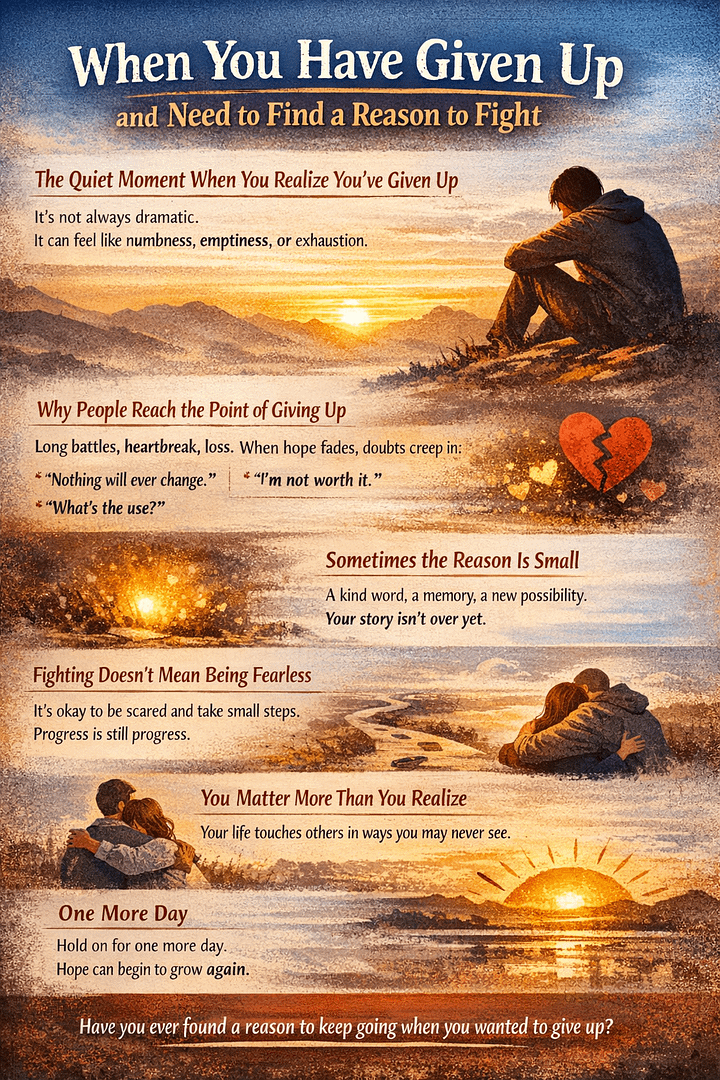
    When You Have Given Up and Need to Find a Reason to Fight

    There are moments in life when the weight of everything becomes too much to carry. The disappointments pile up. The silence becomes louder than conversation. The things you once hoped for begin to feel distant and unreachable. Slowly, almost without noticing, you stop believing things will get better.

    Giving up rarely happens all at once. It is not always a dramatic breaking point or a loud declaration that you are done. More often, it arrives quietly. It slips into your life through exhaustion, disappointment, and the quiet realization that you are tired of trying.

    You still wake up. You still go through the motions. But inside, something feels different. The motivation that once pushed you forward is gone. The hope that once carried you through difficult times has faded. And somewhere deep down, you begin to wonder if fighting for anything anymore is even worth it.

    Many people experience this moment at some point in their lives. It is a place where the heart feels heavy, the mind feels tired, and the future feels uncertain.

    But even in that place, a reason to fight can still exist.

    The Quiet Moment When You Realize You’ve Given Up

    The moment you realize you’ve given up often doesn’t come with anger or tears. Instead, it comes with numbness. A strange emotional quiet where you no longer feel the same urgency to fix things or chase what you once cared about.

    You may find yourself withdrawing from people. Conversations feel exhausting. Dreams that once excited you now feel pointless or unrealistic. Even things that used to bring you joy might no longer hold the same meaning.

    It can feel like you’ve run out of emotional energy.

    And sometimes, people around you may not even notice. From the outside, you might still appear strong, capable, or calm. But inside, the fight that once lived in you feels like it has disappeared.

    This is one of the hardest emotional places a person can reach because it feels like standing in the middle of an empty road with no clear direction forward.

    Why People Reach the Point of Giving Up

    No one gives up easily. People reach this point because they have been fighting for a long time.

    They have tried to hold relationships together that kept falling apart. They have chased dreams that seemed to slip further away no matter how hard they worked. They have endured heartbreak, loneliness, rejection, or loss that slowly chipped away at their strength.

    Sometimes the pain comes from loving someone who doesn’t feel the same. Sometimes it comes from feeling invisible in a world full of people. Sometimes it comes from losing someone who meant everything.

    Life has a way of testing people again and again until they begin to question whether the fight is worth continuing.

    When disappointment repeats itself enough times, the mind begins to protect itself by lowering expectations. It becomes easier to expect nothing than to hope and feel hurt again.

    And so, giving up can begin to feel like a form of emotional self-defense.

    The Dangerous Lies That Appear When Hope Fades

    When a person begins to lose hope, their mind can become their harshest critic. Negative thoughts begin to echo louder than any encouraging words from others.

    You might start hearing thoughts like:

    “Nothing is ever going to change.”
    “No one really cares.”
    “I’m not worth fighting for.”
    “I’ve already tried everything.”

    These thoughts can feel incredibly convincing because they are built on real experiences and real pain. But they are not the full truth.

    The mind has a way of focusing on what has gone wrong while ignoring the possibilities that still exist ahead.

    Just because things have been painful up to this point does not mean the rest of your story will follow the same path.

    Sometimes the Reason to Fight Is Small

    When people talk about finding a reason to keep going, it can sound like they expect some powerful moment of inspiration. But in reality, the reasons that bring people back from the edge are often surprisingly small.

    It might be a conversation with someone who listens without judgment.
    It might be a memory that reminds you of who you once were.
    It might be a simple realization that there are still things in life you haven’t experienced yet.

    Sometimes the reason to fight again is simply curiosity about what the future might hold.

    Life is unpredictable. The people we meet, the opportunities that appear, and the moments that change our perspective often arrive when we least expect them.

    The life you imagine today may not be the life you will live tomorrow.

    Your Story Is Still Being Written

    One of the most powerful truths about life is that it is never finished while you are still here. Every day adds another page to your story.

    Right now, your story may feel heavy with struggle, disappointment, or grief. But stories are not defined by a single chapter.

    There are chapters that bring loss and heartbreak. But there are also chapters that bring healing, connection, growth, and unexpected joy.

    Many people who once believed their lives would never improve eventually found themselves in places they could not have imagined before. They met people who helped them heal. They discovered passions they never knew they had. They found purpose in helping others through struggles similar to their own.

    None of those things seemed possible during their darkest moments.

    But those moments were not the end of their story.

    Fighting Doesn’t Mean Being Fearless

    When people imagine someone who keeps fighting, they often picture a person who is fearless, confident, and strong all the time.

    But the reality is very different.

    Fighting often looks like vulnerability. It looks like admitting you’re struggling. It looks like reaching out to someone when you feel alone. It looks like continuing to move forward even when your confidence is shaken.

    Strength is not the absence of fear, sadness, or exhaustion.

    Strength is continuing despite those feelings.

    Sometimes fighting means taking small steps instead of giant leaps. Sometimes it means resting and gathering your strength before trying again.

    And sometimes it simply means surviving another difficult day.

    The Power of One More Day

    When everything feels overwhelming, thinking about the future can feel impossible. Planning the rest of your life or trying to solve every problem at once can make the situation feel even heavier.

    Instead, focus on something much simpler.

    One more day.

    Just make it through today. Tomorrow can take care of itself when it arrives.

    Many people who have faced deep despair later say that the reason they made it through was because they focused on small moments rather than the entire journey ahead.

    One conversation.
    One step forward.
    One more sunrise.

    Over time, those small moments begin to build into something larger.

    You Matter More Than You Realize

    When someone feels defeated by life, they often begin to believe they do not matter. They feel invisible or unimportant, as if their presence makes little difference in the world.

    But the truth is that every life creates ripples.

    The kindness you show someone on a difficult day can stay with them longer than you know. The support you give a friend or family member may be something they carry with them for years. Even the simple act of being present in someone’s life can mean more than you realize.

    There are people who would feel your absence deeply, even if they struggle to express it.

    And beyond that, there are people you haven’t met yet who may one day benefit from your experiences, your empathy, and your understanding.

    Your story, including your struggles, may one day help someone else survive their own.

    Finding Your Way Back to the Fight

    Returning to the fight does not happen overnight. It often begins slowly.

    It might start with acknowledging your pain instead of hiding it. It might involve talking to someone you trust or seeking support when you need it. It may mean rediscovering small things that once brought you comfort or peace.

    There will still be difficult days. Moments of doubt may return. That is part of the human experience.

    But each time you choose to keep going, you strengthen the part of yourself that refuses to stay defeated.

    And over time, that part can grow stronger than the voice that once told you to give up.

    Standing Back Up

    The people who inspire others the most are not those who never struggle. They are the ones who have faced the darkest moments and still found a way to rise again.

    Standing back up after giving up does not erase the pain you have been through. But it proves something powerful about the human spirit.

    It proves that even when hope feels lost, it can still be rediscovered.

    And sometimes the greatest victories in life are not loud or dramatic.

    Sometimes the greatest victory is simply deciding that your story is not over yet.

    Read More Health & Wellness

  • National Dream Day: Celebrating the Power of Dreams

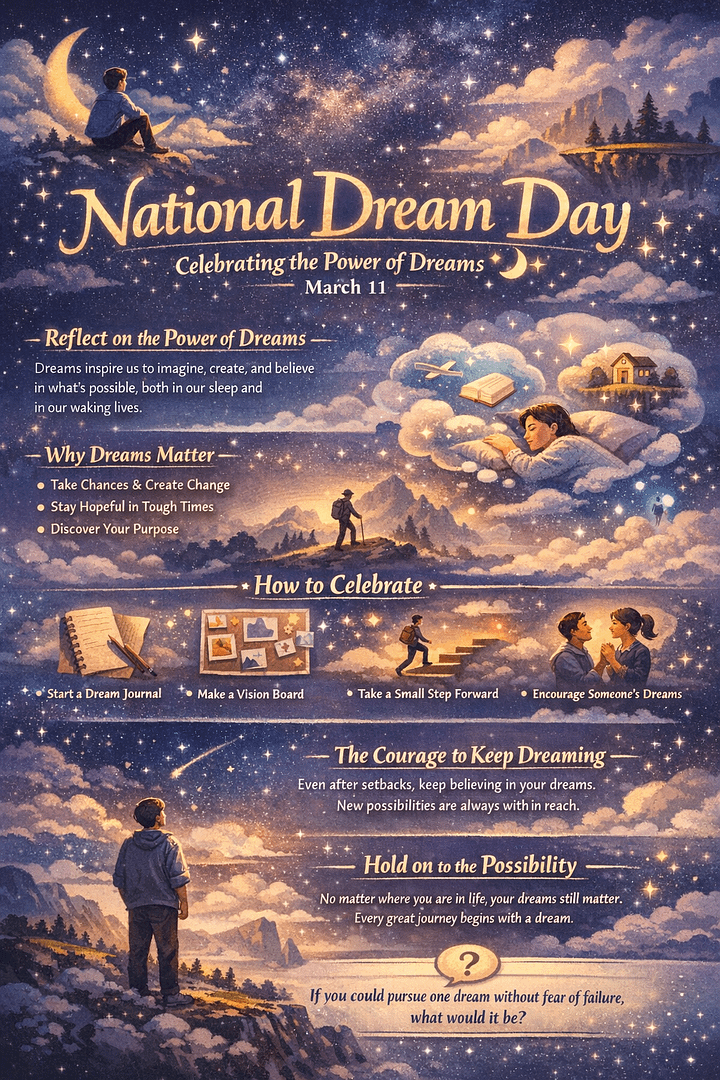
    National Dream Day: Celebrating the Power of Dreams

    Every year on March 11, National Dream Day invites people to reflect on one of the most powerful forces in human life: the ability to dream. Whether those dreams occur in the quiet mystery of sleep or live deep within our hearts as hopes for the future, they shape the way we see the world and our place in it.

    Dreams are where imagination lives. They are where ideas are born, where possibilities first take form, and where the human spirit dares to envision something greater than the present moment. National Dream Day reminds us that dreaming is not a waste of time or an escape from reality—it is often the beginning of transformation.

    Throughout history, dreams have inspired art, innovation, exploration, and personal change. Every invention, every creative masterpiece, and every meaningful life journey started as a thought, a vision, or a dream that someone chose to believe in.

    This day encourages us to reconnect with those visions and remember that dreams—no matter how big or small—have the power to shape our lives.

    The Two Worlds of Dreams

    When most people think about dreams, they imagine the experiences that happen while we sleep. During sleep, our minds create vivid stories, emotions, and images that can feel incredibly real. Some dreams are joyful and inspiring, while others may be confusing or even unsettling.

    Scientists believe dreams play an important role in processing memories, emotions, and experiences. Our brains continue working while we sleep, organizing information and helping us understand the events of our lives. In many ways, dreams help our minds make sense of the world.

    But dreams also exist in another form: the aspirations and goals we carry with us during our waking lives.

    These dreams might include:

    Building a meaningful career

    Creating art or expressing creativity

    Finding love and connection

    Helping others or making a difference

    Achieving personal growth or healing

    These waking dreams often guide our choices and give us a sense of direction. They push us to grow, to take risks, and to believe that the future can hold something beautiful.

    Why Dreams Matter So Much

    Dreams matter because they remind us that life is not limited to what we see in the present moment. They allow us to imagine what could be, rather than simply accepting what already exists.

    Dreams inspire people to:

    Take chances.
    Pursuing a dream often means stepping into the unknown. It requires courage, persistence, and a willingness to fail along the way.

    Create change.
    Many important movements and innovations began with people who dared to dream of a better world.

    Stay hopeful during difficult times.
    Dreams can act as a light during darkness. When life becomes overwhelming, dreams remind us that the future still holds possibility.

    Discover purpose.
    Our dreams often reflect what matters most to us. They can reveal our passions, our values, and the kind of life we truly want to live.

    Without dreams, life can begin to feel routine or stagnant. With dreams, even ordinary days can feel like steps toward something meaningful.

    The Courage to Keep Dreaming

    Dreaming can be easy when life is going well. The real challenge is continuing to dream when life becomes difficult.

    Many people experience moments when their dreams feel distant or impossible. Rejection, failure, heartbreak, and loss can make it tempting to give up on the visions we once held so tightly.

    But one of the most remarkable qualities of the human spirit is resilience. Even after disappointment, people continue to imagine better days ahead.

    Dreams evolve as we grow. The dreams we hold as children may change over time, shaped by experience and understanding. But the ability to dream itself never disappears.

    National Dream Day reminds us that it is never too late to rediscover a dream or create a new one.

    How to Celebrate National Dream Day

    Celebrating National Dream Day does not require a grand event or elaborate plans. Often, the most meaningful way to observe the day is through reflection and inspiration.

    Here are a few ways to honor the spirit of dreaming:

    Take time for reflection.
    Pause and think about the dreams you once had. Are there dreams you still carry today? Are there new dreams waiting to be discovered?

    Start a dream journal.
    Writing down your dreams—both the ones you experience while sleeping and the ones you hope to achieve—can help clarify your thoughts and goals.

    Create a vision board.
    Gather images, quotes, and ideas that represent the future you want to build. Seeing those dreams visually can make them feel more real and attainable.

    Encourage someone else.
    Sometimes the most powerful thing we can do is believe in another person’s dream. A simple message of support can make a huge difference.

    Take one small step forward.
    Dreams often feel overwhelming because they seem so far away. But progress usually begins with a single step—a decision, a plan, or a new opportunity.

    Dreams That Shape the Future

    Dreams are not always about fame, wealth, or recognition. For many people, the most meaningful dreams are deeply personal.

    Some dream of healing after loss.
    Some dream of building a family.
    Some dream of making art, helping others, or simply finding peace.

    These dreams may not always appear in headlines or history books, but they are no less important. They shape individual lives and ripple outward into families, communities, and the world.

    Every act of kindness, every moment of courage, and every step toward a better life begins with the belief that something more is possible.

    That belief begins with a dream.

    Holding On to the Possibility

    National Dream Day is a reminder that dreams are not reserved for the young or the fortunate. They belong to everyone.

    They belong to the person rebuilding their life after hardship.
    They belong to the artist waiting for inspiration.
    They belong to the individual searching for connection and purpose.

    Dreams remind us that the story of our lives is still being written. No matter where we are today, tomorrow still holds room for hope, growth, and possibility.

    Because in the end, every meaningful journey begins the same way.

    With someone daring to dream.

    Read More Holidays & National Days

  • 8 Powerful Sayings for the Day: Simple Reminders That Can Shape Your Life

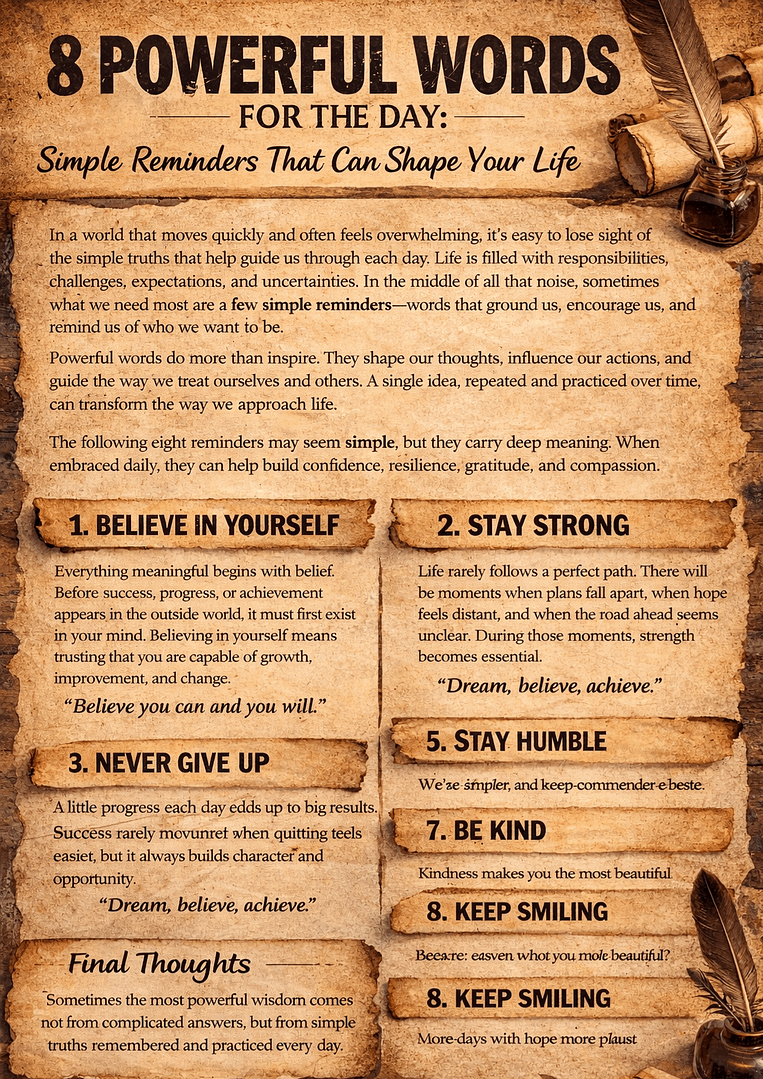
    8 Powerful Sayings for the Day: Simple Reminders That Can Shape Your Life

    In a world that moves quickly and often feels overwhelming, it’s easy to lose sight of the simple truths that help guide us through each day. Life is filled with responsibilities, challenges, expectations, and uncertainties. In the middle of all that noise, sometimes what we need most are a few simple reminders—words that ground us, encourage us, and remind us of who we want to be.

    Powerful words do more than inspire. They shape our thoughts, influence our actions, and guide the way we treat ourselves and others. A single idea, repeated and practiced over time, can transform the way we approach life.

    The following eight reminders may seem simple, but they carry deep meaning. When embraced daily, they can help build confidence, resilience, gratitude, and compassion.

    1. Believe in Yourself

    “Believe you can and you will.”

    Everything meaningful begins with belief. Before success, progress, or achievement appears in the outside world, it must first exist in your mind. Believing in yourself means trusting that you are capable of growth, improvement, and change.

    Many people struggle with self-doubt. They question whether they are good enough, talented enough, or deserving of success. These doubts can quietly hold people back from pursuing dreams, trying new things, or speaking up for what they want.

    But belief is powerful. When you believe in your potential, you begin to take action. You try again after failure. You push forward when things feel uncertain. Confidence does not come from always succeeding—it grows from trusting that you can learn and adapt along the way.

    Believing in yourself is not arrogance. It is the quiet understanding that your life has value and that your efforts matter.

    2. Stay Strong

    “Dream, believe, achieve.”

    Life rarely follows a perfect path. There will be moments when plans fall apart, when hope feels distant, and when the road ahead seems unclear. During those moments, strength becomes essential.

    Strength does not mean pretending everything is easy. It means facing challenges with courage and refusing to let difficulties define your future.

    Sometimes strength looks like continuing to work toward a dream even when progress feels slow. Other times, it means standing up for yourself or choosing to keep hope alive despite disappointment.

    Strength is often quiet. It shows up in the small decisions we make each day—to keep trying, to keep believing, and to keep moving forward even when the outcome is uncertain.

    Every dream requires strength to survive the obstacles that appear along the way.

    3. Never Give Up

    “A little progress each day adds up to big results.”

    One of the greatest misconceptions about success is that it happens quickly. In reality, most accomplishments are the result of consistent effort over time.

    Progress is rarely dramatic. Often it happens in small steps—learning one lesson, making one improvement, or overcoming one obstacle at a time. These small moments of persistence may not seem significant in the moment, but together they create powerful change.

    There will be times when quitting feels easier. The journey toward a goal can be long and frustrating, and setbacks can make progress feel impossible.

    But perseverance separates those who reach their goals from those who abandon them too soon.

    Every day you choose not to give up, you move one step closer to the life you’re building.

    4. Be Grateful

    “A grateful heart is a magnet for miracles.”

    Gratitude has the ability to change how we see the world. When life becomes difficult, it is easy to focus only on what is missing or what has gone wrong. Yet even during challenging times, there are often small blessings that deserve recognition.

    Gratitude encourages us to pause and appreciate the moments we might otherwise overlook—a supportive friend, a beautiful sunrise, a lesson learned from hardship.

    When we practice gratitude, our perspective shifts. Instead of living in constant comparison or dissatisfaction, we begin to recognize the richness already present in our lives.

    Gratitude does not eliminate problems, but it brings balance and clarity. It reminds us that life is not defined solely by what we lack, but also by the many things we are fortunate to experience.

    A grateful heart opens the door to joy, connection, and hope.

    5. Work Hard

    “Good things come to those who hustle.”

    Dreams are powerful, but they require effort to become reality. Hard work is the foundation that turns ideas into achievements.

    Success rarely happens by accident. It is built through dedication, discipline, and persistence. It requires showing up even on days when motivation is low and progress feels slow.

    Working hard also means being willing to learn. Mistakes and failures are not signs of weakness—they are opportunities to grow stronger and wiser.

    Effort shapes character. The commitment to work toward something meaningful develops resilience, patience, and determination.

    The rewards of hard work often extend far beyond the goal itself. They build confidence and prove that your determination can carry you through challenges.

    6. Stay Humble

    “Work hard in silence, let success make the noise.”

    Humility keeps us grounded as we grow and succeed. It reminds us that no accomplishment happens entirely alone. Behind every success are lessons learned, people who offered support, and opportunities that helped shape the journey.

    Staying humble allows us to continue learning. It keeps us open to feedback and new ideas, helping us improve rather than becoming stagnant.

    True confidence does not require constant recognition or validation. The most meaningful achievements often speak for themselves.

    Humility also strengthens relationships. When we remain respectful and appreciative of others, we build trust and connection.

    In a world that often celebrates attention and recognition, humility reminds us that character matters more than applause.

    7. Be Kind

    “Kindness makes you the most beautiful.”

    Kindness is one of the most powerful qualities a person can possess. It costs nothing, yet its impact can be profound.

    Many people carry struggles that are invisible to others. A kind word, a thoughtful gesture, or a moment of understanding can make a significant difference in someone’s life.

    Kindness creates ripple effects. When people feel valued and supported, they are more likely to extend that same compassion to others.

    The beauty of kindness lies in its simplicity. It can appear in small acts—listening carefully, offering encouragement, or showing patience during difficult moments.

    In a world that can sometimes feel harsh or divided, kindness has the power to bring people together.

    8. Keep Smiling

    “Because of your smile, you make life more beautiful.”

    A smile may seem like a small gesture, but it carries remarkable power. It can lift someone’s mood, ease tension in difficult moments, and create a sense of warmth and connection.

    Smiling does not mean life is perfect or free from hardship. Instead, it represents the choice to focus on hope and positivity even during challenging times.

    Sometimes the simple act of smiling can change your own outlook. It reminds you that joy can exist alongside struggle.

    Your smile might brighten someone’s day in ways you never realize. In that sense, a smile becomes a quiet gift shared with the world.

    Final Thoughts

    The eight reminders—Believe in Yourself, Stay Strong, Never Give Up, Be Grateful, Work Hard, Stay Humble, Be Kind, and Keep Smiling—are more than motivational phrases. They are guiding principles for living a meaningful life.

    When practiced daily, these words influence how we see ourselves, how we treat others, and how we approach the challenges we face.

    Life will always contain uncertainty and difficulty, but these simple ideas offer a compass to guide us through both the good days and the hard ones.

    Small choices made each day eventually shape the direction of our lives. By embracing these eight powerful reminders, we take steps toward becoming stronger, kinder, and more hopeful versions of ourselves.

    Sometimes the most powerful wisdom comes not from complicated answers, but from simple truths remembered and practiced every day.

    Read More Of Inspiration & Motivation

  • When the Calendar Remembers: Facing the Anniversary of a Loved One’s Death

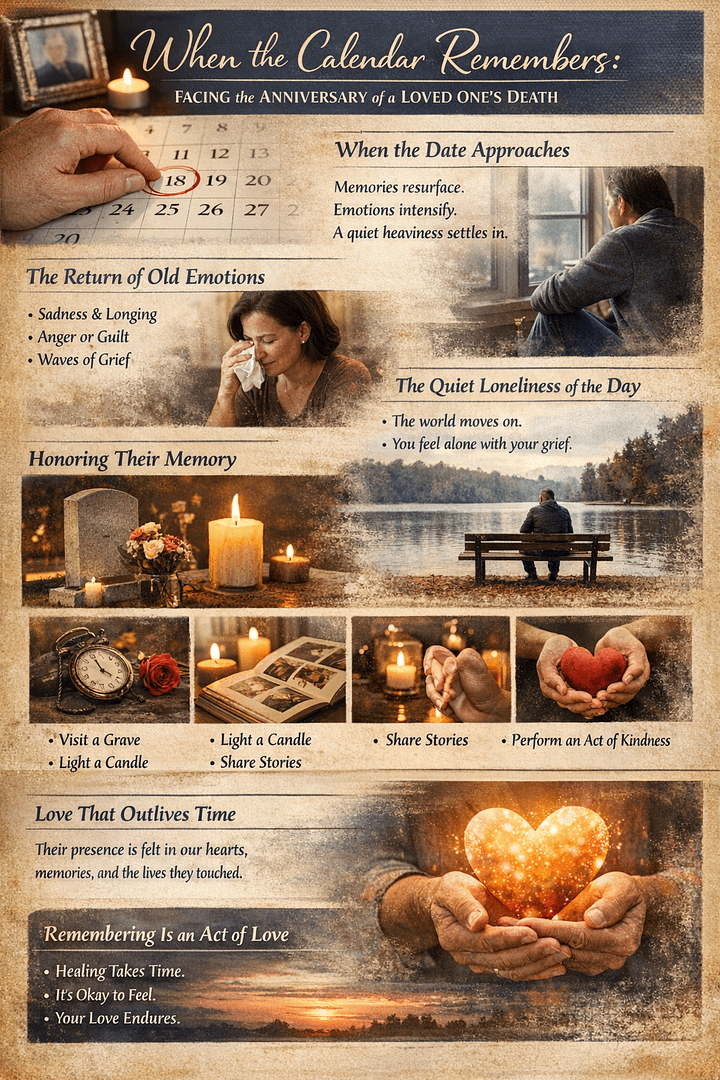
    When the Calendar Remembers: Facing the Anniversary of a Loved One’s Death

    There are dates on the calendar that most people barely notice—days that pass quietly and without meaning. But when you have lost someone you love, there is often one date that never fades into the background. It arrives each year carrying a quiet heaviness that can be felt long before the day itself appears.

    The anniversary of a loved one’s death is not just another day. It is a moment when memories return more vividly, emotions rise more easily, and the reality of loss feels closer than it might on ordinary days.

    For many people, it is one of the most difficult days of the year.

    When the Date Approaches

    Sometimes the anniversary begins affecting us even before we realize it. Days or weeks beforehand, you may notice subtle emotional shifts. You might feel more reflective, more sensitive, or unexpectedly sad. A sense of uneasiness can settle in without an obvious explanation.

    This is often called the “anniversary reaction.” Our minds and bodies remember the trauma of loss, even if we are not consciously thinking about the exact date.

    Memories may surface more frequently. You might find yourself replaying the final days you shared with your loved one, remembering conversations, moments, or details that once seemed small but now feel significant. The mind revisits those memories as if trying to understand them all over again.

    It can feel as though time briefly moves backward.

    The Return of Old Emotions

    Grief is not a straight path. It moves in waves, sometimes gentle and sometimes overwhelming. Even if years have passed since the loss, the anniversary can bring back emotions that feel surprisingly fresh.

    You may feel sadness, longing, anger, regret, or deep loneliness. Some people experience a renewed sense of disbelief, as if part of them still struggles to accept that their loved one is truly gone.

    Others feel a quiet emptiness.

    There can also be moments of guilt—guilt for moving forward with life, guilt for things left unsaid, or guilt for feeling happiness when the person they love is no longer here to share it.

    All of these feelings are normal. Grief is deeply personal, and no two people experience it in exactly the same way.

    The Memories That Surface

    On the anniversary of a loved one’s passing, memories often feel closer than usual. Simple things can trigger them—a familiar song, a photograph, a scent, or even a place you once visited together.

    You may remember the way they laughed, the way they spoke your name, or the small habits that made them uniquely themselves. Sometimes the memories bring smiles. Other times they bring tears.

    What can be surprising is how vivid those memories remain, even years later. It reminds us that the people we love leave permanent imprints on our hearts.

    They may no longer be physically present, but the connection we had with them continues to exist through memory.

    The Quiet Loneliness of the Day

    One of the hardest parts of anniversary days is that the world keeps moving forward while you feel pulled backward in time. For everyone else, it may seem like an ordinary day. But for you, it holds profound meaning.

    This can create a deep sense of isolation.

    Friends and coworkers may not realize what the day represents. Some people may want to acknowledge the loss but feel unsure of what to say. Others may simply not remember the date at all.

    Because of this, many people spend the anniversary quietly, carrying their memories privately.

    Yet it is important to remember that grief is shared by many, even when it feels lonely. Across the world, countless people mark similar days on their calendars—days that represent love, loss, and remembrance.

    Honoring Their Memory

    For some people, the anniversary becomes a day of remembrance rather than just sorrow. Many find comfort in honoring their loved one in ways that feel meaningful.

    Some visit a gravesite or memorial location. Others light a candle at home, say a prayer, or spend time looking through photographs and old letters. Some people listen to music their loved one enjoyed or cook a favorite meal that reminds them of shared moments.

    Others choose to honor the person by doing something kind—donating to a charity, helping someone in need, or simply performing an act of kindness in their memory.

    These rituals do not erase the pain, but they can transform the day into something more than grief alone. They become a way to acknowledge the love that still remains.

    When the Pain Still Feels Fresh

    People sometimes believe that grief should fade completely with time. In reality, the loss of someone deeply loved can stay with us for a lifetime.

    Even decades later, the anniversary may still stir powerful emotions.

    That does not mean you have failed to heal. It simply means the love you had for that person was real and meaningful.

    Healing does not mean forgetting. It means learning to carry the memories forward in a way that allows life to continue.

    Love That Outlives Time

    The anniversary of a loved one’s death reminds us of something both painful and beautiful: love does not end when life does.

    The bond you shared with that person continues through the memories you hold, the stories you tell, and the ways they shaped who you are. Their influence becomes woven into your life, quietly guiding your thoughts and actions.

    Even though they are no longer here physically, their presence remains in countless small ways—in the lessons they taught you, the laughter you shared, and the love that still lives in your heart.

    Moving Through the Day

    There is no right or wrong way to experience an anniversary of loss. Some people prefer to spend the day quietly reflecting. Others surround themselves with family or friends. Some choose to stay busy, while others allow themselves space to grieve openly.

    Whatever approach you take is valid.

    What matters most is allowing yourself to feel what you feel without judgment. Grief is not something that can be rushed or controlled. It unfolds at its own pace.

    Remembering Is an Act of Love

    When the anniversary arrives and the memories return, it may bring tears, reflection, or moments of quiet sadness. But those feelings also represent something deeply meaningful.

    They are reminders of the love that once existed and continues to exist.

    The calendar may mark the day someone left this world, but it also marks the enduring connection that remains.

    And in that way, remembering becomes more than grief—it becomes another expression of love that time can never erase.

    A Father’s Guide to Surviving the Loss of a Child

  • National Day of Awesomeness

    National Day of Awesomeness

    Every year on March 10, people across the world take a moment to celebrate something that often goes unnoticed in everyday life—the awesomeness within themselves and others. The National Day of Awesomeness is a lighthearted yet meaningful reminder that greatness is not reserved only for famous figures or extraordinary achievements. Instead, it exists in the everyday actions, talents, and kindness that make each person unique.

    In a world where it is often easier to focus on flaws or shortcomings, this day flips the perspective. It encourages people to recognize their own value, celebrate the people around them, and embrace the positive energy that comes from confidence, gratitude, and encouragement.

    National Day of Awesomeness is not about arrogance or bragging—it is about acknowledging that every person carries something remarkable within them.

    The Origins of National Day of Awesomeness

    The National Day of Awesomeness was created in 2007 by Kevin Lawver and friends while working at AOL. The group wanted to create a day that celebrated people simply for being themselves. Rather than honoring a specific historical event or tradition, they wanted to encourage confidence, positivity, and the recognition that everyone has something special to offer.

    They chose March 10 as the official date because it falls the day after March 9, which celebrates Mario Day (a nod to the iconic video game character). The creators jokingly referred to March 10 as the day when everyone else could celebrate their own awesomeness.

    What began as a playful idea among coworkers quickly spread across the internet and social media. Over time, more people began sharing messages of encouragement, appreciation, and positivity on this day, helping it grow into a widely recognized celebration of self-worth and community spirit.

    The Meaning Behind the Celebration

    At its core, the National Day of Awesomeness is about recognizing the strengths and qualities that make people special. Too often, individuals underestimate their own value or overlook the positive impact they have on others.

    Awesomeness does not mean being perfect. In fact, the true spirit of awesomeness often appears in small, everyday moments such as:

    Helping someone through a difficult time

    Making others laugh when they need it most

    Standing up for what is right

    Showing kindness to strangers

    Continuing to move forward despite setbacks

    These acts may seem ordinary, but they are powerful reminders that each person contributes something meaningful to the world.

    Why a Day Like This Matters

    While the National Day of Awesomeness may sound playful, the message behind it carries real importance. Many people struggle with self-doubt, loneliness, or feelings of not being good enough. A day dedicated to recognizing personal strengths and uplifting others can have a lasting emotional impact.

    Celebrating awesomeness encourages people to:

    Build confidence by acknowledging their abilities

    Practice gratitude for the people in their lives

    Encourage others through simple words of support

    Recognize small victories that often go unnoticed

    Create a culture of positivity within communities

    When people celebrate the good in themselves and others, it creates a ripple effect that spreads encouragement far beyond a single day.

    Ways to Celebrate National Day of Awesomeness

    There is no official rulebook for celebrating the National Day of Awesomeness. The entire point is to embrace positivity and recognize the unique qualities that make people remarkable.

    Here are a few ways people often celebrate the day:

    Celebrate Your Achievements

    Take a moment to reflect on things you are proud of—whether they are major accomplishments or small personal victories. Recognizing your progress can strengthen confidence and motivation.

    Compliment Someone

    Tell a friend, coworker, or family member why you appreciate them. A genuine compliment or thank-you can brighten someone’s entire day.

    Do Something Bold

    Try something new or take a step toward a goal you have been putting off. Awesomeness often grows when people challenge themselves.

    Share Positivity

    Spread encouraging messages online or in person. Social media has become a popular place for people to share uplifting posts and celebrate others on this day.

    Practice Kindness

    Simple acts of kindness—helping someone, offering support, or listening to a friend—are powerful examples of everyday awesomeness.

    The Everyday Heroes Around Us

    One of the most meaningful aspects of the National Day of Awesomeness is that it highlights the people who rarely receive recognition. Not every hero appears on television or in the news. Many are the quiet individuals who make a difference in the lives of those around them.

    They are the parents who sacrifice for their children, the friends who offer support during difficult times, and the strangers who choose kindness when they could easily walk away.

    These everyday heroes remind us that awesomeness is not about fame—it is about impact.

    A Reminder That Awesomeness Is Within Everyone

    The beauty of the National Day of Awesomeness lies in its simplicity. It does not require grand celebrations or elaborate traditions. All it asks is that people take a moment to recognize the value within themselves and the goodness in others.

    Everyone has experienced moments of doubt or feelings of being overlooked. This day serves as a reminder that those feelings do not define a person’s worth.

    Awesomeness is found in courage, compassion, resilience, creativity, and authenticity. It appears in the quiet strength of people who continue to move forward, even when life becomes difficult.

    In truth, awesomeness is not something that needs to be earned—it already exists within each of us.

    All we have to do is recognize it.

    Read More Holidays & National Days