Author: Brett Murphy

  • Fun Facts About Names Day: Celebrating the Stories Behind What We’re Called

    Fun Facts About Names Day: Celebrating the Stories Behind What We’re Called

    Every name carries a story — a quiet beginning to a lifetime of identity, relationships, and personal meaning. Fun Facts About Names Day is more than just a quirky observance; it’s a celebration of language, culture, history, and individuality. Names connect generations, reflect traditions, and often reveal more about us than we realize.

    From ancient naming rituals to modern creative spellings, this day encourages people to pause and appreciate one of the most personal parts of human identity: the name.

    The History and Purpose Behind Names

    Long before written records, names helped humans establish belonging and recognition within communities. Early societies used names to describe:

    Physical traits

    Personality characteristics

    Occupations

    Geographic origins

    Family lineage

    For example, surnames like Smith, Baker, or Taylor originated from professions, while names such as Hill or Brooks reflected landscapes.

    In many cultures, naming ceremonies were sacred events believed to influence a child’s destiny or spiritual protection. Even today, some families wait days or weeks before naming a newborn, emphasizing how meaningful the decision can be.

    Names as Cultural Time Capsules

    Names preserve culture across centuries. They often survive wars, migrations, and societal change, acting as living history.

    Irish names reflect Gaelic heritage and storytelling traditions.

    African names frequently represent circumstances of birth or hopes for the child’s future.

    Japanese names may combine characters symbolizing virtues like strength, beauty, or harmony.

    Indigenous names often connect individuals to nature or ancestral spirits.

    When someone shares their name, they may also be sharing pieces of cultural heritage that stretch far beyond their lifetime.

    Fascinating Fun Facts About Names
    1. Your Name Activates Your Brain Differently

    Studies show that hearing your own name triggers unique brain activity. Even in a noisy environment, people instantly recognize their name — a phenomenon sometimes called the “cocktail party effect.”

    2. The World Has Millions of Unique Names

    While some names are extremely common worldwide, countless rare names exist that may belong to only a handful of people — or even a single individual.

    The internet age has made originality easier, allowing parents to invent entirely new names or combine existing ones.

    3. Nicknames Strengthen Social Bonds

    Nicknames often signal closeness and trust. Psychologists suggest that giving or receiving a nickname can strengthen emotional connections because it represents shared experiences.

    4. Names Travel Across Borders

    Globalization has allowed names to move freely between cultures. A name once tied to one region can now be found worldwide, reflecting how interconnected humanity has become.

    5. Some People Change Their Names to Mark New Chapters

    Name changes often symbolize transformation — marriage, personal growth, gender identity, spiritual awakening, or simply reclaiming individuality. A new name can represent a fresh beginning.

    The Psychology of Names

    Names influence perception more than most people realize. Research suggests that people may unconsciously associate certain traits with specific names based on familiarity, media exposure, or cultural expectations.

    This doesn’t define who someone is, but it highlights how deeply names are embedded in social interaction.

    Interestingly, many people report feeling more confident when addressed by name during conversations. It creates recognition and respect — a small gesture with powerful emotional impact.

    Naming Trends Through the Decades

    Every generation leaves its mark on naming culture.

    Early 1900s: Classic and biblical names dominated.

    1950s–70s: Traditional yet modern-sounding names gained popularity.

    1990s–2000s: Unique spellings and celebrity-inspired names surged.

    Today: Parents often seek balance — meaningful, distinctive, and globally adaptable names.

    Social media, entertainment, and global culture now influence naming trends faster than ever before.

    Fun Ways to Celebrate Fun Facts About Names Day

    Make the celebration interactive and personal:

    🔎 Discover Your Name’s Story

    Search the origin, language, and historical meaning of your name. You may uncover unexpected symbolism.

    👨‍👩‍👧 Talk With Family

    Ask parents or relatives why your name was chosen. Many people discover heartfelt stories they never knew existed.

    ✍️ Get Creative

    Write your name using:

    Calligraphy

    Digital art

    Different alphabets

    Poetry or storytelling

    🌍 Explore Global Variations

    Learn how your name is spoken or translated in other languages.

    💬 Share Name Compliments

    Tell someone why you like their name or what it reminds you of. Small conversations can create meaningful connections.

    The Emotional Power Behind a Name

    Names are deeply tied to memory. Hearing your name spoken by a loved one, written in a letter, or remembered after years apart carries emotional weight.

    A name can remind us of:

    Childhood moments

    Relationships that shaped us

    Achievements and milestones

    Personal transformation

    For some, reclaiming or redefining their name becomes an act of empowerment — a declaration of identity and self-acceptance.

    Names in the Digital Age

    Today, names extend beyond introductions into usernames, online identities, and personal brands. Choosing how we present our names online has become part of storytelling itself.

    Handles, screen names, and creator identities show how names continue evolving alongside technology. Yet despite digital change, the emotional significance remains the same: names help us be seen and remembered.

    A Celebration of Identity and Connection

    Fun Facts About Names Day reminds us that names are more than labels — they are bridges between past and present, individuality and community. Every name carries intention, history, and meaning, even when we don’t realize it.

    Taking time to explore names encourages empathy. When we learn the story behind someone’s name, we often learn something about their journey as well.

    So today, celebrate the simple magic of names. Say them carefully. Learn their stories. Share their meanings. Because behind every name is a life unfolding — unique, meaningful, and worthy of recognition.

    Read More Holidays & National Days
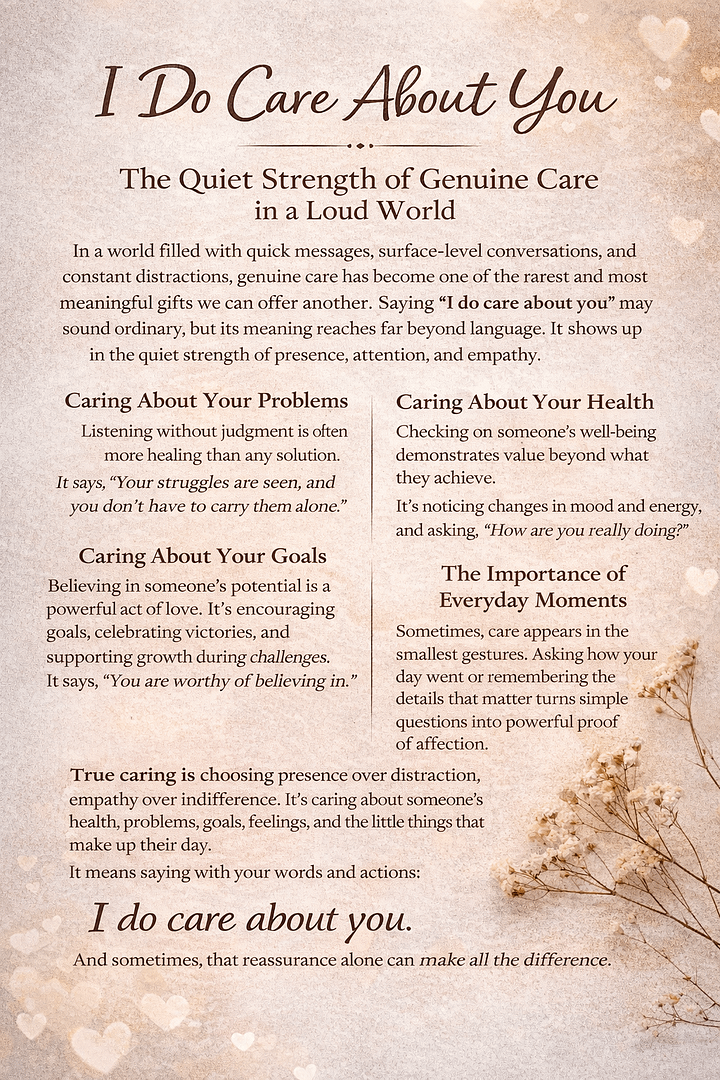
  • I Do Care About You: The Quiet Strength of Genuine Care in a Loud World

    I Do Care About You: The Quiet Strength of Genuine Care in a Loud World

    In a world that moves faster every day, genuine care has become one of the most powerful — and sometimes overlooked — forms of human connection. We live surrounded by notifications, quick replies, and conversations that often skim the surface of who we truly are. Yet beneath all the noise, people are longing for something simple and deeply human: to feel seen, valued, and understood.

    The words “I do care about you” may sound ordinary, but their meaning reaches far beyond language. They represent attention, emotional presence, and a willingness to stand beside someone not only during joyful moments but also through uncertainty, struggle, and vulnerability.

    Real care is not proven by grand declarations. It is revealed through consistency — through small, repeated acts that quietly say, you matter to me.

    Caring About Someone’s Problems

    Everyone carries invisible battles. Some struggles are spoken openly, while others remain hidden behind smiles and routine conversations. When you genuinely care about someone’s problems, you offer more than advice — you offer understanding.

    Caring does not always mean solving issues. Often, the most meaningful support comes from simply listening without judgment. Sitting with someone in their discomfort sends a powerful message: Your pain is not inconvenient to me.

    In a culture that often encourages people to “fix” emotions quickly, patience becomes an act of love. Allowing someone space to feel heard can be more healing than any solution.

    Caring About Health — Seen and Unseen

    True care recognizes that well-being goes beyond physical health. Emotional exhaustion, anxiety, and silent stress can weigh just as heavily as physical illness. When someone checks on your health, they are acknowledging that your life matters beyond productivity or appearances.

    It may look like reminding someone to rest, encouraging healthier choices, or noticing when their energy changes. Sometimes it is asking the simplest yet most meaningful question: “How are you really doing?”

    These moments remind us that care is rooted in awareness — paying attention to what others may not openly express.

    Supporting Goals and Dreams

    One of the deepest ways to care for someone is to believe in their potential. Caring about someone’s goals means investing emotionally in their future. It means celebrating victories, encouraging perseverance during setbacks, and reminding them of their strength when self-doubt appears.

    Support does not require complete understanding of another person’s dream. It only requires respect for what matters to them.

    When someone stands behind your ambitions, they become part of your journey. Their belief can become the motivation that keeps you moving forward when confidence fades.

    The Meaning Behind Everyday Conversations

    Asking how someone’s day went may seem small, but it carries profound emotional significance. These daily check-ins create connection through routine. They communicate interest, reliability, and emotional availability.

    Relationships are rarely strengthened by extraordinary moments alone. Instead, they grow through ordinary interactions repeated over time — shared laughter, small updates, and consistent presence.

    Care lives in these everyday exchanges.

    Being Present Through Communication

    In modern relationships, communication has taken new forms through calls, texts, and messages. Responding, reaching out, and maintaining connection may appear simple, yet they signal priority.

    When someone makes time to communicate, they are offering attention — one of the most valuable resources we possess. Attention cannot be faked for long; it reflects genuine interest.

    Consistent communication reassures people that they are not forgotten, ignored, or alone in their experiences.

    Valuing Opinions and Feelings

    To care about someone is to respect their inner world — their thoughts, perspectives, and emotions. This requires empathy, humility, and openness.

    Listening does not mean agreeing with everything. It means acknowledging that another person’s feelings are valid and worthy of consideration.

    When people feel emotionally safe enough to share openly, trust deepens. And trust is the foundation upon which meaningful relationships are built.

    Understanding What Bothers Someone

    Care also involves awareness of emotional boundaries — knowing what hurts someone, what comforts them, and what brings them peace. This understanding develops over time through attention and compassion.

    It requires remembering details, recognizing patterns, and adjusting behavior out of respect rather than obligation.

    This kind of attentiveness communicates something powerful: I see you as an individual, not just a presence in my life.

    The Courage to Care

    Caring deeply requires vulnerability. It means risking disappointment, misunderstanding, or emotional pain. Many people hesitate to show care openly because it exposes their hearts.

    Yet choosing to care is an act of courage. It means deciding that connection is worth the risk.

    When we allow ourselves to care fully, we create spaces where authenticity can exist — spaces where people feel safe enough to be themselves without fear of rejection.

    Why Caring Matters More Than Ever

    Loneliness has become increasingly common despite constant digital connection. Many people communicate daily yet still feel emotionally unseen. Genuine care breaks through this isolation.

    It reminds us that relationships are not measured by frequency of interaction but by depth of understanding.

    A single person who truly cares can change how someone experiences the world. They can restore hope, rebuild confidence, and remind another human being of their worth.

    The Simple Truth

    At its heart, caring is not complicated. It is choosing presence over distraction, empathy over indifference, and patience over convenience.

    It is caring about someone’s problems, health, goals, feelings, and daily experiences. It is noticing what troubles them and celebrating what brings them joy.

    And ultimately, it is saying — through both words and actions:

    I do care about you.

    Because sometimes the most life-changing thing a person can hear is not advice or solutions, but the reassurance that they matter deeply to someone else.

    Read More Of Love & Relationships

  • When Will I Be Loved?

    When Will I Be Loved?

    There comes a quiet moment in many lives when the question finally rises to the surface — not loudly, not dramatically, but softly and persistently:

    “When will I be loved?”

    It is a question whispered during sleepless nights, asked after another failed connection, or felt while watching others experience the companionship we deeply desire. It is not simply about romance; it is about belonging, being chosen, and feeling seen in a world that can sometimes feel emotionally distant.

    This question lives inside people of every age, background, and story. And while it may feel lonely, it is one of the most human questions we can ask.

    The Silent Ache of Wanting to Be Chosen

    At its core, the longing to be loved is not about needing someone to complete us. It is about wanting to share life with someone who recognizes our worth without hesitation.

    Many people know the experience of giving love freely — supporting others, showing kindness, being emotionally present — while secretly wondering why that same energy has not returned to them in the way they hope.

    You may become the strong one.
    The listener.
    The dependable heart everyone leans on.

    Yet when the day ends, you sit with a quiet thought:

    Who chooses me?

    This ache is rarely visible to others. From the outside, you may appear confident, independent, or fulfilled. But internally, there is a space reserved for connection — a space that remains patiently open.

    The Misunderstanding of Timing

    We often believe love operates on fairness: good people should find love quickly, loyal hearts should be rewarded, and genuine intentions should naturally attract the right person.

    But love does not move according to fairness or logic.

    Timing in love is influenced by countless invisible factors:

    emotional maturity,

    personal healing,

    life circumstances,

    readiness to receive rather than just give.

    Sometimes two people meet too early — before growth has taken place. Sometimes love passes close by but cannot stay because one or both hearts are still learning lessons they cannot yet see.

    What feels like delay may actually be alignment happening slowly behind the scenes.

    The Fear That Grows While Waiting

    Waiting for love can slowly create dangerous beliefs:

    Maybe I’m too much.

    Maybe I’m not enough.

    Maybe love isn’t meant for me.

    These thoughts are understandable, but they are not truths — they are wounds speaking.

    The longer we wait, the easier it becomes to measure our worth by relationship status. Social media, movies, and cultural expectations amplify this pressure, presenting love as something everyone else has already figured out.

    But love is not a race with winners and losers. It is a deeply personal journey shaped by individual growth.

    Your timeline is not broken simply because it looks different.

    Learning the Difference Between Loneliness and Solitude

    One of the hidden gifts of waiting is discovering yourself outside of partnership.

    Loneliness says:
    I am incomplete alone.

    Solitude says:
    I am whole, but I still desire connection.

    This transformation is powerful. When you learn to enjoy your own company — your thoughts, passions, and peace — you stop seeking love out of desperation and begin seeking it from intention.

    Healthy love grows best in two complete lives choosing to walk together, not in two people trying to escape emptiness.

    Why Some Hearts Take Longer to Find Love

    People who feel deeply often take longer to find lasting love. Not because they are difficult to love, but because they are unwilling to settle for something shallow.

    They want:

    emotional safety,

    honesty,

    consistency,

    connection beyond surface attraction.

    And those qualities require emotional readiness from both people involved.

    Sometimes the delay exists because your heart recognizes what it deserves — even when your loneliness tries to convince you otherwise.

    Becoming Ready Without Realizing It

    While asking “When will I be loved?”, something important is happening quietly:

    You are evolving.

    Every disappointment teaches discernment.
    Every heartbreak strengthens boundaries.
    Every period alone builds self-awareness.

    You learn:

    how you want to be treated,

    what you will no longer tolerate,

    how to communicate your needs,

    and how to protect your peace.

    One day, you may look back and realize the waiting period was shaping you into someone capable of receiving a deeper, healthier kind of love.

    Love Often Arrives Differently Than Expected

    Many imagine love arriving dramatically — instant chemistry, overwhelming passion, undeniable certainty.

    But lasting love often feels different.

    It feels calm.
    Safe.
    Consistent.

    It may begin as friendship. It may grow slowly. It may not resemble the intense stories we were taught to expect.

    Real love frequently replaces anxiety with peace. Instead of wondering where you stand, you simply know.

    And sometimes that quiet certainty is what makes it real.

    The Moment the Question Changes

    There is a turning point that happens subtly.

    You stop asking, “When will I be loved?” and begin living fully regardless of the answer.

    You pursue passions.
    You build friendships.
    You invest in personal growth.

    And ironically, it is often during this stage — when love is no longer the center of your identity — that connection finds its way into your life.

    Not because you stopped wanting love, but because you stopped believing you were incomplete without it.

    A Gentle Truth to Hold Onto

    If you are still waiting for love, consider this:

    Your capacity to love is evidence that love belongs in your life. The desire itself is not random; it reflects something real within you.

    You are not late.
    You are not overlooked.
    You are not unworthy.

    You are simply living a chapter that has not yet reached its introduction to the person who will understand your heart.

    And when love finally arrives, it will not erase the waiting — it will make sense of it.

    Final Reflection

    “When will I be loved?” is ultimately a question about hope.

    It is proof that despite disappointment, your heart still believes in connection. And that belief is powerful. It means you have not allowed cynicism to replace your humanity.

    Love is not always immediate, but it is often meaningful precisely because it takes time to find.

    Until that day comes, remember:

    You are already becoming someone worth loving — including by yourself.

    Read More Of Love & Relationships

  • NATIONAL DADGUM THAT’S GOOD DAY – Celebrating the Joy of Truly Delicious Moments

    NATIONAL DADGUM THAT’S GOOD DAY – Celebrating the Joy of Truly Delicious Moments

    A Celebration of Flavor, Gratitude, and Life’s Most Satisfying Moments

    Every year, National Dadgum That’s Good Day invites people everywhere to celebrate one of life’s simplest yet most powerful pleasures — experiencing something so enjoyable, comforting, or delicious that it stops you in your tracks and earns an enthusiastic, heartfelt reaction.

    It’s not just about food. It’s about feeling. It’s about those moments when life surprises you with goodness so genuine that the only response is a smile, a laugh, and the classic phrase:

    “Dadgum… that’s good.”

    This unofficial holiday embraces joy without complication, reminding us that happiness often lives in ordinary moments we overlook every day.

    The Spirit Behind the Celebration

    The phrase “dadgum” has deep roots in Southern American culture, often used as a playful, polite expression of amazement or admiration. It carries warmth, personality, and authenticity — much like the meals and memories this day celebrates.

    Unlike holidays centered on tradition or obligation, National Dadgum That’s Good Day is built around appreciation. It encourages people to recognize excellence in everyday experiences — whether it’s a home-cooked meal, a perfectly timed joke, or a quiet evening that feels just right.

    At its core, the holiday asks one simple question:

    When was the last time you truly savored something?

    Why We Need This Day More Than Ever

    Modern life moves quickly. Meals are eaten while scrolling phones, conversations compete with notifications, and moments pass before we fully experience them. National Dadgum That’s Good Day acts as a gentle reset button.

    It reminds us to:

    Slow down and be present

    Appreciate craftsmanship and effort

    Celebrate comfort over perfection

    Recognize joy in small victories

    Reconnect through shared experiences

    Research consistently shows that mindful enjoyment — especially around food and social connection — improves mood, reduces stress, and strengthens relationships. This holiday naturally encourages those habits without pressure or rules.

    The Emotional Power of Food

    Food is more than nourishment; it’s storytelling. Every dish carries memories:

    Grandma’s kitchen filled with laughter

    Backyard barbecues on warm evenings

    Late-night snacks during deep conversations

    Holiday meals that bring generations together

    A single bite can transport us across time, reconnecting us with people and places that shaped who we are.

    That’s why the phrase “Dadgum that’s good” often comes with emotion. It isn’t just praise for flavor — it’s recognition of comfort, effort, and love.

    Ways to Fully Celebrate the Day
    🍳 Cook Something That Feels Like Home

    Choose a recipe tied to memory or meaning. Comfort food is the heart of this celebration because it feeds both body and soul.

    🍔 Support Local Restaurants

    Visit a neighborhood diner, food truck, or family-owned restaurant. Often, the most unforgettable meals come from passionate cooks working quietly behind the scenes.

    🧑‍🍳 Cook Together

    Invite friends or family into the kitchen. Cooking becomes less about the final dish and more about laughter, teamwork, and shared creation.

    📝 Start a “Dadgum List”

    Write down things that make life feel especially good — foods, places, songs, people, or routines. You may discover how many blessings already surround you.

    📱 Share the Moment

    Post a photo, story, or memory celebrating something that made your day better. Positivity spreads quickly when shared authentically.

    Beyond the Plate: Everyday “Dadgum” Moments

    Although food inspires the holiday, its message extends far beyond the kitchen.

    A “Dadgum That’s Good” moment could be:

    Hearing a song that perfectly matches your mood

    Watching a sunset after a long day

    Completing a personal goal

    Laughing uncontrollably with friends

    Receiving unexpected kindness

    Feeling proud of personal growth

    These moments remind us that joy isn’t rare — awareness is.

    The Social Connection Factor

    Humans are wired for connection, and shared enjoyment strengthens bonds faster than almost anything else. When people gather around a meal or shared experience, walls come down naturally.

    Conversation flows easier. Laughter feels louder. Memories form effortlessly.

    National Dadgum That’s Good Day encourages us to create intentional spaces for connection — even if it’s just sitting down together without distractions.

    In a world increasingly lived online, real shared moments become even more meaningful.

    Gratitude Hidden in Satisfaction

    One reason this holiday resonates so deeply is its connection to gratitude. Recognizing something as “that good” requires awareness and appreciation.

    Gratitude doesn’t always look like grand gestures. Sometimes it sounds like:

    “This meal is amazing.”

    “I needed this today.”

    “Life feels good right now.”

    Acknowledging enjoyment helps train the mind to notice positivity more often, creating a cycle of appreciation and emotional well-being.

    Creating Your Own Tradition

    Because the holiday is flexible and personal, many people choose to create their own traditions:

    Annual cook-offs with friends

    Trying a new cuisine every year

    Sharing family recipes across generations

    Writing down favorite moments from the year

    Hosting a gratitude dinner

    Over time, these traditions turn a simple celebration into lasting memories.

    Final Thoughts

    National Dadgum That’s Good Day isn’t about extravagance or perfection. It’s about recognizing goodness when it appears — on your plate, in your relationships, and in everyday life.

    It reminds us that joy often arrives quietly, wrapped in simple experiences we might otherwise rush past.

    So take a moment today to slow down. Taste fully. Laugh freely. Appreciate deeply.

    Because sometimes the best parts of life don’t need complicated words — just an honest reaction from the heart:

    “Dadgum… that’s good.”

    Read More Holidays & National Days

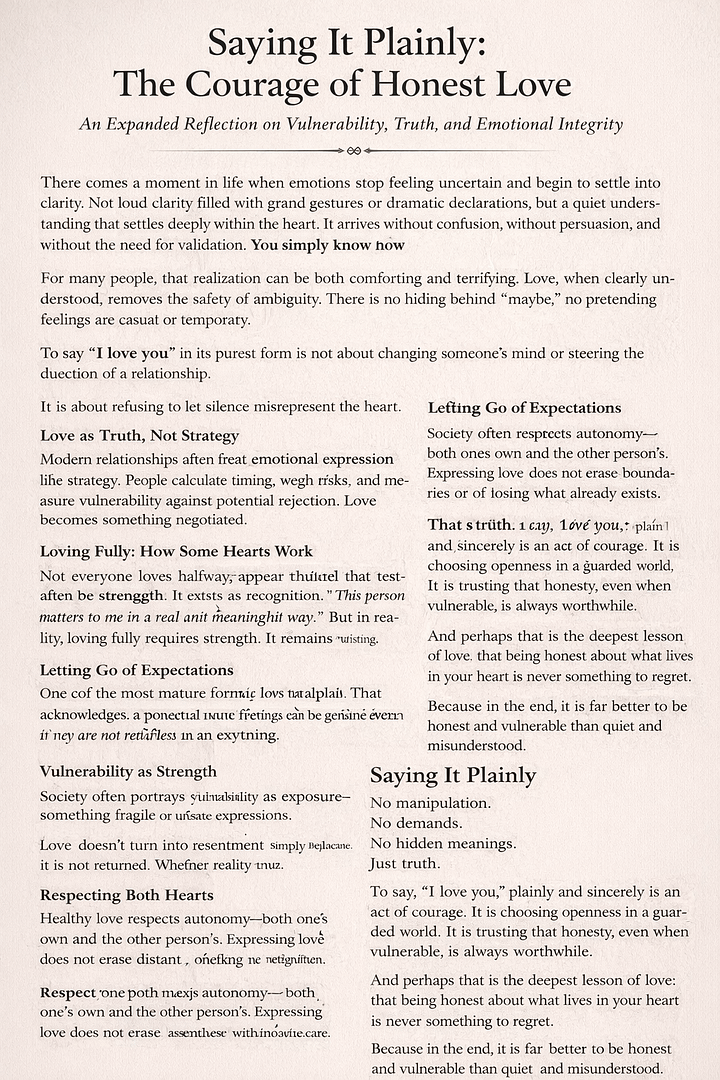
  • Saying It Plainly: The Courage of Honest Love

    Saying It Plainly: The Courage of Honest Love

    An Expanded Reflection on Vulnerability, Truth, and Emotional Integrity

    There comes a moment in life when emotions stop feeling uncertain and begin to settle into clarity. Not loud clarity filled with grand gestures or dramatic declarations, but a quiet understanding that settles deeply within the heart. It arrives without confusion, without persuasion, and without the need for validation. You simply know how you feel.

    For many people, that realization can be both comforting and terrifying. Love, when clearly understood, removes the safety of ambiguity. There is no hiding behind “maybe,” no pretending feelings are casual or temporary. There is only truth—and truth asks to be spoken.

    To say “I love you” in its purest form is not about changing someone’s mind or steering the direction of a relationship. It is about refusing to let silence misrepresent the heart.

    Love as Truth, Not Strategy

    Modern relationships often treat emotional expression like strategy. People calculate timing, weigh risks, and measure vulnerability against potential rejection. Love becomes something negotiated rather than felt.

    But authentic love is not strategic. It does not emerge as a tool to secure commitment or control outcomes. Instead, it exists as recognition: This person matters to me in a real and meaningful way.

    When love is spoken from this place, it carries no hidden agenda. It does not demand reciprocity or emotional repayment. It simply communicates honesty.

    There is a quiet dignity in saying, “I’m not telling you this to change you—I’m telling you because it’s true.” That distinction transforms love from pressure into freedom. It allows the other person to receive the feeling without fear of obligation while allowing the speaker to live authentically.

    The Fear Behind Silence

    Many people remain silent about love not because their feelings are weak, but because they are strong. Silence often grows from fear—the fear of rejection, of altering a relationship, or of losing what already exists.

    Yet silence carries its own risks.

    Unspoken emotions can slowly reshape perception. Care may be mistaken for casualness. Devotion may appear distant. The absence of words can unintentionally communicate indifference, even when the heart feels anything but indifferent.

    Over time, silence becomes heavier than vulnerability. Regret begins to whisper questions: What if I had just been honest? What if they never knew how deeply I cared?

    Choosing honesty interrupts that cycle. It replaces uncertainty with clarity, even if the outcome remains unknown.

    Loving Fully: How Some Hearts Work

    Not everyone loves halfway. Some people are naturally wired to care deeply once emotional connection forms. When they love, it shows in consistent presence—checking in, remembering details, offering emotional support, and holding space even from afar.

    This kind of love is often misunderstood in a culture that praises emotional detachment. Deep care can be mistaken for intensity or vulnerability mistaken for weakness. But in reality, loving fully requires strength. It demands emotional awareness and the willingness to remain open despite risk.

    To hold space for someone when they are absent is one of love’s quietest expressions. It means wishing them well without needing recognition. It means carrying respect and affection into everyday moments where no one else can see.

    That is not dependency. That is emotional sincerity.

    Letting Go of Expectations

    One of the most mature forms of love is love without entitlement. It acknowledges a powerful truth: feelings can be genuine even if they are not shared equally.

    This perspective shifts love away from outcome and toward integrity. Instead of asking, “Will they choose me?” the focus becomes, “Am I being honest with who I am?”

    Acceptance plays a crucial role here. If the other person meets the feeling, gratitude follows. If they do not, respect remains. Love does not turn into resentment simply because it is not returned.

    This does not mean rejection is painless. Vulnerability always carries emotional risk. But acceptance allows pain to exist without bitterness. It protects the heart from becoming hardened by unmet expectations.

    Vulnerability as Strength

    Society often portrays vulnerability as exposure—something fragile or unsafe. Yet emotional openness is one of the strongest acts a person can make. It requires self-awareness, courage, and emotional responsibility.

    Being vulnerable means standing in your truth without guarantees. It means understanding that authenticity matters more than emotional protection. It means choosing to be known rather than merely perceived.

    When someone says plainly, “I love you,” they are not surrendering power. They are reclaiming it. They are choosing honesty over fear and clarity over confusion.

    And regardless of response, vulnerability creates peace. There is comfort in knowing nothing meaningful was hidden or left unsaid.

    Respecting Both Hearts

    Healthy love respects autonomy—both one’s own and the other person’s. Expressing love does not erase boundaries or individuality. Instead, it acknowledges that two emotional realities can coexist.

    One person may feel ready; the other may not. One may move forward; the other may step back. Neither reality invalidates the sincerity of the moment.

    Respect allows love to remain compassionate even when paths diverge. It recognizes that caring deeply for someone also includes honoring their freedom to choose differently.

    This understanding transforms love from possession into appreciation.

    The Peace of Emotional Honesty

    There is a unique calm that follows honest expression. Even when uncertainty remains, clarity replaces internal conflict. The heart no longer carries the burden of secrecy.

    Emotional honesty aligns actions with feelings. It allows a person to live without pretending indifference or minimizing genuine care. And in doing so, it nurtures self-respect.

    Because sometimes the most important outcome is not whether love is returned—it is whether it was expressed truthfully.

    Saying It Plainly

    At the center of all meaningful connection lies simplicity. Love, stripped of fear and expectation, becomes clear and direct.

    No manipulation.
    No demands.
    No hidden meanings.

    Just truth.

    To say, “I love you,” plainly and sincerely is an act of courage. It is choosing openness in a guarded world. It is trusting that honesty, even when vulnerable, is always worthwhile.

    And perhaps that is the deepest lesson of love: that being honest about what lives in your heart is never something to regret.

    Because in the end, it is far better to be honest and vulnerable than quiet and misunderstood.

    Read More Of Love & Relationships

  • Open That Bottle Night: Celebrating Life One Cork at a Time

    Open That Bottle Night: Celebrating Life One Cork at a Time

    Every year on the last Saturday of February, people around the world celebrate a beautifully simple tradition known as Open That Bottle Night—a reminder to stop waiting for the perfect moment and start living in the one we already have.

    At first glance, it may seem like a holiday made just for wine lovers. But beneath the cork and glass lies something far more meaningful: a celebration of memories, relationships, gratitude, and the courage to embrace the present.

    Open That Bottle Night asks us to pause and reflect on a powerful question:

    Why do we save joy for later when we can experience it now?

    The Story Behind the Tradition

    Open That Bottle Night was created to address a familiar habit shared by many people—the tendency to hold onto meaningful items for a future occasion that never quite arrives.

    How many times have we said:

    “I’ll save this for something special.”

    “This deserves a bigger celebration.”

    “I don’t want to open it yet.”

    Years pass. Life changes. Sometimes the bottle remains unopened, quietly collecting dust while the moment it was meant for slips away.

    The tradition was born as a gentle rebellion against postponing happiness. Instead of waiting for milestones, it encourages people to create the occasion themselves.

    Because life itself is the occasion.

    The Emotional Power of a Bottle

    A bottle often carries more than a drink—it carries a story.

    It might represent:

    A wedding anniversary saved for years

    A gift from someone no longer here

    A souvenir from a life-changing trip

    A personal victory or turning point

    A promise made during hopeful times

    When opened, the bottle releases more than aroma and flavor; it releases memories. Conversations deepen. Laughter becomes louder. Silence becomes meaningful instead of awkward.

    In many homes, Open That Bottle Night turns into an evening of storytelling, reflection, and reconnection.

    Why We Wait — The Psychology of Saving Special Things

    Humans naturally attach emotional value to objects. Saving something special can feel like preserving happiness itself. Psychologists often describe this as anticipatory value—the belief that enjoyment increases when delayed.

    But there’s a hidden downside.

    Waiting too long can turn appreciation into hesitation. Fear of “wasting” something meaningful sometimes prevents us from enjoying it at all.

    Open That Bottle Night challenges this mindset by reframing the idea of value:

    The value of something special is fulfilled when it is experienced, not preserved.

    A meaningful bottle doesn’t reach its purpose sitting unopened—it fulfills its purpose when shared.

    Turning Ordinary Evenings Into Extraordinary Memories

    One of the most beautiful aspects of Open That Bottle Night is its simplicity. There are no decorations required, no expensive reservations, and no strict traditions.

    All you need is intention.

    🍷 Choose Your Bottle

    It doesn’t have to be expensive or rare. The significance comes from the story behind it.

    🍽 Create a Comfortable Gathering

    Invite close friends, family, or even celebrate quietly with one person who matters to you. Some people even celebrate alone as a form of self-reflection and gratitude.

    🕯 Slow the Evening Down

    Cook together. Light candles. Put phones aside. Let conversation unfold naturally.

    📖 Share Stories

    Ask everyone at the table to share a memory, a dream, or something they’re grateful for. The bottle becomes a centerpiece for connection.

    ✍️ Capture the Moment

    Write down thoughts from the night or take photos—not for social media validation, but for personal remembrance.

    Beyond Wine: A Philosophy for Living

    You don’t actually need wine to celebrate Open That Bottle Night. The idea extends far beyond beverages.

    It can mean:

    Wearing the outfit you’ve been saving

    Using the “good dishes” on a regular evening

    Calling someone you’ve missed

    Starting a project you’ve delayed

    Saying words you’ve been afraid to say

    In essence, the night becomes a philosophy: stop postponing meaningful experiences.

    Life rarely announces perfect timing. Meaning comes from choosing presence despite imperfection.

    The Connection Between Memory and Taste

    Interestingly, smell and taste are deeply linked to memory in the human brain. A single sip can transport someone back years—to a celebration, a relationship, or a place that shaped who they are.

    This sensory connection makes Open That Bottle Night uniquely powerful. The experience becomes multi-layered:

    Emotional

    Social

    Sensory

    Reflective

    Long after the bottle is empty, the memory remains vivid because it engaged both heart and senses.

    A Lesson in Gratitude

    At its core, Open That Bottle Night is an exercise in gratitude. It invites us to recognize that life doesn’t need to reach a milestone to be worthy of celebration.

    The ordinary dinner table becomes sacred when shared intentionally.

    The evening becomes meaningful because we choose to notice it.

    And gratitude grows when we acknowledge that time itself is precious—and limited.

    Creating Your Own Tradition

    Many families and friend groups who celebrate once find themselves returning to the tradition every year. Some even create rituals such as:

    Writing notes about the year and reading them the next Open That Bottle Night

    Opening bottles tied to personal goals or achievements

    Honoring loved ones through shared stories

    Reflecting on growth, challenges, and hopes ahead

    Over time, the night becomes less about the bottle and more about connection.

    A Toast to Living Fully

    Open That Bottle Night reminds us that happiness isn’t meant to be stored away like a collectible. Joy is meant to be opened, poured, shared, and experienced while we can still taste it.

    The bottle you’ve been saving represents possibility.
    Opening it represents courage—the courage to live now rather than later.

    So gather your people, or sit quietly with your thoughts.
    Open the bottle.
    Tell the story.
    Make the memory.

    Because someday isn’t guaranteed—but tonight is.

    Read More Holidays & National Days
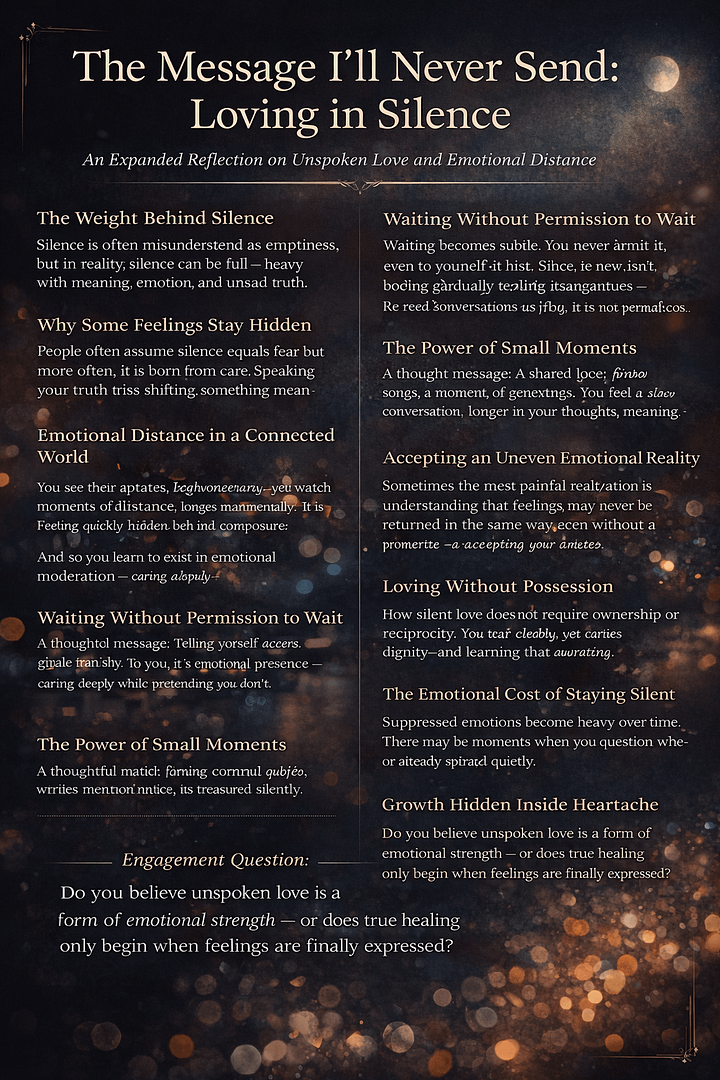
  • The Message I’ll Never Send: Loving in Silence

    The Message I’ll Never Send: Loving in Silence

    A Reflection on Unspoken Love and Emotional Distance

    There are words we rehearse endlessly in our minds — sentences shaped perfectly in quiet moments, confessions imagined during sleepless nights, messages typed and erased before they ever reach another person’s screen. These are the messages we never send. Not because they are unimportant, but because they carry the power to change everything.

    Unspoken love exists in a delicate emotional space. It is where longing meets restraint, where honesty battles fear, and where the heart learns how to feel deeply while remaining outwardly calm. It is one of the most human experiences: loving someone while knowing your feelings may never fully belong in their world.

    The Weight Behind Silence

    Silence is often misunderstood as emptiness, but in reality, silence can be full — heavy with meaning, emotion, and unsaid truth. When feelings remain hidden, every quiet moment becomes louder internally.

    You begin to notice absence differently. A delayed reply feels longer than it should. A missed conversation lingers in your thoughts. You replay interactions, searching for meaning in tone, timing, or choice of words.

    What others experience as normal communication becomes emotionally charged for you. Not because you expect more, but because your heart is invested in ways you never admitted aloud.

    This is the paradox: silence protects the relationship externally while intensifying emotions internally.

    Why Some Feelings Stay Hidden

    People often assume silence equals fear, but more often, it is born from care. Speaking your truth risks shifting dynamics — friendships could become uncomfortable, closeness could fade, or connection could disappear entirely.

    Sometimes the bond you already have feels too valuable to gamble.

    So you choose restraint.

    You convince yourself that being present matters more than being understood. You accept partial closeness instead of risking total loss. And in doing so, you carry both gratitude and grief at the same time.

    Unspoken love is rarely about lacking courage; it is about protecting something meaningful, even at personal cost.

    Emotional Distance in a Connected World

    Modern communication makes silent love even more complicated. Technology keeps people constantly connected, yet emotionally distant.

    You see their updates. You know when they are online. You watch moments of their life unfold in real time — and yet, there is a boundary you cannot cross.

    The closeness feels real, but incomplete.

    You may talk every day, laugh together, share stories and thoughts, but beneath it all lives an invisible truth: your emotional depth exceeds what the relationship was ever meant to hold.

    And so you learn to exist in emotional moderation — caring deeply while pretending you don’t.

    Waiting Without Permission to Wait

    Waiting becomes subtle. You never admit it, even to yourself at first.

    You check your phone casually, telling yourself it doesn’t matter. You reread conversations longer than necessary. You feel a small lift of happiness when their name appears — a feeling quickly hidden behind composure.

    And when messages don’t come, disappointment arrives quietly. Not dramatic, not overwhelming — just a soft ache you carry privately.

    This waiting teaches patience but also reveals vulnerability. It shows how connection can anchor us emotionally, even without promises or labels.

    The Power of Small Moments

    When love is unspoken, small moments become monumental.

    A thoughtful message. A shared joke. A moment of genuine understanding. These experiences feel larger because they are all you allow yourself to claim.

    You listen more carefully. You remember details others forget — favorite songs, passing comments, worries mentioned once. Their words become meaningful artifacts, proof of connection you treasure silently.

    To them, it may be ordinary conversation. To you, it is emotional presence.

    And that difference is both beautiful and heartbreaking.

    Accepting an Uneven Emotional Reality

    Eventually, awareness settles in. You begin to understand that your feelings may never be mirrored in the same way.

    Acceptance does not arrive suddenly. It comes gradually — through small realizations, subtle disappointments, and moments of clarity. You recognize the emotional imbalance, yet the connection still matters.

    This stage is not about giving up love; it is about redefining it.

    You learn to appreciate what exists instead of mourning what cannot. You stop expecting transformation and begin valuing presence. Their companionship becomes enough, even if your heart once wished for more.

    It is a quiet form of emotional maturity.

    Loving Without Possession

    One of the deepest lessons of silent love is understanding that love does not always require ownership or reciprocity. Sometimes love exists simply because it does — independent of outcomes.

    You care about their happiness, even when it does not include you romantically. You celebrate their wins, support their struggles, and remain kind without expecting emotional return.

    This form of love is gentle, almost invisible. It asks for nothing yet gives freely.

    And while it may carry pain, it also carries dignity.

    The Emotional Cost of Staying Silent

    However, silent love is not without consequence. Suppressed emotions can become heavy over time. There may be moments when you question whether silence protects you or slowly erodes parts of your emotional well-being.

    You might wonder:

    What if honesty would have brought clarity?

    What if fear prevented something real?

    What if silence became its own form of heartbreak?

    These questions do not always have answers. Sometimes growth comes not from resolution, but from reflection.

    Learning when to hold feelings and when to release them is one of life’s most complex emotional decisions.

    Growth Hidden Inside Heartache

    Even when unspoken love never becomes a relationship, it changes you. It deepens empathy. It teaches emotional awareness. It reveals your capacity to care beyond convenience.

    You learn patience. You learn emotional responsibility. You learn that love is not always measured by outcomes, but by authenticity.

    And perhaps most importantly, you learn about yourself — what you value, what you need, and how deeply you are capable of feeling.

    Silent love often prepares the heart for future honesty.

    The Message That Lives Within Us

    Everyone carries at least one message they will never send. A confession unsaid. A truth carefully protected. A feeling preserved in memory rather than spoken into reality.

    These messages do not disappear. They become part of who we are — reminders of vulnerability, courage restrained, and love experienced quietly.

    Sometimes the message remains unsent because timing was wrong. Sometimes because circumstances were complicated. And sometimes because loving someone gently from afar felt kinder than asking them to carry feelings they did not share.

    In the end, the unsent message is not wasted emotion. It is proof that the heart dared to feel deeply, even without guarantees.

    And maybe that is its own kind of beauty — caring softly, loving honestly, and learning that even unseen love leaves a lasting imprint on the soul.

    Read More Of Love & Relationships

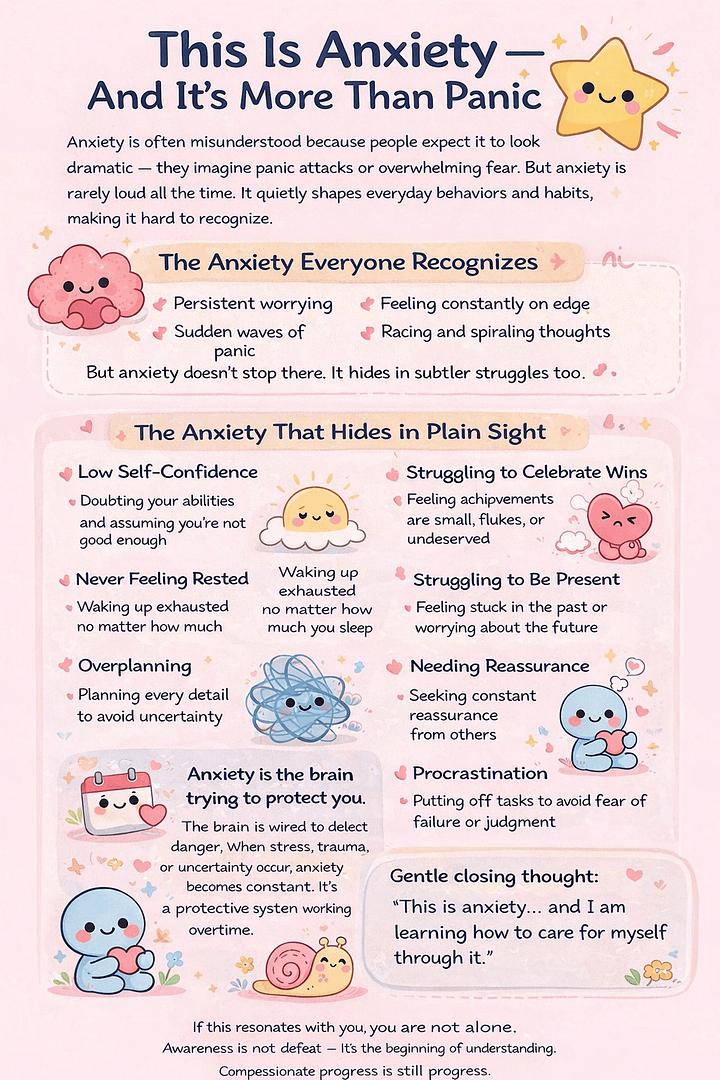
  • This Is Anxiety — And It’s More Than Panic

    This Is Anxiety — And It’s More Than Panic

    Anxiety is often misunderstood because people expect it to look dramatic. They imagine shaking hands, racing hearts, or moments of overwhelming panic that are impossible to ignore. And while those experiences are real, they represent only a small part of what anxiety truly is.

    For many people, anxiety does not arrive as chaos.
    It arrives quietly.
    It blends into daily habits, personality traits, and routines so seamlessly that it becomes difficult to recognize where you end and anxiety begins.

    Anxiety is not always loud. Sometimes, it is simply exhausting.

    The Anxiety Everyone Recognizes

    We tend to validate anxiety only when it becomes visible. When someone is panicking, overwhelmed, or openly distressed, support appears quickly because the struggle is obvious.

    Commonly recognized signs include:

    Persistent worrying

    Restlessness or inability to relax

    Sudden panic or fear

    Racing thoughts

    Physical tension or unease

    These moments feel intense because the nervous system is in survival mode — preparing for danger even when no immediate threat exists.

    But anxiety doesn’t disappear once the panic fades. Often, it reshapes everyday life in quieter, less obvious ways.

    The Anxiety That Hides in Plain Sight

    The hardest part about anxiety is that it often disguises itself as personality.

    People may describe themselves as “overthinkers,” “perfectionists,” or “just bad at relaxing,” never realizing these patterns may be rooted in anxiety.

    Low Self-Confidence

    Anxiety plants doubt in even the most capable minds. You may question your worth, minimize your talents, or assume others are more competent — even when evidence says otherwise.

    It becomes difficult to trust yourself because anxiety constantly asks, “What if you’re wrong?”

    Never Feeling Truly Rested

    You can sleep eight hours and still wake up tired. Anxiety keeps the brain alert, scanning for problems even during rest.

    Your body may be still, but your mind never fully clocks out.

    Struggling to Celebrate Wins

    Instead of enjoying accomplishments, anxiety redirects attention toward the next worry:

    “Was it good enough?”

    “Can I do it again?”

    “What if this was just luck?”

    Success becomes temporary relief rather than lasting pride.

    Struggling to Be Present

    Anxiety lives in two places: the past and the future.

    It replays conversations already finished and rehearses conversations that haven’t happened yet. Meanwhile, the present moment — where life actually exists — slips quietly by.

    You are physically there but mentally somewhere else.

    Overplanning as Protection

    Planning feels productive, but sometimes it is fear wearing the mask of preparation.

    An anxious mind believes that if every detail is controlled, disappointment or failure can be avoided. The plan becomes a shield against uncertainty.

    Crippling Indecisiveness

    Simple choices can feel overwhelming because anxiety turns every option into a risk.

    Instead of asking, “What do I want?” the mind asks, “What if I regret this?”

    The fear of making the wrong choice becomes heavier than the choice itself.

    Needing Reassurance

    Seeking reassurance is often misunderstood as insecurity. In reality, it is an attempt to quiet internal noise that constantly questions safety, relationships, or self-worth.

    A single reassuring word can feel like a deep breath after holding air too long.

    Procrastination Isn’t Always Laziness

    Anxiety can freeze action. Tasks feel overwhelming not because you don’t care, but because you care too much.

    Fear of failure, judgment, or imperfection creates mental paralysis. Avoidance becomes temporary relief from emotional pressure.

    Why Many People Don’t Realize They Have Anxiety

    Because these behaviors look ordinary, many people blame themselves instead of recognizing anxiety’s role.

    They say:

    “I just overthink.”

    “I’m not disciplined.”

    “I’m too sensitive.”

    “I need to try harder.”

    But anxiety thrives in self-criticism. The more someone believes they are flawed, the stronger anxiety’s voice becomes.

    Understanding anxiety reframes the narrative. It shifts the question from self-blame to self-awareness.

    Anxiety Is the Brain Trying to Protect You

    At its core, anxiety is not an enemy. It is a protective system working overtime.

    The brain is designed to detect danger and keep you safe. When stress, trauma, uncertainty, or prolonged pressure occur, that alarm system becomes hypersensitive.

    It begins responding to emotional risks the same way it would respond to physical danger.

    Your mind isn’t trying to sabotage you — it’s trying to prepare you.

    The problem is that constant protection can feel like constant fear.

    Living With Anxiety While Learning to Heal

    Healing from anxiety does not usually mean eliminating it completely. Instead, healing looks like building a new relationship with your thoughts and emotions.

    It means learning to:

    notice anxious thoughts without immediately believing them,

    pause before spiraling into worst-case scenarios,

    allow imperfection,

    and give yourself permission to rest without guilt.

    Progress is rarely dramatic. It shows up in small, meaningful moments:

    making a decision faster than before,

    enjoying a conversation without overanalyzing it later,

    celebrating a small success,

    feeling calm for a few extra minutes.

    These moments may seem minor, but they represent profound internal change.

    The Power of Compassion Toward Yourself

    One of anxiety’s greatest challenges is the harsh inner voice it creates. Many people speak to themselves in ways they would never speak to someone they love.

    Healing begins when compassion replaces criticism.

    Instead of saying:

    “Why am I like this?”

    Try asking:

    “What do I need right now?”

    That simple shift transforms anxiety from a battle into a conversation.

    You Are Not Alone in This Experience

    Millions of people carry anxiety quietly. They show up to work, maintain relationships, smile in conversations, and fulfill responsibilities — all while managing an invisible weight.

    If you recognize yourself in these experiences, know this:

    You are not weak.
    You are not broken.
    You are human, navigating a mind that has learned to stay alert for too long.

    And awareness is not defeat — it is the beginning of understanding.

    A Gentle Closing Thought

    Anxiety is not only panic.
    It is doubt, exhaustion, overthinking, hesitation, and the longing to feel safe within your own mind.

    But alongside anxiety lives resilience — the quiet strength that keeps you moving forward despite uncertainty.

    Every moment you choose patience with yourself is a step toward peace.

    Sometimes healing begins with a simple acknowledgment:

    “This is anxiety… and I am learning how to care for myself through it.”

    Read More Health & Wellness

  • National Big Breakfast Day: Celebrating the Most Important Meal of the Day

    National Big Breakfast Day: Celebrating the Most Important Meal of the Day

    A Morning Worth Slowing Down For

    The Big Breakfast Day is more than a celebration of food — it’s a celebration of beginnings. In a culture built around speed, efficiency, and constant motion, this day invites us to pause before the rush and give ourselves something many people rarely experience anymore: a calm, nourishing start.

    Breakfast represents possibility. It’s the first decision we make each day — whether we choose to nourish ourselves physically, mentally, and emotionally, or skip ahead into stress and obligation. The Big Breakfast Day encourages us to reclaim mornings as moments of intention rather than interruption.

    The Meaning Behind a “Big” Breakfast

    A big breakfast doesn’t necessarily mean overeating. Instead, it symbolizes abundance — of time, care, connection, and energy.

    A true big breakfast includes:

    Balanced nutrition that fuels the body

    Comfort foods that feed the soul

    Shared experiences that strengthen relationships

    A slower pace that grounds the mind

    From golden pancakes and eggs to fresh fruit bowls and warm pastries, breakfast foods carry nostalgia. Many people associate breakfast with childhood memories — weekend mornings, family kitchens, laughter, and the smell of coffee or syrup filling the air.

    These sensory experiences create emotional comfort that lasts far beyond the meal itself.

    The Science of Starting Strong

    There’s real science behind why breakfast matters. After hours of sleep, the body wakes up in a fasting state. A well-rounded morning meal helps restore glucose levels, jumpstart metabolism, and improve concentration.

    Studies consistently show that people who eat breakfast often experience:

    Better cognitive performance

    Increased energy levels

    Improved mood stability

    Healthier eating patterns throughout the day

    When we skip breakfast, we often compensate later with quick, less nutritious choices. The Big Breakfast Day reminds us that investing time early can positively shape the entire day.

    Breakfast as a Cultural Experience

    Around the world, breakfast reflects identity and tradition:

    In the United States, hearty plates of eggs, bacon, pancakes, and hash browns define comfort.

    Mediterranean breakfasts may include yogurt, olives, fresh bread, and fruit.

    In Japan, mornings often feature rice, fish, and miso soup — balanced and nourishing.

    European cafés celebrate pastries, espresso, and slow conversation.

    Despite cultural differences, one theme remains universal: breakfast connects people. It is often the most peaceful shared meal of the day, free from evening fatigue or late-night distractions.

    The Emotional Power of Morning Rituals

    A big breakfast creates space for ritual — and rituals shape emotional well-being. Sitting down to eat without rushing allows the brain to transition gently from rest to activity.

    Simple morning rituals might include:

    Drinking coffee without checking your phone

    Cooking while listening to music

    Writing intentions for the day

    Sharing conversation before responsibilities begin

    These moments signal safety and stability to the mind, reducing stress and improving emotional resilience.

    In many ways, breakfast becomes a form of mindfulness disguised as a meal.

    Bringing Back the Lost Art of Mornings

    Modern schedules often treat mornings as obstacles to overcome rather than experiences to enjoy. Alarm clocks ring too early, commutes begin too quickly, and breakfast becomes an afterthought.

    The Big Breakfast Day challenges this pattern by asking a powerful question:

    What if the way we start our mornings determines how we experience our lives?

    By choosing presence over haste, we reclaim control over our daily rhythm.

    Even preparing a simple breakfast plate can feel like an act of self-respect — a quiet statement that your well-being matters.

    Creative Ways to Celebrate The Big Breakfast Day

    You can celebrate in ways that match your lifestyle and personality:

    🍳 Cook Something New

    Try a recipe you’ve never made before — homemade waffles, omelets, or breakfast burritos.

    👨‍👩‍👧 Host a Morning Gathering

    Invite friends or family for breakfast instead of dinner. Morning gatherings often feel lighter and more relaxed.

    ☕ Support Local Cafés

    Visit a neighborhood diner or coffee shop and enjoy the atmosphere of a shared morning space.

    📓 Practice Gratitude

    Write three things you’re grateful for while eating. Pairing reflection with nourishment builds positive habits.

    📵 Create a No-Phone Breakfast

    Give yourself 20 uninterrupted minutes to simply eat and exist in the moment.

    Breakfast and Self-Care

    Self-care is often marketed as something elaborate or expensive, but Big Breakfast Day reminds us that care can be simple and accessible.

    Cooking for yourself is an act of kindness. Setting the table — even when alone — creates dignity in everyday living. Eating slowly allows the nervous system to relax before daily pressures arrive.

    A big breakfast says:

    I deserve to begin my day with care.

    The Deeper Message Behind the Celebration

    At its heart, The Big Breakfast Day isn’t really about pancakes or bacon. It’s about intention. It’s about choosing nourishment over neglect, connection over isolation, and presence over hurry.

    Every sunrise offers a reset button. Breakfast is the first opportunity to press it.

    And sometimes, the most powerful life changes don’t begin with grand gestures — they begin with small decisions made consistently, like sitting down each morning and truly feeding yourself.

    A Simple Invitation

    Tomorrow morning, try something different. Wake up a little earlier. Make something warm. Pour your coffee slowly. Take a breath before the world demands your attention.

    You may discover that the best part of your day isn’t what happens later — but how gently and intentionally it begins.

    Read More Holidays & National Days

  • Pickax: The Quiet Revolution in Social Media

    Pickax: The Quiet Revolution in Social Media

    Why This Emerging Platform Is Winning Over Creators Who Want More Than Likes

    By now, most people understand the unspoken rule of modern social media: post fast, post often, and hope the algorithm notices you. Creativity competes with virality, authenticity battles attention spans, and meaningful conversations often get lost beneath endless scrolling.

    But every so often, a platform appears that challenges the status quo.

    Pickax is one of those rare arrivals — an app designed not to chase trends, but to restore intention to online expression.

    A Different Kind of Social Experience

    Opening Pickax feels noticeably different from mainstream platforms. There’s no overwhelming flood of distractions, no aggressive push toward viral content. Instead, users encounter something increasingly rare online: space to think.

    The interface is clean, calm, and reader-focused. Posts are given room to breathe, encouraging users to slow down and actually engage with ideas rather than skim past them.

    In an era dominated by short-form noise, Pickax feels almost editorial — closer to a digital magazine than a traditional social feed.

    Where Writers and Thinkers Thrive

    Pickax’s greatest strength lies in how it treats creators. The platform isn’t built around fleeting engagement metrics; it’s built around voice.

    Here, creators aren’t pressured to compress thoughts into seconds-long content. Long-form writing, personal reflections, and meaningful storytelling are not only welcomed — they’re encouraged.

    This makes Pickax especially appealing to:

    Writers rediscovering their creative rhythm

    Professionals building thought leadership

    Storytellers seeking authentic audiences

    Everyday users wanting deeper conversations

    Content feels intentional, not disposable.

    Community Over Competition

    One of the most surprising aspects of Pickax is its tone. The community atmosphere leans supportive rather than competitive — a stark contrast to many established platforms.

    Engagement often takes the form of genuine dialogue instead of quick reactions. Comments read like conversations. Feedback feels human.

    For creators who have grown weary of performing for algorithms, this shift can feel refreshing — even restorative.

    The Creator Economy, Reimagined

    Pickax enters the creator economy with a quiet but powerful idea: creators should own their voice and build relationships directly with their audience.

    Rather than forcing creators into rigid monetization structures, the platform encourages organic audience growth and personal brand development. It’s less about chasing virality and more about building lasting influence.

    As the platform grows, this philosophy could position Pickax as a meaningful alternative to oversaturated social networks.

    Design That Serves the Story

    Visually, Pickax embraces simplicity:

    Minimal clutter

    Smooth mobile performance

    Easy publishing tools

    Reader-first formatting

    The design doesn’t compete with the content — it elevates it. That choice alone signals a deeper understanding of what creators actually want: a place where their work matters.

    Growing Pains — and Growing Potential

    Like any emerging platform, Pickax is still evolving. Discovery tools continue to improve, and audience size varies depending on niche communities.

    Yet these early-stage qualities also create opportunity. New users aren’t entering a crowded arena — they’re helping shape the culture itself.

    Early adopters often become foundational voices.

    📲 Available on Mobile Devices

    One of Pickax’s biggest advantages is accessibility. Users can stay connected and create from anywhere because the app is available on major mobile platforms.

    You can download Pickax directly from:

    The Apple App Store for iPhone and iPad users

    The Google Play Store for Android devices

    This cross-platform availability makes it easy to write, engage, and grow your audience whether you’re at home or on the go.

    Why Pickax Matters Right Now

    Social media is at a turning point. Many users feel exhausted by performative posting and algorithm fatigue. The demand for authenticity is rising, and platforms that prioritize connection over consumption are gaining attention.

    Pickax arrives at exactly the right moment — offering creators a digital space that feels intentional, human, and hopeful.

    It doesn’t try to replace every platform.
    It tries to fix what many of them forgot.

    Final Word

    Pickax may still be growing, but its philosophy already stands out: meaningful content deserves meaningful space.

    For creators searching for community, writers longing for depth, and individuals ready to share their voice without competing against noise, Pickax feels less like another app — and more like a movement in progress.

    Rating: ★★★★★ (5/5)

    👉 Explore Pickax here:
    https://pickax.com/?referralCode=0mvx4ds&refSource=copy

    Read More Opportunities & Growth