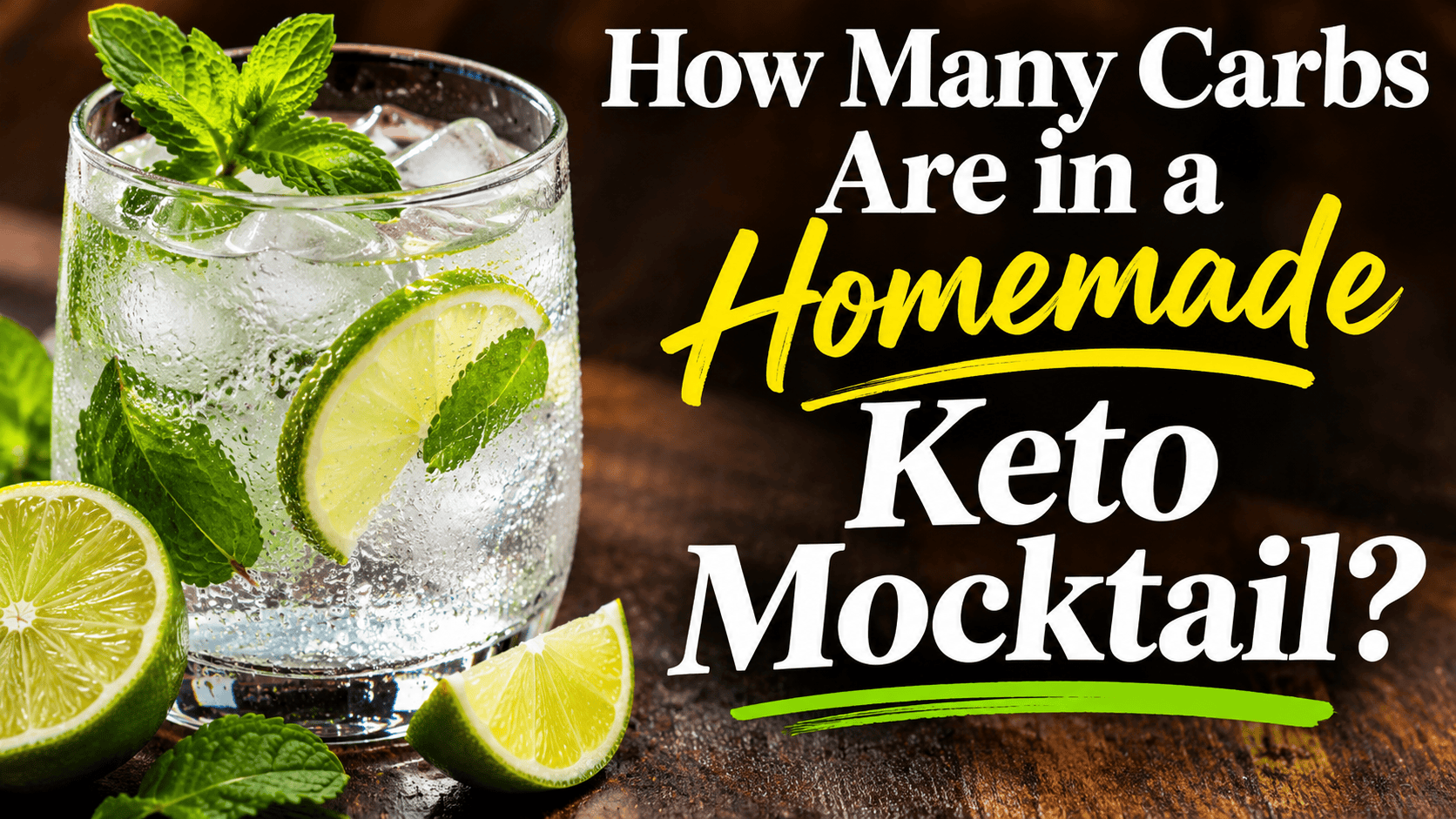
A homemade keto mocktail typically contains between 0 and 5 grams of net carbs per serving, depending on the ingredients, sweeteners, fruit juices, and mixers used. Some simple keto mocktails contain almost zero carbohydrates, while others can quickly exceed 10 or even 20 grams if they include sugary ingredients.
One of the biggest advantages of making keto mocktails at home is having complete control over what goes into your glass. Instead of relying on bottled mixers, traditional syrups, or fruit juices that may contain significant amounts of sugar, you can choose low-carb ingredients that deliver refreshing flavors without unnecessary carbohydrates.
Whether you are following a strict ketogenic diet, reducing your daily sugar intake, or simply looking for healthier alcohol-free beverages, understanding how to calculate the carbs in homemade keto mocktails can help you make better choices.
In this guide, we will explore how many carbohydrates are in common keto mocktail ingredients, how to calculate net carbs, which ingredients to avoid, and how to prepare delicious low-carb mocktails at home.
What Is the Average Carb Count in a Homemade Keto Mocktail?
Most homemade keto mocktails contain approximately 0 to 5 grams of net carbohydrates per 8- to 12-ounce serving when prepared with low-carb ingredients.
However, the exact amount depends on the recipe.
Here is a general comparison:
| Type of Homemade Mocktail | Approximate Net Carbs |
|---|---|
| Sparkling water with lemon | 0–1 gram |
| Sugar-free cucumber cooler | 1–2 grams |
| Keto lime spritzer | 1–3 grams |
| Sugar-free berry mocktail | 2–5 grams |
| Keto coconut mocktail | 1–4 grams |
| Traditional fruit juice mocktail | 15–30+ grams |
| Regular lemonade mocktail | 15–25+ grams |
These figures are estimates rather than guaranteed nutritional values. Serving sizes, ingredient quantities, and product formulations can significantly affect the final carbohydrate count.
For example, a mocktail made with sparkling water, fresh lime juice, mint, and stevia will generally contain fewer carbohydrates than one made with orange juice, pineapple juice, and regular grenadine.
The key is choosing ingredients that naturally contain fewer carbohydrates or using sugar-free alternatives.
What Are Net Carbs in a Keto Mocktail?
When following a ketogenic diet, many people focus on net carbohydrates rather than total carbohydrates.
Net carbs are commonly calculated by subtracting dietary fiber from total carbohydrates.
Net Carbs = Total Carbohydrates − Dietary Fiber
For example, if a homemade mocktail contains:
- Total carbohydrates: 5 grams
- Dietary fiber: 2 grams
- Net carbohydrates: 3 grams
This means the drink contains approximately 3 grams of net carbs.
Some keto calculations also subtract certain sugar alcohols, but their effects vary. Erythritol is generally treated differently from maltitol, for example. Sugar alcohols should not automatically be subtracted in full.
It is also important to remember that beverages containing fruit juice usually have little fiber, meaning their total carbohydrate and net carbohydrate counts may be nearly identical.
Which Keto Mocktail Ingredients Have the Fewest Carbs?
Choosing the right ingredients is the easiest way to keep homemade keto mocktails low in carbohydrates.
1. Sparkling Water
Plain sparkling water is one of the best bases for keto mocktails because it typically contains zero carbohydrates, zero sugar, and zero calories.
It adds carbonation and makes drinks feel refreshing without increasing their carb content.
You can use plain sparkling water or unsweetened flavored varieties.
Always check the nutrition label because some flavored sparkling beverages contain added sugars.
2. Fresh Lemon and Lime Juice
Fresh citrus juice provides a bright, refreshing flavor without requiring large amounts of sugar.
One tablespoon of fresh lemon juice contains approximately 1 gram of total carbohydrates, while one tablespoon of lime juice contains approximately 1.3 grams.
Because most keto mocktail recipes use only a small amount, citrus juice can fit comfortably into a low-carb beverage.
3. Fresh Mint
Mint leaves add flavor and aroma with very little carbohydrate contribution when used in small amounts.
Fresh mint works especially well in keto mojito-style mocktails, cucumber coolers, and citrus spritzers.
4. Cucumber
Cucumber is naturally low in carbohydrates and provides a clean, refreshing taste.
A few cucumber slices can add flavor without contributing many net carbs.
Cucumber pairs particularly well with lime, mint, and sparkling water.
5. Sugar-Free Sweeteners
Sugar-free sweeteners can replace traditional sugar and simple syrup.
Popular options include:
- Stevia
- Monk fruit sweetener
- Erythritol
- Allulose
Pure forms of these sweeteners contribute little or no usable carbohydrate, although commercial blends may contain other ingredients.
Some products labeled sugar-free still contain carbohydrates, so checking the label is important.
Which Mocktail Ingredients Are Highest in Carbs?
Certain ingredients can quickly turn a keto-friendly mocktail into a high-carbohydrate beverage.
Regular Fruit Juice
Fruit juice is one of the biggest sources of carbohydrates in traditional mocktails.
For example, an 8-ounce serving of orange juice typically contains approximately 25 to 26 grams of carbohydrates.
Pineapple juice can contain a similar amount.
Even 2 ounces of juice may add approximately 6 to 8 grams of carbohydrates, depending on the fruit.
Regular Simple Syrup
Traditional simple syrup is made from sugar and water.
One tablespoon of standard 1:1 simple syrup can contain approximately 12 grams of carbohydrates, depending on its preparation.
Adding several tablespoons can dramatically increase the carbohydrate content of a drink.
Grenadine
Traditional grenadine is generally high in added sugar.
A tablespoon may contain roughly 10 to 15 grams of carbohydrates, depending on the brand.
Sugar-free grenadine or a homemade low-carb alternative may be a better choice.
Regular Soda
Traditional soda is another ingredient to avoid when preparing keto mocktails.
A standard 12-ounce can of regular cola contains approximately 39 grams of carbohydrates.
Replacing regular soda with unsweetened sparkling water or a zero-sugar soda can significantly reduce the carbohydrate content.
How Do You Calculate Carbs in a Homemade Keto Mocktail?
Calculating carbohydrates in homemade mocktails is easier than it might seem.
Start by measuring each ingredient and checking its carbohydrate content.
Consider this simple keto lime mocktail.
Ingredients:
- 8 ounces plain sparkling water: 0 grams carbs
- 1 tablespoon fresh lime juice: approximately 1.3 grams carbs
- 5 fresh mint leaves: negligible carbs
- Pure stevia to taste: approximately 0 grams carbs
- Ice: 0 grams carbs
Estimated total carbohydrates: Approximately 1–2 grams
Because the drink contains very little fiber, the net carbohydrate count is approximately the same.
This is an example of how a refreshing homemade mocktail can contain very few carbohydrates without sacrificing flavor.
For more complicated recipes, add the carbohydrates from each ingredient and divide by the number of servings.
If a batch contains 12 grams of net carbs and makes four equal servings, each serving contains approximately 3 grams of net carbs.
What Are Some Homemade Keto Mocktails Under 5 Grams of Net Carbs?
There are plenty of delicious keto mocktails that can fit into a low-carb lifestyle.
1. Keto Lemon Lime Spritzer
Estimated net carbs: 2–3 grams per serving
Ingredients:
- 6 ounces sparkling water
- 1 tablespoon fresh lemon juice
- 1 tablespoon fresh lime juice
- Stevia to taste
- Ice
Instructions:
- Fill a tall glass with ice.
- Add the lemon and lime juice.
- Stir in your preferred amount of stevia.
- Pour sparkling water over the mixture.
- Stir gently and serve immediately.
This mocktail is light, refreshing, and ideal for warm afternoons.
2. Sugar-Free Cucumber Mint Cooler
Estimated net carbs: 1–2 grams per serving
Ingredients:
- 8 ounces sparkling water
- 4 thin cucumber slices
- 5 fresh mint leaves
- 1 teaspoon lime juice
- Stevia or monk fruit sweetener to taste
- Ice
Instructions:
- Add cucumber slices and mint leaves to a glass.
- Gently muddle to release their flavors.
- Add lime juice and sweetener.
- Fill the glass with ice.
- Top with sparkling water and stir.
The cucumber and mint provide a crisp flavor without needing sugary mixers.
3. Keto Raspberry Lime Mocktail
Estimated net carbs: 2–4 grams per serving
Ingredients:
- 6 ounces sparkling water
- 4 fresh raspberries
- 1 tablespoon lime juice
- Sugar-free sweetener to taste
- Ice
Instructions:
- Muddle the raspberries in the bottom of a glass.
- Add lime juice and sweetener.
- Fill the glass with ice.
- Add sparkling water.
- Stir gently and garnish with a raspberry.
Raspberries add natural fruit flavor while keeping the drink relatively low in carbohydrates.
4. Keto Coconut Lime Cooler
Estimated net carbs: 1–3 grams per serving
Ingredients:
- 4 ounces unsweetened coconut milk beverage
- 4 ounces sparkling water
- 1 tablespoon lime juice
- Stevia to taste
- Ice
Instructions:
- Fill a glass with ice.
- Pour in the unsweetened coconut milk beverage.
- Add lime juice and sweetener.
- Top with sparkling water.
- Stir until combined.
Use unsweetened coconut milk beverage rather than sweetened coconut milk or coconut water, which may contain more carbohydrates. The estimate depends on the brand.
Can You Drink Keto Mocktails Every Day?
For many people, homemade keto mocktails can be enjoyed regularly as part of a ketogenic diet.
The most important consideration is how the drink fits into your overall daily carbohydrate intake.
Some ketogenic eating plans limit daily net carbohydrates to approximately 20 to 50 grams, although individual targets vary.
If your daily target is 20 grams of net carbs, a mocktail containing 3 grams would account for 15% of that allowance.
That does not necessarily mean you should avoid the drink. It simply means those carbohydrates should be included in your daily total.
Mocktails made primarily with water, unsweetened sparkling water, fresh herbs, and small amounts of citrus are often easier to fit into a low-carb eating plan than fruit-heavy beverages.
Water should still remain a primary source of hydration.
Are Store-Bought Sugar-Free Mocktail Mixers Really Carb-Free?
Not necessarily.
A product labeled sugar-free does not automatically mean it contains zero carbohydrates.
Some commercial mixers include ingredients such as maltodextrin, fruit concentrates, or sugar alcohols that may contribute carbohydrates.
When buying mixers, check:
- Total carbohydrates per serving
- Added sugars
- Serving size
- Sweetener ingredients
- Number of servings used in the drink
A mixer that contains 2 grams of carbohydrates per serving may seem low-carb, but using three servings would add 6 grams to your mocktail.
Also, products with less than 0.5 grams of carbohydrates per labeled serving may be permitted to display zero grams after rounding under U.S. labeling rules.
This makes portion sizes especially important.
Does Adding Fruit Increase the Carbs in Keto Mocktails?
Yes, but the amount depends on the type and quantity of fruit.
Small amounts of certain berries can add flavor without dramatically increasing carbohydrates.
Raspberries, blackberries, and strawberries are commonly used in low-carb recipes.
However, using large amounts of fruit or blending several servings into one drink can raise the carbohydrate count.
For example, adding three or four raspberries may contribute relatively few carbohydrates, while adding half a cup of mashed fruit will contribute considerably more.
Fruit can still be part of a keto mocktail. The key is controlling the portion.
How Can You Make a Keto Mocktail With Zero Carbs?
A nearly zero-carb mocktail is possible when you use ingredients that contain no measurable carbohydrates.
For example:
Zero-Sugar Sparkling Mint Mocktail
Ingredients:
- 8 ounces plain sparkling water
- A few fresh mint leaves
- A small amount of pure stevia
- Ice
Instructions:
- Place mint leaves in a glass.
- Gently press the leaves to release their aroma.
- Add ice and stevia.
- Fill with sparkling water.
- Stir and serve.
This drink contains approximately zero grams of carbohydrates based on typical ingredient quantities.
However, exact zero-carb claims depend on the ingredients and serving sizes. Even fresh herbs contain trace amounts of carbohydrates.
What Is the Best Way to Keep Homemade Keto Mocktails Low in Carbs?
The simplest strategy is to build your mocktail around ingredients that contain little or no sugar.
Start with a zero-carb base such as sparkling water, add fresh herbs or cucumber for flavor, use citrus juice in moderation, and sweeten with a keto-friendly alternative if needed.
Avoid relying heavily on fruit juices, regular syrups, sweetened sodas, and bottled cocktail mixers.
Another helpful habit is measuring ingredients rather than estimating them.
A small splash of juice may fit into your carbohydrate budget, but several ounces can change the nutritional profile of the entire drink.
Making mocktails at home allows you to adjust the recipe until you find a combination that tastes great and fits your dietary goals.
Frequently Asked Questions About Carbs in Homemade Keto Mocktails
How many carbs should a keto mocktail have?
Many homemade keto mocktails contain between 0 and 5 grams of net carbs per serving. However, there is no universal carbohydrate limit that defines a keto mocktail.
Can a keto mocktail contain 10 grams of carbs?
Yes, but a drink containing 10 grams of net carbs may use a substantial portion of a strict ketogenic daily carbohydrate allowance. Whether it fits depends on your overall diet.
Is lemon juice keto-friendly in mocktails?
Yes. Lemon juice can be used in small amounts to add refreshing citrus flavor while keeping carbohydrate levels relatively low.
Are berries better than fruit juice for keto mocktails?
Small portions of whole berries often provide a lower-carb way to add fruit flavor than using several ounces of juice. They also contain fiber, although the exact carbohydrate contribution depends on the amount used.
Does sparkling water contain carbohydrates?
Plain, unsweetened sparkling water generally contains zero carbohydrates. Flavored versions should be checked for added sugars.
Can you use diet soda in a keto mocktail?
Yes. Zero-sugar diet sodas generally contain little or no carbohydrate and can be used as mixers. Check the nutrition label for the specific product.
Do keto mocktails affect ketosis?
A low-carb mocktail may fit into a ketogenic diet without disrupting ketosis, but the effect depends on total carbohydrate intake and individual metabolism. No particular mocktail can guarantee that ketosis will be maintained.
Final Thoughts: How Many Carbs Are in a Homemade Keto Mocktail?
Homemade keto mocktails typically contain 0 to 5 grams of net carbohydrates per serving, making them a practical option for people who want refreshing alcohol-free drinks while limiting sugar and carbohydrates.
The actual carbohydrate count depends on the ingredients you choose, the amount of fruit or juice you add, and whether you use regular or sugar-free sweeteners.
Sparkling water, fresh mint, cucumber, small amounts of citrus juice, and suitable sugar-free sweeteners can help you create flavorful drinks with minimal carbohydrates.
The biggest advantage of homemade keto mocktails is flexibility. You can adjust the sweetness, experiment with flavors, and control portions without relying on sugary commercial mixers.
Whether you prefer a simple lime spritzer, a refreshing cucumber mint cooler, or a fruity raspberry mocktail, enjoying a delicious drink does not have to mean consuming large amounts of sugar.
With the right ingredients and a little creativity, you can make homemade keto mocktails that are refreshing, flavorful, and easy to fit into your low-carb lifestyle.


Leave a Reply