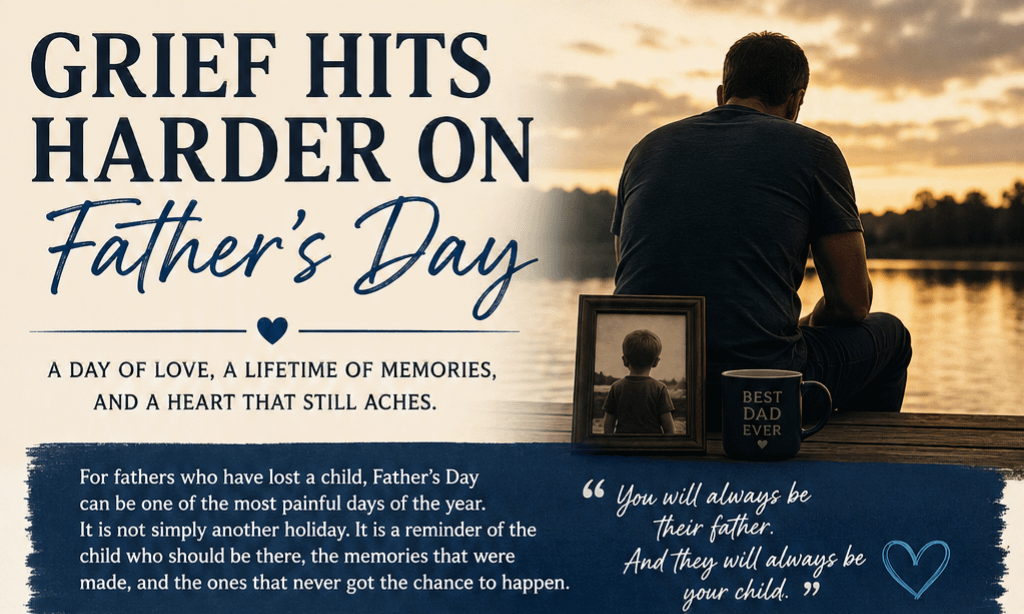
For most people, Father’s Day is a celebration. It is a day filled with family gatherings, phone calls, gifts, cookouts, and expressions of gratitude. Social media fills with photographs of fathers and children smiling together, sharing memories, and celebrating the bond they share.
But for fathers who have lost a child, Father’s Day can be one of the most difficult days of the year.
It is not simply another holiday. It is a reminder.
A reminder of the child who should be there.
A reminder of the memories that were made and the memories that never got the chance to happen.
A reminder that while the world celebrates fatherhood, a grieving father is carrying a loss that many people cannot fully understand.
The truth is that grief hits harder on Father’s Day because Father’s Day itself is about the relationship that was forever changed. It highlights the love that still exists while exposing the painful absence that remains.
The Day Begins Before It Even Arrives
For many grieving fathers, the pain starts long before Father’s Day itself.
As the holiday approaches, reminders begin appearing everywhere.
Store displays showcase Father’s Day gifts. Restaurants advertise special meals. Television commercials focus on fathers spending time with their children. Social media becomes filled with countdowns and celebrations.
Each reminder can feel like a small emotional wound.
What is intended to be joyful for most people can become painful for someone carrying the loss of a child.
The anticipation itself often creates anxiety.
Some fathers dread the day weeks in advance. They know the emotions that are coming. They know the memories that will surface. They know they will once again face the reality that their child is not here.
That anticipation can make Father’s Day feel emotionally exhausting before it even arrives.
A Father’s Identity Never Ends
One of the most misunderstood aspects of child loss is the impact it has on a father’s identity.
When a child dies, fathers do not stop being fathers.
The title remains.
The love remains.
The responsibility to remember remains.
But the daily opportunities to express that fatherhood are suddenly gone.
Father’s Day can bring difficult questions:
“Am I still a father?”
“Do I deserve to celebrate Father’s Day?”
“Should I acknowledge the day at all?”
The answer is yes.
A father remains a father forever.
Death changes the relationship, but it does not erase it.
The bond between parent and child does not end because a heartbeat stops. The love that created that relationship continues to exist.
Many grieving fathers need permission to recognize that they still belong on Father’s Day.
Their child may no longer be physically present, but they are still fathers.
Always.
Missing Their Voice
One of the most painful parts of Father’s Day after losing a child is missing the simple things.
It is not always the major milestones that hurt the most.
Sometimes it is the ordinary moments.
The phone call.
The text message.
The hug.
The laugh.
The simple words:
“Happy Father’s Day, Dad.”
Those words may have once seemed routine.
Now they would mean everything.
Many fathers find themselves staring at old text messages, listening to saved voicemails, or looking through photographs searching for pieces of the child they miss so deeply.
The silence left behind can feel deafening.
There is an emptiness where conversation once lived.
And on Father’s Day, that silence often feels louder than ever.
Grieving the Future That Was Stolen
Losing a child means losing far more than a person.
It means losing an entire future.
Father’s Day often brings that reality into focus.
A father may find himself imagining what life would look like if his child were still here.
Would they have graduated college?
Would they be married?
Would they have children of their own?
Would they be sitting across the table sharing stories and laughter?
The human mind naturally imagines these possibilities because love naturally looks toward the future.
When that future disappears, grief fills the space where dreams once existed.
Many fathers find themselves mourning not only the child they lost but also the life that child never got the chance to live.
The Hidden Grief of Fathers
Society often gives mothers more permission to openly grieve.
People expect mothers to cry.
People expect mothers to talk about their pain.
People expect mothers to struggle.
Fathers are often treated differently.
Many men receive messages throughout their lives that they should be strong, stay composed, and handle pain privately.
As a result, many grieving fathers become experts at hiding their emotions.
They continue working.
They continue providing.
They continue carrying responsibilities.
But inside, they are struggling.
Father’s Day can expose those hidden wounds.
The emotions that have been pushed aside throughout the year often come rushing back.
The grief that has been carefully managed suddenly demands attention.
Many fathers find themselves overwhelmed by emotions they thought they had under control.
This is not weakness.
It is grief.
And grief has its own timetable.
When Other Families Celebrate
One of the hardest parts of Father’s Day is watching other families celebrate.
Most grieving fathers genuinely want others to enjoy the day.
They are happy for fathers who get to spend time with their children.
But that does not erase the pain.
Seeing fathers surrounded by their children can be a painful reminder of what has been lost.
Social media can become especially difficult.
Photographs of family gatherings, vacations, and celebrations may trigger feelings of sadness, jealousy, anger, or loneliness.
These emotions are normal.
They do not mean a grieving father is selfish.
They simply reflect the reality of profound loss.
You can be happy for someone else while still hurting for yourself.
Both emotions can exist at the same time.
The Weight of Guilt
Many grieving fathers carry guilt.
Father’s Day often amplifies those feelings.
They replay decisions.
They revisit conversations.
They wonder if they could have done something differently.
Even when a child’s death was completely beyond their control, many fathers still ask themselves impossible questions.
“What if I had called?”
“What if I had noticed something?”
“What if I had been there?”
Guilt becomes one of grief’s cruelest companions because it constantly rewrites history.
The truth is that most grieving fathers did the best they could with the knowledge they had at the time.
Love does not guarantee control.
Being a father does not mean having the power to prevent every tragedy.
Yet many fathers continue carrying guilt long after the loss.
Father’s Day can bring those feelings back to the surface.
Keeping Their Child’s Memory Alive
Many fathers discover that Father’s Day becomes easier when they intentionally honor their child.
Rather than avoiding memories, they create space for them.
Some visit a cemetery.
Others release balloons, light candles, or write letters.
Some spend time doing activities their child loved.
Others volunteer, donate, or help someone in need in their child’s memory.
These traditions do not erase grief.
But they transform the day from one focused entirely on loss into one that also celebrates love.
The goal is not to move on from the child.
The goal is to move forward while carrying the child’s memory with you.
The Strength to Keep Living
One of the greatest challenges grieving fathers face is learning how to continue living after unimaginable loss.
Father’s Day can highlight this struggle.
Some fathers feel guilty for finding happiness.
Others feel guilty for laughing.
Some feel guilty for enjoying life when their child cannot.
But healing is not betrayal.
Finding joy does not mean forgetting.
Building a future does not mean abandoning the past.
Your child would not want your life to end because theirs did.
They would want you to continue living.
To continue loving.
To continue growing.
To continue finding purpose.
That does not mean the grief disappears.
It means learning to carry grief while still embracing life.
A Message to Every Father Missing a Child
If Father’s Day feels unbearable this year, know that your feelings are valid.
If you cry, it is because you loved.
If you ache, it is because your child mattered.
If you feel lonely, it is because a piece of your heart is missing.
You are not weak.
You are grieving.
And grief is the price we pay for love.
Your child’s life mattered.
Their story mattered.
Their memory matters.
And so does your pain.
This Father’s Day, allow yourself to remember.
Speak their name.
Look at their photographs.
Tell their stories.
Celebrate the love that still exists.
Because while death may have separated you physically, it could never destroy the bond between a father and his child.
You will always be their father.
And they will always be your child.
No holiday, no passing year, and no amount of time can ever change that.
A Father’s Guide to Surviving the Loss of a Child
Leave a Reply