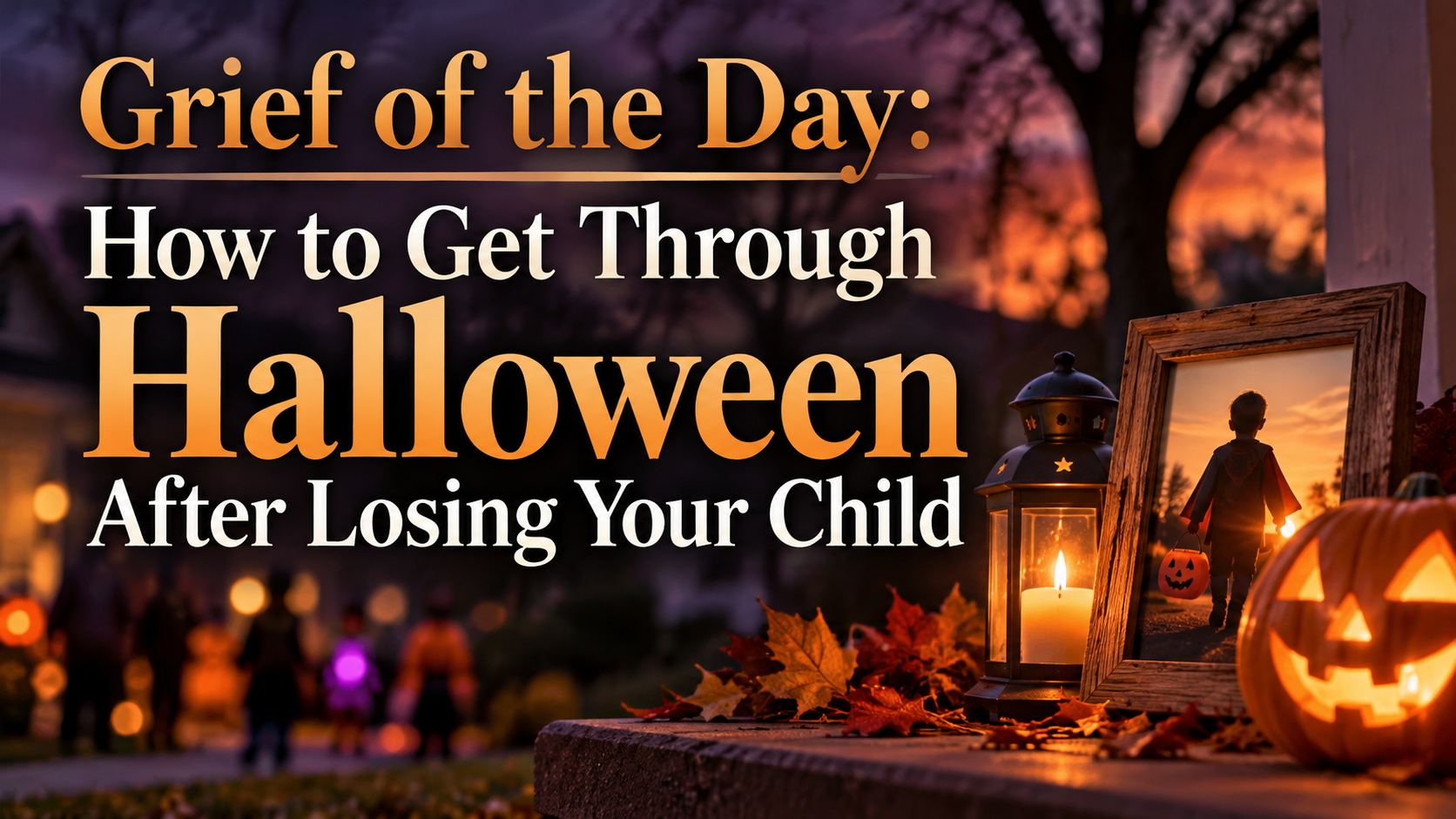
Finding Comfort, Honoring Their Memory, and Surviving a Holiday That Will Never Feel the Same
Halloween is supposed to be a night filled with laughter, costumes, candy, decorations, and excitement. For many families, it is a time when children dress up as their favorite characters, run from house to house collecting treats, and create memories that last a lifetime.
But for a parent who has lost a child, Halloween can feel completely different.
What was once a holiday filled with happiness can become another painful reminder of the person who is missing. The costumes, decorations, trick-or-treaters, and family traditions that once brought joy can now bring tears.
You might remember helping your child choose a costume, carving pumpkins together, watching Halloween movies, or walking through the neighborhood while they excitedly collected candy.
Now, those memories can be both beautiful and heartbreaking.
Losing a child changes everything, including the holidays that once brought your family together.
And Halloween is no exception.
If you are facing Halloween after losing your child, you may be wondering how you are supposed to get through another holiday without them.
The answer is not about forgetting your child, hiding your grief, or pretending everything is okay.
It is about finding a way to survive the day while continuing to carry the love you have for your child.
Why Halloween Can Be So Difficult After Losing a Child
Halloween is often associated with childhood. Even when our children grow older, the memories of their younger years remain with us.
We remember the excitement in their voices, the smiles on their faces, and the little moments we never imagined would someday become priceless memories.
After losing a child, those memories can become especially painful during holidays.
You may find yourself thinking about the costumes your child wore, the candy they loved, or the Halloween traditions your family shared.
You may remember the last Halloween you spent together without realizing it would be your last.
That is one of the cruelest parts of losing a child.
We rarely know when an ordinary moment will become a memory we would give anything to experience again.
Halloween can also be difficult because the world continues celebrating while you are grieving.
Neighbors decorate their homes. Families take pictures. Children laugh as they walk down the street.
Meanwhile, you may be sitting inside your home wishing you could experience just one more Halloween with your child.
The contrast between everyone else’s celebration and your personal heartbreak can make the loneliness feel overwhelming.
But there is something important to understand.
You are not required to celebrate a holiday simply because everyone else is celebrating it.
Your grief deserves compassion, and your emotional well-being matters.
1. Give Yourself Permission to Grieve
One of the most important things you can do during Halloween is give yourself permission to feel whatever emotions come.
You may feel sadness, anger, loneliness, jealousy, guilt, or even moments of happiness.
Sometimes those emotions arrive all at once.
You might wake up feeling strong and believe you can handle the day, only to find yourself crying when you see a child wearing a costume that reminds you of your son or daughter.
You might feel okay watching a Halloween movie but become overwhelmed when you remember watching that same movie with your child.
Grief does not follow a schedule.
It does not care what holiday is being celebrated or how much time has passed since your child died.
There is no correct way to feel on Halloween.
If you need to cry, cry.
If you need to spend time alone, allow yourself that space.
If you want to talk about your child, say their name.
And if you find yourself smiling at a beautiful memory, do not feel guilty.
Experiencing a moment of happiness does not mean you love or miss your child any less.
You can carry grief and gratitude, sadness and laughter, all within the same heart.
2. Remember That You Do Not Have to Celebrate Halloween
Before losing your child, Halloween may have been one of your family’s favorite holidays.
Perhaps you decorated your home, handed out candy, visited pumpkin patches, or planned costumes weeks in advance.
Now, those same activities might feel unbearable.
That is okay.
You do not have to decorate your house.
You do not have to answer the door for trick-or-treaters.
You do not have to attend Halloween parties or pretend to enjoy activities that remind you of what you have lost.
Sometimes surviving a holiday means choosing not to participate.
You might decide to turn off your porch light, close the curtains, and spend the evening somewhere peaceful.
You might choose to stay home and watch a comforting movie that has nothing to do with Halloween.
Or perhaps you would rather spend time with someone who understands your grief.
Whatever you choose, remember that you are not disappointing anyone by protecting your heart.
There may come a year when you feel comfortable celebrating Halloween again.
There may not.
Neither choice determines how well you are grieving.
The important thing is to make decisions based on what you can emotionally handle rather than what others expect.
3. Honor Your Child’s Memory in a Meaningful Way
For some grieving parents, completely avoiding Halloween does not feel right.
Instead, they want to find a way to include their child in the holiday.
Although your child is no longer physically present, their memory can still have a meaningful place in your life.
Honoring them can transform Halloween from a day focused entirely on their absence into a day that also celebrates the love you shared.
Here are a few meaningful possibilities:
-
Light a candle in their memory. Spend a quiet moment remembering the happiness they brought into your life.
-
Display a favorite Halloween photograph. Choose a picture that brings back a special memory.
-
Carve or decorate a pumpkin for them. Include their name, initials, or a design that reminds you of their personality.
-
Prepare their favorite Halloween treat. Remember the foods and candy they enjoyed.
-
Watch a movie you once watched together. Allow yourself to revisit a meaningful family tradition.
-
Share a favorite Halloween memory. Tell someone about a costume, funny moment, or experience you shared.
These gestures do not have to be elaborate.
Sometimes the smallest acts of remembrance carry the greatest meaning.
And if honoring your child in this way feels too painful this year, that is okay too.
You can remember your child without creating a special activity.
Love does not require a ceremony to remain alive.
4. Prepare Yourself for Unexpected Grief Triggers
One of the most challenging parts of Halloween after losing a child is the possibility of encountering unexpected grief triggers.
A grief trigger is something that suddenly brings painful emotions or memories to the surface.
During Halloween, triggers can appear almost anywhere.
A costume might remind you of something your child once wore.
A certain candy might remind you of their favorite treat.
A group of children laughing outside might bring back memories of taking your own child trick-or-treating.
Even the smell of autumn leaves, the sound of a Halloween song, or the sight of pumpkins on a porch can awaken memories.
Sometimes these reminders are comforting.
Other times, they can feel devastating.
You may suddenly find yourself overwhelmed by emotions you thought you had learned to manage.
When this happens, try not to judge yourself.
Take a moment to acknowledge what you are feeling.
If possible, step away from the situation and find somewhere quiet.
Take a few slow breaths, drink some water, or contact someone you trust.
Remind yourself that grief can come in waves, even years after losing your child.
A difficult moment does not mean you have lost all the progress you have made.
It means you are experiencing the continuing impact of loving someone who is no longer physically beside you.
5. Do Not Compare Your Grief to Other Parents
Every parent experiences the loss of a child differently.
Some grieving parents may decorate their homes and participate in Halloween activities because those traditions help them feel connected to their child.
Others may avoid Halloween entirely because the memories are too painful.
Some parents may spend the evening surrounded by family and friends.
Others may prefer solitude.
There is no universal approach to surviving Halloween after child loss.
You may see another grieving parent sharing Halloween pictures, attending parties, or creating memorial decorations and wonder why you cannot do the same.
You may question whether you are handling your grief correctly.
But grief is not a competition.
There is no prize for appearing strong, returning to old traditions, or celebrating holidays before you are ready.
Your relationship with your child was unique.
Your memories are unique.
Your grief will be unique as well.
What brings comfort to another parent may bring pain to you.
And what helps you survive Halloween this year may be completely different from what helps next year.
Allow yourself to grieve in the way that feels right for you.
6. Make a Plan for Halloween Night
Sometimes the anticipation of a difficult holiday can be almost as painful as the holiday itself.
You may spend days or weeks worrying about how you will feel when Halloween finally arrives.
Having a simple plan can make the day feel a little less overwhelming.
Your plan does not have to involve elaborate activities.
It might be as simple as deciding where you want to spend the evening, whether you want company, and what you will do if your grief becomes particularly intense.
For example, you might decide to:
-
Spend the evening at home in a peaceful environment.
-
Have dinner with a trusted friend or family member.
-
Visit a place that reminds you of your child.
-
Write a letter to your child.
-
Watch a comforting movie.
-
Take a quiet walk.
-
Spend time looking through photographs.
-
Turn off your phone and take a break from social media.
You can also create a backup plan.
If you initially decide to attend a Halloween gathering but become overwhelmed, give yourself permission to leave early.
If you plan to spend the evening alone but begin feeling lonely, have someone you can contact.
The goal is not to control your grief.
It is to give yourself options and support when difficult emotions arise.
Remember that plans can change.
You are allowed to make a different decision at any point during the day.
7. Be Careful With Social Media
Social media can be particularly difficult during holidays after losing a child.
On Halloween, your feeds may become filled with photographs of children wearing costumes, families visiting pumpkin patches, and parents sharing happy memories.
Before your loss, you may have enjoyed seeing these pictures.
Afterward, they may remind you of everything you are missing.
You might see a parent posting a picture of their child and immediately remember taking similar photographs.
You may find yourself thinking about the pictures you will never get to take.
The birthdays, holidays, and milestones your child will never experience can suddenly feel painfully close.
If scrolling through social media becomes overwhelming, it is okay to take a break.
You do not have to view every photograph or respond to every holiday greeting.
You can temporarily step away from social media without feeling guilty.
You might also choose to share a photograph or memory of your child.
Sometimes telling the world that you still remember and love your child can bring comfort.
But that choice should come from your heart, not from a feeling of obligation.
8. Find Comfort in Talking About Your Child
One of the loneliest experiences for grieving parents is feeling as though the world has stopped talking about their child.
As time passes, people may become uncomfortable mentioning their name.
They may worry that bringing up your child will make you sad.
What they sometimes fail to understand is that you are already thinking about your child.
You remember them every day.
You miss them during ordinary moments, special occasions, and everything in between.
Halloween can be an opportunity to share memories with someone willing to listen.
Talk about the costumes your child wore.
Remember the funny things they said.
Share stories about their favorite candy, Halloween adventures, or family traditions.
You might discover that telling these stories brings tears and smiles at the same time.
That is one of the complicated realities of grief.
The memories that hurt can also be the memories that keep us connected to the people we love.
If you do not have someone nearby who understands, consider connecting with a bereaved-parent support group.
Sometimes speaking with another parent who has experienced child loss can provide a level of understanding that is difficult to find elsewhere.
You deserve to have people in your life who allow you to say your child’s name without making you feel uncomfortable.
9. Remember That Your Child Is More Than Their Absence
After losing a child, holidays can become dominated by thoughts of everything that is missing.
The empty chair.
The silent bedroom.
The traditions that no longer feel complete.
The photographs that will never be taken.
The conversations that will never happen.
These losses are real, and they deserve acknowledgment.
But your child’s life was more than the pain of losing them.
They were a person with a personality, dreams, interests, laughter, and a story.
They brought something into this world that no one else could have brought.
Halloween can be an opportunity to remember not only what you have lost but also what you were fortunate enough to experience together.
Think about the laughter.
The excitement.
The silly costumes.
The unexpected moments that became treasured memories.
You do not have to force yourself to focus on positive memories when your grief is overwhelming.
But when those memories come, allow yourself to appreciate them.
Your child’s life mattered.
Their happiness mattered.
And the love you shared continues to matter.
Death may have changed your relationship with your child, but it cannot erase the life they lived or the love they gave you.
10. Allow Yourself to Create New Traditions
One of the hardest decisions after losing a child is whether to continue old family traditions.
Some traditions may feel too painful without your child.
Others may become important ways of keeping their memory alive.
You may eventually decide to create something new.
Perhaps you could donate Halloween candy to a community organization in your child’s memory.
Maybe you could support a local children’s charity, participate in a memorial event, or perform an act of kindness in their honor.
You might start a tradition of lighting a candle every Halloween evening.
Or you might simply spend the day doing something that brings you peace.
Creating a new tradition does not mean replacing your child.
It does not mean forgetting the Halloween celebrations you once shared.
And it certainly does not mean that you have moved on from your loss.
It means you are finding ways to continue living while carrying your child’s memory with you.
That distinction matters.
Because moving forward after losing a child should never require leaving them behind.
11. Understand That Grief Can Change From Year to Year
You may discover that Halloween feels different each year.
The first Halloween after losing your child may feel unbearable.
The second may bring unexpected sadness.
Several years later, you might find yourself struggling again, even after experiencing previous holidays with fewer difficulties.
This does not mean you are grieving incorrectly.
It does not mean you should be further along.
Grief changes because life continues changing around it.
New experiences, memories, relationships, and milestones can influence how you feel.
Some years, you may want to honor your child publicly.
Other years, you may prefer to remember them privately.
There may be Halloweens when you laugh at old photographs and others when you cannot bring yourself to look at them.
All of these experiences can be part of living with grief.
The goal is not to reach a point where Halloween never hurts again.
The goal is to develop ways of caring for yourself while acknowledging that your child will always be an important part of your life.
12. Take Care of Yourself Physically and Emotionally
Grief affects more than our emotions.
It can influence sleep, appetite, concentration, energy, and overall well-being.
During difficult holidays, these effects may become more noticeable.
You may have trouble sleeping because memories keep replaying in your mind.
You may feel exhausted even though you have done very little.
You might forget to eat or find yourself withdrawing from people.
Taking care of yourself does not eliminate grief, but it can help you cope with the physical strain of emotional pain.
Try to eat regular meals, drink water, and rest when you need to.
If you feel overwhelmed, consider spending time outdoors or practicing a calming activity.
If your grief becomes difficult to manage, reaching out to a grief counselor or bereavement support group may help.
You do not have to carry every difficult emotion alone.
And seeking support does not mean you are weak.
It means you recognize that losing a child is an enormous burden to carry.
13. Remember That It Is Okay to Laugh Again
For some grieving parents, one of the most complicated emotions after losing a child is guilt.
You might feel guilty when you laugh.
You might feel guilty when you enjoy a holiday activity.
You may even feel guilty when you experience a moment without thinking about your loss.
Halloween can bring these feelings to the surface.
Perhaps someone tells a funny story, and you laugh.
Maybe you see a child wearing a ridiculous costume and smile.
For a brief moment, you experience happiness.
Then guilt appears.
You may wonder how you can possibly enjoy anything when your child is gone.
But happiness and grief are not opposites.
They can exist together.
You can laugh while missing your child.
You can enjoy a moment while wishing they were there to share it.
You can experience happiness without betraying their memory.
Loving your child does not require you to remain miserable for the rest of your life.
Your love is not measured by how much you suffer.
It is reflected in the relationship you shared, the memories you carry, and the place your child continues to hold in your heart.
14. For the Fathers Who Grieve Quietly on Halloween
When people talk about losing a child, fathers are sometimes overlooked.
Society often expects fathers to remain strong, support everyone else, and keep their emotions under control.
But fathers grieve too.
A father remembers helping his child put on a Halloween costume.
He remembers carrying his child when they became tired from trick-or-treating.
He remembers watching their excitement as they counted their candy.
He remembers the laughter, the conversations, and the ordinary moments that became extraordinary after loss.
And when Halloween arrives, he may feel the absence of his child just as deeply as anyone else.
Yet he may not know how to express it.
He may sit quietly while the neighborhood celebrates.
He may look at an old photograph without telling anyone.
He may remember a Halloween from years ago and suddenly feel tears forming.
To every grieving father facing Halloween without his son or daughter:
You do not have to pretend you are okay.
You do not have to hide your tears.
You do not have to be strong every moment of every day.
You are still a father.
Your love for your child did not end when their life ended.
And the fact that you continue missing them is a reflection of the bond you shared.
There is nothing weak about a father who cries for his child.
There is nothing shameful about admitting that holidays are difficult.
Sometimes strength is simply making it through another day while carrying a heartbreak that few people fully understand.
15. When Halloween Brings Back the Pain of Losing Your Child
For some families, Halloween falls especially close to the anniversary of their child’s death.
When a holiday and a painful anniversary occur near each other, grief can become even more intense.
You may already be struggling with memories of the days leading up to your child’s death.
You may remember where you were, what you were doing, or the last conversations you shared.
Then Halloween arrives, bringing its own reminders of family traditions and happier times.
This combination can make October an especially difficult month.
You might feel emotionally exhausted before Halloween even begins.
You may notice that your grief becomes heavier as the date approaches.
Sometimes the anticipation of an anniversary can affect us before we consciously recognize why.
If this happens, try to give yourself additional patience and compassion.
You may need more rest, fewer commitments, or extra support.
You may want to spend time remembering your child or simply allow the day to pass quietly.
There is no requirement to turn a painful anniversary into a celebration.
Sometimes acknowledging the significance of the date is enough.
16. A Personal Reflection: Another Halloween Without My Son
As a father who has lost his son, I understand how holidays can become reminders of everything that has changed.
There was a time when life felt different.
There was a time when I could look forward to holidays without carrying the same weight of grief.
There was a time when the future included my son.
After losing him, I learned that the calendar does not stop simply because your world has fallen apart.
Holidays continue arriving.
Seasons change.
People celebrate.
And somehow, you are expected to keep going.
Halloween is another reminder that life is moving forward even when part of my heart remains in the past.
I think about the memories I have with my son.
I think about the moments we shared and the experiences I wish we could have again.
I think about how much I would give for one more conversation, one more laugh, or one more ordinary day together.
But I also think about the person he was.
I remember the love, the kindness, and the difference he made in my life.
My son was more than the greatest loss I have ever experienced.
He was one of the greatest blessings of my life.
And although I cannot change what happened, I can choose to keep his memory alive.
I can continue speaking his name.
I can continue sharing his story.
I can continue helping other grieving parents understand that they are not alone.
Some days, moving forward feels possible.
Other days, simply getting through the day feels like an accomplishment.
Halloween may never feel the same again.
But my love for my son will never change.
I am still his father. He will always be my son. And nothing, not even death, can take away the love we shared.
17. What to Say to a Parent Who Has Lost a Child on Halloween
If you know someone who has lost a child, Halloween may be an opportunity to offer kindness and support.
You do not need to find the perfect words.
In fact, there may be no words capable of making their pain disappear.
But acknowledging their child and remembering that holidays can be difficult may mean more than you realize.
You might say:
-
“I’m thinking about you and your child today.”
-
“I know Halloween may be difficult. I’m here if you need anything.”
-
“Would you like to share a Halloween memory of your son or daughter?”
-
“You don’t have to do anything today that you don’t feel comfortable doing.”
-
“I haven’t forgotten your child.”
Sometimes the most meaningful thing you can do is listen.
Allow the parent to talk about their child without changing the subject.
Do not pressure them to participate in celebrations.
Avoid telling them that enough time has passed or that they should focus only on happy memories.
And remember that a grieving parent may need support even if their child died many years ago.
The passing of time does not erase the importance of a child.
A simple message, phone call, or thoughtful gesture can remind a grieving parent that both they and their child are remembered.
18. Finding Hope While Carrying Grief
Hope can be difficult to understand after losing a child.
When your child dies, the future you imagined changes forever.
The holidays, birthdays, family gatherings, and milestones you expected to share may never happen the way you planned.
It can be difficult to imagine happiness when someone so important is missing.
But hope does not have to mean believing that everything will return to the way it was.
It does not mean pretending your loss was somehow necessary.
And it does not mean that the pain will completely disappear.
Sometimes hope is much smaller.
Hope may be waking up tomorrow and finding the strength to begin another day.
It may be sharing a memory of your child without feeling completely overwhelmed.
It may be finding someone who understands your grief.
It may be discovering that you can still help others, experience meaningful moments, and build a life that honors the love you shared.
For parents who find comfort in faith, prayer can also provide a quiet place to express sorrow, ask for strength, and seek peace.
You do not need to have all the answers.
You do not need to understand why your child died.
You do not need to know what the rest of your life will look like.
Sometimes hope simply means believing that another meaningful moment may still be possible, even while you continue missing your child.
A Prayer for Grieving Parents on Halloween
Heavenly Father,
As Halloween arrives, I come before You carrying a heart filled with love, memories, and sorrow.
You know the pain of missing my child. You know the memories that bring tears to my eyes and the silence that fills the moments when I wish they were still here.
Please give me strength to face this holiday.
When memories become overwhelming, surround me with Your comfort.
When loneliness feels unbearable, remind me that I do not have to face my grief alone.
Help me remember the beautiful moments I shared with my child and the love that will always remain in my heart.
Give comfort to every mother and father facing another holiday without their son or daughter.
Help us find peace in the memories, strength for the difficult moments, and hope for the days ahead.
And when the weight of grief feels too heavy, remind us that we are allowed to rest, cry, remember, and take life one day at a time.
In Jesus’ name, Amen.
Final Thoughts: Getting Through Halloween One Moment at a Time
Halloween after losing a child is not simply another holiday.
It can be a reminder of the laughter that once filled your home, the traditions you shared, and the future you expected to experience together.
It can bring back memories you treasure and emotions you struggle to carry.
Some parents will choose to celebrate.
Others will choose to stay home.
Some will light candles, share photographs, or continue family traditions.
Others will simply try to make it through the evening.
Every one of those choices deserves understanding.
If you are facing Halloween without your child, remember that you do not have to make the day special.
You do not have to create new traditions.
You do not have to smile for anyone.
You do not even have to feel hopeful today.
Sometimes surviving another holiday is enough.
And if you find a moment of peace, laughter, or comfort, allow yourself to experience it without guilt.
Your child will always be part of your story.
The love you shared did not disappear when their life ended.
It continues through your memories, the lessons they taught you, the people they touched, and the ways you choose to honor them.
Halloween may never be the same.
Your life may never be the same.
But the love between a parent and child remains something extraordinary.
You are not moving on from your child. You are learning how to move forward while carrying them in your heart.
And if all you can do this Halloween is make it through one hour, one memory, or one breath at a time, that is enough.
Because you are still here.
You are still their parent.
And your love for your child will always matter.
A Question for Grieving Parents
What is one Halloween memory of your child that you will always treasure, and how do you honor their memory during the holidays?
If you feel comfortable, share your story. Your memories may help another grieving parent feel less alone.



Leave a Reply