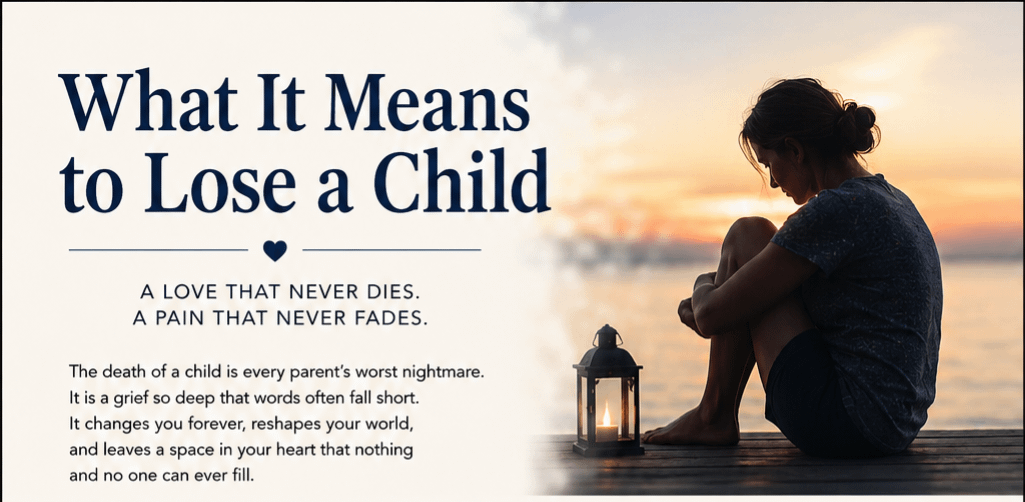
There are losses in life that leave scars. There are losses that change our routines, alter our plans, and challenge our hearts.
Then there is the loss of a child.
Losing a child is not simply another form of grief. It is a life-altering event that changes a parent forever. It reshapes the way you see the world, the way you view yourself, and the way you imagine the future. It is a pain so profound that many parents struggle to find words that adequately describe it.
The death of a child is often called one of the most devastating experiences a human being can endure. Whether the child was young or grown, whether the loss came suddenly or after a long illness, the heartbreak reaches into every corner of a parent’s life.
To lose a child is to lose a piece of your own heart.
The Loss of a Future
When a child dies, parents do not only grieve the life that was lived.
They grieve the life that was supposed to be.
Every parent carries dreams for their child. They imagine birthdays, graduations, careers, marriages, grandchildren, and countless milestones yet to come. They envision family gatherings years into the future and moments that have not yet happened.
When a child dies, those dreams disappear in an instant.
Parents find themselves mourning not only memories but possibilities.
The future they expected is suddenly gone.
The chair at the holiday table remains empty.
The phone no longer rings.
The milestones never arrive.
The silence becomes one of the loudest reminders of all.
A Pain Unlike Any Other
Many grieving parents describe the loss of a child as a physical pain.
Their chest feels heavy.
Their stomach knots with anxiety.
Their body aches from carrying the emotional weight of the loss.
Simple tasks become difficult.
Concentration disappears.
Sleep becomes elusive.
Food loses its taste.
Laughter feels distant.
The pain of child loss often affects every aspect of life—emotionally, mentally, physically, and spiritually.
Even years later, parents can find themselves overwhelmed by memories triggered by a photograph, a song, a familiar scent, or a special date.
Grief does not disappear because time passes.
Love does not disappear either.
The World Keeps Moving
One of the hardest realities after losing a child is watching the world continue as if nothing happened.
People return to work.
Neighbors continue their routines.
Friends celebrate birthdays and anniversaries.
Children play in parks.
Life moves forward.
For grieving parents, this can feel confusing and painful.
How can the world continue when their world has stopped?
Many parents feel isolated during this time. They may withdraw from social events, avoid conversations, or struggle to relate to people whose lives seem untouched by tragedy.
The loneliness of child loss is often one of the most difficult burdens to carry.
The Fear of Forgetting
Many bereaved parents live with a fear that few people talk about openly.
They fear forgetting.
They worry that one day their child’s voice will become harder to remember.
They fear losing small details—the sound of their laugh, the way they smiled, the expressions they made, the little habits that made them unique.
Because of this, many parents hold tightly to photographs, videos, text messages, letters, clothing, and keepsakes.
These items become treasures.
Not because parents are unable to move forward, but because they are determined to preserve the memory of someone they love deeply.
A parent’s greatest fear is often not their own grief.
It is the possibility that their child could be forgotten.
The Guilt Many Parents Carry
After losing a child, many parents wrestle with guilt.
They replay events repeatedly in their minds.
They ask impossible questions:
- What if I had done something differently?
- What if I had called?
- What if I had noticed something sooner?
- What if I had been there?
The mind searches endlessly for answers because answers feel easier than accepting a painful reality.
Yet most grieving parents are carrying responsibility for things they could never have controlled.
The truth is simple:
If love alone could have saved a child, no parent would ever experience this loss.
Parents love with everything they have.
The fact that tragedy occurred does not mean they failed.
It means they are human.
How Child Loss Changes a Parent
The death of a child changes a parent forever.
It changes priorities.
It changes relationships.
It changes perspectives.
Many parents discover they no longer worry about the same things they once did. Problems that once seemed significant suddenly feel trivial.
Life takes on a different meaning.
Some parents become quieter.
Others become more compassionate.
Many develop a deeper appreciation for time, family, and meaningful relationships.
The grief never fully leaves, but it often transforms the person carrying it.
Loss has a way of teaching lessons no one wants to learn.
The Relationship Never Ends
One of the biggest misconceptions about grief is the belief that death ends a relationship.
It does not.
Parents continue loving their children long after death.
They continue talking about them.
They continue celebrating birthdays.
They continue honoring anniversaries.
They continue carrying their child’s memory wherever they go.
Love does not end because a life ends.
The relationship changes, but it remains.
Many parents speak their child’s name often because it keeps their memory alive.
Others volunteer, donate, advocate, or help others in their child’s honor.
Every act of remembrance becomes a way of continuing that bond.
Learning to Live Again
Perhaps the greatest challenge after losing a child is learning how to live in a world without them.
At first, survival becomes the goal.
Simply making it through another day feels impossible.
Over time, many parents begin discovering something unexpected.
The heart can hold grief and joy at the same time.
They can miss their child and still smile.
They can cry and still laugh.
They can carry sorrow while also experiencing moments of gratitude.
This does not mean they have forgotten.
It does not mean the pain is gone.
It means they are learning how to carry both love and loss together.
Healing is not about moving on from a child.
Healing is about moving forward while keeping that child forever in your heart.
What It Truly Means to Lose a Child
To lose a child means carrying a love that has nowhere to go.
It means waking up each day missing someone who should still be here.
It means grieving both memories and dreams.
It means learning to survive the unimaginable.
But it also means discovering the incredible depth of a parent’s love.
A love so powerful that even death cannot erase it.
A love that continues through memories, stories, traditions, and acts of kindness.
A love that remains long after the funeral flowers have faded.
The loss of a child changes everything.
Yet the love for that child remains one of the strongest forces a parent will ever know.
And that love, no matter how much time passes, never dies.
A Father’s Guide to Surviving the Loss of a Child
Leave a Reply