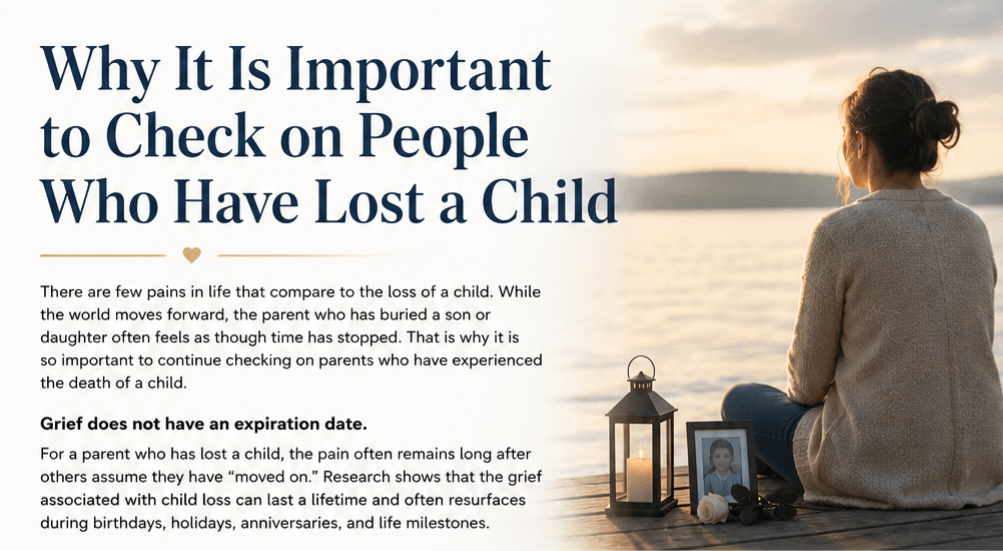
There are few pains in life that compare to the loss of a child. It is a grief that changes a parent forever. While the world continues to move forward, the parent who has buried a son or daughter often feels as though time has stopped. The loss becomes a permanent part of their life, and although they may learn how to carry it, they never truly stop grieving. That is why it is so important to continue checking on parents who have experienced the death of a child.
Many people offer support immediately after a loss. They send cards, flowers, messages, and prayers. Family and friends gather around during the funeral and the weeks that follow. However, as time passes, the phone calls become less frequent, the visits become rare, and life returns to normal for everyone except the grieving parent.
The truth is that grief does not have an expiration date.
For a parent who has lost a child, the pain often remains long after others assume they have “moved on.” Research consistently shows that the grief associated with child loss can last a lifetime and often resurfaces during birthdays, holidays, anniversaries, and significant life milestones.
The Loneliness That Follows
One of the most difficult parts of losing a child is the loneliness that follows.
People often stop mentioning the child because they are afraid of causing pain. They worry they might say the wrong thing. In reality, many grieving parents desperately want to hear their child’s name spoken. They want to know their child has not been forgotten.
When nobody asks how they are doing, it can feel as though the world has forgotten both their child and their grief. Months and years after the loss, many bereaved parents describe feeling isolated as support fades while their pain remains.
A simple text message can make a tremendous difference:
“I was thinking about you today.”
“How are you doing?”
“I remembered your son today and wanted you to know.”
These small gestures remind grieving parents that they are not alone.
Grief Doesn’t Follow a Schedule
One of the biggest misconceptions about grief is that it follows a timeline. Many people assume that after a year or two, a parent should be doing better.
The reality is very different.
Grief can intensify unexpectedly. A song, a photograph, a graduation season, or seeing other families together can trigger powerful emotions. Parents may appear strong on the outside while privately struggling with overwhelming sadness, guilt, anger, or loneliness. There is no “normal” timeline for losing a child.
Checking in regularly lets grieving parents know they do not have to hide their pain.
Sometimes They Won’t Ask for Help
Many grieving parents become experts at saying, “I’m fine.”
Not because they are fine, but because they do not want to burden others.
The emotional weight of child loss can be exhausting. Some parents feel guilty asking for support. Others believe nobody could truly understand what they are experiencing. As a result, they often suffer in silence.
That is why checking on them matters.
Do not wait for them to reach out. Reach out first.
Ask how they are doing. Listen without trying to fix their pain. Sometimes the greatest gift you can give someone is simply your presence.
Remember the Important Dates
One of the most meaningful ways to support a grieving parent is to remember their child.
Remember birthdays.
Remember anniversaries.
Remember holidays.
Remember the day their child passed away.
These dates can be incredibly difficult. While everyone else is focused on celebrations and daily life, parents are often reliving memories and feeling the weight of their loss all over again.
A message that says, “I’m thinking about you and your child today,” can bring comfort during an otherwise painful day.
You Don’t Have to Have the Perfect Words
Many people avoid grieving parents because they are afraid of saying the wrong thing.
The truth is that perfection is not required.
You do not need a speech.
You do not need answers.
You simply need compassion.
Often, the most meaningful words are the simplest:
“I’m here for you.”
“I can’t imagine what you’re going through, but I care.”
“Tell me about your child.”
The willingness to listen is far more valuable than finding the perfect words.
Faith, Hope, and Healing
For many parents, faith becomes an important source of strength after the loss of a child. While it may not remove the pain, it can provide hope during the darkest moments. It reminds them that love does not end with death and that the bond they share with their child continues.
Yet even with faith, grief remains a heavy burden.
No parent should have to carry that burden alone.
Final Thoughts
If you know someone who has lost a child, do not assume they are okay simply because time has passed.
Check on them.
Call them.
Send a message.
Invite them to lunch.
Remember their child.
Remember their pain.
Most importantly, remind them that they are not forgotten.
Your simple act of kindness may not take away their grief, but it can make the journey a little less lonely. Sometimes the greatest gift you can give a grieving parent is letting them know that both they and their child still matter.
A Father’s Guide to Surviving the Loss of a Child
Leave a Reply