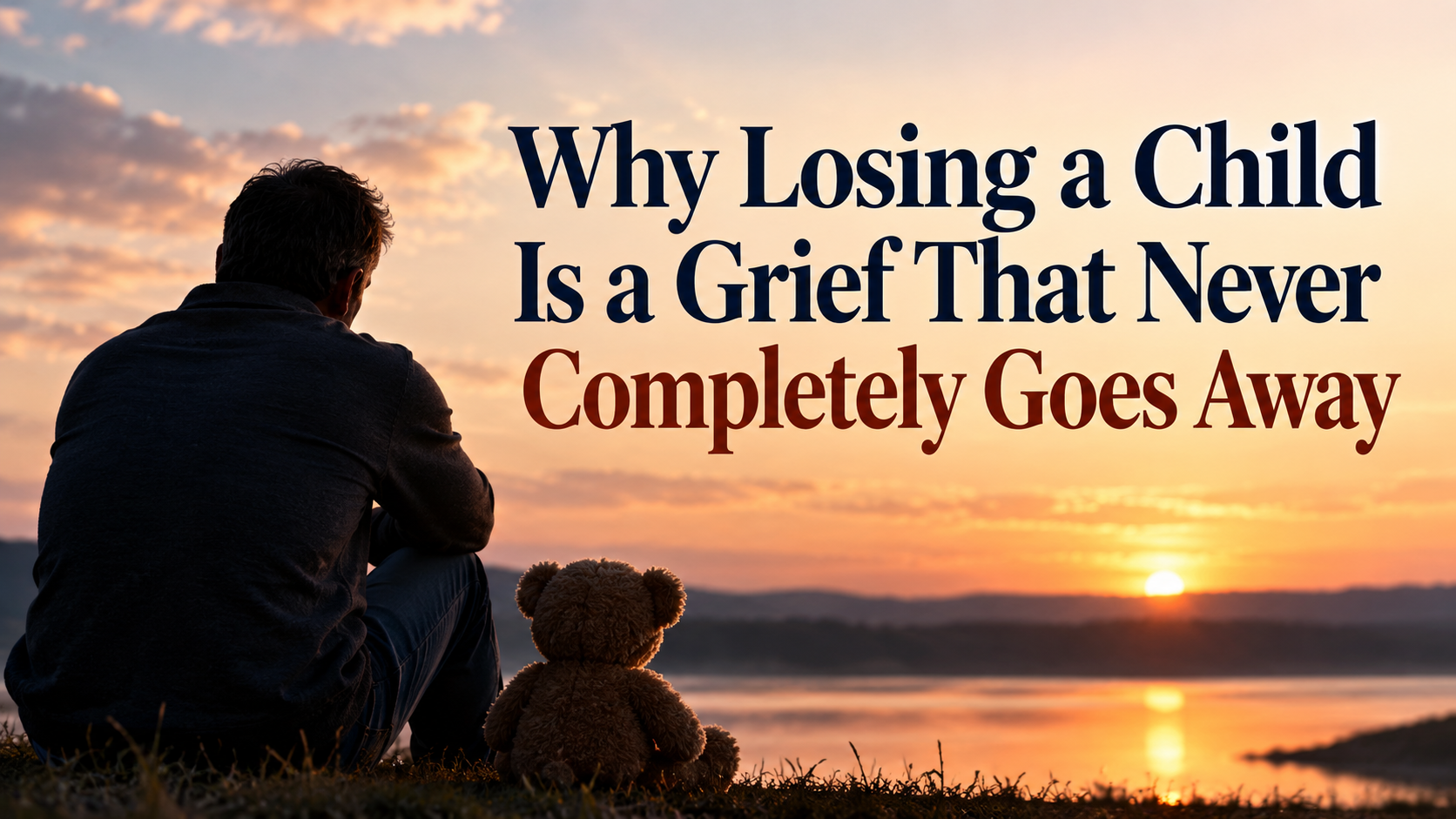
There are losses in life that hurt deeply, change us, and leave memories we carry forever. Then there is the loss of a child.
Losing a child does not simply create an empty place in your life. It changes the shape of your entire world.
When your child dies, you do not only grieve the person you loved. You grieve the future you expected to share with them. You grieve conversations that will never happen, birthdays they will never celebrate, holidays when their chair will remain empty, and ordinary moments that once seemed so insignificant.
You grieve the sound of their voice.
Their laugh.
Their habits.
Their personality.
The way they walked into a room.
The way they said your name.
You grieve the person you were when they were still here.
And perhaps that is one of the hardest things for people who have never lost a child to understand: the grief does not completely disappear because the love does not disappear.
You learn how to carry it.
You learn how to function around it.
You may eventually laugh again, enjoy life again, make plans again, and even find reasons to be excited about tomorrow.
But somewhere inside you remains a father, mother, or parent who desperately wishes their child were still here.
That part of you never completely goes away.
Neither does the grief.
There Is No Finish Line for Child Loss
People sometimes talk about grief as though it is a journey with a destination.
You grieve.
You heal.
You move on.
But losing a child rarely works that way.
There is no morning when you wake up and suddenly declare that you have finished grieving your child.
There is no anniversary when your heart finally decides that enough time has passed.
There is no magical point when memories stop hurting.
Healing after child loss is not about reaching a place where you no longer miss your child. It is learning how to build a life around an absence that can never truly be filled.
That distinction matters.
A grieving parent may become stronger while still hurting.
They may experience happiness while still missing their child.
They may build new relationships, discover new purposes, travel, laugh, celebrate, and enjoy beautiful moments while simultaneously carrying sorrow.
Two things can exist at the same time:
I am grateful to be alive.
And:
I wish my child were here to experience this with me.
That is one of the strange realities of lifelong grief.
Your Child Was Part of Your Identity
Becoming a parent changes how you see yourself.
You are no longer simply living for yourself.
Someone depends on you.
Someone calls you Dad or Mom.
Someone looks to you for protection, guidance, encouragement, and love.
Your child’s existence becomes woven into your identity.
You think about their future.
You worry about them.
You celebrate their accomplishments.
You try to protect them from pain.
You imagine who they will become.
Even when your child becomes an adult, that parental connection does not disappear.
They are still your child.
Then the unimaginable happens.
Your child dies.
Suddenly, one of the most important roles in your life feels shattered.
You are still their parent, but you can no longer parent them in the way you once did.
You cannot call them.
You cannot check on them.
You cannot ask whether they ate.
You cannot remind them about something.
You cannot give them advice.
You cannot hug them.
You cannot tell them face-to-face that you love them.
But the instinct to do those things does not immediately disappear.
In many ways, it never does.
The relationship changes from one of physical presence to one carried through memory, love, remembrance, and legacy.
That is one reason grief can remain so powerful decades later.
You never stop being your child’s parent.
You Do Not Only Lose the Past—You Lose the Future
One of the cruelest parts of losing a child is realizing how much of your grief belongs to things that never happened.
Parents naturally imagine the future.
Graduations.
Careers.
Relationships.
Marriage.
Grandchildren.
Family vacations.
Birthday celebrations.
Christmas mornings.
Sunday dinners.
Random phone calls.
Inside jokes.
Arguments.
Reconciliations.
Growing older together.
Even when we do not consciously think about these moments every day, we assume there will be more time.
Then suddenly there isn’t.
That creates a unique kind of grief.
You are grieving memories you never got the opportunity to make.
Every milestone becomes another reminder.
You may see someone your child’s age getting married and wonder what your child’s wedding might have looked like.
You may see a father having lunch with his adult son and feel something deep inside your chest.
You may see grandparents playing with grandchildren and wonder whether that would have been part of your future.
These moments do not mean you are bitter.
They mean you remember the future you once imagined.
Grief Changes Over Time, but It Does Not Disappear
Early grief can feel unbearable.
Everything reminds you of your child.
You wake up and, for a brief moment, forget what happened.
Then reality returns.
They are gone.
Eventually, something changes.
You begin learning how to survive.
You develop routines.
You discover which situations are difficult.
You learn what triggers memories.
You figure out when you need company and when you need solitude.
You learn how to say your child’s name without always falling apart.
You may even reach a point when memories that once destroyed you begin making you smile.
That is healing.
But healing should not be confused with forgetting.
Years later, grief can still arrive unexpectedly.
A song.
A photograph.
A smell.
A restaurant.
A television show.
A familiar road.
Someone who looks like your child from behind.
A notification from an old social-media memory.
For a moment, years disappear.
Your heart remembers immediately.
That does not mean you have failed at grieving.
It means love has a memory.
Birthdays and Anniversaries Can Bring Everything Back
Dates carry tremendous emotional power after losing a child.
Their birthday.
The day they died.
The last holiday you spent together.
The last conversation you remember.
The last photograph.
The last hug.
Sometimes your body seems to recognize an approaching anniversary before your mind consciously acknowledges it.
You may become restless.
Emotional.
Exhausted.
Irritable.
Withdrawn.
You might wonder why you suddenly feel different, only to look at the calendar and realize what is approaching.
Other dates can hurt too.
Father’s Day.
Mother’s Day.
Christmas.
Thanksgiving.
National Sons Day or National Daughters Day.
Family celebrations.
Even your own birthday can become complicated because another year of your life has passed without your child.
These moments remind grieving parents that grief does not follow a straight line.
You can have months when you feel relatively strong and then experience a date that brings everything rushing back.
Ordinary Moments Can Hurt the Most
People expect the major days to be difficult.
What surprises many grieving parents are the ordinary moments.
Sometimes it is seeing something at the grocery store your child loved.
Sometimes you instinctively reach for your phone because something happened and you want to tell them.
Sometimes you hear a joke they would have loved.
Sometimes you see a movie trailer and think:
They would have wanted to see that.
Sometimes you cook their favorite meal.
Sometimes you find an old piece of clothing.
Sometimes you discover a photograph you forgot existed.
For a moment, you are transported back to another life.
A life where they were still here.
These ordinary reminders can carry extraordinary emotional weight.
Other People May Move Forward Before You Do
One painful reality of grief is that the world continues.
Bills still arrive.
People still go to work.
Restaurants remain open.
Traffic continues.
People celebrate birthdays.
Neighbors mow their lawns.
Television shows continue releasing new episodes.
The world keeps moving while yours feels frozen.
During the first weeks or months after a child’s death, people may check on you frequently.
They send messages.
They bring food.
They call.
They ask how you are doing.
Then slowly, life returns to normal for them.
But your normal no longer exists.
Months later, people may assume you are doing better because you are functioning.
Years later, some may assume you should be completely healed.
They may stop mentioning your child’s name because they worry it will upset you.
What they may not understand is that you were already thinking about your child.
Hearing their name often does not create the grief.
The grief is already there.
Sometimes hearing their name is actually comforting because it tells you that your child has not been forgotten.
Fathers May Carry Their Grief Quietly
Grieving fathers can face another difficulty.
Many men grow up believing they are supposed to remain strong.
Protect the family.
Handle problems.
Keep going.
Do not break down.
After losing a child, those expectations can become crushing.
A father may be completely devastated inside while appearing calm to everyone around him.
He may return to work.
Take care of responsibilities.
Help other family members.
Answer questions.
Make arrangements.
Handle paperwork.
People may look at him and think he is doing well.
But privately, he may be struggling to understand how he is supposed to continue living in a world without his child.
Strength does not mean pretending you are unaffected.
Sometimes strength means admitting:
I miss my child today.
Sometimes it means crying.
Sometimes it means talking.
Sometimes it means asking for help.
And sometimes it simply means getting through another difficult day.
Healing Does Not Mean Leaving Your Child Behind
Some grieving parents struggle with moving forward because it feels like betrayal.
If I laugh again, am I forgetting them?
If I enjoy myself, does that mean I am leaving them behind?
If I start a new chapter of my life, does that mean the old chapter no longer matters?
No.
Living does not erase love.
Finding happiness does not replace your child.
Creating new memories does not destroy the memories you already have.
Your child remains part of your story.
You can carry them forward with you.
You can tell stories about them.
You can say their name.
You can celebrate their birthday.
You can help other grieving parents.
You can support causes that mattered to them.
You can create traditions in their memory.
You can write about them.
You can live in ways that honor what they taught you.
Continuing to live is not the same as moving away from your child.
Sometimes it becomes another way of carrying their love forward.
Grief and Love Become Intertwined
Why does grief remain?
Because love remains.
If someone told you that the only way to completely eliminate your grief was to erase every memory of your child, would you take that deal?
Most grieving parents would probably say no.
Because the memories matter.
The laughter matters.
The conversations matter.
The photographs matter.
The years you had together matter.
Even if remembering sometimes hurts, those memories are evidence of something extraordinary:
Your child lived.
They mattered.
They changed your life.
They were loved.
And they are still loved.
Grief is painful because love was real.
You Learn to Carry Your Child Differently
At first, grief can feel like something you are carrying against your will.
It is heavy.
Unmanageable.
Exhausting.
Over time, something can gradually change.
You begin carrying more than the pain.
You carry the lessons your child taught you.
You carry their sense of humor.
You carry stories.
You carry photographs.
You carry their kindness.
You carry memories of ordinary days that now feel priceless.
You carry the love they gave you.
The grief remains, but it becomes part of something larger.
It becomes remembrance.
Legacy.
Love.
Purpose.
Your child’s physical presence may be gone, but their influence can continue through the person you become.
Some Days Will Always Be Hard
Healing does not guarantee that every day becomes easy.
There may always be days when grief knocks you down.
Sometimes there will be an obvious reason.
Sometimes there will not.
You may wake up one morning desperately missing your child.
Let yourself miss them.
You do not have to apologize.
You do not have to explain.
You do not have to prove that you have healed.
Grief does not have an expiration date.
Your relationship with your child was unique.
So is your grief.
You Are Allowed to Live Again
This may be one of the hardest truths for grieving parents to accept.
You are allowed to live.
Not merely survive.
Live.
You are allowed to laugh.
You are allowed to travel.
You are allowed to love.
You are allowed to meet new people.
You are allowed to create goals.
You are allowed to become excited about something.
You are allowed to enjoy a beautiful morning.
You are allowed to experience happiness without immediately feeling guilty.
None of those things erase your child.
Your love for your child is not measured by how miserable you remain.
Your grief does not have to destroy the rest of your life to prove how deeply you loved them.
You can miss your child desperately and still choose life.
Both can be true.
There Will Always Be a Before and an After
For many grieving parents, life eventually becomes divided into two eras.
Before their child died.
And after.
You remember who you were before.
You remember the assumptions you had about life.
You remember believing certain tragedies happened to other families.
Then everything changed.
The person who emerges afterward may be different.
Perhaps quieter.
More compassionate.
Less interested in meaningless arguments.
More aware of how quickly life can change.
More willing to tell people you love them.
More sensitive to other people’s pain.
Grief takes things from us.
But sometimes, through years of carrying it, we also discover things about ourselves we never knew.
Not because losing a child was somehow necessary.
It wasn’t.
But because when we are forced to live through something we never would have chosen, we eventually have to decide what we will do with the life that remains.
The Goal Is Not to Forget
I do not believe healing after losing a child should ever be measured by how rarely you think about them.
Maybe healing looks completely different.
Maybe healing is being able to say their name.
Maybe healing is telling their stories.
Maybe healing is remembering a funny moment and laughing instead of immediately crying.
Maybe healing is helping another grieving parent survive their darkest night.
Maybe healing is waking up one morning and realizing you actually want to see what tomorrow brings.
Maybe healing is understanding that missing your child and continuing to live are not opposites.
You can do both.
Your Child’s Story Continues Through You
A child’s life cannot be measured only by the number of years they lived.
Their influence continues through the people they touched.
Through stories.
Through memories.
Through photographs.
Through traditions.
Through lessons.
Through love.
And through you.
Every time you speak their name, part of their story continues.
Every time you share something they taught you, their influence continues.
Every time their life inspires you to show compassion to someone else, something they gave you continues moving through the world.
Death ended their physical life.
It did not erase their significance.
Why Losing a Child Never Completely Goes Away
The grief remains because your child remains part of who you are.
You cannot remove someone from your heart simply because they are no longer physically beside you.
Years may pass.
Life may change.
People may come and go.
You may build new dreams.
You may become stronger than you ever imagined possible.
But there will probably always be moments when your heart quietly says:
I wish you were here.
That sentence may follow a grieving parent throughout life.
And perhaps that is okay.
Because grief is not evidence that you failed to heal.
It is evidence that someone mattered enough to leave an absence that time cannot completely erase.
Final Thoughts
Losing a child is not something a parent simply gets over.
It becomes something you learn to carry.
Some days, the weight feels manageable.
Other days, it feels almost as heavy as it did in the beginning.
But over time, you may discover that you are carrying something else alongside the pain.
Love.
Memories.
Lessons.
Gratitude for the time you had.
And a determination to make the life you still have mean something.
You do not have to forget your child to move forward.
You do not have to stop grieving to experience happiness.
You do not have to leave your child behind to continue living.
Your child can remain part of your heart, your story, and the person you are becoming.
Because when a parent loses a child, grief may never completely disappear.
But neither does love.
And sometimes learning to carry that love forward becomes one of the most meaningful ways we continue their legacy.
If you have lost a child, what is one memory of them that you hope you will carry with you for the rest of your life?



Leave a Reply