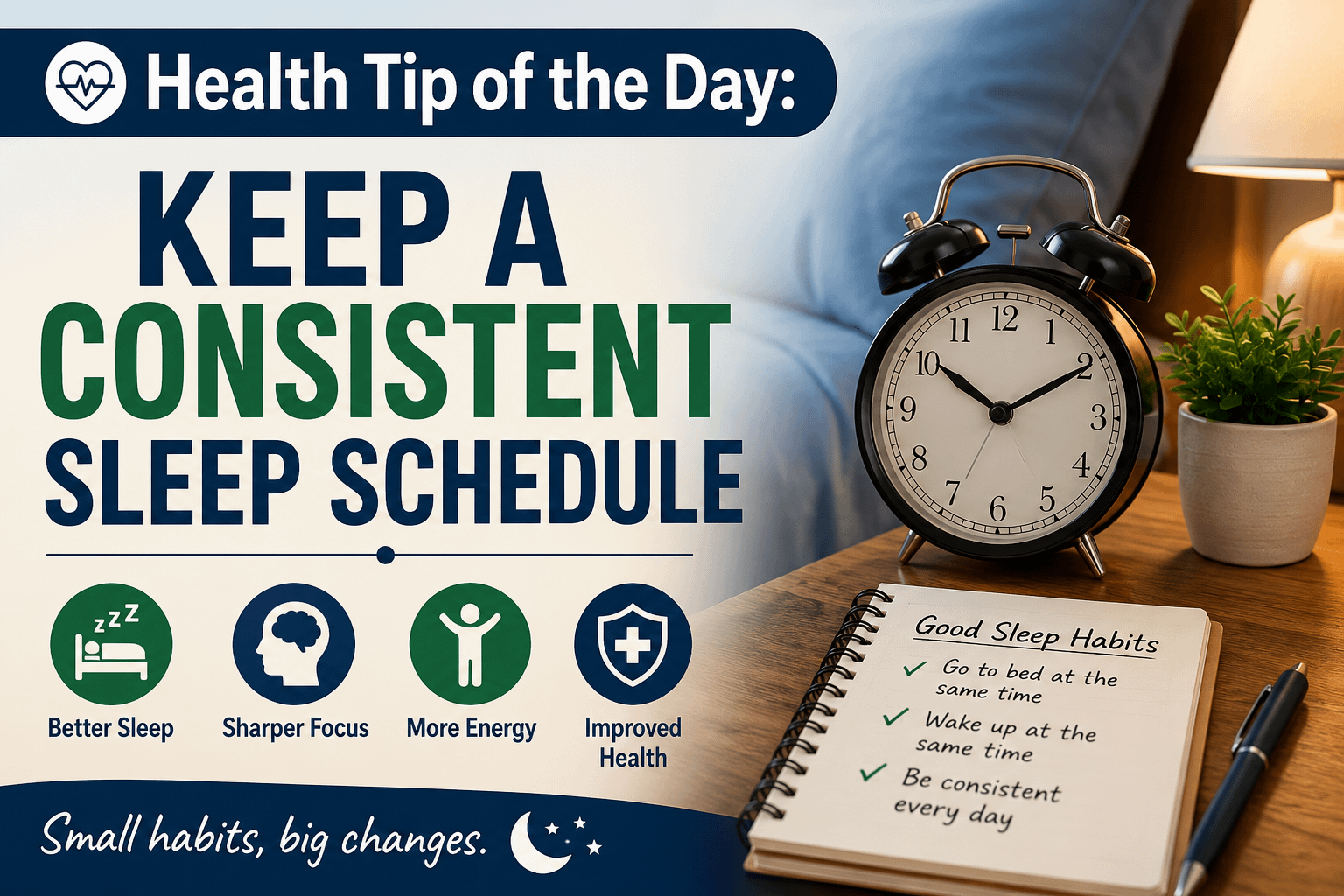
Sleep is one of the foundations of good health, yet it is often one of the first things we sacrifice when life becomes busy. We stay up late finishing work, watching television, scrolling through our phones, spending time with friends, or simply trying to squeeze a little more into the day.
Then morning arrives, the alarm goes off, and we wonder why getting out of bed feels so difficult.
While getting enough sleep is important, there is another part of healthy sleep that deserves attention: consistency.
Going to bed and waking up at approximately the same time each day can help your body establish a predictable rhythm. Over time, your body begins to recognize when it should become sleepy and when it should become alert.
You don’t need a perfect sleep schedule down to the exact minute. The goal is simply to create enough consistency that your body isn’t constantly adjusting to dramatically different sleeping and waking times.
Today’s health tip is simple:
Choose a realistic sleep schedule and try to stick with it.
It may seem like a small change, but small daily habits can have a meaningful impact on how you feel.
Why Your Body Loves Routine
Human beings naturally function according to patterns.
We eat around certain times, become hungry at predictable times, experience changes in energy throughout the day, and eventually become tired and ready for sleep.
Your body has an internal timing system known as the circadian rhythm. This roughly 24-hour cycle helps coordinate periods of wakefulness and sleep.
Light and darkness are particularly important signals for this internal clock.
During the daytime, especially when you’re exposed to natural light, your body receives signals that it is time to be awake and active.
As evening arrives and the environment becomes darker, your body begins preparing for rest.
Keeping regular sleep and wake times helps reinforce those signals.
When your schedule constantly changes, your body has to repeatedly adjust.
What an Inconsistent Sleep Schedule Can Look Like
Consider this example.
Monday through Thursday, you go to bed around 10:30 p.m. and wake up at 6:30 a.m.
Friday arrives, and you stay awake until 1:30 a.m.
Saturday morning, you sleep until 10:30.
Saturday night, you stay awake until 2:00 a.m. and sleep late again Sunday morning.
Then Sunday night arrives.
Suddenly, you’re lying in bed at 10:30 p.m. trying to fall asleep because you have to wake up early Monday morning.
But you’re not tired.
Your body has spent the weekend following a completely different schedule.
Monday morning can then feel especially difficult.
This doesn’t mean you can never stay up late or sleep in. Life includes celebrations, vacations, family gatherings, special events, late nights, and mornings when getting some extra rest feels wonderful.
The goal isn’t perfection.
The goal is to prevent major schedule changes from becoming your normal routine.
A Consistent Wake-Up Time Can Be Especially Helpful
Many people focus primarily on bedtime.
However, your wake-up time deserves just as much attention.
Getting out of bed at approximately the same time every morning creates a reliable starting point for your daily rhythm.
Instead of waking at 6:30 one morning, 8:00 the next, 10:30 on Saturday, and noon on Sunday, try keeping your wake-up time within a relatively consistent range whenever your responsibilities allow it.
Your routine becomes something your body can anticipate.
Eventually, you may notice that you naturally begin becoming tired around your usual bedtime and waking near your usual morning time.
Determine How Much Sleep You Need
A consistent schedule should also give you enough opportunity to sleep.
For most adults, regularly getting at least seven hours of sleep is generally recommended, although individual sleep needs vary.
Think about what time you need to wake up.
Then work backward to determine an appropriate bedtime.
For example, if you need to wake at 6:30 a.m., going to bed after midnight every night probably isn’t going to provide enough sleep opportunity.
Instead of viewing bedtime as the point when everything else has finally been completed, consider making sleep part of your schedule.
You schedule work.
You schedule appointments.
You schedule meals.
You schedule activities.
Sleep deserves a place on the schedule too.
Create a Wind-Down Period Before Bed
One reason people struggle with bedtime is that they expect themselves to switch instantly from activity to sleep.
At 10:25 they’re answering emails, watching videos, checking social media, cleaning the house, or thinking about tomorrow.
At 10:30 they climb into bed and expect their mind to immediately become quiet.
For many people, that transition doesn’t happen instantly.
Try creating a short wind-down period before bedtime.
Thirty minutes to an hour before bed, begin reducing stimulation and preparing yourself for rest.
Your routine might include:
- Dimming the lights around your home
- Putting away work
- Reducing screen use
- Taking a warm shower
- Washing your face and brushing your teeth
- Putting on comfortable sleepwear
- Reading something relaxing
- Listening to quiet music
- Stretching gently
- Practicing deep breathing
- Writing in a journal
- Making a short gratitude list
- Spending a few minutes in prayer or meditation
- Preparing tomorrow’s clothes
- Setting out anything you’ll need in the morning
Your bedtime routine doesn’t have to be complicated.
In fact, simpler is often better.
Choose a few calming activities that you genuinely enjoy and can realistically repeat.
Give Yourself a “Bedtime Reminder”
Many people use an alarm to wake up but never use one to remind themselves to go to bed.
Consider setting a reminder approximately 30 to 60 minutes before your intended bedtime.
When the reminder appears, treat it as your signal to begin winding down.
For example:
9:30 p.m. — Begin bedtime routine
10:00 p.m. — Put away phone
10:15 p.m. — Read or relax
10:30 p.m. — Bedtime
Having a reminder can prevent the common experience of checking the clock and suddenly realizing another hour has disappeared.
Be Mindful of Screens Before Bed
Phones, tablets, televisions, computers, and other electronic devices can easily keep us awake longer than intended.
Sometimes the issue isn’t simply the screen itself.
It’s what we’re doing on it.
You tell yourself you’ll check social media for five minutes.
Thirty minutes disappear.
You watch one episode.
Then another starts automatically.
You read one news story.
Suddenly you’re reading ten more.
The easiest solution may be creating a personal cutoff time for unnecessary screen use.
You don’t have to completely eliminate technology from your evening. Simply become more intentional about when you’re using it.
Your bedtime shouldn’t repeatedly lose a battle against “just five more minutes.”
Use Morning Light to Start Your Day
Your sleep routine doesn’t end when you wake up.
Morning habits can also help reinforce your daily rhythm.
When you wake up, open your curtains or blinds and allow natural light into the room.
If possible, spend some time outside during the morning.
You might:
Take a short walk.
Drink your morning coffee outside.
Sit near a sunny window.
Stretch on the porch.
Walk the dog.
Natural morning light provides your body with a strong daytime signal.
It also gives you another reason to get out of bed instead of repeatedly hitting the snooze button.
Try Not to Depend on the Snooze Button
The snooze button can be incredibly tempting.
The alarm rings.
You press snooze.
Nine minutes later, it rings again.
You press snooze again.
Before you know it, you’ve spent 30 or 40 minutes drifting in and out of sleep.
If possible, try getting up when your alarm first goes off.
One way to make this easier is placing your alarm or phone far enough away that you need to physically get out of bed to turn it off.
Then begin your morning routine immediately.
Open the curtains.
Drink some water.
Wash your face.
Get dressed.
Start moving.
Creating a consistent morning routine can make waking up feel less chaotic.
Watch the Weekend Sleep-In
After several early mornings, sleeping late on Saturday can feel like a reward.
Occasionally getting extra rest is understandable.
However, dramatically shifting your schedule every weekend can make Sunday night and Monday morning more difficult.
If possible, keep weekend sleeping and waking times relatively close to your weekday schedule.
You can still enjoy a slower Saturday morning without turning your entire sleep routine upside down.
Again, consistency doesn’t mean perfection.
It means avoiding extreme changes whenever possible.
Pay Attention to Caffeine
That afternoon coffee might affect you longer than you realize.
Caffeine can remain in your system for hours, and sensitivity varies from person to person.
Coffee isn’t the only source.
Caffeine may also be found in:
- Tea
- Energy drinks
- Soda
- Chocolate
- Certain medications and supplements
If you have difficulty falling asleep, consider paying attention to when you consume caffeine.
Try moving your final caffeinated drink earlier in the day and see whether it makes a difference.
Be Careful With Late-Night Heavy Meals
Going to bed extremely hungry can be uncomfortable, but so can going to bed immediately after a very large meal.
Try to give yourself some time between a heavy dinner and bedtime when possible.
If you’re hungry later in the evening, a lighter snack may be more comfortable than a large meal.
The goal is to create an evening environment that supports relaxation rather than making your body work through an enormous meal while you’re trying to sleep.
Create a Bedroom That Encourages Sleep
Your environment can influence your sleep habits.
Try making your bedroom feel like a place designed for rest.
Consider factors such as:
Temperature: Many people sleep better in a comfortably cool room.
Noise: Reduce disruptive sounds when possible.
Light: Keep your sleeping environment reasonably dark.
Comfort: Make sure your mattress, pillows, sheets, and blankets are comfortable.
Clutter: A calmer bedroom environment may help some people feel more relaxed.
You don’t need an expensive bedroom makeover.
Sometimes small adjustments can make a noticeable difference.
Watch Your Naps
There is nothing inherently wrong with taking a nap.
A short nap can sometimes help restore energy.
However, long naps or naps taken late in the afternoon or evening may interfere with your ability to fall asleep at your normal bedtime.
If you’re having trouble sleeping at night, pay attention to your daytime sleeping habits.
Ask yourself:
What time am I napping?
How long am I sleeping?
Do I have more difficulty falling asleep on days when I nap?
Your own patterns can provide useful clues.
Exercise Can Support Healthy Sleep
Regular physical activity provides many health benefits and can also support better sleep.
You don’t necessarily need an intense workout.
Walking, cycling, swimming, strength training, gardening, dancing, or other forms of movement can all contribute to an active lifestyle.
Even a daily walk can be a positive habit.
However, everyone responds differently to exercise timing. Some people can exercise in the evening and sleep perfectly well, while others find vigorous activity too close to bedtime leaves them feeling energized.
Pay attention to how your body responds.
What If You Can’t Fall Asleep?
One of the most frustrating experiences is lying in bed thinking:
“I have to fall asleep right now.”
Then you check the clock.
Another 20 minutes have passed.
You start calculating how many hours of sleep remain.
That creates stress.
The stress makes sleeping even harder.
Instead of forcing sleep, focus on relaxation.
Keep the environment calm and avoid turning bedtime into a nightly battle.
If you remain awake for a while, getting out of bed briefly and doing something quiet and relaxing in dim light may be helpful. Return to bed when you begin feeling sleepy again.
Most importantly, try not to panic over one difficult night.
Everyone occasionally sleeps poorly.
Return to your normal routine the following day rather than abandoning it completely.
Don’t “Fix” One Bad Night by Changing Everything
Suppose you barely sleep one night.
The next morning you’re exhausted.
You may be tempted to sleep until noon, take a three-hour afternoon nap, and then go to bed extremely early.
Unfortunately, making several major schedule changes at once may make the next night’s sleep more difficult.
When practical, try returning to your regular schedule.
Your body responds to patterns, and maintaining the pattern can help you get back on track.
Shift Your Schedule Gradually
If your current sleep schedule is dramatically different from the schedule you want, don’t expect your body to adjust instantly.
Suppose you’re currently falling asleep around 1:00 a.m., but you’d like to eventually go to bed at 10:30 p.m.
Trying to move bedtime several hours earlier in one night may leave you lying awake and frustrated.
Instead, gradually move your bedtime and wake-up time earlier.
Small adjustments repeated consistently are often easier to maintain than dramatic changes.
Give yourself time.
You’re creating a new habit.
Consistency Is More Important Than Perfection
One of the biggest mistakes people make with healthy habits is believing they must follow them perfectly.
You won’t.
Some nights you’ll stay up late.
You might attend a wedding.
You may travel.
You might have family visiting.
Work could run late.
You may watch a movie that ends later than expected.
You might simply have a night when you aren’t tired.
That’s normal.
One late night doesn’t destroy your sleep routine.
What matters is what you do most of the time.
Return to your regular schedule as soon as you reasonably can.
Healthy habits aren’t built through perfection.
They’re built through repetition.
Keep a Simple Sleep Journal
If you’re curious about your sleeping habits, try tracking them for a week.
Write down:
Bedtime
Approximate time you fell asleep
Wake-up time
How many times you woke during the night
Naps
Caffeine intake
Exercise
How rested you felt in the morning
You may begin noticing patterns.
Maybe you sleep better on days when you walk.
Maybe late caffeine keeps you awake.
Maybe sleeping late Sunday morning makes Sunday night difficult.
Maybe scrolling through your phone keeps pushing bedtime later.
You can’t change a pattern you haven’t noticed.
Tracking your sleep for even a short period can help you become more aware of your habits.
Build a Routine You Can Actually Maintain
The best sleep schedule isn’t the one that sounds perfect.
It’s the one that works with your real life.
If you work until 10:00 p.m., a 9:30 bedtime isn’t realistic.
If you need to leave home at 6:00 a.m., sleeping until 7:30 isn’t realistic.
Look at your responsibilities and build your schedule around them.
Ask yourself:
What time do I realistically need to wake up?
Then work backward.
Give yourself enough time to sleep without making the schedule so unrealistic that you abandon it after three days.
Sustainable habits are better than perfect plans.
Why Better Sleep Matters
Sleep influences far more than whether you feel tired.
Healthy sleep supports many important functions involving your body and brain, including:
- Attention
- Learning
- Memory
- Mood
- Reaction time
- Immune function
- Physical recovery
- Everyday decision-making
- Overall health and well-being
When you’re well rested, everyday responsibilities may feel more manageable.
You may have more patience.
You may think more clearly.
You may feel more motivated to exercise.
You may have more energy to prepare healthier meals.
You may find it easier to concentrate.
In this way, sleep can support many of the other healthy habits you’re trying to build.
Make Sleep Part of Your Self-Care
We often think about self-care as something extra.
A vacation.
A spa day.
A special meal.
A relaxing afternoon.
But some of the most powerful forms of self-care are ordinary habits practiced repeatedly.
Drinking enough water.
Moving your body.
Eating nutritious foods.
Taking breaks.
Managing stress.
And getting enough sleep.
Going to bed at a reasonable time isn’t boring.
It’s an investment in tomorrow.
A Simple Seven-Day Sleep Challenge
For the next seven days, challenge yourself to create a more consistent routine.
Day 1: Choose Your Wake-Up Time
Decide what time you realistically need to wake up each morning.
Day 2: Choose Your Bedtime
Work backward from your wake-up time and create enough opportunity for adequate sleep.
Day 3: Create a Wind-Down Routine
Choose two or three calming activities you’ll do before bed.
Day 4: Reduce Late-Night Screens
Set a time when you’ll stop unnecessary scrolling or entertainment.
Day 5: Get Morning Light
Spend a few minutes outside or near natural light shortly after waking.
Day 6: Watch Your Caffeine
Notice when you’re consuming caffeine and whether it affects your sleep.
Day 7: Review Your Progress
Ask yourself:
Did I fall asleep more easily?
Was waking up easier?
Did I feel more energetic during the day?
Which habits helped?
Which habits were difficult?
Then continue the parts that worked.
When Sleep Problems Continue
Healthy sleep habits can be helpful, but they aren’t a solution for every sleep problem.
If you regularly struggle to fall asleep, frequently wake throughout the night, consistently wake much earlier than intended, experience significant daytime sleepiness despite allowing enough time for sleep, or have concerns such as loud snoring or breathing interruptions during sleep, consider discussing your symptoms with a healthcare professional.
Persistent sleep problems deserve attention.
Health Tip of the Day
Go to bed and wake up at approximately the same time every day, including weekends whenever possible.
You don’t need to transform your entire lifestyle tonight.
Start with one decision:
What time am I going to bed?
Then make another decision tomorrow morning:
What time am I getting up?
Repeat those choices.
Day after day.
Week after week.
Eventually, what once required effort can become routine.
Final Thought
Your body does a tremendous amount of work every day.
Your heart keeps beating.
Your brain processes countless pieces of information.
Your muscles move you through your daily activities.
Your immune system works to protect you.
Your mind manages responsibilities, decisions, emotions, conversations, and challenges.
Sleep gives your body and brain important time for restoration and recovery.
Don’t treat sleep as the leftover part of your day.
Make it part of your health plan.
A healthier tomorrow can begin with something as simple as going to bed on time tonight.
Question of the Day
How consistent is your sleep schedule? Do you usually go to bed and wake up around the same time every day, or does your schedule change throughout the week?
Leave a Reply