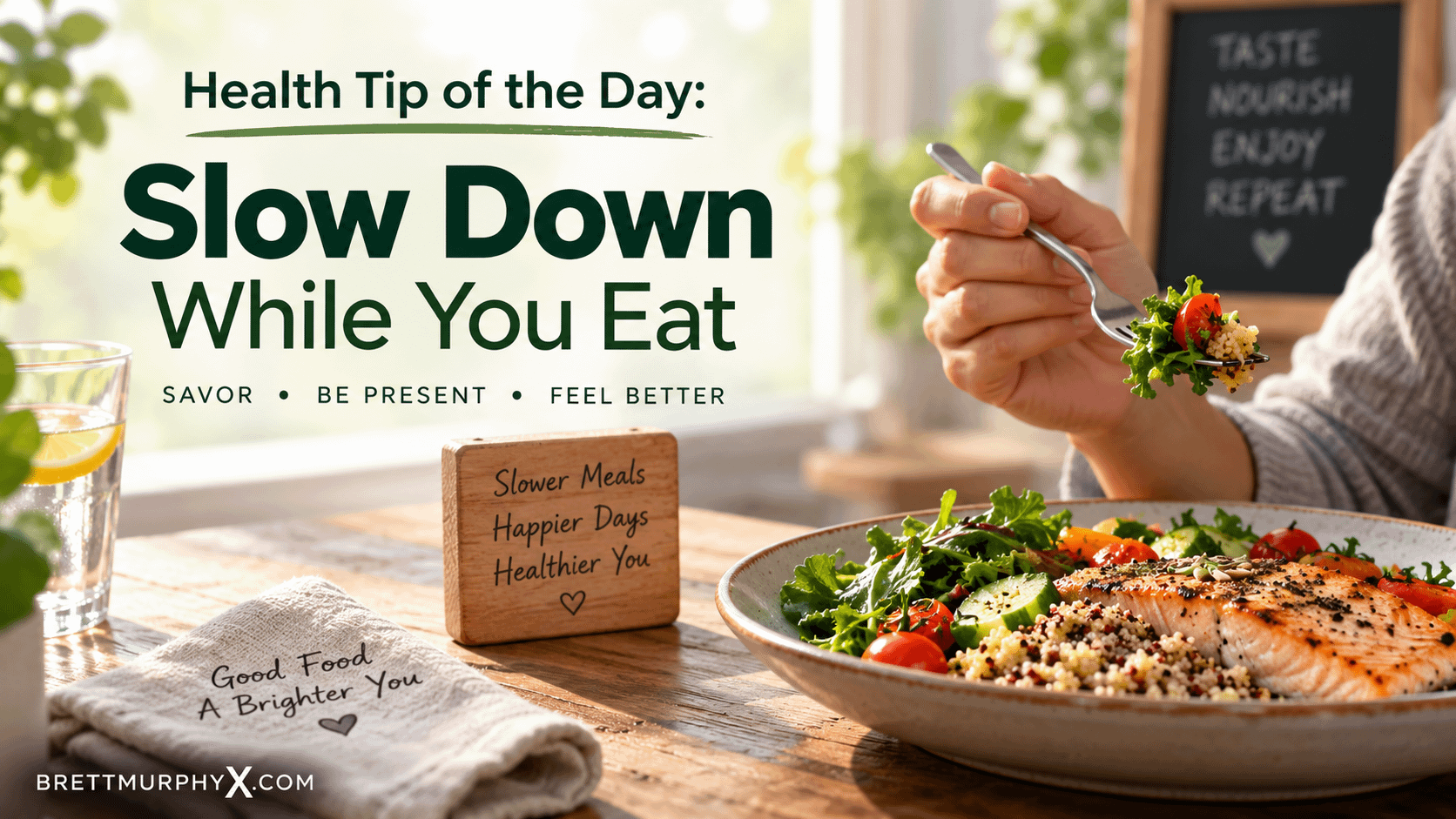
Eating is something most of us do several times every day, yet it is surprisingly easy to rush through a meal without really paying attention to it.
Breakfast might be eaten while getting ready for work.
Lunch might happen at a desk while answering emails.
Dinner might be eaten in front of the television.
Snacks might disappear while scrolling through a phone without us even realizing how much we have eaten.
Modern life encourages us to move quickly, and eating has become another activity we often try to squeeze into an already busy schedule.
But today’s Health Tip of the Day is remarkably simple:
Slow down while you eat.
You do not need a complicated diet plan.
You do not need special foods.
You do not need to count every calorie.
You do not need to completely change what is on your plate.
Simply paying more attention to how quickly you eat can help make meals more intentional and enjoyable.
Slowing down gives you an opportunity to actually taste your food, recognize your body’s hunger and fullness signals, and turn eating back into an experience rather than another task you are trying to finish as quickly as possible.
How Fast Do You Actually Eat?
Think about your last few meals.
How long did they take?
Did you sit at a table?
Were you watching television?
Were you looking at your phone?
Were you working?
Did you take time to chew your food thoroughly?
Did you notice when you began feeling satisfied?
Or did you simply continue eating until everything on your plate was gone?
Many people have become so accustomed to eating quickly that they don’t realize they’re doing it.
You may have learned the habit years ago.
Maybe your lunch breaks have always been short.
Perhaps you grew up in a busy household.
Maybe your work schedule requires you to eat whenever you get an opportunity.
Or perhaps you simply developed the habit of finishing meals quickly.
Whatever the reason, slowing down can be practiced.
Your Meal Doesn’t Have to Be a Race
There is usually no prize for being the first person to finish dinner.
Yet watch people eating together and you will often notice dramatically different eating speeds.
One person may still have most of their meal remaining while another person’s plate is already empty.
Fast eating can happen automatically.
Take a bite.
Chew quickly.
Swallow.
Immediately take another bite.
Repeat.
Before long, the entire meal is gone.
Try changing the rhythm.
Take a bite.
Put your fork down.
Chew.
Taste the food.
Finish the bite before preparing the next one.
Take a drink.
Have a conversation.
Then continue eating.
You’re still enjoying exactly the same meal, but you’re giving yourself more time to experience it.
Give Your Body Time to Recognize Fullness
Hunger and fullness are not simply on-and-off switches.
You can experience different levels of hunger.
You might be extremely hungry, moderately hungry, slightly hungry, comfortable, satisfied, very full, or uncomfortably stuffed.
When you eat very quickly, it can be easier to move from hungry to overly full before you’ve paid much attention to what your body is telling you.
Slowing down creates more opportunities to check in with yourself.
Halfway through your meal, ask:
Am I still hungry?
That is different from asking:
Is there still food on my plate?
Those two questions do not necessarily have the same answer.
You may discover that you are comfortably satisfied even though food remains.
Or you may discover that you’re still genuinely hungry and want to continue eating.
The goal isn’t to follow a rigid rule.
The goal is awareness.
Learn the Difference Between Satisfied and Stuffed
Many of us were taught to finish everything on our plates.
There are understandable reasons for that lesson. Nobody wants food wasted, and parents often want children to eat enough.
But adulthood gives us an opportunity to become more aware of our body’s signals.
There is a difference between feeling comfortably satisfied and feeling completely stuffed.
Think about how you feel after overeating.
Your stomach may feel uncomfortable.
You might feel sluggish.
You may want to loosen your belt or lie down.
Instead of automatically eating until you reach that point, try noticing the earlier signal that says:
I’ve had enough.
You don’t have to wait until you physically cannot imagine another bite.
Put Your Fork Down Between Bites
One of the easiest ways to slow your eating is also one of the simplest.
Put your fork or spoon down occasionally.
Many people prepare their next bite while they are still chewing the previous one.
The fork becomes a conveyor belt between the plate and mouth.
Instead, take a bite and put the utensil down.
Chew.
Swallow.
Take a breath.
Then pick your utensil back up.
It may feel strange at first because you’re interrupting an automatic habit.
That’s exactly the point.
You’re making eating intentional again.
Actually Taste Your Food
Imagine ordering one of your favorite meals.
The food arrives looking incredible.
You’re hungry.
You immediately start eating.
Five minutes later, half of it is gone.
Did you really experience the flavor?
Slowing down gives you an opportunity to notice what you’re eating.
Pay attention to the temperature.
Notice the texture.
Taste the seasoning.
Notice sweetness, saltiness, acidity, bitterness, richness, or spice.
Think about what you enjoy about the meal.
Food is not only fuel.
It can also be one of life’s simple pleasures.
If you’re eating something you enjoy, give yourself enough time to actually enjoy it.
Chew Your Food Thoroughly
Chewing is the first physical step of digestion.
Yet when people eat quickly, chewing can become rushed too.
You don’t need to count every chew or turn dinner into a mathematical exercise.
Simply become more aware of it.
Instead of taking several quick chews and immediately swallowing, chew until the food is comfortably broken down.
This is especially useful with foods that naturally require more chewing, such as vegetables, meats, whole grains, nuts, and certain fruits.
Slower chewing naturally reduces the pace of your meal.
It also forces you to pay attention to what you’re doing.
Remove Some Distractions
Think about how often eating happens while something else has most of your attention.
Television.
Phones.
Computers.
Social media.
Videos.
Work.
Emails.
Games.
None of these things automatically makes a meal unhealthy.
But distraction can make it much easier to eat without paying attention.
You reach for another bite while watching the screen.
Then another.
Then another.
Suddenly the plate is empty, and you barely remember eating it.
Try having some meals without a screen.
You don’t necessarily have to ban electronics from every meal forever.
Start small.
Put your phone away for the first ten minutes.
Turn off the television during breakfast.
Step away from your computer during lunch.
Sit at the table for dinner.
Give the food some of your attention.
Don’t Wait Until You’re Absolutely Starving
Think about what happens when you become extremely hungry.
Patience tends to disappear.
You aren’t thinking about eating slowly.
You’re thinking:
Give me food now.
Extreme hunger can make it much harder to slow down because your body wants energy quickly.
When practical, try to avoid allowing yourself to become overwhelmingly hungry before eating.
Regular meals and appropriately timed snacks can make it easier to approach food calmly rather than feeling desperate to eat everything immediately.
Your schedule will not always cooperate, but recognizing the pattern can help.
Start With a Smaller Portion and Get More If Needed
Large portions can sometimes encourage us to keep eating simply because the food is there.
One strategy is to begin with a reasonable amount.
Eat slowly.
Then wait a few minutes.
If you’re still hungry, you can always have more.
This is very different from telling yourself that certain foods are forbidden or that you aren’t allowed seconds.
You’re simply giving your body an opportunity to provide feedback.
Maybe you want more.
Maybe you don’t.
Either answer is fine.
The important part is making the decision intentionally rather than automatically.
Take a Short Pause Halfway Through Your Meal
Try this experiment.
When you are approximately halfway through your meal, stop eating for a minute.
Take a drink of water.
Talk to someone.
Look around.
Then ask yourself:
How hungry am I right now?
You might discover that you still have plenty of appetite.
Continue eating.
Or you might realize that you’re beginning to feel satisfied.
Continue more slowly and see how you feel.
This small pause interrupts autopilot.
Eat at a Table When You Can
Meals can happen almost anywhere.
In the car.
At a desk.
On the couch.
Standing over the kitchen counter.
Sometimes that’s unavoidable.
But when possible, sitting at a table can help create a clearer beginning and end to your meal.
You sit down.
You eat.
You finish.
Then you leave.
That structure can make eating feel more deliberate.
It may also help separate eating from other habits, such as automatically snacking whenever you watch television.
You don’t need a beautifully decorated dining room.
A kitchen table works.
A break-room table works.
A picnic table works.
The goal is simply to give the meal its own space.
Make Meals Social When Possible
Eating with other people can naturally slow the pace of a meal.
You take a bite.
Someone says something.
You respond.
You laugh.
You continue eating.
Conversation creates natural pauses.
Shared meals can also provide something beyond nutrition: connection.
Invite your family to sit together.
Have lunch with a coworker.
Meet a friend for breakfast.
Prepare dinner with someone you care about.
Instead of everyone eating separately while looking at different screens, occasionally make the meal an opportunity to connect.
Slow Eating Isn’t About Perfection
There will be days when you have ten minutes for lunch.
There will be mornings when you’re running late.
There will be road trips, work emergencies, appointments, family responsibilities, and unpredictable schedules.
You don’t need to eat every meal at an incredibly slow pace.
Health habits don’t need to be perfect to be useful.
If you normally finish dinner in seven minutes, maybe your first goal is simply to make it last ten.
Then perhaps twelve.
Small changes matter.
Don’t Turn Eating Into Another Source of Stress
Health advice sometimes becomes so complicated that eating starts feeling like homework.
Count this.
Measure that.
Avoid this.
Track that.
Never eat this.
Always eat that.
For some people, this creates unnecessary anxiety around meals.
Today’s tip is intentionally different.
You aren’t being asked to label foods as good or bad.
You’re simply being encouraged to pay attention.
Slow down.
Taste your meal.
Notice your hunger.
Notice your fullness.
Enjoy what you’re eating.
Then continue with your day.
Try the 20-Minute Meal Experiment
For one meal today, see whether you can make the experience last approximately 20 minutes.
Don’t obsess over the clock.
The purpose is simply to slow your normal pace.
You might:
- Take smaller bites.
- Chew thoroughly.
- Put your fork down periodically.
- Take occasional sips of water.
- Have a conversation.
- Pause halfway through the meal.
- Keep your phone away.
- Pay attention to the flavor.
- Notice when your hunger begins disappearing.
At the end of the meal, compare the experience with how you normally eat.
Did you enjoy your food more?
Did you notice flavors you normally ignore?
Did you recognize fullness sooner?
Did the meal feel more satisfying?
Those observations can teach you more about your eating habits.
Use the First Few Bites as a Reminder
You don’t have to remember dozens of rules.
Create one simple habit:
Make the first three bites slow.
Take the first bite and really taste it.
Chew thoroughly.
Pause.
Take another bite.
Do the same thing.
Then a third.
Those first few intentional bites can help establish a slower rhythm for the rest of the meal.
This is especially helpful if you tend to attack your plate when you’re hungry.
Pay Attention to Hunger Before You Eat
Before eating, briefly ask yourself:
How hungry am I?
There’s no right answer.
You may be very hungry.
You may be moderately hungry.
You may realize you’re eating because you’re bored.
Maybe you’re stressed.
Maybe someone else is eating.
Maybe food simply happens to be available.
Again, this doesn’t mean you’re forbidden from eating unless you’re physically hungry.
It simply helps you recognize why you’re reaching for food.
Awareness gives you information.
Information gives you choices.
Enjoy Foods You Love Without Rushing Them
Slowing down becomes especially meaningful when you’re eating something you really enjoy.
If you’ve been looking forward to a piece of cake, why finish it in ninety seconds?
Enjoy it.
If you’re eating your favorite pizza, taste it.
If you’ve ordered an incredible steak, don’t rush through it.
If you’re enjoying fresh fruit at its peak, notice the sweetness.
Sometimes slowing down allows a smaller amount of something enjoyable to feel more satisfying because you’re actually experiencing every bite.
Make Water Part of the Meal
Keeping water nearby can create natural pauses while you’re eating.
Take a few bites.
Have a sip.
Continue eating.
You don’t need to force yourself to drink excessive amounts of water during meals.
Simply having a glass available can help interrupt the rapid bite-after-bite rhythm that often happens when we’re extremely hungry.
Notice Your Eating Environment
Your surroundings can influence your pace more than you realize.
Are you standing?
Are you rushing?
Is the television loud?
Are you scrolling through stressful news?
Are you trying to answer work emails?
Are you eating directly from a large container?
Creating a calmer environment doesn’t require candles and relaxing music at every meal.
Sometimes it simply means sitting down and putting the phone away.
Teach Children That Meals Don’t Have to Be Rushed
Families can also practice slower meals together.
Children often learn eating habits by watching adults.
If everyone at the table eats quickly while staring at phones, that becomes normal.
Instead, create opportunities for conversation.
Ask about everyone’s day.
Talk about something funny that happened.
Let dinner become a moment when people reconnect.
Healthy eating habits aren’t only about which vegetables are served.
They’re also about the relationship we develop with food and meals.
Give Yourself Permission to Leave Food
You are allowed to stop eating when you’re satisfied.
That can be difficult for people who were raised with a strict “clean your plate” rule.
Food waste isn’t ideal, but eating beyond comfortable fullness doesn’t undo the waste.
When practical, leftovers can be saved.
Restaurant meals can be taken home.
Large portions can become tomorrow’s lunch.
Listening to your body doesn’t mean disrespecting food.
It means recognizing that your stomach doesn’t have to become the storage container for everything remaining on the plate.
Slowing Down Can Make Healthy Eating Feel Simpler
Healthy living is often presented as a massive transformation.
Join a gym.
Completely change your diet.
Meal prep every Sunday.
Track everything you eat.
Exercise every day.
Drink enormous amounts of water.
Never eat your favorite foods again.
That approach can feel overwhelming.
But meaningful health habits can also be incredibly simple.
Take a walk.
Drink water.
Eat vegetables.
Get enough sleep.
Stretch.
Spend time outside.
And slow down when you eat.
You don’t have to completely reinvent your life overnight.
Sometimes the habits that stick are the ones small enough to repeat.
Try It at Your Next Meal
Your next meal gives you an opportunity to practice.
You don’t have to wait until Monday.
You don’t need to buy anything.
You don’t need an app.
You don’t need special equipment.
When your food is ready, sit down if possible.
Put your phone aside.
Take a bite.
Chew.
Taste it.
Put your fork down occasionally.
Take a drink.
Pause halfway through.
Ask yourself whether you’re still hungry.
Then continue eating according to what your body is telling you.
That’s it.
Simple doesn’t mean meaningless.
Health Tip of the Day: Give Your Meal More Time
Today, make one meal a little slower than usual.
You don’t have to dramatically change what you eat.
Instead, change how you eat it.
Give yourself enough time to notice the food in front of you.
Taste the flavors.
Chew thoroughly.
Take a few pauses.
Pay attention to your hunger.
Notice when you begin feeling satisfied.
Put distractions away when possible.
Most importantly, stop treating every meal like another item you need to cross off your schedule.
Food provides nourishment, but meals can also provide enjoyment, conversation, connection, and a much-needed pause during a busy day.
Your health is shaped by countless small decisions repeated over time.
Slowing down while you eat is one of the simplest experiments you can try.
At your next meal, don’t race toward the final bite.
Give yourself permission to slow down and enjoy the ones along the way.
How long does it usually take you to finish a meal, and do you think you could slow it down today?
Leave a Reply