Category: Health & Wellness

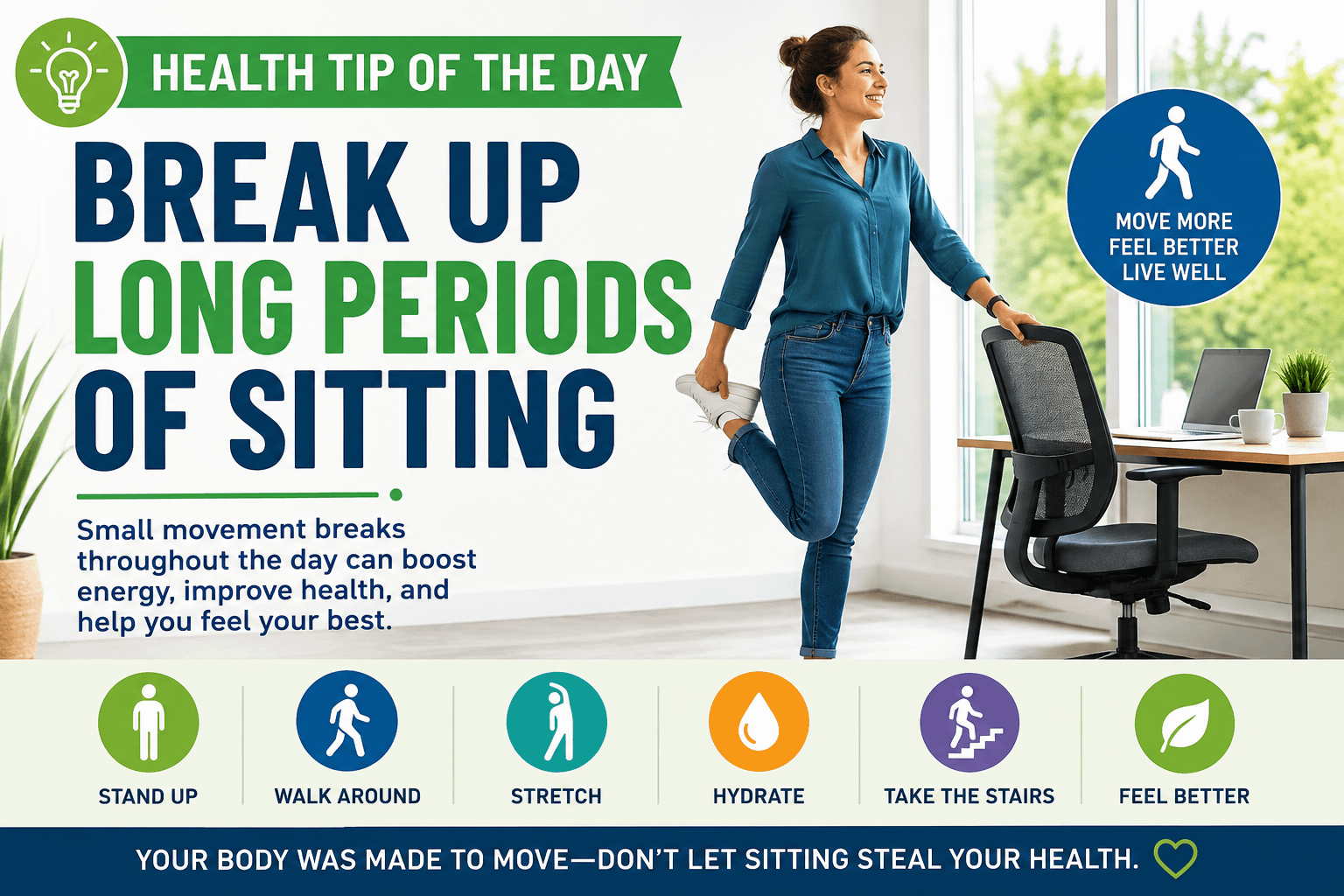
  • Health Tip of the Day: Break Up Long Periods of Sitting

    Health Tip of the Day: Break Up Long Periods of Sitting

    It is surprisingly easy to spend most of the day sitting.

    You might sit while eating breakfast, driving to work, working at a desk, attending meetings, watching television, using your phone, playing video games, or relaxing at night. Even on a busy day, you can spend hours in a chair without realizing just how little you’ve moved.

    That’s why today’s Health Tip of the Day focuses on a simple habit that can make your day more active:

    Break Up Long Periods of Sitting

    You don’t have to completely change your lifestyle overnight. You don’t need to turn every break into a workout, either.

    The goal is much simpler.

    Don’t stay in the same seated position for hours at a time when you’re able to move.

    Stand up. Stretch. Walk around the room. Refill your water. Step outside. Complete a household chore. Take a short walk.

    Small movement breaks throughout the day can help you build a lifestyle where physical activity becomes something you naturally incorporate into your routine.


    We Sit More Than We Realize

    Think about a typical day.

    You wake up and sit down for breakfast.

    You sit in your car during your commute.

    You arrive at work and sit at your desk.

    You sit during lunch.

    You drive home.

    You sit while eating dinner.

    Then you sit on the couch watching television or scrolling through your phone.

    Even someone who feels busy throughout the day can accumulate a lot of sitting time.

    Technology has made many parts of life easier, but it has also removed many opportunities for everyday movement.

    We can order food without leaving the couch. We can shop online without walking through a store. We can communicate with coworkers without leaving our desks. Entertainment is available instantly on our televisions, computers, tablets, and phones.

    Convenience isn’t necessarily bad, but it means we sometimes have to intentionally create opportunities to move.


    Your Body Was Made to Move

    The human body isn’t designed to remain completely still all day.

    Muscles, joints, bones, and the cardiovascular system all benefit from regular movement. Physical activity also plays an important role in maintaining overall health and independence.

    That doesn’t mean you need to constantly exercise.

    It simply means that movement should remain part of everyday life.

    Walking across a parking lot is movement.

    Cleaning your kitchen is movement.

    Gardening is movement.

    Taking the stairs is movement.

    Walking the dog is movement.

    Stretching after sitting at your desk is movement.

    Playing with your children or grandchildren is movement.

    Taking groceries into the house is movement.

    All of these activities contribute to a more active day.


    Exercise Is Important, but So Is Everyday Movement

    A common misconception is that exercising once means you don’t need to think about movement during the rest of the day.

    Imagine someone who exercises for 30 minutes in the morning but then spends most of the next ten hours sitting.

    That workout is still valuable, but there are also many hours throughout the day where additional movement could be incorporated.

    This is why it can be helpful to think about health in two ways:

    Planned exercise and everyday movement.

    Planned exercise might include walking, strength training, swimming, cycling, or another structured activity.

    Everyday movement includes all the smaller physical activities that happen between workouts.

    Both matter.

    Instead of thinking, “I already exercised today,” consider asking:

    “How can I continue moving throughout my day?”


    Why Breaking Up Sitting Time Can Be Helpful

    Long periods of sitting often mean your large muscles aren’t doing very much.

    Getting up periodically changes that.

    Even simple movement requires your muscles to become active again. Walking across the room, standing while talking on the phone, or stretching for a few minutes interrupts a long period of inactivity.

    Movement breaks can also help you notice stiffness that develops after you’ve been sitting in one position for too long.

    You may have experienced this yourself.

    You spend a couple of hours working at the computer and finally stand up.

    Your back feels tight.

    Your hips feel stiff.

    Your legs need a moment to adjust.

    Your shoulders may be hunched forward from looking at the screen.

    Sometimes the body simply appreciates a change of position.


    Start With a Simple Movement Reminder

    When you’re focused on something, time can disappear.

    You might intend to work for 30 minutes and suddenly realize you’ve been sitting for two hours.

    Setting a reminder can help.

    Consider creating a reminder every 30 to 60 minutes during periods when you’re likely to remain seated.

    When the reminder goes off, you don’t necessarily need to stop working for long.

    Try taking a brief movement break.

    Stand up.

    Stretch.

    Walk around.

    Get some water.

    Look away from the screen.

    Then return to what you were doing.

    If getting up every 30 to 60 minutes isn’t practical for your schedule or abilities, choose an interval that works for you. The important thing is avoiding unnecessary stretches of prolonged inactivity whenever possible.


    The Two-Minute Movement Break

    One useful approach is to make movement so easy that it becomes difficult to make excuses.

    Tell yourself:

    “I’m going to move for two minutes.”

    Walk around your home.

    Stand and stretch.

    Walk down the hallway.

    Put away a few dishes.

    Take something to another room.

    Step outside.

    Walk around your workplace.

    Two minutes may not sound impressive, but that isn’t the point.

    The goal is to interrupt sitting.

    And something interesting often happens once you start moving.

    Two minutes sometimes becomes five.

    Five minutes sometimes becomes ten.

    The hardest part can simply be getting out of the chair.


    Use Your Daily Routine as a Reminder

    You don’t necessarily need alarms or fitness trackers to remember to move.

    You can connect movement to things you already do every day.

    This is sometimes called attaching a new habit to an existing routine.

    For example:

    After finishing your coffee: walk around for a few minutes.

    After checking your email: stand and stretch.

    After a meeting: take a short walk.

    After lunch: walk for five minutes.

    After dinner: walk around your neighborhood if you’re able.

    During television commercials: get up from the couch.

    Between episodes: walk around the house.

    While talking on the phone: stand or pace.

    When movement becomes connected to activities that already happen naturally, remembering it becomes easier.


    Turn Television Time Into Movement Time

    Television can easily turn into several hours of uninterrupted sitting.

    You don’t have to stop watching your favorite shows.

    Instead, use television as a movement reminder.

    Between episodes, stand up.

    During commercials, walk around the room.

    Stretch while watching.

    Fold laundry.

    Put dishes away.

    Walk in place if that is comfortable for you.

    Do a simple household task.

    Even if you spend most of the evening relaxing, breaking up that sitting time can help you add more movement to your day.


    Take Advantage of Phone Calls

    Phone calls can be another opportunity to move.

    If you don’t need to look at a computer or take detailed notes during the conversation, consider standing.

    You could also slowly walk around your home, office, backyard, or another safe area.

    A 15-minute conversation could become a 15-minute period of gentle movement instead of another 15 minutes sitting in a chair.

    Over the course of a week, those small choices can add up.


    Walk After Meals When Appropriate

    A short walk after eating can be another convenient way to incorporate movement into your day.

    It doesn’t need to be a long or fast walk.

    You might simply walk around the block, through your workplace, around your home, or outside for a few minutes.

    The important part is developing the habit of moving.

    Instead of immediately moving from the dinner table to the couch, consider taking a brief walk first.

    It can become a peaceful daily ritual.


    Create a More Active Workday

    For many people, work is responsible for the largest amount of sitting.

    Desk jobs can make movement particularly challenging because sitting is part of the job.

    However, small changes can create opportunities to move.

    Try standing during certain phone calls.

    Walk to speak with a coworker when appropriate.

    Take the stairs when practical.

    Use part of your lunch break for a short walk.

    Refill your water bottle instead of keeping several drinks at your desk.

    Walk the longer route to the restroom.

    Stand and stretch between tasks.

    If you work from home, you may have even more flexibility.

    You can walk around the house between meetings, step outside briefly, stretch in another room, or complete a small household task.


    Use Movement to Break Up Screen Time

    Sitting and screen time often go together.

    Computers, smartphones, tablets, televisions, and gaming systems can keep us in the same position for hours.

    Movement breaks can provide benefits beyond simply getting out of your chair.

    They also give your mind an opportunity to disconnect from the screen.

    Walk into another room.

    Look outside.

    Step into your yard.

    Stretch.

    Get some water.

    Spend a couple of minutes away from your phone.

    You may return feeling more refreshed and focused.


    Movement Can Be a Mental Reset

    Have you ever stared at a computer screen so long that you stopped being productive?

    Sometimes continuing to sit there isn’t the answer.

    Get up.

    Walk around.

    Stretch.

    Take a few slow breaths.

    Step outside for a moment.

    Changing your environment and moving your body can provide a mental break.

    You may return to your work with a clearer mind.

    This is another reason movement breaks shouldn’t necessarily be viewed as wasted time.

    Sometimes taking a short break can help you return with better concentration.


    Make Your Environment Encourage Movement

    Your surroundings can influence your habits.

    If everything you need is within arm’s reach, you have very little reason to leave your chair.

    You can intentionally create small reasons to move.

    Keep your water somewhere that requires you to stand up to refill it.

    Put the trash can slightly farther from your desk.

    Walk documents to another area instead of letting them pile up.

    Take the stairs when you’re comfortable doing so.

    Park a little farther from an entrance when it is safe and appropriate.

    None of these actions alone will transform your health.

    But together they create a lifestyle that includes more movement.


    Household Chores Count as Movement

    Sometimes people believe physical activity only counts when they’re wearing workout clothes.

    That isn’t true.

    Everyday household activities can get you moving.

    Vacuuming.

    Sweeping.

    Doing laundry.

    Washing dishes.

    Taking out the trash.

    Cleaning the bathroom.

    Organizing a closet.

    Gardening.

    Washing your car.

    Putting groceries away.

    These tasks may not replace structured exercise, but they can certainly help reduce the amount of time you spend sitting.

    Instead of viewing chores only as work, consider them another opportunity to get your body moving.


    Don’t Underestimate Short Walks

    People sometimes avoid walking because they think a walk must be long to be worthwhile.

    But shorter walks can be easier to fit into your day.

    You might not have 30 uninterrupted minutes available.

    But perhaps you have five minutes after breakfast.

    Another five minutes during lunch.

    Another ten minutes after dinner.

    Instead of waiting for the perfect opportunity to exercise, use the opportunities already available.

    Consistency is often easier when the goal feels manageable.


    Start Where You Are

    If you’ve spent years living a mostly sedentary lifestyle, don’t feel like you suddenly need to become extremely active tomorrow.

    Start gradually.

    Maybe today’s goal is simply standing more often.

    Tomorrow, perhaps you add a short walk.

    Next week, you might begin walking after dinner several nights.

    Healthy habits are easier to maintain when they’re realistic.

    Trying to completely transform your lifestyle overnight can feel overwhelming.

    Small improvements are easier to repeat.

    And repeatable habits are often the ones that last.


    Movement Looks Different for Everyone

    Not everyone has the same physical abilities.

    Someone may be able to walk several miles comfortably, while another person may have difficulty standing for extended periods.

    Movement should be appropriate for your body, circumstances, and abilities.

    For some people, a movement break might involve walking around the building.

    For others, it could mean standing briefly with support.

    Someone else may benefit from gentle seated movements or stretches.

    The goal isn’t to compare yourself with anyone else.

    The goal is to find safe ways to avoid unnecessary inactivity within your own abilities.

    If you have a medical condition, significant pain, balance concerns, or mobility limitations, consider discussing appropriate physical activity with a qualified healthcare professional.


    Don’t Chase Perfection

    You will have days when you sit longer than you intended.

    That’s okay.

    Maybe work becomes unusually busy.

    Maybe you’re traveling.

    Maybe you’re exhausted.

    Maybe you’re watching a movie and forget to get up.

    One long period of sitting doesn’t mean you’ve failed.

    Healthy living isn’t about being perfect.

    It is about noticing your habits and making better choices more often.

    When you realize you’ve been sitting for a long time, don’t criticize yourself.

    Simply use that realization as your cue:

    Time to move.


    Make Movement Something You Enjoy

    Movement doesn’t always have to feel like a chore.

    Find activities you enjoy.

    Walk while listening to your favorite music.

    Take your dog outside.

    Walk with a family member.

    Spend time gardening.

    Dance around your home.

    Explore a local park.

    Play with your children.

    Walk while listening to a podcast.

    The more enjoyable movement feels, the easier it becomes to repeat.


    Small Choices Add Up Over Time

    One movement break probably won’t feel significant.

    Neither will one short walk.

    But health isn’t determined by one moment.

    It is influenced by patterns.

    Imagine standing and moving for a few minutes several times throughout your day.

    Then imagine doing that most days of the week.

    Then most weeks of the year.

    Those tiny decisions begin forming a completely different pattern from sitting uninterrupted for hours every day.

    That is the power of small habits.


    A Simple Daily Movement Plan

    You don’t need an elaborate fitness schedule to start reducing prolonged sitting.

    Try something simple:

    Morning: Move around after breakfast instead of immediately sitting down.

    Midmorning: Stand and stretch after a period of work.

    Lunch: Take a short walk if you’re able.

    Afternoon: Walk around or stretch between tasks.

    Dinner: Consider a short walk afterward.

    Evening: Get up periodically while watching television or using your phone.

    That’s it.

    You’re simply creating multiple opportunities for movement throughout your day.


    Today’s Health Challenge

    For the rest of today, become aware of your sitting time.

    You don’t need to obsess over numbers.

    Just pay attention.

    Whenever you realize you’ve been sitting for a long period, ask:

    “Can I move for a few minutes right now?”

    If you can, do it.

    Stand.

    Stretch.

    Walk.

    Get water.

    Step outside.

    Do a chore.

    Walk down the hallway.

    Move in whatever safe and comfortable way works for you.

    Then continue with your day.

    Try repeating that habit tomorrow.

    And the next day.

    Eventually, you may not need to remind yourself nearly as often because movement has simply become part of your routine.


    Final Thoughts: Your Body Needs Regular Movement

    Improving your health doesn’t always begin with a dramatic transformation.

    Sometimes it begins with standing up.

    We often focus on major health goals: losing weight, joining a gym, running a race, changing our entire diet, or beginning an intense exercise program.

    Those goals can be worthwhile, but don’t overlook the smaller decisions happening every day.

    How long have you been sitting?

    Could you stand for a few minutes?

    Could you walk around the room?

    Could you take a short walk?

    Could you stretch?

    Could you complete a task that requires you to move?

    Those choices may seem small, but they’re part of creating a more active lifestyle.

    Your body doesn’t only benefit from movement during scheduled workouts.

    It benefits from having regular opportunities to move throughout the day.

    So the next time you notice you’ve been sitting for an extended period, use it as your reminder.

    Get up.

    Move around.

    Stretch your legs.

    Give your body a break from the chair.

    Health Tip of the Day

    Break up long periods of sitting.

    You don’t have to spend your entire day exercising. Simply look for realistic opportunities to stand, walk, stretch, and move.

    A few minutes of movement may seem small, but repeated throughout your day, those small choices can become a healthier way of living.
  • Health Tip of the Day: Take the Stairs When You Can

    Health Tip of the Day: Take the Stairs When You Can

    When people think about improving their health, they often imagine major lifestyle changes: joining a gym, following an intense workout program, running several miles every morning, or completely changing their diet.

    Those things can certainly be helpful, but better health doesn’t always begin with a dramatic transformation.

    Sometimes it begins with something as simple as choosing the stairs.

    Taking the stairs when you can is an easy way to add more movement to your everyday life. It doesn’t require special equipment, a membership, or a scheduled workout. When stairs are already part of your surroundings, they give you an opportunity to turn an ordinary moment into physical activity.

    One flight might not seem significant. Neither does an extra five-minute walk, parking farther away, or standing up during a work break.

    But healthy living isn’t only about what you do once.

    It’s about what you repeatedly do.

    Those little decisions can become habits, and healthy habits can gradually create a more active lifestyle.

    Why Everyday Movement Matters

    Modern life makes it incredibly easy to remain sedentary.

    We drive instead of walking. We take elevators instead of stairs. We sit at desks for hours. We order things online rather than walking through stores. After work, many of us relax by sitting in front of televisions, computers, tablets, or phones.

    Technology has made life more convenient, but convenience often means we have fewer reasons to move.

    That’s why intentionally looking for small opportunities for activity can be valuable.

    You don’t necessarily need to turn every free moment into a workout. Instead, start recognizing situations where you can comfortably choose movement over convenience.

    Taking the stairs is one of the easiest examples.

    You’re already going upstairs.

    The staircase simply allows you to use your own body to get there.

    Stair Climbing Is More Challenging Than It Looks

    Walking up stairs requires your body to repeatedly lift its weight against gravity.

    Your lower-body muscles have to work harder than they typically would while walking across a flat surface. Depending on your pace, fitness level, and number of stairs, your heart rate and breathing may increase as well.

    Several major muscle groups are involved in stair climbing, including the:

    • Quadriceps
    • Hamstrings
    • Glutes
    • Calves
    • Hip muscles
    • Core muscles used for balance and stability

    That’s a lot of activity from something as ordinary as walking to another floor.

    You might notice that even a couple of flights leave you breathing harder. That’s because climbing stairs can be physically demanding, particularly if you’re just beginning to become more active.

    There’s nothing wrong with starting slowly.

    A Simple Way to Support Cardiovascular Fitness

    When you climb stairs, your muscles need energy and oxygen. Your heart and lungs respond to the increased demand.

    Regular physical activity that raises your heart rate can help support cardiovascular fitness over time.

    You don’t necessarily need to climb dozens of flights at once to make stair climbing part of an active lifestyle.

    Maybe you take one flight at work.

    Another while shopping.

    A couple more when visiting an office building.

    Individually, these moments may be brief. Collectively, they’re additional physical activity you wouldn’t have gotten if you had automatically chosen the elevator.

    The important idea is simple:

    Movement adds up.

    Strengthen Your Legs Through Everyday Activity

    Strong legs matter for much more than appearance.

    Your lower-body muscles help you walk, stand, climb, bend, balance, and perform countless everyday activities.

    Maintaining strength becomes especially important as we age because staying physically capable can help us remain independent and continue doing the things we enjoy.

    Stair climbing naturally asks your legs to work.

    Every time you step upward, your muscles help lift your body to the next step.

    While taking the stairs isn’t a complete substitute for a well-designed strength-training program, it can be another way to use your lower-body muscles throughout the day.

    Think of it as adding little bursts of activity to the life you’re already living.

    You Don’t Need an Hour for Movement to Matter

    One of the most common obstacles to exercise is time.

    People have jobs, families, appointments, errands, responsibilities, and countless other demands competing for their attention.

    Finding an uninterrupted hour for exercise can sometimes feel impossible.

    That’s why small opportunities for movement are worth recognizing.

    Taking the stairs might only take two minutes.

    Walking around the building might take five.

    Stretching during a break might take three.

    Walking after dinner might take ten.

    Those short periods of activity are easier to fit into a busy schedule than waiting for the perfect opportunity to complete a long workout.

    You can still have structured exercise goals while also becoming more active throughout your normal day.

    It doesn’t have to be one or the other.

    Stop Thinking of Exercise as Something That Only Happens at the Gym

    A gym can be an excellent place to exercise, but movement isn’t limited to treadmills and weight machines.

    Your everyday environment contains opportunities to be active.

    You can:

    • Take the stairs instead of the elevator.
    • Park farther from the entrance.
    • Walk during part of your lunch break.
    • Take a short walk after dinner.
    • Stand up regularly when working at a desk.
    • Walk while having certain phone conversations.
    • Do household chores.
    • Work in the yard.
    • Carry groceries inside.
    • Walk your dog.
    • Play outside with your children or grandchildren.
    • Stretch while watching television.

    None of these activities need to feel like formal workouts.

    That’s part of their advantage.

    You’re simply creating a lifestyle that involves more movement.

    Try the “One Flight Rule”

    If taking the stairs feels intimidating, create a simple rule:

    If I’m physically able and it’s only one flight, I’ll take the stairs.

    That’s it.

    Don’t worry about climbing ten floors.

    Start with one.

    After you’ve done that consistently, perhaps you’ll decide that two flights are manageable.

    Then maybe three.

    There’s no required number.

    The goal is to gradually become more comfortable choosing movement when it’s practical.

    You can always take the stairs part of the way and use the elevator for the remaining floors when that’s more appropriate.

    Healthy living doesn’t have to follow an all-or-nothing mindset.

    Don’t Turn the Stairs Into a Competition

    You don’t have to race anyone.

    You don’t have to prove how fit you are.

    And you don’t have to reach the top without stopping.

    Go at your own pace.

    Use the handrail when necessary.

    Pause if you need to.

    Pay attention to your breathing and how your body feels.

    If someone passes you, let them.

    Your goal isn’t to win a stair-climbing contest.

    Your goal is simply to add a little more movement to your life.

    Create “Movement Triggers” Throughout Your Day

    One useful way to become more active is to connect movement with situations you already encounter.

    For example:

    See stairs → consider taking them.

    Finish lunch → take a five-minute walk.

    Phone call → stand or walk when practical.

    Commercial break → stand and stretch.

    Park the car → choose a slightly farther space when safe.

    These become movement triggers.

    Instead of depending entirely on motivation, you’re connecting physical activity to normal events in your routine.

    Eventually, you may not even have to think about it.

    You simply see the stairs and start walking toward them.

    That’s how habits become part of your lifestyle.

    Taking the Stairs Can Build Confidence

    There’s another benefit that isn’t always discussed: seeing yourself improve.

    Maybe the first time you climb two flights, you’re breathing heavily.

    After consistently becoming more active, you might eventually notice those same stairs don’t feel quite as difficult.

    Perhaps you’re less winded.

    Maybe your legs don’t tire as quickly.

    Maybe you can climb another flight.

    Those little improvements can be encouraging.

    They remind you that progress doesn’t always appear as a dramatic transformation.

    Sometimes progress sounds like:

    “That was easier than it used to be.”

    That’s still progress.

    Small Wins Can Lead to Bigger Changes

    Healthy habits often build on each other.

    Taking the stairs can seem insignificant, but successfully changing one behavior can make another healthy choice feel more achievable.

    You start taking the stairs.

    Then you begin walking ten minutes after dinner.

    Eventually, you decide to increase your daily steps.

    Maybe you start preparing healthier meals.

    Then you begin doing some strength exercises.

    One small decision creates momentum for another.

    You don’t need to completely reinvent yourself on Monday morning.

    You can start with something manageable today.

    Consistency Is More Important Than Perfection

    You aren’t going to take the stairs every time.

    And you don’t need to.

    Some days you’re carrying something heavy.

    Sometimes you’re tired.

    Sometimes you’re injured.

    Sometimes you’re traveling with someone who needs the elevator.

    Sometimes you’re going up fifteen floors.

    Sometimes your body simply needs a break.

    None of those situations mean you’ve failed.

    A healthy lifestyle should have flexibility.

    Instead of saying:

    “I have to take the stairs every single time.”

    Try:

    “When it’s practical and safe, I’ll choose the stairs.”

    That approach is much easier to maintain.

    Make Your Environment Work for You

    Pay attention to how your environment influences your behavior.

    If you automatically walk toward the elevator every morning, you might not even notice the staircase anymore.

    Start looking for it.

    At work, find out where the stairs are located.

    At a hotel, notice which floor you’re staying on and whether taking the stairs occasionally makes sense.

    At a parking garage, consider walking up a flight rather than immediately waiting for the elevator.

    When movement becomes the convenient choice—or at least an obvious choice—you’re more likely to do it.

    Sometimes healthier living isn’t about finding more motivation.

    It’s about creating better defaults.

    Remember That Stairs Aren’t Appropriate for Everyone

    While stair climbing can be a convenient form of activity, it isn’t suitable for every person or every situation.

    People experiencing mobility limitations, balance problems, significant knee or hip pain, certain heart or lung conditions, or other medical concerns may need to limit or avoid stairs.

    If you’ve been given activity restrictions by a healthcare professional, follow those recommendations.

    Safety should always come first.

    When using stairs:

    • Use the handrail when needed.
    • Wear stable footwear.
    • Watch where you’re stepping.
    • Avoid rushing.
    • Keep stairs clear of distractions.
    • Be particularly careful on wet or poorly lit staircases.
    • Stop if something feels wrong.

    If physical activity causes chest pain, severe or unusual shortness of breath, fainting, significant dizziness, or other alarming symptoms, stop and seek appropriate medical care.

    Taking the elevator when you need it isn’t failure.

    The goal is better health, not unnecessary risk.

    What If You Can’t Take the Stairs?

    That’s completely okay.

    The larger message isn’t really about staircases.

    It’s about finding your opportunity to move.

    If stairs aren’t appropriate for you, consider another activity that’s safe and accessible.

    That might include:

    • Walking for a few extra minutes.
    • Doing seated exercises.
    • Stretching.
    • Standing periodically if you’re able.
    • Taking a comfortable walk around your home.
    • Performing an appropriate exercise recommended by your healthcare provider or physical therapist.

    Everyone’s abilities and circumstances are different.

    The healthiest activity is one you can perform safely and consistently.

    Don’t Ignore the Power of Five Minutes

    People sometimes avoid exercising because they believe that if they can’t do a long workout, there’s no point doing anything.

    That’s an unfortunate mindset.

    Five minutes of movement is still movement.

    Ten minutes is still ten minutes more than zero.

    One flight of stairs is still activity you wouldn’t have gotten from standing in an elevator.

    You don’t have to wait until you have the perfect workout plan.

    Use the time and opportunities you have.

    Look for Movement Instead of Convenience

    Modern life constantly asks:

    “How can we make this easier?”

    When it comes to physical activity, occasionally asking the opposite question can be useful:

    “Where can I safely make my body do a little more work?”

    That doesn’t mean intentionally making your life difficult.

    It means recognizing that convenience isn’t always the healthiest option.

    If you’re physically capable of walking a short distance, perhaps you don’t need the closest parking space.

    If you’re going up one floor, perhaps you don’t need the elevator.

    If you’re sitting during a phone call, perhaps you could stand.

    Those are small decisions, but they’re opportunities.

    Build an Active Lifestyle, Not Just an Exercise Schedule

    There’s an important difference between exercising and living actively.

    Someone might work out for 30 minutes and then spend nearly the entire rest of the day sitting.

    Another person might exercise while also regularly walking, standing, climbing stairs, doing chores, and moving throughout the day.

    Structured exercise is valuable, but everyday movement matters too.

    The ultimate goal is to create a lifestyle where movement feels normal.

    Take the stairs.

    Walk across the parking lot.

    Stand up.

    Stretch.

    Carry the groceries.

    Walk after dinner.

    Move whenever you reasonably can.

    Your body was made to move.

    Today’s Health Challenge

    Pay attention to your surroundings today.

    Every time you encounter an elevator, escalator, or staircase, ask yourself:

    “Can I safely take the stairs?”

    If you can, try it.

    Start with one flight.

    There’s no need to rush.

    Then challenge yourself to identify three additional opportunities to move during your day.

    Maybe you’ll walk for five minutes.

    Maybe you’ll park farther away.

    Maybe you’ll stand while talking on the phone.

    Maybe you’ll stretch before bed.

    The activity itself doesn’t have to be impressive.

    The important thing is intentionally choosing movement.

    One Step Today Can Become a Habit Tomorrow

    People often underestimate what can happen when small actions are repeated consistently.

    One healthy meal won’t completely transform your health.

    One walk won’t either.

    Neither will one trip up the stairs.

    But repeated choices begin creating habits.

    Habits influence routines.

    Routines influence lifestyles.

    And your lifestyle can have a significant impact on your long-term health.

    That’s why small decisions deserve more credit than we often give them.

    Final Thought: Your Health Journey Happens One Step at a Time

    You don’t need to change everything about your life today.

    You don’t need the perfect diet.

    You don’t need the perfect workout plan.

    And you don’t need to suddenly become the most active person you know.

    Start where you are.

    Look for one opportunity to move.

    When you see the staircase and you’re physically able to use it safely, consider skipping the elevator.

    Take one flight.

    Then another when you’re ready.

    Every step represents a choice to move your body instead of remaining still.

    Some days you’ll do more.

    Some days you’ll do less.

    What matters is continuing to look for realistic ways to make movement part of your everyday life.

    Your health isn’t built from one enormous decision. It’s built through thousands of small choices made over time.

    So when you have the opportunity, take the stairs.

    One step may seem small, but every step is still moving you forward.

  • EthicaRx: A Free Prescription Savings Program Helping Make Medications More Affordable

    EthicaRx: A Free Prescription Savings Program Helping Make Medications More Affordable

    The cost of prescription medications can put serious pressure on a household budget. Even people with health insurance can sometimes face high copays, deductibles, or medications that simply aren’t covered at an affordable price.

    That is where EthicaRx comes in.

    EthicaRx is a prescription discount program designed to help consumers find lower prices on prescription medications at participating pharmacies across the United States. According to the Ethica Rx, people may be able to save up to 80% on prescription medications, with access to more than 70,000 participating pharmacies nationwide.

    The program is free to use and does not require traditional health insurance.

    What Is EthicaRx?

    EthicaRx provides consumers with a free prescription discount card that can be presented at participating pharmacies when filling prescriptions.

    It is important to understand that EthicaRx is not health insurance. Instead, it is a prescription savings program designed to provide discounted cash prices on eligible medications.

    Ethica Rx says its discounts cover more than 10,000 FDA-approved generic and brand-name prescription medications.

    For someone paying cash for prescriptions—or someone whose insurance copay is particularly expensive—checking the EthicaRx price could potentially result in meaningful savings.

    How Does EthicaRx Work?

    Using a prescription savings program is generally straightforward.

    With EthicaRx, consumers present the card to a participating pharmacist. The pharmacy processes the prescription using the information associated with the discount program.

    The basic process is:

    1. Have a EthicaRx discount card.
    2. Search or check the potential savings on your medication.
    3. Take your prescription to a participating pharmacy.
    4. Show your EthicaRx card to the pharmacist.
    5. Ask the pharmacy to process the prescription using the discount card.
    6. Compare the discounted price with other available payment options before purchasing.

    There are no enrollment or membership fees advertised for consumers using the prescription discount card.

    Save Up to 80% on Prescription Medications

    One of the biggest attractions of EthicaRx is the potential savings.

    EthicaRx advertises savings of up to 80% on prescription medications.

    However, “up to 80%” does not mean every medication will receive an 80% discount.

    Actual savings can vary depending on factors such as:

    • The medication
    • Brand-name versus generic medication
    • Dosage
    • Quantity
    • Pharmacy
    • Location
    • Current retail price
    • Available discount pricing

    Because prices can vary, it can be worthwhile to compare your options rather than assuming your regular pharmacy automatically has the lowest price.

    You Don’t Need Insurance

    Another important feature of EthicaRx is that consumers don’t need health insurance to use the prescription savings program.

    This could make the program particularly useful for people who are uninsured or who are paying cash for certain prescriptions.

    It may also be useful for people who have insurance.

    Having health insurance doesn’t necessarily mean the insurance price will always be the least expensive option for every prescription. EthicaRx states that consumers with insurance can use its card when the EthicaRx discounted price provides greater savings than their insurance copay.

    The key is to compare before you pay.

    EthicaRx Works at Thousands of Pharmacies

    Accessibility is important for any prescription savings program.

    EthicaRx says its prescription discount card can be used at more than 60,000 pharmacies throughout the United States.

    Some of the places to use the discount are major pharmacy retailers including CVS, Walgreens, Walmart and Kroger, along with thousands of independent pharmacies.

    Participation can change, so consumers should confirm that their pharmacy participates and check the current discounted price before filling a prescription.

    Generic and Brand-Name Prescription Savings

    Prescription savings aren’t necessarily limited to generic medications.

    EthicaRx says discounts are available across more than 10,000 FDA-approved prescriptions, including both generic and brand-name medications.

    Generic medications are often significantly less expensive than their brand-name equivalents, but consumers should always follow the prescription and guidance provided by their healthcare professional.

    When appropriate, you can also ask your doctor or pharmacist whether a lower-cost generic alternative is available.

    Why Prescription Price Comparison Matters

    One of the most important lessons consumers can learn about prescription medications is simple:

    The price can vary from pharmacy to pharmacy.

    People routinely comparison-shop for groceries, gasoline, electronics, hotel rooms and airline tickets, yet many never think about comparing prescription prices.

    A prescription savings program gives consumers another price to compare.

    Before paying for a prescription, consider asking the pharmacist:

    “What is my price with insurance?”

    Then ask:

    “What is the price using this prescription discount card?”

    If you’re paying cash, you can also ask about the pharmacy’s regular cash price.

    You can then determine which available option costs less.

    A Free Tool for Families

    EthicaRx isn’t limited to one individual.

    The program says its prescription savings can be used by individuals and families, with no enrollment or membership costs for the discount card. The digital card can also be saved or shared with family members who may need prescription savings.

    For families filling several prescriptions each month, even relatively small savings on individual medications could add up over time.

    EthicaRx for Healthcare Providers

    EthicaRx also positions its program as a resource for healthcare professionals.

    According to Ethica, healthcare providers can access tools designed to help share prescription savings opportunities with patients who may be struggling to afford their medications.

    Medication affordability matters because receiving a prescription doesn’t help very much if the patient cannot afford to fill it.

    Prescription savings resources can therefore provide another option for patients to investigate.

    EthicaRx for Employers

    Employers may also be able to introduce EthicaRx prescription savings to their workforce.

    EthicaRx promotes its program as an additional prescription savings benefit employers can share with employees.

    This doesn’t replace comprehensive health insurance. Instead, it can provide employees with another potential way to compare prescription prices.

    Prescription Discount Cards Are Not Insurance

    This point deserves repeating.

    EthicaRx is a prescription discount program—not health insurance.

    A prescription discount card does not replace medical coverage, prescription drug insurance or professional medical advice.

    Instead, think of it as another potential pricing option when purchasing prescription medication.

    Depending on the prescription, your insurance could offer the better price.

    For another medication, a discount program could potentially offer the lower price.

    That is why comparing prices is so important.

    Always Ask Before You Pay

    Many consumers simply hand over their insurance card and pay whatever amount appears at the pharmacy counter.

    It doesn’t hurt to ask questions.

    Try asking your pharmacist:

    “Is this the lowest available price for this prescription?”

    You can also ask whether your insurance price, cash price or available prescription discount price is cheaper.

    A few minutes of comparison could potentially save money—especially on prescriptions that are filled every month.

    Small Savings Can Become Significant Savings

    Imagine saving $10 on a monthly prescription.

    That would equal $120 over a year.

    Saving $25 each month would equal $300 annually.

    For someone taking several medications, prescription savings could potentially become an important part of managing household healthcare expenses.

    Of course, savings aren’t guaranteed, and prices vary by prescription and pharmacy. But checking available discounts takes relatively little effort.

    Affordable Healthcare Starts With Knowing Your Options

    Healthcare costs can be complicated, but consumers don’t have to accept the first price they encounter without asking questions.

    Programs such as EthicaRx demonstrate why prescription price comparison is worth considering.

    Your insurance price isn’t necessarily your only option.

    Your usual pharmacy isn’t necessarily the least expensive pharmacy.

    And the retail cash price isn’t necessarily the price you ultimately have to pay.

    Knowledge gives consumers another opportunity to make informed decisions about their healthcare spending.

    Final Thoughts

    Prescription medications can be essential, but paying for them shouldn’t be more difficult than necessary.

    EthicaRx provides a free prescription savings option that consumers can check before purchasing their medications. With advertised savings of up to 80%, discounts on thousands of generic and brand-name prescriptions, and access to more than 60,000 participating pharmacies, it may be worth comparing the EthicaRx price with your other available options.

    Not every prescription will produce significant savings, and results will vary. But checking takes only a little time.

    Before filling your next prescription, compare your options.

    Search. Compare. Ask questions. Then choose the price that makes the most sense for you.

    Prescription savings programs aren’t insurance and shouldn’t replace advice from your doctor, pharmacist, or other qualified healthcare professional. Medication availability, pharmacy participation, prices and discounts may change.

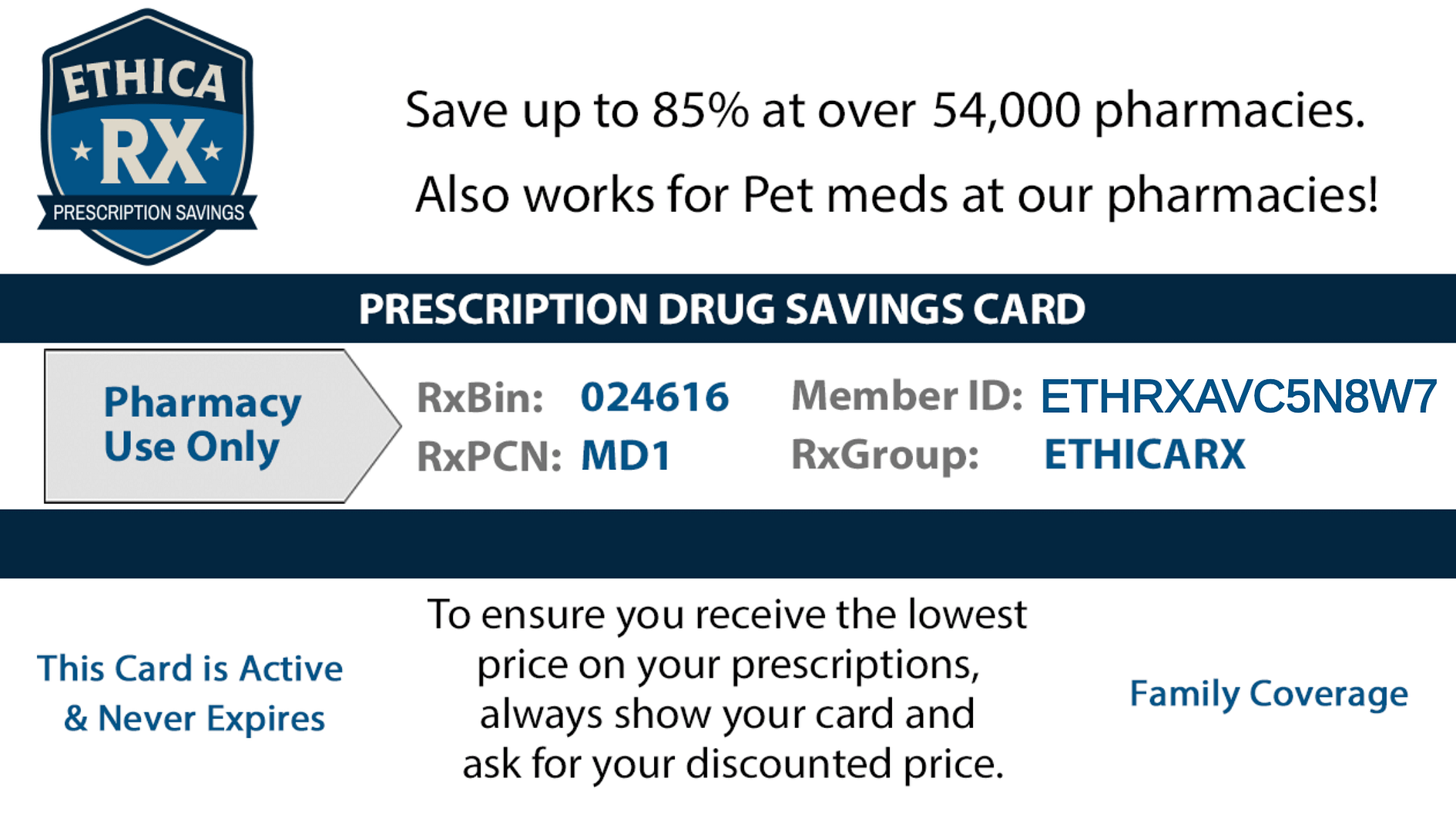
    Just show this card to save on your prescriptions.

    render

  • Health Tip of the Day: Strength Training Benefits Everyone

    Health Tip of the Day: Strength Training Benefits Everyone

    When people hear the words strength training, they often picture bodybuilders lifting enormous barbells or athletes spending hours in the gym. That image can make resistance exercise seem intimidating or unnecessary for the average person.

    But strength training isn’t only for athletes, bodybuilders, or people trying to develop large muscles.

    Strength training can benefit almost everyone.

    Whether you’re in your 20s and want to become stronger, in your 40s and trying to stay active, or entering your later years and hoping to maintain mobility and independence, resistance exercise can play an important role in a healthy lifestyle.

    You don’t need to lift hundreds of pounds. You don’t necessarily need a gym membership. You don’t even need traditional weights.

    Dumbbells, resistance bands, weight machines, household objects, and your own body weight can all provide resistance.

    Today’s Health Tip of the Day is about changing the way we think about strength training.

    Don’t exercise only because you want to change how your body looks.

    Train because you want your body to remain strong enough to support the life you want to live.


    What Exactly Is Strength Training?

    Strength training, also known as resistance training, is exercise that requires your muscles to work against some type of resistance.

    That resistance challenges your muscles. When training is performed consistently and appropriately, your body adapts and can gradually become stronger.

    Resistance can come from many sources, including:

    • Dumbbells
    • Barbells
    • Kettlebells
    • Weight machines
    • Cable machines
    • Resistance bands
    • Medicine balls
    • Your own body weight
    • Household objects

    Common strength-training exercises include squats, lunges, rows, presses, step-ups, calf raises, push-ups, and many other movements.

    Some exercises may look impressive, but complicated movements aren’t required to experience the benefits of resistance training.

    A simple routine performed consistently can be extremely valuable.


    Why Strength Matters in Everyday Life

    We sometimes think about strength only in terms of how much weight someone can lift.

    But everyday life requires strength constantly.

    Think about everything you might do during an ordinary day.

    You may have to:

    • Get out of bed
    • Stand up from a chair
    • Carry groceries
    • Lift a laundry basket
    • Climb stairs
    • Carry a child
    • Move something around the house
    • Take out the garbage
    • Get into and out of a vehicle
    • Bend down and pick something up
    • Work in the yard
    • Walk up a hill

    Your muscles make these movements possible.

    The stronger and more capable your body is, the easier many ordinary activities may become.

    That’s one of the most important reasons to consider resistance exercise.

    Strength training prepares your body for life outside the gym.


    1. Strength Training Helps Build and Maintain Muscle

    One of the best-known benefits of strength training is its ability to help build and maintain muscle.

    Muscle isn’t simply something people develop because they want a certain appearance.

    Muscle is functional.

    Your muscles allow you to move, lift, carry, stand, walk, push, pull, and perform countless other activities.

    Maintaining muscle becomes particularly important as we grow older because aging is commonly associated with gradual losses in muscle mass and strength.

    Regular resistance exercise provides your muscles with a reason to remain active and strong.

    That doesn’t mean everyone who strength trains will suddenly develop enormous muscles.

    For most people, the goal can simply be:

    Maintain the strength you need to live your life comfortably and independently.


    2. Strength Training Can Make Everyday Tasks Easier

    One of the most rewarding parts of becoming stronger isn’t necessarily what happens during your workout.

    It’s what happens afterward.

    Maybe the grocery bags don’t feel quite as heavy.

    Maybe climbing the stairs becomes easier.

    Maybe you can stand up from the couch without struggling.

    Maybe you’re able to spend more time gardening.

    Maybe carrying a suitcase doesn’t feel as difficult.

    Maybe you’re able to play with your children or grandchildren longer.

    These improvements may not earn medals or appear impressive on social media, but they can significantly affect your quality of life.

    Functional strength matters.

    Your workouts should ultimately help you live your life.


    3. Strength Training Supports Healthy Bones

    Your muscles aren’t the only parts of your body that respond to exercise.

    Your bones do too.

    Weight-bearing and resistance activities place stress on the bones, encouraging them to adapt.

    Maintaining bone health becomes increasingly important as people age.

    While nutrition and other lifestyle factors also play important roles in bone health, appropriately performed resistance training can be part of an overall strategy for maintaining strong bones.

    Think about strength training as an investment.

    The effort you put into maintaining your physical abilities today may help support your mobility and independence later.


    4. Stronger Legs Can Support Mobility

    Your legs contain some of the largest and most important muscles in your body.

    You depend on them constantly.

    Strong legs help you:

    • Walk
    • Stand
    • Climb stairs
    • Sit down
    • Stand back up
    • Maintain stability
    • Navigate uneven surfaces
    • Perform household activities

    That’s why exercises targeting the legs and hips are commonly included in strength-training programs.

    Depending on your abilities, these might include:

    • Chair squats
    • Traditional squats
    • Step-ups
    • Lunges
    • Leg presses
    • Calf raises
    • Glute bridges

    You don’t have to perform every exercise.

    Find movements that are appropriate for your current fitness level.


    5. Strength Training Can Improve Balance and Stability

    Strength and balance are closely connected.

    Your muscles help stabilize your body when you stand, walk, bend, reach, or change direction.

    Building strength in your legs, hips, and core can contribute to better overall stability.

    This can become especially important later in life.

    Falls are a significant concern for older adults, and maintaining strength and balance can be part of reducing fall risk.

    Strength training can’t eliminate every possibility of falling, but maintaining a stronger and more capable body can help support safer movement.


    6. Strength Training Supports Your Core

    When people hear “core,” they often think about abdominal appearance.

    But your core has a much bigger job.

    Your core muscles help stabilize your torso and support many movements.

    You use your core when you:

    • Walk
    • Bend
    • Lift
    • Carry
    • Reach
    • Stand
    • Sit
    • Exercise
    • Perform household tasks

    A strong core isn’t simply about having visible abdominal muscles.

    It’s about developing stability.

    Core training can include many exercises beyond traditional sit-ups. Depending on your fitness level, appropriate movements might include planks, modified planks, carries, bridges, or other stability exercises.


    7. Strength Training Can Support Better Posture

    Modern lifestyles often involve a lot of sitting.

    We sit at computers.

    We sit while driving.

    We sit while watching television.

    We look down at our phones.

    Over time, weak or underused muscles can contribute to poor movement patterns and posture.

    Strengthening muscles in the back, shoulders, core, and hips can support better body positioning and movement.

    Strength training isn’t a guaranteed solution for every posture issue, but developing balanced muscular strength can be beneficial.


    8. Strength Training Can Complement Cardio

    Sometimes people believe they have to choose between strength training and cardiovascular exercise.

    In reality, they can complement each other.

    Cardiovascular activities such as walking, cycling, swimming, or jogging provide important benefits.

    Strength training provides different benefits.

    A balanced fitness routine may include both.

    For example, someone might walk several days each week while performing resistance exercises two or three days per week.

    You don’t have to spend hours exercising every day.

    The goal is to build a sustainable routine.


    9. Strength Training Can Support Weight Management

    If weight management is one of your goals, resistance exercise can be a useful part of your overall approach.

    Strength training helps preserve and potentially increase lean muscle while you’re working toward your goals.

    But it’s important to remember that no single type of exercise is a magic solution.

    Healthy weight management generally involves multiple factors, including:

    • Nutrition
    • Physical activity
    • Sleep
    • Stress management
    • Consistency
    • Individual health circumstances

    Strength training can be one piece of that larger picture.

    Instead of focusing only on calories burned during a workout, consider what you’re building.

    You’re building a stronger and more capable body.


    10. Strength Training Can Help You Feel More Capable

    There’s something encouraging about discovering that your body can do something it couldn’t do several weeks or months earlier.

    Maybe you start with five chair squats.

    Eventually, you can do ten.

    Maybe you begin with very light dumbbells.

    Eventually, those weights feel easy.

    Maybe climbing the stairs used to leave your legs exhausted.

    After consistently exercising, the same stairs may become more manageable.

    These small improvements can create a sense of accomplishment.

    You’re seeing evidence that your effort is producing change.


    11. Strength Training Can Support Healthy Aging

    One of the strongest arguments for resistance training is its potential role in healthy aging.

    When you’re younger, you might exercise primarily because you want to look better.

    As you grow older, another goal often becomes increasingly important:

    Independence.

    Can you continue doing things for yourself?

    Can you carry your groceries?

    Can you climb stairs?

    Can you get up from a chair?

    Can you travel?

    Can you enjoy hobbies?

    Can you maintain an active lifestyle?

    Strength plays an important role in many of these abilities.

    Exercise isn’t about trying to stop aging.

    It’s about giving yourself the best opportunity to remain active and capable as you age.


    12. You Are Never “Too Old” to Care About Strength

    Some people believe strength training is something you do when you’re young.

    That’s a misconception.

    Resistance training can be adapted for many different ages and abilities.

    An older adult’s workout might look completely different from an athlete’s workout.

    That’s perfectly fine.

    Exercise isn’t a competition.

    The appropriate amount of resistance depends on the individual.

    Some people may use heavy weights.

    Others may use light dumbbells.

    Some may use resistance bands.

    Others may begin with chair-assisted exercises.

    The goal isn’t to copy someone else’s workout.

    The goal is to safely challenge your own body.


    13. Beginners Don’t Need Heavy Weights

    Walking into a gym for the first time can feel intimidating.

    You might see people lifting heavy barbells or using machines you don’t understand.

    Don’t worry about them.

    Everyone starts somewhere.

    Beginners generally benefit from focusing on proper movement and technique before worrying about heavy resistance.

    Start with a manageable level of resistance.

    Learn the movement.

    Practice good form.

    Become comfortable.

    Then gradually progress.

    Your muscles don’t know whether someone across the gym is lifting more than you.

    They only know whether you’re challenging them.


    14. Progress Should Be Gradual

    One of the basic principles of strength training is progressive overload.

    This simply means gradually increasing the challenge placed on your muscles.

    That doesn’t always mean adding large amounts of weight.

    Progress can happen in several ways.

    You might:

    • Add a little resistance
    • Perform another repetition
    • Improve your technique
    • Increase your range of motion when appropriate
    • Add another set
    • Progress to a slightly more challenging exercise

    Small increases over time can create meaningful improvements.

    There’s no reason to rush.


    15. Body-Weight Exercises Are Real Strength Training

    You don’t need expensive equipment.

    Your own body can provide resistance.

    Body-weight exercises can include:

    • Chair squats
    • Squats
    • Wall push-ups
    • Modified push-ups
    • Traditional push-ups
    • Step-ups
    • Glute bridges
    • Calf raises
    • Planks

    These exercises can also be modified.

    Someone new to exercise might perform wall push-ups rather than floor push-ups.

    Someone who struggles with squats might begin by repeatedly sitting down and standing up from a sturdy chair.

    The exercise should meet you where you are.


    16. Resistance Bands Can Make Strength Training Accessible

    Resistance bands are another useful option.

    They’re portable, inexpensive, and don’t require much storage space.

    Bands can be used for exercises targeting many areas of the body, including the:

    • Arms
    • Shoulders
    • Back
    • Chest
    • Legs
    • Hips

    They can also be useful for people who prefer exercising at home.

    You don’t need an elaborate home gym.

    Sometimes a resistance band, sturdy chair, and a little space are enough to get started.


    17. You Don’t Need Long Workouts

    Another misconception is that exercise only counts if you spend an hour or two in the gym.

    It doesn’t.

    A shorter workout can still be valuable.

    For beginners, even a simple routine containing several basic exercises can provide a starting point.

    For example:

    Chair squats

    Wall push-ups

    Resistance-band rows

    Calf raises

    Glute bridges

    An appropriate core exercise

    You could begin with a manageable number of repetitions and gradually increase the challenge as your fitness improves.

    The goal isn’t to destroy yourself during a workout.

    The goal is to stimulate your muscles and return consistently.


    18. How Often Should You Strength Train?

    Physical activity guidelines generally recommend that adults perform muscle-strengthening activities involving all major muscle groups on at least two days per week.

    Major muscle groups include the:

    • Legs
    • Hips
    • Back
    • Abdomen
    • Chest
    • Shoulders
    • Arms

    Beginners don’t necessarily need complicated workout schedules.

    Two full-body strength-training sessions each week can be a reasonable starting structure for many people.

    Some individuals may eventually prefer three or more sessions depending on their goals, experience, recovery, and overall health.


    19. Rest Is Part of Getting Stronger

    One of the most common mistakes people make when beginning an exercise routine is believing that more is always better.

    Your muscles need recovery.

    Exercise provides the challenge.

    Recovery allows your body to adapt.

    That means rest isn’t laziness.

    It’s part of training.

    A healthy routine should include adequate recovery between challenging workouts.

    Listen to your body and avoid repeatedly training through significant pain or exhaustion.


    20. Nutrition Matters Too

    Exercise and nutrition work together.

    Your body needs nutrients to support physical activity and recovery.

    A balanced eating pattern should generally include a variety of nutritious foods such as:

    • Vegetables
    • Fruits
    • Whole grains
    • Protein-rich foods
    • Healthy fats
    • Appropriate amounts of fluids

    Protein is particularly important because it provides amino acids used to maintain and repair muscle tissue.

    You don’t necessarily need complicated supplements or expensive products.

    Start by improving the overall quality and balance of your everyday meals.


    21. Hydration Is Easy to Forget

    Strength training may not always leave you dripping with sweat like a long cardio workout, but hydration still matters.

    Drink fluids throughout your day and pay attention to your needs around physical activity.

    Your hydration requirements can vary based on your body size, activity level, environment, health, and other factors.

    Make drinking water part of your daily routine rather than waiting until you’re extremely thirsty.


    22. Sleep Supports Your Training

    If you’re exercising regularly but constantly neglecting sleep, you’re overlooking an important part of recovery.

    Sleep supports numerous processes involved in health and physical recovery.

    Think about health as a combination of habits.

    Exercise matters.

    Nutrition matters.

    Hydration matters.

    Sleep matters.

    Recovery matters.

    You don’t have to perfect everything overnight.

    Work on improving one habit at a time.


    23. Don’t Chase Soreness

    Some people judge a workout by how sore they feel the next morning.

    But soreness isn’t necessarily proof of an effective workout.

    A productive workout should challenge you without making normal life unnecessarily difficult.

    Some muscle soreness can occur, especially when beginning a new routine, but extreme soreness shouldn’t be the goal.

    Your goal is progress.

    Not punishment.


    24. Don’t Let the Scale Be Your Only Measure of Progress

    If you’re strength training as part of a healthier lifestyle, don’t judge every improvement by the number on the scale.

    There are many ways to measure progress.

    Ask yourself:

    • Am I stronger?
    • Can I perform more repetitions?
    • Are everyday activities easier?
    • Do I have better endurance?
    • Is my balance improving?
    • Can I walk farther?
    • Do I feel more physically capable?
    • Am I becoming more consistent?

    The scale provides one piece of information.

    It doesn’t tell the entire story.


    25. Keep Track of Your Improvements

    Recording your workouts can help you recognize progress.

    You might write down:

    • The exercise
    • Weight or resistance used
    • Number of repetitions
    • Number of sets
    • How the exercise felt

    Several weeks later, you can look back.

    Maybe you started with five repetitions and now perform twelve.

    Maybe you began with a light resistance band and moved to a stronger one.

    Maybe an exercise that once felt difficult now feels manageable.

    Those improvements deserve recognition.


    26. Exercise Should Fit Your Life

    A fitness program that looks perfect on paper isn’t useful if you can’t maintain it.

    Find a routine that fits your schedule and lifestyle.

    If mornings work best, exercise in the morning.

    If evenings work better, train in the evening.

    If you prefer a gym, use one.

    If you’d rather exercise at home, create a simple home routine.

    The best program isn’t necessarily the most advanced.

    It’s the program you can consistently follow.


    27. You Don’t Have to Love Every Workout

    Some days you’ll feel motivated.

    Other days you won’t.

    That’s normal.

    You don’t have to feel excited every time you exercise.

    Habits become powerful when you stop depending entirely on motivation.

    Create a routine.

    Schedule your workouts.

    Prepare your equipment.

    Show up.

    Even when a workout isn’t perfect, doing something appropriate can help maintain your habit.


    28. Strength Training Is About Your Future

    One of the best ways to think about resistance exercise is as an investment in your future self.

    You’re not only exercising for today.

    You’re training for the person you want to be five, ten, twenty, or thirty years from now.

    You may be training so you can continue traveling.

    You may be training so you can play with grandchildren.

    You may be training so you can keep gardening.

    You may be training so you can climb stairs.

    You may simply be training because you want to remain independent for as long as possible.

    Those are powerful reasons to become stronger.


    Strength Looks Different for Everyone

    For one person, strength might mean deadlifting hundreds of pounds.

    For another person, strength might mean standing up from a chair without assistance.

    Both accomplishments can matter.

    Fitness should be personal.

    You don’t have to meet someone else’s definition of strong.

    Focus on improving your own abilities.

    If you can do something today that you couldn’t comfortably do several months ago, that’s progress.


    A Simple Beginner Approach

    If you’ve never strength trained before, keep things simple.

    Start with a few basic movements that target different areas of your body.

    You might include:

    Legs

    Chair squats or another appropriate squat variation.

    Chest and Arms

    Wall push-ups or modified push-ups.

    Back

    Resistance-band rows.

    Lower Legs

    Calf raises while holding a sturdy surface for support if necessary.

    Hips

    Glute bridges or another appropriate hip exercise.

    Core

    A beginner-friendly stability exercise.

    You don’t have to perform dozens of different exercises.

    Learn a few basic movements and practice them consistently.


    Make Proper Form a Priority

    Don’t sacrifice technique simply because you want to lift heavier weight.

    Poor technique can increase the risk of injury and reduce the effectiveness of the exercise.

    Move with control.

    Learn the exercise.

    Use resistance appropriate for your abilities.

    If you’re unsure how to perform a movement, consider getting instruction from a qualified fitness professional.

    Sometimes using less weight with better technique is the smarter choice.


    Know When to Stop

    Exercise should challenge you, but you shouldn’t ignore serious warning signs.

    Stop exercising and seek appropriate medical care if you experience concerning symptoms such as:

    • Chest pain
    • Fainting
    • Severe or unusual shortness of breath
    • Sudden severe pain
    • Other significant or alarming symptoms

    If you have chronic health conditions, injuries, substantial mobility limitations, or haven’t exercised in a long time, consider discussing your plans with a healthcare professional or qualified exercise professional.

    Strength training can often be modified.

    There’s almost always more than one way to perform a movement.


    Today’s Health Challenge

    You don’t need to transform your entire fitness routine today.

    Instead, take one small step.

    Choose one strength-training exercise appropriate for your abilities.

    You might try:

    5–10 chair squats

    or

    5–10 wall push-ups

    or

    a few resistance-band rows

    or

    several controlled calf raises while holding a sturdy surface

    The number isn’t what’s most important.

    Starting is.

    Once that exercise becomes part of your routine, add another.

    Then another.

    Build gradually.


    Your Future Self Will Appreciate the Strength You Build Today

    We spend a lot of time thinking about how exercise changes our appearance.

    Maybe we should spend more time thinking about what exercise allows us to do.

    Imagine yourself years from now.

    You want to be able to walk comfortably.

    You want to get out of a chair easily.

    You want to carry your groceries.

    You want to travel.

    You want to enjoy your hobbies.

    You want to remain independent.

    You want to continue participating in life.

    Strength training can be one tool that helps support those goals.

    Every squat, push, pull, step, and controlled repetition is more than exercise.

    It’s an investment in your future ability.


    Final Thoughts: Strength Training Benefits Everyone

    Strength training isn’t reserved for bodybuilders.

    It isn’t only for athletes.

    It isn’t only for young people.

    And it certainly isn’t only for people who want bigger muscles.

    Strength training can benefit people across many ages, abilities, and fitness levels.

    It can help you maintain muscle.

    It can support healthy bones.

    It can improve functional strength.

    It can contribute to balance and stability.

    It can complement cardiovascular exercise.

    It can make everyday activities easier.

    And perhaps most importantly, maintaining strength can help support your ability to remain active and independent as you grow older.

    You don’t need to start with heavy weights.

    You don’t need expensive equipment.

    You don’t need hour-long workouts.

    You don’t need to compare yourself with anyone else.

    Start where you are.

    Choose exercises appropriate for your abilities.

    Learn proper technique.

    Increase the challenge gradually.

    Give yourself time to recover.

    Stay consistent.

    And remember why you’re doing it.

    The goal isn’t simply to become better at lifting weights.

    The goal is to become stronger for life.

    Every bit of strength you build today can help prepare your body for tomorrow.

    Health Tip of the Day

    Strength training benefits everyone. Start small, stay consistent, and build the strength that can help you keep moving, living, and enjoying life for years to come.

  • Health Tip of the Day: Stretch Every Morning

    Health Tip of the Day: Stretch Every Morning

    The first few minutes after you wake up can set the tone for your entire morning. Your mind may already be thinking about work, appointments, family responsibilities, errands, meals, bills, and everything else waiting for you. Meanwhile, your body has just spent several hours relatively still.

    Before rushing into the day, give your body something simple: a few minutes of gentle stretching.

    Today’s Health Tip of the Day: Stretch Every Morning.

    Morning stretching doesn’t require a gym membership, special equipment, or an hour of free time. You don’t have to be flexible, athletic, or experienced. A short routine of comfortable movements can help you transition from sleep to activity, loosen areas that feel stiff, and create a calmer beginning to your day.

    Even five minutes can be a meaningful addition to your morning routine.

    Why Do We Feel Stiff When We Wake Up?

    Many people wake up with stiffness in their neck, shoulders, back, hips, or legs. That’s understandable considering you’ve spent hours sleeping with relatively little movement.

    Your sleeping position, mattress, pillow, previous day’s activities, and general activity level can all influence how your body feels when you wake up.

    Sometimes your first instinct may be to jump out of bed and immediately begin moving quickly.

    Instead, try giving yourself a moment.

    Sit up.

    Take a breath.

    Move your shoulders.

    Stretch your arms.

    Stand carefully.

    Allow your body to gradually transition from rest to movement.

    Morning stretching can become a gentle bridge between sleeping and starting your day.

    Stretching Can Help You Maintain Flexibility

    Flexibility is an important part of physical function.

    You use flexibility during ordinary activities without necessarily thinking about it.

    You need comfortable movement to bend down and tie your shoes, reach into a cabinet, turn around, get dressed, climb stairs, pick something up, or perform countless other everyday tasks.

    Regular stretching may help maintain or gradually improve flexibility and range of motion.

    However, flexibility doesn’t develop overnight.

    The goal isn’t to force your body into uncomfortable positions. It’s to practice comfortable movement consistently.

    You may barely reach toward your toes today.

    That’s okay.

    You may move a little farther several weeks from now.

    That’s progress.

    Healthy habits don’t require perfection.

    They require consistency.

    Morning Stretching Helps Wake Up Your Body

    When your alarm rings, your brain may understand that it’s morning, but your muscles may still feel like they’re sleeping.

    Gentle movement can help your body transition into the day.

    Stretching your shoulders, arms, back, hips, and legs can help you feel more mobile before you begin walking around, commuting, working, exercising, or completing household responsibilities.

    Think about how naturally many animals stretch when they wake up.

    They don’t check the clock first.

    They don’t schedule it.

    They simply stretch.

    Our bodies often appreciate the same gradual transition.

    Stretching May Help You Feel Less Stiff

    Morning stiffness doesn’t necessarily mean something is wrong. Sometimes your body simply needs movement after being relatively inactive overnight.

    Gentle stretching may help you feel looser and more comfortable.

    The key word is gentle.

    Morning isn’t necessarily the time to test how far you can stretch.

    Move slowly.

    Pay attention to your body.

    Allow your muscles to gradually wake up.

    If a movement feels uncomfortable, reduce the range or try something different. Sharp or significant pain is a reason to stop rather than push harder.

    Stretching Can Improve Your Awareness of Your Body

    One overlooked benefit of a morning stretching routine is that it gives you a chance to notice how your body feels.

    Maybe your shoulders feel unusually tight.

    Maybe your lower back feels stiff.

    Maybe one leg feels tighter than the other.

    Maybe everything feels great.

    When you immediately rush into your day, you may not notice these things until later.

    A few minutes of gentle movement can help you become more aware of your body before your schedule takes over.

    This doesn’t mean analyzing every sensation or worrying about normal stiffness. It simply means paying attention.

    Your body communicates with you constantly.

    Sometimes slowing down for five minutes makes it easier to listen.

    Stretching Can Be Part of a Calmer Morning

    There is another reason to stretch that has nothing to do with touching your toes.

    It can give you a peaceful moment.

    Many mornings begin with stimulation.

    The alarm goes off.

    You grab your phone.

    Notifications appear.

    Emails are waiting.

    Social media is updating.

    News headlines demand attention.

    Your mind can go from sleeping to overloaded within minutes.

    Consider doing something different.

    Before giving the outside world your attention, give yourself five minutes.

    Stretch.

    Breathe.

    Move.

    Be quiet.

    Allow your mind and body to wake up together.

    You may discover that stretching becomes more than a physical routine. It can become a small morning ritual that helps you begin the day intentionally.

    Try This Simple 5–10 Minute Morning Stretch

    You don’t need to follow an exact routine. Choose movements that are comfortable and appropriate for you.

    Here’s a simple place to begin.

    1. Start With Deep Breathing

    Before doing anything else, sit or stand comfortably.

    Take a slow breath in.

    Pause naturally.

    Then slowly breathe out.

    Repeat several times.

    Let your shoulders relax.

    This gives you a moment to transition from sleep into movement.

    2. Reach Toward the Ceiling

    Stand comfortably with your feet stable.

    Slowly raise both arms overhead.

    Reach upward gently without straining.

    Imagine creating space through your upper body.

    Hold for a few comfortable breaths.

    Then slowly lower your arms.

    Repeat if it feels good.

    3. Roll Your Shoulders

    Your shoulders may become tight from sleeping positions, sitting, computer work, driving, or everyday stress.

    Slowly roll your shoulders backward several times.

    Then roll them forward.

    Keep the movement controlled.

    Don’t rush.

    4. Gently Move Your Neck

    Your neck can be especially sensitive, so movements should be slow and comfortable.

    Gently turn your head toward one side.

    Return to the center.

    Then turn toward the other side.

    Stay within a comfortable range.

    Avoid forcing your neck or making sudden circular movements.

    5. Stretch Your Sides

    Raise one arm overhead.

    Gently lean toward the opposite side.

    You may feel a stretch along your side and torso.

    Return to the center.

    Switch arms and repeat on the other side.

    Keep your movements slow and controlled.

    6. Open Your Chest

    If you spend significant time sitting or looking at screens, the front of your body may feel tight.

    Gently draw your shoulders back while keeping your posture comfortable.

    You can bring your hands behind you if that position feels natural, but don’t force it.

    Take a few slow breaths.

    Then relax.

    7. Gentle Back Movement

    Stand with your feet comfortably apart.

    Place your hands on your hips.

    Gently shift your torso or pelvis within a comfortable range.

    The goal isn’t to dramatically bend your spine.

    You’re simply introducing movement after hours of rest.

    8. Stretch Your Hamstrings

    The muscles along the backs of your thighs can become tight.

    Choose a stable position and gently lengthen the backs of your legs without locking your knees or forcing yourself toward your toes.

    Hold the stretch comfortably.

    Breathe.

    Then release.

    9. Stretch Your Calves

    Stand facing a wall and place your hands against it for support.

    Step one foot backward.

    Keep your movement comfortable and gently press the back heel toward the floor.

    Hold briefly.

    Switch sides.

    This can feel especially good before spending a day walking or standing.

    10. Finish With a Full-Body Reach

    Finish where you started.

    Stand comfortably.

    Raise your arms overhead.

    Take a slow breath.

    Stretch upward gently.

    Then lower your arms while breathing out.

    Your morning stretching routine is complete.

    Stretching Shouldn’t Hurt

    There’s an important difference between feeling a gentle stretch and feeling pain.

    A mild pulling or tension sensation can occur during stretching.

    Sharp, burning, sudden, or significant pain is different.

    Don’t force your body into positions because you think you “should” be able to reach farther.

    Flexibility varies dramatically from person to person.

    Someone else’s range of motion doesn’t determine what is appropriate for you.

    Your goal isn’t to win at stretching.

    Your goal is to move comfortably.

    Don’t Bounce Into Stretches

    When performing basic stretches, slow and controlled movements are generally preferable to aggressive bouncing.

    Ease into the position.

    Hold comfortably.

    Breathe normally.

    Then release slowly.

    Stretching harder isn’t necessarily stretching better.

    Patience matters.

    You Don’t Need to Touch Your Toes

    Many people assume flexibility means being able to touch their toes.

    It doesn’t.

    If you reach toward your toes and your hands stop at your knees or shins, that’s where you are today.

    Respect that.

    Your body isn’t competing with anyone else’s body.

    Over time, consistent movement may improve your flexibility, but there’s no reason to force progress.

    Celebrate comfortable movement rather than chasing a particular position.

    Stretching Is Especially Important If You Sit a Lot

    Modern life involves a tremendous amount of sitting.

    We sit while driving.

    We sit at work.

    We sit while eating.

    We sit while watching television.

    We sit while scrolling through our phones.

    For some people, several hours can pass with very little meaningful movement.

    Morning stretching won’t erase an entire day of inactivity, but it can become one piece of a more active lifestyle.

    Combine your morning stretching routine with other simple habits:

    Take short walking breaks.

    Stand periodically.

    Move your shoulders.

    Change positions.

    Walk when practical.

    Stretch gently throughout the day.

    Your body was designed to move.

    Give it opportunities to do so.

    Morning Stretching Doesn’t Replace Exercise

    Stretching is valuable, but it isn’t a replacement for other forms of physical activity.

    A balanced approach to fitness can include aerobic activity, strength training, balance work, flexibility, and everyday movement.

    Think of morning stretching as one piece of the puzzle.

    It prepares you to move.

    Then continue finding opportunities to be active throughout the day.

    You don’t have to become an athlete.

    You simply want to keep moving.

    Create a Morning Routine You Can Actually Maintain

    A healthy routine only works when you can realistically continue doing it.

    Don’t create a complicated 30-minute stretching routine if you know your mornings are already rushed.

    Start with five minutes.

    Or even two.

    You can always add more later.

    Choose three or four stretches you enjoy.

    Do them every morning.

    Once the habit feels natural, add another movement.

    Small habits are often easier to maintain than dramatic lifestyle changes.

    Connect Stretching to Something You Already Do

    One effective way to remember a new habit is to connect it with an existing habit.

    For example:

    Wake up → Drink water → Stretch → Shower → Breakfast.

    Or:

    Brush your teeth → Stretch for five minutes → Get dressed.

    Or:

    Start the coffee → Stretch while it brews → Begin your morning.

    Eventually, stretching can become something you do automatically.

    You won’t have to debate whether you’re going to do it.

    It will simply become part of your morning.

    Try the Two-Minute Rule

    If you’re struggling to begin, tell yourself:

    “I’m only stretching for two minutes.”

    Two minutes doesn’t sound intimidating.

    Stretch your arms.

    Roll your shoulders.

    Move your legs.

    Take a few deep breaths.

    You’re done.

    But something interesting often happens.

    Once you’ve started, you may decide to continue for another few minutes.

    Starting is usually the hardest part.

    Make starting easy.

    Don’t Let Missing One Morning End the Habit

    You will eventually miss a day.

    Maybe you oversleep.

    Maybe you’re traveling.

    Maybe you’re sick.

    Maybe your schedule changes.

    That doesn’t mean you’ve failed.

    Simply begin again the next morning.

    Healthy habits aren’t destroyed by one imperfect day.

    The important thing is returning to them.

    Consistency doesn’t mean never missing.

    It means continuing.

    Combine Stretching With Hydration

    Another simple morning health habit is drinking water.

    After sleeping for several hours without drinking, having some water in the morning can be an easy way to begin meeting your fluid needs for the day.

    Pair the habits together:

    Drink water. Stretch. Start your day.

    Simple routines are often the easiest ones to maintain.

    Put Your Phone Down for Five Minutes

    Here’s a challenge.

    Tomorrow morning, don’t immediately reach for your phone.

    Give yourself five minutes first.

    Stretch.

    Breathe.

    Move.

    Look outside.

    Think about what you’re grateful for.

    Prepare yourself mentally for the day.

    Then check your phone.

    Those five minutes belong to you.

    The notifications can wait.

    Use Morning Stretching as a Moment of Gratitude

    While you’re stretching, consider thinking about something you’re thankful for.

    Your morning doesn’t have to begin with everything that’s wrong.

    Think about something good.

    Another sunrise.

    Someone you love.

    A roof over your head.

    A meal waiting for you.

    Another opportunity.

    Another day.

    Another chance to keep moving forward.

    Physical health and emotional well-being aren’t completely separate parts of life. Your morning routine can create space to care for both.

    Small Healthy Habits Add Up

    People sometimes avoid improving their health because they imagine the changes must be enormous.

    They think they need to completely change their diet.

    Exercise every day.

    Lose a significant amount of weight.

    Wake up at 5 a.m.

    Give up everything they enjoy.

    That’s overwhelming.

    Instead, start smaller.

    Stretch for five minutes.

    Drink another glass of water.

    Walk for ten minutes.

    Eat another serving of vegetables.

    Go to bed a little earlier.

    Stand up more often.

    Take the stairs when appropriate.

    Healthy living isn’t built from one perfect decision.

    It’s built from thousands of small decisions repeated over time.

    Listen to Your Body

    Every morning may feel different.

    Some days you’ll feel loose and energetic.

    Other mornings you’ll feel stiff.

    Your routine doesn’t have to be identical every day.

    Pay attention to what your body needs.

    If your shoulders feel tight, spend more time gently moving them.

    If your legs feel stiff, focus on comfortable lower-body stretches.

    If you’re feeling great, enjoy a slightly longer routine.

    The goal is to work with your body rather than against it.

    Know When to Get Professional Guidance

    General morning stiffness can be common, but persistent, severe, unexplained, or worsening pain deserves attention.

    If you’re dealing with an injury, recent surgery, significant balance difficulties, severe pain, unusual weakness or numbness, or a condition that affects your movement, talk with an appropriate healthcare professional before starting a new stretching routine.

    A physical therapist or other qualified professional can also help identify movements that are appropriate for your individual needs.

    Make Tomorrow Morning Different

    Tomorrow morning, when your alarm goes off, resist the temptation to immediately rush.

    Give yourself a few minutes.

    Sit up.

    Take a breath.

    Stretch your arms.

    Move your shoulders.

    Gently stretch your legs.

    Stand carefully.

    Take another deep breath.

    Then begin your day.

    Five minutes may not sound significant.

    But five minutes every morning becomes more than 30 minutes of intentional movement every week.

    Over months, those small moments become part of your lifestyle.

    Health Tip of the Day

    Stretch every morning.

    You don’t need complicated equipment.

    You don’t need perfect flexibility.

    You don’t need an elaborate routine.

    You simply need a few minutes and the willingness to move.

    Start gently.

    Breathe normally.

    Never force painful movements.

    Be consistent.

    And remember that taking care of your health doesn’t always require making enormous changes.

    Sometimes it begins with something incredibly simple.

    Wake up. Stretch. Breathe. Move.

    Then step into your day feeling a little more prepared for whatever comes next.

    Today’s Challenge

    Tomorrow morning, spend at least five minutes gently stretching before you become distracted by your phone, work, or daily responsibilities.

    Choose a few comfortable movements, breathe slowly, and notice how your body feels afterward.

    Then challenge yourself to repeat it for seven mornings.

    A healthier routine doesn’t have to start with a giant transformation.

    It can start tomorrow morning with one simple stretch.

  • Health Tip of the Day: Recognize the Signs of Dehydration

    Health Tip of the Day: Recognize the Signs of Dehydration

    Water is one of the most basic necessities of life, yet staying properly hydrated is something many of us overlook.

    You may remember to drink water when you’re exercising, spending a hot afternoon outdoors, or feeling extremely thirsty. But dehydration doesn’t always announce itself dramatically. Sometimes it develops gradually while you’re working, running errands, traveling, sleeping, exercising, or simply getting caught up in a busy day.

    By the time you notice a headache, dry mouth, unusual tiredness, or dizziness, your body may already be telling you that it needs more fluids.

    That’s why today’s Health Tip of the Day is about awareness:

    Learn to recognize the signs of dehydration and respond to them early.

    Hydration isn’t about forcing yourself to drink enormous amounts of water. It’s about consistently giving your body the fluids it needs and paying attention when it tells you something is changing.

    What Is Dehydration?

    Dehydration occurs when your body loses more fluid than you’re replacing.

    Your body is constantly losing water. You lose it through:

    • Urination
    • Sweating
    • Breathing
    • Bowel movements

    Additional fluid can be lost when you’re exercising, spending time in hot weather, experiencing a fever, vomiting, or having diarrhea.

    When you’re not replacing enough of that lost fluid, dehydration can develop.

    Along with water, your body can lose electrolytes, including sodium and potassium. These minerals play important roles in normal nerve and muscle function and maintaining fluid balance.

    The greater the fluid loss becomes, the more difficult it can be for your body to perform its normal functions.

    Why Your Body Needs Water

    Water isn’t simply something that prevents thirst.

    Adequate hydration supports many important processes throughout your body. Water helps with temperature regulation, digestion, circulation, nutrient transportation, waste removal, joint lubrication, and many other normal functions.

    Think about how much your body accomplishes during an ordinary day.

    Your heart keeps beating. Your lungs keep breathing. Your digestive system processes food. Your kidneys filter waste. Your muscles allow you to move. Your body constantly works to maintain a stable temperature.

    Water helps support all of these processes.

    That’s one reason hydration deserves to be part of your everyday health routine rather than something you think about only when you’re thirsty.

    Your Body Often Warns You

    Dehydration doesn’t necessarily happen all at once.

    Your body may provide several clues that your fluid intake isn’t keeping up with your needs.

    Learning those signals is important because the earlier you recognize dehydration, the sooner you can begin replacing lost fluids.

    Some signs can be subtle, and they may have other causes as well. But when several symptoms occur together—especially after sweating, being outside in hot weather, exercising, vomiting, or having diarrhea—dehydration becomes something worth considering.

    1. Increased Thirst

    Thirst is perhaps the most familiar sign that you need fluids.

    If you suddenly find yourself craving water or feeling much thirstier than usual, don’t ignore it.

    Drink something.

    However, thirst shouldn’t necessarily be your only hydration strategy. Some people, particularly older adults, may not experience thirst as strongly even when they need additional fluids.

    Instead of waiting until you’re extremely thirsty, make drinking fluids a regular part of your day.

    2. Dry Mouth and Lips

    A dry or sticky feeling in your mouth can be another indication that you need more fluids.

    You may also notice dry or cracked lips.

    If you’ve been busy for several hours and suddenly notice your mouth feels unusually dry, think about when you last had something to drink.

    Sometimes a glass of water and a little attention to hydration can make a noticeable difference.

    3. Darker Urine

    Urine color can sometimes provide a helpful clue about hydration.

    Pale yellow urine often accompanies adequate hydration, while darker yellow urine can occur when your body is conserving water.

    However, urine color isn’t a perfect hydration test.

    Certain foods, supplements, medications, and medical conditions can affect its appearance. For example, some vitamins can make urine look unusually bright.

    Instead of relying entirely on color, consider it one piece of information alongside how often you’re urinating, how much you’ve been sweating, whether you’re thirsty, and how you’re feeling.

    4. Urinating Less Often

    Another potential warning sign is going to the bathroom much less frequently than you normally would.

    When you’re dehydrated, your body attempts to conserve water. As a result, you may produce less urine.

    Pay attention to significant changes in your usual routine, particularly during hot weather, illness, or periods of increased physical activity.

    Very little or no urination can be a sign of more serious dehydration and may require medical attention, especially when accompanied by other concerning symptoms.

    5. Headaches

    There are many possible causes of headaches, and dehydration is one of them.

    If you’ve spent several hours without drinking much, especially while exercising or being outdoors in the heat, dehydration may contribute to a headache.

    Before automatically assuming every headache is caused by dehydration, consider the circumstances.

    Ask yourself:

    How much have I had to drink today?

    Have I been sweating more than usual?

    Have I been outside in hot weather?

    Am I experiencing other signs such as thirst, dry mouth, or darker urine?

    Recognizing patterns can help you become more aware of your body’s needs.

    6. Fatigue and Low Energy

    Feeling unusually tired doesn’t always mean you need another cup of coffee.

    Sometimes you may simply need fluids.

    Dehydration can contribute to feelings of tiredness, sluggishness, or reduced energy.

    When you’re experiencing an afternoon energy slump, consider whether you’ve been drinking enough throughout the day.

    A short break, some water, a nutritious snack, and a little movement may sometimes be more helpful than immediately reaching for another sugary or highly caffeinated drink.

    7. Dizziness or Lightheadedness

    Dehydration can sometimes make you feel dizzy or lightheaded, particularly when fluid loss is more significant.

    This can become especially concerning if you feel unsteady when standing or walking.

    Sit or lie down somewhere safe if you’re feeling faint or dizzy. If symptoms are severe, persistent, or accompanied by fainting, confusion, chest pain, difficulty breathing, or other serious symptoms, seek medical attention rather than assuming dehydration is the only explanation.

    8. Weakness

    Your muscles and nervous system depend on appropriate fluid and electrolyte balance.

    When you lose substantial fluids through sweating or illness, you may begin feeling weaker than usual.

    This can be particularly noticeable during prolonged physical activity or when you’re outside in extreme heat.

    Weakness shouldn’t automatically be blamed on dehydration, but it can be another clue when combined with thirst, decreased urination, dizziness, or other symptoms.

    9. Trouble Concentrating

    Your hydration status may influence how alert and focused you feel.

    If you’re struggling to concentrate after several hours of working, studying, driving, or completing tasks, consider whether you’ve been drinking regularly.

    This doesn’t mean every concentration problem is caused by dehydration. However, maintaining appropriate hydration is one simple part of supporting your overall physical and mental performance.

    10. Feeling Irritable or “Off”

    Sometimes dehydration doesn’t feel like thirst.

    You might simply feel uncomfortable, tired, irritable, sluggish, or generally not like yourself.

    That’s another reason paying attention to patterns is helpful.

    When something feels off, take a moment to check the basics.

    Have you eaten?

    Have you slept enough?

    Have you been drinking fluids?

    Have you been spending time in the heat?

    Simple questions can sometimes identify habits that need attention.

    Dehydration Can Happen Faster in Hot Weather

    Hot summer days deserve additional attention.

    Your body uses sweating as one way to regulate its temperature. The more you sweat, the more fluid you’re losing.

    This is particularly important when you’re:

    • Working outdoors
    • Exercising
    • Gardening
    • Hiking
    • Attending outdoor festivals or sporting events
    • Doing yard work
    • Spending extended periods in direct sunlight
    • Working in hot indoor environments

    Don’t wait until you’re exhausted and extremely thirsty before drinking.

    Bring water with you, take breaks, seek shade or air conditioning when appropriate, and listen to your body’s warning signs.

    Extreme heat can cause serious heat-related illness, so confusion, fainting, severe weakness, or other alarming symptoms shouldn’t be dismissed as “just dehydration.”

    Exercise Increases Your Fluid Needs

    Physical activity can dramatically increase how much you sweat.

    Your individual needs depend on factors such as exercise intensity, duration, temperature, humidity, clothing, and how much you personally sweat.

    For ordinary workouts, water is often sufficient.

    Longer or particularly intense exercise—especially when you’re sweating heavily—may require additional attention to electrolyte replacement.

    The important thing is to avoid beginning exercise already dehydrated and then ignoring fluid loss throughout your workout.

    Drink appropriately before, during, and after exercise.

    Illness Can Quickly Affect Hydration

    Vomiting and diarrhea can cause significant fluid and electrolyte losses.

    Fever may also increase fluid needs.

    This is why hydration becomes particularly important when you’re sick.

    Small, frequent amounts of fluid may sometimes be easier to tolerate than drinking a large amount at once when your stomach is upset.

    Depending on the circumstances, oral rehydration solutions can help replace both water and electrolytes.

    If someone cannot keep fluids down, has ongoing severe vomiting or diarrhea, becomes confused or extremely weak, or shows signs of significant dehydration, medical care may be necessary.

    Older Adults Need Extra Awareness

    Hydration can become especially important as we age.

    Some older adults may experience a reduced sense of thirst, meaning they may not feel extremely thirsty even when their bodies need more fluid.

    Mobility challenges can also make getting water more difficult, and certain medications or medical conditions can affect fluid balance.

    Keeping water accessible and establishing regular drinking habits can help.

    However, people who have been instructed by a healthcare professional to limit fluids because of heart, kidney, or other medical conditions should follow their individualized medical guidance.

    Children Can Become Dehydrated Too

    Children, particularly infants and young children, can become dehydrated more quickly during illnesses involving vomiting, diarrhea, or fever.

    Parents and caregivers should watch for changes such as significantly decreased urination, unusual sleepiness, dry mouth, lack of tears when crying, or other concerning changes in behavior or responsiveness.

    When dehydration is suspected in an infant or young child, particularly when symptoms are significant, contacting a healthcare professional is important.

    Hydration Doesn’t Have to Mean Plain Water All Day

    Water is an excellent choice, but your overall fluid intake can come from multiple sources.

    Other beverages and foods contribute water too.

    Water-rich foods include:

    • Watermelon
    • Cantaloupe
    • Strawberries
    • Oranges
    • Grapes
    • Cucumbers
    • Tomatoes
    • Lettuce
    • Celery
    • Peaches
    • Pineapple
    • Soups
    • Broths

    Adding fruits and vegetables to your meals can support hydration while providing important nutrients.

    Make Water More Enjoyable

    If you find plain water boring, you don’t necessarily need to rely on sugary drinks.

    Try naturally flavoring your water with:

    • Lemon slices
    • Lime
    • Orange
    • Strawberries
    • Blueberries
    • Cucumber
    • Watermelon
    • Fresh mint

    Experiment until you find something you enjoy.

    You may discover that lightly flavored water makes it much easier to drink consistently throughout the day.

    Build Hydration Into Your Daily Routine

    Healthy habits become easier when you connect them to things you already do.

    Instead of relying entirely on remembering to drink, create simple hydration cues throughout your day.

    For example:

    When you wake up: Have some water.

    With breakfast: Include a beverage.

    During your morning: Keep water nearby.

    With lunch: Drink something.

    During exercise: Replace fluids appropriately.

    After exercise: Rehydrate.

    With dinner: Have another beverage.

    The point isn’t to follow a rigid schedule. It’s to prevent hours from passing without thinking about hydration.

    Keep Water Where You Can See It

    Sometimes the simplest strategy is the most effective.

    If your water bottle is sitting in another room, you may forget about it.

    Put it somewhere visible.

    Keep water:

    • On your desk
    • In your vehicle
    • In your gym bag
    • Near your favorite chair
    • With you while running errands
    • Beside you during outdoor activities

    Making the healthier choice convenient often makes it easier to follow through.

    Don’t Replace All Your Water With Sugary Drinks

    Soda, sweet tea, energy drinks, sweetened coffee drinks, and other sugary beverages can contribute fluids, but they can also add substantial amounts of sugar and calories.

    Water remains one of the simplest hydration choices because it contains no added sugar or calories.

    You don’t necessarily need to eliminate every other beverage you enjoy.

    Instead, make water a regular part of your routine and consider replacing some sugary drinks with water or unsweetened alternatives.

    One small replacement each day can become a meaningful long-term habit.

    What About Coffee?

    Coffee and tea do contribute to daily fluid intake, despite the common belief that every caffeinated drink automatically dehydrates you.

    However, water is still an excellent primary beverage, and excessive caffeine may not be appropriate for everyone.

    Rather than worrying about whether every beverage “counts,” focus on maintaining a balanced approach and paying attention to how your body feels.

    Electrolytes: When Do They Matter?

    You’ve probably seen countless beverages advertised as electrolyte drinks.

    Electrolytes are minerals—including sodium and potassium—that help with important functions involving fluid balance, nerves, and muscles.

    Most people eating a normal diet and performing routine daily activities don’t need to constantly drink electrolyte beverages.

    However, electrolyte replacement may become more relevant during prolonged intense exercise, significant sweating, vomiting, diarrhea, or other situations involving substantial fluid and electrolyte loss.

    The appropriate choice depends on the circumstances.

    Can You Drink Too Much Water?

    Yes.

    Although dehydration receives much more attention, drinking excessive amounts of water—particularly very quickly—can also be dangerous.

    Too much water can dilute sodium levels in the blood, potentially causing a serious condition known as hyponatremia.

    That’s why the goal shouldn’t be:

    “Drink as much water as humanly possible.”

    A better goal is:

    Stay consistently and appropriately hydrated.

    Your needs vary based on your body, diet, activity, environment, medications, and medical conditions.

    More isn’t automatically healthier.

    How Much Water Do You Actually Need?

    There isn’t one perfect amount that applies to every person in every situation.

    Fluid needs can vary depending on:

    • Body size
    • Activity level
    • Climate
    • Temperature
    • Humidity
    • Diet
    • Pregnancy or breastfeeding
    • Illness
    • Medications
    • Certain medical conditions

    Rather than becoming obsessed with one universal number, develop regular hydration habits and adjust your intake based on your circumstances.

    If you have a medical condition that affects fluid balance, ask your healthcare professional what amount is appropriate for you.

    Severe Dehydration Can Be Dangerous

    Mild dehydration can often improve when fluids are replaced, but significant dehydration may require medical treatment.

    Potential warning signs of more serious dehydration can include:

    • Confusion
    • Fainting
    • Severe dizziness
    • Extreme weakness
    • Very little or no urination
    • Inability to keep fluids down
    • Rapid breathing or heartbeat
    • Significant changes in alertness

    These symptoms shouldn’t simply be ignored while trying to drink more water at home.

    Seek appropriate medical care when dehydration appears severe or when you’re unsure whether symptoms could indicate something more serious.

    Listen to Your Body Before It Has to Shout

    One of the most valuable health habits you can develop is learning to notice small changes before they become major problems.

    Your body communicates with you constantly.

    Thirst.

    Dry mouth.

    Fatigue.

    Headache.

    Dizziness.

    Changes in urination.

    Reduced energy.

    These signals don’t always mean dehydration, but they shouldn’t automatically be ignored either.

    Take a moment to evaluate what’s happening.

    Sometimes the solution may be as simple as drinking some water and taking a break.

    Other times, symptoms may require medical attention.

    The important thing is to pay attention.

    Today’s Hydration Challenge

    For the rest of today, become more aware of your hydration habits.

    Don’t obsess over numbers.

    Instead, notice your routine.

    Ask yourself:

    When was the last time I had something to drink?

    Have I been sweating more than usual?

    Is my mouth unusually dry?

    Am I extremely thirsty?

    Am I urinating normally?

    Have I been feeling unusually tired, dizzy, or sluggish?

    Then make water easily accessible.

    Fill a bottle or glass and keep it somewhere you can see it.

    Every time you notice it, take a moment to check in with yourself.

    That simple act can help turn hydration from something you occasionally remember into a regular part of taking care of yourself.

    Small Habits Protect Your Health

    Healthy living isn’t always about making dramatic changes.

    You don’t have to completely transform your life overnight.

    Sometimes better health begins with small actions repeated consistently.

    Drinking water.

    Eating nutritious foods.

    Getting enough sleep.

    Moving your body.

    Taking breaks.

    Managing stress.

    Listening when your body tells you something isn’t right.

    Individually, these habits may seem small.

    Together, they create the foundation of a healthier lifestyle.

    Hydration is one of those foundational habits.

    Final Thought

    Your body works for you every minute of every day, and water helps support many of the processes that keep it functioning.

    Don’t wait until you’re exhausted, dizzy, or overwhelmingly thirsty before thinking about hydration.

    Learn your body’s signals.

    Keep fluids accessible.

    Drink regularly.

    Pay additional attention during exercise, hot weather, and illness.

    And recognize when symptoms are serious enough to require medical care.

    Most importantly, remember that good health isn’t built through perfection.

    It’s built through awareness and consistent choices.

    Today, one of those choices can be incredibly simple:

    Drink some water and listen to what your body is telling you.

    Health Tip of the Day

    Recognize the early signs of dehydration—such as thirst, dry mouth, darker urine, decreased urination, headache, fatigue, or dizziness—and replace lost fluids before dehydration becomes more serious.

    Your body gives you signals for a reason.

    Pay attention to them, respond early, and make hydration part of your everyday health routine.

  • Health Tip of the Day: Replace Sugary Drinks with Water

    Health Tip of the Day: Replace Sugary Drinks with Water

    When people think about improving their health, they often focus first on food. They think about eating more vegetables, reducing fast food, controlling portions, or cooking more meals at home. Those are all worthwhile habits, but there is another part of your daily diet that deserves just as much attention:

    What you drink.

    One of the simplest changes you can make is to replace sugary drinks with water more often.

    Soda, sweet tea, lemonade, energy drinks, fruit drinks, sports drinks, and heavily sweetened coffee beverages can contribute significant amounts of added sugar and calories. Because drinking something can feel less substantial than eating it, it’s easy to overlook just how much sugar beverages can add to your day.

    Water provides hydration without added sugar or calories. Making it your everyday beverage can be a practical way to reduce added sugar while supporting your body’s normal functions.

    You don’t have to swear off every sweet beverage forever. The goal is much more realistic:

    Make water your normal choice and sugary drinks an occasional choice.

    That simple shift can become a powerful long-term habit.

    We Often Pay More Attention to Food Than Drinks

    Imagine someone decides they’re going to eat healthier.

    For breakfast, they choose eggs and whole-grain toast.

    At lunch, they have grilled chicken and vegetables.

    For dinner, they prepare fish with rice and a salad.

    They may feel great about their food choices—and rightfully so.

    But throughout the day, they also drink a large sweetened coffee, a soda with lunch, an energy drink in the afternoon, and sweet tea with dinner.

    The beverages can quietly add a substantial amount of sugar and calories to an otherwise balanced day.

    That’s why improving your diet shouldn’t stop with your plate.

    Your glass matters too.

    Sugary Drinks Can Add Up Faster Than You Realize

    A sugary beverage here and there may not seem significant. The problem often develops when those drinks become part of an automatic daily routine.

    Maybe you grab a soda every time you stop for lunch.

    Perhaps you start every morning with a heavily sweetened coffee.

    Maybe you reach for an energy drink whenever you’re tired.

    Or perhaps sweet tea is simply what you’ve always had with dinner.

    One drink becomes two. Two becomes three. Before long, you’re consuming sugary beverages throughout much of the day without giving them much thought.

    Common sources of added sugar in beverages include:

    • Regular soda
    • Sweetened iced tea
    • Lemonade
    • Energy drinks
    • Many sports drinks
    • Fruit punches
    • Fruit-flavored beverages
    • Sweetened bottled coffee
    • Specialty coffee drinks
    • Some flavored waters
    • Sweetened smoothies and shakes

    The point isn’t to label every one of these beverages as forbidden.

    Instead, become aware of how frequently you’re drinking them.

    Awareness gives you the opportunity to make a different choice.

    Why Water Matters

    Water isn’t flashy. It doesn’t come with dramatic health claims, exciting flavors, or trendy advertising.

    But your body depends on it.

    Water supports many essential functions, including helping regulate body temperature, transporting nutrients, supporting digestion, lubricating joints, and maintaining normal body processes.

    Your body continually loses water through breathing, sweating, urination, and other normal processes, so that water needs to be replaced.

    When you’re not adequately hydrated, you may experience thirst and other signs that your body needs more fluids.

    Instead of waiting until you’re extremely thirsty, make water something you drink regularly throughout your day.

    Water Doesn’t Need to Be Complicated

    Health advice sometimes becomes unnecessarily complicated.

    There are apps, special bottles, elaborate hydration schedules, powders, supplements, and countless products promising to improve the way you drink water.

    For most people, the basic habit can be much simpler:

    Keep water available and drink it regularly.

    Put a glass beside you while you’re working.

    Carry a reusable bottle when you’re away from home.

    Have water with your meals.

    Drink some after physical activity.

    Pay attention to thirst.

    Refill your bottle when it’s empty.

    The easier you make water to access, the more likely you are to drink it.

    Start by Replacing Just One Sugary Drink

    If you currently drink several sugary beverages every day, trying to eliminate all of them immediately may feel overwhelming.

    You don’t need to do that.

    Start with one.

    If you normally have a soda with lunch, replace it with water.

    Continue doing that until water with lunch feels normal.

    Then look at another part of your day.

    Maybe your next change is replacing your afternoon sweet tea with water.

    After that, perhaps you reduce the amount of sugar in your morning coffee.

    One change at a time can eventually produce a very different routine.

    Healthy living doesn’t have to be an all-or-nothing decision.

    Small improvements still count.

    Make Water Your Default Beverage

    One of the most effective changes you can make is changing what you consider your “normal” drink.

    Instead of asking:

    “Should I drink water with dinner tonight?”

    Try making water the automatic choice.

    Water becomes what you normally drink.

    Soda becomes something you occasionally enjoy.

    Sweet tea becomes a treat rather than an everyday requirement.

    That distinction matters because habits reduce the number of decisions you have to make.

    When water becomes your default, you don’t have to debate with yourself every time you’re thirsty.

    You simply reach for water.

    Drink Water With Your Meals

    Meals are an excellent place to begin because beverages are often connected to routines.

    Some people automatically associate pizza with soda.

    Others associate breakfast with juice.

    Fast food might mean a fountain drink.

    Dinner might mean sweet tea.

    These associations become habits because we repeat them over and over.

    Try creating a new association:

    Meals = water.

    Pour yourself a glass before you start eating.

    If you’re dining at a restaurant, order water.

    If you’re picking up takeout, skip the sugary drink and drink water at home.

    Do this consistently and it may eventually feel completely normal.

    Keep Water Where You Can See It

    Your environment has a powerful influence on your habits.

    If soda is sitting directly in front of you and water requires extra effort, you’re more likely to choose the soda.

    Reverse the situation.

    Keep a water bottle beside your computer.

    Place water on your desk.

    Carry a bottle in your bag.

    Keep cold water readily available in your refrigerator.

    Bring water when you’re running errands.

    Have a glass nearby while watching television.

    Visibility serves as a reminder.

    Every time you see the bottle, you’re reminded to take a drink.

    Sometimes the best way to build a healthy habit is simply to make the healthier option easier.

    Make Water Taste Better Without Loading It With Sugar

    Not everyone enjoys plain water, especially if they’re accustomed to intensely sweet beverages.

    That’s okay.

    Experiment until you find something you enjoy.

    Try adding:

    • Lemon
    • Lime
    • Orange
    • Strawberries
    • Raspberries
    • Blueberries
    • Cucumber
    • Watermelon
    • Pineapple
    • Mint
    • Basil
    • Ginger

    You can also combine ingredients.

    Try cucumber and mint.

    Strawberry and lemon.

    Orange and lime.

    Watermelon and mint.

    Experimenting with different combinations can make hydration more enjoyable while avoiding the large amounts of added sugar found in many sweetened beverages.

    Try Sparkling Water If You Miss Soda

    For some people, the hardest thing to give up isn’t the sweetness of soda.

    It’s the carbonation.

    If you enjoy fizzy beverages, sparkling water can be a useful alternative.

    Add lemon, lime, orange, or berries for extra flavor.

    When buying flavored sparkling water, check the nutrition label. Products vary, and some beverages that look like sparkling water may contain added sugar or other sweeteners.

    Learning to read labels gives you greater control over what you’re actually drinking.

    Read the Nutrition Label

    Beverage marketing can be confusing.

    Words such as:

    Natural

    Organic

    Made with real fruit

    Vitamin enhanced

    Electrolytes

    Plant based

    may make a drink sound healthier than it actually is.

    Instead of relying entirely on the front of the bottle, turn it around.

    Look at the nutrition information.

    Pay attention to the serving size and added sugars.

    A beverage can contain vitamins and still contain a significant amount of added sugar.

    Marketing tells you what the company wants you to notice.

    The nutrition label tells you what is actually in the drink.

    Be Careful With Portion Sizes

    Another thing to watch is the number of servings in a container.

    You may look at the nutrition label and assume the information applies to the entire bottle when it actually applies to a smaller serving.

    Always check.

    If a bottle contains multiple servings and you drink the entire bottle, you’re consuming more than the amount listed for a single serving.

    This is another reason water is so simple.

    There are no hidden sugars to calculate.

    What About Fruit Juice?

    Fruit juice can provide certain nutrients, but juice isn’t the same thing as eating whole fruit.

    Whole fruit generally contains fiber and requires chewing, which changes the experience compared with quickly drinking a glass of juice.

    If you’re trying to reduce the amount of sugar you’re consuming through beverages, consider choosing whole fruit more often and drinking water alongside it.

    For example:

    Instead of a large glass of orange juice, eat an orange and have water.

    Instead of relying on fruit drinks, eat berries, apples, peaches, or other fruits you enjoy.

    This doesn’t mean fruit juice can never fit into your diet. It simply means it’s worth paying attention to portion size and frequency.

    Sports Drinks Aren’t Always Necessary

    Sports drinks can be useful in certain circumstances, particularly during prolonged or intense physical activity when fluid and electrolyte replacement is needed.

    But many people drink them casually while sitting at a desk, driving, or performing ordinary daily activities.

    Depending on the product, some sports drinks contain added sugar and calories.

    For routine hydration, water is often the simpler choice.

    Your individual needs can vary depending on your health, activity level, environment, and other factors, so specific hydration recommendations should be individualized when necessary.

    Energy Drinks Deserve Attention Too

    Energy drinks can contain substantial amounts of sugar in addition to caffeine and other ingredients.

    If you regularly depend on energy drinks to get through the day, consider looking at the bigger picture.

    Are you sleeping enough?

    Are you drinking enough water?

    Are you eating regularly?

    Are you relying on caffeine because you’re consistently exhausted?

    Replacing an energy drink with water doesn’t automatically solve fatigue, but examining the habit may help you recognize other areas of your routine that deserve attention.

    Watch the Sugar in Your Coffee

    Coffee itself doesn’t necessarily contain much sugar.

    What gets added to it can change everything.

    Sugar, flavored syrups, sweetened creamers, whipped toppings, and sauces can transform coffee into something closer to dessert.

    You don’t necessarily need to drink your coffee black.

    Try gradually reducing the sweetness.

    If you normally use several pumps of flavored syrup, reduce the amount.

    If you add multiple spoonfuls of sugar, try using less.

    Gradual changes can be easier to maintain than suddenly eliminating everything you enjoy.

    Don’t Drink Your Calories Without Thinking About Them

    One challenge with sugary beverages is that drinking calories can feel different from eating them.

    You might remember eating a large dessert.

    You may not think twice about the soda you drank alongside lunch.

    Then you have another drink later.

    And another with dinner.

    Because beverages are consumed quickly and often automatically, they can become an overlooked part of your daily intake.

    Try asking yourself:

    “Am I drinking this because I’m thirsty, or because it’s a habit?”

    If you’re thirsty, try water first.

    Sometimes You’re Simply Thirsty

    You walk into the kitchen and open the refrigerator.

    You see soda, juice, sweet tea, and water.

    Your first instinct might be to grab whichever beverage tastes the most exciting.

    But what does your body actually need?

    Sometimes the answer is simply fluid.

    Drink a glass of water first.

    You may discover that your thirst disappears and you no longer feel the same desire for a sugary drink.

    Water doesn’t have to compete with every other beverage.

    Give it the first opportunity to satisfy your thirst.

    Your Taste Preferences Can Change

    If you’ve been drinking very sweet beverages for years, water may initially taste bland.

    Don’t assume that means you’ll always dislike it.

    Taste preferences can change as habits change.

    As you gradually reduce your intake of very sweet drinks, you may become more comfortable with beverages that aren’t intensely sweet.

    You might even reach a point where something you once drank every day suddenly tastes overwhelmingly sugary.

    Give yourself time to adjust.

    Use Gradual Reduction If Necessary

    If completely replacing a sugary drink with water feels difficult, reduce the sweetness gradually.

    For example:

    Mix sweet tea with unsweetened tea.

    Dilute juice with water.

    Alternate soda and water.

    Use less syrup in coffee.

    Choose a smaller beverage.

    Replace one refill with water.

    The goal is movement in a healthier direction.

    You don’t have to make the perfect choice every single time to make meaningful progress.

    Save Sugary Drinks for Occasional Enjoyment

    There is a major difference between enjoying something occasionally and consuming it automatically every day.

    If you love a particular soda, you don’t necessarily have to declare that you’ll never drink it again.

    Instead, make it something you consciously choose.

    Perhaps you enjoy it occasionally with a favorite meal.

    Then you return to water afterward.

    This approach can feel much more sustainable than treating foods and beverages as either completely good or completely forbidden.

    Drinking Water Can Save Money

    There’s another benefit that’s easy to overlook:

    Water can be much cheaper than constantly buying beverages.

    Think about how much you might spend on:

    • Bottled soda
    • Convenience-store drinks
    • Energy drinks
    • Sweetened coffees
    • Restaurant beverages
    • Sports drinks
    • Bottled teas

    A few dollars here and there may not seem significant, but repeated every day, the cost can add up.

    Choosing tap or filtered water and carrying a reusable bottle can reduce both added sugar and unnecessary spending.

    A healthier habit doesn’t always have to cost more.

    Sometimes it costs less.

    Build Hydration Into Your Morning

    One simple routine is drinking water early in your day.

    Keep a bottle or glass somewhere convenient.

    After waking up, have some water as part of your morning routine.

    Then continue drinking periodically throughout the day.

    You don’t need to force yourself to consume a huge amount at once.

    Consistency is often easier.

    A little now.

    A little later.

    Another glass with lunch.

    More throughout the afternoon.

    Water with dinner.

    Your daily intake accumulates naturally.

    Create Reminders Around Things You Already Do

    One way to build a habit is to connect it with an existing routine.

    For example:

    After waking up → drink some water.

    With breakfast → have water available.

    When arriving at work → fill your bottle.

    At lunch → choose water.

    During an afternoon break → refill your bottle.

    At dinner → pour a glass of water.

    You aren’t creating an entirely separate routine.

    You’re attaching hydration to things you already do.

    That can make the habit easier to remember.

    Your Water Needs Are Personal

    You’ve probably heard rules telling everyone to drink a specific number of glasses or ounces every day.

    The reality is more individual.

    Fluid needs can vary depending on factors including:

    • Body size
    • Physical activity
    • Weather
    • Diet
    • Pregnancy or breastfeeding
    • Certain medications
    • Health conditions
    • How much you sweat
    • Illness

    Foods can also contribute to your total fluid intake.

    Rather than assuming one number is perfect for everyone, pay attention to your thirst, daily routine, environment, and any recommendations you’ve received from your healthcare professional.

    Some people with certain medical conditions may need individualized fluid guidance, so more water isn’t automatically better for everyone.

    Hot Weather Can Increase Your Needs

    When temperatures rise and you’re sweating more, fluid needs can increase.

    This is especially important when working, exercising, or spending extended periods outdoors.

    Don’t wait until you’re feeling extremely thirsty to think about hydration.

    Bring water with you.

    Take regular breaks.

    Drink appropriately for your activity and environment.

    And remember that extreme heat can create serious health risks, so hydration should be part of a broader approach that includes shade, rest, appropriate clothing, and recognizing signs of heat-related illness.

    Exercise Changes the Equation

    Physical activity can also increase fluid needs.

    If you’re walking, running, cycling, working out, playing sports, or doing physical labor, you’re likely losing additional water through sweat.

    Have water available before, during, and after activity as appropriate.

    The amount you need depends on factors such as exercise duration, intensity, temperature, and how much you sweat.

    For ordinary activity, water is often a practical choice. Longer or more intense exercise may require additional considerations.

    Make Water Easy When You’re Away From Home

    Many sugary drink decisions happen because of convenience.

    You’re driving.

    You’re shopping.

    You’re at work.

    You’re hungry and thirsty.

    You stop somewhere and grab whatever is available.

    Planning ahead can help.

    Before leaving home:

    Fill your water bottle.

    Bring it with you.

    Refill it when necessary.

    When water is already available, you’re less likely to buy another beverage simply because you’re thirsty.

    Restaurant Habits Matter

    Restaurants can be another easy place to reduce sugary drinks.

    Instead of automatically ordering soda, sweet tea, or lemonade, ask for water.

    If you eat out frequently, this one habit can make a meaningful difference over time.

    It may also lower your restaurant bill.

    Again, you don’t have to make this an absolute rule.

    The goal is simply to make water your usual choice.

    Don’t Let One Sugary Drink Ruin Your Day

    Suppose you’ve been drinking water all week and then have a large soda.

    What happens?

    You enjoyed a soda.

    That’s it.

    You haven’t failed.

    You don’t need to abandon your healthy habits because of one choice.

    Your next beverage can be water.

    Health isn’t determined by one meal, one drink, or one day.

    It’s shaped by patterns that develop over time.

    Focus on the pattern.

    Healthy Habits Work Better Than Perfect Rules

    Strict rules can sometimes make healthy living feel exhausting.

    Never drink this.

    Always drink that.

    You failed because you had something sweet.

    That mindset isn’t necessary.

    Try something more practical:

    Drink water most of the time.

    That’s simple.

    That’s flexible.

    And for many people, that’s sustainable.

    A Simple Seven-Day Water Challenge

    If you’d like to improve your drinking habits, try this for one week.

    Day 1: Pay attention to everything you drink.

    Don’t change anything yet. Just notice.

    Day 2: Replace one sugary beverage with water.

    Day 3: Carry water with you throughout the day.

    Day 4: Drink water with every meal.

    Day 5: Try fruit-infused or sparkling water if plain water feels boring.

    Day 6: Read the nutrition labels on your usual beverages.

    Day 7: Look back at the week and decide which habits you want to continue.

    You may discover that replacing sugary drinks isn’t nearly as difficult as you expected.

    Small Choices Can Produce Big Changes Over Time

    A glass of water doesn’t feel like a dramatic health decision.

    That’s exactly why it’s so powerful.

    It’s easy.

    It’s accessible.

    It’s repeatable.

    And repeatable actions become habits.

    Imagine replacing just one sugary beverage every day for the next year.

    That’s hundreds of individual occasions when you chose water instead.

    Now imagine gradually making water your primary beverage.

    You aren’t relying on a temporary diet.

    You’re changing your normal routine.

    Those are the kinds of changes that can last.

    Today’s Health Tip Challenge

    Take a look at your beverages today.

    Ask yourself three questions:

    1. How many sugary drinks do I normally have?

    2. Which one would be easiest to replace?

    3. What can I do to make water more convenient?

    Then choose one beverage and replace it with water.

    That’s today’s challenge.

    Not perfection.

    Not an extreme diet.

    Not an unrealistic promise.

    Just one healthier decision.

    Tomorrow, make it again.

    Final Thought

    Improving your health doesn’t always require a dramatic transformation.

    Sometimes it begins with something as ordinary as what you pour into your glass.

    You don’t have to eliminate everything you enjoy. You don’t have to completely change your lifestyle overnight.

    Simply start choosing water more often.

    Make it available.

    Make it convenient.

    Make it your default.

    And when you choose something sweet occasionally, enjoy it and return to your normal healthy routine afterward.

    Replace one sugary drink with water today.

    One choice may seem small.

    But when a small healthy choice becomes something you repeat day after day, it isn’t small anymore.

    Drink more water. Consume less added sugar. Build healthier habits one glass at a time.

  • Health Tip of the Day: Carry a Reusable Water Bottle

    Health Tip of the Day: Carry a Reusable Water Bottle

    Taking better care of your health doesn’t always require a complicated diet, expensive equipment, or a complete lifestyle overhaul. Sometimes, one of the most effective changes you can make is also one of the simplest.

    Carry a reusable water bottle with you throughout the day.

    It sounds almost too easy to matter, but having water readily available can make staying hydrated much more convenient. When your bottle is sitting beside you at your desk, traveling with you in the car, or coming along on your walk, drinking water becomes something you can do naturally throughout the day instead of something you have to remember later.

    Hydration supports many of the body’s normal functions, and creating a simple routine around drinking water can help turn good intentions into an everyday habit.

    Why Water Is So Important

    Water is essential to life. Every system in your body depends on adequate fluid to function normally.

    Water helps your body regulate temperature, transport nutrients, support digestion, lubricate joints, produce saliva, and remove waste. It also replaces fluid lost through breathing, sweating, urination, and other normal bodily processes.

    This is why hydration isn’t simply something to think about when you’re exercising or spending a hot summer afternoon outside.

    Your body needs fluids every day.

    The amount you need isn’t necessarily identical from one day to another. Physical activity, temperature, humidity, diet, age, pregnancy, illness, medications, and certain medical conditions can all influence individual fluid needs.

    Instead of becoming overly focused on achieving one perfect number, concentrate on creating consistent hydration habits that work with your lifestyle.

    Why We Sometimes Forget to Drink Water

    Most people aren’t intentionally avoiding water. They simply get busy.

    Think about how quickly a normal day can disappear.

    You wake up and immediately start getting ready. You rush through breakfast. You drive to work, begin answering messages, attend meetings, handle responsibilities, run errands, prepare meals, take care of your family, and deal with everything else demanding your attention.

    Then suddenly you realize several hours have passed and you’ve barely had anything to drink.

    This is where carrying a reusable water bottle becomes helpful.

    Instead of relying completely on memory, you create a physical reminder.

    You see the bottle.

    You reach for it.

    You take a drink.

    Then you continue with your day.

    The healthier behavior becomes easier because you’ve made it convenient.

    Your Environment Influences Your Habits

    We often think improving our health is entirely about willpower.

    But our surroundings can have a major influence on the choices we make.

    If water is across the building while a soda is sitting beside you, the soda may become the easier option. If you’re running errands without bringing anything to drink, you may stop somewhere and purchase whatever sounds good at the moment.

    But when you’ve already filled your reusable bottle and brought it with you, water becomes the convenient choice.

    That’s an important principle for building healthier habits:

    Make the healthier choice easier to make.

    You don’t have to constantly argue with yourself or depend on motivation. You can organize your environment so that healthier choices naturally fit into your routine.

    Keep Water Within Arm’s Reach

    If your goal is to drink water more consistently, don’t leave your bottle somewhere you can’t see it.

    Keep it close.

    Working at a computer? Put your bottle beside your monitor.

    Watching television? Keep it on the table beside you.

    Driving somewhere? Put it securely in your vehicle’s cup holder.

    Going outside? Bring it with you.

    Exercising? Have water available before you begin.

    Running errands? Fill your bottle before leaving home.

    Visibility matters.

    Every time you see the bottle, it becomes a small reminder that water is available.

    Build Hydration Into Things You Already Do

    One of the easiest ways to develop a new habit is to connect it with habits you already have.

    You don’t necessarily need complicated reminders or an elaborate hydration schedule.

    Instead, attach drinking water to familiar moments throughout your day.

    For example, you could take a drink:

    • After waking up
    • With breakfast
    • Before leaving home
    • When arriving at work
    • After finishing a task
    • During breaks
    • With lunch
    • Before or after a walk
    • During appropriate exercise breaks
    • When returning home
    • While preparing dinner
    • With your evening meal

    The goal isn’t to drink enormous amounts at each opportunity.

    It’s simply to create regular opportunities to drink.

    Small amounts consumed consistently can feel much more manageable than suddenly realizing late in the day that you’ve barely had any water.

    Choose the Right Reusable Bottle for Your Lifestyle

    There’s no single perfect water bottle for everyone.

    The best bottle is one that makes drinking water convenient for you.

    Some people love large insulated bottles because they don’t want to refill them frequently. Others prefer smaller bottles because they’re lighter and easier to carry.

    Some people drink more water through a straw. Others prefer a wide-mouth bottle.

    You might want measurement markings, a carrying handle, a leak-resistant lid, or a bottle that fits easily into your vehicle’s cup holder.

    Consider where you’ll use it most.

    If you’re constantly driving, choose something that fits securely in your cup holder.

    If you’re working at a desk, size and portability might matter less.

    If you’re walking frequently, you may prefer something lightweight.

    If you enjoy cold water, an insulated bottle may encourage you to drink more.

    Don’t choose a bottle because it’s popular.

    Choose one you’ll actually use.

    Prepare Your Bottle the Night Before

    Healthy habits become easier when you remove decisions from busy moments.

    Consider making your water bottle part of your evening routine.

    Wash it.

    Let it dry appropriately.

    Prepare it so it’s ready for the following morning.

    Then, when you wake up, filling your bottle can become part of getting ready for the day.

    You could even place your empty clean bottle beside something you know you won’t forget—such as your keys or work bag.

    The goal is to make forgetting your bottle less likely.

    Refill Whenever You Have the Opportunity

    Another useful habit is to avoid waiting until you’re completely out of water before thinking about your next refill.

    When you’re near a convenient and safe water source, refill your bottle.

    Heading out for several hours? Fill it first.

    Leaving work? Refill it if appropriate.

    Taking a long drive? Prepare before getting on the road.

    Going for a walk? Bring enough water for the conditions and activity.

    A bottle only helps when there’s actually something in it.

    Making refilling automatic is just as important as remembering to carry the bottle.

    Make Plain Water More Enjoyable

    Not everyone enjoys drinking plain water all day.

    That’s okay.

    You can experiment with ways of making water more appealing without automatically reaching for heavily sweetened drinks.

    Depending on your preferences, try adding:

    • Lemon slices
    • Lime wedges
    • Orange slices
    • Strawberries
    • Raspberries
    • Blueberries
    • Cucumber
    • Mint
    • Other fresh fruit or herbs you enjoy

    You might also discover that temperature makes a difference.

    Some people drink significantly more water when it’s ice cold. Others prefer room-temperature water.

    Unsweetened sparkling water can also provide variety for people who enjoy carbonation.

    Experiment until you discover what makes drinking water enjoyable enough that you’ll continue doing it.

    Carrying Water Can Help You Rethink Sugary Drinks

    Another potential benefit of keeping water available is that it gives you an immediate alternative when you’re thirsty.

    Imagine you’re driving and suddenly feel thirsty.

    Without water available, you might stop at a convenience store or fast-food restaurant. Once you’re there, a soda, sweet tea, energy drink, or other sweetened beverage can become tempting.

    But if your reusable bottle is already beside you, you have another option.

    You can simply drink your water.

    This doesn’t mean you can never enjoy another beverage.

    Instead, water can become your everyday default while other beverages become intentional choices rather than automatic responses to thirst.

    That distinction can make a meaningful difference over time.

    Hydration During Physical Activity

    When you’re physically active, fluid needs can increase, particularly when you’re sweating.

    Whether you’re walking, gardening, exercising, playing sports, doing physical work, or simply spending extended periods outside, having water readily available becomes even more important.

    Hot and humid conditions can increase fluid loss through sweating.

    Instead of beginning an activity without anything to drink and hoping you’ll find water later, prepare beforehand.

    Fill your bottle.

    Bring it with you.

    Take appropriate hydration breaks.

    And pay attention to how you’re feeling.

    Hot Weather Makes Preparation Especially Important

    Warm weather can increase the importance of paying attention to hydration.

    When temperatures rise, your body may sweat more as it works to regulate temperature. Spending significant time outdoors, particularly while physically active, can increase fluid loss.

    A reusable bottle can make preparation much easier.

    Before heading outside, fill it.

    If you’ll be gone for an extended period, consider whether you’ll have opportunities to refill it.

    And remember that extremely hot conditions can require additional precautions beyond simply carrying water, including taking breaks, seeking shade or cooler environments, and avoiding unnecessary strenuous activity during the hottest parts of the day.

    Don’t Ignore Your Body’s Signals

    Thirst is an obvious signal that it’s time to drink, but your body may provide other clues that you need to pay attention to your fluid intake.

    Rather than trying to diagnose dehydration based on one symptom, consider your overall circumstances.

    Have you been outside in hot weather?

    Have you been exercising?

    Have you been sweating heavily?

    Have you been sick?

    Have you simply forgotten to drink for several hours?

    Your body’s needs can change throughout the day.

    The purpose of carrying water isn’t to force yourself to drink constantly. It’s to make appropriate hydration easily available when you need it.

    More Water Isn’t Always Better

    It’s important to understand that hydration isn’t a competition.

    You don’t need to constantly force yourself to drink excessive amounts of water simply because you’ve heard that drinking more is always healthier.

    Drinking too much water too quickly can be dangerous because it can disrupt the body’s electrolyte balance.

    Your needs are also highly individual.

    People with certain heart, kidney, liver, or other medical conditions may be instructed by healthcare professionals to limit fluids. Certain medications and health circumstances can also affect hydration recommendations.

    If you’ve been given specific medical guidance about fluids, follow that guidance rather than general wellness recommendations.

    The goal is appropriate hydration, not drinking as much water as physically possible.

    Keep Your Reusable Bottle Clean

    If you’re carrying the same bottle every day, cleaning it needs to become part of your routine too.

    Moisture can remain inside lids, straws, seals, mouthpieces, and other small components.

    Follow the manufacturer’s cleaning instructions for your particular bottle.

    Regularly take apart removable components when appropriate and clean areas that might otherwise be overlooked.

    Allow parts to dry thoroughly when recommended.

    If you regularly add fruit, flavored beverages, electrolyte products, or anything besides plain water, cleaning becomes particularly important because residue can remain behind.

    A clean bottle makes the habit more pleasant and hygienic.

    Make Your Bottle Part of Your “Don’t Leave Home Without It” Routine

    Most people have a mental checklist before leaving home.

    Phone.

    Keys.

    Wallet.

    Maybe sunglasses.

    Try adding one more item:

    Water bottle.

    At first, you may forget it occasionally.

    That’s normal when you’re developing a new habit.

    But after repeatedly grabbing your bottle before leaving home, it can become automatic.

    Eventually, walking out the door without it may feel strange.

    That’s when you know the habit is becoming part of your lifestyle.

    Small Habits Can Lead to Bigger Changes

    One of the most encouraging things about improving your health is that one positive habit can sometimes influence another.

    Carrying water may encourage you to drink fewer sugary beverages.

    Drinking water during the day may remind you to take a walking break.

    Walking may encourage you to pay more attention to what you’re eating.

    Making healthier food choices may motivate you to prepare more meals at home.

    One change doesn’t guarantee another, but positive habits can create momentum.

    You don’t necessarily have to change everything at once.

    Start with something manageable.

    Fill your bottle.

    Carry it with you.

    Drink regularly.

    Repeat tomorrow.

    Don’t Aim for Perfection

    There will be days when you forget your bottle.

    There will be days when you don’t drink as regularly as you intended.

    There will be days when your routine gets interrupted.

    That doesn’t mean you’ve failed.

    Healthy living isn’t about achieving perfect behavior every single day.

    It’s about developing patterns you can return to.

    If you forget your bottle today, bring it tomorrow.

    If you realize you haven’t had much to drink, simply make water available again.

    Don’t turn one imperfect day into a reason to abandon a useful habit.

    Turn Your Water Bottle Into a Visual Health Reminder

    Your reusable bottle can represent more than hydration.

    Every time you see it, allow it to remind you of a simple message:

    Take care of yourself today.

    Maybe that means drinking some water.

    Maybe it reminds you to stand up and stretch.

    Maybe it reminds you to take a short walk.

    Maybe it reminds you to eat something nourishing.

    Maybe it reminds you that your health is built through the small decisions you make repeatedly.

    You don’t have to completely transform your life today.

    You simply need to make the next healthy choice available.

    Today’s Health Challenge

    Today’s challenge is simple:

    Carry a reusable water bottle with you for the entire day.

    Fill it before you leave home.

    Place it somewhere visible.

    Take regular sips when you’re thirsty and throughout your normal routine.

    Refill it when needed.

    At the end of the day, ask yourself whether having water nearby made you more likely to drink it.

    If it did, repeat the challenge tomorrow.

    Then repeat it again.

    Eventually, it won’t feel like a challenge anymore.

    It’ll simply be something you do.

    Final Thought

    Some of the healthiest habits are surprisingly simple.

    You don’t need expensive equipment to drink water.

    You don’t need an elaborate system.

    You don’t need to completely reorganize your life.

    Sometimes you just need to make the healthy choice convenient.

    A reusable water bottle puts water within reach while providing a visible reminder to pay attention to your hydration throughout the day.

    Fill it. Carry it. Keep it nearby. Refill it. Clean it. Repeat.

    One reusable bottle won’t magically transform your health overnight, but the habit it represents can become one small part of taking better care of yourself every day.

    Health Tip of the Day

    Before you walk out the door, grab your reusable water bottle. Keeping water within reach can make staying hydrated easier throughout your busy day.

    Your health is shaped by the choices you make repeatedly—and sometimes a healthier day can begin with something as simple as filling your water bottle.

  • Health Tip of the Day: Stay Hydrated Throughout the Day

    Health Tip of the Day: Stay Hydrated Throughout the Day

    Water may not be the most exciting part of a healthy lifestyle, but it is one of the most important. Every day, your body relies on water to perform essential functions—from regulating temperature and supporting digestion to transporting nutrients and keeping your joints functioning properly.

    Yet staying hydrated is something many of us forget about.

    You wake up, grab some coffee, start working, run errands, take care of responsibilities, and suddenly several hours have passed without much water.

    That is why today’s Health Tip of the Day is something simple that can make a meaningful difference:

    Stay hydrated throughout the day.

    Instead of waiting until you’re extremely thirsty and then drinking a large amount at once, make hydration a regular part of your daily routine.

    Your Body Depends on Water

    Water makes up a significant portion of the human body and is involved in almost everything your body does.

    Adequate hydration helps your body:

    • Regulate its temperature
    • Transport nutrients
    • Remove waste
    • Support digestion
    • Lubricate and cushion joints
    • Maintain normal blood volume
    • Support physical performance
    • Maintain normal cognitive function
    • Replace fluids lost through breathing, sweating, and urination

    You continuously lose water throughout the day, even when you aren’t exercising.

    That means hydration isn’t something that matters only when you’re working out or spending time in the summer heat. It is an everyday health habit.

    Don’t Make Thirst Your Only Reminder

    Thirst is your body’s natural way of encouraging you to drink, but it is easy to ignore when you’re busy.

    You may notice you’re thirsty and think:

    “I’ll get some water in a minute.”

    Then a phone call comes in.

    You start another project.

    You leave the house.

    An hour passes.

    Instead of relying entirely on thirst, create regular opportunities to drink throughout your day.

    You don’t need to constantly force yourself to drink water. Simply making fluids readily available and drinking regularly can make hydration much easier.

    Begin Your Day With Water

    One of the easiest hydration habits starts shortly after waking up.

    You’ve just gone several hours without drinking while sleeping, so having some water in the morning can help you begin replenishing fluids.

    Try keeping a reusable bottle or glass nearby and drink some water while getting ready for your day.

    You could associate it with something you already do every morning:

    Wake up → drink some water.

    Take your morning medications → have water if appropriate for your medication instructions.

    Prepare breakfast → pour a glass of water.

    Make coffee → drink some water too.

    Attaching a new habit to an established routine can make it easier to remember.

    Keep Water Where You Can See It

    Convenience matters.

    When water is sitting right beside you, taking a drink requires almost no effort.

    When you have to stop what you’re doing, find a glass, walk to the kitchen, fill it, and return to your desk, it’s easier to keep postponing it.

    Keep water somewhere visible throughout your day.

    That could mean:

    • A reusable bottle on your desk
    • A glass beside your chair
    • Water in your vehicle when appropriate and safe
    • A bottle in your bag
    • Water nearby during exercise
    • A pitcher in the refrigerator

    Sometimes the best healthy habits aren’t about motivation. They’re about making the healthier choice easier.

    Drink With Your Meals

    Mealtimes provide another natural opportunity to remember hydration.

    If you eat three meals each day, you already have three built-in reminders.

    Have water or another suitable beverage with breakfast.

    Drink again with lunch.

    Have something with dinner.

    You don’t necessarily need to drink a huge glass every time. The idea is simply to incorporate hydration into routines you’re already following.

    Create Hydration Checkpoints

    If remembering to drink is difficult, divide your day into smaller sections.

    For example:

    Morning: Have fluids after waking and with breakfast.

    Midmorning: Take a few drinks during your break.

    Lunch: Have water with your meal.

    Afternoon: Refill your bottle and continue sipping.

    Dinner: Have another beverage with your meal.

    Evening: Drink according to your thirst and needs without necessarily consuming large amounts immediately before bed if that disrupts your sleep.

    Instead of thinking, “I need to drink all this water today,” you’re simply maintaining hydration throughout your normal routine.

    How Much Water Should You Drink?

    There is no universal number that is perfect for everyone.

    Your individual fluid needs depend on many factors, including:

    • Age
    • Body size
    • Physical activity
    • Climate
    • How much you sweat
    • Diet
    • Pregnancy or breastfeeding
    • Certain medications
    • Medical conditions

    One commonly referenced guideline from the U.S. National Academies estimates adequate total daily water intake at approximately 3.7 liters (about 15.5 cups) for adult men and 2.7 liters (about 11.5 cups) for adult women.

    However, there is an important detail:

    Those amounts include water from all foods and beverages—not just glasses of plain water.

    Fruits, vegetables, soups, milk, tea, coffee, and many other foods and drinks contribute to your total fluid intake.

    So don’t automatically interpret those numbers as a requirement to drink 15 or 11 glasses of plain water every day.

    Individual needs vary.

    Your Hydration Needs Can Change From Day to Day

    You may not need exactly the same amount of fluid every single day.

    Imagine spending one day relaxing indoors in a comfortable temperature and another day working outside in hot weather.

    Your fluid losses will probably be different.

    You may need additional fluids when:

    • Exercising
    • Sweating heavily
    • Spending extended time outdoors
    • Working in hot conditions
    • Experiencing hot weather
    • Traveling to different climates
    • Experiencing vomiting or diarrhea

    Illness can also affect hydration needs.

    The important lesson is to pay attention to circumstances rather than treating hydration as one fixed number.

    Hydration and Hot Weather

    Hot weather deserves special attention.

    As your body becomes warmer, sweating helps regulate your temperature. That sweat contains water and electrolytes, meaning prolonged sweating increases fluid losses.

    If you’re going to be outside on a hot afternoon, don’t wait until you’re already overheated and extremely thirsty to think about hydration.

    Prepare beforehand.

    Bring water with you.

    Take breaks.

    Seek shade or cooler environments when needed.

    Drink regularly according to your needs.

    People working outdoors, exercising outside, or participating in sports should be particularly mindful of heat and hydration.

    Severe heat illness is a medical emergency, especially when someone develops confusion, fainting, seizures, or other serious symptoms.

    Hydration During Exercise

    Physical activity increases the importance of hydration because exercise often causes additional fluid loss through sweat.

    The amount varies significantly from person to person.

    Someone taking a short walk in mild weather may have very different hydration needs than someone running for an hour in summer heat.

    Factors include:

    • Exercise intensity
    • Exercise duration
    • Temperature
    • Humidity
    • Clothing
    • Body size
    • Individual sweat rate

    For many routine workouts, water is an appropriate beverage.

    Long-duration or intense exercise—especially when significant sweating is involved—may sometimes require attention to electrolytes and carbohydrates as well.

    The goal isn’t to drink as much as physically possible. It’s to replace fluids appropriately.

    Water Doesn’t Have to Be Boring

    One reason people don’t drink enough water is simple:

    They don’t enjoy plain water.

    If that’s you, experiment.

    Try adding natural flavors such as:

    • Lemon
    • Lime
    • Orange
    • Strawberries
    • Raspberries
    • Blueberries
    • Watermelon
    • Cucumber
    • Mint

    You can combine ingredients too.

    Try cucumber and mint.

    Strawberry and lemon.

    Orange and lime.

    Watermelon and mint.

    A pitcher of naturally flavored water in your refrigerator may make reaching for water more appealing.

    Unsweetened sparkling water can also provide variety if you enjoy carbonation.

    Eat Your Water Too

    Hydration doesn’t come exclusively from beverages.

    Many fruits and vegetables contain large amounts of water.

    Examples include:

    Watermelon – refreshing and naturally high in water.

    Cucumber – an easy addition to salads, sandwiches, or snacks.

    Strawberries – provide water along with vitamins and other nutrients.

    Oranges – contain fluid while providing vitamin C and other nutrients.

    Lettuce – adds water and volume to meals.

    Celery – crunchy, convenient, and water-rich.

    Tomatoes – useful in salads, sandwiches, sauces, and many other meals.

    Melons – refreshing options that can contribute to overall fluid intake.

    Including more fruits and vegetables in your meals can therefore support hydration while improving the nutritional variety of your diet.

    Consider Replacing Some Sugary Drinks

    Hydration doesn’t have to mean drinking only water, but choosing water more often can have another benefit: it may reduce your intake of added sugar and unnecessary calories from beverages.

    Think about what you normally drink throughout the day.

    Soda?

    Sweet tea?

    Sugary coffee drinks?

    Energy drinks?

    Fruit-flavored beverages?

    You don’t necessarily need to eliminate everything immediately.

    Try replacing one sugary beverage per day with water.

    Once that feels normal, you can decide whether you’d like to make another substitution.

    Small improvements are often easier to maintain than dramatic overnight changes.

    What About Coffee and Tea?

    A common misconception is that coffee and tea automatically dehydrate you.

    Caffeinated beverages can contribute to daily fluid intake, although water remains an excellent calorie-free hydration choice.

    The bigger consideration may be what you’re adding to those beverages.

    A plain cup of coffee is very different nutritionally from a large specialty drink loaded with syrups, sugar, whipped cream, and other extras.

    You don’t necessarily have to give up your morning coffee.

    You can simply make water part of your morning routine too.

    Use Your Water Bottle as a Visual Reminder

    Reusable bottles can be helpful because they make hydration visible.

    If your bottle has been sitting beside you untouched for four hours, that’s a pretty obvious reminder.

    Try filling your bottle in the morning and keeping it within reach.

    When it’s empty, refill it as appropriate.

    You can also bring it with you when leaving home so you aren’t dependent on buying drinks while you’re out.

    The bottle becomes more than a container.

    It becomes a visual cue:

    Remember to drink.

    Signs You May Need More Fluids

    Your body often provides clues when fluid intake isn’t keeping up with your needs.

    Possible signs of dehydration can include:

    • Thirst
    • Dry mouth
    • Darker urine
    • Urinating less frequently
    • Headache
    • Fatigue
    • Dizziness
    • Weakness

    Urine color can sometimes provide a general clue. Pale yellow urine is often associated with adequate hydration, while darker urine can indicate a need for additional fluids.

    However, urine color isn’t a perfect measurement. Foods, vitamins, medications, and medical conditions can change its appearance.

    Severe symptoms such as confusion, fainting, significant weakness, or very little urination deserve prompt medical attention.

    More Water Isn’t Always Better

    Hydration advice sometimes creates the impression that you should drink as much water as possible.

    That’s not true.

    Drinking excessive amounts of water, particularly very quickly, can potentially dilute sodium levels in the blood and cause a dangerous condition called hyponatremia.

    Healthy hydration is about balance, not extremes.

    Drink regularly and appropriately for your needs rather than forcing yourself to consume enormous quantities.

    Some People Need Individual Fluid Recommendations

    General hydration advice doesn’t apply equally to everyone.

    People with certain medical conditions—particularly some kidney, heart, or liver conditions—may be instructed to limit or carefully manage their fluid intake.

    Some medications can also affect fluid balance.

    If you’ve been given specific instructions about fluids by a doctor or healthcare professional, those individualized recommendations should take priority over general hydration tips.

    Don’t Forget Older Adults

    Hydration can become especially important as people age because the sensation of thirst may become less noticeable.

    Older adults may therefore benefit from intentionally keeping beverages accessible and drinking regularly according to their medical needs.

    Family members and caregivers can also help by making water convenient and offering fluids throughout the day when appropriate.

    Make Hydration Convenient When Traveling

    Travel can disrupt almost every healthy routine.

    You leave home early.

    You spend hours driving.

    You board a flight.

    You attend meetings.

    You eat at different times.

    Suddenly your usual water routine disappears.

    Bring a reusable bottle when practical and refill it when you have access to safe drinking water.

    If you’re taking a road trip, make hydration part of your travel preparations just like snacks, directions, and fuel.

    Build a Habit Instead of Chasing Perfection

    One of the biggest mistakes people make with health goals is believing they must immediately become perfect.

    You don’t.

    If you currently drink very little water, you don’t have to completely transform your routine tomorrow.

    Start somewhere manageable.

    Drink a glass in the morning.

    Then start having water with lunch.

    Keep a bottle beside you in the afternoon.

    Replace one soda with water.

    Add some fruit to your water if that makes it more enjoyable.

    Those small behaviors can gradually become habits.

    And habits repeated consistently are what create lasting change.

    A Simple Hydration Routine

    Your routine could look something like this:

    Morning: Begin your day with some water.

    Breakfast: Have water or another suitable beverage with your meal.

    Midmorning: Take a few sips while working or during your break.

    Lunch: Drink with your meal.

    Afternoon: Refill your bottle and keep it nearby.

    Exercise: Drink according to your activity, environment, and individual needs.

    Dinner: Have fluids with your meal.

    Evening: Continue drinking according to thirst and your personal needs.

    There is nothing complicated about it.

    That’s exactly why it can work.

    Small Choices Add Up

    Improving your health isn’t always about making enormous lifestyle changes.

    Sometimes it’s choosing water instead of another sugary drink.

    Sometimes it’s filling your bottle before leaving home.

    Sometimes it’s taking a few sips while sitting at your desk.

    Sometimes it’s noticing that you’re thirsty and responding instead of ignoring it.

    Those choices might seem insignificant individually.

    But repeated every day, small healthy decisions can become part of a healthier lifestyle.

    Today’s Hydration Challenge

    Give yourself a simple challenge today:

    Keep water within reach for the rest of the day.

    Don’t hide your bottle in your bag.

    Don’t leave it across the room.

    Put it somewhere visible.

    Every time you notice it, consider taking a drink.

    You may be surprised by how much easier hydration becomes when water is convenient and constantly within sight.

    Health Tip of the Day: Stay Hydrated Throughout the Day

    Your body works around the clock.

    Your heart keeps beating.

    Your lungs keep breathing.

    Your digestive system keeps working.

    Your muscles keep moving.

    Your kidneys help remove waste and maintain fluid balance.

    And water plays an important role throughout your body.

    You don’t need an expensive product or complicated health routine to support hydration.

    Sometimes you simply need to remember to drink.

    Start your morning with water.

    Keep it nearby.

    Drink with meals.

    Increase your attention to fluids when exercising or spending time in hot weather.

    Eat water-rich fruits and vegetables.

    Listen to your body’s signals.

    And make hydration something you practice throughout the day.

    One glass won’t transform your health overnight. But one healthy choice repeated consistently can become a habit—and healthy habits are where meaningful change begins.

  • Health Tip of the Day: Eat Slowly and Mindfully

    Health Tip of the Day: Eat Slowly and Mindfully

    Life moves quickly. Between work, responsibilities, errands, family, appointments, and everything else demanding our attention, even something as basic as eating can become rushed.

    Breakfast may be eaten while getting ready for the day. Lunch might happen at a desk while answering messages. Dinner may be enjoyed in front of the television while scrolling through a phone. Snacks can disappear almost without us realizing we’ve eaten them.

    When eating becomes automatic, we may stop paying attention to one of the most important parts of the experience: what our body is telling us.

    That’s why today’s health tip is surprisingly simple:

    Slow down and pay attention when you eat.

    Mindful eating isn’t a strict diet. It doesn’t require expensive foods, complicated meal plans, or counting every calorie. It’s about becoming more aware of your food, your hunger, your fullness, and the experience of eating.

    Something as simple as slowing down may help you enjoy meals more, recognize when you’re satisfied, and develop a healthier relationship with food.


    What Does It Mean to Eat Mindfully?

    Mindful eating means intentionally paying attention while you’re eating rather than allowing the meal to happen completely on autopilot.

    Think about the difference between these two situations.

    You sit in front of the television with a bag of chips. You’re watching something interesting and reaching into the bag without really thinking about it. Suddenly, you look down and realize you’ve eaten much more than you intended.

    Now imagine putting a reasonable portion of those chips into a bowl, sitting down, and actually paying attention to them.

    You notice the crunch.

    You notice the saltiness.

    You notice the flavor.

    You notice when the initial hunger or craving begins disappearing.

    The food hasn’t changed.

    Your awareness has.

    That’s the foundation of mindful eating.


    Why Do We Eat So Quickly?

    Many of us have developed the habit of eating quickly without realizing it.

    Maybe you learned to eat fast because lunch breaks were short.

    Maybe mornings are always rushed.

    Maybe you’ve spent years eating meals while working.

    Perhaps you’re used to watching television during dinner.

    Or maybe eating quickly has simply become your normal pace.

    Modern life often encourages speed.

    We want faster internet, faster deliveries, faster service, faster transportation, and faster results.

    Unfortunately, that mentality can carry over to meals.

    Instead of sitting down and experiencing food, we sometimes treat eating like another item on our to-do list:

    Eat. Finish. Move on.

    But meals don’t always need to be rushed.

    Sometimes slowing down is one of the simplest ways to become more aware of your eating habits.


    Your Body Needs Time to Communicate

    Hunger and fullness aren’t simply switches that instantly turn on and off.

    Your digestive system and brain communicate throughout a meal through physical sensations and hormonal signals.

    As you eat, your body gradually begins recognizing that food has arrived and your energy needs are being met.

    If you’re eating extremely quickly, however, you may consume a significant amount of food before you fully notice that you’re becoming satisfied.

    That’s why slowing down can be helpful.

    It creates more opportunity for you to notice the transition from:

    Hungry → Less hungry → Comfortable → Satisfied

    instead of going directly from:

    Hungry → Stuffed.

    The goal doesn’t have to be stopping at some perfect moment.

    It’s simply becoming better at noticing what your body is communicating.


    Learn to Recognize Comfortable Fullness

    Many people don’t stop eating when they’re satisfied.

    They stop when the plate is empty.

    Those aren’t necessarily the same thing.

    You may have been taught growing up that you should always finish everything on your plate. That lesson often comes from good intentions, but as adults, it can make it harder to listen to internal hunger and fullness cues.

    Mindful eating gives you permission to check in with yourself.

    Halfway through your meal, ask:

    “Am I still hungry?”

    Then ask:

    “How would I feel if I stopped eating right now?”

    Maybe you’re still hungry.

    Continue eating.

    Maybe you’re beginning to feel comfortable.

    Slow down.

    Maybe you’re already satisfied.

    You don’t necessarily have to continue simply because food remains on the plate.

    Leftovers can become tomorrow’s lunch.


    Eating Slowly Can Help You Enjoy Food More

    One overlooked benefit of mindful eating is simple:

    Food can taste better when you actually pay attention to it.

    Think about your favorite meal.

    Maybe it’s steak and potatoes.

    Perhaps it’s homemade pasta.

    Maybe it’s pizza.

    Or tacos.

    Or grilled chicken.

    Or a warm bowl of soup on a cold evening.

    Whatever your favorite food happens to be, part of the enjoyment comes from experiencing it.

    The aroma.

    The temperature.

    The seasoning.

    The texture.

    The first bite.

    The combination of ingredients.

    If you finish the entire meal in a few minutes while distracted by your phone, you’ve missed much of the experience.

    Slowing down allows you to enjoy what you’re eating rather than simply consuming it.


    Try Putting Your Fork Down

    One of the easiest strategies for eating more slowly doesn’t require counting bites or watching a timer.

    Simply put your fork or spoon down occasionally.

    Take a bite.

    Chew.

    Taste your food.

    Swallow.

    Take a short pause.

    Then pick your utensil back up.

    You don’t have to do this after every single bite.

    The idea is simply to break the habit of preparing your next bite while you’re still chewing the previous one.

    That small pause can naturally slow your eating pace.


    Chew Your Food Instead of Racing Through It

    Another simple mindful-eating practice is paying attention to chewing.

    You don’t need to follow a rigid rule such as chewing every bite exactly 20 or 30 times.

    Different foods naturally require different amounts of chewing.

    Instead, focus on chewing thoroughly enough to experience the food.

    Notice how its texture changes.

    Notice how the flavors develop.

    Then swallow before immediately reaching for another bite.

    It sounds incredibly basic.

    That’s because it is.

    Healthy habits don’t always have to be complicated.


    Take Smaller Bites

    Large bites naturally encourage faster eating.

    Try slightly smaller bites instead.

    This can help extend your meal without dramatically changing what you’re eating.

    Smaller bites also give you more opportunities to experience your food.

    Instead of trying to finish dinner as quickly as possible, think about enjoying the meal one bite at a time.


    Remove Some Distractions

    One of the biggest challenges to mindful eating is distracted eating.

    Television.

    Phones.

    Social media.

    Emails.

    Videos.

    Work.

    Games.

    All of these can pull attention away from your meal.

    You don’t need to eat every meal alone in complete silence.

    That’s not realistic for most people.

    Conversation around the dinner table can actually be one of the enjoyable parts of eating.

    The goal is simply to reduce distractions that cause you to stop noticing your food entirely.

    Try putting your phone somewhere you can’t easily reach during dinner.

    Turn off the television occasionally.

    Close the laptop.

    Give your meal your attention.

    Even doing this for the first 10 minutes can be a good place to start.


    The 10-Minute Mindful Eating Challenge

    Try this experiment with your next meal.

    For the first 10 minutes, don’t look at your phone.

    Don’t watch television.

    Don’t answer emails.

    Don’t scroll social media.

    Just eat.

    During those 10 minutes:

    Notice the smell of your food.

    Take smaller bites.

    Chew slowly.

    Put your utensil down occasionally.

    Take a sip of water.

    Notice the flavors.

    Pay attention to your hunger.

    You may discover that the meal feels very different when you’re actually present for it.


    Understand Physical Hunger

    Mindful eating can also help you become more familiar with what physical hunger feels like.

    Physical hunger may develop gradually and can include sensations such as an empty feeling in your stomach, stomach growling, lower energy, or difficulty concentrating.

    But hunger isn’t the only reason people eat.

    Sometimes we eat because we’re bored.

    Sometimes we’re stressed.

    Sometimes we’re lonely.

    Sometimes we’re celebrating.

    Sometimes we’re tired.

    Sometimes we’re watching a movie and automatically associate the experience with snacking.

    Sometimes the food simply looks good.

    None of this means you’ve done something wrong.

    Food is part of human life and enjoyment.

    Mindfulness simply gives you the opportunity to recognize what’s happening.


    Ask Yourself Why You’re Eating

    Before grabbing a snack, try asking:

    “Why do I want to eat right now?”

    Maybe the answer is:

    “Because I’m hungry.”

    Great.

    Eat.

    But maybe the answer is:

    “I’m bored.”

    Or:

    “I’ve had a stressful day.”

    Or:

    “I saw the cookies sitting there.”

    Recognizing the reason doesn’t mean you’re forbidden from eating.

    Instead, it gives you a choice.

    You may decide you still want the cookie.

    Enjoy it.

    Or you may realize you weren’t actually hungry and decide to do something else.

    Either way, the decision becomes intentional rather than automatic.


    Emotional Eating Happens

    Food and emotions have always been connected.

    Birthday cake.

    Holiday dinners.

    Comfort food.

    Family recipes.

    Celebration meals.

    Ice cream after a difficult day.

    These connections are normal.

    Mindful eating isn’t about eliminating emotion from food.

    It’s about recognizing when emotions are driving your eating decisions.

    If you’re stressed and craving something, you can acknowledge:

    “I’m stressed right now, and I want something comforting.”

    That awareness alone can be powerful.

    You might still choose to eat.

    Or you might choose another comforting activity such as taking a walk, listening to music, calling someone, taking a shower, reading, praying, journaling, or simply resting.

    The important thing is having a choice.


    Don’t Label Every Food “Good” or “Bad”

    Mindful eating can also encourage a more balanced way of thinking about food.

    Some foods provide more nutrients than others.

    Some foods are better suited for everyday meals.

    Others are better enjoyed occasionally.

    But constantly labeling yourself as “good” because you ate a salad or “bad” because you ate dessert can create unnecessary guilt around food.

    One meal doesn’t define your health.

    One dessert doesn’t ruin everything.

    One salad doesn’t automatically make your entire diet healthy either.

    Your overall eating pattern matters much more than one individual food choice.

    Mindful eating focuses on awareness and balance rather than guilt.


    Enjoy Your Favorite Foods Without Rushing

    Ironically, slowing down can make treats more enjoyable.

    Imagine having a slice of chocolate cake.

    If you eat it quickly while distracted, the experience may be over in two minutes.

    But if you take smaller bites and actually taste the chocolate, frosting, texture, and sweetness, you may get more enjoyment from the experience.

    Mindful eating isn’t about removing pleasure from food.

    It’s about experiencing that pleasure more intentionally.


    Pause Halfway Through Your Meal

    Here’s another easy habit.

    When you’re approximately halfway through your meal, stop for a moment.

    Take a drink of water.

    Then ask yourself:

    “How hungry am I now?”

    Don’t worry about finding the perfect answer.

    Just notice.

    Are you still very hungry?

    Keep eating.

    Are you beginning to feel satisfied?

    Slow down.

    Are you comfortably full?

    Maybe you’ve had enough.

    This simple check-in can gradually help you become more aware of your body’s signals.


    Stop Eating on Autopilot

    One of the biggest ideas behind mindful eating is breaking automatic behaviors.

    Think about situations where eating happens almost automatically:

    Movie = popcorn.

    Driving = snacks.

    Watching sports = chips.

    Stressful day = comfort food.

    Late night television = something sweet.

    None of these habits are automatically harmful.

    But it’s useful to recognize them.

    The next time you automatically reach for something, pause for five seconds.

    Ask:

    “Do I actually want this right now?”

    If the answer is yes, enjoy it.

    If the answer is no, you’ve interrupted the automatic habit.

    That tiny pause can become a powerful tool.


    Make Your Meal an Experience

    Presentation isn’t only for restaurants.

    Even simple food can feel more satisfying when you make the meal intentional.

    Instead of eating directly from containers or packages, consider putting food on a plate.

    Sit somewhere comfortable.

    Pour your drink into a glass.

    Take a moment to look at the meal before beginning.

    It doesn’t have to be fancy.

    You’re simply reminding yourself:

    This is a meal. I’m going to take a few minutes and enjoy it.


    Eating With Other People Can Naturally Slow You Down

    Meals with family or friends often create natural pauses.

    You eat.

    Someone talks.

    You listen.

    You respond.

    Then you take another bite.

    Conversation can help transform eating from a rushed activity into a social experience.

    When possible, use meals as opportunities to connect.

    Ask about someone’s day.

    Share something funny.

    Talk about plans.

    Enjoy the company.

    Healthy living isn’t only about nutrients and exercise.

    Relationships and connection matter too.


    Give Yourself Enough Time to Eat

    Sometimes eating quickly happens because we simply haven’t given ourselves enough time.

    If you routinely allow only five minutes for breakfast, you’re probably going to eat quickly.

    When possible, build a little more time into meals.

    Even an additional five or 10 minutes can make a difference in how rushed the experience feels.

    You don’t need an hour-long lunch every day.

    Just try not to make every meal a race.


    Start With One Meal a Day

    Trying to eat mindfully at every meal immediately can feel overwhelming.

    Instead, choose one.

    Maybe breakfast works best.

    Maybe lunch.

    Maybe dinner.

    Pick the meal where you have the most control over your environment.

    For that one meal, practice slowing down.

    Once the habit becomes easier, you can bring the same awareness to other meals.

    Healthy habits are often easier to maintain when they’re built gradually.


    Mindful Eating When Dining Out

    Restaurant meals can also be opportunities to practice mindful eating.

    Restaurant portions may sometimes be larger than what you’d normally serve yourself at home.

    You don’t automatically have to finish everything.

    Eat slowly.

    Enjoy the conversation.

    Pause periodically.

    Notice how you feel.

    If you’re satisfied before finishing, you can save the remainder for later when practical.

    Again, the goal isn’t restriction.

    The goal is awareness.


    Mindful Eating Doesn’t Mean Perfect Eating

    Some days you’ll eat slowly.

    Other days you’ll finish lunch in five minutes because you’re busy.

    Sometimes you’ll pay attention to your hunger.

    Sometimes you’ll realize you’ve eaten an entire bowl of snacks while watching television.

    That’s life.

    Mindful eating isn’t a test you either pass or fail.

    It’s a skill.

    And like most skills, it improves with practice.

    Every meal gives you another opportunity.


    Try a Hunger and Fullness Check

    Before eating, pause and ask yourself how hungry you feel.

    You don’t need a complicated system.

    You could simply think:

    Not hungry

    A little hungry

    Hungry

    Very hungry

    Then check again during the meal.

    Later, notice how you feel afterward.

    Are you comfortably satisfied?

    Still hungry?

    Uncomfortably full?

    Over time, you may begin noticing patterns that weren’t obvious before.


    Avoid Waiting Until You’re Extremely Hungry

    When you’re extremely hungry, slowing down can become much harder.

    You may naturally want to eat very quickly.

    Regular, balanced meals and appropriate snacks can help some people avoid reaching that point.

    This is another reason paying attention to hunger throughout the day can be useful.

    Rather than ignoring hunger until you’re ravenous, recognize it earlier.


    Water Can Be Part of the Pause

    Keeping water with your meal can create natural breaks.

    Take a few bites.

    Pause.

    Have some water.

    Continue eating.

    You don’t need to drink excessive amounts or force yourself to drink when you aren’t thirsty.

    It’s simply another way to create a slower rhythm during your meal while supporting normal hydration.


    Pay Attention to How Food Makes You Feel

    Mindfulness doesn’t have to stop when the meal ends.

    Notice how you feel afterward.

    Do you feel energized?

    Comfortably satisfied?

    Sluggish?

    Still hungry?

    Uncomfortably full?

    Are there certain meals that keep you satisfied longer?

    Do certain combinations leave you hungry again quickly?

    Your body’s responses can provide useful information about your individual eating patterns.


    Mindful Eating and Portion Awareness

    One reason mindful eating can be useful is that it encourages you to respond to your body rather than relying entirely on external cues.

    External cues might include:

    The size of the package.

    The amount served at a restaurant.

    The size of your plate.

    Someone else continuing to eat.

    Food remaining on the table.

    Mindful eating shifts some attention back toward internal cues.

    How hungry am I?

    Am I enjoying this?

    Am I satisfied?

    Do I actually want another serving?

    That doesn’t mean ignoring nutrition or reasonable portions. It simply adds another important source of information: your own body’s signals.


    Five Simple Ways to Eat More Slowly Today

    You don’t have to completely redesign your eating habits.

    Start small.

    1. Put your phone away.
    Give at least part of your meal your full attention.

    2. Take smaller bites.
    There’s no prize for finishing first.

    3. Put your utensil down occasionally.
    Create a natural pause between bites.

    4. Check your hunger halfway through.
    Ask whether you’re still hungry or beginning to feel satisfied.

    5. Taste your food.
    Pay attention to flavor, temperature, texture, and aroma.

    These small actions can gradually change how you experience meals.


    Turn Eating Into a Moment of Gratitude

    Mindful eating can also be an opportunity for gratitude.

    Before beginning your meal, take a moment to appreciate it.

    Think about everything that had to happen for that food to reach your plate.

    Someone grew it.

    Someone harvested it.

    Someone transported it.

    Someone stocked it.

    Someone prepared it.

    Perhaps you prepared it yourself.

    Maybe someone you love cooked it for you.

    For people of faith, mealtime can also be a natural moment to thank God for the food and provision of another day.

    Gratitude creates another reason to slow down.


    Your Relationship With Food Matters

    Health isn’t only about finding the perfect combination of calories, protein, carbohydrates, and fats.

    Your relationship with food matters too.

    Meals shouldn’t constantly feel like battles between guilt and restriction.

    Food nourishes us.

    Food brings people together.

    Food is part of celebrations.

    Food connects us with cultures and traditions.

    Food can create memories.

    Mindful eating allows room for both nutrition and enjoyment.

    The goal is not to fear food.

    The goal is to become more intentional about how you eat it.


    Don’t Expect Overnight Changes

    If you’ve spent decades eating quickly, you probably aren’t going to completely change the habit tomorrow.

    That’s okay.

    Start by noticing.

    Maybe today you realize you eat lunch incredibly quickly.

    Tomorrow you decide to slow down for the first five minutes.

    A few days later, you start putting your phone away.

    Eventually, you begin noticing fullness earlier.

    Small changes build on one another.

    You don’t have to transform everything at once.


    A Simple Mindful Eating Routine

    Try this routine with one meal today.

    Before the Meal

    Pause for a few seconds.

    Ask yourself:

    “How hungry am I?”

    Look at your food.

    Notice the smell.

    Take a moment of gratitude.

    During the Meal

    Take smaller bites.

    Chew thoroughly.

    Taste your food.

    Put your utensil down occasionally.

    Take natural pauses.

    Drink water when you’re thirsty.

    Halfway Through

    Stop briefly.

    Ask:

    “Am I still hungry?”

    “Am I beginning to feel satisfied?”

    Then continue based on what your body is telling you.

    After the Meal

    Notice how you feel.

    Don’t judge yourself.

    Simply observe.

    That’s mindfulness.


    Healthy Habits Don’t Have to Be Extreme

    Health advice often focuses on major changes.

    Lose a large amount of weight.

    Completely change your diet.

    Exercise every day.

    Eliminate certain foods.

    Track everything.

    But sustainable health can also be built through much smaller habits.

    Drinking more water.

    Adding vegetables to dinner.

    Taking a short walk.

    Getting enough sleep.

    Choosing nutritious snacks.

    Eating slowly.

    These habits may seem small individually, but consistent small decisions can add up over time.


    Give Yourself Permission to Slow Down

    Meals are one of the few activities we do every single day.

    Instead of treating every meal as something that needs to be completed as quickly as possible, allow yourself to experience it.

    Sit down.

    Put the phone away.

    Take the first bite.

    Taste it.

    Have a conversation.

    Pause.

    Listen to your body.

    Enjoy your food.

    You may discover that slowing down isn’t only beneficial for your eating habits.

    It can also provide a few peaceful minutes during an otherwise busy day.


    Health Tip of the Day

    Eat slowly and mindfully.

    Pay attention to your hunger before you begin eating. Take smaller bites, chew thoroughly, reduce distractions when possible, and give your body time to recognize when you’re becoming satisfied.

    Don’t worry about doing it perfectly.

    Start with one meal.

    Then one snack.

    Then another meal.

    The goal isn’t to create another complicated health rule.

    The goal is simply to become more present.

    Because healthier eating isn’t always about changing what’s on your plate.

    Sometimes it’s about changing how you experience what’s already there.

    Today’s Healthy Challenge

    Choose one meal today and make it a mindful meal.

    Put your phone away for at least the first 10 minutes.

    Take smaller bites.

    Slow down.

    Taste your food.

    Pause halfway through.

    Ask yourself whether you’re still hungry.

    And most importantly, enjoy the experience.

    Your next healthier habit may not require eating less, counting more, or following another complicated rule. It may simply begin by slowing down.