Category: Health & Wellness

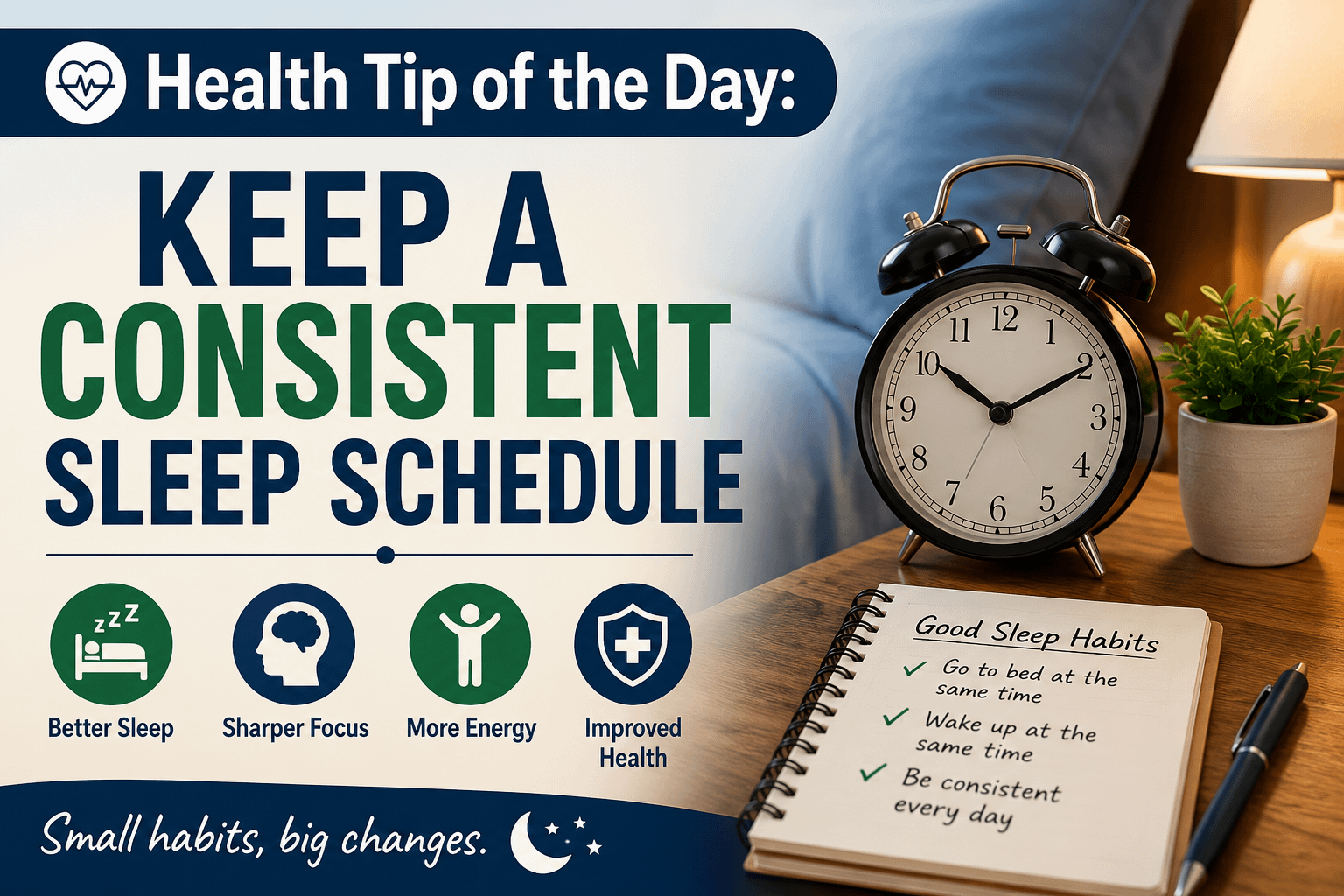
  • Health Tip of the Day: Keep a Consistent Sleep Schedule

    Health Tip of the Day: Keep a Consistent Sleep Schedule

    Sleep is one of the foundations of good health, yet it is often one of the first things we sacrifice when life becomes busy. We stay up late finishing work, watching television, scrolling through our phones, spending time with friends, or simply trying to squeeze a little more into the day.

    Then morning arrives, the alarm goes off, and we wonder why getting out of bed feels so difficult.

    While getting enough sleep is important, there is another part of healthy sleep that deserves attention: consistency.

    Going to bed and waking up at approximately the same time each day can help your body establish a predictable rhythm. Over time, your body begins to recognize when it should become sleepy and when it should become alert.

    You don’t need a perfect sleep schedule down to the exact minute. The goal is simply to create enough consistency that your body isn’t constantly adjusting to dramatically different sleeping and waking times.

    Today’s health tip is simple:

    Choose a realistic sleep schedule and try to stick with it.

    It may seem like a small change, but small daily habits can have a meaningful impact on how you feel.

    Why Your Body Loves Routine

    Human beings naturally function according to patterns.

    We eat around certain times, become hungry at predictable times, experience changes in energy throughout the day, and eventually become tired and ready for sleep.

    Your body has an internal timing system known as the circadian rhythm. This roughly 24-hour cycle helps coordinate periods of wakefulness and sleep.

    Light and darkness are particularly important signals for this internal clock.

    During the daytime, especially when you’re exposed to natural light, your body receives signals that it is time to be awake and active.

    As evening arrives and the environment becomes darker, your body begins preparing for rest.

    Keeping regular sleep and wake times helps reinforce those signals.

    When your schedule constantly changes, your body has to repeatedly adjust.

    What an Inconsistent Sleep Schedule Can Look Like

    Consider this example.

    Monday through Thursday, you go to bed around 10:30 p.m. and wake up at 6:30 a.m.

    Friday arrives, and you stay awake until 1:30 a.m.

    Saturday morning, you sleep until 10:30.

    Saturday night, you stay awake until 2:00 a.m. and sleep late again Sunday morning.

    Then Sunday night arrives.

    Suddenly, you’re lying in bed at 10:30 p.m. trying to fall asleep because you have to wake up early Monday morning.

    But you’re not tired.

    Your body has spent the weekend following a completely different schedule.

    Monday morning can then feel especially difficult.

    This doesn’t mean you can never stay up late or sleep in. Life includes celebrations, vacations, family gatherings, special events, late nights, and mornings when getting some extra rest feels wonderful.

    The goal isn’t perfection.

    The goal is to prevent major schedule changes from becoming your normal routine.

    A Consistent Wake-Up Time Can Be Especially Helpful

    Many people focus primarily on bedtime.

    However, your wake-up time deserves just as much attention.

    Getting out of bed at approximately the same time every morning creates a reliable starting point for your daily rhythm.

    Instead of waking at 6:30 one morning, 8:00 the next, 10:30 on Saturday, and noon on Sunday, try keeping your wake-up time within a relatively consistent range whenever your responsibilities allow it.

    Your routine becomes something your body can anticipate.

    Eventually, you may notice that you naturally begin becoming tired around your usual bedtime and waking near your usual morning time.

    Determine How Much Sleep You Need

    A consistent schedule should also give you enough opportunity to sleep.

    For most adults, regularly getting at least seven hours of sleep is generally recommended, although individual sleep needs vary.

    Think about what time you need to wake up.

    Then work backward to determine an appropriate bedtime.

    For example, if you need to wake at 6:30 a.m., going to bed after midnight every night probably isn’t going to provide enough sleep opportunity.

    Instead of viewing bedtime as the point when everything else has finally been completed, consider making sleep part of your schedule.

    You schedule work.

    You schedule appointments.

    You schedule meals.

    You schedule activities.

    Sleep deserves a place on the schedule too.

    Create a Wind-Down Period Before Bed

    One reason people struggle with bedtime is that they expect themselves to switch instantly from activity to sleep.

    At 10:25 they’re answering emails, watching videos, checking social media, cleaning the house, or thinking about tomorrow.

    At 10:30 they climb into bed and expect their mind to immediately become quiet.

    For many people, that transition doesn’t happen instantly.

    Try creating a short wind-down period before bedtime.

    Thirty minutes to an hour before bed, begin reducing stimulation and preparing yourself for rest.

    Your routine might include:

    • Dimming the lights around your home
    • Putting away work
    • Reducing screen use
    • Taking a warm shower
    • Washing your face and brushing your teeth
    • Putting on comfortable sleepwear
    • Reading something relaxing
    • Listening to quiet music
    • Stretching gently
    • Practicing deep breathing
    • Writing in a journal
    • Making a short gratitude list
    • Spending a few minutes in prayer or meditation
    • Preparing tomorrow’s clothes
    • Setting out anything you’ll need in the morning

    Your bedtime routine doesn’t have to be complicated.

    In fact, simpler is often better.

    Choose a few calming activities that you genuinely enjoy and can realistically repeat.

    Give Yourself a “Bedtime Reminder”

    Many people use an alarm to wake up but never use one to remind themselves to go to bed.

    Consider setting a reminder approximately 30 to 60 minutes before your intended bedtime.

    When the reminder appears, treat it as your signal to begin winding down.

    For example:

    9:30 p.m. — Begin bedtime routine

    10:00 p.m. — Put away phone

    10:15 p.m. — Read or relax

    10:30 p.m. — Bedtime

    Having a reminder can prevent the common experience of checking the clock and suddenly realizing another hour has disappeared.

    Be Mindful of Screens Before Bed

    Phones, tablets, televisions, computers, and other electronic devices can easily keep us awake longer than intended.

    Sometimes the issue isn’t simply the screen itself.

    It’s what we’re doing on it.

    You tell yourself you’ll check social media for five minutes.

    Thirty minutes disappear.

    You watch one episode.

    Then another starts automatically.

    You read one news story.

    Suddenly you’re reading ten more.

    The easiest solution may be creating a personal cutoff time for unnecessary screen use.

    You don’t have to completely eliminate technology from your evening. Simply become more intentional about when you’re using it.

    Your bedtime shouldn’t repeatedly lose a battle against “just five more minutes.”

    Use Morning Light to Start Your Day

    Your sleep routine doesn’t end when you wake up.

    Morning habits can also help reinforce your daily rhythm.

    When you wake up, open your curtains or blinds and allow natural light into the room.

    If possible, spend some time outside during the morning.

    You might:

    Take a short walk.

    Drink your morning coffee outside.

    Sit near a sunny window.

    Stretch on the porch.

    Walk the dog.

    Natural morning light provides your body with a strong daytime signal.

    It also gives you another reason to get out of bed instead of repeatedly hitting the snooze button.

    Try Not to Depend on the Snooze Button

    The snooze button can be incredibly tempting.

    The alarm rings.

    You press snooze.

    Nine minutes later, it rings again.

    You press snooze again.

    Before you know it, you’ve spent 30 or 40 minutes drifting in and out of sleep.

    If possible, try getting up when your alarm first goes off.

    One way to make this easier is placing your alarm or phone far enough away that you need to physically get out of bed to turn it off.

    Then begin your morning routine immediately.

    Open the curtains.

    Drink some water.

    Wash your face.

    Get dressed.

    Start moving.

    Creating a consistent morning routine can make waking up feel less chaotic.

    Watch the Weekend Sleep-In

    After several early mornings, sleeping late on Saturday can feel like a reward.

    Occasionally getting extra rest is understandable.

    However, dramatically shifting your schedule every weekend can make Sunday night and Monday morning more difficult.

    If possible, keep weekend sleeping and waking times relatively close to your weekday schedule.

    You can still enjoy a slower Saturday morning without turning your entire sleep routine upside down.

    Again, consistency doesn’t mean perfection.

    It means avoiding extreme changes whenever possible.

    Pay Attention to Caffeine

    That afternoon coffee might affect you longer than you realize.

    Caffeine can remain in your system for hours, and sensitivity varies from person to person.

    Coffee isn’t the only source.

    Caffeine may also be found in:

    • Tea
    • Energy drinks
    • Soda
    • Chocolate
    • Certain medications and supplements

    If you have difficulty falling asleep, consider paying attention to when you consume caffeine.

    Try moving your final caffeinated drink earlier in the day and see whether it makes a difference.

    Be Careful With Late-Night Heavy Meals

    Going to bed extremely hungry can be uncomfortable, but so can going to bed immediately after a very large meal.

    Try to give yourself some time between a heavy dinner and bedtime when possible.

    If you’re hungry later in the evening, a lighter snack may be more comfortable than a large meal.

    The goal is to create an evening environment that supports relaxation rather than making your body work through an enormous meal while you’re trying to sleep.

    Create a Bedroom That Encourages Sleep

    Your environment can influence your sleep habits.

    Try making your bedroom feel like a place designed for rest.

    Consider factors such as:

    Temperature: Many people sleep better in a comfortably cool room.

    Noise: Reduce disruptive sounds when possible.

    Light: Keep your sleeping environment reasonably dark.

    Comfort: Make sure your mattress, pillows, sheets, and blankets are comfortable.

    Clutter: A calmer bedroom environment may help some people feel more relaxed.

    You don’t need an expensive bedroom makeover.

    Sometimes small adjustments can make a noticeable difference.

    Watch Your Naps

    There is nothing inherently wrong with taking a nap.

    A short nap can sometimes help restore energy.

    However, long naps or naps taken late in the afternoon or evening may interfere with your ability to fall asleep at your normal bedtime.

    If you’re having trouble sleeping at night, pay attention to your daytime sleeping habits.

    Ask yourself:

    What time am I napping?

    How long am I sleeping?

    Do I have more difficulty falling asleep on days when I nap?

    Your own patterns can provide useful clues.

    Exercise Can Support Healthy Sleep

    Regular physical activity provides many health benefits and can also support better sleep.

    You don’t necessarily need an intense workout.

    Walking, cycling, swimming, strength training, gardening, dancing, or other forms of movement can all contribute to an active lifestyle.

    Even a daily walk can be a positive habit.

    However, everyone responds differently to exercise timing. Some people can exercise in the evening and sleep perfectly well, while others find vigorous activity too close to bedtime leaves them feeling energized.

    Pay attention to how your body responds.

    What If You Can’t Fall Asleep?

    One of the most frustrating experiences is lying in bed thinking:

    “I have to fall asleep right now.”

    Then you check the clock.

    Another 20 minutes have passed.

    You start calculating how many hours of sleep remain.

    That creates stress.

    The stress makes sleeping even harder.

    Instead of forcing sleep, focus on relaxation.

    Keep the environment calm and avoid turning bedtime into a nightly battle.

    If you remain awake for a while, getting out of bed briefly and doing something quiet and relaxing in dim light may be helpful. Return to bed when you begin feeling sleepy again.

    Most importantly, try not to panic over one difficult night.

    Everyone occasionally sleeps poorly.

    Return to your normal routine the following day rather than abandoning it completely.

    Don’t “Fix” One Bad Night by Changing Everything

    Suppose you barely sleep one night.

    The next morning you’re exhausted.

    You may be tempted to sleep until noon, take a three-hour afternoon nap, and then go to bed extremely early.

    Unfortunately, making several major schedule changes at once may make the next night’s sleep more difficult.

    When practical, try returning to your regular schedule.

    Your body responds to patterns, and maintaining the pattern can help you get back on track.

    Shift Your Schedule Gradually

    If your current sleep schedule is dramatically different from the schedule you want, don’t expect your body to adjust instantly.

    Suppose you’re currently falling asleep around 1:00 a.m., but you’d like to eventually go to bed at 10:30 p.m.

    Trying to move bedtime several hours earlier in one night may leave you lying awake and frustrated.

    Instead, gradually move your bedtime and wake-up time earlier.

    Small adjustments repeated consistently are often easier to maintain than dramatic changes.

    Give yourself time.

    You’re creating a new habit.

    Consistency Is More Important Than Perfection

    One of the biggest mistakes people make with healthy habits is believing they must follow them perfectly.

    You won’t.

    Some nights you’ll stay up late.

    You might attend a wedding.

    You may travel.

    You might have family visiting.

    Work could run late.

    You may watch a movie that ends later than expected.

    You might simply have a night when you aren’t tired.

    That’s normal.

    One late night doesn’t destroy your sleep routine.

    What matters is what you do most of the time.

    Return to your regular schedule as soon as you reasonably can.

    Healthy habits aren’t built through perfection.

    They’re built through repetition.

    Keep a Simple Sleep Journal

    If you’re curious about your sleeping habits, try tracking them for a week.

    Write down:

    Bedtime

    Approximate time you fell asleep

    Wake-up time

    How many times you woke during the night

    Naps

    Caffeine intake

    Exercise

    How rested you felt in the morning

    You may begin noticing patterns.

    Maybe you sleep better on days when you walk.

    Maybe late caffeine keeps you awake.

    Maybe sleeping late Sunday morning makes Sunday night difficult.

    Maybe scrolling through your phone keeps pushing bedtime later.

    You can’t change a pattern you haven’t noticed.

    Tracking your sleep for even a short period can help you become more aware of your habits.

    Build a Routine You Can Actually Maintain

    The best sleep schedule isn’t the one that sounds perfect.

    It’s the one that works with your real life.

    If you work until 10:00 p.m., a 9:30 bedtime isn’t realistic.

    If you need to leave home at 6:00 a.m., sleeping until 7:30 isn’t realistic.

    Look at your responsibilities and build your schedule around them.

    Ask yourself:

    What time do I realistically need to wake up?

    Then work backward.

    Give yourself enough time to sleep without making the schedule so unrealistic that you abandon it after three days.

    Sustainable habits are better than perfect plans.

    Why Better Sleep Matters

    Sleep influences far more than whether you feel tired.

    Healthy sleep supports many important functions involving your body and brain, including:

    • Attention
    • Learning
    • Memory
    • Mood
    • Reaction time
    • Immune function
    • Physical recovery
    • Everyday decision-making
    • Overall health and well-being

    When you’re well rested, everyday responsibilities may feel more manageable.

    You may have more patience.

    You may think more clearly.

    You may feel more motivated to exercise.

    You may have more energy to prepare healthier meals.

    You may find it easier to concentrate.

    In this way, sleep can support many of the other healthy habits you’re trying to build.

    Make Sleep Part of Your Self-Care

    We often think about self-care as something extra.

    A vacation.

    A spa day.

    A special meal.

    A relaxing afternoon.

    But some of the most powerful forms of self-care are ordinary habits practiced repeatedly.

    Drinking enough water.

    Moving your body.

    Eating nutritious foods.

    Taking breaks.

    Managing stress.

    And getting enough sleep.

    Going to bed at a reasonable time isn’t boring.

    It’s an investment in tomorrow.

    A Simple Seven-Day Sleep Challenge

    For the next seven days, challenge yourself to create a more consistent routine.

    Day 1: Choose Your Wake-Up Time

    Decide what time you realistically need to wake up each morning.

    Day 2: Choose Your Bedtime

    Work backward from your wake-up time and create enough opportunity for adequate sleep.

    Day 3: Create a Wind-Down Routine

    Choose two or three calming activities you’ll do before bed.

    Day 4: Reduce Late-Night Screens

    Set a time when you’ll stop unnecessary scrolling or entertainment.

    Day 5: Get Morning Light

    Spend a few minutes outside or near natural light shortly after waking.

    Day 6: Watch Your Caffeine

    Notice when you’re consuming caffeine and whether it affects your sleep.

    Day 7: Review Your Progress

    Ask yourself:

    Did I fall asleep more easily?

    Was waking up easier?

    Did I feel more energetic during the day?

    Which habits helped?

    Which habits were difficult?

    Then continue the parts that worked.

    When Sleep Problems Continue

    Healthy sleep habits can be helpful, but they aren’t a solution for every sleep problem.

    If you regularly struggle to fall asleep, frequently wake throughout the night, consistently wake much earlier than intended, experience significant daytime sleepiness despite allowing enough time for sleep, or have concerns such as loud snoring or breathing interruptions during sleep, consider discussing your symptoms with a healthcare professional.

    Persistent sleep problems deserve attention.

    Health Tip of the Day

    Go to bed and wake up at approximately the same time every day, including weekends whenever possible.

    You don’t need to transform your entire lifestyle tonight.

    Start with one decision:

    What time am I going to bed?

    Then make another decision tomorrow morning:

    What time am I getting up?

    Repeat those choices.

    Day after day.

    Week after week.

    Eventually, what once required effort can become routine.

    Final Thought

    Your body does a tremendous amount of work every day.

    Your heart keeps beating.

    Your brain processes countless pieces of information.

    Your muscles move you through your daily activities.

    Your immune system works to protect you.

    Your mind manages responsibilities, decisions, emotions, conversations, and challenges.

    Sleep gives your body and brain important time for restoration and recovery.

    Don’t treat sleep as the leftover part of your day.

    Make it part of your health plan.

    A healthier tomorrow can begin with something as simple as going to bed on time tonight.

    Question of the Day

    How consistent is your sleep schedule? Do you usually go to bed and wake up around the same time every day, or does your schedule change throughout the week?
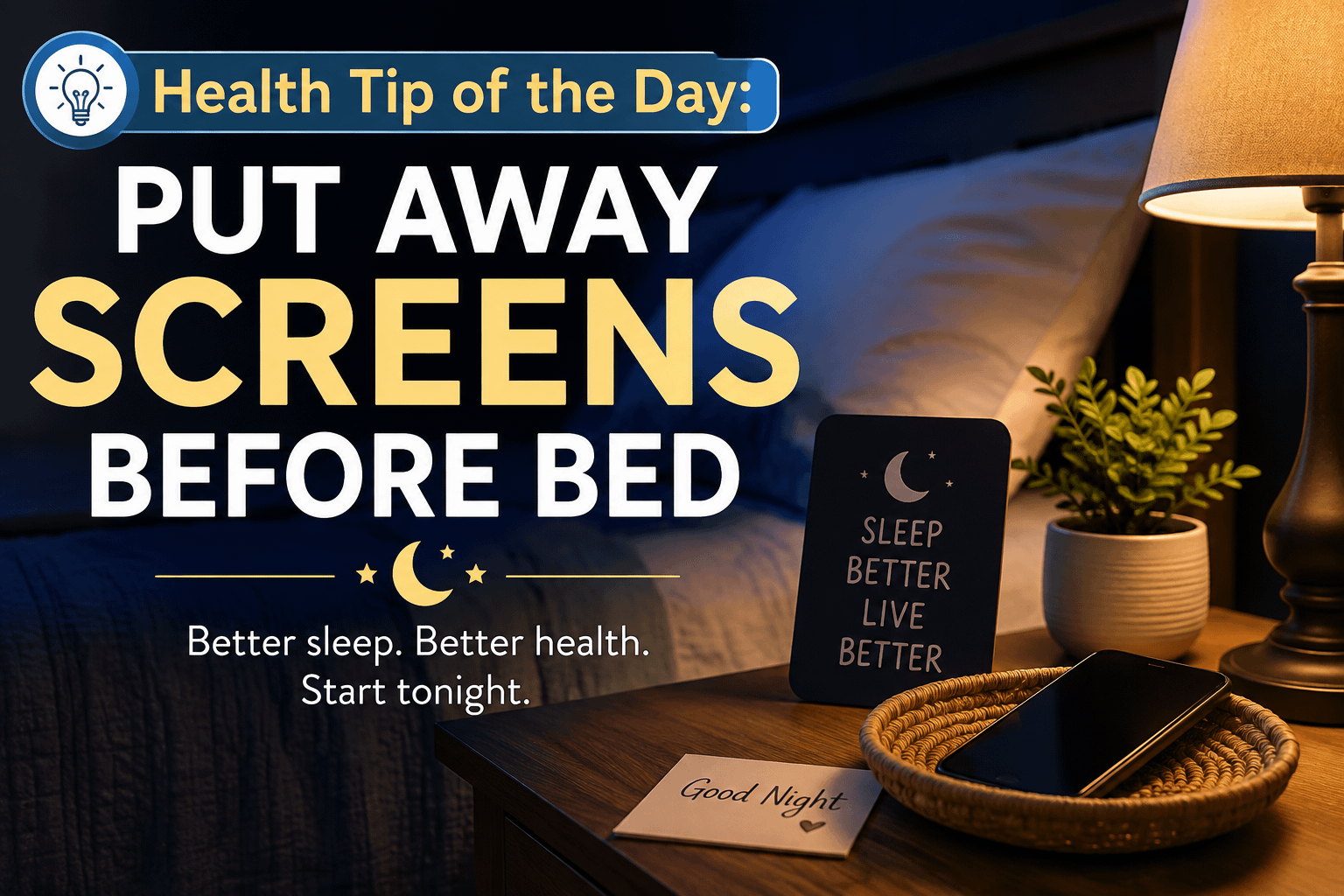
  • Health Tip of the Day: Put Away Screens Before Bed

    Health Tip of the Day: Put Away Screens Before Bed

    At the end of a long day, reaching for your phone can feel almost automatic. You climb into bed, get comfortable, and decide to check a few messages. Then you look at social media, watch a couple of videos, check tomorrow’s weather, read the latest headlines, or start another episode of your favorite show.

    What was supposed to be five minutes can quickly become thirty minutes—or an hour.

    Meanwhile, your body is waiting for something important: sleep.

    Today’s Health Tip of the Day is one of the simplest changes you can make to your nighttime routine:

    Put away your screens before bed.

    Your phone, tablet, television, computer, and other electronic devices keep you connected to the world, but bedtime is one part of the day when disconnecting can be valuable. Creating a screen-free period before sleep can help you transition away from the stimulation and responsibilities of the day and toward a calmer nighttime routine.

    You don’t need to completely change your life or abandon technology. You simply need to create a boundary between your digital world and your sleeping world.

    That boundary might begin with just 15 or 30 minutes.

    Over time, it can become one of the most peaceful parts of your day.

    Why Bedtime Has Become Screen Time

    Technology has changed what bedtime looks like.

    Years ago, people might have ended their evening by reading, talking with family, listening to music, or simply lying quietly in bed. Today, we can carry almost the entire world into the bedroom through a device small enough to fit in our hands.

    Your phone can be your:

    • Alarm clock
    • Television
    • Newspaper
    • Music player
    • Social network
    • Email inbox
    • Calendar
    • Camera
    • Entertainment center
    • Shopping center
    • Workplace
    • Connection to friends and family

    That convenience is incredible, but it also makes switching off more difficult.

    There’s always another notification to check.

    Another video to watch.

    Another post to read.

    Another message to answer.

    Another headline to investigate.

    Another email that suddenly feels urgent.

    Because there is no natural ending to most digital content, you have to create the ending yourself.

    Your Brain Needs a Transition Between Day and Night

    Think about everything your mind processes during an ordinary day.

    You make decisions, solve problems, remember responsibilities, communicate with people, deal with unexpected situations, work, plan, worry, laugh, learn, and constantly receive new information.

    Then bedtime arrives.

    If you immediately continue consuming information through your phone, you’re asking your mind to move directly from daytime stimulation into sleep.

    For many people, that transition isn’t easy.

    A calmer nighttime routine creates a buffer.

    Instead of:

    Work → Phone → Social Media → News → Messages → Sleep

    you can gradually transition:

    Work → Relaxation → Quiet Activity → Bed → Sleep

    That middle period matters.

    You’re giving yourself time to stop reacting to the outside world.

    Light Is Only Part of the Story

    You’ve probably heard discussions about blue light and sleep.

    Light exposure in the evening can influence the body’s natural sleep-wake rhythm. That’s one reason reducing bright screen exposure before bedtime may be helpful.

    But focusing only on light misses another major issue:

    Screens are mentally stimulating.

    Consider what might happen during ten minutes of scrolling.

    You see something funny.

    Then something upsetting.

    Then an advertisement.

    Then someone’s vacation pictures.

    Then a political argument.

    Then a heartbreaking story.

    Then a recipe.

    Then breaking news.

    Then a message from someone.

    Then a video that makes you laugh.

    Your emotions can move through several different states within minutes.

    Your body may be physically lying in bed, but your mind is still traveling through the world.

    The “Just Five Minutes” Problem

    One of the biggest ways screens interfere with bedtime is surprisingly simple:

    They keep us awake longer than we intended.

    You might tell yourself:

    “I’ll check my phone for five minutes.”

    But digital platforms are designed around continuous content.

    There’s always another post.

    Another video.

    Another recommendation.

    Another episode.

    Another story.

    Another notification.

    There’s rarely a natural signal telling you:

    You’re finished. Go to sleep.

    That means you have to create your own stopping point.

    If you intended to sleep at 10:30 p.m. but scroll until 11:15, you’ve lost 45 minutes of potential sleep.

    Do that repeatedly throughout the week and those lost minutes add up.

    Give Yourself a Digital Curfew

    A useful strategy is establishing a specific time when your screens go away for the night.

    Think of it as a digital curfew.

    For example, if you normally go to bed around 10:30 p.m., you might decide that your phone, tablet, and television are finished for the evening at 10:00.

    At 10:00:

    The television goes off.

    Your phone goes on the charger.

    Notifications are silenced.

    The lights become softer.

    Your nighttime routine begins.

    The exact time isn’t important.

    Consistency is.

    When you repeatedly follow the same pattern, the routine itself can become a signal that the day is ending.

    How Long Before Bed Should You Put Screens Away?

    There isn’t one perfect rule that works for everyone.

    For some people, creating a 30-minute screen-free period is realistic and helpful.

    Others may prefer an hour.

    If you’re currently using your phone until the moment you fall asleep, even ten or fifteen screen-free minutes can be a meaningful beginning.

    Instead of worrying about achieving the perfect nighttime routine, focus on making your current routine slightly better.

    You can gradually increase your screen-free time.

    Week One

    Try putting screens away 15 minutes before bedtime.

    Week Two

    Increase it to 30 minutes.

    Week Three

    Experiment with 45 minutes.

    Week Four

    See whether an hour feels comfortable.

    You don’t necessarily need to reach an hour. The goal is simply to discover what helps you create a peaceful transition into sleep.

    Don’t Replace One Stressful Habit With Another

    A screen-free bedtime shouldn’t become another rule that makes you anxious.

    If you occasionally need to answer an important message, that’s okay.

    If you watch a movie with your family one evening, that’s okay.

    If you’re traveling or your routine changes, that’s okay.

    Healthy habits work best when they support your life rather than control it.

    Aim for consistency, not perfection.

    If you spend one night scrolling longer than you intended, simply return to your routine the following evening.

    What Should You Do Without Your Phone?

    This is where many people struggle.

    They put their phone down and immediately think:

    “Now what?”

    The answer can be surprisingly simple.

    You don’t need to fill every moment.

    One of the purposes of reducing screen time is allowing your brain to experience a little less stimulation.

    Still, having a few relaxing alternatives can make the transition easier.

    Read Something on Paper

    Reading a physical book or magazine can become a calming bedtime ritual.

    Choose something enjoyable rather than something that feels like work.

    You don’t need to read an entire chapter.

    Even ten quiet minutes can become part of your nighttime transition.

    Write in a Journal

    Nighttime journaling can give you somewhere to place the thoughts you’ve been carrying throughout the day.

    You might write about:

    • Something good that happened.
    • Something difficult you experienced.
    • Something you’re grateful for.
    • Something you’re looking forward to.
    • Something you need to remember tomorrow.
    • Something you need to release tonight.

    Writing down tomorrow’s responsibilities can also help prevent you from repeatedly thinking about them while trying to sleep.

    Practice Gratitude

    Before bed, think about three things you appreciated during the day.

    They don’t have to be extraordinary.

    Maybe someone made you laugh.

    Maybe you enjoyed a good meal.

    Maybe you received an encouraging message.

    Maybe the weather was beautiful.

    Maybe you accomplished something you’d been putting off.

    Maybe you simply made it through a difficult day.

    Gratitude doesn’t require pretending everything is perfect. It’s simply noticing that even complicated days can contain meaningful moments.

    Spend Time in Prayer or Reflection

    For people who practice prayer, meditation, or personal reflection, bedtime can be an especially meaningful opportunity for quiet.

    Without notifications constantly interrupting you, you can reflect on the day, express gratitude, think about the people you care about, and prepare yourself emotionally for tomorrow.

    Sometimes the quiet we avoid throughout the day is exactly what we need at night.

    Try Gentle Stretching

    You don’t need an intense workout before bed.

    A few gentle stretches can help create a physical transition from activity to rest.

    Move slowly.

    Relax your shoulders.

    Stretch your legs.

    Take comfortable breaths.

    Allow your body to gradually release some of the tension you’ve carried throughout the day.

    Prepare for Tomorrow

    Another useful screen-free activity is preparing a few things for the next morning.

    Lay out your clothes.

    Prepare your work bag.

    Put your keys where you’ll find them.

    Fill your water bottle.

    Write tomorrow’s priorities on paper.

    Prepare breakfast ingredients.

    These small actions can reduce morning stress while giving you something calm and practical to do before bed.

    Just avoid turning your bedtime routine into another hour of work.

    The goal is preparation—not productivity.

    Make Your Bedroom a Place for Rest

    Your surroundings can influence your habits.

    If your bedroom is filled with bright lights, television, work materials, buzzing notifications, and constant activity, your mind receives conflicting signals.

    Try making the room feel different at night.

    Lower the lights.

    Reduce unnecessary noise.

    Adjust the temperature to something comfortable.

    Put work materials away.

    Silence unnecessary notifications.

    Keep your sleeping area comfortable and uncluttered when possible.

    Your bedroom doesn’t need to look like a luxury hotel.

    It simply needs to communicate:

    This is where the day slows down.

    Stop Charging Your Phone Beside Your Pillow

    Keeping your phone within arm’s reach makes checking it incredibly easy.

    You wake briefly during the night.

    You check the time.

    You notice a notification.

    You open the notification.

    You check another app.

    Then another.

    Suddenly, you’re fully awake.

    Consider placing your phone somewhere farther away from the bed.

    If possible, charge it across the room.

    This creates a small but useful barrier between impulse and action.

    Sometimes a few extra steps are enough to prevent unnecessary nighttime scrolling.

    “But I Use My Phone as My Alarm”

    Many people do.

    You don’t necessarily have to stop.

    Simply place your phone far enough away that you can’t comfortably reach it while lying in bed.

    There’s even a bonus:

    When your alarm rings in the morning, you’ll have to physically get out of bed to turn it off.

    Another option is using an inexpensive traditional alarm clock and keeping your phone outside the bedroom.

    Silence Notifications at Night

    Even when you’re not actively using your phone, notifications can pull your attention back toward it.

    A vibration.

    A flashing screen.

    A message preview.

    An email alert.

    Your curiosity immediately activates.

    “Who messaged me?”

    “What happened?”

    “Is it important?”

    Most notifications can wait until morning.

    Consider using your phone’s sleep settings, Do Not Disturb mode, or notification scheduling tools so only genuinely important communications can reach you overnight.

    Don’t Bring Work to Bed

    Remote work and smartphones have blurred the line between professional and personal time.

    It’s easy to answer one final email from bed.

    Then another.

    Then check tomorrow’s calendar.

    Then remember something you forgot.

    Suddenly, your brain is back in work mode.

    When possible, create a clear stopping point for work-related communication.

    There will almost always be another email.

    Another task.

    Another problem.

    Another responsibility.

    But tomorrow needs a rested version of you more than tonight needs another unnecessary email.

    Social Media Can Wait Until Tomorrow

    Social media isn’t inherently bad.

    It can help us stay connected, laugh, discover new ideas, follow people we care about, and participate in communities.

    The problem comes when there’s no boundary.

    At bedtime, social media can expose you to an unpredictable mixture of emotions and information immediately before you’re trying to sleep.

    Something you read might make you angry.

    Something might make you anxious.

    Something might make you compare your life with someone else’s.

    Something might remind you of a problem.

    Something might pull you into an argument.

    Something might simply keep you entertained far longer than you intended.

    None of it needs your attention at midnight.

    Don’t Start Your Morning With the Same Habit

    There’s another benefit to charging your phone away from your bed.

    It can help change your morning routine too.

    Many people wake up and immediately grab their phones.

    Before they’ve even gotten out of bed, they’re checking:

    Messages.

    News.

    Social media.

    Email.

    Notifications.

    Work.

    Instead of deciding how your morning begins, you’re allowing the digital world to decide for you.

    Try giving yourself a few minutes before reconnecting.

    Get out of bed.

    Drink some water.

    Open the curtains.

    Stretch.

    Get dressed.

    Eat breakfast.

    Then check your phone.

    Even ten minutes can create a calmer beginning to your day.

    Create a Bedtime Routine You Actually Enjoy

    Healthy habits are easier to maintain when you enjoy them.

    Your nighttime routine shouldn’t feel like punishment.

    Create something you look forward to.

    Maybe your routine looks like this:

    9:30 p.m. — Finish television and social media.

    9:35 p.m. — Put your phone on the charger.

    9:40 p.m. — Take a warm shower.

    9:50 p.m. — Prepare clothes for tomorrow.

    10:00 p.m. — Read.

    10:20 p.m. — Gratitude, prayer, or reflection.

    10:30 p.m. — Lights out.

    Your routine might look completely different.

    That’s fine.

    The best routine is the one you can realistically follow.

    Help Children and Teenagers Develop Healthy Screen Habits Too

    Adults aren’t the only ones surrounded by screens.

    Children and teenagers may spend significant portions of their day using phones, tablets, computers, televisions, gaming systems, and other devices.

    Families can benefit from creating shared nighttime expectations around technology.

    For example, you might establish a household charging area outside bedrooms.

    Instead of saying:

    “You need to get off your phone.”

    make it something the entire household practices.

    “At night, our devices charge outside the bedrooms.”

    Children often notice what adults do more than what adults say.

    Modeling healthy technology boundaries can be more powerful than simply creating rules.

    Make Your Phone Less Tempting

    Technology can also help you use technology less.

    Try experimenting with features such as:

    • Do Not Disturb.
    • Sleep Focus.
    • App limits.
    • Notification schedules.
    • Grayscale mode.
    • Automatic bedtime reminders.
    • Social media time limits.

    You can also remove particularly distracting apps from your home screen.

    The idea isn’t to make your phone unusable.

    It’s to add enough friction that opening an app becomes a conscious decision rather than an automatic habit.

    Notice How You Feel

    After trying a screen-free bedtime routine for several nights, pay attention to what changes.

    Ask yourself:

    Am I getting into bed earlier?

    Do I feel calmer before sleeping?

    Am I spending less time mindlessly scrolling?

    Do I wake up reaching for my phone less often?

    Do my evenings feel more peaceful?

    Am I giving myself enough time to sleep?

    You’re conducting a small experiment with your own habits.

    Keep what helps.

    Adjust what doesn’t.

    Your Evening Shapes Tomorrow Morning

    It’s tempting to think that tomorrow morning begins when your alarm goes off.

    In reality, tomorrow often begins the night before.

    Staying online late can make it harder to give yourself enough time for sleep.

    Going to bed late can make waking up harder.

    A difficult morning can affect your mood, energy, concentration, and motivation throughout the day.

    That’s why your nighttime habits matter.

    Taking care of tomorrow’s version of yourself can begin with one small decision tonight:

    Put the phone down.

    Rest Is Not Wasted Time

    We live in a culture that often celebrates constant productivity.

    Do more.

    Work longer.

    Stay connected.

    Respond immediately.

    Keep moving.

    Keep scrolling.

    Keep consuming.

    But human beings aren’t designed to remain switched on every moment.

    Rest is part of taking care of yourself.

    You don’t have to earn the right to sleep by finishing every task on your list.

    Some responsibilities will still be there tomorrow.

    That’s okay.

    Your body needs recovery.

    Your mind needs quiet.

    And sometimes the healthiest decision you can make is deciding that you’ve done enough for one day.

    Give Yourself Permission to Be Unavailable

    Smartphones have created an expectation that we’re always reachable.

    Someone can text us at 11:30 p.m., and we may feel obligated to respond immediately.

    But unless something is genuinely urgent, most communication can wait.

    You are allowed to have boundaries.

    You are allowed to silence notifications.

    You are allowed to stop answering emails.

    You are allowed to leave messages unread until morning.

    You are allowed to disconnect.

    Your phone is a tool.

    It doesn’t need to control when your day ends.

    Try a Seven-Night Screen-Free Challenge

    If you’d like to see whether reducing nighttime screen use makes a difference, try this simple experiment for one week.

    For the next seven nights:

    1. Choose a consistent bedtime.
    2. Set a screen cutoff time.
    3. Put your phone on the charger away from the bed.
    4. Silence unnecessary notifications.
    5. Choose one relaxing screen-free activity.
    6. Go to bed without checking your phone again.
    7. Notice how you feel the next morning.

    Don’t worry about being perfect.

    You’re simply collecting information about yourself.

    At the end of seven days, ask:

    Did I like my evenings better this way?

    If the answer is yes, you’ve discovered a habit worth continuing.

    Tonight’s Health Challenge

    You don’t need to wait until Monday.

    You don’t need to buy anything.

    You don’t need special equipment.

    You don’t need to completely redesign your bedroom.

    Tonight, simply choose a time when your screens will go away.

    When that time arrives:

    Put your phone down.

    Turn off the television.

    Close the laptop.

    Silence unnecessary notifications.

    Lower the lights.

    Take care of your nighttime routine.

    Read something.

    Stretch.

    Write.

    Pray.

    Reflect.

    Talk with someone you love.

    Or simply enjoy a few quiet minutes.

    The world will continue without you scrolling for another half hour.

    The messages can wait.

    The emails can wait.

    The videos can wait.

    The headlines can wait.

    Tomorrow will bring plenty of opportunities to reconnect.

    Tonight, give yourself permission to disconnect.

    Final Thought

    Technology has given us extraordinary ways to communicate, learn, work, create, and stay connected. But healthy technology use also means knowing when to put it away.

    Bedtime is a good place to start.

    Creating even a short screen-free period before sleep can transform the end of your day from endless stimulation into something quieter and more intentional.

    You don’t have to create the perfect nighttime routine overnight.

    Start small.

    Put your phone away ten minutes earlier.

    Then twenty.

    Then thirty.

    Find what works for you.

    Because sometimes improving your health isn’t about adding another complicated habit to your life.

    Sometimes it’s about removing one.

    Tonight, put away the screens, quiet the notifications, let the day end, and give yourself the opportunity to rest.

    Health Tip of the Day

    Put away screens before bed. Create a screen-free buffer between your busy day and bedtime, replace scrolling with something calming, and make rest a priority rather than an afterthought.

    What’s the last thing you usually do before going to sleep—check your phone, watch TV, read, pray, listen to music, or something else?

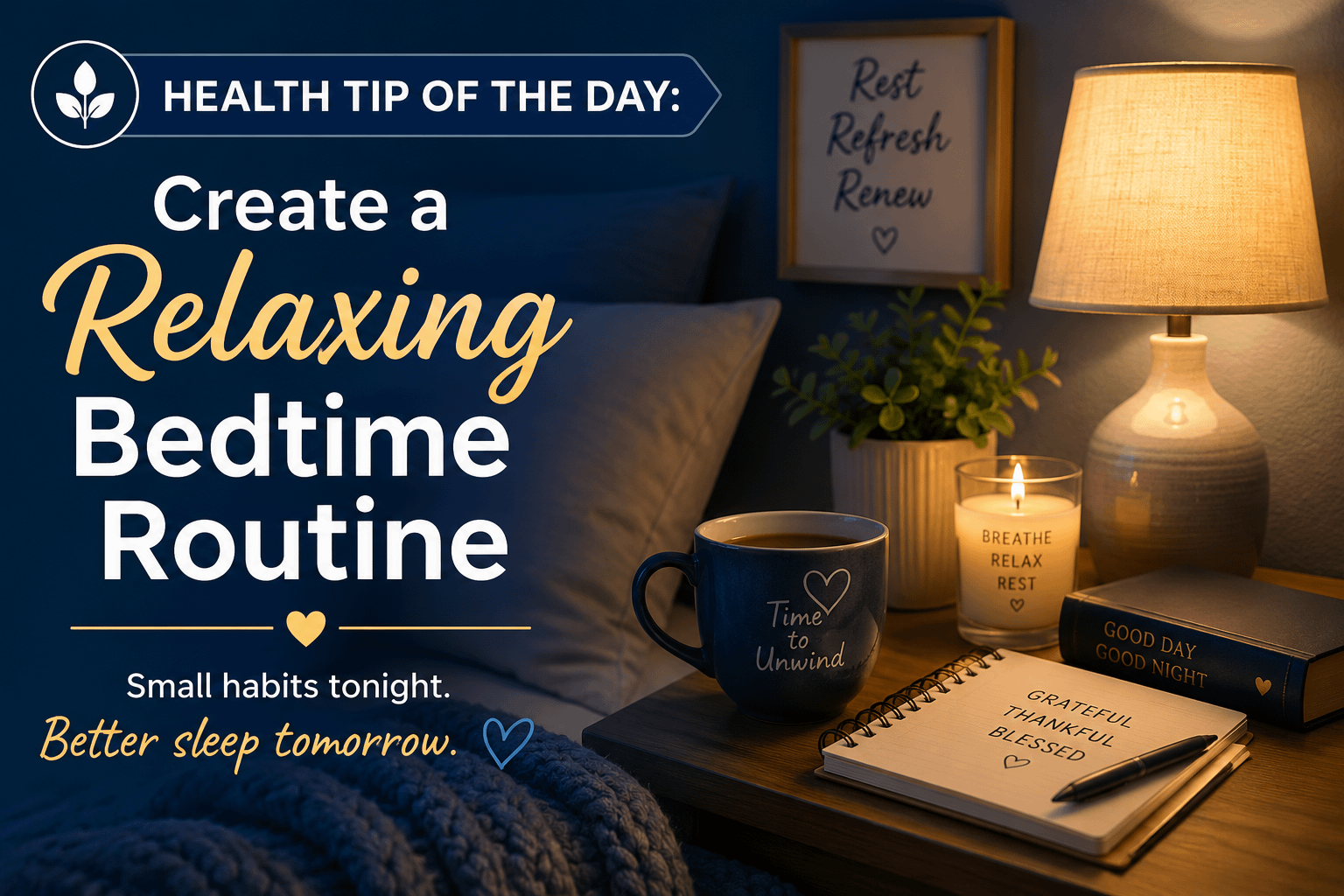
  • Health Tip of the Day: Create a Relaxing Bedtime Routine

    Health Tip of the Day: Create a Relaxing Bedtime Routine

    At the end of a long day, your body may be tired while your mind is still racing.

    You turn off the lights, climb into bed, and expect sleep to happen. Instead, you start thinking about tomorrow’s responsibilities, replaying conversations from earlier in the day, worrying about unfinished tasks, or reaching for your phone and scrolling much longer than you intended.

    This is one reason a relaxing bedtime routine can be so valuable.

    Sleep preparation doesn’t have to begin when you close your eyes. It can begin 30 minutes, an hour, or even longer before you actually go to bed.

    Creating a consistent evening routine gives you an opportunity to gradually transition from the stimulation and responsibilities of daytime into a quieter state of rest.

    A bedtime routine doesn’t need to be elaborate or perfect. It simply needs to help you slow down.


    Why Your Evening Routine Matters

    Most of us have routines throughout the day without even thinking about them.

    You might wake up, make coffee, shower, get dressed, eat breakfast, and head to work in roughly the same order every morning.

    Those repeated behaviors become familiar.

    A bedtime routine works in a similar way.

    When you consistently perform calming activities before bed, those activities can become associated with the end of your day.

    Instead of suddenly telling yourself, “It’s time to sleep,” you’re creating a gradual transition.

    Your evening routine might communicate something much simpler:

    The work is finished.

    The responsibilities can wait.

    The day is winding down.

    It’s time to rest.

    That transition can be especially important when your days are busy, stressful, unpredictable, or emotionally demanding.


    You Can’t Always Go From 100 MPH to Sleep

    Imagine driving down the freeway at full speed and suddenly trying to stop immediately.

    Your mind can feel similar.

    Throughout the day, you’re constantly processing information.

    You’re working.

    Talking.

    Driving.

    Reading.

    Making decisions.

    Answering messages.

    Checking social media.

    Watching videos.

    Handling responsibilities.

    Solving problems.

    Thinking about finances.

    Planning tomorrow.

    Taking care of other people.

    By bedtime, you may physically lie down while your mind remains in daytime mode.

    That’s why creating a period between “busy” and “sleep” can be helpful.

    Think of your bedtime routine as your personal slow-down period.

    You aren’t trying to force yourself to fall asleep.

    You’re creating an environment that makes relaxation easier.


    Start With a Consistent Bedtime

    One of the simplest ways to improve your evening routine is to establish a reasonably consistent bedtime.

    You don’t have to go to bed at exactly the same minute every night.

    Life doesn’t always work that way.

    But having a general target can help you organize the rest of your evening.

    For example, if you’d like to be in bed around 10:30 p.m., you might begin winding down around 9:30 or 10:00.

    That creates a natural transition.

    Instead of realizing at midnight that you’ve spent two hours scrolling through your phone, you’ve intentionally created a stopping point.

    You might even set an evening alarm.

    Most people use alarms to tell themselves when to wake up.

    Try using one to remind yourself when it’s time to start slowing down.

    Your alarm isn’t saying:

    “Go to sleep immediately.”

    It’s simply saying:

    “The day is winding down. Start preparing for tomorrow by taking care of yourself tonight.”


    Create a 30-to-60-Minute Wind-Down Period

    Your bedtime routine doesn’t need to take hours.

    Even 30 minutes of intentional relaxation can create separation between your busy day and your sleeping hours.

    During this period, begin reducing stimulation.

    You might:

    • Lower the lights.
    • Put away work.
    • Stop checking email.
    • Silence unnecessary notifications.
    • Change into comfortable clothes.
    • Take a warm shower.
    • Prepare your bedroom.
    • Read something relaxing.
    • Stretch gently.
    • Pray or meditate.
    • Write in a journal.
    • Listen to calming music.
    • Prepare what you’ll need tomorrow.

    None of these activities is complicated.

    That’s actually the point.

    Your bedtime routine shouldn’t become another demanding project on your schedule.

    It should make your evening simpler.


    Put the Day Away

    Sometimes creating a bedtime routine requires more than turning off the television.

    You also need to mentally close the day.

    That can be difficult when you have unfinished responsibilities.

    Maybe you didn’t accomplish everything you wanted.

    Maybe you made a mistake.

    Maybe you’re worried about something happening tomorrow.

    Maybe someone upset you.

    Maybe you’re waiting for an answer.

    Maybe you’re facing a problem that doesn’t have an immediate solution.

    You may carry those thoughts into bed and repeatedly replay them.

    Before bedtime, intentionally remind yourself:

    “I have done what I can for today.”

    Tomorrow gives you another opportunity to work on the things that remain unfinished.

    Rest isn’t avoiding your responsibilities.

    Rest helps prepare you to face them again.


    Make a Tomorrow List

    One reason people struggle to mentally shut down is because they’re afraid they’ll forget something.

    Your brain starts reminding you:

    “Call them tomorrow.”

    “Don’t forget that appointment.”

    “You need to pay that bill.”

    “Remember to send that email.”

    “Pick that up on the way home.”

    Instead of trying to hold everything in your head overnight, write it down.

    Keep a small notebook near your bed or somewhere you complete your evening routine.

    Before bed, write down the most important things you need to remember tomorrow.

    Once they’re on paper, you no longer have to keep rehearsing them mentally.

    Tell yourself:

    It’s written down. I can handle it tomorrow.


    Create a Digital Sunset

    Technology is one of the biggest obstacles to a peaceful bedtime routine.

    Phones are designed to keep us engaged.

    There is always another notification.

    Another video.

    Another article.

    Another message.

    Another post.

    Another comment.

    Another headline.

    Another thing to check.

    Five minutes can easily become 30 minutes.

    Thirty minutes can become an hour.

    And suddenly you’ve sacrificed part of your sleeping time without realizing it.

    Consider creating what you might call a digital sunset.

    Choose a time when your phone, tablet, computer, and other unnecessary screens begin shutting down for the evening.

    You don’t necessarily have to eliminate every screen hours before bed.

    Start realistically.

    Try putting your phone away 30 minutes before bedtime.

    If that works, perhaps gradually increase the time.

    The goal isn’t perfection.

    The goal is creating space where your brain isn’t constantly receiving new information.


    Don’t Let Your Phone Become Your Bedtime Companion

    Many people sleep with their phones within arm’s reach.

    That makes checking them incredibly easy.

    You wake up during the night.

    You check the time.

    Then you see a notification.

    You open it.

    Then you check something else.

    Before you know it, you’re completely awake.

    If possible, consider placing your phone somewhere that requires you to intentionally reach for it rather than automatically grabbing it.

    You might place it:

    • Across the room.
    • On a dresser.
    • On a desk.
    • Outside the bedroom.
    • In a designated charging location.

    If you use your phone as an alarm, simply putting it several feet away may help create a boundary.

    Your bed should ideally become associated with rest rather than endless scrolling.


    Lower the Lights

    Your surroundings can influence your evening mood.

    Bright lights can make your environment feel active.

    As bedtime approaches, try gradually lowering the lighting in your home.

    Turn off unnecessary overhead lights.

    Use softer lighting if available.

    Close the curtains.

    Reduce screen brightness.

    Create an atmosphere that feels different from daytime.

    This simple environmental change can become another signal:

    The day is ending.

    You may notice that when your surroundings become quieter and darker, you naturally begin slowing down too.


    Take a Warm Shower or Bath

    A warm shower or bath can become a powerful psychological boundary between your day and your evening.

    Instead of thinking of it simply as another task, turn it into part of your wind-down ritual.

    While you’re showering, imagine yourself leaving the day’s stress behind.

    You don’t have to solve anything.

    You don’t have to answer anyone.

    You don’t have to accomplish anything.

    You’re transitioning into rest.

    Afterward, change into comfortable clothes, dim the lights, and continue with the calmer part of your evening.

    When repeated consistently, something as ordinary as a shower can become part of your body’s familiar bedtime rhythm.


    Try Gentle Stretching

    Stress doesn’t only live in your thoughts.

    You may physically carry tension in your:

    • Neck
    • Shoulders
    • Back
    • Hips
    • Legs

    Gentle stretching before bed may help you become more aware of that tension and relax.

    The important word is gentle.

    Your bedtime stretching doesn’t need to become a workout.

    Try slow, comfortable movements while breathing naturally.

    Avoid forcing stretches or pushing through pain.

    You’re not trying to improve athletic performance.

    You’re simply giving your body permission to loosen up after carrying you through another day.


    Read Instead of Scroll

    One of the easiest substitutions you can make is replacing late-night phone scrolling with reading.

    Keep a book near your bed.

    Choose something enjoyable and relatively calming.

    You might read:

    • A novel.
    • Poetry.
    • Inspirational writing.
    • Scripture.
    • A devotional.
    • A biography.
    • A magazine.
    • Something encouraging.

    You don’t need to read for an hour.

    Ten or fifteen minutes may be enough.

    The important part is establishing a quieter activity that doesn’t encourage endless clicking, notifications, and stimulation.


    Listen to Something Peaceful

    Some people relax better with sound.

    Your bedtime routine could include calming music, nature sounds, soft instrumental music, a peaceful audiobook, or another relaxing audio experience.

    Keep the volume comfortable.

    The purpose isn’t entertainment.

    It’s atmosphere.

    You’re trying to make your environment feel quieter and less demanding.


    Practice Gratitude Before Bed

    Bedtime can become the moment when every negative event from the day suddenly feels louder.

    Instead of allowing your final thoughts to focus exclusively on what went wrong, intentionally remember something that went right.

    Ask yourself:

    What am I thankful for today?

    Your answer doesn’t have to be dramatic.

    Maybe you had a good cup of coffee.

    Someone checked on you.

    You laughed.

    You finished something difficult.

    You had enough food.

    Someone showed you kindness.

    You helped another person.

    The weather was beautiful.

    You heard a song you love.

    You enjoyed dinner.

    You made it through a difficult day.

    Write down three things if you’d like.

    Gratitude doesn’t erase hardship.

    It simply reminds you that hardship isn’t always the only thing present in your life.


    Make Prayer Part of Your Evening

    For people whose faith is important to them, bedtime can be a meaningful opportunity for prayer.

    You might reflect on the day, express gratitude, pray for the people you love, ask for guidance, and surrender the worries you’ve been carrying.

    Sometimes we bring tomorrow’s problems into tonight because we feel responsible for figuring everything out immediately.

    Prayer can become a moment of release.

    You can acknowledge:

    I’ve done what I can today.

    Some things are outside my control.

    Tomorrow is another day.

    Then allow yourself to rest.


    Try Journaling

    If your thoughts feel crowded at night, writing them down may help you organize what you’re feeling.

    Your journal doesn’t have to become pages of detailed writing.

    You might answer three simple questions:

    What happened today?

    What am I thankful for?

    What can wait until tomorrow?

    Or simply write whatever is occupying your mind.

    Sometimes thoughts feel much larger when they’re circling endlessly in your head.

    Putting them on paper can give them somewhere else to exist.


    Prepare for Tomorrow Tonight

    A surprising amount of nighttime stress comes from thinking about the morning.

    You can reduce some of that stress by completing a few simple preparations before bed.

    For example:

    Lay out your clothes.

    Prepare your lunch.

    Put your keys where you can find them.

    Pack your work bag.

    Fill your water bottle.

    Review your morning schedule.

    Write your priorities.

    Set your alarm.

    These small actions can create reassurance.

    Instead of going to bed thinking:

    “I have so much to do tomorrow morning,”

    you can tell yourself:

    “I’ve already prepared what I can.”


    Make Your Bedroom a Place of Rest

    Your environment matters.

    You don’t need an expensive mattress, luxury bedding, or a perfectly designed bedroom to create a more relaxing space.

    Focus on simple things.

    Try keeping the room:

    Dark.

    Reduce unnecessary light when possible.

    Quiet.

    Limit disruptive noises or use comfortable background sound if needed.

    Comfortable.

    Adjust the room temperature, bedding, and pillows to what feels appropriate for you.

    Uncluttered.

    You don’t have to create a spotless room every night, but reducing obvious clutter may help the space feel calmer.

    You want your bedroom to communicate one primary message:

    This is where I rest.


    Watch Late-Night Caffeine

    Coffee isn’t the only source of caffeine.

    Caffeine can also be found in some teas, sodas, energy drinks, chocolate, medications, and other products.

    People respond to caffeine differently, but consuming it too late in the day can interfere with sleep for some individuals.

    Pay attention to your own patterns.

    If you’re regularly struggling to fall asleep, consider whether afternoon or evening caffeine might be contributing.

    Your bedtime routine actually begins earlier than you might realize.

    What you do during the afternoon can sometimes affect how easily you relax later that night.


    Be Careful With Heavy Late-Night Meals

    Going to bed extremely hungry can be uncomfortable, but so can going to bed immediately after a very large meal.

    Try to pay attention to how different foods and meal times affect you personally.

    If you’re hungry before bed, a light snack may work better for you than a heavy meal.

    Again, the goal isn’t creating rigid rules.

    It’s learning what helps your body feel comfortable enough to rest.


    Create a Personal “Closing Ceremony” for Your Day

    You can think of your bedtime routine as your personal closing ceremony.

    Every business eventually closes.

    The doors lock.

    The lights turn off.

    The work stops.

    Your day needs a closing time too.

    At some point, you have to decide:

    That’s enough for today.

    There will always be something else you could do.

    Another email.

    Another chore.

    Another article.

    Another television episode.

    Another social media post.

    Another problem to think about.

    Another task to complete.

    If you wait until absolutely everything is finished before allowing yourself to rest, bedtime may never arrive.

    Choose a stopping point.

    Tomorrow exists for a reason.


    What If You Can’t Stop Thinking?

    You can create the perfect bedtime routine and still occasionally have nights when your thoughts won’t cooperate.

    Don’t turn that into another reason to become frustrated.

    Instead, acknowledge the thought.

    If it’s important, write it down.

    Then gently return your attention to something calming.

    Try slow breathing.

    Notice the feeling of your pillow.

    Listen to the quiet sounds around you.

    Focus on relaxing different parts of your body.

    Remind yourself that you don’t have to solve everything while lying in bed.

    Sometimes saying,

    “I’ll think about this tomorrow,”

    is enough to create a small boundary between you and the problem.


    Don’t Chase Perfect Sleep

    A bedtime routine is meant to support sleep—not create another source of pressure.

    If you become obsessed with doing everything perfectly, the routine itself can become stressful.

    You don’t need:

    The perfect pillow.

    The perfect tea.

    The perfect temperature.

    The perfect breathing technique.

    The perfect sleep tracker score.

    The perfect eight-step nighttime ritual.

    You simply need habits that help you slow down.

    Some nights you’ll sleep wonderfully.

    Other nights may be more difficult.

    That’s normal.

    Focus on building healthy patterns rather than demanding perfect results every night.


    Your Bedtime Routine Should Be Realistic

    The best bedtime routine isn’t the one that looks impressive online.

    It’s the one you’ll actually follow.

    If you currently stay up until midnight watching television, don’t suddenly create a two-hour routine involving yoga, journaling, reading, meditation, tea, stretching, prayer, skincare, and 14 other activities.

    You’ll probably abandon it within a week.

    Start small.

    Choose three things.

    For example:

    Put your phone away.

    Take a shower.

    Read for 15 minutes.

    That’s a bedtime routine.

    Once those behaviors become consistent, you can add something else if you want.


    Sample 30-Minute Bedtime Routine

    If you want something simple, try this:

    30 Minutes Before Bed

    Turn off unnecessary screens and dim the lights.

    25 Minutes Before Bed

    Brush your teeth, wash your face, and prepare for bed.

    20 Minutes Before Bed

    Do five minutes of gentle stretching.

    15 Minutes Before Bed

    Write down tomorrow’s priorities and three things you’re thankful for.

    10 Minutes Before Bed

    Read something peaceful.

    Bedtime

    Turn off the lights, take several slow breaths, and allow the day to end.

    Simple.

    Repeatable.

    Calm.


    Sample One-Hour Bedtime Routine

    If you have more time, your routine could look like this:

    60 Minutes Before Bed

    Finish work, chores, and unnecessary screen time.

    50 Minutes Before Bed

    Prepare anything you’ll need tomorrow.

    40 Minutes Before Bed

    Take a warm shower or bath.

    30 Minutes Before Bed

    Change into comfortable clothes and lower the lights.

    25 Minutes Before Bed

    Stretch gently.

    20 Minutes Before Bed

    Journal, pray, or practice gratitude.

    15 Minutes Before Bed

    Read quietly.

    5 Minutes Before Bed

    Put everything away, silence your phone, and settle into bed.

    Lights Out

    Breathe slowly and remind yourself:

    Today is finished. Tomorrow can wait.


    Protect Your Sleep Like You Protect Your Other Priorities

    We schedule appointments.

    We schedule meetings.

    We schedule dinner.

    We schedule entertainment.

    We schedule work.

    We schedule errands.

    But sleep often gets whatever time is left over.

    Consider reversing that thinking.

    Rest isn’t the leftover part of your day.

    It’s part of preparing for the next one.

    When you protect your sleep schedule, you’re protecting time for your body and mind to recover.

    That makes bedtime an act of self-care rather than something you reluctantly do after everything else is finished.


    A Relaxing Bedtime Routine Is About More Than Sleep

    Your evening routine can become one of the rare moments in your day when nobody is demanding anything from you.

    You’re not working.

    You’re not answering messages.

    You’re not rushing somewhere.

    You’re not checking another notification.

    You’re simply slowing down.

    That quiet period can become valuable on its own.

    It gives you room to reflect.

    To breathe.

    To pray.

    To think.

    To appreciate.

    To release.

    And eventually, to sleep.


    Tonight’s Health Challenge

    Don’t wait until next week to create the perfect bedtime routine.

    Start tonight.

    Choose three simple activities that help you relax.

    Your routine might be:

    Put away your phone → Take a warm shower → Read for 15 minutes

    Or:

    Dim the lights → Stretch → Practice gratitude

    Or:

    Prepare tomorrow’s clothes → Pray → Read

    Or:

    Write tomorrow’s priorities → Listen to relaxing music → Lights out

    Try repeating the same routine for several nights.

    Pay attention to how you feel.

    Then adjust it until you discover what works best for you.


    Remember: Rest Is Productive Too

    We live in a culture that often celebrates constant productivity.

    Keep working.

    Keep pushing.

    Keep accomplishing.

    Keep moving.

    But human beings aren’t designed to operate endlessly without recovery.

    Sometimes one of the healthiest things you can do is stop.

    Close the laptop.

    Put down the phone.

    Turn off the television.

    Leave tomorrow’s problems for tomorrow.

    Rest.

    You don’t have to earn sleep by accomplishing everything on your list.

    There will always be another task.

    There will always be another responsibility.

    There will always be another day.

    Tonight, your responsibility is simply to prepare yourself for rest.


    Final Thought

    A peaceful night often begins before you ever climb into bed.

    It begins when you intentionally decide that the day’s responsibilities are coming to an end.

    Create a routine that tells your mind and body:

    We’re slowing down now.

    Dim the lights.

    Put away the phone.

    Take a warm shower.

    Stretch.

    Read.

    Pray.

    Write down your worries.

    Remember something you’re grateful for.

    Prepare what you can for tomorrow.

    Then release everything else.

    You cannot control every thought that enters your mind or guarantee yourself a perfect night of sleep.

    But you can create an evening environment that encourages calm.

    And sometimes the most important part of a bedtime routine is the message you’re giving yourself:

    I’ve done enough for today.

    Tomorrow can wait.

    Right now, it’s time to rest.

    Health Tip of the Day

    Create a relaxing bedtime routine that you can realistically repeat each night. Even a few simple habits—such as reducing screen time, dimming the lights, reading, stretching, praying, or journaling—can help create a peaceful transition between your busy day and bedtime.

    Question of the Day

    What is one relaxing activity you could add to your bedtime routine tonight?

  • Health Tip of the Day: Prioritize Seven to Nine Hours of Sleep

    Health Tip of the Day: Prioritize Seven to Nine Hours of Sleep

    Sleep is one of the most powerful tools we have for supporting our health, yet it is often one of the first things we sacrifice when life becomes busy.

    We stay awake to finish work. We watch one more episode. We scroll through our phones longer than planned. We get up early to take care of responsibilities. Before long, getting five or six hours of sleep can start feeling normal.

    But your body needs rest.

    Today’s Health Tip of the Day is to make sleep a priority by giving yourself the opportunity to get seven to nine hours of quality sleep each night.

    For many adults, regularly getting enough sleep supports physical health, mental performance, emotional well-being, energy, and recovery. While individual sleep needs vary, establishing healthy sleep habits can be one of the most valuable investments you make in yourself.

    Sleep isn’t laziness.

    Sleep isn’t wasted time.

    Sleep is part of taking care of your body.

    Sleep Is One of the Foundations of Good Health

    When people think about improving their health, they usually think about food and exercise first.

    Eat more vegetables.

    Drink more water.

    Walk every day.

    Exercise regularly.

    Reduce processed foods.

    Those are worthwhile habits, but sleep belongs in the same conversation.

    You can eat nutritious meals and exercise consistently, but if you’re regularly exhausted, many parts of everyday life can become more difficult.

    Sleep gives your body and brain time to recover from everything you’ve experienced throughout the day. Even though you may appear inactive while sleeping, important biological processes continue behind the scenes.

    Your brain remains active.

    Your body continues regulating essential functions.

    Your tissues recover from normal daily wear.

    Your memories are processed and organized.

    Your body prepares itself for another day.

    Sleep is not simply the absence of activity.

    It is an active part of recovery.

    Why Aim for Seven to Nine Hours?

    For many adults, approximately seven to nine hours of sleep per night is a commonly recommended range.

    That doesn’t mean every person needs exactly eight hours.

    Some people may feel refreshed after seven hours, while others function better closer to nine. Sleep requirements can also change depending on age, lifestyle, physical activity, stress, illness, and other circumstances.

    Instead of becoming obsessed with a particular number, pay attention to how you feel.

    Do you wake up refreshed?

    Can you concentrate throughout the day?

    Are you constantly fighting sleepiness?

    Do you depend heavily on caffeine just to function?

    Do you regularly fall asleep unintentionally while watching television?

    Are you struggling to stay awake during quiet moments?

    Your body may be telling you that it needs more rest.

    Sleep Helps Restore Your Energy

    Think about everything your body does during a normal day.

    You walk.

    You work.

    You think.

    You make decisions.

    You manage responsibilities.

    You interact with other people.

    You deal with stress.

    You exercise.

    You complete household chores.

    You solve problems.

    Even on days when you aren’t extremely physically active, your body and brain are constantly working.

    Eventually, you need recovery.

    Sleep provides that opportunity.

    When you’ve had enough rest, you may notice that ordinary activities feel easier. Getting out of bed doesn’t feel quite as difficult. Exercise may feel more manageable. Concentrating at work can become easier.

    When you’re exhausted, however, almost everything can feel like it requires additional effort.

    Sometimes the problem isn’t that you lack motivation.

    You may simply need rest.

    Your Brain Benefits From Quality Sleep

    Sleep plays an important role in brain function.

    After a poor night’s sleep, you’ve probably experienced what many people describe as “brain fog.”

    You read something and immediately forget it.

    You lose your train of thought.

    You struggle to remember someone’s name.

    You walk into another room and forget why you’re there.

    You reread the same paragraph several times.

    You make mistakes you normally wouldn’t make.

    One occasional night of poor sleep isn’t unusual. Nearly everyone experiences it.

    But consistently getting enough sleep gives your brain the opportunity to function at its best.

    Adequate rest supports areas such as attention, memory, learning, concentration, decision-making, and problem-solving.

    If you have an important day tomorrow, staying awake several extra hours trying to prepare may not always be the best strategy.

    Sometimes preparation includes going to sleep.

    Sleep Can Affect Your Mood

    You’ve probably noticed that you’re not quite yourself after a terrible night’s sleep.

    You may become irritated more easily.

    Minor inconveniences seem bigger.

    Patience disappears faster.

    Stress feels heavier.

    Conversations become more frustrating.

    Emotions can feel more intense.

    When you’re physically and mentally exhausted, dealing with life’s ordinary challenges can become more difficult.

    Sleep won’t make your problems disappear, but being well-rested can help put you in a better position to deal with them.

    Sometimes an overwhelming situation looks different after you’ve rested.

    Instead of staying awake until 2:00 a.m. worrying about tomorrow, give yourself permission to stop for the night.

    Tomorrow will arrive whether you worry all night or sleep.

    Give yourself the opportunity to face it rested.

    Sleep Supports Physical Recovery

    Your body experiences small amounts of physical stress every day.

    Walking, lifting, working, exercising, and simply moving through everyday life place demands on your muscles and tissues.

    Sleep gives your body valuable recovery time.

    This becomes particularly important when you’re exercising regularly.

    It’s easy to think that fitness improvements happen only during workouts, but recovery matters too. Exercise challenges the body; rest gives it time to adapt.

    That is why a balanced healthy lifestyle should include both movement and recovery.

    You don’t have to be moving every moment to be making progress.

    Rest is part of the process.

    Sleep and Your Immune System

    Healthy sleep also plays an important role in supporting normal immune function.

    Your immune system works continuously to protect your body, and sufficient rest is one part of creating conditions that allow your body to function properly.

    Sleep isn’t a magical shield against illness, of course. Getting eight hours doesn’t guarantee you’ll never get sick.

    But consistently neglecting sleep can place additional strain on your body.

    Eating nutritious foods, staying physically active, managing stress, practicing good hygiene, and getting sufficient sleep all work together as parts of a healthier lifestyle.

    There isn’t one magic habit.

    Health is built through many small choices.

    Sleep May Influence Your Appetite

    Have you ever noticed that you’re hungrier after a poor night’s sleep?

    Lack of sleep can affect the systems involved in appetite and food choices. When you’re exhausted, you may also have less energy for preparing nutritious meals.

    Convenience becomes more appealing.

    Instead of cooking dinner, ordering something sounds easier.

    Instead of preparing breakfast, grabbing something sugary on the way out the door sounds faster.

    Instead of exercising, sitting on the couch sounds much better.

    None of those choices make someone unhealthy by themselves. The bigger issue is when exhaustion repeatedly makes healthy choices harder.

    Getting enough sleep can help create a stronger foundation for the other habits you’re trying to develop.

    Sleep and Exercise Work Together

    Exercise and sleep can complement each other.

    Regular physical activity can support overall health and may help improve sleep for many people. Meanwhile, sufficient sleep can help you feel more prepared for physical activity.

    Imagine trying to exercise after sleeping four hours.

    Your body feels heavy.

    Your motivation is low.

    You want caffeine instead of movement.

    Now imagine waking after a refreshing night’s sleep.

    Going for a walk may suddenly feel much more manageable.

    This is why health habits shouldn’t always be viewed separately.

    Sleep supports exercise.

    Exercise may support sleep.

    Nutrition supports energy.

    Energy helps you remain active.

    Healthy habits often reinforce one another.

    Create a Bedtime Instead of Just a Wake-Up Time

    Most adults have a required wake-up time.

    You have to wake up at 6:00 because of work.

    You need to be awake at 7:00 to get everyone ready.

    You have an appointment.

    You have responsibilities.

    But many people don’t have an actual bedtime.

    Instead, they go to sleep whenever everything else is finished.

    That can easily become midnight, 1:00 a.m., or later.

    Try reversing the process.

    Start with your required wake-up time and work backward.

    If you need to wake at 6:00 a.m. and you’re aiming for eight hours of sleep, you’ll need to be asleep around 10:00 p.m.

    That means your bedtime routine may need to begin even earlier.

    Scheduling sleep gives it a place in your day instead of leaving it to whatever time remains.

    Build a Nighttime Routine

    A relaxing nighttime routine can help create separation between the demands of the day and your sleeping hours.

    Your routine doesn’t need to be elaborate.

    It could include:

    • Turning down the lights.
    • Taking a warm shower.
    • Changing into comfortable clothes.
    • Putting away your phone.
    • Reading for a few minutes.
    • Listening to calming music.
    • Doing gentle stretching.
    • Writing tomorrow’s priorities down.
    • Practicing gratitude.
    • Spending a few minutes praying or reflecting.
    • Preparing your bedroom for sleep.

    Repeating similar activities each evening can become a signal that it’s time to slow down.

    The goal isn’t to create another complicated routine you have to complete perfectly.

    The goal is simply to transition from busy mode into rest mode.

    Protect Yourself From the Endless Scroll

    One of the biggest modern obstacles to bedtime fits in the palm of your hand.

    Your phone.

    You check one notification.

    Then another.

    You watch a video.

    You check social media.

    You read comments.

    You check the news.

    You answer a message.

    You watch another video.

    Suddenly, an hour has disappeared.

    Technology is useful, but it can make bedtime incredibly easy to postpone.

    Consider creating a screen boundary.

    Maybe you stop scrolling 30 minutes before bed.

    Maybe your phone charges across the room instead of beside your pillow.

    Maybe you activate a nighttime setting that reduces unnecessary notifications.

    Maybe you decide that social media can wait until tomorrow.

    Your phone will still be there in the morning.

    Protecting your sleep may require intentionally disconnecting from the digital world for a little while.

    Create a Bedroom That Encourages Sleep

    Your environment matters.

    Ideally, your bedroom should feel like a place where your body can relax.

    Consider factors such as:

    Temperature: Many people sleep better in a comfortably cool room.

    Light: A darker environment can make sleeping easier. Consider curtains or reducing unnecessary lights.

    Noise: If possible, reduce disruptive sounds. Some people find a fan or steady background sound relaxing.

    Comfort: Make sure your mattress, pillows, and bedding are comfortable enough for you.

    Clutter: For some people, a calmer bedroom environment makes it easier to mentally unwind.

    You don’t need an expensive bedroom makeover.

    Small improvements can make your sleeping environment more comfortable.

    Watch Your Caffeine Timing

    Caffeine can be helpful when you need alertness, but consuming it too late in the day may interfere with sleep for some people.

    Coffee isn’t the only source.

    Caffeine may also be found in tea, energy drinks, soda, chocolate, certain supplements, and some medications.

    If you regularly struggle to fall asleep, consider paying attention to when you’re consuming caffeine.

    You may discover that moving your last caffeinated drink earlier in the day helps.

    Everyone responds differently, so learn what works for your body.

    Be Mindful of Late-Night Eating

    Going to bed extremely hungry can make sleeping difficult, but eating a very heavy meal immediately before lying down may also be uncomfortable for some people.

    Whenever possible, give yourself some time between a large meal and bedtime.

    If you’re genuinely hungry later in the evening, a small snack may be more comfortable than a huge meal.

    Again, there isn’t one perfect rule for everyone.

    The goal is awareness.

    Notice what helps you sleep well and what seems to interfere with your rest.

    Don’t Spend the Night Worrying About Tomorrow

    For many people, the body is tired but the brain refuses to stop.

    You lie down and suddenly remember everything you need to do.

    Did I send that email?

    What am I doing tomorrow?

    How am I going to pay that bill?

    What if something goes wrong?

    Why did I say that earlier?

    What happens next week?

    Your bedroom becomes a meeting room for every unfinished thought in your mind.

    One strategy is to write things down before bed.

    Create tomorrow’s short to-do list.

    Write down the things you’re afraid you’ll forget.

    Once they’re written somewhere safe, remind yourself that you don’t have to solve everything tonight.

    Some problems require action.

    Some require patience.

    Very few are improved by lying awake worrying for hours.

    Stop Treating Exhaustion as an Achievement

    Modern culture sometimes treats lack of sleep like proof of ambition.

    “I only slept four hours.”

    “I worked until 2:00 this morning.”

    “I don’t have time to sleep.”

    “I’m always busy.”

    There may be periods in life when reduced sleep is unavoidable. Parents with newborns, caregivers, shift workers, emergency workers, people experiencing difficult circumstances, and many others may not always have complete control over their schedules.

    But whenever you do have a choice, don’t intentionally deprive yourself of rest simply because being exhausted feels productive.

    Being awake longer doesn’t automatically mean accomplishing more.

    Quality matters.

    A focused, rested hour may sometimes accomplish more than several exhausted ones.

    Don’t Feel Guilty for Resting

    You don’t have to earn sleep.

    Think about that for a moment.

    You don’t have to complete every task before you’re allowed to rest.

    There will always be another responsibility.

    Another email.

    Another dish.

    Another project.

    Another load of laundry.

    Another television episode.

    Another social media post.

    Another task waiting tomorrow.

    At some point, you have to decide that you’ve done enough for today.

    Resting doesn’t mean you stopped caring.

    It means you’re taking care of the person who has to continue tomorrow.

    Consistency Matters More Than Perfection

    You aren’t going to get the perfect amount of sleep every single night.

    Life doesn’t work that way.

    You may attend a celebration.

    You may travel.

    You may have trouble falling asleep.

    You may have an early appointment.

    You may need to care for someone.

    You may simply have an occasional late night.

    Don’t turn healthy sleep into another reason to criticize yourself.

    One imperfect night doesn’t destroy your health.

    Focus instead on your overall pattern.

    If you’re regularly getting enough sleep, an occasional short night is very different from intentionally sleeping only four or five hours every night.

    Healthy living is rarely about perfection.

    It’s about consistency.

    Pay Attention to Sleep Quality

    The amount of time you spend in bed is only part of the picture.

    Quality matters too.

    Someone may spend nine hours in bed but wake repeatedly throughout the night and still feel exhausted.

    Pay attention to how you feel in the morning.

    If you’re consistently giving yourself plenty of time to sleep but still wake up extremely tired, or if you regularly experience significant sleep difficulties, frequent awakenings, or excessive daytime sleepiness, consider discussing those concerns with a healthcare professional.

    Persistent sleep problems shouldn’t simply be ignored.

    Naps Can Help—But Timing Matters

    Sometimes you genuinely need additional rest during the day.

    A short nap can feel refreshing, particularly after an unusually poor night’s sleep.

    However, long or late naps may make it harder for some people to fall asleep at night.

    If nighttime sleep is already difficult, pay attention to whether daytime naps are affecting your schedule.

    The ultimate goal is to create a routine that allows most of your restorative sleep to happen during your regular nighttime sleep period.

    Make Sleep Part of Your Self-Care Routine

    Self-care isn’t always exciting.

    Sometimes self-care is turning off the television.

    Sometimes it’s putting your phone down.

    Sometimes it’s saying no to another commitment.

    Sometimes it’s going home early.

    Sometimes it’s leaving tomorrow’s chores until tomorrow.

    And sometimes it’s simply going to bed.

    Taking care of yourself doesn’t always require buying something, traveling somewhere, or creating an elaborate wellness routine.

    Sometimes the most powerful thing you can do costs nothing.

    Close your eyes and rest.

    Try a Seven-Day Sleep Challenge

    For the next seven nights, make sleep one of your health priorities.

    Start by choosing a realistic bedtime.

    Then try to follow a few simple guidelines:

    • Aim for seven to nine hours of sleep.
    • Keep your bedtime and wake-up time reasonably consistent.
    • Reduce unnecessary screen time before bed.
    • Create a relaxing nighttime routine.
    • Make your bedroom comfortable for sleeping.
    • Pay attention to caffeine later in the day.
    • Avoid unnecessarily staying awake when you’re already tired.
    • Notice how you feel each morning.

    At the end of the week, ask yourself:

    Do I have more energy?

    Is it easier to concentrate?

    Has my mood changed?

    Do mornings feel different?

    Do I feel more motivated to exercise or complete daily tasks?

    Use what you learn to build a sleep routine that works for your life.

    Small Changes Can Make a Big Difference

    You don’t have to completely redesign your schedule tonight.

    If you normally sleep five hours, suddenly expecting yourself to sleep nine hours may not be realistic.

    Start smaller.

    Go to bed 15 minutes earlier.

    Then perhaps 30 minutes.

    Turn your phone off sooner.

    Move your afternoon caffeine earlier.

    Create a consistent wake-up time.

    Make your bedroom darker.

    Read instead of scrolling.

    Small improvements repeated night after night can eventually become habits.

    The best health routine isn’t necessarily the most complicated one.

    It’s the one you can continue.

    Today’s Health Challenge

    Tonight, make sleep an appointment with yourself.

    Decide when you need to wake up tomorrow.

    Work backward approximately seven to nine hours.

    Then create enough time beforehand to wind down.

    When bedtime arrives, resist the temptation to squeeze another hour out of the day unless it’s genuinely necessary.

    The dishes can wait.

    Social media can wait.

    That television episode can wait.

    Many of tomorrow’s responsibilities can wait.

    Your body has worked for you all day.

    Give it time to recover.

    Final Thought: Give Tomorrow a Rested Version of You

    We spend so much time preparing for tomorrow.

    We make lists.

    We set alarms.

    We schedule appointments.

    We prepare meals.

    We organize our calendars.

    But one of the best ways to prepare for tomorrow may simply be getting enough sleep tonight.

    You don’t have to stay awake until every problem has been solved.

    You don’t have to complete every task before resting.

    And you don’t have to feel guilty for giving your body what it needs.

    Your health is built through the choices you make repeatedly, and sleep is one of those choices.

    Tonight, make rest a priority.

    Turn off the distractions.

    Quiet the room.

    Allow the unfinished tasks to wait.

    Give yourself permission to stop.

    Health Tip of the Day: Prioritize seven to nine hours of sleep. Protect your bedtime, respect your body’s need for recovery, and remember that a healthier tomorrow can begin with a good night’s sleep tonight.

  • Health Tip of the Day: Make Movement Part of Your Daily Routine

    Health Tip of the Day: Make Movement Part of Your Daily Routine

    When people hear the words physical activity, they often immediately think about going to the gym, running several miles, lifting weights, attending fitness classes, or completing an intense workout. While structured exercise can certainly be valuable, it isn’t the only way to become healthier and more active.

    One of the most practical health changes you can make is much simpler:

    Move more throughout your everyday life.

    Your body benefits from regular movement, and that movement can happen almost anywhere. Walking through your neighborhood, stretching in the morning, cleaning your home, gardening, taking the stairs, carrying groceries, dancing to your favorite music, or standing up periodically during the workday are all ways to become more active.

    You don’t have to completely transform your lifestyle overnight.

    You simply need to start looking for opportunities to move.

    Over time, those small moments of activity can become habits—and those habits can become part of a healthier lifestyle.

    Your Body Was Designed to Move

    Modern life has made it incredibly easy to remain seated for long periods.

    Many people wake up, sit while eating breakfast, sit during their commute, sit at work, sit while eating dinner, and then spend the evening sitting while watching television or using a phone or computer.

    Before you realize it, most of the day has passed with very little physical activity.

    That’s why intentional movement is so important.

    Regular physical activity can support many areas of health, including cardiovascular fitness, muscle strength, mobility, balance, endurance, sleep, and emotional well-being.

    Movement doesn’t have to be extreme to matter.

    Your body doesn’t only benefit from the movement you perform during a formal workout. It also benefits when you choose to become more active during ordinary moments throughout your day.

    Movement and Exercise Aren’t Exactly the Same Thing

    It’s helpful to understand the difference between structured exercise and general physical activity.

    Exercise usually refers to planned activities such as:

    • Walking or jogging for fitness
    • Strength training
    • Cycling
    • Swimming
    • Fitness classes
    • Sports
    • Resistance exercises

    Daily movement includes all the other physical activity you perform throughout the day.

    Examples include:

    • Walking around your home
    • Doing household chores
    • Gardening
    • Carrying groceries
    • Walking the dog
    • Taking the stairs
    • Standing while completing certain tasks
    • Walking around while talking on the phone
    • Playing outside with children
    • Cleaning your car
    • Walking through a store
    • Stretching during television breaks

    Both structured exercise and everyday movement can have a place in an active lifestyle.

    The important lesson is that physical activity doesn’t have to happen exclusively inside a gym.

    Small Amounts of Movement Add Up

    People sometimes dismiss short periods of activity because they don’t feel significant enough.

    You might think:

    “What’s the point of walking for only five minutes?”

    But five minutes is still five minutes you weren’t sitting.

    If you take several short movement breaks throughout the day, those minutes begin adding up.

    Imagine taking a ten-minute walk in the morning, walking for ten minutes during lunch, and taking another ten-minute walk after dinner.

    You’ve now accumulated 30 minutes of walking without needing to find one uninterrupted 30-minute block.

    That approach can make becoming more active feel much more manageable.

    Instead of asking yourself:

    “Where am I going to find an hour to exercise?”

    Try asking:

    “Where can I find five or ten minutes to move?”

    That change in perspective can make a tremendous difference.

    Start Where You Are

    Your fitness journey doesn’t need to look like anyone else’s.

    If someone you know walks five miles every morning, that doesn’t mean you need to do the same.

    If you’ve been inactive for a long time, beginning with a short walk might be an accomplishment.

    That’s perfectly okay.

    Your starting point is simply your starting point.

    Begin with what feels realistic and appropriate for your abilities.

    Maybe today that’s five minutes of walking.

    Next week it might be seven minutes.

    Eventually it might become ten, fifteen, or twenty minutes.

    Progress doesn’t have to happen quickly to be meaningful.

    The goal is to create something you can continue.

    Break Up Long Periods of Sitting

    One of the easiest ways to introduce more movement into your day is to interrupt extended periods of sitting.

    If your work or daily routine requires you to sit for long stretches, periodically stand up and move around when possible.

    You might:

    • Walk to refill your water bottle.
    • Stand and stretch.
    • Walk around your office or home.
    • Step outside for a few minutes.
    • Perform gentle mobility movements.
    • Walk while making a phone call.
    • Complete a quick household task.

    These breaks don’t need to become workouts.

    Sometimes you’re simply reminding your body:

    It’s time to move.

    Make Walking Your Everyday Exercise

    Walking is one of the most accessible ways for many people to become more physically active.

    You don’t necessarily need special equipment, complicated instructions, or an expensive membership.

    Walking can also fit naturally into your existing routine.

    Consider taking a short walk:

    In the morning: Start your day with movement and fresh air.

    During lunch: Give yourself a break from your desk or usual environment.

    After dinner: Take a relaxing walk instead of immediately sitting down.

    While running errands: Park a little farther away when it is safe and practical.

    While waiting: Instead of sitting while waiting for something, walk around when appropriate.

    You don’t have to measure every step or turn every walk into a fitness competition.

    Sometimes walking simply needs to be walking.

    Create a Morning Movement Habit

    The way you begin your morning can influence the rest of your day.

    Before immediately settling into a chair or staring at your phone, consider adding a few minutes of movement.

    Your morning routine might include:

    • Gentle stretching
    • Walking around the house
    • A short outdoor walk
    • Light mobility exercises
    • Household chores
    • A few minutes of dancing to music
    • A structured workout if that’s something you enjoy

    Your morning movement routine doesn’t have to be long.

    Even five or ten minutes can establish the mindset that movement is part of your day.

    Add Movement to Your Workday

    Whether you work from home, in an office, behind a counter, or in another environment, look for appropriate opportunities to move.

    If you work at a desk, you could occasionally stand while completing certain tasks.

    When possible, walk to speak with someone instead of sending another message.

    Take a short walking break during lunch.

    Stand up while talking on the phone.

    Walk around while thinking through an idea.

    Even small changes can reduce the amount of uninterrupted sitting in your day.

    Turn Household Chores Into Physical Activity

    Your home provides plenty of opportunities to move.

    Cleaning isn’t usually considered exercise, but many household tasks require walking, reaching, bending, lifting, and carrying.

    Activities such as:

    • Vacuuming
    • Sweeping
    • Mopping
    • Washing windows
    • Doing laundry
    • Organizing rooms
    • Cleaning the kitchen
    • Washing the car
    • Gardening
    • Yard work

    can all contribute to a more active day.

    Put on some music and make your chores more enjoyable.

    You might accomplish two things at once: getting your home cleaner while getting your body moving.

    Take the Longer Route Sometimes

    Modern convenience encourages us to eliminate unnecessary movement.

    We park as close as possible.

    We take elevators.

    We use drive-throughs.

    We sit whenever we have the opportunity.

    Convenience isn’t bad, but occasionally choosing the slightly less convenient option can naturally increase your activity.

    When appropriate and safe:

    Park farther from the entrance.

    Take the stairs.

    Walk down another aisle.

    Make two trips instead of trying to carry everything at once.

    Walk somewhere nearby instead of driving.

    These decisions might seem insignificant, but repeated regularly, they can help make movement part of everyday life.

    Use Technology as a Movement Reminder

    Technology often contributes to sedentary behavior, but you can also use it to remind yourself to move.

    Set reminders on your phone or smartwatch.

    When the reminder appears, stand up.

    Stretch.

    Walk around.

    Get some water.

    Step outside.

    You don’t need to move for 30 minutes every time.

    Even a short movement break can interrupt a long stretch of inactivity.

    Eventually, you may find that you no longer need the reminders because movement has become automatic.

    Move While Watching Television

    Watching your favorite television show doesn’t necessarily mean you have to remain seated the entire time.

    You could stand periodically, stretch, walk around the room, or complete simple household tasks.

    You might even decide that every time an episode ends, you’ll stand and walk around for a few minutes before starting another.

    Instead of trying to eliminate relaxation, combine relaxation with occasional movement.

    Find Activities You Actually Enjoy

    One of the biggest reasons people abandon exercise programs is that they don’t enjoy what they’re doing.

    If you hate running, you don’t necessarily need to become a runner.

    If you dislike gyms, you don’t necessarily need a gym membership.

    There are many ways to move.

    You might enjoy:

    • Walking
    • Swimming
    • Cycling
    • Dancing
    • Hiking
    • Gardening
    • Basketball
    • Bowling
    • Golf
    • Playing with your dog
    • Exploring parks
    • Walking along the waterfront
    • Strength training
    • Group fitness activities

    Experiment until you discover something that feels enjoyable and sustainable.

    The activity you consistently do is usually more useful than the “perfect” workout you constantly avoid.

    Make Movement Social

    Physical activity doesn’t always have to be something you do alone.

    Invite someone to join you.

    Instead of meeting a friend only for coffee or a meal, consider taking a walk together.

    Walk with your spouse or partner after dinner.

    Take your children or grandchildren to the park.

    Join a walking group.

    Explore a new trail with friends.

    When movement becomes a social activity, you may look forward to it more.

    Use the Five-Minute Rule

    There will be days when you don’t feel motivated.

    On those days, tell yourself:

    “I’ll move for five minutes.”

    Walk for five minutes.

    Stretch for five minutes.

    Dance for five minutes.

    Clean for five minutes.

    After five minutes, you can decide whether you want to continue.

    Sometimes you’ll stop after five minutes—and that’s still movement.

    Other times, starting will give you enough momentum to continue.

    The hardest part is often getting started.

    Stop Waiting for Motivation

    Motivation can be helpful, but it isn’t always reliable.

    Some mornings you’ll feel energized.

    Other mornings you’ll want to stay on the couch.

    If your movement routine depends entirely on feeling motivated, consistency can become difficult.

    That’s why routines are powerful.

    You don’t brush your teeth only when you feel inspired.

    You do it because it’s part of your routine.

    Movement can eventually become the same way.

    You walk after dinner because that’s what you do.

    You stretch after waking up because that’s part of your morning.

    You stand periodically while working because it has become automatic.

    The goal is to make movement something you do—not something you constantly debate whether to do.

    Schedule Movement Into Your Day

    If something matters, give it a place on your schedule.

    You might schedule:

    7:30 a.m. — 10-minute walk

    10:30 a.m. — Stand and stretch

    12:30 p.m. — Walk during lunch

    3:00 p.m. — Movement break

    6:30 p.m. — Walk after dinner

    Your schedule doesn’t have to look exactly like this.

    The idea is simply to make movement intentional.

    Otherwise, it’s easy to tell yourself you’ll exercise “later.”

    Later becomes tonight.

    Tonight becomes tomorrow.

    Tomorrow becomes next week.

    Putting movement on your schedule creates a reminder that your health deserves time too.

    Don’t Underestimate Stretching and Mobility

    Movement doesn’t always need to involve walking or vigorous activity.

    Gentle stretching and mobility work can also be valuable parts of your routine.

    After sitting for a while, you might gently move your shoulders, ankles, wrists, hips, and other joints through comfortable ranges of motion.

    Stretching can also give you an opportunity to slow down and pay attention to how your body feels.

    Avoid forcing painful movements. Movement should generally feel controlled and appropriate for your body.

    Movement Can Support Your Mental Health

    Physical activity isn’t only about changing your appearance or improving physical fitness.

    Movement can also be beneficial for emotional well-being.

    Going outside for a walk can give you a temporary break from screens, responsibilities, and stressful thoughts.

    Movement can provide structure to your day and give you something positive to focus on.

    A quiet walk can also become personal thinking time.

    You might listen to music, enjoy nature, practice gratitude, pray, listen to a podcast, or simply appreciate a few minutes without distractions.

    Sometimes a walk isn’t about how many calories you burned.

    Sometimes it’s about giving your mind somewhere to breathe.

    Get Outside When You Can

    Outdoor movement can make physical activity feel less like exercise.

    Walk through your neighborhood.

    Visit a local park.

    Explore a walking trail.

    Walk near a lake or waterfront.

    Do some gardening.

    Sit outside and periodically walk around your yard.

    Pay attention to the environment around you.

    Notice the trees.

    Listen to birds.

    Feel the breeze.

    Look at the sky.

    Moving outdoors can transform an ordinary walk into something you genuinely look forward to.

    Don’t Let the Scale Determine Whether Movement “Worked”

    Physical activity provides benefits that go far beyond body weight.

    If you begin moving more but the number on the scale doesn’t immediately change, that doesn’t mean your effort was pointless.

    Movement can support your:

    • Cardiovascular health
    • Strength
    • Endurance
    • Mobility
    • Balance
    • Energy
    • Sleep
    • Independence
    • Emotional well-being
    • Ability to perform everyday activities

    Your health journey is bigger than one number.

    Celebrate the fact that you’re becoming more active.

    Avoid the All-or-Nothing Trap

    One of the most damaging thoughts in any health journey is:

    “If I can’t do the whole workout, there’s no point doing anything.”

    That’s simply not a helpful way to approach movement.

    If you planned a 30-minute walk but only have ten minutes, walk for ten.

    If you missed your morning activity, move later.

    If you had an inactive day yesterday, start again today.

    You don’t need a perfect streak.

    You need a habit you can return to.

    One missed day doesn’t erase your progress.

    Track Progress Without Becoming Obsessed With Numbers

    Some people enjoy tracking steps, walking distance, workout minutes, or other activity measurements.

    Tracking can be motivating because it allows you to see progress over time.

    But don’t allow numbers to determine whether your day was successful.

    If your watch says you walked fewer steps today, that doesn’t automatically mean you failed.

    Pay attention to other victories too.

    Maybe you walked farther without needing to stop.

    Maybe the stairs felt easier.

    Maybe you had more energy.

    Maybe you stood more often.

    Maybe you went outside instead of sitting on the couch.

    Those improvements matter.

    Celebrate Small Wins

    Every healthy habit begins somewhere.

    Celebrate progress such as:

    “I walked today.”

    “I took the stairs.”

    “I got up from my desk more often.”

    “I stretched this morning.”

    “I walked after dinner instead of immediately sitting down.”

    Those might not sound like dramatic accomplishments, but they’re exactly how long-term habits are created.

    Small wins build confidence.

    Confidence encourages consistency.

    Consistency creates progress.

    Make Your Environment Encourage Movement

    Your surroundings can influence your behavior.

    Place your walking shoes somewhere visible.

    Keep comfortable clothing ready.

    Put your water bottle where you’ll see it.

    Keep exercise equipment accessible instead of buried in a closet.

    Create reminders on your phone.

    Choose walking routes ahead of time.

    The easier you make movement, the less resistance you’ll experience when it’s time to get started.

    Increase Gradually

    Once you’ve established a consistent routine, you may decide to gradually increase your activity.

    Maybe your five-minute walk becomes ten minutes.

    Then fifteen.

    Maybe you begin walking a little farther.

    Maybe you add strength exercises.

    Maybe you start exploring different activities.

    Progress doesn’t need to happen quickly.

    In fact, gradual increases may make it easier to build a sustainable routine.

    You aren’t competing against anyone else.

    You’re simply trying to become a little more active than you were before.

    Rest Is Still Important

    Making movement part of your daily routine doesn’t mean you must constantly push yourself.

    Your body also needs recovery.

    There will be days when you have less energy.

    There may be times when gentle movement is more appropriate than intense exercise.

    A healthy relationship with physical activity includes knowing when to move and when to recover.

    Movement and rest aren’t enemies.

    Both can be important parts of caring for yourself.

    Listen to Your Body

    Pay attention to what your body tells you.

    Normal exertion and serious discomfort aren’t the same thing.

    If an activity causes significant pain, dizziness, chest discomfort, unusual shortness of breath, or other concerning symptoms, stop and seek appropriate medical guidance.

    People with medical conditions, injuries, mobility limitations, or long periods of inactivity may benefit from talking with a qualified healthcare professional before significantly changing their activity levels.

    Your movement routine should be appropriate for your body, your abilities, and your circumstances.

    Make Movement Part of Your Identity

    Eventually, the goal is to stop thinking of movement as something you occasionally force yourself to do.

    Instead, think:

    “I’m someone who tries to stay active.”

    That doesn’t mean you’re an athlete.

    It doesn’t mean you never miss a day.

    It doesn’t mean you love every workout.

    It simply means movement has become part of how you care for yourself.

    You walk.

    You stretch.

    You stand.

    You take the stairs.

    You explore.

    You move whenever reasonable opportunities appear.

    Those decisions become part of your lifestyle.

    A Simple Daily Movement Routine

    If you’re looking for an easy place to begin, consider building movement around different parts of your day.

    Morning

    Spend five to ten minutes walking, stretching, or gently moving your body.

    Mid-Morning

    Stand up and walk around after a long period of sitting.

    Lunch

    Take a short walk before or after eating if practical.

    Afternoon

    Take another brief movement or stretching break.

    Evening

    Walk after dinner, do household chores, garden, or participate in another enjoyable activity.

    Before Bed

    Consider gentle stretching or another relaxing form of movement if it’s comfortable for you.

    You don’t need to follow this exact schedule.

    Create something that fits your life.

    Today’s Health Challenge: Add Three Movement Moments

    Your challenge today is simple:

    Find three opportunities to intentionally move your body.

    They don’t have to be long workouts.

    Movement #1: Morning

    Take a five- or ten-minute walk or spend a few minutes stretching.

    Movement #2: Afternoon

    Stand up and move around during a break.

    Movement #3: Evening

    Walk after dinner, clean your home, garden, dance, or choose another enjoyable activity.

    At the end of the day, ask yourself:

    Did I move more today than I normally would?

    If the answer is yes, you’ve made progress.

    Tomorrow, try again.

    One Healthy Choice Can Lead to Another

    An interesting thing often happens when you begin moving more: one healthy habit can encourage another.

    A morning walk may encourage you to drink more water.

    Feeling more active may encourage you to choose a nutritious meal.

    Spending time outside may encourage you to go to bed earlier.

    Feeling stronger may motivate you to walk farther.

    Healthy lifestyles usually aren’t created through one enormous decision.

    They’re created through many small decisions repeated over time.

    Movement can be one of those foundational habits.

    Don’t Wait for the “Perfect Time”

    There may never be a perfect time to begin.

    Life will always have responsibilities.

    There will always be busy days.

    There will always be reasons to postpone taking better care of yourself.

    You don’t need the perfect shoes.

    You don’t need the perfect workout plan.

    You don’t need an expensive gym membership.

    You don’t need to wait until Monday.

    You don’t need to wait until next month.

    If it’s safe for you, you can begin with something as simple as standing up and walking for a few minutes.

    That’s enough to start.

    Final Thoughts

    Becoming healthier doesn’t always require dramatic changes.

    Sometimes it begins with one simple decision:

    Move more.

    Walk when you can.

    Stand when you’ve been sitting too long.

    Stretch when your body feels stiff.

    Take the stairs when appropriate.

    Do some yard work.

    Clean your home.

    Walk after dinner.

    Dance to your favorite song.

    Explore your neighborhood.

    Find activities you enjoy.

    Most importantly, keep showing up.

    Don’t worry about whether your movement looks impressive to someone else. Your health journey belongs to you.

    Five minutes matters.

    Ten minutes matters.

    One walk matters.

    One healthier decision matters.

    And when those decisions are repeated day after day, they can gradually become habits.

    You don’t have to transform your entire life today.

    Just look for one more opportunity to move.

    Then find another.

    And another.

    Eventually, movement stops feeling like something extra you’re trying to squeeze into your schedule.

    It simply becomes part of your life.

    Health Tip of the Day

    Make movement part of your daily routine instead of waiting for the perfect time to exercise. Walk, stretch, stand, clean, garden, dance, or simply move whenever you have the opportunity. Small amounts of activity throughout the day can add up, and consistency is more important than perfection.

    Remember

    You don’t have to move the fastest. You don’t have to move the farthest. You just have to keep moving forward—one step at a time.

  • Health Tip of the Day: Exercise Is Good for Your Mental Health

    Health Tip of the Day: Exercise Is Good for Your Mental Health

    When we talk about exercise, the conversation often centers around physical changes. We hear about losing weight, strengthening muscles, improving cardiovascular health, increasing endurance, and becoming more physically fit.

    Those are important reasons to stay active, but they aren’t the whole story.

    Exercise can also be an important part of caring for your mental and emotional health.

    Moving your body can provide a healthy outlet for stress, give your mind a break from repetitive thoughts, create a sense of accomplishment, support better sleep, and help you build routines that contribute to overall well-being.

    You also don’t have to become an athlete to experience the benefits of movement.

    Walking around your neighborhood counts.

    Stretching counts.

    Dancing in your living room counts.

    Swimming counts.

    Gardening counts.

    Riding a bicycle counts.

    Doing chair exercises counts.

    The goal isn’t necessarily to push yourself to exhaustion. It’s to find safe, sustainable ways to incorporate more movement into your life.

    Today’s health tip is a reminder worth remembering:

    Exercise your body because your mind can benefit from the movement too.


    Physical Health and Mental Health Are Connected

    We sometimes treat physical health and mental health as though they are completely separate.

    They aren’t.

    Your body and mind constantly influence one another.

    Think about how you feel after several nights of poor sleep. You may become more irritable, have difficulty concentrating, feel less motivated, or find ordinary problems harder to manage.

    Now think about how your body feels during periods of significant stress. Your muscles may become tense. Your shoulders might tighten. You may feel restless or exhausted.

    The relationship works in the other direction too.

    Taking care of your body through movement, nutritious food, hydration, rest, and healthy routines can support your overall sense of well-being.

    Exercise is one piece of that larger picture.


    What Happens When You Exercise?

    Physical activity produces many changes throughout your body.

    Your heart rate increases.

    Your muscles work.

    Your breathing changes.

    Blood flow increases.

    Your brain also responds to physical activity.

    Exercise can influence brain chemicals and biological processes associated with mood, stress, attention, motivation, and feelings of well-being.

    This is one reason many people notice that they feel different mentally after moving their bodies.

    You might start your walk feeling frustrated and return feeling calmer.

    You might begin your workout feeling tired and finish feeling more energized.

    You might start with your thoughts racing and discover that they’re quieter afterward.

    Exercise doesn’t guarantee that every difficult emotion will disappear, but it can provide your mind and body with a healthy way to respond to stress.


    Exercise Can Help You Manage Everyday Stress

    Stress is part of life.

    Work responsibilities, financial concerns, relationships, family responsibilities, deadlines, health concerns, uncertainty, grief, and unexpected problems can all create pressure.

    You may not always be able to eliminate those stressors.

    However, you can develop healthier ways of responding to them.

    Exercise can become one of those responses.

    Imagine you’ve had a frustrating day.

    Your first instinct might be to sit on the couch and replay everything that went wrong.

    Instead, you decide to take a 20-minute walk.

    The situation hasn’t magically disappeared, but you’ve done something constructive with the tension you’re carrying.

    You gave your body movement.

    You gave your mind a different environment.

    You gave yourself time away from the immediate source of frustration.

    Sometimes that’s exactly what you need.


    Movement Can Interrupt Overthinking

    Have you ever had one thought that simply wouldn’t leave you alone?

    You think about it while eating breakfast.

    You think about it while working.

    You think about it while sitting on the couch.

    You think about it when you’re trying to sleep.

    The more you think about it, the bigger it seems to become.

    Exercise can sometimes help interrupt that cycle.

    When you’re walking, swimming, cycling, stretching, or performing another activity, part of your attention shifts toward what your body is doing.

    You notice your breathing.

    You notice your surroundings.

    You concentrate on your movements.

    You pay attention to your pace.

    That temporary change in attention can give your mind some breathing room.

    The problem may still need your attention later, but you may return to it with a clearer perspective.


    A Walk Can Be More Powerful Than It Looks

    Walking is one of the simplest ways to become more physically active.

    You don’t necessarily need expensive equipment, a gym membership, or complicated instructions.

    For many people, walking can be adjusted to their current abilities.

    You can walk for five minutes.

    You can walk for 15 minutes.

    You can walk around your home, neighborhood, park, shopping center, or another safe location.

    You can walk alone or with someone else.

    You can listen to music, a podcast, or simply the sounds around you.

    Most importantly, walking gives you an opportunity to move while temporarily stepping away from the environment where you may have been feeling stressed or overwhelmed.

    Don’t underestimate a simple walk.


    Exercise Can Create a Sense of Accomplishment

    One of the overlooked mental benefits of exercise is the feeling that comes from completing something you set out to do.

    Suppose you tell yourself:

    “I’m going to walk for 10 minutes today.”

    Then you complete those 10 minutes.

    You’ve kept a promise to yourself.

    Tomorrow, you do it again.

    After several days, you may begin thinking:

    “I’m actually doing this.”

    That feeling matters.

    Small accomplishments can gradually build confidence.

    You don’t need to run a marathon to feel successful.

    Sometimes success is getting off the couch.

    Sometimes success is putting on your shoes.

    Sometimes success is walking around the block.

    Sometimes success is completing five minutes when you didn’t feel like doing anything.

    Progress begins wherever you are.


    Exercise Can Help Build Confidence

    Confidence doesn’t always come from thinking positively about yourself.

    Sometimes confidence grows because you repeatedly prove to yourself that you can do difficult things.

    Exercise provides opportunities to do that.

    Maybe you couldn’t walk very far when you started.

    Several weeks later, you’re walking farther.

    Maybe you struggled to complete a particular exercise.

    Eventually, it becomes easier.

    Maybe you couldn’t imagine exercising three days a week.

    Now you’re doing it regularly.

    These improvements can remind you that change is possible.

    The lesson can extend beyond exercise.

    You begin realizing:

    “If I can improve here, maybe I can improve somewhere else too.”


    Movement Can Support Better Sleep

    Sleep plays an enormous role in how we feel mentally.

    A poor night’s sleep can leave you exhausted, irritable, distracted, and unmotivated.

    Several poor nights can make everyday challenges feel much more difficult.

    Regular physical activity can support healthy sleep for many people.

    Exercise can also give your day more structure, which may help reinforce consistent routines around waking, activity, meals, and bedtime.

    Pay attention to your own body’s response.

    Some people enjoy exercising in the morning.

    Others feel better exercising during the afternoon.

    Some prefer an evening walk.

    The best schedule is generally the one that feels appropriate for you and that you’re able to maintain.


    Exercise Can Give You More Energy

    It sounds strange.

    How can spending energy exercising give you more energy?

    But inactivity can sometimes leave you feeling sluggish.

    When you haven’t moved much, the idea of exercise may feel exhausting before you’ve even started.

    That’s why starting small can be so useful.

    You don’t have to begin with a demanding workout.

    Stand up.

    Stretch.

    Walk for five minutes.

    Move around your home.

    Take the stairs when appropriate.

    Do a few gentle exercises.

    Once you begin moving regularly, you may notice that being active becomes easier.


    Exercise Gives You Something Positive to Focus On

    There are times when life feels dominated by things you cannot control.

    Exercise gives you something you can influence.

    You may not control everything happening around you.

    But today, you may be able to choose to walk for 10 minutes.

    You may be able to stretch.

    You may be able to drink some water and take a short walk.

    You may be able to complete a beginner workout.

    That small sense of control can be meaningful.

    Instead of asking:

    “How am I going to fix everything?”

    Try asking:

    “What’s one healthy thing I can do for myself today?”

    Exercise can be one answer.


    Take Your Exercise Outdoors

    When it’s safe and practical, consider exercising outside.

    Walk through a park.

    Take a stroll around your neighborhood.

    Visit a comfortable walking trail.

    Walk near a lake or other peaceful area.

    Being outdoors gives you an opportunity to disconnect temporarily from screens, notifications, television, and other distractions.

    Instead of looking at your phone, look around.

    Notice the clouds.

    Listen to the birds.

    Watch the trees moving in the breeze.

    Feel the sunshine.

    Pay attention to what’s happening around you.

    Exercise can become an opportunity to practice being present.


    Put Your Phone Away Occasionally

    Phones can be useful during exercise.

    You might use yours for music, directions, safety, or tracking your activity.

    But occasionally consider taking a walk without constantly checking messages, social media, news, or notifications.

    Give yourself permission to be unavailable for a little while when circumstances allow.

    Your mind receives information throughout the day.

    Messages.

    Emails.

    Videos.

    News.

    Social media.

    Advertisements.

    Notifications.

    Sometimes your brain needs fewer inputs.

    A quiet walk can provide that space.


    Music Can Change the Entire Experience

    If silence isn’t your thing, use music.

    Create an exercise playlist filled with songs that make you feel motivated, energetic, hopeful, or happy.

    Music can turn an ordinary walk into something you look forward to.

    You may find yourself walking farther because you’re enjoying the songs.

    You may exercise longer because you’re focused on the rhythm instead of the clock.

    Sometimes the difference between skipping exercise and completing it is simply making the experience more enjoyable.


    Exercise Can Be Social

    Movement doesn’t have to be a solitary activity.

    Invite someone to walk with you.

    Ask a family member to join you.

    Meet a friend at a park.

    Take a class.

    Join a recreational activity.

    Go hiking with a group.

    Social exercise can provide both movement and connection.

    Instead of sitting across from someone while talking, try walking together.

    Some conversations actually feel easier when you’re moving side by side.


    Exercise Can Provide Routine During Difficult Times

    When life becomes difficult, routines can disappear.

    You may start sleeping at different times.

    Meals become inconsistent.

    Days blend together.

    Motivation decreases.

    Having one simple daily routine can provide structure.

    Exercise can become that anchor.

    Perhaps every morning you walk for 10 minutes.

    Maybe every afternoon you stretch.

    Perhaps after dinner you walk around the neighborhood.

    It doesn’t have to be complicated.

    You’re simply creating something predictable.

    At this time, I move my body.

    That routine can become part of your day even when other parts of life feel uncertain.


    Exercise and Difficult Emotions

    There will be days when you’re angry.

    There will be days when you’re sad.

    There will be days when you’re frustrated.

    There will be days when you feel emotionally exhausted.

    You don’t always have to sit still with those emotions.

    Sometimes movement can give them somewhere to go.

    Walk.

    Run if appropriate for you.

    Lift weights.

    Swim.

    Ride a bicycle.

    Stretch.

    Clean the house.

    Work in the yard.

    Move.

    Exercise doesn’t erase what you’re feeling, and it shouldn’t be used to avoid emotions that need to be processed. But movement can provide a constructive outlet while you’re working through them.


    Exercise During Grief

    Grief can affect both the mind and body.

    Someone experiencing grief may feel emotionally exhausted, physically drained, distracted, restless, or disconnected from normal routines.

    During those periods, exercise may feel especially difficult.

    That’s why expectations may need to change.

    You don’t need to complete an intense workout.

    A quiet walk may be enough.

    You might walk somewhere peaceful and allow yourself to think.

    You might listen to music that brings comfort.

    You might simply notice the world around you.

    There is no requirement to feel better when the walk is finished.

    The accomplishment may simply be that you got outside and moved.

    On difficult days, that can be enough.


    Don’t Turn Exercise Into Another Source of Stress

    Exercise is supposed to support your health.

    It shouldn’t become another reason to criticize yourself.

    If you planned to exercise five days this week and only managed three, those three days still matter.

    If you planned to walk 30 minutes but only completed 15, those 15 minutes still count.

    If yesterday was a difficult day and you didn’t exercise at all, today gives you another opportunity.

    Avoid the all-or-nothing mentality.

    Missing one workout doesn’t mean you’ve failed.

    Having one difficult week doesn’t erase your previous progress.

    Just return when you can.


    Stop Comparing Yourself to Everyone Else

    Social media can make fitness comparisons especially difficult.

    You see someone running miles every morning.

    Someone else is lifting impressive amounts of weight.

    Another person posts dramatic before-and-after photos.

    Meanwhile, you’re trying to walk around the block.

    Don’t allow someone else’s chapter to make you ashamed of your beginning.

    You don’t know how long they’ve been exercising.

    You don’t know their health circumstances.

    You don’t know their schedule.

    You don’t know their starting point.

    Your job isn’t to become them.

    Your goal is to become a healthier version of yourself.


    Start Where You Are

    You don’t need to wait until Monday.

    You don’t need to wait until next month.

    You don’t need to buy new workout clothes.

    You don’t need expensive equipment.

    You don’t need the perfect fitness program.

    Start with what you have.

    If five minutes is manageable, start with five.

    If walking is comfortable, walk.

    If standing exercises are difficult, explore appropriate seated exercises.

    If you prefer swimming, swim.

    If you enjoy dancing, dance.

    The perfect exercise is useless if you never do it.

    A simple activity you can consistently perform is often far more valuable.


    Create Small Goals

    Instead of saying:

    “I need to get in shape.”

    Make your goal specific.

    For example:

    “I’m going to walk for 10 minutes after dinner three days this week.”

    That’s something you can measure.

    Once that becomes comfortable, increase it gradually.

    Maybe 10 minutes becomes 15.

    Three days becomes four.

    One block becomes two.

    Small goals allow you to experience success instead of constantly feeling like you’re chasing something impossible.


    Celebrate Non-Scale Victories

    Exercise progress isn’t only measured by weight.

    Pay attention to other improvements.

    Maybe you can walk farther without stopping.

    Maybe climbing stairs feels easier.

    Maybe you’re sleeping better.

    Maybe you feel stronger.

    Maybe your clothes fit differently.

    Maybe you’re less winded.

    Maybe your balance has improved.

    Maybe your energy is better.

    Maybe your mood feels more stable.

    Maybe you’ve become more consistent.

    These are meaningful victories.

    Your health is much bigger than a number on a scale.


    Exercise Can Be an Act of Self-Care

    Self-care isn’t always bubble baths, vacations, or relaxing on the couch.

    Sometimes self-care means doing something today that your future self will appreciate.

    Going for a walk can be self-care.

    Stretching can be self-care.

    Strengthening your body can be self-care.

    Taking time away from your phone can be self-care.

    Going outside can be self-care.

    Choosing movement instead of sitting with stress all evening can be self-care.

    Exercise isn’t punishment for what you ate.

    Movement can be something you do because your body and mind deserve care.


    What If You Have No Motivation?

    Waiting for motivation can keep you waiting forever.

    Some days you’ll feel motivated.

    Other days you won’t.

    That’s normal.

    Instead of relying entirely on motivation, build habits.

    Put your walking shoes somewhere visible.

    Schedule your exercise.

    Create a playlist.

    Ask someone to walk with you.

    Keep your workout simple.

    Tell yourself you’ll only do five minutes.

    Often, starting is the hardest part.

    After five minutes, you may decide to continue.

    And if you don’t?

    You still moved for five minutes.

    That’s better than doing nothing.


    Make Exercise Convenient

    The harder something is to start, the easier it becomes to avoid.

    Remove unnecessary obstacles.

    Keep your shoes ready.

    Choose a walking route in advance.

    Keep basic exercise equipment somewhere accessible if you use it.

    Save your workout video beforehand.

    Choose activities close to home.

    Create a backup option for bad weather.

    Convenience can make consistency much easier.


    Track How Exercise Makes You Feel

    Instead of only tracking calories, steps, miles, or weight, consider tracking your mental state.

    Before exercising, ask:

    How stressed do I feel right now?

    What’s my mood?

    How energetic do I feel?

    Afterward, ask the same questions.

    You may begin noticing patterns.

    Perhaps walking helps when you’re frustrated.

    Maybe stretching helps you relax in the evening.

    Perhaps strength training gives you confidence.

    Maybe outdoor activity helps clear your mind.

    Understanding those patterns can help you use exercise intentionally.


    Some Days Will Be Harder Than Others

    Health isn’t a straight line.

    There will be great days.

    There will be difficult days.

    Sometimes you’ll feel energetic.

    Sometimes you’ll feel exhausted.

    Your exercise routine should have enough flexibility to accommodate real life.

    On high-energy days, maybe you do more.

    On lower-energy days, perhaps you walk slowly or stretch.

    The goal is not to prove how tough you are.

    The goal is to build a sustainable relationship with movement.


    Exercise Is Helpful, but It Isn’t a Cure-All

    It’s important to keep exercise in perspective.

    Physical activity can support mental well-being, but someone experiencing persistent depression, severe anxiety, overwhelming stress, or another mental health concern shouldn’t feel as though they’re failing simply because exercise hasn’t made the problem disappear.

    Mental health conditions can require professional care.

    Exercise can complement treatment, but it doesn’t replace appropriate medical or mental health support.

    There’s strength in using every appropriate resource available to care for yourself.


    Build Your Personal Mental-Health Movement Routine

    Your routine doesn’t have to look like anyone else’s.

    You could try something like:

    Monday: 15-minute walk

    Tuesday: Gentle stretching

    Wednesday: 20-minute walk

    Thursday: Rest or light movement

    Friday: Beginner strength exercises

    Saturday: Longer outdoor walk

    Sunday: Rest, stretching, or recreational activity

    Adjust the intensity and activities to match your abilities and circumstances.

    Consistency matters more than perfection.


    Today’s 20-Minute Mental Health Challenge

    If you’re able, set aside 20 minutes today.

    Choose a safe activity you enjoy.

    Walk.

    Stretch.

    Dance.

    Swim.

    Cycle.

    Garden.

    Complete a simple workout.

    For those 20 minutes, try not to worry about calories or performance.

    Instead, focus on how movement feels.

    Pay attention to your breathing.

    Notice your surroundings.

    Listen to your music.

    Allow your mind to temporarily step away from everything demanding your attention.

    When you’re finished, take a moment and ask:

    Do I feel different than I did 20 minutes ago?

    Maybe the answer is yes.

    Maybe you feel calmer.

    Maybe you feel energized.

    Maybe you feel proud.

    Maybe nothing dramatically changed.

    That’s okay too.

    You still gave your body movement and dedicated time to your health.


    Five Minutes Still Counts

    If 20 minutes sounds overwhelming, forget about 20.

    Do five.

    One of the biggest barriers to exercise is believing that a workout must be long enough to “count.”

    Movement counts.

    Five minutes today can become 10 minutes later.

    Ten minutes can eventually become 20.

    The important part is beginning.

    You don’t have to transform your life this afternoon.

    You simply have to make one healthier choice.


    Give Yourself Credit for Showing Up

    Sometimes we spend so much time thinking about what we haven’t accomplished that we forget to acknowledge what we have.

    You walked today?

    Give yourself credit.

    You stretched?

    Give yourself credit.

    You exercised even though you didn’t feel like it?

    Give yourself credit.

    You restarted after missing several days?

    Give yourself credit.

    Progress requires repeatedly showing up.

    Not perfectly.

    Just consistently enough to keep moving forward.


    Your Mind Deserves Exercise Too

    Physical fitness is visible in ways mental well-being often isn’t.

    People can see muscles.

    They can see weight loss.

    They can see someone running.

    They can’t always see reduced stress, increased confidence, clearer thinking, better sleep, or the quiet feeling of accomplishment that comes after finishing a workout.

    But those benefits matter.

    Sometimes the most important changes happening through exercise aren’t visible in a mirror.

    They’re happening inside you.


    Final Thought: Move Because You Deserve to Feel Better

    Exercise doesn’t have to be about punishing your body.

    It doesn’t have to be about chasing perfection.

    It doesn’t have to be about becoming the person you see in a fitness advertisement.

    Exercise can simply be something you do because you care about yourself.

    You move because you want to become stronger.

    You walk because you need some fresh air.

    You stretch because your body feels tight.

    You exercise because you’ve been stressed.

    You go outside because your thoughts have been overwhelming.

    You take that first step because sitting still isn’t helping today.

    Some days movement will feel easy.

    Other days getting started will feel like an accomplishment all by itself.

    Both days count.

    Remember:

    You don’t have to exercise perfectly for exercise to benefit you.

    Start small.

    Choose activities you enjoy.

    Listen to your body.

    Celebrate progress.

    Rest when you need to.

    Then get up and begin again.

    Your physical health matters.

    Your emotional health matters.

    Your mental health matters.

    And sometimes one of the healthiest things you can do for all three is simply get your body moving.

    Health Tip of the Day

    Exercise isn’t only about changing your body. It’s also an opportunity to care for your mind. Even a short period of movement can give you a healthy break from stress, create a sense of accomplishment, and help you build habits that support your overall well-being.

    You don’t need to do everything today.

    Just take the next healthy step.

  • Health Tip of the Day: Don’t Forget Recovery Days

    Health Tip of the Day: Don’t Forget Recovery Days

    When people decide they want to improve their health, one of the first things they often focus on is doing more.

    Walk more. Exercise more. Lift more. Burn more calories. Take more steps. Push harder. Stay active.

    That motivation can be a powerful thing. Creating a regular exercise routine can improve strength, endurance, mobility, cardiovascular fitness, and overall well-being. But there is another side of fitness that doesn’t always receive the same attention.

    Recovery.

    Your body isn’t designed to operate at maximum effort every single day. Exercise challenges your body, but recovery gives your body the opportunity to adapt to those challenges.

    That’s why today’s health tip is simple:

    Don’t forget recovery days. Rest isn’t the opposite of progress. Rest is part of progress.

    Whether you’re walking for better health, lifting weights, swimming, cycling, doing home workouts, playing sports, or simply trying to become more active, recovery deserves a place in your routine.

    Exercise and Recovery Work Together

    It’s easy to think that the workout itself is where all the progress happens.

    You finish a difficult workout and think, “That made me stronger.”

    But exercise is only one part of the process.

    During physical activity, your muscles use energy and experience stress. Your cardiovascular system works harder. Your joints and connective tissues deal with repeated movement and impact. Your nervous system coordinates everything you’re doing.

    Afterward, your body begins recovering.

    It replenishes energy, repairs tissues, adapts to the physical demands you placed on it, and prepares itself for future activity.

    Think about fitness as a cycle:

    Challenge → Recover → Adapt → Repeat

    Remove recovery from that cycle and you may eventually find yourself constantly tired rather than consistently improving.

    Recovery Days Aren’t Lazy Days

    Some people feel guilty when they take a day away from exercise.

    They might think:

    “I should be doing something.”

    “I’m falling behind.”

    “I’ll lose my progress.”

    “I didn’t burn enough calories today.”

    “Other people are exercising, so I should be exercising too.”

    Those thoughts can turn fitness into something stressful instead of healthy.

    A planned recovery day isn’t laziness.

    It’s a deliberate decision to give your body the time it needs before asking it to perform again.

    You aren’t abandoning your goals.

    You’re supporting them.

    Your Body Needs Time to Repair

    Physical activity creates stress within the muscles and other tissues involved in movement. Your body responds by beginning repair and adaptation processes afterward.

    That process requires time.

    If you’re constantly stressing the same areas without enough recovery, fatigue can accumulate.

    This is particularly important with strength training.

    For example, if you’ve completed a challenging workout involving your legs, immediately performing another extremely demanding leg workout may not necessarily produce better results.

    Your muscles need opportunities to recover from demanding training.

    This doesn’t mean you can’t move the following day.

    You might simply choose a different activity, train another muscle group, reduce the intensity, or take a recovery day.

    Smart training isn’t always about doing more.

    Sometimes it’s about knowing when enough is enough.

    Recovery Helps Restore Your Energy

    Exercise requires energy.

    After a demanding workout, you might notice that you’re physically tired, mentally tired, or both.

    That’s normal.

    Your body needs opportunities to replenish what it used.

    Adequate nutrition, hydration, sleep, and rest all contribute to this process.

    When recovery is consistently neglected, workouts can begin feeling increasingly difficult.

    You might notice that exercises that normally feel manageable suddenly seem exhausting.

    Your usual walk feels harder.

    Weights you normally handle comfortably feel heavier.

    You don’t feel as motivated.

    You have difficulty concentrating.

    Your performance declines.

    Sometimes the solution isn’t another energy drink, another supplement, or more determination.

    Sometimes you simply need recovery.

    Recovery Can Help You Perform Better

    Imagine trying to complete a challenging workout when you’re exhausted.

    Your movements may become slower.

    Your concentration may decrease.

    Your motivation may disappear.

    You may cut your workout short.

    Now imagine approaching that same workout after you’ve slept well, eaten properly, stayed hydrated, and allowed your body to recover.

    You’re more likely to feel prepared.

    That’s why rest days can actually improve the quality of future workouts.

    The goal shouldn’t simply be accumulating as many workouts as possible.

    The goal should be creating a routine where you can consistently perform well while supporting your overall health.

    Learn the Difference Between Discomfort and Pain

    Exercise can sometimes produce temporary discomfort.

    Your muscles may feel tired.

    Your breathing may become heavier.

    You may experience ordinary post-workout soreness later.

    But there is an important difference between expected exercise-related discomfort and pain that may indicate something is wrong.

    Sharp, sudden, severe, worsening, or persistent pain shouldn’t simply be ignored.

    Trying to prove your toughness by exercising through significant pain can potentially turn a small problem into a larger one.

    If you’re experiencing concerning pain, significant swelling, loss of function, or symptoms following an injury, consider getting appropriate medical advice.

    Your body doesn’t give awards for ignoring warning signs.

    Listening to your body is part of taking care of it.

    Active Recovery Can Keep You Moving

    A recovery day doesn’t always require complete inactivity.

    For many people, gentle movement can feel good on easier days.

    This is often called active recovery.

    Active recovery might include:

    • An easy walk
    • Gentle stretching
    • Light mobility exercises
    • Relaxed swimming
    • Easy cycling
    • Gentle yoga
    • Casual outdoor activity
    • Light household activities
    • Playing outside with your family
    • A comfortable walk through a park

    The key word is easy.

    A recovery walk shouldn’t accidentally become a competition with yesterday’s workout.

    You shouldn’t finish active recovery feeling completely exhausted.

    Think of it as movement designed to help you feel refreshed.

    Complete Rest Has a Place Too

    Active recovery can be helpful, but there will also be days when doing very little is appropriate.

    Maybe you’ve completed several demanding workouts.

    Maybe you haven’t been sleeping well.

    Maybe work has been unusually stressful.

    Maybe you’ve been traveling.

    Maybe you’re physically exhausted.

    Maybe your body simply feels like it needs a break.

    It’s okay to rest.

    You don’t have to turn every recovery day into another fitness challenge.

    Sometimes recovery means stretching and walking.

    Sometimes recovery means relaxing on the couch, watching a movie, reading a book, and going to bed early.

    Both can have a place in a balanced lifestyle.

    Sleep May Be Your Most Powerful Recovery Tool

    You can buy expensive recovery products, supplements, massage devices, special clothing, and fitness gadgets.

    But one of the most valuable recovery tools is something your body already requires:

    Sleep.

    Sleep supports physical recovery, mental performance, mood, energy regulation, and many other important functions.

    If you’re exercising regularly while consistently sleeping poorly, your body may struggle to recover as effectively as you’d like.

    Try creating a consistent nighttime routine.

    Reduce unnecessary distractions before bed.

    Make your bedroom comfortable.

    Give yourself enough time to sleep instead of treating sleep as whatever time remains after everything else is finished.

    Exercise matters.

    Nutrition matters.

    Hydration matters.

    But sleep deserves a place beside them.

    Nutrition Is Part of Recovery

    Recovery doesn’t stop when you leave the gym or finish your walk.

    What you eat afterward—and throughout the day—helps provide your body with the nutrients and energy it needs.

    A balanced eating pattern that includes adequate protein, carbohydrates, healthy fats, fruits, vegetables, and other nutrient-rich foods can support your overall health and recovery.

    Protein provides amino acids your body uses for maintaining and repairing tissues.

    Carbohydrates help provide and replenish energy.

    Healthy fats contribute to numerous normal bodily functions.

    Vitamins and minerals support countless processes throughout your body.

    You don’t necessarily need complicated recovery shakes or expensive products.

    For many people, ordinary nutritious meals can provide what the body needs.

    Think long-term rather than looking for one perfect “recovery food.”

    Hydration Doesn’t End When the Workout Ends

    Water is another important part of recovery.

    You lose fluids throughout the day, and physical activity—especially exercise that causes significant sweating—can increase those losses.

    Don’t wait until your next workout to think about hydration.

    Drink fluids regularly throughout your day.

    Your needs can vary depending on your body size, activity level, environment, diet, medications, and health circumstances.

    Hot weather and prolonged exercise can also increase fluid needs.

    Rather than thinking:

    “I need water because I’m exercising.”

    Think:

    “Hydration is part of taking care of my body every day.”

    Recovery Is Mental Too

    Your muscles aren’t the only things that become tired.

    Your mind can become exhausted from constantly trying to improve.

    Fitness trackers, calorie goals, step counts, workout streaks, scales, and social media can sometimes make people feel like they must constantly be achieving something.

    That pressure can become exhausting.

    A recovery day can also be a mental break.

    Put the fitness tracker aside for a while.

    Stop worrying about beating yesterday’s step count.

    Spend time doing something simply because you enjoy it.

    Read.

    Listen to music.

    Spend time outside.

    Call someone.

    Watch your favorite show.

    Work on a hobby.

    Prepare a meal.

    Relax.

    Take a nap if you need one.

    Your health is bigger than your workout statistics.

    Stress Can Affect Recovery

    Recovery isn’t determined solely by what happens during exercise.

    Your entire life affects how you feel.

    Work stress matters.

    Family responsibilities matter.

    Poor sleep matters.

    Travel matters.

    Emotional stress matters.

    Busy schedules matter.

    All of these things can contribute to fatigue.

    That’s why two identical workouts may feel completely different depending on what else is happening in your life.

    One week you may feel fantastic.

    Another week the same routine may feel much harder.

    Your exercise plan should have enough flexibility to recognize that you’re a human being—not a machine.

    Your Recovery Needs May Change

    There isn’t a universal rule saying everyone needs exactly the same number of recovery days.

    Recovery needs depend on many factors, including:

    • Exercise intensity
    • Exercise duration
    • Fitness level
    • Training experience
    • Age
    • Sleep quality
    • Nutrition
    • Hydration
    • Stress
    • Work demands
    • Physical activity outside of workouts
    • Individual health considerations

    Someone doing gentle 20-minute walks will have different recovery needs than someone completing demanding strength workouts several times per week.

    And even your own needs can change.

    You might need more recovery after an unusually challenging workout.

    You might need additional rest during a stressful week.

    You might recover more quickly after an easy session.

    Instead of comparing yourself with someone else’s schedule, pay attention to how your body responds.

    Beginners Especially Need to Respect Recovery

    Starting a fitness routine can be exciting.

    You feel motivated.

    You’re ready to make changes.

    You want results.

    So you exercise hard on Monday.

    Again on Tuesday.

    Again Wednesday.

    Thursday arrives and everything hurts.

    By Friday, you’re exhausted.

    Then the weekend arrives and you’re ready to quit.

    This is one reason starting gradually can be helpful.

    Your body needs time to adjust to increased physical activity.

    You don’t have to prove anything during your first week.

    The objective isn’t to survive the hardest workout possible.

    The objective is to build habits you can maintain.

    Consistency beats intensity that you can’t sustain.

    Don’t Turn Exercise Into Punishment

    Exercise shouldn’t be punishment for eating.

    You don’t have to “work off” yesterday’s dinner.

    You don’t have to exercise twice as long because you ate dessert.

    And you don’t have to feel guilty for taking a recovery day because you think you haven’t earned it.

    Movement can be something you do because you want to take care of yourself.

    You can exercise because you want more energy.

    Because you want to become stronger.

    Because you want better endurance.

    Because you enjoy being outdoors.

    Because movement improves your mood.

    Because you want to maintain independence.

    Because you want to improve your overall quality of life.

    Those are much healthier long-term motivations than constantly punishing yourself.

    Avoid the “All or Nothing” Mentality

    One of the biggest obstacles to long-term fitness is believing every day must be perfect.

    You either complete your entire workout or the day was a failure.

    You either hit your step goal or you failed.

    You either exercise intensely or it doesn’t count.

    Health doesn’t work that way.

    There are many levels between doing absolutely nothing and completing a demanding workout.

    Maybe today isn’t a 60-minute workout day.

    Maybe it’s a 20-minute walk.

    Maybe it’s 10 minutes of stretching.

    Maybe it’s light mobility.

    Maybe it’s complete rest.

    All of those choices can fit into a healthy lifestyle.

    You don’t have to be perfect to make progress.

    Schedule Recovery Before You Need It

    One of the best approaches is making recovery part of your plan rather than waiting until you’re completely exhausted.

    If you know you’ve scheduled a demanding workout, consider what the following day should look like.

    Maybe it’s another workout targeting different muscles.

    Maybe it’s an easy walking day.

    Maybe it’s active recovery.

    Maybe it’s complete rest.

    Planning recovery can also remove guilt.

    Instead of waking up thinking:

    “I’m skipping my workout today.”

    You can think:

    “Today is my scheduled recovery day.”

    That small shift in perspective can make a major psychological difference.

    Use Recovery Days to Support Other Healthy Habits

    You can still make your recovery day productive without turning it into another workout.

    Use the time to improve other areas of your health.

    Prepare healthy meals.

    Wash and organize your workout clothes.

    Plan your meals for the week.

    Refill your water bottles.

    Go grocery shopping.

    Spend time stretching.

    Prepare your schedule.

    Get outside.

    Spend time with people you care about.

    Reduce stress.

    Go to bed earlier.

    Recovery days can become days when you strengthen the habits surrounding your fitness routine.

    Don’t Chase Soreness

    Some people believe that if they’re not sore after exercising, their workout wasn’t effective.

    That’s not necessarily true.

    Soreness isn’t the only measurement of progress.

    You can have an effective workout without struggling to walk the following day.

    Instead of judging workouts entirely by soreness, look at broader indicators.

    Are you becoming stronger?

    Can you walk farther?

    Do stairs feel easier?

    Can you perform more repetitions?

    Is your balance improving?

    Do you have better endurance?

    Are everyday activities becoming easier?

    Are you exercising more consistently?

    Those are meaningful forms of progress.

    Recovery Can Support Long-Term Consistency

    Imagine two people beginning a new fitness routine.

    The first person exercises as hard as possible every single day.

    Within several weeks, they’re exhausted and frustrated.

    The second person exercises consistently but includes easier days and planned recovery.

    Months later, they’re still exercising.

    Who is more likely to make meaningful long-term progress?

    Usually, the person who created a routine they could maintain.

    Fitness isn’t a seven-day challenge.

    It’s not a 30-day challenge.

    Ideally, movement becomes part of your lifestyle for years.

    That requires sustainability.

    One Recovery Day Won’t Ruin Your Progress

    Sometimes people panic when they miss a workout.

    They think everything they’ve accomplished is disappearing.

    It isn’t.

    Your health isn’t determined by one day.

    One workout won’t transform your body.

    One unhealthy meal won’t destroy your health.

    One recovery day won’t erase your fitness.

    Look at the bigger picture.

    What are you doing most weeks?

    What habits are you maintaining over months?

    Are you generally moving more?

    Are you becoming stronger?

    Are you improving your eating habits?

    Are you sleeping better?

    Are you taking better care of yourself?

    Long-term patterns matter much more than individual days.

    Rest Can Be an Act of Discipline

    We often associate discipline with pushing harder.

    But discipline can also mean stopping when appropriate.

    It can mean recognizing that another intense workout isn’t what your body needs today.

    It can mean going to bed instead of staying awake another two hours.

    It can mean eating enough nutritious food to support your activity.

    It can mean taking a recovery day even though part of you feels guilty.

    Sometimes discipline means doing more.

    Sometimes discipline means knowing when not to do more.

    You Don’t Have to Compete With Social Media

    Social media can make it seem like everyone else is constantly exercising.

    Someone ran five miles before breakfast.

    Someone completed an intense gym session.

    Someone hit 20,000 steps.

    Someone set a personal record.

    What you don’t always see are their recovery days.

    You don’t see every tired morning.

    You don’t see every modified workout.

    You don’t know their training history, schedule, genetics, health, responsibilities, or fitness level.

    Your health journey isn’t a competition with someone else’s highlight reel.

    Focus on your own progress.

    Ask Yourself Better Questions

    Instead of constantly asking:

    “How hard can I push today?”

    Try asking:

    “What would help me become healthier today?”

    Sometimes the answer will be a challenging workout.

    Sometimes it’ll be a walk.

    Sometimes it’ll be stretching.

    Sometimes it’ll be preparing nutritious meals.

    Sometimes it’ll be getting eight hours of sleep.

    Sometimes it’ll be drinking more water.

    Sometimes it’ll be sitting down and allowing your body to rest.

    Health includes all of these things.

    Build a Routine You Can Live With

    The best exercise routine isn’t necessarily the hardest one.

    It’s the routine you can realistically continue.

    If your plan constantly leaves you exhausted, sore, stressed, or feeling guilty, it may be worth reconsidering how you’re approaching fitness.

    A balanced routine leaves room for life.

    There will be birthdays.

    Vacations.

    Busy workdays.

    Family responsibilities.

    Unexpected events.

    Poor nights of sleep.

    Stressful weeks.

    And days when you’re simply tired.

    Your routine should be flexible enough to survive those realities.

    Recovery Days Are Part of Self-Care

    Taking care of yourself means more than forcing yourself to accomplish something every day.

    It means respecting your body’s needs.

    Your body carries you through every workout, every workday, every responsibility, and every challenge.

    Treat it accordingly.

    Feed it.

    Hydrate it.

    Move it.

    Challenge it.

    Let it sleep.

    And let it recover.

    A Simple Recovery-Day Routine

    Your recovery day doesn’t have to be complicated.

    You could keep it as simple as:

    Morning: Drink some water, eat a nutritious breakfast, and take a few minutes to gently move or stretch.

    Afternoon: Take an easy walk if you feel like moving. Keep the pace comfortable.

    Evening: Eat a balanced dinner, relax, reduce unnecessary stress, and prepare for a good night’s sleep.

    That’s it.

    No complicated recovery program required.

    Sometimes simple habits are the most sustainable ones.

    Recovery Is Where Patience Becomes Progress

    We live in a culture that often celebrates constant productivity.

    Do more.

    Work harder.

    Keep going.

    Never stop.

    But your body doesn’t measure success by how busy you are.

    It responds to stress, nourishment, movement, sleep, and recovery.

    If you want to become stronger and healthier, patience matters.

    You don’t need immediate results.

    You need consistent habits.

    Some days will be about challenging yourself.

    Other days will be about allowing yourself to recover from those challenges.

    Both days matter.

    Today’s Health Challenge

    Take a moment to look at your current routine.

    Ask yourself:

    When was my last real recovery day?

    If you’ve been exercising intensely without giving yourself much time to recover, consider scheduling an easier day.

    Drink water.

    Eat nutritious foods.

    Take a gentle walk.

    Stretch if it feels comfortable.

    Get some extra sleep.

    Give yourself permission to slow down.

    Then notice how you feel when you return to your regular exercise.

    You may discover that slowing down occasionally helps you move forward more consistently.

    Health Tip of the Day: Don’t Forget Recovery Days

    Improving your health isn’t about pushing your body until it has nothing left.

    It’s about learning how to challenge your body while also taking care of it.

    Exercise provides the stimulus.

    Nutrition provides fuel.

    Hydration supports normal function.

    Sleep supports restoration.

    Recovery gives your body time to prepare for what comes next.

    All of these pieces work together.

    So the next time you feel guilty about taking a recovery day, change the way you think about it.

    You’re not quitting.

    You’re not falling behind.

    You’re not wasting time.

    You’re recovering so you can continue.

    Your health journey is measured over months and years, not by whether you completed a workout every single day.

    Work hard when it’s appropriate.

    Move regularly.

    Eat well.

    Stay hydrated.

    Sleep.

    Listen to your body.

    And when it’s time to recover, recover without guilt.

    Because sometimes one of the healthiest things you can do today is give your body what it needs to be ready for tomorrow.

  • Health Tip of the Day: Improve Your Balance with Simple Exercises

    Health Tip of the Day: Improve Your Balance with Simple Exercises

    Balance is one of those abilities we often take for granted. You probably don’t think about balance when you get out of bed, walk across the kitchen, step onto a curb, climb a flight of stairs, or reach into a cabinet. Yet behind every one of those movements, your body is making constant adjustments to keep you upright and stable.

    Good balance helps you move confidently through everyday life. It works alongside strength, coordination, flexibility, vision, and body awareness to help you respond when the ground is uneven or your body suddenly shifts position.

    And balance isn’t something reserved for athletes or older adults.

    Everyone can benefit from working on balance.

    Like strength and flexibility, balance can often be improved through regular practice. You don’t need complicated equipment or lengthy workouts. Several simple exercises can be performed at home in only a few minutes.

    Making balance training part of your regular routine may help you move more confidently today while supporting your mobility and independence in the years ahead.


    What Is Balance?

    Balance is your body’s ability to maintain control of its position while standing still or moving.

    That sounds simple, but several systems have to work together to make it happen.

    Your brain receives information from your eyes, inner ear, muscles, joints, and nerves. It processes that information and tells your muscles how to adjust your position.

    This happens constantly and usually without you noticing.

    Imagine stepping onto slightly uneven ground.

    Your ankle may shift, your hips may move, and your arms may automatically change position. Within a fraction of a second, your body attempts to correct itself and keep you upright.

    That automatic response is part of balance.

    The more effectively these systems communicate and respond, the easier it can be to maintain stability during everyday activities.


    Why Good Balance Is Important

    Balance affects much more than your ability to stand on one foot.

    You rely on it when you:

    • Get in and out of bed
    • Stand up from a chair
    • Walk through your home
    • Step over an object
    • Walk on uneven surfaces
    • Climb stairs
    • Carry groceries
    • Reach into cabinets
    • Bend down and stand back up
    • Get into or out of a vehicle
    • Walk through a crowded area
    • Change direction while moving

    Even activities such as putting on pants while standing can require a surprising amount of balance.

    Improving your balance may support greater confidence during these everyday movements.


    Balance Becomes Increasingly Important as We Age

    Maintaining balance becomes especially important as we grow older.

    Muscle strength, reaction time, flexibility, vision, and coordination can change with age. Some people also become less physically active, which may contribute to declining strength and stability.

    That doesn’t mean losing balance is simply something you have to accept.

    Regular physical activity—including appropriate balance and strength exercises—can help maintain many of the abilities involved in safe movement.

    The goal isn’t necessarily to perform impressive balancing tricks.

    The goal is practical.

    You want your body to be capable of responding when you unexpectedly step off a curb, encounter an uneven sidewalk, turn quickly, or temporarily lose your footing.


    10 Simple Exercises to Improve Your Balance

    Always prioritize safety when practicing balance. Keep a sturdy chair, countertop, railing, or wall nearby, especially when beginning.

    Never deliberately place yourself in a position where falling could cause serious injury.

    1. Single-Leg Stand

    This is one of the easiest exercises for testing and practicing balance.

    Stand next to a sturdy chair or kitchen counter.

    Slowly lift one foot a few inches from the floor.

    Try to remain upright without leaning excessively.

    Hold the position for approximately 10–30 seconds.

    Lower your foot and repeat on the opposite side.

    Try performing the exercise two or three times on each leg.

    If you need to hold the chair with both hands initially, that’s fine. As your balance improves, you might progress to using one hand, then a few fingers, and eventually no assistance when it is safe.

    Don’t rush the progression.

    Even standing unsupported for a few seconds can provide a challenge when you’re starting.


    2. Heel-to-Toe Walking

    Heel-to-toe walking challenges your ability to maintain balance while moving with a narrow base of support.

    Imagine there is a straight line running across the floor.

    Place one foot directly in front of the other so that the heel of your front foot nearly touches the toes of your back foot.

    Take another slow step and repeat.

    Try taking 10–20 steps.

    Keep your movements controlled.

    If you’re concerned about stability, practice beside a wall or kitchen counter so you can quickly grab something if necessary.

    As your confidence increases, gradually rely less on the support.


    3. Sit-to-Stand Exercise

    Getting up from a chair is something many people do dozens of times each day.

    It’s also an excellent functional exercise.

    Sit toward the front of a sturdy chair with your feet approximately hip-width apart and flat on the floor.

    Lean slightly forward and slowly stand.

    Pause briefly.

    Then carefully lower yourself back into the chair.

    Try performing 5–10 repetitions.

    If you need your hands for assistance, use them.

    Over time, if it’s safe and comfortable, you can work toward standing without pushing yourself up with your arms.

    This exercise strengthens muscles in your legs and hips that are important for everyday mobility.


    4. Calf Raises

    Your calf muscles help support your ankles and contribute to walking and standing stability.

    Stand behind a sturdy chair and lightly hold the back.

    Slowly lift your heels from the floor until you’re standing on the balls of your feet.

    Pause briefly.

    Then slowly lower your heels.

    Perform approximately 10–15 repetitions.

    Avoid bouncing.

    The movement should be slow and controlled.

    As the exercise becomes easier, you may gradually reduce how much support you use from the chair.


    5. Side Leg Raises

    The muscles surrounding your hips play an important role in keeping your pelvis and lower body stable.

    Stand next to a chair or countertop.

    Keeping your torso upright, slowly lift one leg out to the side.

    You don’t need to lift it very high.

    Hold briefly before slowly lowering your leg.

    Try 8–12 repetitions before switching sides.

    Avoid swinging your leg or leaning dramatically in the opposite direction.

    Controlled movement is the goal.


    6. Marching in Place

    Marching combines balance, coordination, and lower-body movement.

    Stand near something sturdy.

    Slowly raise one knee.

    Lower it and raise the opposite knee.

    Continue alternating legs.

    Try marching for approximately 30–60 seconds.

    Focus on maintaining an upright posture.

    As your balance improves, you can experiment with lifting your knees slightly higher or pausing briefly at the top of each movement.


    7. Backward Leg Raises

    Backward leg raises can help strengthen muscles around your hips and buttocks.

    Stand behind a sturdy chair.

    Hold the chair and slowly extend one leg behind you.

    Keep your torso upright and avoid excessively arching your back.

    Lower the leg.

    Perform approximately 8–12 repetitions and switch sides.

    Use a comfortable range of motion.

    You don’t need to lift your leg very high for the exercise to be useful.


    8. Side-to-Side Weight Shifts

    Weight shifting is an excellent beginner exercise because it teaches you to control your center of gravity.

    Stand with your feet approximately shoulder-width apart.

    Slowly shift your body weight toward your right leg.

    Hold for a moment.

    Then shift toward your left leg.

    Continue moving slowly from side to side.

    Try approximately 10 repetitions in each direction.

    Keep your feet planted and avoid sudden movements.

    Once you become comfortable, you can experiment with shifting enough weight that the opposite heel becomes slightly lighter while keeping safety in mind.


    9. Forward and Backward Weight Shifts

    You can also practice moving your weight forward and backward.

    Stand with your feet comfortably apart.

    Without lifting your feet, gently shift your weight slightly toward your toes.

    Return to the center.

    Then shift slightly toward your heels.

    Return to the center again.

    Keep the movement small.

    This exercise helps you become more aware of your center of gravity and how your body responds when your weight changes position.

    Keep a sturdy support nearby.


    10. Step-Ups

    If you’re comfortable with the previous exercises, step-ups can add a slightly greater challenge.

    Use the bottom stair or a low, stable step with a railing or sturdy support nearby.

    Step up with one foot.

    Bring the opposite foot up.

    Then carefully step back down.

    Repeat several times before changing which leg leads.

    Start with approximately 5 repetitions per side.

    This movement can help strengthen the legs while practicing coordination and balance.

    If stairs are difficult or unsafe for you, skip this exercise.


    Don’t Forget About Core Strength

    When people think about balance, they often think only about their legs.

    Your core is also important.

    Your core includes muscles around your abdomen, lower back, hips, and pelvis. These muscles help stabilize your body as you stand, walk, bend, twist, and change direction.

    A stronger core can provide a more stable foundation for movement.

    Simple core-strengthening exercises may include:

    • Bridges
    • Modified planks
    • Seated knee lifts
    • Bird-dog variations
    • Gentle abdominal contractions
    • Pelvic tilts

    You don’t need to perform hundreds of abdominal exercises.

    Consistent, controlled movements that strengthen the muscles responsible for stability can be more useful than trying to complete large numbers of repetitions.


    Strengthen Your Legs Too

    Strong legs and good balance often go hand in hand.

    Your hips, thighs, calves, ankles, and feet constantly make small adjustments to keep you upright.

    Exercises such as sit-to-stands, calf raises, step-ups, and appropriate resistance training can help maintain lower-body strength.

    Walking can also be an excellent addition to an overall movement routine.

    The stronger and more capable your lower body is, the better prepared it may be to respond to changes in position.


    Your Feet and Ankles Matter

    Balance starts at the ground.

    Your feet are the foundation connecting your body to the surface beneath you.

    Muscles around your feet and ankles continuously make tiny adjustments while you’re standing and walking.

    That’s one reason calf raises, controlled weight shifts, and other ankle-strengthening movements can be valuable.

    Appropriate footwear matters as well.

    Shoes that fit properly and provide suitable traction can make walking safer, particularly on slippery or uneven surfaces.


    Your Eyes Play an Important Role in Balance

    Your vision provides your brain with information about your surroundings and your position relative to nearby objects.

    That’s why balancing can become more difficult in dark rooms or unfamiliar environments.

    Regular eye examinations can be an important part of maintaining overall health, especially if you notice changes in your vision.

    Adequate lighting around your home can also make navigation safer.

    Pay particular attention to:

    • Stairways
    • Hallways
    • Bathrooms
    • Bedrooms
    • Entryways
    • Outdoor walkways

    Nightlights can also be useful in areas you frequently walk through after dark.


    Turn Everyday Activities into Balance Practice

    You don’t always need a formal workout.

    There are opportunities to practice strength and stability throughout your normal day.

    For example, you might perform several calf raises while standing at the kitchen counter.

    You could practice controlled sit-to-stands when getting out of a chair.

    While waiting for something to heat in the microwave, you might practice gentle weight shifts.

    You could practice standing on one leg for several seconds while keeping your hand directly above a countertop for support.

    The goal isn’t to make everyday activities dangerous.

    It’s to safely add small amounts of movement into your routine.


    Create a Five-Minute Balance Routine

    If you’re not sure where to begin, keep things simple.

    Try this short routine:

    Minute 1: March in Place

    March slowly while staying close to a sturdy support.

    Minute 2: Calf Raises

    Perform approximately 10–15 slow calf raises.

    Rest if necessary.

    Minute 3: Sit-to-Stands

    Perform 5–10 controlled repetitions.

    Minute 4: Single-Leg Stands

    Practice balancing on each leg for several seconds at a time.

    Minute 5: Heel-to-Toe Walking

    Take several slow heel-to-toe steps near a wall or counter.

    That’s it.

    Five minutes may not seem like much, but developing a consistent habit can be more valuable than doing one long workout and then forgetting about balance training for weeks.


    Make Balance Exercises More Challenging Gradually

    As your balance improves, exercises that once felt difficult may become easier.

    That’s a sign of progress.

    You can gradually increase the challenge by:

    • Holding a position slightly longer
    • Performing additional repetitions
    • Reducing hand support
    • Moving more slowly
    • Adding controlled movement
    • Combining balance exercises with appropriate strength exercises

    However, more difficult isn’t automatically better.

    Never remove support simply because you think you “should” be able to balance without it.

    Safety comes first.

    The goal is improvement—not proving something.


    Don’t Practice Balance in Dangerous Areas

    Where you exercise matters.

    Avoid practicing balance:

    • At the top of stairs
    • On slippery floors
    • Near sharp furniture
    • Around clutter
    • On unstable objects
    • Near glass tables
    • In poorly lit areas

    Use sturdy furniture for support rather than lightweight chairs that could slide or tip.

    If you have significant balance difficulties, having another person nearby may also be appropriate.


    Make Your Home Safer

    Exercise is only one part of fall prevention.

    Your environment matters too.

    Take a look around your home for potential hazards.

    Common problems can include loose rugs, electrical cords across walking areas, cluttered hallways, poor lighting, slippery bathroom floors, and objects left on stairs.

    Simple changes may make movement around your home safer.

    Consider keeping frequently used items within easy reach so you don’t constantly need to climb, stretch excessively, or use unstable furniture to reach them.


    Balance Training Isn’t Just for Older Adults

    You don’t have to wait until balance becomes difficult before working on it.

    Younger adults can benefit too.

    Balance is useful for hiking, recreational sports, running, strength training, dancing, and countless everyday activities.

    Even if you currently have excellent balance, maintaining it can be part of a well-rounded approach to fitness.

    Think of balance training like saving money.

    Small investments made consistently can become valuable later.


    Consistency Matters More Than Perfection

    You may wobble.

    You may need to grab the chair.

    One side may feel significantly steadier than the other.

    That’s okay.

    The purpose of balance exercises isn’t to perform them perfectly.

    The challenge itself is part of the exercise.

    Your body learns by repeatedly adjusting to small changes in position.

    Instead of worrying about how long you can stand on one leg, focus on practicing regularly and safely.

    You might notice that 5 seconds eventually becomes 10.

    Then 15.

    Small improvements matter.


    Combine Balance with Walking

    Walking is one of the most accessible forms of physical activity for many people.

    Regular walking can help maintain endurance, lower-body strength, coordination, and mobility.

    When appropriate for your ability, consider gradually incorporating more walking into your routine.

    Start with distances and durations that feel manageable.

    You don’t have to walk miles.

    A few additional minutes of movement throughout your day can contribute to an overall active lifestyle.


    Stretching and Mobility Can Help Too

    Restricted movement can sometimes make certain everyday activities more difficult.

    Gentle mobility exercises for the ankles, hips, shoulders, and spine can complement balance training.

    For example, ankle mobility is useful when walking on uneven ground, while hip mobility contributes to comfortable stepping and changing direction.

    Stretching shouldn’t be painful.

    Move gradually and stay within a comfortable range.


    Give Your Body Time to Recover

    More exercise isn’t always better.

    Your muscles need recovery, particularly if you’re beginning a new activity program.

    Balance exercises themselves may not feel strenuous, but combining them with strength training and walking can challenge muscles that haven’t been used regularly.

    Start gradually.

    Pay attention to how your body responds.

    Mild muscle fatigue may occur when beginning new exercises, but sharp pain is a reason to stop and reassess.


    Know When Balance Problems Need Medical Attention

    Balance difficulties aren’t always caused by weakness or inactivity.

    They can sometimes be related to medications, vision changes, inner-ear problems, blood pressure changes, neurological conditions, injuries, or other medical issues.

    Seek medical evaluation if you develop new or worsening balance problems.

    Particularly concerning symptoms can include:

    • Sudden severe dizziness
    • Fainting
    • New weakness
    • New numbness
    • Difficulty speaking
    • Sudden vision changes
    • Severe headache
    • New difficulty walking
    • Repeated unexplained falls

    Sudden neurological symptoms can require urgent medical attention.

    If you’ve already fallen repeatedly or you’re afraid of falling, discussing the issue with a healthcare professional can be worthwhile.


    A Physical Therapist Can Help

    If balance is a significant concern, you don’t necessarily have to figure everything out yourself.

    Physical therapists can evaluate areas such as strength, walking ability, coordination, mobility, and balance.

    They can then recommend exercises appropriate for your abilities.

    This can be especially useful after an injury, surgery, prolonged illness, or repeated falls.

    Individualized guidance may also help someone progress more safely than trying increasingly difficult exercises on their own.


    Keep Track of Your Progress

    Improvement can happen gradually, making it difficult to notice from day to day.

    Consider tracking a few simple measurements.

    For example:

    Week 1: Single-leg balance — 7 seconds

    Week 2: Single-leg balance — 10 seconds

    Week 3: Single-leg balance — 14 seconds

    You could also track:

    • Number of controlled sit-to-stands
    • Number of calf raises
    • Time spent marching
    • Walking duration
    • How much support you need during exercises

    Progress doesn’t have to happen every week.

    Some days will naturally feel better than others.

    Look at the overall trend rather than one individual workout.


    Today’s 10-Minute Balance Challenge

    Want to put today’s health tip into action?

    Try this simple routine:

    2 minutes: Gentle walking or marching in place

    1 minute: Calf raises

    1 minute: Side-to-side weight shifts

    2 minutes: Sit-to-stands with rest as needed

    1 minute: Side leg raises

    1 minute: Single-leg balance practice

    1 minute: Heel-to-toe walking

    1 minute: Gentle walking to finish

    Keep a sturdy chair, wall, railing, or countertop nearby whenever necessary.

    Modify or skip any movement that doesn’t feel safe.


    Small Habits Can Protect Your Independence

    One of the greatest benefits of staying physically active is maintaining the ability to do everyday things independently.

    Being able to stand from a chair, walk through a grocery store, climb stairs, carry groceries, get into a vehicle, or move comfortably around your home can have an enormous impact on quality of life.

    These abilities aren’t guaranteed forever.

    They’re worth maintaining.

    Balance exercises are one small piece of that larger picture.

    Strength training, walking, flexibility, adequate nutrition, appropriate medical care, good vision, and a safe home environment can all contribute to maintaining mobility.


    Health Tip of the Day

    Don’t wait until you start losing your balance to work on it.

    Add a few minutes of balance exercises to your regular routine.

    Stand on one leg near a countertop.

    Do a few calf raises.

    Practice getting up from a chair slowly.

    March in place.

    Walk heel-to-toe.

    Strengthen your legs and core.

    Most importantly, practice consistently.

    Five minutes today may not feel like much, but repeated over weeks and months, those small efforts can become an important investment in your strength, confidence, and mobility.


    Final Thought

    Good health isn’t always built through dramatic changes.

    Sometimes it’s built through small movements repeated consistently.

    Balance is a perfect example.

    You don’t need fancy equipment, complicated workouts, or hours at the gym. You simply need safe opportunities to challenge your body and give it a reason to stay strong and responsive.

    Your ability to move confidently through life matters.

    So today, find a sturdy chair or countertop and spend a few minutes practicing your balance.

    A steadier future can begin with one small step today.

    This article is intended for general educational purposes and isn’t a substitute for professional medical advice, diagnosis, or treatment. Anyone with significant balance problems, repeated falls, dizziness, mobility limitations, or medical conditions affecting movement should consult an appropriate healthcare professional before beginning a new exercise program.

  • Health Tip of the Day: Walk After Dinner

    Health Tip of the Day: Walk After Dinner

    Sometimes the healthiest changes aren’t dramatic. They don’t require an expensive gym membership, complicated equipment, a strict training program, or completely rearranging your schedule.

    Sometimes improving your health begins with something as simple as taking a walk after dinner.

    After finishing an evening meal, many of us naturally move toward the couch, television, computer, or phone. After a long day, sitting down and relaxing feels well deserved. There’s certainly nothing wrong with resting, but adding a short period of gentle movement before settling in for the evening can be a worthwhile habit.

    A 10- to 20-minute walk after dinner can add physical activity to your day, provide an opportunity to unwind, and create a healthier transition between dinner and bedtime.

    You don’t need to walk fast.

    You don’t need to walk far.

    You simply need to get moving.

    Why Walking Is Such an Underrated Form of Exercise

    When people hear the word “exercise,” they sometimes imagine running several miles, lifting heavy weights, completing intense workouts, or spending an hour at the gym.

    Those activities can certainly be beneficial, but exercise doesn’t always have to be intense.

    Walking counts.

    Walking is accessible to many people, can be adjusted to different fitness levels, requires very little equipment, and can be incorporated into everyday life.

    The simplicity of walking is actually one of its greatest advantages.

    You don’t need to drive anywhere.

    You don’t need an appointment.

    You don’t need to learn complicated exercises.

    You don’t need expensive equipment.

    In many cases, you simply need a comfortable pair of shoes and somewhere safe to walk.

    That simplicity makes walking one of the easier healthy habits to repeat consistently.

    Why Walk After Dinner?

    You can walk at any time of day, and the best time to exercise is often whatever time you’ll actually do it consistently.

    However, walking after dinner has some practical advantages.

    Dinner is already part of your routine, which means you can connect walking to something you’re doing every day.

    Instead of telling yourself:

    “I’ll exercise sometime today.”

    Create a specific routine:

    Dinner → clean up → walking shoes → short walk → relax for the evening.

    Connecting a new habit to an established routine can make it easier to remember.

    Eventually, finishing dinner may naturally become your reminder that it’s time to move.

    Walking After Meals May Support Blood Sugar Management

    After eating, carbohydrates from your meal are broken down into glucose, which enters your bloodstream. Your body then uses insulin and other processes to help move glucose where it is needed.

    Physical activity encourages your muscles to use glucose for energy.

    Research has found that light activity after eating can help moderate post-meal blood sugar responses in some people. That doesn’t mean an evening walk replaces medication, medical treatment, or dietary recommendations for anyone with diabetes or another health condition.

    It simply means that movement after meals can be one useful part of an overall healthy lifestyle.

    Even short bouts of movement may be worthwhile.

    That’s another reason you shouldn’t dismiss a 10-minute walk because it doesn’t seem long enough.

    Small amounts of activity still count.

    Break Up Long Periods of Sitting

    Many people spend large portions of their day sitting.

    You might sit while driving.

    Sit while working.

    Sit while eating.

    Sit while watching television.

    Sit while scrolling through your phone.

    Before you realize it, hours have passed with very little movement.

    An after-dinner walk gives you another opportunity to interrupt sedentary time.

    Instead of moving directly from the dinner table to the couch, spend a few minutes on your feet.

    Over the course of weeks and months, those additional periods of movement accumulate.

    Support Your Heart Through Regular Movement

    Your heart is a muscle, and regular physical activity is an important part of cardiovascular health.

    Walking can contribute to overall fitness and may be part of a lifestyle that supports healthy blood pressure, circulation, cholesterol levels, and weight management.

    One evening walk won’t transform your cardiovascular health overnight.

    That’s not the point.

    The benefits of healthy habits are often created through repetition.

    A walk tonight.

    Another tomorrow.

    Another next week.

    Eventually, those walks become dozens of walks.

    Dozens become hundreds.

    The individual decision may feel small, but the accumulated behavior can become significant.

    Walking Can Be Part of Healthy Weight Management

    If you’re trying to maintain or lose weight, walking can be a useful addition to your routine.

    Walking requires energy, which means it contributes to your overall daily energy expenditure. But it is important not to think of an after-dinner walk simply as a way to “burn off” what you ate.

    Food isn’t something you need to punish yourself for eating.

    A healthier mindset is:

    I ate dinner, and now I’m giving my body some movement.

    Weight management is influenced by many factors, including nutrition, activity, sleep, stress, medications, medical conditions, and individual biology.

    Walking is simply one positive piece of the larger picture.

    Gentle Movement May Feel Better After Dinner

    We’ve probably all experienced that heavy, sluggish feeling after eating a large meal.

    The temptation may be to lie down immediately.

    For some people, gentle movement feels more comfortable than becoming completely sedentary after eating.

    However, there’s an important distinction between a gentle walk and an intense workout.

    Immediately following a large meal probably isn’t the ideal moment for sprinting, heavy lifting, or vigorous exercise if it makes you uncomfortable.

    An after-dinner walk should feel manageable.

    Think comfortable pace rather than competition.

    Walking Can Help You Transition Out of Work Mode

    The benefits of an evening walk aren’t limited to your physical health.

    Think about how much information your brain processes during an average day.

    Work responsibilities.

    Phone calls.

    Messages.

    Emails.

    Bills.

    Family responsibilities.

    News.

    Social media.

    Appointments.

    Traffic.

    Problems that need solving.

    By evening, your mind may still be racing even though the workday has technically ended.

    Walking can create a boundary between the busy part of your day and the quieter part of your evening.

    Step outside.

    Put the phone away.

    Take a few slow breaths.

    Look at the sky.

    Notice the temperature.

    Listen to the sounds around you.

    Give yourself permission to simply walk.

    You don’t need to accomplish anything during those few minutes.

    Sometimes movement combined with quiet surroundings is exactly what your mind needs.

    Use the Walk to Practice Gratitude

    Your evening walk can also become a simple gratitude practice.

    As you walk, think of three things from the day you’re grateful for.

    They don’t have to be enormous.

    Maybe someone made you laugh.

    Maybe you enjoyed your dinner.

    Maybe you received an encouraging message.

    Maybe you completed something you’ve been putting off.

    Maybe the sunset is beautiful.

    Maybe you’re simply grateful that you had another day.

    Practicing gratitude doesn’t mean pretending problems don’t exist. It means intentionally recognizing that difficult days can still contain meaningful moments.

    Combining reflection with walking can turn an ordinary health habit into something that benefits your emotional well-being as well.

    Make It Family Time

    An after-dinner walk doesn’t have to be something you do alone.

    Invite your spouse, partner, children, roommate, friend, or another family member.

    Walking together creates an opportunity for conversation without as many distractions.

    Ask:

    “What was the best part of your day?”

    “Anything bothering you?”

    “What are you looking forward to tomorrow?”

    You may discover that some of your best conversations happen while you’re walking side by side.

    Instead of everyone immediately disappearing into separate rooms and screens after dinner, an evening walk can become a small family tradition.

    Walk the Dog

    If you have a dog, you already have a walking partner who may be thrilled about your new routine.

    Rather than viewing walking the dog as another chore, turn it into part of your health routine.

    Your dog gets exercise and stimulation.

    You get movement and fresh air.

    Everybody wins.

    Having a dog waiting for a walk can also provide some extra motivation on evenings when you’d rather stay on the couch.

    Listen to Something You Enjoy

    Walking doesn’t have to be boring.

    Use the time to listen to something you enjoy.

    Try:

    • Music
    • A podcast
    • An audiobook
    • An educational program
    • Inspirational content
    • A favorite playlist

    You can even create a rule for yourself:

    I only listen to this particular podcast or audiobook while I’m walking.

    That gives you something to look forward to and can provide additional motivation to get outside.

    Of course, always keep the volume low enough to remain aware of traffic, bicycles, other pedestrians, and your surroundings.

    Or Walk Without Technology

    Some evenings, the healthiest choice may be leaving the headphones at home.

    We spend so much time consuming information that silence can feel unusual.

    Try walking without music.

    Without a podcast.

    Without checking notifications.

    Without scrolling.

    Just walk.

    Listen to your footsteps.

    Notice your breathing.

    Watch what’s happening around you.

    Give your brain a few minutes when nobody is asking anything from you.

    That quiet can become one of the best parts of your day.

    Start With Five Minutes If Necessary

    One of the easiest ways to sabotage a new health habit is making it too difficult at the beginning.

    You decide you’re going to start walking.

    Then you tell yourself every walk needs to be 45 minutes.

    A few days later, you’re busy and don’t have 45 minutes.

    So you skip it.

    Then you skip another day.

    Before long, the habit disappears.

    Instead, lower the barrier.

    Tell yourself:

    I’ll walk for five minutes.

    Five minutes may feel almost too easy.

    That’s exactly why it can work.

    Once you’re outside, you may decide to continue for 10 or 15 minutes.

    But even if you only walk five minutes, you kept the habit alive.

    Consistency often matters more than making every session impressive.

    Gradually Increase Your Walking Time

    Once walking after dinner becomes comfortable, gradually increase the amount you’re doing if appropriate for your fitness level.

    For example:

    Week 1: 5-10 minutes
    Week 2: 10-15 minutes
    Week 3: 15-20 minutes
    Week 4: 20-30 minutes

    There’s no requirement to follow this exact schedule.

    Some people may progress faster.

    Others may need considerably more time.

    Your health journey isn’t a competition.

    Build the routine around what your body can safely handle.

    Don’t Worry About Walking Fast

    You may eventually want to increase your pace, but speed doesn’t have to be your first goal.

    Your initial goal should simply be:

    Show up and walk.

    Once the habit is established, you can gradually experiment with walking a little faster or farther.

    But don’t allow the idea of having to achieve a certain pace to stop you from walking altogether.

    A comfortable walk is better than a perfect workout that never happens.

    Track Your Progress

    If tracking motivates you, keep a simple record of your walks.

    You could track:

    • Number of walks each week
    • Minutes walked
    • Distance
    • Daily steps
    • How you felt afterward

    Your phone, smartwatch, fitness tracker, or even a paper calendar can work.

    Try putting a checkmark on the calendar every evening you walk.

    Watching those checkmarks accumulate can provide a satisfying reminder that you’re building consistency.

    Just remember that the numbers are tools—not judgments.

    If you miss your goal one day, you haven’t failed.

    Set a Weekly Goal

    Instead of demanding that you walk every single evening, you might begin with a more flexible goal.

    For example:

    Walk after dinner four nights this week.

    That gives you room for life to happen.

    Maybe Monday is busy.

    Maybe Wednesday it’s raining.

    Maybe Saturday you’re exhausted.

    You still have several opportunities to reach your weekly goal.

    Flexibility can make healthy habits easier to maintain over the long term.

    Create a Backup Plan for Bad Weather

    Weather shouldn’t automatically destroy your walking routine.

    If conditions outside are unsafe or uncomfortable, have a backup option ready.

    You could:

    • Walk around your home
    • Use a treadmill
    • Walk inside a shopping mall
    • Walk through a large store
    • March gently in place
    • Do another form of appropriate light indoor movement

    The goal isn’t necessarily being outdoors.

    The goal is creating the habit of moving after dinner.

    Make Your Route Interesting

    Walking the exact same route every evening may eventually become boring.

    Change things occasionally.

    Walk through another part of your neighborhood.

    Visit a nearby park.

    Choose a route where you can watch the sunset.

    Walk near trees or water when safe and accessible.

    Explore streets you normally drive past.

    Having several routes can make walking feel less repetitive.

    Use Walking as Personal Reflection Time

    Your evening walk can also become a time to think about your life.

    Ask yourself:

    What went well today?

    What could I have handled differently?

    What am I worried about?

    What can I actually control?

    What do I need to let go of tonight?

    What is one thing I want to accomplish tomorrow?

    You may be surprised how many problems become clearer when you’re walking instead of staring at a screen.

    Walking Can Become Part of Your Evening Routine

    Healthy routines work well when one habit naturally leads to another.

    Your evening might eventually look something like this:

    Dinner → short walk → shower → prepare for tomorrow → relaxing activity → bedtime.

    Compare that with:

    Dinner → couch → television → phone → scrolling → staying up later than planned.

    Nobody follows a perfect routine every evening, but creating a general pattern can help you become more intentional about how you spend the final hours of your day.

    Don’t Use Walking as Punishment

    This is worth repeating.

    Your evening walk shouldn’t be punishment because you ate dessert.

    It shouldn’t be punishment because dinner was larger than planned.

    It shouldn’t be punishment because you missed a workout earlier.

    Exercise is something you’re doing for your body, not something you’re doing to your body.

    You’re walking because movement supports your health.

    That mindset can help create a healthier relationship with physical activity.

    Celebrate the Small Wins

    Did you walk for five minutes tonight?

    That’s a win.

    Did you walk three nights this week?

    That’s progress.

    Did you choose walking instead of sitting on the couch for another half hour?

    That’s a healthy decision.

    Don’t wait until you’ve lost weight, reached a step goal, or walked a certain distance before giving yourself credit.

    Healthy lifestyles are built from hundreds of small decisions.

    Recognize them.

    What If You Miss a Few Days?

    Start again.

    That’s it.

    Don’t create a complicated story about failure.

    Don’t tell yourself you’ve ruined everything.

    Don’t wait until Monday.

    Don’t wait until next month.

    Take your next walk.

    The ability to restart is one of the most valuable skills you can develop when building healthier habits.

    Everyone gets interrupted.

    Successful long-term habits aren’t created by never missing a day. They’re created by returning to the habit after life gets in the way.

    Remember to Listen to Your Body

    Walking is generally a moderate, accessible activity for many people, but everyone’s circumstances are different.

    If you’re new to physical activity, begin gradually.

    Wear supportive shoes.

    Stay hydrated when appropriate.

    Choose safe walking surfaces.

    Be careful in extreme temperatures.

    And pay attention to what your body is telling you.

    Stop exercising and seek appropriate medical attention if you develop concerning symptoms such as chest pain, fainting, severe shortness of breath, or other significant or unusual symptoms.

    If you have medical conditions or significant mobility concerns, a healthcare professional can help you determine an appropriate activity level.

    Your 7-Day After-Dinner Walking Challenge

    Want to turn today’s health tip into action?

    Try this simple challenge:

    Day 1: Walk 5 minutes after dinner.

    Day 2: Walk 7 minutes.

    Day 3: Walk 10 minutes.

    Day 4: Walk 10 minutes and pay attention to your surroundings instead of your phone.

    Day 5: Walk 15 minutes.

    Day 6: Invite someone to walk with you.

    Day 7: Walk for whatever amount of time feels comfortable and reflect on how you feel compared with the beginning of the week.

    At the end of seven days, ask yourself:

    Do I feel better after walking?

    Do I enjoy having quiet time after dinner?

    Is walking becoming easier?

    Could I realistically continue doing this several nights each week?

    If the answer is yes, keep going.

    Think About Where This Habit Could Lead

    The first evening, you might walk for five minutes.

    A month later, you might regularly walk for 20 minutes.

    Eventually, you may find yourself looking forward to your evening walk.

    You may begin exploring longer routes.

    You may become interested in other forms of exercise.

    You may notice that you’re intentionally choosing movement more often throughout your day.

    One small habit can sometimes become the doorway to several healthier habits.

    But you don’t need to worry about all of that tonight.

    Tonight, your job is simple.

    Take the first walk.

    Health Tip of the Day: Walk After Dinner

    You don’t have to completely transform your lifestyle overnight.

    Start with one decision.

    When dinner is finished, don’t immediately settle in for the rest of the evening.

    Put on a comfortable pair of shoes.

    Step outside if conditions are safe.

    Walk around the block.

    Walk for five minutes.

    Walk for 10 minutes.

    Walk for 20 minutes.

    Choose whatever is realistic for you.

    Enjoy the fresh air.

    Clear your mind.

    Talk with someone you care about.

    Listen to your favorite music.

    Watch the sunset.

    Or simply enjoy a few peaceful minutes to yourself.

    Then come home knowing you did something positive for your health.

    Tomorrow evening, do it again.

    Today’s Healthy Reminder

    A short walk is still a walk. A small healthy choice is still a healthy choice. And when small choices become consistent habits, they can make a meaningful difference over time.

    You don’t need to walk farther than everyone else.

    You don’t need to walk faster than everyone else.

    You simply need to keep moving forward—one step at a time.

  • Health Tip of the Day: Find an Exercise You Actually Enjoy

    Health Tip of the Day: Find an Exercise You Actually Enjoy

    When people decide they want to become healthier, exercise is often one of the first things they think about. Unfortunately, it can also be one of the first things they give up.

    Why?

    Sometimes it’s because they’ve chosen a form of exercise they simply don’t enjoy.

    If every workout feels like punishment, it becomes incredibly difficult to stay consistent. You might force yourself through a routine for a few days or weeks, but eventually motivation begins to disappear.

    That’s why today’s health tip is so important:

    Find an exercise you actually enjoy.

    You don’t have to love every second of every workout. There will still be days when you’d rather stay on the couch. But finding physical activities you genuinely like can completely change your relationship with exercise.

    Instead of constantly thinking, “I have to work out,” you may eventually begin thinking, “I get to do something I enjoy while taking care of myself.”

    That difference can help turn temporary motivation into a sustainable lifestyle.

    Stop Thinking of Exercise as Punishment

    For some people, exercise has become connected with guilt.

    They eat something they believe they shouldn’t have eaten and think:

    “Now I need to work that off.”

    Or they look at the scale and decide they need to punish themselves with an exhausting workout.

    Exercise doesn’t need to be punishment for eating.

    Movement is something you can do because your body benefits from being active.

    Walking, swimming, dancing, cycling, strength training, stretching, gardening, hiking, and countless other activities can all be ways of caring for yourself.

    Changing your mindset from punishment to self-care can make exercise feel much more positive.

    Instead of:

    “I need to exercise because I ate too much.”

    Try:

    “I’m going to move today because movement is good for me.”

    It’s a small change in language, but it can create a healthier relationship with physical activity.

    The Best Workout Is the One You’ll Keep Doing

    People frequently search for the “best” exercise.

    What’s the best exercise for losing weight?

    What’s the best exercise for getting stronger?

    What’s the best exercise for your heart?

    What’s the best exercise for burning calories?

    Those can be useful questions, but there’s another question that deserves just as much attention:

    What exercise will you actually continue doing?

    You could design the most scientifically impressive workout routine imaginable, but it won’t provide much benefit if you hate it so much that you stop after two weeks.

    Consistency matters.

    An activity you enjoy enough to perform regularly can be more practical than an intense program you constantly avoid.

    The goal shouldn’t only be to find something effective.

    Find something sustainable.

    There Are More Ways to Exercise Than Going to the Gym

    You don’t need a gym membership to become more active.

    For some people, the gym is perfect. They enjoy lifting weights, using cardio equipment, attending classes, and being around other people who are exercising.

    Other people can’t stand it.

    Both are okay.

    Physical activity comes in many forms.

    You could try:

    • Walking
    • Hiking
    • Swimming
    • Cycling
    • Dancing
    • Strength training
    • Yoga
    • Pilates
    • Water aerobics
    • Pickleball
    • Basketball
    • Tennis
    • Golf
    • Gardening
    • Resistance-band exercises
    • Chair exercises
    • Low-impact aerobics
    • Exercise videos
    • Walking your dog
    • Playing active games with your children or grandchildren
    • Exploring local parks
    • Taking fitness classes
    • Using an exercise bike
    • Walking on a treadmill
    • Using an elliptical machine
    • Doing household projects that keep you moving

    There is no rule saying your exercise needs to look like someone else’s workout.

    Movement is movement.

    Think Back to What You Used to Enjoy

    If you don’t know what kind of exercise you might enjoy, think about activities you liked earlier in your life.

    What did you enjoy doing as a child?

    Did you ride your bike everywhere?

    Did you love swimming?

    Did you play basketball?

    Did you enjoy walking through nature?

    Were you constantly dancing when your favorite music came on?

    Did you play baseball, soccer, football, tennis, or another sport?

    You might not be able—or want—to participate in those activities exactly as you once did, but they can provide clues about the types of movement you naturally enjoy.

    For example, someone who loved basketball may enjoy casually shooting hoops.

    Someone who enjoyed riding a bicycle might try a stationary bike.

    Someone who loved dancing could put together a playlist and dance at home.

    Fitness doesn’t always require discovering something completely new.

    Sometimes it’s about rediscovering something you once loved.

    Make Walking More Enjoyable

    Walking is one of the simplest ways many people can become more active.

    You don’t need complicated equipment, and you can adjust the distance and pace according to your abilities.

    But even walking can become boring if you approach it as something you simply have to endure.

    Make your walks enjoyable.

    Listen to music.

    Find a favorite podcast.

    Start an audiobook.

    Walk through a beautiful park.

    Explore different neighborhoods.

    Walk along the water.

    Invite a friend.

    Take your dog.

    Use the time to think.

    Pray.

    Reflect on your day.

    Take pictures of interesting things you see.

    You can even create different walking routes so you’re not looking at the same scenery every day.

    The exercise doesn’t change.

    Your experience does.

    And sometimes changing the experience is what makes an activity sustainable.

    Music Can Completely Change a Workout

    Never underestimate what your favorite music can do for your motivation.

    Create an exercise playlist filled with songs that make you want to move.

    It doesn’t matter whether they’re new songs or music you’ve loved for decades.

    The goal is to make movement more enjoyable.

    Music can turn an ordinary walk into personal time.

    It can make cleaning the house feel more active.

    It can make a home workout more entertaining.

    It can even inspire you to dance around your living room.

    Exercise doesn’t always have to be serious.

    Sometimes getting healthier can actually be fun.

    Exercise With Someone

    Physical activity can become much more enjoyable when you have someone to share it with.

    Ask a friend, spouse, partner, family member, coworker, or neighbor to join you.

    Instead of meeting only for food or drinks, occasionally meet for a walk.

    You can talk while you’re moving.

    A workout partner can also provide accountability.

    There may be days when you don’t feel motivated, but knowing someone is expecting you can make it easier to show up.

    Likewise, you’ll sometimes be the person encouraging them.

    Exercise can become less about completing a workout and more about spending quality time together while doing something healthy.

    Try Group Activities

    Some people thrive on social interaction.

    If that’s you, group activities may make exercise significantly more enjoyable.

    Consider trying a walking group, recreational sports league, dance class, water aerobics class, beginner fitness class, yoga class, or another community activity.

    You may discover that you look forward to seeing the people as much as you look forward to the exercise.

    That social connection can become another reason to stay active.

    Start Smaller Than You Think You Need To

    One of the biggest reasons people abandon exercise routines is that they try to change everything immediately.

    They go from barely exercising to deciding they’re going to work out for an hour every single day.

    After several exhausting workouts, they’re sore, tired, frustrated, and ready to quit.

    You don’t have to begin that way.

    Start small.

    If you’re currently inactive, even a short period of appropriate activity can be a meaningful beginning.

    Maybe you walk for five minutes.

    Then eventually ten.

    Then fifteen.

    Perhaps you begin with a few basic strength exercises.

    Over time, you gradually increase what you’re doing.

    You’re building something that can last.

    There is no prize for exhausting yourself on the first day.

    Don’t Underestimate Short Bursts of Activity

    A busy schedule doesn’t automatically mean you can’t exercise.

    You don’t necessarily need a huge block of free time.

    Movement can be incorporated throughout your day.

    You might walk for ten minutes in the morning and again later.

    Take a short walk during lunch.

    Stand up and move periodically when you’ve been sitting for a long time.

    Walk around while talking on the phone.

    Take the stairs when appropriate.

    Do a few exercises during television commercials.

    Stretch while watching your favorite show.

    Small opportunities to move can add up over the course of the day.

    Don’t fall into the trap of thinking:

    “If I can’t do a full workout, there’s no point doing anything.”

    Something is usually better than nothing.

    Low-Impact Exercise Still Counts

    Not everyone can—or should—perform high-impact workouts.

    You don’t have to run, jump, or complete intense interval workouts for exercise to count.

    Low-impact activities can still provide meaningful health and fitness benefits.

    Depending on your individual circumstances, possibilities may include walking, swimming, water exercise, stationary cycling, elliptical exercise, chair-based exercise, resistance training, or gentle mobility work.

    Choose activities that fit your abilities.

    If a particular movement causes significant or unusual pain, don’t assume you’re supposed to “push through it.” Adjusting the activity or seeking professional guidance may be appropriate.

    Fitness should challenge you appropriately—not unnecessarily hurt you.

    Strength Training Isn’t Just for Bodybuilders

    Some people hear “strength training” and immediately picture bodybuilders lifting enormous weights.

    Strength training can be much simpler.

    It can include:

    • Bodyweight exercises
    • Resistance bands
    • Light dumbbells
    • Weight machines
    • Functional movements
    • Appropriately modified exercises

    Maintaining muscle and strength becomes particularly important as we get older because strength supports everyday activities and physical independence.

    And you may discover you enjoy watching yourself gradually become stronger.

    Progress can be motivating.

    Something that felt difficult a few weeks ago may eventually feel easier.

    That sense of improvement can help make exercise enjoyable in its own way.

    Make Progress Your Competition

    Exercise doesn’t need to become a competition with everyone around you.

    You don’t have to run faster than your friend.

    You don’t have to lift as much as someone at the gym.

    You don’t need to walk as far as someone posting their workout online.

    Instead, compete with your previous self.

    Maybe last month you could comfortably walk for ten minutes and now you can walk for fifteen.

    That’s progress.

    Maybe you started with a lighter resistance and now you can safely use more.

    Progress.

    Maybe you needed several breaks when you started swimming and now you need fewer.

    Progress.

    Celebrate improvements that matter to your life.

    Don’t Compare Your Beginning to Someone Else’s Middle

    Comparison can quickly destroy motivation.

    You might see someone who has exercised consistently for years and wonder why you can’t do what they’re doing.

    But you aren’t seeing everything that happened before that moment.

    They may have started slowly too.

    They may have struggled.

    They may have stopped and restarted many times.

    Your job isn’t to become them.

    Your job is to improve your own health.

    Your first workout doesn’t need to be impressive.

    It simply needs to be a beginning.

    Give Yourself Permission to Be a Beginner

    Trying something new can feel uncomfortable.

    You might feel awkward in a fitness class.

    You may not know how every machine works at the gym.

    You might struggle to follow a beginner exercise video.

    That’s okay.

    Nobody begins as an expert.

    Give yourself permission to learn.

    Ask questions.

    Use beginner programs.

    Focus on proper technique rather than trying to impress anyone.

    Confidence often comes through repetition.

    The thing that feels uncomfortable today may eventually become something you genuinely enjoy.

    Track How Exercise Makes You Feel

    Instead of tracking only calories burned, miles walked, or numbers on the scale, pay attention to how exercise affects your life.

    Ask yourself:

    Do I have more energy?

    Am I sleeping better?

    Do I feel stronger?

    Is walking becoming easier?

    Do I feel proud after finishing?

    Does exercise help me clear my mind?

    These benefits can sometimes become more motivating than a number on the scale.

    Weight can fluctuate for many reasons, and physical activity provides benefits that aren’t always immediately visible.

    Your progress is bigger than one number.

    Make Your Environment Work for You

    Make exercise easier to start.

    If you want to walk in the morning, put your walking shoes somewhere visible the night before.

    If you exercise at home, keep your equipment somewhere accessible.

    If you use resistance bands, don’t bury them in a closet where you’ll forget about them.

    If music motivates you, prepare your playlist.

    If you enjoy walking outdoors, identify a few favorite routes.

    Reducing the number of obstacles between you and exercise can make it easier to follow through.

    Sometimes the hardest part of exercising is simply getting started.

    Schedule Movement Like an Appointment

    If exercise is always something you’ll do “when you have time,” there’s a good chance something else will take its place.

    Consider scheduling it.

    It doesn’t need to be complicated.

    Maybe you decide:

    Monday, Wednesday, and Friday: 20-minute walk.

    Or:

    Tuesday and Saturday: strength exercises.

    Or simply:

    Every evening after dinner: take a walk.

    Connecting exercise with an existing habit can make it easier to remember.

    For example:

    After breakfast, walk.

    After work, exercise.

    After dinner, take the dog outside.

    The more predictable your routine becomes, the less mental energy you’ll need to spend deciding whether you’re going to exercise.

    But Don’t Be Afraid to Change Your Routine

    Consistency doesn’t mean doing exactly the same thing forever.

    Eventually, you may become bored.

    That’s okay.

    Change things.

    Walk somewhere different.

    Try a new class.

    Change your playlist.

    Go swimming instead of walking.

    Exercise with someone new.

    Try a different strength routine.

    Explore another park.

    Seasonal changes can also provide opportunities to experiment.

    The goal is consistent movement—not loyalty to one particular workout.

    Some Days Will Be Easier Than Others

    You’re going to have days when you feel motivated.

    You’ll also have days when you don’t.

    That’s part of being human.

    Instead of expecting yourself to feel enthusiastic every day, develop a flexible approach.

    On high-energy days, perhaps you exercise longer.

    On lower-energy days, maybe you choose something easier or shorter.

    You don’t necessarily have to choose between an intense workout and doing absolutely nothing.

    There can be plenty of options in between.

    A short walk still counts.

    Gentle movement still counts.

    Showing up in a smaller way can help maintain your routine.

    Don’t Let One Missed Workout Become a Month

    Everyone misses workouts.

    You get busy.

    The weather changes.

    Something unexpected happens.

    You travel.

    Your schedule becomes chaotic.

    Missing one day isn’t failure.

    Missing several days doesn’t mean you’ve ruined everything either.

    Simply begin again.

    Avoid thinking:

    “I’ll restart next month.”

    Or:

    “I’ll start again Monday.”

    If you’re able, restart with your next available opportunity.

    Fitness doesn’t require perfection.

    It requires returning.

    Your Exercise Preferences May Change

    The activity you enjoy now may not be what you enjoy five years from now.

    That’s completely fine.

    Your body changes.

    Your interests change.

    Your schedule changes.

    Your goals change.

    Your circumstances change.

    Fitness should be able to change with you.

    You might spend one season enjoying outdoor walks and another using an indoor exercise bike.

    Maybe you eventually transition from walking to hiking.

    Or perhaps you discover that swimming is your favorite activity.

    Don’t become so attached to a particular fitness identity that you forget the bigger goal:

    Keep moving in ways that support your health and fit your life.

    Exercise Can Be Personal Time

    Life can become incredibly busy.

    Work.

    Family.

    Bills.

    Responsibilities.

    Appointments.

    Phones.

    Emails.

    Social media.

    Sometimes exercise becomes one of the few moments when you can disconnect.

    A quiet walk can become thinking time.

    A bike ride can become an escape.

    Swimming can become peaceful.

    Strength training can help you focus completely on the moment.

    Movement doesn’t have to be another responsibility added to your day.

    It can become time you protect for yourself.

    Exercise Can Help Build Confidence

    There’s something powerful about making a commitment to yourself and keeping it.

    Every time you complete a walk, finish a workout, attend a class, or choose movement instead of remaining inactive, you’re reinforcing the idea:

    “I’m capable of taking care of myself.”

    Over time, those small victories can build confidence.

    You don’t need dramatic transformations.

    Sometimes confidence comes from simply noticing:

    I’m stronger than I was.

    I’m moving more than I used to.

    I’m keeping promises to myself.

    Those victories matter.

    Don’t Wait Until You Feel Completely Motivated

    Motivation is helpful, but it’s unreliable.

    If you wait until you feel perfectly motivated every time, you may spend a lot of time waiting.

    Sometimes motivation appears after you start.

    You might not feel like walking, but after five minutes outside you begin enjoying yourself.

    You may not want to work out, but afterward you’re glad you did.

    This is another reason choosing enjoyable activities matters.

    The barrier to getting started becomes smaller.

    Focus on Building a Lifestyle, Not Completing a Challenge

    Thirty-day fitness challenges can be motivating.

    New Year’s resolutions can provide a starting point.

    Short-term goals can help you focus.

    But health doesn’t end when the challenge ends.

    The bigger goal is building a lifestyle that includes regular movement.

    Ask yourself:

    “Could I imagine doing some version of this six months from now?”

    If the answer is yes, you may have found something sustainable.

    You don’t need the most extreme routine.

    You need something that fits into your real life.

    Make Movement Part of Your Identity

    Instead of thinking:

    “I’m trying to exercise.”

    You can gradually begin thinking:

    “I’m someone who stays active.”

    That doesn’t mean you need to become a fitness fanatic.

    It simply means movement becomes something you value.

    You walk because you’re someone who walks.

    You swim because you’re someone who enjoys swimming.

    You exercise because taking care of your health is part of your life.

    That mindset can become powerful over time.

    Today’s Health Challenge

    Today, don’t worry about creating the perfect workout plan.

    Instead, make a list of three physical activities you might genuinely enjoy.

    Maybe they’re:

    Walking.

    Swimming.

    Dancing.

    Or perhaps:

    Cycling.

    Strength training.

    Playing basketball.

    Choose one.

    Then find a realistic way to try it.

    It doesn’t have to be an hour.

    Start with a few minutes if that’s appropriate for you.

    Pay attention to how you feel.

    If you enjoy it, do it again.

    If you hate it, try something else.

    You’re not failing.

    You’re learning what works for you.

    A Simple Question to Ask Yourself

    At the end of your workout, ask:

    “Would I be willing to do this again?”

    If the answer is yes, that’s a good sign.

    If the answer is absolutely not, consider trying something different.

    You have options.

    Fitness doesn’t need to fit into one narrow definition.

    Final Thought

    Getting healthier isn’t about finding the hardest workout you can survive.

    It’s about finding ways to move your body that you can realistically continue.

    Exercise can be challenging without being miserable.

    It can be productive while still being enjoyable.

    It can improve your health while also giving you something to look forward to.

    Walk.

    Swim.

    Dance.

    Lift weights.

    Ride your bike.

    Play a sport.

    Explore nature.

    Exercise at home.

    Take a class.

    Try something new.

    Find movement that makes you want to come back tomorrow.

    Because the most effective exercise routine isn’t necessarily the trendiest, hardest, or most impressive.

    It’s the one you can safely enjoy enough to keep doing.

    Start where you are.

    Do what you can.

    Experiment until you find something you like.

    Celebrate your progress.

    And keep moving forward—one enjoyable step at a time.

    Health note: Physical activity needs vary from person to person. If you have a medical condition, significant pain, mobility limitations, concerning symptoms, or have been inactive for an extended period, consider discussing a new exercise program with an appropriate healthcare professional.