Category: Health

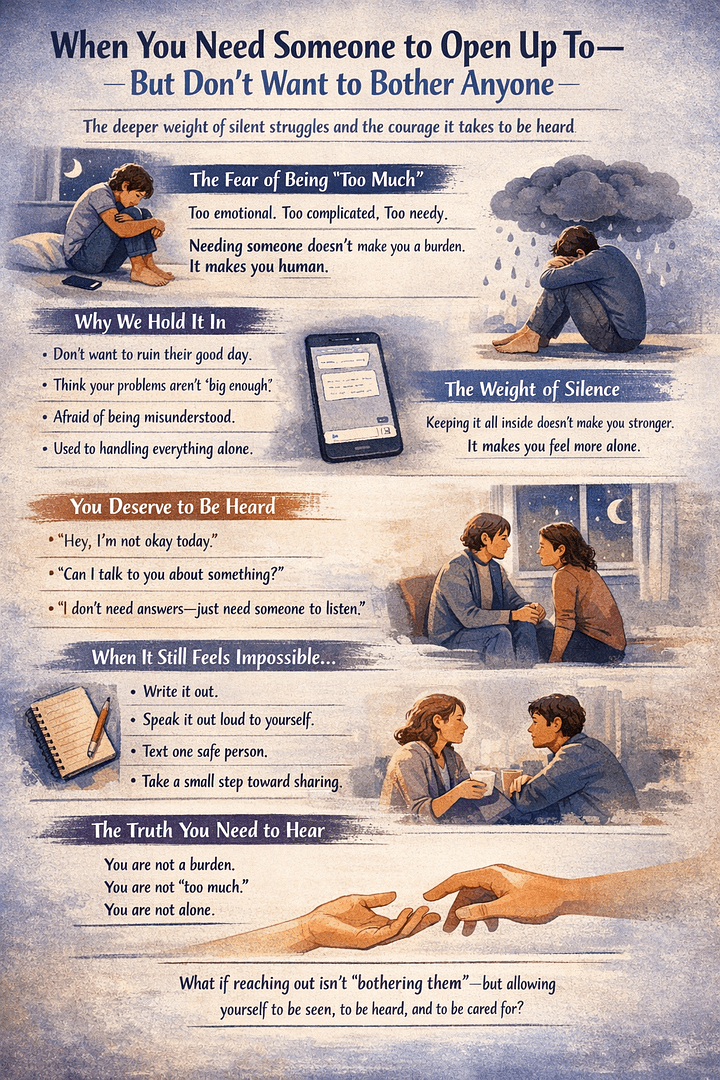
  • When You Need Someone to Open Up To—But Don’t Want to Bother Anyone

    When You Need Someone to Open Up To—But Don’t Want to Bother Anyone

    The deeper weight of silent struggles and the courage it takes to be heard

    There’s a specific kind of heaviness that settles in when you need someone—really need someone—but stop yourself from reaching out. It’s not loud or dramatic. It doesn’t always come with tears. Sometimes it’s just a quiet ache sitting in your chest while you go about your day, pretending everything is fine.

    You might be surrounded by people. You might even have conversations, laugh, respond, show up. But underneath it all is this constant thought:

    “I wish I could tell someone how I actually feel… but I don’t want to bother anyone.”

    So you don’t.

    And that silence becomes its own kind of burden.

    The Inner Conflict No One Sees

    What makes this feeling so exhausting is the constant internal push and pull.

    One part of you is overwhelmed—full of thoughts, emotions, questions, maybe even pain you don’t fully understand yourself. That part is asking for release, for connection, for someone to sit with you in it.

    But another part of you shuts it down just as quickly:

    They’re busy.

    They have their own problems.

    This isn’t important enough.

    I’ll just deal with it myself.

    You go back and forth, sometimes within seconds. You open a message, type something vulnerable… then delete it. You consider making a call… then decide against it. You tell yourself to wait until the “right time,” but that time rarely comes.

    So the words stay inside.

    And over time, they don’t just stay—they build.

    Where This Feeling Comes From

    This hesitation doesn’t come out of nowhere. It’s often rooted in experiences that taught you—directly or indirectly—that your feelings might be inconvenient.

    Maybe at some point in your life:

    You were told you were “too sensitive”

    Your emotions were minimized or ignored

    Someone reacted with impatience when you tried to open up

    You learned to be the “strong one” for everyone else

    You felt like you had to earn your place by not needing too much

    Even subtle moments can shape this belief. A sigh. A distracted response. A conversation that quickly shifted away from you. These things add up, and eventually, you start filtering yourself before anyone else gets the chance to.

    You don’t stop feeling—you just stop sharing.

    The Role You’ve Learned to Play

    For many people, this struggle is even deeper because they’ve become the listener in everyone else’s life.

    You’re the one people come to. The one who gives advice, who shows up, who checks in, who carries others when they’re falling apart. You know how to hold space for people—but you don’t always know how to ask for space in return.

    Not because you don’t deserve it.

    But because you’ve trained yourself not to need it.

    And when you’re used to being the strong one, asking for help can feel like breaking character.

    The Misunderstanding of “Being a Burden”

    Somewhere along the way, needing someone became confused with being a burden.

    But they are not the same thing.

    A burden is something forced, unwanted, or excessive.
    But opening up—honestly, gently, vulnerably—is an invitation. It’s trust.

    The people who care about you don’t measure your worth by how little you need them. They care because of who you are—not because of how quiet you can keep your struggles.

    In fact, many people feel closer to someone because they opened up, not in spite of it.

    Connection isn’t built on perfection. It’s built on honesty.

    The Cost of Keeping Everything Inside

    When you keep everything to yourself, it doesn’t just disappear.

    It shows up in other ways:

    Overthinking small things until they feel overwhelming

    Feeling emotionally distant, even when you’re around people

    Carrying a constant sense of tension or exhaustion

    Struggling to sleep because your mind won’t slow down

    Feeling unseen, even by people who care about you

    You start to feel like you’re living two lives—the one people see, and the one you’re silently managing on your own.

    And the longer you stay in that space, the harder it becomes to step out of it.

    What Opening Up Actually Looks Like

    Opening up doesn’t have to be a dramatic, all-at-once release.

    It can be simple. Imperfect. Even a little awkward.

    It might sound like:

    “Hey… can I talk to you about something that’s been on my mind?”

    “I don’t really know how to explain this, but I’ve been struggling a bit.”

    “I don’t need you to fix anything—I just don’t want to feel alone in it.”

    You don’t have to have the right words. You don’t have to explain everything perfectly. You just have to start.

    Because often, the hardest part isn’t being heard—it’s allowing yourself to be.

    When It Still Feels Too Hard

    Even knowing all of this, there are moments when reaching out feels impossible.

    And that’s okay.

    Start where you are.

    Write everything down without filtering it.
    Record your thoughts out loud just to hear them.
    Send a message you don’t over-edit.
    Choose one person who feels even slightly safe.

    Or even take a step toward connection in a different way—reading something that resonates, listening to a voice that understands, reminding yourself that you’re not the only one who feels this way.

    You don’t have to go from silence to full vulnerability overnight.

    You just have to take one small step toward not carrying it alone.

    The Truth You Might Need to Hear

    You are not a burden for having feelings.

    You are not “too much” for needing support.

    You are not weak for wanting someone to listen.

    And you don’t have to earn the right to be heard by suffering in silence first.

    The right people won’t see your honesty as an interruption.
    They’ll see it as trust—and they’ll meet you there.

    Final Reflection

    There will always be moments in life when things feel heavier than you can carry on your own. That doesn’t mean you’ve failed. It means you’re human.

    And being human was never meant to be a solo experience.

    So the next time that thought creeps in—“I don’t want to bother anyone”—pause and ask yourself something different:

    “What if I’m not bothering them… what if I’m giving someone a chance to be there for me?”

    Because sometimes, the connection you’re afraid to reach for…
    is the very thing that will remind you you’re not alone.
    Read More Health & Wellness

  • When the Pain of Night Hits

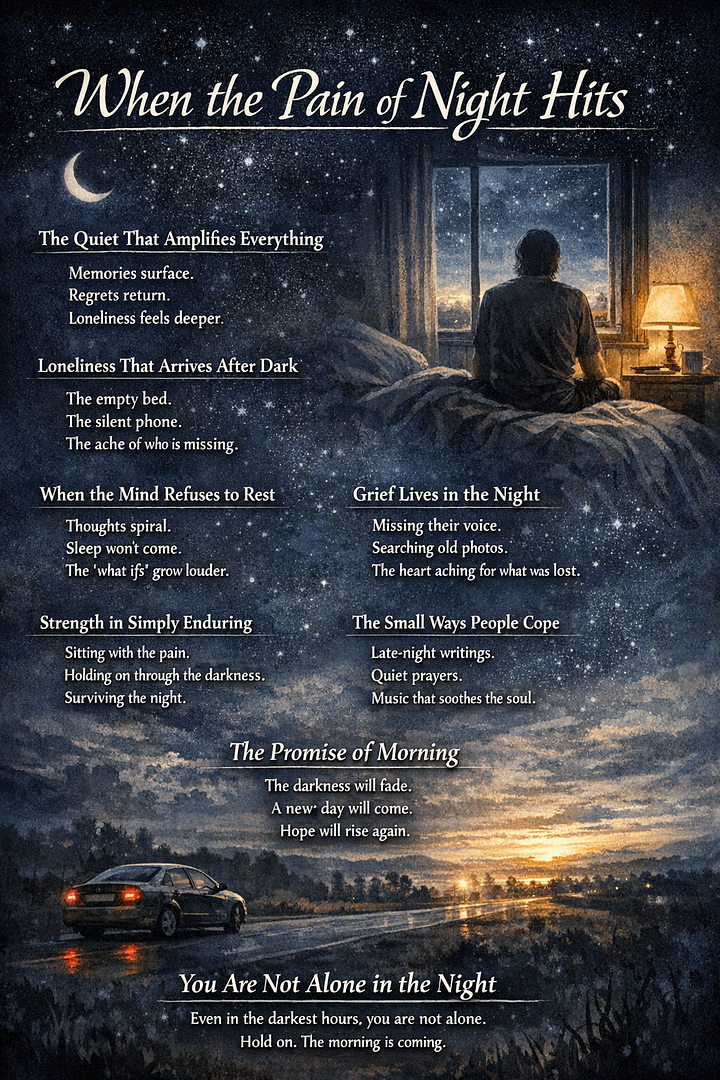
    When the Pain of Night Hits

    There is something about nighttime that can make pain feel deeper.

    During the day, life moves quickly. Responsibilities demand our attention. Phones ring, people talk, work needs to be done, and the noise of everyday life keeps our minds occupied. Even when we are hurting, the pace of the day gives us moments of distraction. It allows us to function, to push emotions aside long enough to get through what needs to be done.

    But night is different.

    When the sun sets and the world begins to quiet down, the distractions fade. Conversations end, streets empty, and the hum of daily activity slowly disappears. What remains is silence—and in that silence, emotions that were buried during the day often rise to the surface.

    For many people, the pain they have been holding inside all day finally shows itself once the night arrives.

    The Quiet That Amplifies Everything

    Nighttime has a unique way of magnifying thoughts and emotions. When everything around us becomes still, our minds begin to wander through places we sometimes try to avoid.

    Memories surface more vividly.

    You might think about someone you lost, replaying moments that once felt ordinary but now feel priceless. You might remember the sound of their voice, the way they laughed, or the conversations you wish you could have one more time.

    For others, the memories involve relationships that ended. The mind drifts back to happier moments, questioning where things went wrong. You revisit words that were said, words that were never spoken, and moments when everything could have gone differently.

    At night, the mind can become a storyteller, replaying scenes from the past over and over again.

    Sometimes it is comforting.

    But often, it hurts.

    The Loneliness That Arrives After Dark

    Loneliness often feels stronger at night.

    During the day, even if you feel alone inside, the world is filled with people. There are coworkers, strangers in stores, conversations in passing, and the simple awareness that life is happening all around you.

    But when night comes, the world grows quieter. Lights turn off in windows, phones stop buzzing, and social media feeds slow down. The outside world begins to rest.

    And suddenly, the emptiness feels louder.

    You might look around the room and feel the absence of someone who used to be there. A chair at the table, an empty side of the bed, or a quiet phone that once held conversations that meant everything.

    Loneliness at night is not always about being physically alone. Sometimes it is the emotional feeling of being disconnected from the person you wish was beside you.

    The person you want to talk to.

    The person you miss.

    The person who once made everything feel lighter.

    When the Mind Refuses to Rest

    One of the hardest parts about nighttime pain is how it interferes with sleep.

    When the body is tired but the mind is racing, rest can feel impossible. Thoughts move in circles, replaying past mistakes, unanswered questions, and fears about the future.

    “What if I had done things differently?”
    “Why did things turn out this way?”
    “Will things ever get better?”

    The ceiling becomes familiar as you stare into the darkness, hoping your mind will eventually quiet itself. But the more you try to force sleep, the more awake you feel.

    Hours pass slowly.

    And sometimes the night feels endless.

    Grief That Lives in the Night

    For those who are grieving, nighttime can be particularly difficult.

    Grief does not follow a schedule. It appears when it chooses, often catching us off guard. But night is when grief often finds the most space to speak.

    You might find yourself scrolling through old photos. Listening to songs that remind you of someone you lost. Re-reading messages you once took for granted.

    The quiet gives grief room to breathe.

    In those moments, the ache can feel overwhelming—not because the love is gone, but because it remains so strong while the person is no longer here.

    Grief is, in many ways, love that no longer has a place to land.

    And at night, that love often searches for somewhere to go.

    The Invisible Battles

    Many people fight battles at night that the outside world never sees.

    They may appear strong during the day. They may smile, laugh, work, and interact with others without anyone realizing the storm that waits for them once they are alone.

    But when the door closes and the lights dim, those hidden struggles can rise to the surface.

    Anxiety.
    Heartbreak.
    Regret.
    Fear of the future.
    Feelings of worthlessness or being unlovable.

    Night does not create these emotions, but it removes the distractions that normally keep them quiet.

    And for some, that silence can feel overwhelming.

    Strength in Simply Enduring

    One of the most overlooked forms of strength is endurance.

    When people think of strength, they often imagine dramatic moments—acts of bravery, bold decisions, or powerful words. But sometimes strength looks much quieter than that.

    Sometimes strength is simply surviving the night.

    It is allowing yourself to feel pain without letting it completely break you. It is sitting with difficult emotions and choosing to keep going even when the path forward feels uncertain.

    You may not feel strong in those moments. You may feel exhausted, vulnerable, or lost.

    But every night you make it through is proof that something inside you is still holding on.

    Even when it feels fragile.

    The Small Ways People Cope

    When the pain of night hits, people often search for small ways to make the darkness easier to carry.

    Some write their thoughts in journals, turning overwhelming emotions into words on a page. Others listen to music that understands their feelings better than conversation ever could.

    Some people watch movies or television simply to fill the silence. Others go for late-night drives, letting the motion of the road calm their racing thoughts.

    There are those who pray.
    Those who read.
    Those who cry quietly into pillows until the weight begins to ease.

    None of these actions erase pain completely. But they create small spaces of comfort inside the darkness.

    And sometimes, those small spaces are enough to get through another night.

    The Promise Hidden in Every Morning

    No matter how long a night feels, morning eventually arrives.

    It may come slowly, with the faint glow of early light pushing back the darkness. Or it may arrive suddenly, when the alarm clock rings and a new day demands your attention.

    The pain you carried through the night may still exist. Healing rarely happens instantly.

    But morning offers something important: perspective.

    It reminds you that the night did not last forever.

    It reminds you that time continues to move forward.

    And it reminds you that even when you felt completely alone in the darkness, you made it through.

    You Are Not Alone in the Night

    If you have ever laid awake while the world slept, carrying thoughts that felt too heavy for one heart to hold, know that you are not alone.

    Across cities, towns, and quiet homes around the world, there are countless people staring into the same darkness, fighting similar battles inside their own minds.

    Different stories.

    Different losses.

    Different struggles.

    But the same quiet hope that the pain will one day soften.

    Night can make pain feel overwhelming, but it can also reveal something powerful: the resilience of the human heart.

    Because even when the darkness feels endless, people continue to endure.

    They continue to breathe.

    They continue to hold on.

    And eventually, they continue to rise with the morning.

    A Father’s Guide to Surviving the Loss of a Child

  • When You Feel Like Just a Background Character in Everyone Else’s Life

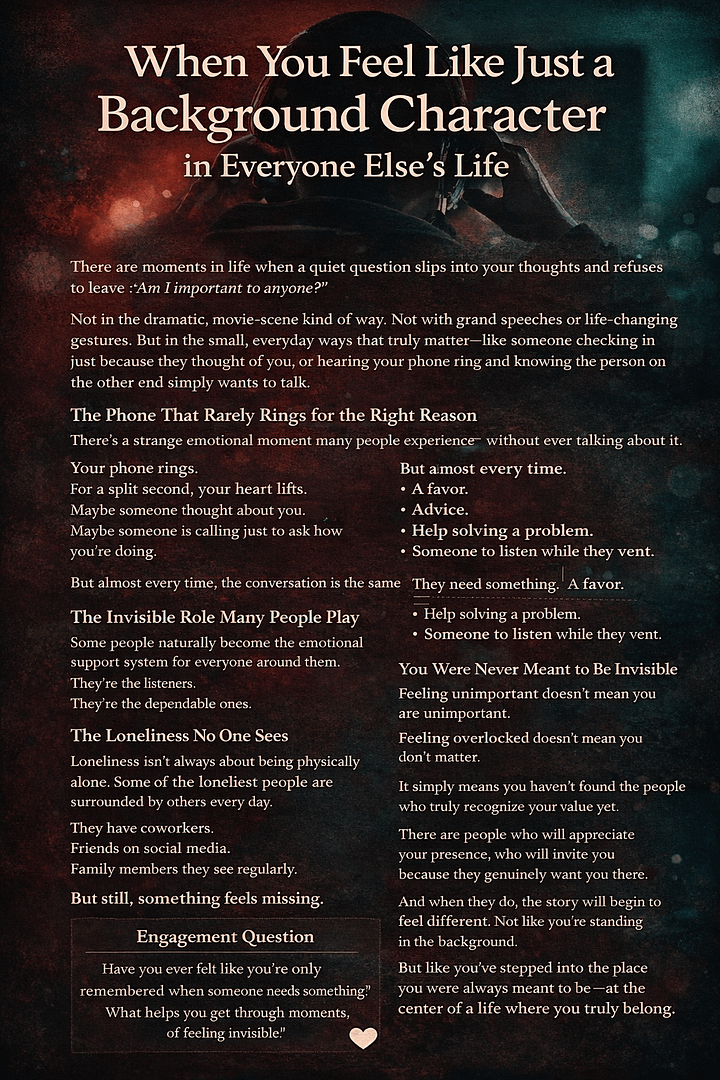
    When You Feel Like Just a Background Character in Everyone Else’s Life

    There are moments in life when a quiet question slips into your thoughts and refuses to leave:

    Am I important to anyone?

    Not in the dramatic, movie-scene kind of way. Not with grand speeches or life-changing gestures. But in the small, everyday ways that truly matter—like someone checking in just because they thought of you, or hearing your phone ring and knowing the person on the other end simply wants to talk.

    For many people, life can begin to feel like they are nothing more than a background character in everyone else’s story. They are present, but not central. Helpful, but not sought after. Reliable, but rarely remembered when there’s no need involved.

    You exist in the background—supporting others, listening to their problems, offering help when they ask—but when the noise fades and the day becomes quiet, you start to realize something painful.

    No one seems to check in on you.

    The Phone That Rarely Rings for the Right Reason

    There’s a strange emotional moment many people experience without ever talking about it.

    Your phone rings.

    For a split second, your heart lifts. A spark of hope appears. Maybe someone thought about you. Maybe someone wanted to hear your voice. Maybe someone is calling just to ask how you’re doing.

    But the conversation almost always follows the same pattern.

    They need something.

    A favor.
    Advice.
    Help solving a problem.
    Someone to listen while they vent.

    And because you’re the kind of person who cares, you answer. You help. You listen. You give your time.

    But after the call ends, a quiet realization lingers.

    If you hadn’t been useful in that moment… would they have called at all?

    The Invisible Role Many People Play

    There are people in the world who naturally become the emotional support system for everyone around them.

    They’re the listeners.

    They’re the dependable ones.

    They’re the people others turn to when life gets difficult.

    But those same people often carry a silent burden. Because while they are always there for others, they rarely feel like anyone is there for them.

    They become the safe place for everyone else, yet have nowhere to place their own worries.

    They’re the strong one.
    The understanding one.
    The one who always says, “It’s okay.”

    But sometimes, even the strongest person wishes someone would simply ask:

    “Are you okay?”

    The Loneliness No One Sees

    Loneliness isn’t always about being physically alone. Some of the loneliest people are surrounded by others every day.

    They have coworkers.
    Friends on social media.
    Family members they see regularly.

    But still, something feels missing.

    The absence of genuine connection can leave a person feeling invisible. Like they exist in people’s lives only when needed.

    Days go by without messages.

    Weekends pass without invitations.

    And slowly, a quiet narrative begins forming in the back of the mind:

    Maybe I’m just not that important.

    This kind of loneliness doesn’t scream for attention. It whispers.

    And because it whispers, it often goes unnoticed.

    The Painful Cycle of Hope

    Despite the disappointment, hope rarely disappears completely.

    Every notification brings a moment of curiosity.

    Every ringing phone creates a brief surge of anticipation.

    Maybe this time someone just wants to talk.
    Maybe someone thought about me today.
    Maybe someone wants to spend time together.

    Hope can feel foolish after being disappointed so many times. But the truth is, hope is not weakness.

    Hope is the heart refusing to give up on connection.

    It’s the quiet belief that somewhere, someone will value you for more than what you can do for them.

    Why This Happens More Than People Realize

    Modern life has created a strange kind of distance between people.

    Everyone is busy.

    Everyone is distracted.

    Everyone assumes everyone else is doing fine.

    Social media can create the illusion that people are constantly connected, but real connection—the kind where someone genuinely checks in, listens, and cares—is often much rarer than it appears.

    Many people don’t intentionally overlook others. Sometimes they simply get caught in their own struggles.

    But that doesn’t make the feeling of being forgotten any less real.

    The People Who Feel This Way the Most

    Ironically, the people most likely to feel like background characters are often the ones who matter deeply to others.

    They’re compassionate.

    They’re thoughtful.

    They’re the people who remember birthdays, send encouraging messages, and show up when someone needs help.

    But because they give so much of themselves, others begin to rely on them without realizing they also need support.

    When you are the person who always shows up, people sometimes assume you don’t need anyone to show up for you.

    You Were Never Meant to Be Invisible

    Feeling unimportant doesn’t mean you are unimportant.

    Feeling overlooked doesn’t mean you don’t matter.

    Sometimes it simply means you haven’t found the people who truly recognize your value yet.

    There are people in the world who will appreciate your presence—not just your help.

    People who will call simply because they enjoy talking with you.

    People who will invite you not because they need something, but because they genuinely want you there.

    Those connections might take time to find, but they exist.

    And when they arrive in your life, something shifts.

    You realize the problem was never that you were a background character.

    It was that you were surrounded by people who didn’t know how to recognize the importance of someone like you.

    The Truth About Your Story

    Every life is a story.

    And in your story, you are not the extra standing quietly in the corner.

    You are not the supporting role that no one notices.

    You are the main character.

    Your experiences matter.
    Your feelings matter.
    Your presence matters.

    Even if the world around you hasn’t fully acknowledged it yet.

    Because somewhere out there are people who will see you, value you, and appreciate the quiet strength you carry every day.

    And when they do, the story will finally begin to feel different.

    Not like you’re standing in the background.

    But like you’ve stepped into the place you were always meant to be—at the center of a life where you truly belong.

    Read More Health & Wellness

  • When You Have Given Up and Need to Find a Reason to Fight

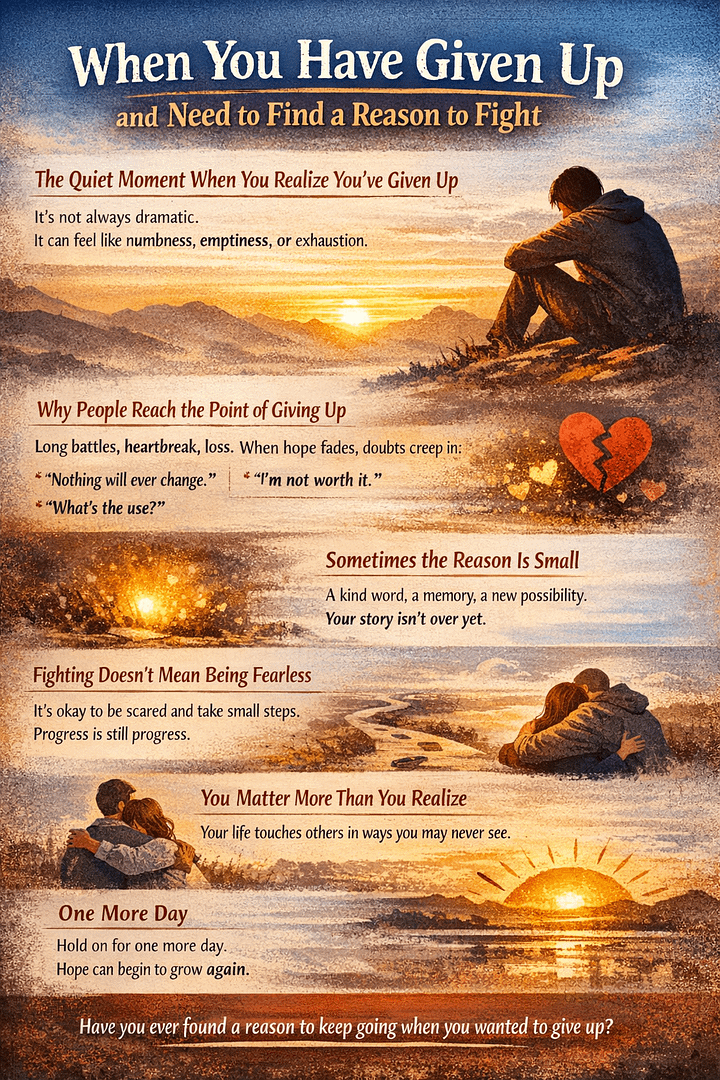
    When You Have Given Up and Need to Find a Reason to Fight

    There are moments in life when the weight of everything becomes too much to carry. The disappointments pile up. The silence becomes louder than conversation. The things you once hoped for begin to feel distant and unreachable. Slowly, almost without noticing, you stop believing things will get better.

    Giving up rarely happens all at once. It is not always a dramatic breaking point or a loud declaration that you are done. More often, it arrives quietly. It slips into your life through exhaustion, disappointment, and the quiet realization that you are tired of trying.

    You still wake up. You still go through the motions. But inside, something feels different. The motivation that once pushed you forward is gone. The hope that once carried you through difficult times has faded. And somewhere deep down, you begin to wonder if fighting for anything anymore is even worth it.

    Many people experience this moment at some point in their lives. It is a place where the heart feels heavy, the mind feels tired, and the future feels uncertain.

    But even in that place, a reason to fight can still exist.

    The Quiet Moment When You Realize You’ve Given Up

    The moment you realize you’ve given up often doesn’t come with anger or tears. Instead, it comes with numbness. A strange emotional quiet where you no longer feel the same urgency to fix things or chase what you once cared about.

    You may find yourself withdrawing from people. Conversations feel exhausting. Dreams that once excited you now feel pointless or unrealistic. Even things that used to bring you joy might no longer hold the same meaning.

    It can feel like you’ve run out of emotional energy.

    And sometimes, people around you may not even notice. From the outside, you might still appear strong, capable, or calm. But inside, the fight that once lived in you feels like it has disappeared.

    This is one of the hardest emotional places a person can reach because it feels like standing in the middle of an empty road with no clear direction forward.

    Why People Reach the Point of Giving Up

    No one gives up easily. People reach this point because they have been fighting for a long time.

    They have tried to hold relationships together that kept falling apart. They have chased dreams that seemed to slip further away no matter how hard they worked. They have endured heartbreak, loneliness, rejection, or loss that slowly chipped away at their strength.

    Sometimes the pain comes from loving someone who doesn’t feel the same. Sometimes it comes from feeling invisible in a world full of people. Sometimes it comes from losing someone who meant everything.

    Life has a way of testing people again and again until they begin to question whether the fight is worth continuing.

    When disappointment repeats itself enough times, the mind begins to protect itself by lowering expectations. It becomes easier to expect nothing than to hope and feel hurt again.

    And so, giving up can begin to feel like a form of emotional self-defense.

    The Dangerous Lies That Appear When Hope Fades

    When a person begins to lose hope, their mind can become their harshest critic. Negative thoughts begin to echo louder than any encouraging words from others.

    You might start hearing thoughts like:

    “Nothing is ever going to change.”
    “No one really cares.”
    “I’m not worth fighting for.”
    “I’ve already tried everything.”

    These thoughts can feel incredibly convincing because they are built on real experiences and real pain. But they are not the full truth.

    The mind has a way of focusing on what has gone wrong while ignoring the possibilities that still exist ahead.

    Just because things have been painful up to this point does not mean the rest of your story will follow the same path.

    Sometimes the Reason to Fight Is Small

    When people talk about finding a reason to keep going, it can sound like they expect some powerful moment of inspiration. But in reality, the reasons that bring people back from the edge are often surprisingly small.

    It might be a conversation with someone who listens without judgment.
    It might be a memory that reminds you of who you once were.
    It might be a simple realization that there are still things in life you haven’t experienced yet.

    Sometimes the reason to fight again is simply curiosity about what the future might hold.

    Life is unpredictable. The people we meet, the opportunities that appear, and the moments that change our perspective often arrive when we least expect them.

    The life you imagine today may not be the life you will live tomorrow.

    Your Story Is Still Being Written

    One of the most powerful truths about life is that it is never finished while you are still here. Every day adds another page to your story.

    Right now, your story may feel heavy with struggle, disappointment, or grief. But stories are not defined by a single chapter.

    There are chapters that bring loss and heartbreak. But there are also chapters that bring healing, connection, growth, and unexpected joy.

    Many people who once believed their lives would never improve eventually found themselves in places they could not have imagined before. They met people who helped them heal. They discovered passions they never knew they had. They found purpose in helping others through struggles similar to their own.

    None of those things seemed possible during their darkest moments.

    But those moments were not the end of their story.

    Fighting Doesn’t Mean Being Fearless

    When people imagine someone who keeps fighting, they often picture a person who is fearless, confident, and strong all the time.

    But the reality is very different.

    Fighting often looks like vulnerability. It looks like admitting you’re struggling. It looks like reaching out to someone when you feel alone. It looks like continuing to move forward even when your confidence is shaken.

    Strength is not the absence of fear, sadness, or exhaustion.

    Strength is continuing despite those feelings.

    Sometimes fighting means taking small steps instead of giant leaps. Sometimes it means resting and gathering your strength before trying again.

    And sometimes it simply means surviving another difficult day.

    The Power of One More Day

    When everything feels overwhelming, thinking about the future can feel impossible. Planning the rest of your life or trying to solve every problem at once can make the situation feel even heavier.

    Instead, focus on something much simpler.

    One more day.

    Just make it through today. Tomorrow can take care of itself when it arrives.

    Many people who have faced deep despair later say that the reason they made it through was because they focused on small moments rather than the entire journey ahead.

    One conversation.
    One step forward.
    One more sunrise.

    Over time, those small moments begin to build into something larger.

    You Matter More Than You Realize

    When someone feels defeated by life, they often begin to believe they do not matter. They feel invisible or unimportant, as if their presence makes little difference in the world.

    But the truth is that every life creates ripples.

    The kindness you show someone on a difficult day can stay with them longer than you know. The support you give a friend or family member may be something they carry with them for years. Even the simple act of being present in someone’s life can mean more than you realize.

    There are people who would feel your absence deeply, even if they struggle to express it.

    And beyond that, there are people you haven’t met yet who may one day benefit from your experiences, your empathy, and your understanding.

    Your story, including your struggles, may one day help someone else survive their own.

    Finding Your Way Back to the Fight

    Returning to the fight does not happen overnight. It often begins slowly.

    It might start with acknowledging your pain instead of hiding it. It might involve talking to someone you trust or seeking support when you need it. It may mean rediscovering small things that once brought you comfort or peace.

    There will still be difficult days. Moments of doubt may return. That is part of the human experience.

    But each time you choose to keep going, you strengthen the part of yourself that refuses to stay defeated.

    And over time, that part can grow stronger than the voice that once told you to give up.

    Standing Back Up

    The people who inspire others the most are not those who never struggle. They are the ones who have faced the darkest moments and still found a way to rise again.

    Standing back up after giving up does not erase the pain you have been through. But it proves something powerful about the human spirit.

    It proves that even when hope feels lost, it can still be rediscovered.

    And sometimes the greatest victories in life are not loud or dramatic.

    Sometimes the greatest victory is simply deciding that your story is not over yet.

    Read More Health & Wellness

  • The Quiet Weight of Feeling Unwanted

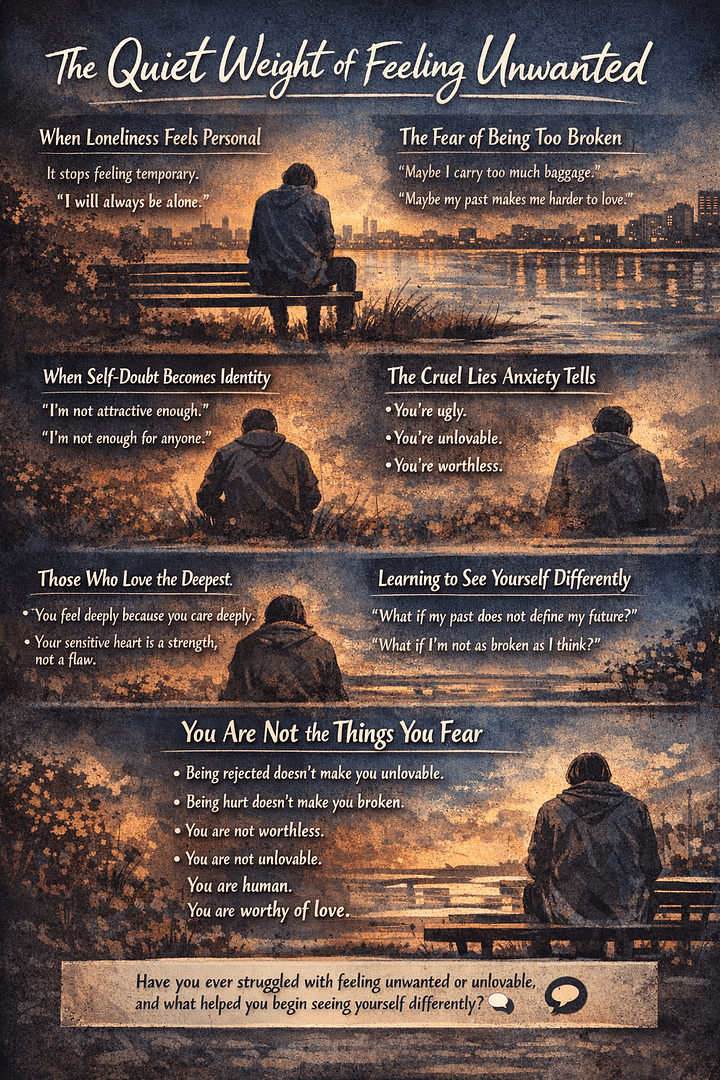
    The Quiet Weight of Feeling Unwanted

    There are some emotions that people talk about openly—stress, heartbreak, disappointment. But there are other feelings that live quietly beneath the surface, rarely spoken aloud. One of the heaviest of these is the anxiety of believing you are unwanted.

    It is not just the fear of being single or alone for a period of time. It is something deeper and more personal. It is the haunting thought that maybe people simply do not choose you. That maybe, no matter how much you care or how much love you are willing to give, you will somehow always be the one left behind.

    This kind of anxiety can shape the way a person sees themselves and the world around them. Over time, it can quietly rewrite a person’s inner story—turning moments of disappointment into proof that something must be wrong with them.

    And once that belief takes root, it can be incredibly difficult to let go.

    When Loneliness Feels Personal

    Loneliness is a universal human experience. Everyone feels it at times. But when someone struggles with the anxiety of being unwanted, loneliness becomes something much more painful.

    It stops feeling temporary.

    Instead of thinking, I’m alone right now, the thought becomes, I will always be alone.

    Simple moments can trigger this feeling. A message that goes unanswered. Being the one who always reaches out first. Watching others find love and connection while you stand quietly on the outside.

    These moments might seem small to others, but to someone already battling these fears, they reinforce a painful belief: that they are somehow not enough.

    It can feel like standing in a crowded room yet still feeling invisible.

    The Fear of Being Too Broken

    Many people who struggle with these thoughts begin to see themselves as damaged or broken. They look at their past—the heartbreaks, the rejections, the moments where they opened their heart and were hurt—and they begin to believe those experiences have permanently changed them.

    They wonder if others can somehow see the cracks.

    They may think:

    Maybe I carry too much baggage.
    Maybe my past makes me harder to love.
    Maybe people can tell I’m broken.

    This belief can create a painful cycle. Because someone who feels broken may start to pull away from opportunities for connection. They may avoid expressing their feelings. They may hide parts of themselves to avoid rejection.

    In trying to protect their heart, they sometimes build walls around it.

    But those walls can also keep love from reaching them.

    When Self-Doubt Becomes Identity

    Anxiety has a powerful way of repeating certain thoughts until they begin to feel like facts. Over time, these thoughts stop sounding like fears and start sounding like truth.

    A person might begin telling themselves things like:

    I’m not attractive enough.
    I’m not interesting enough.
    I’m too much for people.
    I’m not enough for anyone.

    Eventually, those thoughts form a painful identity. A person no longer just feels unworthy—they begin to believe that they are unworthy.

    This can affect every part of life. Compliments are brushed off. Kindness feels suspicious. When someone shows interest, it can feel confusing or even unbelievable.

    Deep down, the mind is waiting for the moment when the person leaves, because that is what it has come to expect.

    The Invisible Battle

    One of the most difficult parts of this kind of anxiety is that it is often invisible to others. On the outside, someone might appear strong, kind, even confident.

    They may laugh with friends, go to work, and carry on with daily life.

    But inside, there is a quiet battle happening every day.

    They may constantly question themselves:

    Did I say something wrong?
    Do they actually want me around?
    Am I just tolerated instead of loved?

    It is exhausting to live with a mind that constantly doubts your own worth.

    The Cruel Lies Anxiety Tells

    Anxiety has a way of turning past pain into present fear. It takes a few moments of rejection and stretches them into a permanent story about who you are.

    But the things anxiety tells you are often deeply unfair.

    It may say you are ugly when beauty is subjective and far more complex than appearance.

    It may say you are unlovable when the truth is that love often depends on timing, compatibility, and circumstances far beyond your control.

    It may say you are worthless when your value as a human being has nothing to do with how others treat you.

    The mind can be incredibly convincing—but it is not always accurate.

    The People Who Feel the Most Are Often the Ones Who Love the Deepest

    There is a quiet irony in this struggle.

    Many people who feel unlovable are the ones capable of loving the most deeply.

    They notice the small details about others. They care about people’s feelings. They remember things that matter. They invest emotionally in ways that others sometimes overlook.

    Their sensitivity, which sometimes feels like a flaw, is actually one of their greatest strengths.

    They feel deeply because they care deeply.

    And in a world that often rushes past emotional connection, that kind of heart is rare.

    Learning to See Yourself Differently

    Healing from these beliefs does not happen quickly. When someone has spent years questioning their worth, it takes time to rewrite that inner narrative.

    But change begins with small moments of self-awareness.

    It begins with asking difficult but important questions:

    What if the things I believe about myself are not actually true?
    What if I have been measuring my worth by the wrong standards?
    What if my past does not define my future?

    Sometimes the first step is simply recognizing that the harsh voice in your head is not an objective judge of your value.

    It is a voice shaped by hurt.

    And hurt can be healed.

    You Are Not the Things You Fear

    Being rejected does not make you unlovable.

    Being hurt does not make you broken.

    Feeling alone does not mean you will always be alone.

    The truth is that every person carries invisible struggles. Many people who appear confident or loved have battled the same doubts in quiet moments.

    Human beings are far more fragile—and far more resilient—than we often realize.

    Your story is not finished. Your worth is not determined by the people who failed to see it.

    You are not ugly because someone did not choose you.

    You are not worthless because someone walked away.

    And you are not unlovable simply because you have not yet found the person who sees you clearly.

    Sometimes the hardest thing to believe is also the most important truth:

    You are not broken.

    You are human.

    And that alone makes you worthy of love, connection, and belonging.

    Read More Health & Wellness

  • The Truth That Comes Out When the Walls Come Down

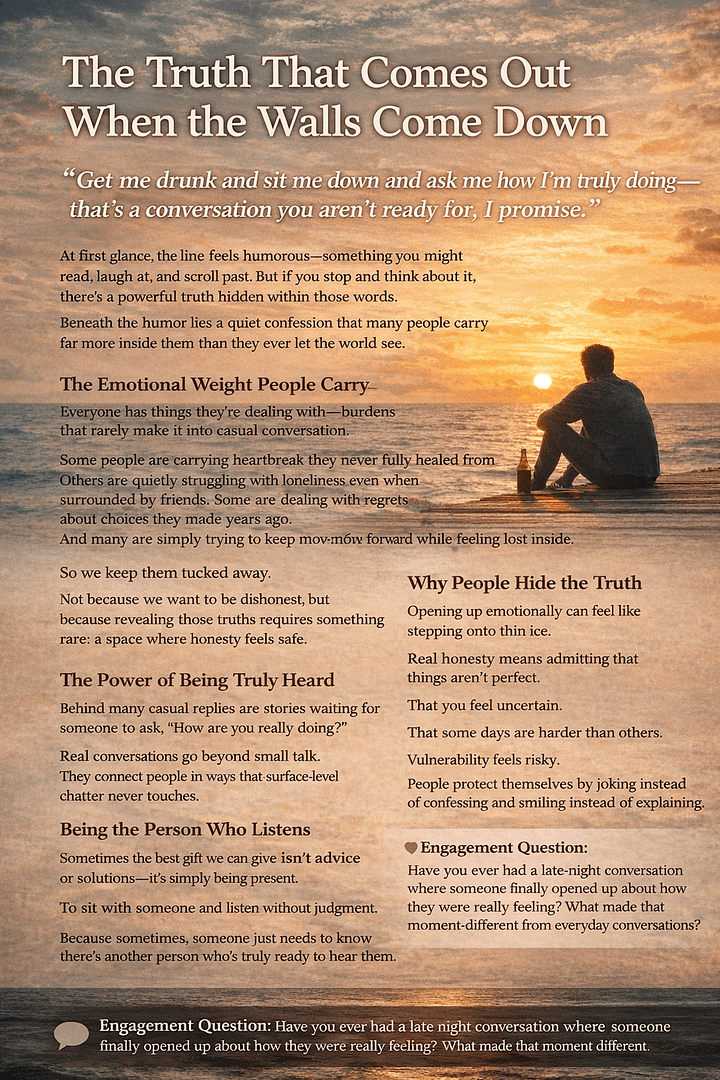
    The Truth That Comes Out When the Walls Come Down

    “Get me drunk and sit me down and ask me how I’m truly doing—that’s a conversation you aren’t ready for, I promise.”

    At first glance, the line feels humorous—something you might read, laugh at, and scroll past. But if you stop and think about it, there’s a powerful truth hidden within those words. Beneath the humor lies a quiet confession that many people carry far more inside them than they ever let the world see.

    Most of us have become masters of the polite response. When someone asks, “How are you?” the answer almost always comes automatically.

    “I’m good.”
    “Doing fine.”
    “Can’t complain.”

    These phrases have become social shorthand—quick, simple replies designed to keep conversations moving and emotions neatly tucked away. They allow us to navigate daily interactions without revealing the deeper layers of what we’re actually feeling.

    But the truth is, those answers are rarely the full story.

    The Emotional Weight People Carry

    Everyone has things they’re dealing with—burdens that rarely make it into casual conversation.

    Some people are carrying heartbreak they never fully healed from.
    Others are quietly struggling with loneliness even when surrounded by friends.
    Some are dealing with regrets about choices they made years ago.
    And many are simply trying to keep moving forward while feeling lost inside.

    Life has a way of layering experiences on top of each other. Over time, those layers become stories we carry within us—stories that are often too complex, too vulnerable, or too painful to casually share.

    So we keep them tucked away.

    Not because we want to be dishonest, but because revealing those truths requires something rare: a space where honesty feels safe.

    Why People Hide the Truth

    Opening up emotionally can feel like stepping onto thin ice. When someone asks how you’re really doing, answering honestly means exposing parts of yourself that you usually keep guarded.

    It means admitting that things aren’t perfect.
    That you feel uncertain.
    That some days are harder than others.

    For many people, vulnerability feels dangerous because they’ve learned—through experience—that not everyone is prepared for it. Sometimes when people open up, the response they receive is awkward silence, quick advice, or someone trying to change the subject.

    So over time, people learn to protect themselves by keeping things light.

    They joke instead of confessing.
    They smile instead of explaining.
    They say they’re fine even when they’re anything but.

    The Role of Lowered Defenses

    That’s where the quote’s reference to alcohol comes in—not as encouragement, but as symbolism.

    When people relax or let their guard down, the walls they’ve carefully built around their emotions can begin to soften. The things they normally keep hidden suddenly feel easier to say.

    Late-night conversations often have this effect. The world quiets down, distractions fade, and people begin speaking more honestly than they would during the day.

    In those moments, you sometimes hear the real answers:

    “I’m actually struggling more than people realize.”
    “I miss someone I can’t talk to anymore.”
    “I’m not sure where my life is going.”

    These are the truths that rarely appear in casual daytime conversation.

    The Power of Being Truly Heard

    At its core, the quote reveals something deeply human: many people are waiting for someone who genuinely wants to hear the truth.

    Not someone who asks out of politeness.
    Not someone looking for a quick answer.

    But someone willing to sit through the real conversation.

    Real conversations can be messy. They might involve sadness, frustration, confusion, or unresolved emotions. But they also create something incredibly valuable: connection.

    When someone finally speaks honestly about what they’re carrying, they’re not just sharing their struggles—they’re sharing trust.

    And being heard without judgment can be one of the most healing experiences a person can have.

    Why Deep Conversations Matter

    In a world filled with constant noise, real conversations have become rare. Social media highlights the best moments of people’s lives, while everyday interactions often stay at surface level.

    But beneath those surfaces, people are craving authenticity.

    They want conversations that go deeper than small talk.
    They want moments where they can put down the emotional armor they wear every day.

    Those moments remind us that we’re not alone in our struggles. They remind us that everyone is navigating their own complicated story.

    And sometimes, simply knowing someone is willing to listen can lighten a burden that’s been carried for far too long.

    Learning to Ask the Right Question

    The deeper message behind the quote isn’t really about alcohol or dramatic confessions. It’s about the courage required to ask—and answer—a simple question honestly.

    “How are you really doing?”

    It’s a question that invites truth instead of routine. But asking it means being prepared for the possibility that the answer might be complicated.

    It might take time.
    It might involve emotions.
    It might reveal things you didn’t expect.

    But those are often the conversations that matter the most.

    Being the Person Who Listens

    Sometimes the greatest gift we can give someone isn’t advice, solutions, or perfectly chosen words. Sometimes it’s simply our presence.

    To sit with someone.
    To listen without rushing them.
    To let them say what they’ve been holding inside.

    Because behind many quiet smiles and casual replies are stories waiting to be told.

    And every once in a while, someone just needs another person who’s truly ready to hear them.

    Read More Health & Wellness

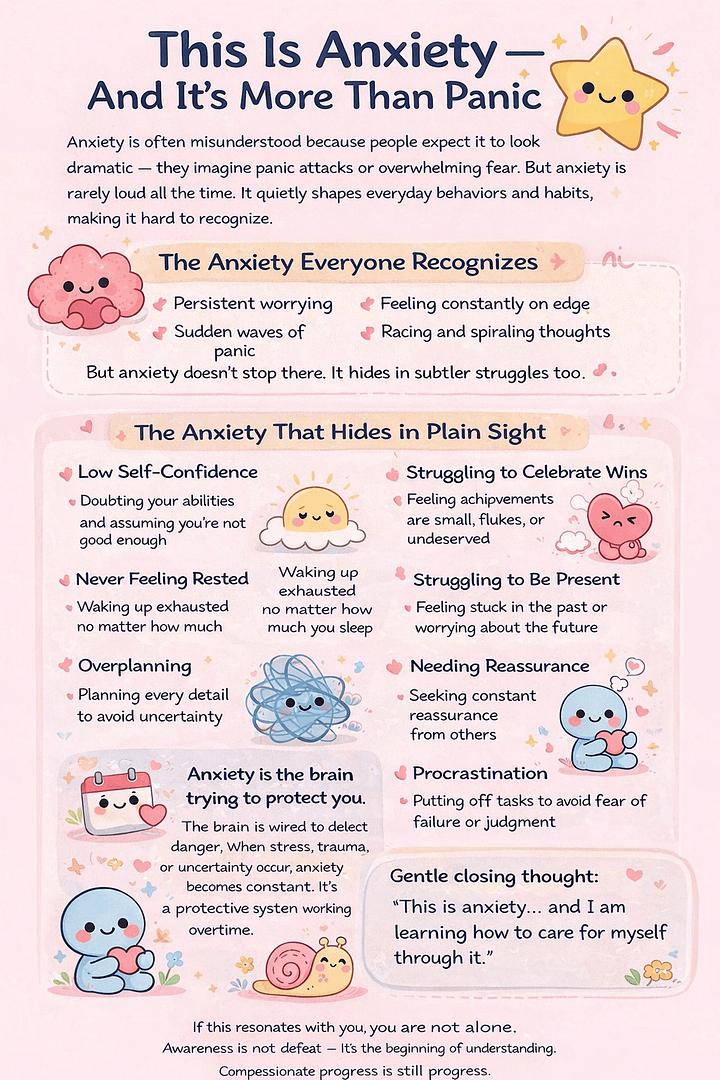
  • This Is Anxiety — And It’s More Than Panic

    This Is Anxiety — And It’s More Than Panic

    Anxiety is often misunderstood because people expect it to look dramatic. They imagine shaking hands, racing hearts, or moments of overwhelming panic that are impossible to ignore. And while those experiences are real, they represent only a small part of what anxiety truly is.

    For many people, anxiety does not arrive as chaos.
    It arrives quietly.
    It blends into daily habits, personality traits, and routines so seamlessly that it becomes difficult to recognize where you end and anxiety begins.

    Anxiety is not always loud. Sometimes, it is simply exhausting.

    The Anxiety Everyone Recognizes

    We tend to validate anxiety only when it becomes visible. When someone is panicking, overwhelmed, or openly distressed, support appears quickly because the struggle is obvious.

    Commonly recognized signs include:

    Persistent worrying

    Restlessness or inability to relax

    Sudden panic or fear

    Racing thoughts

    Physical tension or unease

    These moments feel intense because the nervous system is in survival mode — preparing for danger even when no immediate threat exists.

    But anxiety doesn’t disappear once the panic fades. Often, it reshapes everyday life in quieter, less obvious ways.

    The Anxiety That Hides in Plain Sight

    The hardest part about anxiety is that it often disguises itself as personality.

    People may describe themselves as “overthinkers,” “perfectionists,” or “just bad at relaxing,” never realizing these patterns may be rooted in anxiety.

    Low Self-Confidence

    Anxiety plants doubt in even the most capable minds. You may question your worth, minimize your talents, or assume others are more competent — even when evidence says otherwise.

    It becomes difficult to trust yourself because anxiety constantly asks, “What if you’re wrong?”

    Never Feeling Truly Rested

    You can sleep eight hours and still wake up tired. Anxiety keeps the brain alert, scanning for problems even during rest.

    Your body may be still, but your mind never fully clocks out.

    Struggling to Celebrate Wins

    Instead of enjoying accomplishments, anxiety redirects attention toward the next worry:

    “Was it good enough?”

    “Can I do it again?”

    “What if this was just luck?”

    Success becomes temporary relief rather than lasting pride.

    Struggling to Be Present

    Anxiety lives in two places: the past and the future.

    It replays conversations already finished and rehearses conversations that haven’t happened yet. Meanwhile, the present moment — where life actually exists — slips quietly by.

    You are physically there but mentally somewhere else.

    Overplanning as Protection

    Planning feels productive, but sometimes it is fear wearing the mask of preparation.

    An anxious mind believes that if every detail is controlled, disappointment or failure can be avoided. The plan becomes a shield against uncertainty.

    Crippling Indecisiveness

    Simple choices can feel overwhelming because anxiety turns every option into a risk.

    Instead of asking, “What do I want?” the mind asks, “What if I regret this?”

    The fear of making the wrong choice becomes heavier than the choice itself.

    Needing Reassurance

    Seeking reassurance is often misunderstood as insecurity. In reality, it is an attempt to quiet internal noise that constantly questions safety, relationships, or self-worth.

    A single reassuring word can feel like a deep breath after holding air too long.

    Procrastination Isn’t Always Laziness

    Anxiety can freeze action. Tasks feel overwhelming not because you don’t care, but because you care too much.

    Fear of failure, judgment, or imperfection creates mental paralysis. Avoidance becomes temporary relief from emotional pressure.

    Why Many People Don’t Realize They Have Anxiety

    Because these behaviors look ordinary, many people blame themselves instead of recognizing anxiety’s role.

    They say:

    “I just overthink.”

    “I’m not disciplined.”

    “I’m too sensitive.”

    “I need to try harder.”

    But anxiety thrives in self-criticism. The more someone believes they are flawed, the stronger anxiety’s voice becomes.

    Understanding anxiety reframes the narrative. It shifts the question from self-blame to self-awareness.

    Anxiety Is the Brain Trying to Protect You

    At its core, anxiety is not an enemy. It is a protective system working overtime.

    The brain is designed to detect danger and keep you safe. When stress, trauma, uncertainty, or prolonged pressure occur, that alarm system becomes hypersensitive.

    It begins responding to emotional risks the same way it would respond to physical danger.

    Your mind isn’t trying to sabotage you — it’s trying to prepare you.

    The problem is that constant protection can feel like constant fear.

    Living With Anxiety While Learning to Heal

    Healing from anxiety does not usually mean eliminating it completely. Instead, healing looks like building a new relationship with your thoughts and emotions.

    It means learning to:

    notice anxious thoughts without immediately believing them,

    pause before spiraling into worst-case scenarios,

    allow imperfection,

    and give yourself permission to rest without guilt.

    Progress is rarely dramatic. It shows up in small, meaningful moments:

    making a decision faster than before,

    enjoying a conversation without overanalyzing it later,

    celebrating a small success,

    feeling calm for a few extra minutes.

    These moments may seem minor, but they represent profound internal change.

    The Power of Compassion Toward Yourself

    One of anxiety’s greatest challenges is the harsh inner voice it creates. Many people speak to themselves in ways they would never speak to someone they love.

    Healing begins when compassion replaces criticism.

    Instead of saying:

    “Why am I like this?”

    Try asking:

    “What do I need right now?”

    That simple shift transforms anxiety from a battle into a conversation.

    You Are Not Alone in This Experience

    Millions of people carry anxiety quietly. They show up to work, maintain relationships, smile in conversations, and fulfill responsibilities — all while managing an invisible weight.

    If you recognize yourself in these experiences, know this:

    You are not weak.
    You are not broken.
    You are human, navigating a mind that has learned to stay alert for too long.

    And awareness is not defeat — it is the beginning of understanding.

    A Gentle Closing Thought

    Anxiety is not only panic.
    It is doubt, exhaustion, overthinking, hesitation, and the longing to feel safe within your own mind.

    But alongside anxiety lives resilience — the quiet strength that keeps you moving forward despite uncertainty.

    Every moment you choose patience with yourself is a step toward peace.

    Sometimes healing begins with a simple acknowledgment:

    “This is anxiety… and I am learning how to care for myself through it.”

    Read More Health & Wellness

  • Broken, But Still Trying: The Quiet Courage of Continuing

    Broken, But Still Trying: The Quiet Courage of Continuing

    There are moments in life when strength does not look like confidence, success, or certainty. Instead, it looks like survival. It looks like waking up tired but choosing to face the day anyway. It looks like breathing through pain no one else can see. It looks like trying — even when part of you feels broken.

    Many people carry wounds that remain invisible to the outside world. Behind ordinary routines and polite smiles are stories filled with loss, disappointment, heartbreak, and unanswered questions. These experiences shape us in ways that words often fail to capture. The truth is, not all pain announces itself loudly. Some of it settles quietly into the soul, appearing only in moments of solitude when memories return and emotions can no longer be distracted away.

    To feel broken is deeply human.

    It often comes after loving deeply, trusting fully, or believing in something that didn’t unfold as hoped. Brokenness can come from grief, betrayal, failure, loneliness, or simply the weight of life’s accumulated struggles. Over time, these experiences can leave a person feeling exhausted — as though they are carrying pieces of a life that no longer fit together the way they once did.

    Yet within that brokenness lies something remarkable: endurance.

    The Strength No One Sees

    Society often celebrates visible victories — achievements, milestones, and outward success. But some of the greatest acts of courage happen quietly, without applause. Choosing to keep going when motivation is gone is strength. Allowing yourself to feel pain rather than hiding from it is strength. Admitting that you do not have all the answers is strength.

    There is bravery in vulnerability.

    When someone says, “I’m still trying,” they are expressing one of the most powerful declarations a person can make. It means they have faced moments that could have defeated them but chose persistence instead. It means hope still exists, even if only as a small flicker in the darkness.

    Trying does not always look impressive. Sometimes it means completing small tasks that once felt effortless. Sometimes it means getting through the day without falling apart. Sometimes it means simply breathing deeply and reminding yourself that this moment will pass.

    These quiet victories matter more than we often realize.

    Living With the Weight of Memory

    Memories have a way of lingering long after circumstances change. Certain songs, places, or conversations can reopen emotions thought to be healed. The mind revisits moments that once held meaning, replaying them in search of understanding or closure.

    This is part of the human process of healing.

    We are storytelling beings, constantly trying to make sense of our experiences. When something meaningful ends or changes, the heart struggles to reconcile what was with what is. Missing what once meant everything does not make someone weak — it makes them honest.

    Healing does not require forgetting. Instead, it asks us to learn how to carry memories differently, allowing them to exist without controlling our present.

    The Myth of Having It All Together

    One of the greatest pressures people face is the belief that they must appear strong at all times. Social expectations often encourage perfection — emotional stability, confidence, certainty — even when reality feels far from those ideals.

    But no one truly has everything figured out.

    Life is not a straight path toward clarity. It is messy, unpredictable, and filled with moments of doubt. Accepting this truth can be liberating. Not having all the answers does not mean failure; it means you are still growing.

    Growth rarely feels comfortable. In fact, it often feels like falling apart before coming back together in a new way.

    Small Steps Forward

    Healing rarely arrives in dramatic breakthroughs. More often, it comes quietly through small, consistent acts of self-compassion:

    Choosing rest when exhaustion takes over

    Speaking kindly to yourself instead of harshly

    Allowing emotions to exist without judgment

    Taking one step forward, even when the destination feels unclear

    These small steps may seem insignificant, but over time they create movement. Progress is not measured by speed but by persistence.

    Each day you continue is evidence of resilience.

    Redefining Brokenness

    Perhaps the word broken itself deserves reconsideration. Brokenness suggests something damaged beyond repair, yet human beings are not objects. We adapt, evolve, and rebuild in ways that often make us stronger and more compassionate than before.

    What feels like brokenness may actually be transformation.

    Pain reshapes perspective. It deepens empathy. It teaches patience and humility. Those who have struggled often become the ones who understand others most deeply because they recognize the silent battles behind a stranger’s smile.

    The cracks we carry sometimes become the places where light enters.

    The Power of Trying Again

    Every morning presents a quiet choice: to give up or to try again. Choosing to try does not erase pain, but it creates possibility. It opens space for healing, connection, and unexpected joy.

    Trying again is an act of hope.

    Hope does not always feel optimistic or cheerful. Sometimes hope is stubborn. Sometimes it whispers instead of shouting. Sometimes it simply says, “Maybe tomorrow will be a little easier.”

    And that is enough.

    A Message for Anyone Still Trying

    If you feel tired, overwhelmed, or incomplete, know that you are not alone. Many people are walking similar paths, carrying unseen burdens while doing their best to move forward.

    You do not need to be fully healed to keep living.
    You do not need certainty to take the next step.
    You do not need perfection to be worthy.

    The simple act of continuing — breathing, trying, hoping — is already a victory.

    Because strength is not the absence of struggle.

    Strength is waking up, facing the day, and saying:

    “I may feel broken, but I haven’t given up. I’m still trying.”

    Read More Health & Wellness

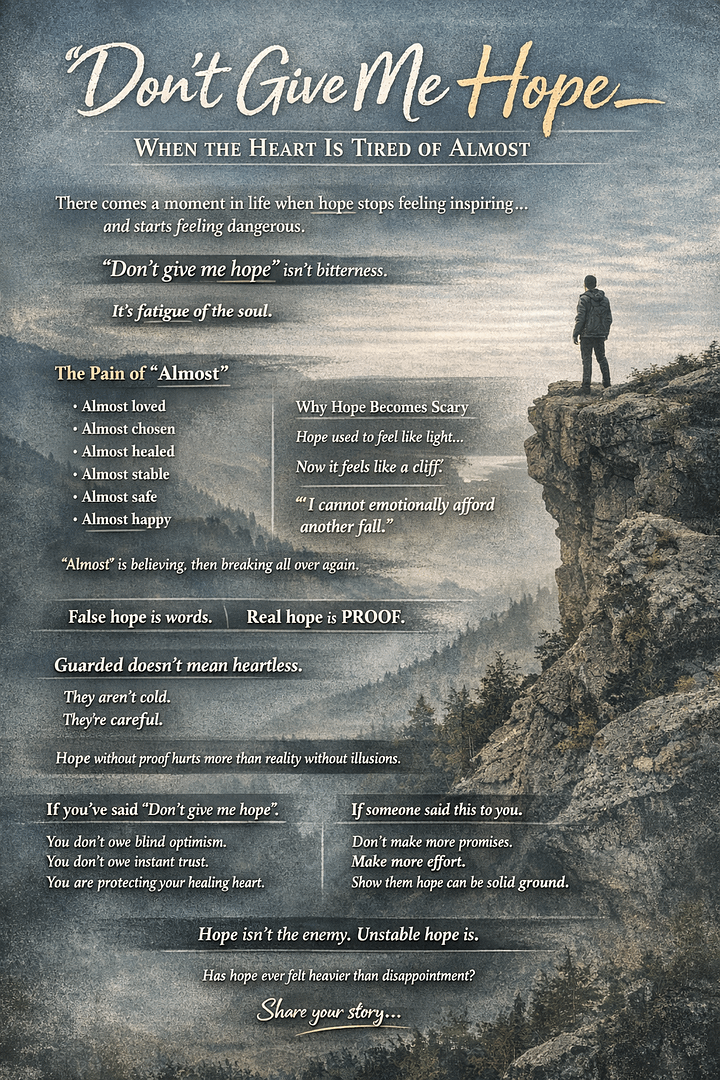
  • “Don’t Give Me Hope” — When the Heart Is Tired of Almost

    “Don’t Give Me Hope” — When the Heart Is Tired of Almost

    There comes a moment in life when hope stops feeling inspiring… and starts feeling dangerous.

    We grow up being told hope is everything. Hope keeps us going. Hope heals. Hope is strength. But no one talks about what happens when hope has been broken too many times. When believing starts to feel like volunteering to be hurt again.

    “Don’t give me hope” isn’t bitterness.

    It’s fatigue of the soul.

    It’s what someone says when they’ve stood at the doorway of something good — love, healing, opportunity, reconciliation, change — and watched it slip away at the last second. Not once. Not twice. But enough times that their heart now flinches at possibility.

    The Pain of “Almost”

    Clear endings hurt, but they heal.

    “Almost” lingers.

    Almost loved

    Almost chosen

    Almost healed

    Almost stable

    Almost safe

    Almost happy

    “Almost” is the slowest kind of heartbreak. There’s no closure, no clean ending, no clear line between what was real and what wasn’t. Just a thousand “what ifs” echoing in the mind.

    Hope is what makes “almost” hurt so deeply. Because for a moment, you believed.

    And belief makes the fall longer.

    Why Hope Becomes Scary

    Hope asks you to open your heart.

    But opening your heart means removing the armor you worked so hard to build. It means saying, “Maybe this time will be different,” even when your past whispers, It never is.

    Every disappointment doesn’t just hurt — it rewires you.

    After enough emotional drops, your nervous system stops reacting to hope as excitement and starts reacting to it as a threat. Your body remembers the crash. So when someone offers promises, affection, reassurance, or “good news,” your instinct isn’t relief.

    It’s caution.

    That’s when the phrase appears:

    “Don’t give me hope.”

    What it really means is:

    “I cannot emotionally afford another fall.”

    False Hope vs. Real Hope

    There’s a difference between hope built on words and hope built on evidence.

    False hope sounds like:

    “I promise things will change.”

    “Trust me this time.”

    “It’s going to work out.”

    “I’ll do better.”

    These phrases aren’t evil. But when they’ve been repeated without follow-through, they become emotional landmines.

    False hope lifts someone emotionally… then drops them from a height they didn’t choose.

    Real hope feels different.

    It’s quieter. Less dramatic. Less flashy.

    It’s:

    Actions matching words

    Time proving patterns

    Effort that continues when no one is watching

    Consistency when it’s inconvenient

    Real hope doesn’t rush in loudly.

    It rebuilds trust one brick at a time.

    Guarded Doesn’t Mean Heartless

    People who say “don’t give me hope” are often the ones who once loved the hardest, believed the deepest, and trusted the most.

    They are not cold.

    They are careful.

    Carefulness is what happens when a warm heart learns the cost of blind optimism. It’s not negativity — it’s emotional intelligence shaped by experience.

    They’ve learned:
    Hope without proof hurts more than reality without illusions.

    So they choose grounded expectations over emotional freefall.

    The Exhaustion No One Sees

    There’s a special kind of tired that comes from emotional whiplash.

    Getting excited.
    Letting your guard down.
    Imagining the future.
    Feeling safe for a moment.

    Then… losing it.

    Again.

    After enough cycles, even good news feels suspicious. Compliments feel temporary. Promises feel hollow. Opportunities feel fragile.

    That’s not cynicism.

    That’s self-protection.

    Hope becomes something you ration — not something you live on.

    How Hope Comes Back (The Right Way)

    Hope cannot be forced. It cannot be argued into someone. It cannot be demanded.

    It must be earned.

    Not through grand gestures.
    Not through emotional speeches.
    Not through “just believe.”

    But through reliability.

    Hope returns when:

    Someone does what they said they would

    Patterns stay stable

    Effort doesn’t disappear

    Words don’t change with moods

    Presence doesn’t vanish during hard moments

    That kind of hope feels different. It doesn’t give you butterflies.

    It gives you peace.

    And peace is safer than excitement.

    If You’ve Said “Don’t Give Me Hope”

    It means your heart is still alive — just cautious.

    You’re not refusing joy.
    You’re refusing illusions.

    You’re not incapable of believing.
    You’re waiting for something real enough to believe in.

    That’s strength, not weakness.

    You don’t owe anyone instant trust.
    You don’t owe blind optimism.
    You don’t owe emotional risk without evidence.

    You are allowed to protect your heart while it heals.

    If Someone Said This To You

    Don’t try to talk them out of it.

    Don’t drown them in reassurance.

    And definitely don’t take it as rejection.

    They are not saying, “I don’t care.”
    They are saying, “I care too much to be hurt like that again.”

    The most powerful response isn’t more words.

    It’s time. Consistency. Follow-through.

    It’s proving that this time, hope won’t be a cliff — it will be solid ground.

    Because Here’s the Truth

    Hope isn’t the enemy.

    Unstable hope is.

    And people who are afraid of hope are usually people who once believed in it with their whole heart.

    They’re not asking for miracles.

    They’re asking for something they can stand on without falling.

    Read More Health & Wellness

  • Just Tell Me the Truth

    Just Tell Me the Truth

    There’s a sentence people say when they’re bracing for impact.

    “Just tell me the truth.”

    It sounds simple. Direct. Brave, even. But underneath it is something raw:
    I can handle pain. I can’t handle confusion.
    I can survive hurt. I can’t survive guessing.

    Because the space between suspicion and certainty is where the mind does its worst work.


    The Weight of Not Knowing

    Humans are wired to search for answers. When something feels off — a shift in tone, a distance that wasn’t there before, a story that doesn’t quite line up — the mind starts filling in blanks.

    And it rarely fills them with comfort.

    Silence becomes betrayal.
    Delay becomes rejection.
    “Maybe” becomes “definitely.”

    Not knowing stretches pain out like a slow ache. Truth, even when it stings, is clean. It has edges. You can wrap your hands around it and say, “Okay. This is real. Now I deal with it.”

    But uncertainty? That’s fog. You walk into it and lose your sense of direction.


    Why Truth Feels So Hard to Give

    People avoid honesty for reasons that feel noble in the moment:

    • “I don’t want to hurt them.”

    • “It’s easier to let this fade.”

    • “They’ll take it badly.”

    But withholding truth rarely protects anyone. It only delays the impact while deepening the wound. When the truth finally surfaces — and it always does — it carries an extra sting:

    Not only did this happen…
    You let me stand in the dark while it was happening.

    That’s the part people struggle to forgive.


    The Courage on Both Sides

    Asking for the truth takes courage. You are essentially saying:

    “I’m willing to hear something that might change how I see you, us, or my future. But I’d rather face reality than live in illusion.”

    That’s strength, not weakness.

    Giving the truth takes courage too. It means choosing discomfort now over damage later. It means respecting someone enough to let them make decisions based on reality, not hope built on half-information.

    Truth says: I value you enough not to manipulate your perception.


    Pain Heals Faster Than Confusion

    Heartbreak with clarity eventually settles. You grieve. You process. You rebuild.

    But heartbreak tangled with lies or avoidance? That lingers. You replay conversations. You question your judgment. You lose trust not just in others, but in yourself.

    Clarity may hurt sharply, but it heals cleanly.
    Confusion wounds quietly and leaves scars that resurface in every future connection.


    What “Just Tell Me the Truth” Really Means

    It means:

    Don’t soften it so much that it stops being real.
    Don’t disappear instead of speaking.
    Don’t make me decode your silence.

    It means:

    “I respect myself enough to face the truth. Please respect me enough to give it.”


    Honesty doesn’t guarantee the relationship survives.
    But it guarantees dignity does.

    And sometimes, dignity is what carries us through when everything else falls apart.

    Read More Health & Wellness