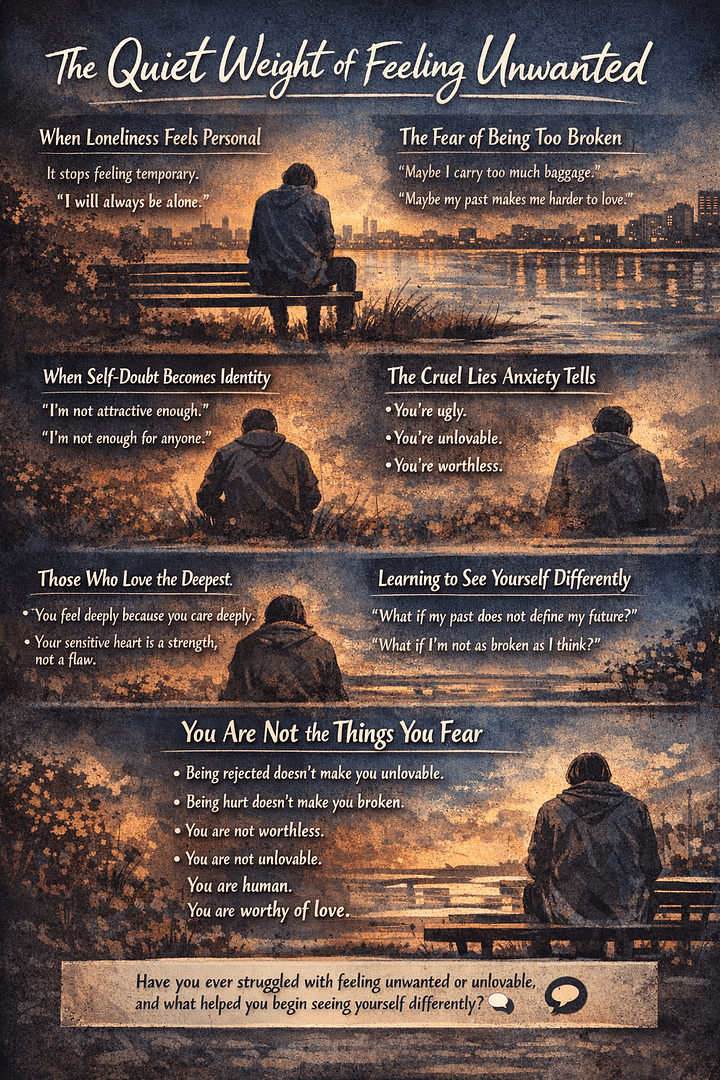
There are some emotions that people talk about openly—stress, heartbreak, disappointment. But there are other feelings that live quietly beneath the surface, rarely spoken aloud. One of the heaviest of these is the anxiety of believing you are unwanted.
It is not just the fear of being single or alone for a period of time. It is something deeper and more personal. It is the haunting thought that maybe people simply do not choose you. That maybe, no matter how much you care or how much love you are willing to give, you will somehow always be the one left behind.
This kind of anxiety can shape the way a person sees themselves and the world around them. Over time, it can quietly rewrite a person’s inner story—turning moments of disappointment into proof that something must be wrong with them.
And once that belief takes root, it can be incredibly difficult to let go.
When Loneliness Feels Personal
Loneliness is a universal human experience. Everyone feels it at times. But when someone struggles with the anxiety of being unwanted, loneliness becomes something much more painful.
It stops feeling temporary.
Instead of thinking, I’m alone right now, the thought becomes, I will always be alone.
Simple moments can trigger this feeling. A message that goes unanswered. Being the one who always reaches out first. Watching others find love and connection while you stand quietly on the outside.
These moments might seem small to others, but to someone already battling these fears, they reinforce a painful belief: that they are somehow not enough.
It can feel like standing in a crowded room yet still feeling invisible.
The Fear of Being Too Broken
Many people who struggle with these thoughts begin to see themselves as damaged or broken. They look at their past—the heartbreaks, the rejections, the moments where they opened their heart and were hurt—and they begin to believe those experiences have permanently changed them.
They wonder if others can somehow see the cracks.
They may think:
Maybe I carry too much baggage.
Maybe my past makes me harder to love.
Maybe people can tell I’m broken.
This belief can create a painful cycle. Because someone who feels broken may start to pull away from opportunities for connection. They may avoid expressing their feelings. They may hide parts of themselves to avoid rejection.
In trying to protect their heart, they sometimes build walls around it.
But those walls can also keep love from reaching them.
When Self-Doubt Becomes Identity
Anxiety has a powerful way of repeating certain thoughts until they begin to feel like facts. Over time, these thoughts stop sounding like fears and start sounding like truth.
A person might begin telling themselves things like:
I’m not attractive enough.
I’m not interesting enough.
I’m too much for people.
I’m not enough for anyone.
Eventually, those thoughts form a painful identity. A person no longer just feels unworthy—they begin to believe that they are unworthy.
This can affect every part of life. Compliments are brushed off. Kindness feels suspicious. When someone shows interest, it can feel confusing or even unbelievable.
Deep down, the mind is waiting for the moment when the person leaves, because that is what it has come to expect.
The Invisible Battle
One of the most difficult parts of this kind of anxiety is that it is often invisible to others. On the outside, someone might appear strong, kind, even confident.
They may laugh with friends, go to work, and carry on with daily life.
But inside, there is a quiet battle happening every day.
They may constantly question themselves:
Did I say something wrong?
Do they actually want me around?
Am I just tolerated instead of loved?
It is exhausting to live with a mind that constantly doubts your own worth.
The Cruel Lies Anxiety Tells
Anxiety has a way of turning past pain into present fear. It takes a few moments of rejection and stretches them into a permanent story about who you are.
But the things anxiety tells you are often deeply unfair.
It may say you are ugly when beauty is subjective and far more complex than appearance.
It may say you are unlovable when the truth is that love often depends on timing, compatibility, and circumstances far beyond your control.
It may say you are worthless when your value as a human being has nothing to do with how others treat you.
The mind can be incredibly convincing—but it is not always accurate.
The People Who Feel the Most Are Often the Ones Who Love the Deepest
There is a quiet irony in this struggle.
Many people who feel unlovable are the ones capable of loving the most deeply.
They notice the small details about others. They care about people’s feelings. They remember things that matter. They invest emotionally in ways that others sometimes overlook.
Their sensitivity, which sometimes feels like a flaw, is actually one of their greatest strengths.
They feel deeply because they care deeply.
And in a world that often rushes past emotional connection, that kind of heart is rare.
Learning to See Yourself Differently
Healing from these beliefs does not happen quickly. When someone has spent years questioning their worth, it takes time to rewrite that inner narrative.
But change begins with small moments of self-awareness.
It begins with asking difficult but important questions:
What if the things I believe about myself are not actually true?
What if I have been measuring my worth by the wrong standards?
What if my past does not define my future?
Sometimes the first step is simply recognizing that the harsh voice in your head is not an objective judge of your value.
It is a voice shaped by hurt.
And hurt can be healed.
You Are Not the Things You Fear
Being rejected does not make you unlovable.
Being hurt does not make you broken.
Feeling alone does not mean you will always be alone.
The truth is that every person carries invisible struggles. Many people who appear confident or loved have battled the same doubts in quiet moments.
Human beings are far more fragile—and far more resilient—than we often realize.
Your story is not finished. Your worth is not determined by the people who failed to see it.
You are not ugly because someone did not choose you.
You are not worthless because someone walked away.
And you are not unlovable simply because you have not yet found the person who sees you clearly.
Sometimes the hardest thing to believe is also the most important truth:
You are not broken.
You are human.
And that alone makes you worthy of love, connection, and belonging.
Leave a Reply