Category: History & Culture

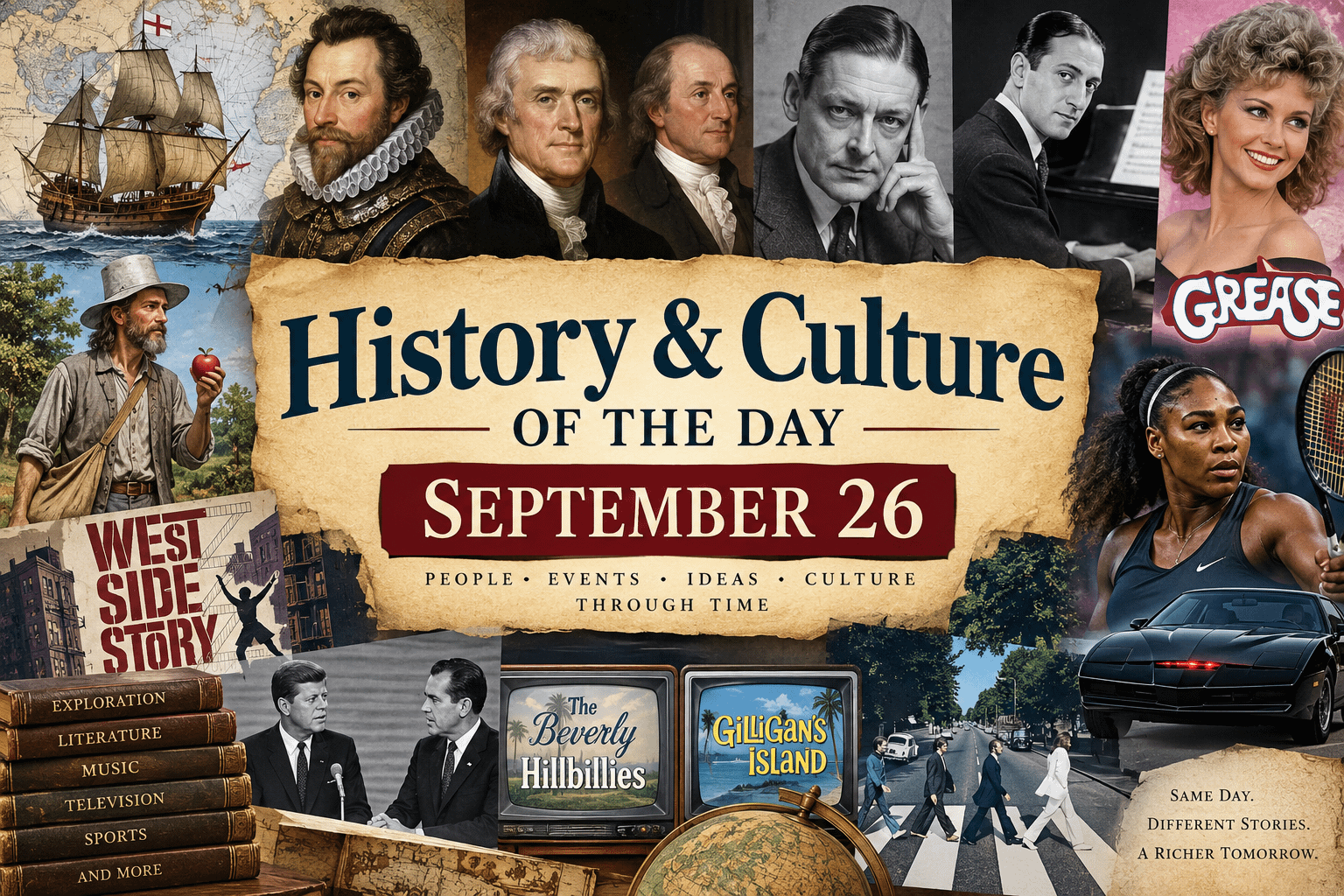
  • History & Culture of the Day: September 26

    History & Culture of the Day: September 26

    September 26 is a date filled with moments that have influenced politics, entertainment, music, literature, technology, and popular culture. Like every day on the calendar, its history is not defined by one event. Instead, it represents a collection of discoveries, milestones, famous births, cultural shifts, and memories that connect different generations.

    From groundbreaking developments in science to television programs that became part of American culture, September 26 offers plenty to explore.

    Here is a look at some of the history and culture connected to September 26.

    1580 — Francis Drake Completes His Circumnavigation

    One of the earliest major historical events associated with September 26 occurred in 1580, when English explorer Francis Drake returned to England after completing a voyage around the world.

    Drake’s expedition had begun in 1577.

    Although his journey included conflict, privateering, and actions that remain part of a complicated historical legacy, the voyage itself became a major achievement in European maritime history.

    Drake became the first Englishman to complete a circumnavigation of the globe.

    His expedition also demonstrated how rapidly European nations were expanding their knowledge of global geography, navigation, trade routes, and ocean travel during the 16th century.

    The voyage occurred during an era when maritime exploration was dramatically changing international trade and relations between nations.

    1774 — Johnny Appleseed Is Born

    John Chapman, better known to generations of Americans as Johnny Appleseed, was born on September 26, 1774.

    Over time, Chapman became one of America’s most recognizable folk figures.

    The popular image of Johnny Appleseed depicts a wandering man traveling across the frontier and casually scattering apple seeds wherever he went.

    The real story was somewhat different.

    Chapman established apple nurseries in parts of Pennsylvania, Ohio, Indiana, Illinois, and other frontier areas. He planted seeds, cared for nurseries, and sold or transferred trees and land.

    His life eventually became intertwined with American folklore.

    Stories portrayed him as gentle, generous, deeply connected to nature, and committed to helping settlers.

    The legend grew so powerful that Johnny Appleseed eventually became more than a historical person. He became a symbol of American frontier culture.

    1789 — Thomas Jefferson Is Appointed Secretary of State

    September 26 also played a role in the development of the young United States government.

    In 1789, President George Washington appointed Thomas Jefferson as the nation’s first Secretary of State.

    The newly created federal government was still determining how its departments would operate and how the United States would conduct relations with other nations.

    Jefferson would become one of the most influential figures in early American political history.

    His appointment helped establish a position that remains central to American foreign policy and diplomacy today.

    1789 — John Jay Becomes the First Chief Justice

    The same day also brought another important appointment.

    George Washington nominated John Jay to become the first Chief Justice of the United States.

    The Supreme Court was a new institution created under the Constitution, and its exact role within the federal government would continue evolving over the following decades.

    Jay’s appointment placed him at the beginning of a judicial institution that would eventually become one of the most influential courts in the world.

    September 26, 1789, therefore stands out as an important date in the formation of America’s early federal institutions.

    1888 — T. S. Eliot Is Born

    Poet, playwright, critic, and editor T. S. Eliot was born on September 26, 1888, in St. Louis, Missouri.

    Eliot became one of the most influential literary figures of the 20th century.

    His works included The Waste Land, The Love Song of J. Alfred Prufrock, Four Quartets, and Murder in the Cathedral.

    His writing frequently explored themes involving isolation, spirituality, modern life, identity, memory, and the passage of time.

    Eliot’s influence extended far beyond poetry.

    His essays and literary criticism helped shape discussions about literature for generations of students, writers, and scholars.

    In 1948, he received the Nobel Prize in Literature.

    1898 — George Gershwin Is Born

    September 26 also marks the birthday of one of America’s great composers.

    George Gershwin was born in Brooklyn, New York, on September 26, 1898.

    Gershwin became known for combining elements of classical music, jazz, popular music, and Broadway.

    His compositions included “Rhapsody in Blue,” “An American in Paris,” and the opera “Porgy and Bess.”

    Together with his brother Ira Gershwin, he also created songs that became standards of American popular music.

    George Gershwin’s career was relatively short—he died in 1937 at only 38 years old—but his musical influence has lasted for generations.

    His work remains an important bridge between American classical traditions and the emerging sounds of jazz and popular entertainment.

    1948 — Olivia Newton-John Is Born

    Singer and actress Olivia Newton-John was born on September 26, 1948.

    Her career would eventually make her one of the most recognizable entertainers of the 1970s and 1980s.

    For many people, she will forever be associated with the role of Sandy Olsson in the 1978 movie Grease, opposite John Travolta.

    The movie became a cultural phenomenon.

    Songs including “You’re the One That I Want,” “Summer Nights,” and “Hopelessly Devoted to You” became closely associated with the film and remain familiar decades later.

    Newton-John also enjoyed enormous success as a recording artist.

    Her 1981 song “Physical” became one of the defining pop hits of the early 1980s.

    Later in life, she became known for advocacy connected to cancer research and wellness following her own experiences with breast cancer.

    She died in 2022 at the age of 73.

    1957 — West Side Story Opens on Broadway

    One of the most influential musicals in American theater history opened on Broadway on September 26, 1957.

    West Side Story transformed Shakespeare’s Romeo and Juliet into a story set in 1950s New York City.

    The musical featured music by Leonard Bernstein, lyrics by Stephen Sondheim, choreography by Jerome Robbins, and a book by Arthur Laurents.

    Songs including “Maria,” “Tonight,” “America,” and “Somewhere” became theater classics.

    The musical also addressed serious social themes involving immigration, prejudice, neighborhood conflict, violence, identity, and young love.

    A 1961 film adaptation became enormously successful and won 10 Academy Awards, including Best Picture.

    Another film adaptation, directed by Steven Spielberg, was released in 2021.

    More than half a century after its Broadway debut, West Side Story continues to be performed and studied around the world.

    1960 — The First Televised U.S. Presidential Debate

    September 26, 1960, became an important date in television and political history when John F. Kennedy and Richard Nixon participated in the first of their nationally televised general-election presidential debates.

    Television had already become increasingly important in American homes, but the debate demonstrated just how influential the medium could become in national politics.

    Millions of Americans watched.

    The event helped establish televised debates as a major feature of modern presidential campaigns.

    It also highlighted a broader cultural transformation.

    Political communication was no longer shaped only by newspapers, radio broadcasts, speeches, and rallies. Television allowed voters to watch candidates respond to one another in real time.

    Future campaigns would increasingly recognize that presentation, imagery, and television performance had become important components of political communication.

    1962 — The Beverly Hillbillies Premieres

    On September 26, 1962, American television audiences were introduced to the Clampett family when The Beverly Hillbillies premiered on CBS.

    The show’s premise was simple.

    A poor rural family discovers oil on its land, becomes incredibly wealthy, and moves to Beverly Hills.

    The cultural differences between the Clampetts and their wealthy California neighbors created much of the show’s comedy.

    Despite receiving mixed reactions from some critics, audiences embraced it.

    The Beverly Hillbillies became one of the most popular television programs of the 1960s and remained on the air until 1971.

    Its characters—including Jed Clampett, Granny, Elly May, and Jethro—became recognizable pieces of American television culture.

    1964 — Gilligan’s Island Premieres

    Two years later, September 26 brought another television premiere that would become part of pop-culture history.

    Gilligan’s Island debuted on CBS on September 26, 1964.

    The premise centered around seven people stranded on an island after what was supposed to be a short boat excursion.

    The passengers and crew included Gilligan, the Skipper, a millionaire and his wife, a movie star, a professor, and Mary Ann.

    Although the original series lasted only three seasons, something unusual happened afterward.

    Reruns gave the show a second life.

    Generations who weren’t alive during its original broadcast discovered Gilligan’s Island through syndicated television.

    Its theme song became instantly recognizable, its characters became cultural stereotypes, and the show’s premise was repeatedly referenced and parodied in movies, television programs, cartoons, and comedy.

    It demonstrates how a television show’s cultural impact isn’t always determined by the length of its original run.

    1969 — The Beatles Release Abbey Road in the United Kingdom

    September 26, 1969, brought one of the most famous albums in popular music history.

    The Beatles released Abbey Road in the United Kingdom.

    The album included songs such as “Come Together,” “Something,” “Here Comes the Sun,” and “Octopus’s Garden.”

    Its second side became especially famous for a sequence of interconnected songs often referred to as the Abbey Road medley.

    The album’s cover became almost as famous as the music.

    John Lennon, Ringo Starr, Paul McCartney, and George Harrison were photographed walking across a pedestrian crossing outside Abbey Road Studios in London.

    That simple photograph became one of the most recreated album covers ever made.

    Fans continue visiting the location decades later.

    Abbey Road arrived near the end of The Beatles’ time together and has become one of the defining recordings of their career.

    1981 — Serena Williams Is Born

    Tennis champion Serena Williams was born on September 26, 1981, in Saginaw, Michigan.

    Along with her sister Venus Williams, Serena transformed women’s tennis and became one of the most prominent athletes of her generation.

    During her career, Serena won 23 Grand Slam singles titles.

    Her combination of power, athleticism, determination, and longevity helped reshape expectations in women’s tennis.

    Her cultural influence also extended beyond sports.

    Williams became involved in fashion, business, philanthropy, and discussions surrounding opportunities for women and athletes.

    Her career introduced countless young people around the world to tennis and helped make the Williams family one of the most famous families in sports.

    1982 — Knight Rider Premieres

    September 26, 1982, introduced television audiences to a talking car that would become an unmistakable symbol of 1980s pop culture.

    Knight Rider starred David Hasselhoff as Michael Knight.

    But the show’s other star wasn’t human.

    It was KITT—the Knight Industries Two Thousand—a technologically advanced Pontiac Trans Am equipped with artificial intelligence.

    KITT could communicate with Michael, analyze situations, and perform extraordinary driving maneuvers.

    At a time when home computers and emerging technologies were capturing the public imagination, the idea of an intelligent car felt futuristic.

    Decades later, technologies such as voice assistants, navigation systems, driver-assistance features, and increasingly sophisticated automotive computers make parts of the show’s fictional technology seem surprisingly familiar.

    September 26 and the Evolution of Entertainment

    Looking across the history of September 26 reveals an interesting concentration of entertainment milestones.

    George Gershwin helped define American music.

    West Side Story changed musical theater.

    The Beverly Hillbillies and Gilligan’s Island became television classics.

    The Beatles released one of rock music’s most celebrated albums.

    Knight Rider brought futuristic technology into living rooms.

    Olivia Newton-John became part of multiple generations’ musical memories.

    These events represent different eras, but together they illustrate how culture continuously evolves.

    Broadway gave way to television as a dominant form of entertainment. Television existed alongside rock and pop music. Eventually, cable television, home video, computers, streaming services, smartphones, and social media would transform entertainment again.

    Yet many of the cultural works created decades ago remain recognizable.

    People still perform West Side Story.

    People still listen to Abbey Road.

    People still recognize the Gilligan’s Island theme song.

    People still watch Grease.

    Great entertainment has a way of surviving the technology that originally delivered it.

    The Power of Popular Culture

    History isn’t limited to wars, elections, laws, and political leaders.

    Popular culture tells us something about the people living through a particular era.

    The television shows people watched, songs they played, books they read, athletes they followed, and movies they loved become pieces of shared memory.

    Sometimes a song instantly transports someone back decades.

    A television theme can remind someone of sitting in a childhood living room.

    An old movie can remind someone of a parent or grandparent.

    A sporting event can remind an entire generation where they were when it happened.

    That is why cultural history deserves to be remembered alongside traditional historical events.

    Culture helps tell the human side of history.

    A Day Connecting Different Generations

    Perhaps the most interesting thing about September 26 is how many generations can find something familiar within its history.

    Someone interested in early exploration might remember Francis Drake.

    Those interested in American folklore can explore the real story behind Johnny Appleseed.

    Literature lovers can celebrate T. S. Eliot.

    Music lovers can remember George Gershwin or The Beatles.

    Classic television fans have The Beverly Hillbillies and Gilligan’s Island.

    Fans of 1980s television remember Knight Rider.

    Sports fans can celebrate Serena Williams.

    Movie fans may immediately think about Olivia Newton-John and Grease.

    Each represents a different chapter of cultural history.

    Final Thoughts

    September 26 reminds us that history is happening constantly.

    Some events immediately appear significant. Others only reveal their importance years later.

    When Gilligan’s Island premiered, no one could have known that people would still recognize its characters generations later.

    When The Beatles photographed themselves crossing Abbey Road, few could have predicted that fans would recreate the photograph more than half a century later.

    When Serena Williams was born in 1981, no one knew that she would grow up to become one of the most celebrated tennis players in history.

    That uncertainty is part of what makes exploring history so fascinating.

    The ordinary day we are living through right now could eventually contain a moment future generations remember.

    September 26 has given history explorers plenty to rediscover—from exploration and American folklore to literature, Broadway, television, music, sports, and changing technology.

    Which September 26 moment brings back the strongest memory for you—or which piece of history did you just discover for the first time?
  • This Day in American History — September 26

    This Day in American History — September 26

    Every date on the calendar carries pieces of America’s story, but September 26 connects several especially significant chapters. On this date, British troops marched into the revolutionary capital of Philadelphia, American forces began their largest operation of World War I, television entered presidential campaigning in an unprecedented way, and Americans who influenced culture, exploration, sports, and entertainment were born.

    Here is a journey through some of the most memorable events associated with September 26 in American history.

    1774 — Johnny Appleseed Is Born

    On September 26, 1774, John Chapman, better known to generations of Americans as Johnny Appleseed, was born in Leominster, Massachusetts.

    Over time, Chapman became one of the most recognizable folk figures connected with the early American frontier.

    But Johnny Appleseed was more than a character from legends and children’s stories.

    As settlers moved westward, Chapman traveled through areas that became parts of Ohio, Indiana, Pennsylvania, and surrounding regions. Rather than simply scattering apple seeds randomly, he established nurseries where apple trees could grow.

    The Library of Congress notes that Chapman planted nurseries and individual apple trees across a vast area of the Midwest. His work helped settlers establish orchards as communities expanded westward.

    His life eventually became surrounded by folklore. Stories often portray him wandering barefoot through the wilderness with a bag of apple seeds, peacefully planting trees wherever he traveled.

    While those stories sometimes exaggerate the details, they reflect something genuine about his legacy.

    Johnny Appleseed became a symbol of the American frontier — representing simplicity, generosity, perseverance, and the transformation of wilderness into growing communities.

    More than two centuries after his birth, his nickname remains familiar throughout the United States.

    1777 — British Forces Occupy Philadelphia

    September 26, 1777, brought a far more serious moment during the American Revolution.

    British troops marched into Philadelphia, then the political center of the American revolutionary movement.

    Earlier that month, General George Washington and the Continental Army had attempted to stop British forces at the Battle of Brandywine on September 11.

    The Americans were defeated.

    With the British advancing toward Philadelphia, members of the Continental Congress were forced to leave the city. Congress briefly met in Lancaster before relocating to York, Pennsylvania.

    Then, on September 26, British troops entered Philadelphia.

    The occupation represented a symbolic victory for Britain. Philadelphia was one of the largest and most important cities in the colonies and had been the location where the Declaration of Independence was adopted.

    But capturing Philadelphia did not end the Revolution.

    The Continental Congress continued functioning elsewhere, and Washington’s army remained intact.

    The British eventually abandoned Philadelphia in June 1778 as the strategic situation changed following the American alliance with France.

    The episode demonstrated an important reality of the Revolutionary War: capturing an important American city did not necessarily mean defeating the revolutionary movement.

    1786 — Shays’ Rebellion Intensifies in Massachusetts

    September 26 is also associated with the unrest known as Shays’ Rebellion.

    During the years following the Revolutionary War, many farmers faced serious economic difficulties. Taxes, debt and court actions created growing resentment in parts of Massachusetts.

    Groups of protesters began attempting to prevent courts from hearing debt and foreclosure cases.

    The movement became associated with Daniel Shays, a Revolutionary War veteran who eventually emerged as one of its best-known leaders.

    The rebellion exposed weaknesses in the government established under the Articles of Confederation.

    The national government had limited power to raise money, maintain forces and respond effectively to major domestic disturbances.

    Although Shays’ Rebellion was ultimately suppressed, the crisis contributed to a broader debate over whether the United States needed a stronger federal government.

    The following year, delegates gathered in Philadelphia for the Constitutional Convention of 1787.

    The rebellion therefore became part of the larger story leading toward the creation of the United States Constitution.

    1914 — The Federal Trade Commission Is Established

    On September 26, 1914, President Woodrow Wilson signed the Federal Trade Commission Act.

    The legislation created the Federal Trade Commission, commonly known as the FTC.

    The agency became an important part of the federal government’s efforts to address unfair methods of competition and, as its responsibilities developed, protect consumers.

    The creation of the FTC reflected changes occurring throughout the United States during the Progressive Era.

    Industrialization had created enormous companies and transformed the American economy. At the same time, concerns grew about monopolies, deceptive business practices and the concentration of economic power.

    Federal regulation expanded as lawmakers attempted to establish rules for increasingly complex national markets.

    More than a century later, the Federal Trade Commission remains part of the federal government’s consumer-protection and competition framework.

    1918 — The Meuse-Argonne Offensive Begins

    One of the largest military operations in American history began on September 26, 1918.

    At approximately 5:30 in the morning, American forces launched the Meuse-Argonne Offensive in France during World War I.

    The operation became the largest campaign undertaken by the American Expeditionary Forces during the war.

    American troops attacked German positions between the Argonne Forest and the Meuse River northwest of Verdun.

    The battlefield was extremely difficult.

    German forces had spent years constructing defensive positions throughout the region. American soldiers faced machine guns, artillery, fortified positions, forests, hills and enormous logistical challenges.

    More than one million American troops ultimately participated in the campaign.

    The fighting continued for 47 days, from September 26 until the armistice took effect on November 11, 1918.

    The human cost was enormous.

    According to the National Archives, more than 26,000 American soldiers were killed during the campaign, with total American casualties exceeding 120,000.

    Despite those losses, American forces continued pushing German defenses backward.

    The Meuse-Argonne Offensive became a major American contribution to the final Allied operations that helped bring World War I to an end.

    Today, thousands of American service members who died during the campaign are buried at the Meuse-Argonne American Cemetery in France.

    September 26 therefore marks the beginning of one of the largest and deadliest military campaigns ever fought by American forces.

    1945 — An American OSS Officer Is Killed in Vietnam

    Another lesser-known event occurred on September 26, 1945.

    Lt. Col. Peter Dewey, an officer with the American Office of Strategic Services, was killed in Saigon during the turbulent period following Japan’s surrender at the end of World War II.

    Dewey had been leading an OSS team tasked with gathering intelligence and locating missing American personnel.

    His death occurred years before the United States became deeply involved militarily in Vietnam.

    Because of that timing, Dewey is sometimes described as the first American serviceman killed in circumstances connected to the conflict that eventually developed into the Vietnam War.

    His death illustrates how complicated the political situation in Southeast Asia had already become immediately after World War II.

    1957 — “West Side Story” Opens on Broadway

    American history isn’t only shaped by wars, politics and government.

    Culture matters too.

    On September 26, 1957, West Side Story opened at the Winter Garden Theatre on Broadway.

    The musical featured music by Leonard Bernstein, lyrics by Stephen Sondheim, a book by Arthur Laurents, and choreography associated with Jerome Robbins.

    Inspired by Shakespeare’s Romeo and Juliet, the story transported the basic tragedy into mid-20th-century New York City.

    Its story of rival street gangs, love, prejudice, immigration and violence helped distinguish it from many earlier Broadway musicals.

    Songs from the production became enduring parts of American musical theater, and West Side Story later reached even larger audiences through film adaptations.

    Decades later, it remains one of the best-known works in American musical theater.

    1960 — Kennedy and Nixon Meet in a Historic Televised Debate

    Perhaps the best-known American event associated with September 26 occurred in 1960.

    Democratic presidential nominee John F. Kennedy and Republican presidential nominee Richard Nixon met in Chicago for the first of four debates during the 1960 presidential campaign.

    The September 26 event became historically important because it was the first nationally televised general-election presidential debate.

    Television had already transformed American entertainment and news.

    Now it was transforming presidential politics.

    Millions of Americans could watch the candidates answer questions and compare not only what they said but how they presented themselves.

    The debate focused primarily on domestic issues and lasted roughly an hour.

    Kennedy and Nixon would participate in three additional debates before Election Day.

    Kennedy ultimately won the November 1960 election by a very narrow popular-vote margin.

    The debates demonstrated television’s growing importance in American political communication.

    From that point forward, a candidate’s ability to communicate through television increasingly became part of modern campaigning.

    Presidential debates later returned in 1976 and have remained an important feature of many presidential campaigns since.

    1983 — America Loses the America’s Cup

    September 26, 1983, also produced a major moment in American sports history.

    For more than a century, the United States had dominated the America’s Cup, one of international sailing’s most prestigious competitions.

    The winning streak stretched back to 1851.

    Then came Australia II.

    On September 26, 1983, the Australian yacht defeated the American yacht Liberty in the deciding race off Newport, Rhode Island.

    Australia II won the race by just 41 seconds.

    The victory ended the longest winning streak in the history of the competition.

    After 132 years of American control, the America’s Cup was leaving the United States.

    The result became one of the most celebrated moments in Australian sporting history while marking the end of an extraordinary era of American dominance.

    1986 — William Rehnquist Becomes Chief Justice

    On September 26, 1986, William H. Rehnquist was sworn in as the 16th Chief Justice of the United States.

    That same day, Antonin Scalia joined the Supreme Court as an associate justice.

    Both appointments would influence American constitutional law for years.

    Rehnquist remained chief justice until his death in 2005, while Scalia served on the Supreme Court until his death in 2016.

    Their service placed September 26 among the noteworthy dates in the institutional history of the United States Supreme Court.

    1990 — The NC-17 Movie Rating Is Introduced

    American popular culture experienced another change on September 26, 1990.

    The Motion Picture Association announced the NC-17 rating, replacing the controversial X rating within its film-rating system.

    The change attempted to distinguish mainstream films intended strictly for adults from pornography, which had become strongly associated with the X designation.

    The new rating meant that children 17 and younger would not be admitted.

    Although the rating remained controversial among filmmakers, theaters and studios, its creation became another chapter in America’s long-running debate over movies, artistic expression, censorship and age restrictions.

    1991 — Biosphere 2 Begins Its Closed Mission

    On September 26, 1991, eight people entered Biosphere 2 in Arizona to begin an ambitious experiment.

    The enormous enclosed structure was designed to simulate a largely self-contained ecological system.

    Inside were environments representing several ecosystems as well as agricultural areas intended to provide food.

    The participants attempted to live inside the facility for two years while relying heavily on the closed environment around them.

    The experiment encountered serious challenges, including declining oxygen levels and ecological problems.

    Although Biosphere 2 did not function exactly as originally envisioned, the project generated valuable discussion and research concerning closed ecological systems, sustainability and how humans interact with their environment.

    The facility later became associated with scientific research and education.

    2022 — NASA Successfully Alters an Asteroid’s Orbit

    September 26 gained another place in American scientific history in 2022.

    NASA’s Double Asteroid Redirection Test, better known as DART, deliberately crashed a spacecraft into the asteroid moonlet Dimorphos.

    The mission was designed to test whether humanity could intentionally alter an asteroid’s motion.

    It worked.

    Follow-up observations confirmed that the impact changed Dimorphos’ orbital period around its larger companion asteroid, Didymos.

    The mission represented the first demonstration of a planetary-defense technique involving the deliberate deflection of an asteroid.

    No asteroid involved in the test threatened Earth.

    Instead, DART was an experiment designed to answer an important question:

    Could humanity potentially change the trajectory of a dangerous asteroid if one were someday discovered heading toward Earth?

    The successful test provided scientists with valuable information that could help shape future planetary-defense strategies.

    Notable Americans Born on September 26

    September 26 is also the birthday of several influential figures.

    George Gershwin, born in 1898, became one of America’s most celebrated composers. His music blended elements of classical composition, jazz and popular American music. Works such as Rhapsody in Blue helped define a distinctly American musical sound.

    T. S. Eliot, born in 1888 in St. Louis, became one of the most influential poets of the 20th century and later received the Nobel Prize in Literature.

    Serena Williams, born September 26, 1981, became one of the most accomplished tennis players in history. Her career included 23 Grand Slam singles titles and helped reshape women’s professional tennis.

    And, of course, John Chapman — Johnny Appleseed — was born on September 26, 1774, eventually becoming one of America’s enduring frontier legends.

    Remembering September 26

    Few dates demonstrate the variety of American history better than September 26.

    On this date, British soldiers occupied Philadelphia during America’s struggle for independence.

    Farmers challenged economic and political conditions during the era of Shays’ Rebellion.

    The federal government expanded its role in regulating commerce.

    More than a million American soldiers participated in a massive World War I offensive.

    Broadway welcomed one of its most enduring musicals.

    Television transformed presidential campaigning.

    A 132-year American sailing streak came to an end.

    Scientists sealed people inside an experimental artificial ecosystem.

    And NASA deliberately struck an asteroid millions of miles from Earth to test whether humanity might someday defend the planet from a dangerous object.

    These events seem unrelated, yet together they illustrate the extraordinary range of the American story.

    American history isn’t contained only in famous wars or presidential administrations. It can be found in science, music, exploration, sports, political institutions, technological change and the lives of ordinary people facing extraordinary circumstances.

    September 26 reminds us that history is constantly being created — sometimes on battlefields, sometimes in laboratories, sometimes on television screens, and sometimes through people whose actions aren’t fully understood until generations later.

    Which September 26 moment in American history do you find the most interesting?

  • History & Culture of the Day – September 25

    History & Culture of the Day – September 25

    September 25 is a day filled with fascinating moments from world history, cultural change, exploration, scientific development, entertainment, and human achievement. Like every date on the calendar, September 25 offers a chance to look backward and discover how events from different generations helped create the world we know today.

    Some events associated with this date changed governments and nations. Others influenced transportation, communication, music, entertainment, and popular culture. September 25 is also the birthday of several people whose work left lasting marks on society.

    History is more than memorizing dates. It is the story of people making decisions, taking risks, confronting challenges, creating new ideas, and sometimes changing the course of civilization without realizing how significant their actions would eventually become.

    Here is a look at some of the history and culture connected with September 25.

    1513 – Vasco Núñez de Balboa Reaches the Pacific

    One of the most significant events associated with September 25 occurred in 1513, during the age of European exploration.

    Spanish explorer Vasco Núñez de Balboa crossed the Isthmus of Panama and became the first European known to have seen the Pacific Ocean from the Americas.

    Balboa had heard stories about another great body of water beyond the mountains of Panama. He organized an expedition and traveled through extremely difficult terrain.

    On September 25, he reportedly reached a mountain summit where he could see the enormous body of water stretching into the distance.

    He called it the “South Sea.”

    Years later, Portuguese explorer Ferdinand Magellan would give the ocean the name by which we know it today: the Pacific.

    Balboa’s expedition represented an important moment in European understanding of the geography of the Americas. Europeans were gradually realizing just how enormous the newly encountered continents were—and that another vast ocean separated the Americas from Asia.

    The event also represents the complicated legacy of the Age of Exploration.

    European expeditions expanded geographical knowledge and created new global connections, but they were also followed by conquest, colonization, exploitation, disease, and enormous suffering among Indigenous populations.

    Understanding both sides of that history gives us a more complete picture of how exploration reshaped the world.

    1690 – One of America’s Earliest Newspapers Appears

    September 25 also has an interesting connection to the history of journalism.

    On September 25, 1690, Publick Occurrences Both Forreign and Domestick was published in Boston.

    It is generally recognized as the first multi-page newspaper published in the English colonies of North America.

    There was one major problem.

    Colonial authorities had not approved it.

    The newspaper contained reports about local and international events, and officials quickly ordered its suppression. Only one edition was published.

    Although its life was extraordinarily short, the publication became an important milestone in American journalism.

    It also foreshadowed a debate that would continue throughout American history: How much freedom should journalists have to report information that governments or powerful institutions would prefer to control?

    Decades later, freedom of the press would become one of the fundamental principles protected by the First Amendment to the United States Constitution.

    Today, news travels around the world almost instantly through websites, social media, television, podcasts, and smartphones.

    The contrast with 1690 is remarkable.

    A newspaper that could be shut down after a single issue helped represent the beginning of a media tradition that would eventually become a central part of American culture.

    1789 – Congress Proposes the Bill of Rights

    One of the most important political developments associated with September 25 occurred in 1789.

    The First Congress of the United States approved twelve proposed amendments to the Constitution and sent them to the states for ratification.

    Ten of those amendments were eventually ratified in 1791.

    They became known collectively as the Bill of Rights.

    These amendments established protections that remain central to American political and legal culture.

    Among them are protections involving freedom of speech, freedom of religion, freedom of the press, peaceful assembly, due process, criminal proceedings, and other individual rights.

    The Bill of Rights grew partly from concerns that the original Constitution did not provide enough explicit protection for individual liberties.

    During debates over ratification of the Constitution, Anti-Federalists frequently argued that a bill of rights was necessary to protect citizens from potential abuses of federal power.

    The amendments sent to the states on September 25, 1789, were an answer to many of those concerns.

    More than two centuries later, Americans continue to debate exactly how these constitutional protections should be interpreted.

    That ongoing debate demonstrates how documents written centuries ago can continue influencing everyday life.

    1890 – Yosemite National Park Moves Closer to Protection

    September 25, 1890, also played a role in the conservation history of the United States.

    Congress approved legislation associated with establishing Yosemite National Park, with the measure becoming law shortly afterward.

    The broader movement to protect Yosemite helped establish the idea that extraordinary natural landscapes should be preserved rather than simply developed or exploited.

    Yosemite would become one of America’s most famous national parks.

    Its towering granite cliffs, waterfalls, forests, giant sequoias, and dramatic valleys have inspired generations of visitors, photographers, artists, conservationists, and outdoor enthusiasts.

    Naturalist John Muir became one of the most famous advocates for protecting Yosemite and other wilderness areas.

    The conservation movement surrounding places like Yosemite helped change American attitudes toward wilderness.

    Instead of viewing untouched land solely as territory waiting for development, conservationists argued that certain places possessed ecological, cultural, and spiritual value that deserved protection for future generations.

    That philosophy eventually contributed to the growth of America’s national park system.

    1926 – Henry Ford Introduces the Eight-Hour, Five-Day Workweek

    September 25 also has a connection to an enormous cultural change in the American workplace.

    In 1926, the Ford Motor Company adopted a five-day, 40-hour workweek for many factory employees.

    At the time, six-day workweeks were common.

    The shift was significant because Ford was one of the country’s most influential industrial companies.

    Henry Ford understood something that went beyond factory production: workers were also consumers.

    Giving employees additional leisure time created more opportunities for people to travel, shop, enjoy entertainment, and participate in recreational activities.

    The five-day workweek was not created by Ford alone. Labor activists and unions had fought for shorter working hours for generations.

    But Ford’s decision helped demonstrate that a major industrial corporation could operate with a shorter workweek.

    Eventually, the idea of the five-day, 40-hour workweek became deeply embedded in American culture.

    That is why the concept of “the weekend” carries so much cultural importance today.

    Friday evening represents freedom for millions of workers because generations before them fought to reduce the amount of time people were expected to spend working.

    1956 – The First Transatlantic Telephone Cable Enters Service

    Imagine trying to call someone across the Atlantic Ocean before modern telecommunications.

    International communication could be difficult, expensive, and unreliable.

    That changed dramatically with technological advances during the twentieth century.

    On September 25, 1956, the first transatlantic telephone cable system, known as TAT-1, entered service.

    It connected North America and Europe through an underwater telecommunications cable.

    This represented an enormous improvement in international communication.

    Before submarine telephone cables, transatlantic telephone conversations relied heavily on radio technology.

    The cable offered more dependable communication and helped expand the number of conversations that could occur between continents.

    Today, international communication feels almost effortless.

    A person can send a message, participate in a video call, share photographs, or communicate through social media with someone thousands of miles away in seconds.

    TAT-1 belonged to an earlier technological revolution that helped make our interconnected world possible.

    1957 – Central High School and the Struggle for Integration

    September 25, 1957, became an important date in the American civil rights movement.

    Nine Black students entered Little Rock Central High School in Arkansas under the protection of federal troops.

    The students became known as the Little Rock Nine.

    Three years earlier, the Supreme Court had ruled in Brown v. Board of Education that racial segregation in public schools was unconstitutional.

    Yet implementing that ruling faced intense resistance in parts of the country.

    Arkansas Governor Orval Faubus had previously used the Arkansas National Guard to prevent the students from entering Central High.

    President Dwight D. Eisenhower eventually federalized the Arkansas National Guard and sent members of the 101st Airborne Division to Little Rock.

    On September 25, the nine students entered the school under military protection.

    The images became symbols of the struggle over school integration and civil rights.

    The courage of the Little Rock Nine remains an important part of American history.

    These teenagers were not simply attending classes. They were entering an environment where they faced hostility, harassment, threats, and intense public attention.

    Their experiences remind us that major social changes are often carried forward by individuals willing to endure extraordinary pressure.

    1965 – “Eve of Destruction” Reaches No. 1

    September 25 also has an interesting place in music history.

    In 1965, Barry McGuire’s protest song “Eve of Destruction” reached No. 1 on the Billboard Hot 100.

    The song reflected the anxieties of the 1960s.

    The Vietnam War was escalating. The Cold War created fears of nuclear conflict. Civil rights struggles were transforming American society. Younger generations were increasingly questioning political leaders and traditional institutions.

    Popular music became one of the places where those frustrations were expressed.

    Protest music was not simply entertainment.

    Songs became cultural statements.

    Artists used music to address war, racism, poverty, inequality, freedom, and political power.

    That tradition continues today.

    Musicians still respond to major social and political events, demonstrating that popular culture often acts as a mirror of the era in which it is created.

    1976 – U2 Begins to Take Shape

    September 25 also holds a special place in rock music history.

    In 1976, four teenagers gathered in Dublin after drummer Larry Mullen Jr. posted a notice seeking musicians for a band.

    Among those who joined were Paul Hewson, who would become known as Bono, David Evans, who became The Edge, and Adam Clayton.

    The group eventually became U2.

    Few people at that early rehearsal could have predicted what would follow.

    U2 grew into one of the world’s most successful and recognizable rock bands.

    Albums including The Joshua Tree, War, and Achtung Baby helped establish the band’s international reputation.

    Their music frequently explored subjects including faith, politics, conflict, human rights, love, and personal struggle.

    Their beginnings provide a wonderful reminder about creativity.

    Some of the world’s biggest cultural movements start very small.

    A notice asking for musicians can become a legendary rock band.

    A conversation can become a company.

    An idea written in a notebook can become a book.

    History is often created long before anyone realizes they are making it.

    1981 – Sandra Day O’Connor Becomes the First Woman on the Supreme Court

    September 25, 1981, marked another historic American milestone.

    Sandra Day O’Connor was sworn in as an associate justice of the United States Supreme Court.

    She became the first woman to serve on the nation’s highest court.

    President Ronald Reagan had nominated O’Connor earlier that year.

    Her confirmation represented a significant breakthrough for women in American law and government.

    For most of American history before that moment, the Supreme Court had been exclusively male.

    O’Connor’s appointment demonstrated how institutions that once seemed closed to certain groups could gradually change.

    She served on the Court until her retirement in 2006.

    Regardless of disagreements over individual Supreme Court decisions, the historical importance of her appointment remains clear.

    A barrier that had existed since the Supreme Court’s creation was finally broken.

    Famous People Born on September 25

    September 25 is also the birthday of several notable figures from entertainment, politics, sports, literature, and culture.

    One of the most famous is actor and filmmaker Michael Douglas, born in 1944. Douglas became one of Hollywood’s most recognizable actors, appearing in movies including Wall Street, Fatal Attraction, and Basic Instinct.

    Actor Will Smith was born on September 25, 1968. Smith first became widely known through music and television before developing into a major Hollywood movie star.

    Writer William Faulkner was born September 25, 1897. Faulkner became one of the most influential American writers of the twentieth century and received the Nobel Prize in Literature.

    Journalist and television personality Barbara Walters was born September 25, 1929. Her interviewing career helped reshape the role of women in American television journalism.

    Basketball legend Scottie Pippen was born September 25, 1965. Pippen became an essential member of the Chicago Bulls teams that dominated the NBA during much of the 1990s.

    Actor Catherine Zeta-Jones was born September 25, 1969—exactly 25 years after her husband, Michael Douglas.

    These birthdays demonstrate the remarkable range of people connected with a single date.

    How September 25 Connects Exploration, Rights, Technology, and Culture

    When we examine the events connected with September 25, several themes emerge.

    One is exploration.

    Balboa’s expedition represented humanity’s continuing desire to discover what exists beyond the horizon.

    Another is freedom.

    The publication and suppression of an early American newspaper reminds us of the long struggle over freedom of the press.

    The congressional approval of the amendments that became the Bill of Rights demonstrates the continuing importance of individual liberty.

    The Little Rock Nine remind us that rights written into law do not automatically become reality. Sometimes people must fight—and demonstrate extraordinary courage—to make those rights meaningful.

    September 25 is also about innovation.

    The transatlantic telephone cable helped connect continents.

    Changes in industrial working schedules contributed to the modern weekend.

    And cultural developments in music demonstrated how artists can give a voice to the concerns of their generation.

    Why Studying History and Culture Matters

    It is easy to think of history as something finished.

    It isn’t.

    History continues to influence almost everything around us.

    The freedoms we exercise, the technology we use, the places we protect, the music we listen to, the schools our children attend, and even the structure of the workweek have histories behind them.

    Understanding those histories gives everyday life greater meaning.

    The smartphone in your hand represents centuries of communication innovation.

    A weekend trip to a national park connects to generations of conservation efforts.

    Reading an uncensored news article connects to centuries of debate about freedom of the press.

    Students attending an integrated public school are connected to young people who once needed federal troops simply to enter their classrooms.

    History is never as distant as it appears.

    Final Thoughts

    September 25 offers an extraordinary journey through history and culture.

    It takes us from Balboa looking across the Pacific in 1513 to colonial printers challenging authority in 1690. It brings us to Congress proposing amendments that would become the Bill of Rights, conservation efforts surrounding Yosemite, the development of the modern workweek, breakthroughs in international communication, the courage of the Little Rock Nine, protest music of the 1960s, the beginnings of U2, and Sandra Day O’Connor breaking a historic barrier on the Supreme Court.

    Some moments changed governments.

    Others changed technology.

    Some changed culture.

    And others changed what future generations believed was possible.

    That is one of the greatest lessons history can teach us.

    The world we inherit is shaped by people who came before us—but the choices we make today become part of the history inherited by those who come after us.

    Which event from September 25 do you believe had the greatest impact on the world we live in today?

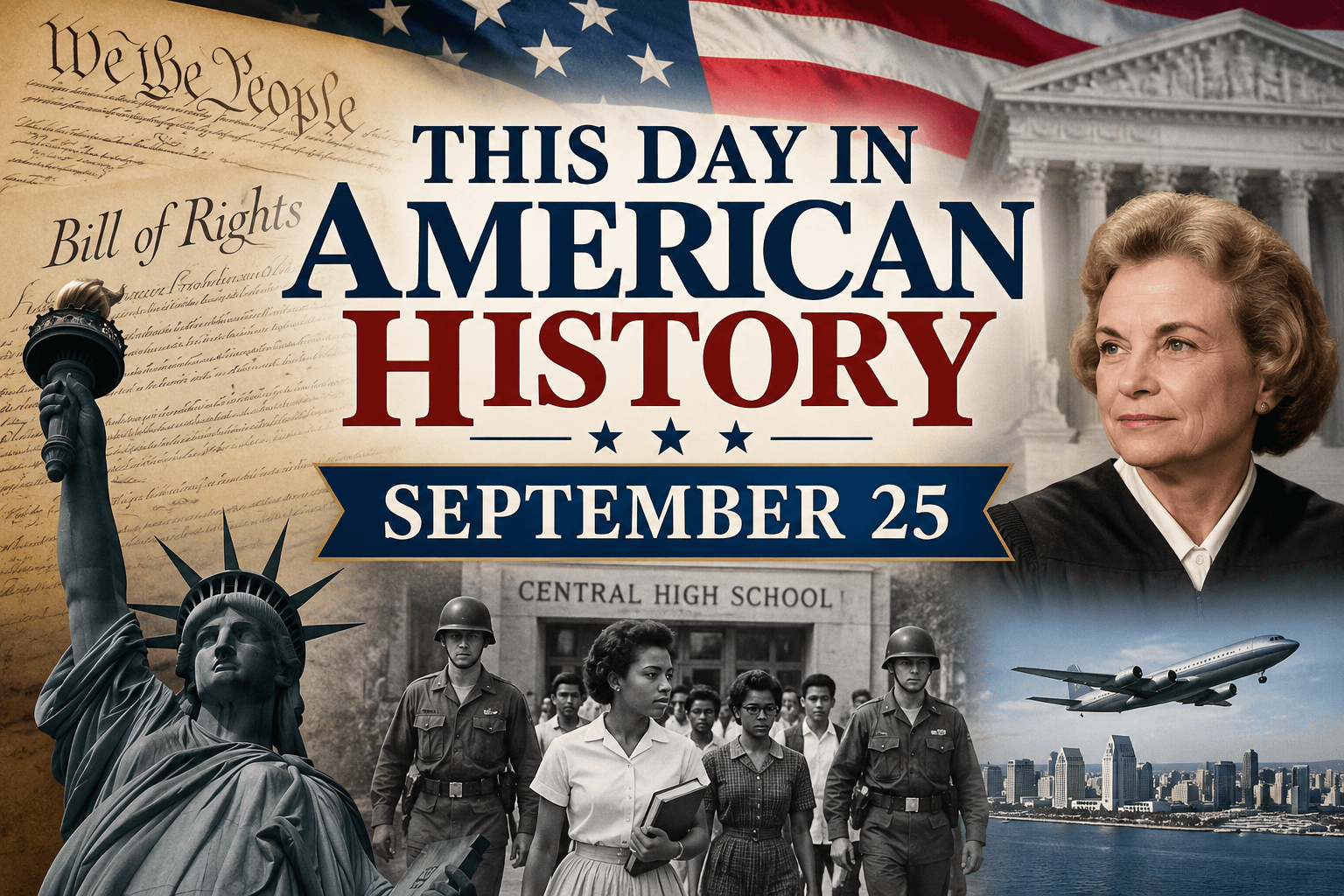
  • This Day in American History – September 25

    This Day in American History – September 25

    September 25 is a date connected to some of the most important themes in American history: individual liberty, constitutional government, civil rights, equality, tragedy, technological progress, and breaking barriers.

    Perhaps no event associated with September 25 is more foundational than the action taken by the First Congress in 1789. On this date, Congress approved 12 proposed amendments to the newly created United States Constitution and sent them to the states for ratification. Ten eventually became what Americans know today as the Bill of Rights.

    Nearly 170 years later, September 25 became another defining date in the continuing struggle to make the nation’s promises of equality a reality. On September 25, 1957, the Little Rock Nine entered Central High School in Little Rock, Arkansas, under the protection of federal troops.

    Then, in 1981, another barrier fell when Sandra Day O’Connor was sworn in as the first woman to serve on the United States Supreme Court.

    Together, these moments make September 25 a remarkable day for looking at how American ideals have developed—and how generations of Americans have struggled to make those ideals apply more fully.

    1789 – Congress Proposes the Bill of Rights

    One of the most consequential events in American constitutional history occurred on September 25, 1789.

    The Constitution had gone into effect earlier that year, establishing the framework for the new federal government. But the Constitution remained controversial.

    Many Americans feared that the federal government might eventually become too powerful. Memories of British rule and abuses of governmental authority before the American Revolution were still fresh. Critics of the Constitution wanted explicit protections for individual liberties.

    Several states had called for amendments protecting those rights during the Constitution’s ratification process.

    James Madison became one of the leading figures in turning those demands into constitutional amendments. He introduced proposed amendments in the House of Representatives on June 8, 1789. After months of debate and revisions between the House and Senate, Congress agreed on a package of 12 amendments on September 25.

    Those amendments were then submitted to the states.

    Only ten of the original twelve received the necessary approval at the time. They were ratified on December 15, 1791, becoming the first ten amendments to the Constitution—the Bill of Rights.

    The Rights That Became Part of American Life

    The Bill of Rights established protections that remain central to American constitutional law and political debate.

    Among them are protections involving freedom of religion, speech, press, assembly and petition; the right to keep and bear arms; protections against unreasonable searches and seizures; protections for people accused of crimes; the right to a speedy and public trial; and protections against excessive bail and cruel and unusual punishment.

    The Ninth Amendment recognizes that listing certain rights in the Constitution should not be interpreted as denying other rights retained by the people.

    The Tenth Amendment addresses the division of governmental authority by reserving powers not delegated to the federal government, or prohibited to the states, to the states or the people.

    These amendments did much more than complete a political compromise from the founding era. They became an enduring part of the country’s understanding of liberty.

    Americans continue to debate exactly how individual constitutional rights should be interpreted and applied, but those debates themselves demonstrate the lasting importance of what Congress did on September 25, 1789.

    An Interesting Story About the Original 12 Amendments

    An often-overlooked fact about the Bill of Rights is that Congress originally proposed 12 amendments, not ten.

    The first proposed amendment concerned representation in the House of Representatives and was never ratified.

    The second dealt with changes in congressional compensation. It remained unratified for more than two centuries before finally receiving the required approval in 1992.

    It became the 27th Amendment to the Constitution—203 years after Congress originally proposed it.

    That extraordinary journey demonstrates how American constitutional history sometimes develops across generations rather than years.

    1957 – The Little Rock Nine Enter Central High School

    September 25 would become significant again in 1957, this time during one of the defining confrontations of the American Civil Rights Movement.

    Three years earlier, the Supreme Court’s decision in Brown v. Board of Education had declared racial segregation in public schools unconstitutional.

    But a Supreme Court ruling did not immediately eliminate segregation.

    Resistance remained fierce in many communities.

    One of the most dramatic confrontations occurred at Central High School in Little Rock, Arkansas.

    Nine African American students had been selected to integrate the previously all-white school. They became known as the Little Rock Nine.

    Their names were:

    Ernest Green, Elizabeth Eckford, Jefferson Thomas, Terrence Roberts, Carlotta Walls LaNier, Minnijean Brown, Gloria Ray Karlmark, Thelma Mothershed and Melba Pattillo Beals.

    The students faced enormous hostility.

    Arkansas Governor Orval Faubus initially used the Arkansas National Guard to prevent them from entering the school.

    The conflict quickly became a national constitutional crisis.

    Could a state resist federal court orders?

    And would the federal government enforce the constitutional rights of Black students?

    President Eisenhower Takes Action

    The crisis intensified during September 1957.

    On September 23, the students entered Central High, but a violent crowd gathered outside. Police eventually removed the students because officials feared for their safety.

    President Dwight D. Eisenhower then intervened.

    On September 24, Eisenhower federalized the Arkansas National Guard and ordered soldiers from the U.S. Army’s 101st Airborne Division into Little Rock.

    The following morning, September 25, the Little Rock Nine returned.

    This time, federal troops protected them.

    At approximately 9:22 a.m., the nine students were escorted through the front doors of Central High School by members of the 101st Airborne. Hundreds of paratroopers were positioned around the school as federal authorities worked to maintain order.

    The students completed their first full day of classes at Central High.

    It was an extraordinary scene.

    American soldiers were protecting American children so that they could exercise a constitutional right to attend school.

    The Courage of the Little Rock Nine

    Federal troops could escort the students through the doors, but they could not eliminate racism inside the school.

    The Little Rock Nine endured harassment, threats and abuse throughout the school year.

    Yet they continued.

    Their courage transformed them into enduring figures in American civil rights history.

    Their experience also demonstrated an important reality about constitutional rights: a right written in law means little if institutions are unwilling to enforce it.

    That makes the connection between September 25, 1789, and September 25, 1957 especially powerful.

    In 1789, Americans were defining constitutional liberties.

    In 1957, the country was confronting the difficult question of whether constitutional guarantees would actually be enforced when people resisted them.

    The two events occurred 168 years apart, yet they belong to the same larger American story.

    1956 – A New Era of Transatlantic Communication

    September 25 also represents technological progress.

    In 1956, the first transatlantic telephone cable entered service, dramatically improving telephone communications between North America and Europe.

    Before reliable undersea telephone cables, transatlantic communication had been far more limited.

    The new system helped make direct voice communication across the Atlantic more practical and dependable.

    From today’s perspective—when people can instantly video-call someone thousands of miles away—the accomplishment can seem modest.

    At the time, however, it represented another major step toward the interconnected world we now take for granted.

    Technology has repeatedly changed the way Americans conduct business, maintain relationships, share information and interact with the rest of the world.

    The communications revolution of the twentieth century did not happen all at once. It developed through innovations like radio, telephone networks, undersea cables, communications satellites, computers, fiber optics and eventually the internet.

    September 25, 1956, represents one important chapter in that transformation.

    1978 – The Pacific Southwest Airlines Flight 182 Disaster

    Not every important event remembered on September 25 is a story of progress.

    On September 25, 1978, tragedy struck the skies above San Diego, California.

    Pacific Southwest Airlines Flight 182 collided in midair with a small Cessna aircraft while approaching San Diego.

    Both aircraft crashed.

    The disaster killed 144 people, including people on the ground, making it one of the deadliest aviation disasters in United States history at the time.

    The tragedy became part of the broader history of American aviation safety.

    Major transportation disasters often lead investigators, regulators and the aviation industry to examine procedures and technologies designed to prevent similar accidents.

    The story of American aviation is therefore not simply one of aircraft becoming faster and more advanced. It is also a story of lessons learned—often painfully—from accidents and failures.

    September 25, 1978, remains a solemn date in San Diego history and in the history of American commercial aviation.

    1981 – Sandra Day O’Connor Breaks a 191-Year Barrier

    Another historic American milestone occurred on September 25, 1981.

    Sandra Day O’Connor was sworn in as the first woman to serve as a justice of the United States Supreme Court.

    President Ronald Reagan had nominated O’Connor earlier that year.

    Her appointment broke a barrier that had existed since the Supreme Court was established.

    For approximately 191 years, every Supreme Court justice had been a man.

    That changed when O’Connor raised her hand and took the oath of office.

    Chief Justice Warren Burger administered the oath before hundreds of guests, with President Reagan among those attending the ceremony.

    O’Connor’s appointment carried significance far beyond one person receiving a prestigious government position.

    Generations of American women had been largely excluded from positions of political, legal and institutional authority.

    By 1981, that landscape had changed considerably, although substantial barriers remained.

    Seeing a woman seated on the nation’s highest court represented another visible change in American public life.

    O’Connor would go on to serve on the Supreme Court for more than two decades.

    September 25 and America’s Continuing Story

    Looking across the history associated with September 25 reveals something interesting.

    Several of the day’s most important events involve the meaning of rights, opportunity and equality.

    On September 25, 1789, Congress proposed amendments intended to protect individual liberty from governmental abuse.

    On September 25, 1957, nine Black students entered a previously segregated public school under federal protection.

    On September 25, 1981, Sandra Day O’Connor took her place on a Supreme Court bench that had never before included a woman.

    These events are separated by generations, yet each raises a similar question:

    Who gets to participate fully in the American promise?

    The answer has changed throughout American history.

    The ideals written into America’s founding documents were powerful, but the country’s history repeatedly demonstrates that putting those ideals into practice has required debate, court decisions, legislation, political leadership and personal courage.

    The Little Rock Nine did not simply read about constitutional equality.

    They walked through a hostile crowd to claim it.

    Sandra Day O’Connor did not merely live in a country that spoke about equal opportunity.

    Her appointment demonstrated that another institution once closed to women could change.

    And the Bill of Rights did not end arguments over individual freedom.

    It created a constitutional framework within which many of those arguments continue.

    Why September 25 Matters

    History becomes more meaningful when we stop viewing it as a collection of unrelated dates.

    September 25 shows how different generations can become connected through the same fundamental ideas.

    The lawmakers of 1789 could not have imagined soldiers from the 101st Airborne escorting Black teenagers into an Arkansas high school in 1957.

    The Little Rock Nine could not have known every way their courage would inspire future generations.

    And when the Supreme Court began operating in 1790, few could have imagined that nearly two centuries would pass before a woman finally joined the Court.

    Yet all of these events became chapters in the same national story.

    American history has always contained a tension between ideals and reality.

    The country has declared powerful principles about liberty and equality while repeatedly struggling over who receives those protections.

    Progress has rarely happened automatically.

    It has happened because people challenged existing systems, demanded that laws be enforced, changed institutions and sometimes displayed remarkable courage simply by walking through a door others believed should remain closed to them.

    Remembering September 25

    September 25 deserves recognition as an especially meaningful date in American history.

    It gave the country the proposed amendments that eventually became the Bill of Rights.

    It witnessed federal troops escort the Little Rock Nine into Central High School as the United States confronted segregation and resistance to constitutional authority.

    It brought technological progress through improved transatlantic telephone communication.

    It carries the memory of 144 lives lost in the 1978 San Diego aviation disaster.

    And it marked the moment Sandra Day O’Connor became the first woman to sit on the United States Supreme Court.

    Some September 25 stories are inspiring.

    Others are painful.

    Together, they remind us that American history is not simply the story of presidents, wars and elections. It is also the story of rights being written, challenged and defended; barriers being confronted; technologies changing everyday life; tragedies reshaping safety; and ordinary people finding themselves at the center of extraordinary moments.

    More than two centuries after Congress approved the proposed Bill of Rights, Americans are still debating many of the same fundamental questions about liberty, equality, government power and individual rights.

    That may be one of the greatest lessons September 25 offers us.

    History does not stay in the past.

    The decisions made by one generation become the freedoms, responsibilities, debates and challenges inherited by the next.

    When future generations look back at our time, what will they say we did to protect freedom, expand opportunity and move America closer to the ideals it has promised for generations?

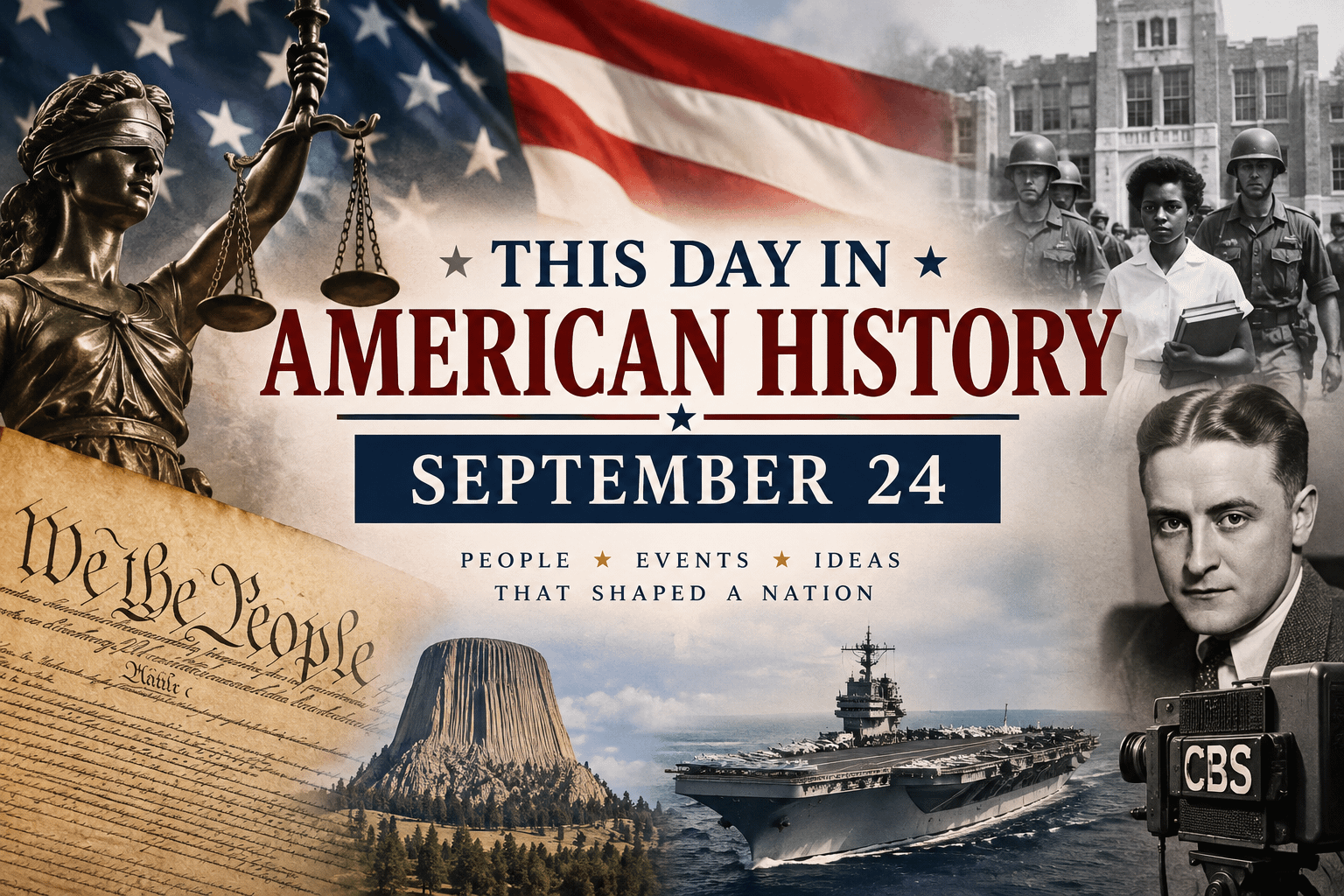
  • History & Culture of the Day — September 24

    History & Culture of the Day — September 24

    September 24 is a date filled with moments that have influenced politics, science, entertainment, transportation, sports, and popular culture. From the creation of the United States Supreme Court to the arrival of one of the most famous aircraft carriers in American history, September 24 offers a fascinating journey through the past.

    History is more than a collection of dates. It is the story of people—their decisions, discoveries, struggles, creativity, and determination. Looking back at September 24 reminds us how events from centuries ago can continue to influence the way we live today.

    1789 — The United States Establishes Its Federal Judiciary

    One of the most important events associated with September 24 occurred in 1789, when President George Washington signed the Judiciary Act of 1789.

    The newly created United States had a Constitution, a president, and Congress, but the federal judicial system still needed to be organized. The Judiciary Act established the structure of the federal courts and provided for a Supreme Court consisting initially of a chief justice and five associate justices.

    Washington also nominated the first members of the Supreme Court on September 24, including John Jay as the first chief justice.

    The judiciary would eventually become one of the three central branches of the federal government, alongside the executive and legislative branches.

    Over the centuries, the Supreme Court has issued decisions affecting civil rights, presidential authority, freedom of speech, voting, criminal justice, business, privacy, and countless other aspects of American life.

    September 24 therefore represents an important moment in the development of the American system of government.

    1869 — Black Friday Shakes the American Economy

    September 24, 1869, became known as “Black Friday” after a dramatic collapse in the United States gold market.

    Financiers Jay Gould and James Fisk attempted to gain control over a significant portion of the nation’s gold supply. Their actions contributed to rapidly rising gold prices and widespread speculation.

    When the federal government intervened by selling gold, prices suddenly collapsed.

    Investors suffered enormous losses, and the disruption spread into other parts of the economy.

    This Black Friday should not be confused with the modern shopping day following Thanksgiving. The 1869 event was a financial crisis demonstrating how speculation and attempts to manipulate markets could have consequences far beyond Wall Street.

    1890 — The Mormon Church Moves Away From Plural Marriage

    September 24, 1890, marked an important turning point in the history of The Church of Jesus Christ of Latter-day Saints.

    Church president Wilford Woodruff issued what became known as the 1890 Manifesto, announcing his intention to submit to laws prohibiting plural marriage.

    Plural marriage had created intense conflict between the church and the United States government during the nineteenth century.

    The Manifesto became a major step toward ending the church-sanctioned practice, although the transition was more complicated and gradual than a single declaration might suggest.

    The event illustrates how religious practices, law, culture, and government authority sometimes collide—and how those conflicts can reshape communities over time.

    1906 — Devils Tower Becomes America’s First National Monument

    On September 24, 1906, President Theodore Roosevelt proclaimed Devils Tower in Wyoming the first national monument established under the Antiquities Act.

    The enormous geological formation rises dramatically above the surrounding landscape and has long held deep cultural and spiritual significance for several Indigenous peoples.

    Its designation represented a major development in America’s conservation movement.

    Theodore Roosevelt became closely associated with efforts to preserve important landscapes, wildlife habitats, forests, archaeological sites, and natural wonders.

    Today, America’s national monuments help protect places with historical, scientific, cultural, and environmental importance.

    The creation of Devils Tower National Monument demonstrated that preserving America’s heritage could mean protecting both human history and the natural world.

    1929 — Jimmy Doolittle Demonstrates Instrument Flight

    Aviation history took an important step forward on September 24, 1929.

    American aviator James “Jimmy” Doolittle completed an experimental flight using instruments to guide the aircraft rather than relying primarily on what he could see outside the cockpit.

    Instrument flying became essential to the development of modern aviation because pilots needed reliable ways to navigate through clouds, darkness, poor visibility, and difficult weather.

    Doolittle would later become famous for leading the 1942 Doolittle Raid against Japan during World War II.

    His earlier aviation experiments, however, were significant in their own right.

    Modern commercial air travel depends heavily on instruments, navigation technology, radar, communications, and sophisticated flight-control systems. The pioneering work of early aviators helped make today’s global aviation network possible.

    1941 — The Houston Colt .45s’ Future Home Begins to Take Shape

    September 24 also connects with the development of professional sports and the changing cultural landscape of American cities during the twentieth century.

    Houston’s eventual rise as a major professional sports city reflected broader changes occurring throughout the United States as baseball expanded and cities invested in increasingly ambitious stadium projects.

    That transformation would eventually produce one of the most famous stadiums of its era: the Astrodome.

    Opened in 1965, it became known as the “Eighth Wonder of the World” and helped popularize the concept of large indoor stadiums.

    The Houston Colt .45s eventually became the Houston Astros, a name inspired by the city’s growing association with America’s space program.

    Sports, technology, civic identity, and popular culture were increasingly becoming intertwined.

    1957 — President Eisenhower Sends Federal Troops to Little Rock

    One of the defining events of the American civil rights era intensified on September 24, 1957.

    President Dwight D. Eisenhower ordered federal troops from the 101st Airborne Division to Little Rock, Arkansas, after attempts to integrate Central High School were met with resistance and hostility.

    Nine Black students—later known as the Little Rock Nine—were attempting to attend the previously segregated school following the Supreme Court’s decision in Brown v. Board of Education.

    Arkansas Governor Orval Faubus had previously used the state’s National Guard to prevent the students from entering.

    The confrontation raised a fundamental question: Would federal civil-rights law actually be enforced when state officials resisted it?

    Eisenhower ultimately federalized the Arkansas National Guard and sent troops to protect the students.

    The Little Rock crisis became one of the most powerful images of the civil rights movement and demonstrated that court decisions alone could not eliminate segregation. Enforcement, courage, activism, and political action were also necessary.

    1960 — The USS Enterprise Is Launched

    On September 24, 1960, the USS Enterprise was launched.

    The ship was revolutionary.

    USS Enterprise (CVN-65) became the world’s first nuclear-powered aircraft carrier. Nuclear propulsion allowed the enormous vessel to operate for long periods without the frequent refueling required by conventionally powered ships.

    The Enterprise would serve the United States Navy for more than half a century.

    Its name also carried tremendous cultural significance.

    “Enterprise” had already been used for earlier American naval vessels, and it later became internationally famous through the fictional starship USS Enterprise in Star Trek.

    The connection between naval history and science-fiction culture helped make the name synonymous with exploration, technological ambition, and adventure.

    1964 — The Warren Commission Report Is Presented to President Johnson

    On September 24, 1964, the Warren Commission presented its report to President Lyndon B. Johnson concerning the assassination of President John F. Kennedy.

    Kennedy had been assassinated in Dallas, Texas, on November 22, 1963.

    The commission, headed by Chief Justice Earl Warren, concluded that Lee Harvey Oswald acted alone in assassinating Kennedy and that Jack Ruby acted alone when he killed Oswald.

    The report became one of the most debated government investigations in American history.

    Questions and alternative theories surrounding Kennedy’s assassination have remained part of American political culture for generations.

    Books, documentaries, films, television programs, government investigations, and public debates have continued examining what happened in Dallas.

    Few events demonstrate more clearly how history can remain culturally alive long after the official investigations have ended.

    1968 — 60 Minutes Debuts on CBS

    Television journalism changed on September 24, 1968, when 60 Minutes premiered on CBS.

    Created by producer Don Hewitt, the program developed a distinctive approach that combined investigative reporting, interviews, profiles, and feature stories.

    Its famous ticking stopwatch became one of television’s most recognizable sounds and images.

    Rather than presenting news exclusively through the traditional nightly-news format, 60 Minutes demonstrated that long-form television journalism could attract a massive audience.

    The program would eventually become one of the longest-running and most influential news programs in American television history.

    Its success helped establish investigative television journalism as an important part of American culture.

    1976 — Newspaper Heiress Patty Hearst Is Sentenced

    On September 24, 1976, Patty Hearst was sentenced to prison following her conviction for participating in a bank robbery.

    Her story had fascinated the country.

    Hearst, granddaughter of newspaper publisher William Randolph Hearst, had been kidnapped in 1974 by the Symbionese Liberation Army, a radical organization.

    She later appeared to join the group and participated in criminal activity, including a bank robbery.

    Her defense argued that she had been subjected to coercion and psychological manipulation.

    The case sparked intense national discussions about kidnapping, coercive control, trauma, personal responsibility, radical political movements, and the power of the media.

    President Jimmy Carter later commuted her sentence, and President Bill Clinton granted her a full pardon in 2001.

    Her case remains one of the strangest intersections of crime, celebrity, psychology, politics, and media culture in twentieth-century America.

    1991 — Nevermind Changes Rock Music

    September 24, 1991, became an important date in music history with the release of Nirvana’s album Nevermind.

    Led by Kurt Cobain, Nirvana helped bring the Seattle grunge movement into mainstream popular culture.

    The album’s breakout song, “Smells Like Teen Spirit,” became an anthem for a generation.

    Rock music in the late 1980s had been dominated partly by highly polished arena rock and glam metal. Nirvana’s sound and image offered something different—raw guitars, emotional lyrics, understated fashion, and an anti-celebrity attitude that ironically turned the band into global celebrities.

    Nevermind eventually became one of the most influential rock albums of its era.

    Grunge fashion also moved into mainstream culture. Flannel shirts, ripped jeans, worn sneakers, and deliberately casual styles became associated with early-1990s youth culture.

    September 24, 1991, therefore represents not merely an album release but a cultural shift.

    1991 — The Red Hot Chili Peppers Release Blood Sugar Sex Magik

    Nirvana was not the only influential rock band releasing a major album on September 24, 1991.

    The Red Hot Chili Peppers released Blood Sugar Sex Magik on the same day.

    The album included songs such as “Under the Bridge” and “Give It Away” and helped transform the band into international stars.

    Their combination of rock, funk, alternative music, and punk influences contributed to the rapidly changing sound of popular music during the early 1990s.

    Looking back, September 24, 1991, was an extraordinary day for rock music.

    Two albums released that day would help define alternative rock for years to come.

    1993 — Boy Meets World Premieres

    September 24 also holds a nostalgic place in 1990s television culture.

    On September 24, 1993, Boy Meets World premiered on ABC.

    The series followed Cory Matthews as he navigated childhood, adolescence, friendships, school, family relationships, love, and eventually adulthood.

    Characters such as Cory, Topanga, Shawn, Eric, and Mr. Feeny became familiar figures to a generation of viewers.

    Although the program was a comedy, it frequently addressed serious subjects involving friendship, family difficulties, responsibility, identity, relationships, and growing up.

    For many viewers who grew up during the 1990s, Boy Meets World became more than another sitcom. It became part of the shared cultural memory of the era.

    Jim Henson Was Born on September 24, 1936

    September 24 is also the birthday of one of the most imaginative figures in entertainment history.

    Jim Henson was born on September 24, 1936.

    Henson created the Muppets and helped bring characters including Kermit the Frog, Miss Piggy, Fozzie Bear, and many others into popular culture.

    His work also played a central role in Sesame Street, where puppetry became an extraordinarily effective tool for children’s education.

    Henson understood something powerful: entertainment could make people laugh while also teaching kindness, curiosity, friendship, creativity, and acceptance.

    His influence continues through television, movies, puppetry, children’s entertainment, and generations of performers inspired by his creativity.

    F. Scott Fitzgerald Was Born on September 24, 1896

    American author F. Scott Fitzgerald was born September 24, 1896.

    Fitzgerald became one of the literary voices most closely associated with the Jazz Age.

    His best-known novel, The Great Gatsby, explored wealth, ambition, love, class, illusion, and the pursuit of the American Dream.

    Although the novel initially experienced only modest commercial success, its reputation grew dramatically after Fitzgerald’s death.

    Today, The Great Gatsby is widely taught in American schools and remains one of the most recognizable works of twentieth-century American literature.

    Fitzgerald’s writing continues to resonate because many of the questions he explored remain relevant: What does success really mean? Can wealth create happiness? Can people recreate the past? And what happens when dreams become more powerful than reality?

    September 24 and the Power of Culture

    One of the fascinating things about examining a single date is seeing how different parts of history overlap.

    September 24 connects government with music, aviation with civil rights, literature with television, military technology with science fiction, and financial history with popular culture.

    The establishment of America’s federal judiciary shaped government.

    The Little Rock crisis helped define the struggle for civil rights.

    Jimmy Doolittle’s experiments helped transform aviation.

    USS Enterprise represented technological innovation.

    Jim Henson transformed children’s entertainment.

    F. Scott Fitzgerald influenced American literature.

    Nirvana and the Red Hot Chili Peppers helped reshape popular music.

    Boy Meets World became part of the childhood memories of millions.

    Each event belongs to a different era, yet together they demonstrate how history is constantly being created.

    Why Remembering History Matters

    It can be tempting to think of history as something finished—names, dates, and events locked permanently in the past.

    But history surrounds us.

    The courts established in the eighteenth century still influence American life. Civil-rights battles of the twentieth century continue to shape discussions about equality. Technologies pioneered by early aviators evolved into systems used on thousands of flights every day.

    Music released decades ago continues to find new listeners.

    Television programs watched by one generation are rediscovered by another.

    Books written more than a century ago still ask questions people struggle with today.

    History survives because its consequences survive.

    Culture survives because people continue sharing it.

    Final Thought

    September 24 reminds us that history is not created only during wars, elections, or political crises. It is also created in recording studios, laboratories, classrooms, courtrooms, television studios, airplanes, ships, books, and ordinary communities.

    Some moments change laws.

    Others change technology.

    Some change music or entertainment.

    And others change how people understand themselves and the world around them.

    Every generation inherits stories from those who came before it while simultaneously creating stories for those who will come next.

    That is what makes studying history and culture so fascinating.

    Which September 24 moment do you think had the greatest impact on the world we live in today?

  • This Day in American History — September 24

    This Day in American History — September 24

    September 24 has witnessed several important moments in American history, from the creation of the federal court system to a defining confrontation during the Civil Rights Movement. It is also the birthday of one of America’s most celebrated novelists.

    Looking back at September 24 shows how the United States has repeatedly wrestled with questions of law, equality, government authority, culture, and national identity.

    1789 — George Washington Signs the Judiciary Act

    One of the most consequential events associated with September 24 occurred in 1789, during the first year of government under the United States Constitution.

    President George Washington signed the Judiciary Act of 1789 into law on September 24, providing the structure for the new nation’s federal judiciary.

    The Constitution had established the judicial branch in Article III and called for a Supreme Court, but it left many important details for Congress to determine.

    The Judiciary Act helped answer those questions.

    The legislation established a three-part federal judiciary consisting of the Supreme Court, federal district courts, and federal circuit courts. The original Supreme Court consisted of a chief justice and five associate justices.

    The law also established the office of the Attorney General of the United States.

    The significance of the legislation is difficult to overstate. The Constitution may have created the judicial branch, but the Judiciary Act provided much of the framework necessary for that branch to operate.

    More than two centuries later, the federal judiciary remains one of the three major branches of the United States government.

    John Jay Becomes Washington’s Choice for Chief Justice

    September 24, 1789, was important for another reason.

    On the same day Washington signed the Judiciary Act, he nominated John Jay of New York to become the first Chief Justice of the United States. Washington also submitted nominations for the other positions on the original Supreme Court.

    Jay was already a significant figure in the founding generation. He had served as president of the Continental Congress, worked as a diplomat, and helped negotiate the Treaty of Paris that formally ended the Revolutionary War.

    The creation of the Supreme Court represented another important step in transforming the Constitution from a document describing a government into a government that could actually function.

    Why the Judiciary Act Still Matters

    It can be easy to overlook the importance of establishing courts compared with dramatic events such as wars, elections, and presidential decisions.

    Yet an independent judicial system became essential to the American constitutional experiment.

    Courts would eventually confront questions involving individual rights, presidential authority, congressional power, relations between states and the federal government, civil rights, elections, criminal justice, and the interpretation of the Constitution itself.

    The federal court system has changed considerably since 1789, but the Judiciary Act established a basic judicial framework whose influence remains visible today.

    September 24 therefore represents an important milestone in the development of American constitutional government.


    1869 — Black Friday Shakes Wall Street

    September 24 also became associated with one of America’s early financial panics.

    On September 24, 1869, financial markets were thrown into turmoil during an episode remembered as Black Friday.

    Speculators Jay Gould and James Fisk had attempted to gain control over the nation’s gold market. Their activities helped drive the price of gold upward as speculation intensified.

    When the federal government intervened by selling gold, prices collapsed.

    The sudden reversal created financial chaos, producing losses for investors and contributing to economic disruption.

    The episode became an early demonstration of how financial speculation, political influence, government policy, and market psychology could collide with devastating consequences.

    Long before the stock market crash of 1929 or the financial crisis of 2008, Black Friday of 1869 showed Americans how quickly confidence in financial markets could disappear.


    1896 — F. Scott Fitzgerald Is Born

    American literature also has an important connection to September 24.

    F. Scott Fitzgerald was born September 24, 1896, in St. Paul, Minnesota.

    Fitzgerald would eventually become one of the most recognizable American writers of the twentieth century.

    His most famous novel, The Great Gatsby, published in 1925, became one of the defining literary works associated with the Jazz Age.

    Through his writing, Fitzgerald explored wealth, ambition, romance, social class, disappointment, and the pursuit of the American Dream.

    Interestingly, Fitzgerald was named after a distant relative: Francis Scott Key, the writer whose poem became the lyrics of “The Star-Spangled Banner.”

    Fitzgerald experienced both success and struggle during his lifetime. Although his reputation declined during his later years, his literary standing increased dramatically after his death in 1940.

    Today, The Great Gatsby remains widely read and studied, making Fitzgerald’s September 24 birthday another notable entry in American cultural history.


    1906 — Devils Tower Becomes America’s First National Monument

    September 24 also played a role in the history of conservation.

    In 1906, President Theodore Roosevelt designated Devils Tower in Wyoming as the first national monument in the United States.

    The designation came under the recently enacted Antiquities Act, which gave presidents authority to protect certain historic landmarks, structures, and objects of scientific or historic interest located on federal land.

    The creation of the country’s first national monument represented an important development in America’s growing conservation movement.

    During Theodore Roosevelt’s presidency, conservation became a significant national priority. Millions of acres of land received various forms of federal protection.

    The national monument system eventually expanded across the country, protecting landscapes, archaeological sites, historic locations, and culturally important places.

    What began with Devils Tower helped establish a conservation tradition that continues today.


    1957 — Eisenhower Sends Federal Troops to Little Rock

    One of the most dramatic events to occur on September 24 came during the struggle over school desegregation.

    On September 24, 1957, President Dwight D. Eisenhower ordered members of the U.S. Army’s 101st Airborne Division into Little Rock, Arkansas, and federalized the Arkansas National Guard.

    The confrontation centered on nine Black students who became known as the Little Rock Nine.

    Three years earlier, the Supreme Court’s decision in Brown v. Board of Education had ruled that racial segregation in public schools was unconstitutional.

    Yet implementing desegregation faced intense resistance in many communities.

    Little Rock Central High School became one of the most visible battlegrounds.

    Arkansas Governor Orval Faubus had previously used the Arkansas National Guard to prevent the students from entering the school.

    When the Little Rock Nine entered Central High on September 23, a hostile crowd gathered outside. The situation became dangerous enough that authorities removed the students for their safety.

    The crisis forced President Eisenhower to confront a fundamental question:

    Would the federal government enforce federal court orders when state officials and local resistance stood in their way?

    On September 24, Eisenhower acted.

    He federalized the Arkansas National Guard and ordered federal soldiers into Little Rock.

    That evening, Eisenhower addressed the nation from the White House and explained his decision.

    The following morning, September 25, soldiers from the 101st Airborne escorted the Little Rock Nine into Central High School for their first full day of classes.

    The Importance of Little Rock

    The Little Rock crisis became one of the defining confrontations of the Civil Rights Movement.

    It demonstrated that Supreme Court decisions alone could not necessarily guarantee change.

    Court rulings sometimes required enforcement.

    Eisenhower’s decision showed that the federal government was prepared to use its authority to enforce federal law and court orders despite resistance from state officials.

    The images of Black students walking into school while surrounded by federal soldiers became some of the most recognizable photographs of the struggle for civil rights.

    The Little Rock Nine faced harassment, threats, and hostility simply for attempting to receive an education at a previously segregated school.

    Their courage helped expose the reality of segregation to Americans across the country and people around the world.


    1960 — USS Enterprise Is Launched

    Another important September 24 milestone involved American military and technological history.

    On September 24, 1960, USS Enterprise was launched.

    The ship would become famous as the world’s first nuclear-powered aircraft carrier.

    Nuclear propulsion dramatically changed what was possible for large naval vessels. Instead of relying on conventional fuel in the same manner as earlier carriers, nuclear-powered ships could operate for extended periods without needing frequent refueling.

    The Enterprise represented the increasing technological sophistication of the United States Navy during the Cold War.

    The carrier would go on to serve for more than half a century and participate in numerous operations around the world.

    Its name also carried a long naval tradition, with several American ships having previously carried the name Enterprise.


    1968 — 60 Minutes Premieres

    American television history changed on September 24 as well.

    On September 24, 1968, CBS premiered 60 Minutes.

    The program helped redefine television journalism by combining investigative reporting, interviews, profiles, and feature stories within a television newsmagazine format.

    Over the decades, 60 Minutes became one of the longest-running and most recognizable news programs in American television history.

    Its correspondents interviewed presidents, world leaders, celebrities, business executives, athletes, activists, whistleblowers, and ordinary people whose experiences became major national stories.

    The show’s longevity demonstrates how television became an increasingly important way Americans learned about politics, culture, international affairs, and social issues during the second half of the twentieth century.


    1969 — The Chicago Eight Trial Begins

    On September 24, 1969, another chapter in the political and cultural turmoil of the late 1960s began when the trial commonly known as the Chicago Eight trial got underway.

    The defendants had been charged following protests surrounding the 1968 Democratic National Convention in Chicago.

    Demonstrations against the Vietnam War had drawn thousands of protesters to the city. Violent confrontations occurred between protesters and police, producing scenes broadcast across the nation.

    The subsequent trial became almost as controversial as the protests themselves.

    The defendants included prominent activists representing different parts of the antiwar and counterculture movements.

    After defendant Bobby Seale’s case was separated from the others, the remaining defendants became widely known as the Chicago Seven.

    The trial reflected the deep political divisions affecting the United States during the Vietnam War era.

    Questions involving protest, police power, political dissent, free speech, and government authority became central to the proceedings and the larger national debate.


    2017 — NFL Protests Become a National Story

    September 24 also became part of a much more recent debate over protest, patriotism, race, and professional sports.

    On September 24, 2017, more than 200 NFL players reportedly knelt or sat during the national anthem amid a rapidly escalating national controversy surrounding player protests.

    The protests had grown from demonstrations intended to call attention to racial inequality and police treatment of Black Americans.

    Supporters viewed the demonstrations as a legitimate exercise of free expression and a way to draw attention to racial injustice.

    Critics argued that protesting during the national anthem showed disrespect toward the flag, military members, veterans, or the country.

    The disagreement became one of the most visible cultural and political debates surrounding professional sports during the period.

    Whatever one’s position, the controversy demonstrated once again how sports can become connected to much larger conversations about American identity, patriotism, race, and freedom of expression.


    September 24 and the American Story

    When these events are considered together, September 24 reveals several recurring themes in American history.

    In 1789, the young country worked to establish a functioning federal judiciary.

    In 1869, financial speculation contributed to a dramatic market panic.

    In 1896, one of America’s future literary giants was born.

    In 1906, the federal government took an important step toward protecting America’s natural and cultural heritage.

    In 1957, federal soldiers were sent to Little Rock to enforce the constitutional rights of Black students.

    In 1960, American naval technology entered a new era with USS Enterprise.

    In 1968, television journalism gained a program that would become an American institution.

    In 1969, the Chicago Eight trial reflected the enormous political divisions surrounding the Vietnam War and the protest movements of the era.

    And in 2017, protests by professional football players became part of another national debate about race, patriotism, and freedom of expression.

    History is rarely one continuous story of progress. It is made from moments when Americans disagree about what the country’s principles mean and how those principles should be applied.

    September 24 offers several powerful examples.

    A Day Connected by the Rule of Law

    Perhaps the most striking connection can be found between the events of 1789 and 1957.

    On September 24, 1789, the United States established the structure of its federal court system.

    Exactly 168 years later, on September 24, 1957, a president sent federal troops into an American city in a confrontation ultimately centered on enforcing federal court orders.

    Those events occurred in completely different Americas, but they share an important theme.

    The rule of law matters only when the institutions created to protect it are willing to uphold it.

    The founders could create courts, Congress could pass laws, judges could issue rulings, and presidents could speak about constitutional principles.

    But throughout American history, the country’s greatest tests have often come when those principles had to be applied during moments of intense disagreement.

    That is one reason studying history remains valuable.

    History is not simply about remembering names and dates. It allows us to see how earlier generations confronted questions that continue to influence American life.

    September 24 reminds us that the American story has been shaped in courtrooms, classrooms, financial markets, military institutions, television studios, literature, protest movements, and even football stadiums.

    Each generation inherits institutions and ideals from the generation before it.

    What happens next depends on what people choose to do with them.

    Which September 24 event do you believe had the greatest impact on American history?

  • History & Culture of the Day — September 23

    History & Culture of the Day — September 23

    September 23 sits near one of the most noticeable turning points of the year. In the Northern Hemisphere, September brings the transition from summer toward autumn, while in the Southern Hemisphere it marks the arrival of spring. Depending on the year, the September equinox may fall on September 22 or September 23.

    But September 23 is about much more than a changing season.

    Across centuries and cultures, this date has been connected with political change, artistic expression, music, technology, national identity, and important moments that helped shape the modern world.

    From ancient seasonal traditions to the rise of Nintendo, the birth of jazz legend John Coltrane, the emergence of Bruce Springsteen, and the celebration of Saudi Arabia’s National Day, September 23 offers an interesting journey through history and culture.

    The September Equinox and the Changing Seasons

    One of the most important cultural themes associated with this time of September is the autumnal equinox in the Northern Hemisphere and the vernal equinox in the Southern Hemisphere.

    An equinox occurs when the Sun crosses Earth’s celestial equator. Around the equinox, day and night are close to equal in length, although they are not necessarily exactly 12 hours each.

    For people living in the Northern Hemisphere, the September equinox represents the astronomical beginning of autumn.

    Temperatures begin to cool. Leaves eventually change color. Harvest season arrives in many agricultural regions. Families begin preparing for the colder months ahead.

    In the Southern Hemisphere, the opposite transition takes place. September signals spring—a season associated with warmer weather, blooming plants, renewal, and new growth.

    Long before modern calendars and astronomy explained the movement of Earth around the Sun, civilizations carefully observed seasonal changes.

    Agricultural societies depended upon them.

    Knowing when seasons changed helped communities determine when to plant crops, harvest food, prepare livestock, and store supplies.

    Because survival was closely connected with the seasons, the equinox became culturally significant in many societies.

    Harvest Traditions Around the World

    The arrival of autumn has historically been associated with harvest celebrations.

    Farmers worked for months growing crops, and the harvest represented the reward for their labor.

    Communities often celebrated successful harvests with feasts, ceremonies, music, dancing, and religious observances.

    Different cultures developed their own traditions.

    Across Europe, harvest festivals became important community gatherings. Churches sometimes held thanksgiving services celebrating the food produced from the land.

    In parts of Asia, autumn festivals became associated with family gatherings, gratitude, food, and the moon.

    The Mid-Autumn Festival, celebrated in China and several other Asian cultures according to a lunar calendar, is one of the world’s best-known autumn celebrations. Families gather, share food such as mooncakes, and appreciate the full moon.

    Although these celebrations do not necessarily occur on September 23, they demonstrate the larger cultural importance of the seasonal transition surrounding this part of the year.

    Autumn has traditionally represented both abundance and preparation.

    People celebrate what has been gathered while recognizing that winter is approaching.

    That combination has made autumn a powerful symbol in art, literature, religion, and philosophy.

    September 23, 1889 — Nintendo Is Founded

    One of the most fascinating cultural connections to September 23 began in Kyoto, Japan.

    On September 23, 1889, Fusajiro Yamauchi founded the company that would eventually become Nintendo.

    Modern audiences immediately associate Nintendo with video games, but the company began in a completely different industry.

    Nintendo originally produced handmade hanafuda playing cards.

    Hanafuda cards feature beautifully illustrated flowers and plants representing different months of the year. The cards became popular for various traditional Japanese games.

    Nintendo spent decades operating primarily within the playing-card business before experimenting with other products and industries.

    Eventually, the company entered electronic entertainment.

    That decision transformed not only Nintendo but popular culture around the world.

    Nintendo later became responsible for some of the most recognizable characters and franchises in entertainment history.

    Mario, Luigi, Donkey Kong, Link, Princess Zelda, Kirby, and many others became internationally recognized characters.

    The Nintendo Entertainment System helped revitalize the home video game market during the 1980s.

    Later systems—including the Game Boy, Super Nintendo Entertainment System, Nintendo 64, Wii, Nintendo DS, and Nintendo Switch—continued influencing generations of players.

    What makes Nintendo’s history especially remarkable is its longevity.

    A business that began by making traditional Japanese playing cards in 1889 eventually became one of the world’s most influential entertainment companies.

    September 23 therefore holds a unique place in gaming and entertainment history.

    September 23, 1926 — John Coltrane Is Born

    September 23 is also an important date in American music history.

    Jazz saxophonist and composer John Coltrane was born on September 23, 1926, in Hamlet, North Carolina.

    Coltrane became one of the most influential musicians in jazz history.

    His career included collaborations with legendary performers such as Miles Davis and Thelonious Monk before he emerged as an innovative bandleader in his own right.

    Coltrane continually experimented with musical structure, harmony, improvisation, and spirituality.

    Albums such as Giant Steps and A Love Supreme became landmarks of jazz.

    A Love Supreme, released in 1965, became especially important because it combined extraordinary musical creativity with Coltrane’s spiritual reflections.

    His music could be intense, complicated, emotional, and deeply personal.

    Coltrane died in 1967 at only 40 years old, but his influence continued growing after his death.

    Musicians across jazz, rock, experimental music, and other genres have studied and drawn inspiration from his work.

    His birthday on September 23 provides an opportunity to remember how one musician’s willingness to explore new artistic possibilities permanently changed American music.

    September 23, 1949 — Bruce Springsteen Is Born

    Another major figure in American music was born on September 23.

    Bruce Springsteen was born in Long Branch, New Jersey, in 1949.

    Springsteen eventually became known worldwide for songs exploring working-class life, hope, frustration, love, dreams, economic hardship, and the complicated experience of pursuing the American Dream.

    His music became closely associated with New Jersey and American working-class culture.

    With the E Street Band, Springsteen developed a reputation for energetic concerts that could last for hours.

    Songs including “Born to Run,” “Thunder Road,” “Dancing in the Dark,” and “Born in the U.S.A.” became major parts of American popular music.

    But beneath the catchy melodies and arena-sized performances, many Springsteen songs contain complicated stories about ordinary people.

    Factory workers.

    Young couples.

    Veterans.

    Families.

    People trying to escape struggling towns.

    People chasing opportunities that sometimes remain just beyond their reach.

    That storytelling helped Springsteen become more than a successful rock musician. His catalog became a musical portrait of different aspects of American life.

    September 23 — Saudi National Day

    September 23 is also an important national celebration in Saudi Arabia.

    Saudi National Day commemorates the unification of the Kingdom of Saudi Arabia.

    In 1932, King Abdulaziz announced the unification of the regions under the name Kingdom of Saudi Arabia.

    September 23 became the date associated with that historic transformation.

    Today, Saudi National Day is celebrated with public events, decorations, flags, entertainment, cultural programs, and displays of national pride.

    Cities may be illuminated in green, the color strongly associated with the Saudi flag and national identity.

    The celebration provides an opportunity for people to reflect on Saudi history while also highlighting modern developments and national goals.

    Like national days around the world, it demonstrates how historical events eventually become cultural traditions passed from one generation to another.

    September 23, 1952 — Richard Nixon’s “Checkers Speech”

    September 23 also played a memorable role in American political and television history.

    During the 1952 presidential campaign, vice-presidential candidate Richard Nixon faced controversy involving a political expense fund.

    Nixon responded with a nationally televised speech on September 23, 1952.

    The address became known as the “Checkers speech.”

    The unusual nickname came from Nixon’s discussion of a gift his family had received—a black-and-white cocker spaniel named Checkers.

    Nixon said his daughters loved the dog and that the family intended to keep it.

    The speech became a significant moment in the relationship between television and American politics.

    Television was becoming an increasingly powerful medium.

    Politicians could now speak directly to millions of Americans in their homes.

    Political communication would never be quite the same.

    Later presidential debates, campaign advertisements, televised addresses, political interviews, and eventually internet and social-media campaigning continued that transformation.

    The Checkers speech demonstrated early on how television could influence a political controversy by allowing a candidate to appeal directly to the public.

    September 23, 1962 — The Jetsons Enter American Pop Culture

    September 23, 1962, introduced television audiences to one of popular culture’s most memorable visions of the future.

    The Jetsons premiered on ABC.

    Created by Hanna-Barbera, the animated television series followed George Jetson and his family as they lived in a futuristic world filled with flying cars, robots, moving sidewalks, video communication, and automated household technology.

    The show became a cultural counterpart to The Flintstones.

    While The Flintstones humorously imagined modern family life in the Stone Age, The Jetsons imagined family life in the future.

    Some of the show’s futuristic technology seemed impossible to viewers in the 1960s.

    Video calls were science fiction.

    Home automation seemed futuristic.

    Robotic household assistants belonged to cartoons.

    Today, video conferencing, smart-home devices, robotic vacuum cleaners, digital assistants, and other technologies make portions of The Jetsons feel surprisingly familiar.

    We may not commute to work in flying cars, but the program remains an interesting example of how entertainment imagines the future.

    The Cultural Meaning of Autumn

    Beyond specific historical events, September 23 represents something deeper.

    Autumn has always carried powerful symbolism.

    Spring represents beginnings.

    Summer represents growth and energy.

    Autumn often represents maturity, change, reflection, and letting go.

    Leaves that were once green begin turning yellow, orange, red, and brown before eventually falling.

    The transformation has inspired poets, painters, photographers, musicians, and writers for generations.

    Autumn reminds us that change can be beautiful even when something is ending.

    The season also encourages reflection.

    As the days become shorter and another year moves toward its final months, people often begin thinking about what has happened during the year.

    What changed?

    What did we accomplish?

    What did we lose?

    What did we learn?

    What do we still hope to accomplish before the year ends?

    These questions are part of what makes seasonal transitions culturally meaningful.

    September 23 Connects the Past With the Present

    One of the most interesting things about studying history is discovering how seemingly unrelated events can share the same calendar date.

    On September 23, we can remember a Japanese playing-card company founded in 1889 that eventually transformed global video gaming.

    We can celebrate the birth of John Coltrane and his extraordinary contribution to jazz.

    We can recognize Bruce Springsteen and the stories of American life told through his music.

    We can learn about Saudi National Day and the formation of modern Saudi Arabia.

    We can look back at Richard Nixon’s Checkers speech and see how television began changing political communication.

    We can remember the premiere of The Jetsons and smile at how yesterday’s imagined future sometimes resembles today’s everyday life.

    And around this point in September, we can look toward the changing seasons and recognize something humanity has observed for thousands of years.

    The world is always changing.

    Why History and Culture Matter

    History isn’t simply a collection of dates that students memorize.

    History is the story of people.

    Culture is what those people create, celebrate, believe, share, preserve, and pass forward.

    A playing-card company can eventually transform entertainment.

    A saxophonist can change music forever.

    A songwriter can tell stories that generations recognize themselves in.

    A television cartoon can influence how people imagine the future.

    A national celebration can preserve the memory of a country’s formation.

    And the changing seasons can connect modern people with ancestors who watched the same skies thousands of years ago.

    That is what makes studying history and culture so fascinating.

    Every date contains stories.

    Some changed nations.

    Some changed technology.

    Some changed music.

    Some changed entertainment.

    And others changed the way people understood the world around them.

    Final Thoughts

    September 23 reminds us that history and culture are constantly connected.

    The inventions we use, music we hear, traditions we celebrate, entertainment we enjoy, and even the way we understand the seasons have histories behind them.

    Some began hundreds or thousands of years ago.

    Others began with one person willing to create something different.

    As September moves deeper into the changing season, September 23 offers an opportunity to appreciate where humanity has been while wondering where we are going next.

    History tells us what happened.

    Culture tells us what those experiences meant to people.

    Together, they help tell the story of who we are.

    What piece of September 23 history or culture do you find the most interesting?

  • This Day in American History – September 23

    This Day in American History – September 23

    September 23 has witnessed exploration, political drama, struggles over civil rights, and moments that helped shape the United States. From the triumphant return of Lewis and Clark to one of the most famous televised political speeches in American history and the confrontation over school integration in Little Rock, this date offers a fascinating look at the country’s evolving story.

    Here are some of the most significant moments connected to September 23 in American history.

    1780 – The Plot to Surrender West Point Is Exposed

    One of the most infamous acts of betrayal in American history began unraveling around September 23, 1780.

    During the Revolutionary War, American General Benedict Arnold secretly negotiated with the British to surrender the strategically important American fortress at West Point, New York.

    Arnold had become frustrated with the Continental Congress and increasingly resentful over what he believed was a lack of recognition for his military accomplishments. Eventually, he began communicating with British Major John André.

    AndrĂ© was captured by American militiamen while carrying documents connected to Arnold’s plan. His capture exposed the conspiracy before West Point could be surrendered.

    Arnold learned that the plot had been discovered and escaped to British-controlled New York City. André was later convicted as a spy and executed.

    Benedict Arnold’s name would become synonymous with betrayal in the United States.

    The episode demonstrated just how vulnerable the American Revolution remained even several years after the Declaration of Independence. A successful British takeover of West Point could have created serious strategic problems for the Continental Army.

    1806 – Lewis and Clark Return to St. Louis

    One of America’s greatest expeditions officially reached its conclusion on September 23, 1806.

    Meriwether Lewis, William Clark, and the Corps of Discovery arrived in St. Louis after spending more than two years exploring the western portion of the North American continent.

    Their journey had begun in 1804 following the Louisiana Purchase.

    President Thomas Jefferson wanted the expedition to explore the newly acquired territory, document its geography and natural resources, establish relationships with Native American nations, and search for practical transportation routes toward the Pacific.

    The expedition eventually reached the Pacific Ocean before beginning the long journey home.

    At approximately noon on September 23, 1806, the expedition arrived back in St. Louis. According to the National Park Service, members of the expedition fired their weapons in salute as they approached the town, where residents gathered to welcome them home.

    William Clark recorded that they were greeted warmly by the inhabitants of St. Louis.

    Their return was remarkable.

    The expedition had been gone for more than two years, four months, and ten days.

    The information collected during the journey dramatically expanded American knowledge of the West. Maps, journals, observations of wildlife and plants, and descriptions of Indigenous nations became invaluable records of the early American frontier.

    The expedition also became closely connected with the story of Sacagawea, the Lemhi Shoshone woman whose knowledge, interpretation skills, and presence proved important during portions of the journey.

    September 23 therefore represents one of the great homecoming moments in early American history.

    1846 – The Discovery of Neptune

    September 23, 1846, also became an important date in the history of astronomy.

    German astronomer Johann Gottfried Galle observed the planet Neptune after calculations by French mathematician Urbain Le Verrier predicted where the unknown planet should appear.

    Although the discovery occurred in Europe, it would have a lasting impact on astronomy around the world, including scientific research in the United States.

    The discovery was especially important because Neptune’s location had essentially been predicted mathematically before the planet was directly identified.

    It demonstrated the extraordinary power of mathematics to reveal something in the universe that human eyes had not yet recognized.

    1952 – Richard Nixon Delivers the “Checkers Speech”

    On September 23, 1952, Senator Richard Nixon delivered one of the most famous political television speeches in American history.

    Nixon was Dwight D. Eisenhower’s Republican vice-presidential running mate during the 1952 presidential campaign.

    His position on the ticket came under threat following controversy surrounding a political expense fund supported by donors.

    Rather than quietly withdraw from the campaign, Nixon decided to make his case directly to the American people.

    He appeared on national television and discussed his personal finances while defending himself against allegations that the fund had been improperly used for personal benefit.

    Then came the moment that gave the speech its famous nickname.

    Nixon explained that his family had received a gift: a black-and-white cocker spaniel named Checkers.

    He made it clear that regardless of political criticism, his daughters loved the dog and the family intended to keep it.

    The emotional reference captured enormous public attention.

    The address became known simply as the “Checkers Speech.”

    The speech helped Nixon remain on Eisenhower’s ticket. Eisenhower and Nixon went on to win the 1952 presidential election, beginning Nixon’s long and complicated place in American political history.

    But the speech was significant for another reason.

    It demonstrated the enormous political power of television.

    Politicians could now speak directly to millions of Americans inside their homes rather than depending entirely on newspapers, radio reports, or campaign rallies.

    Television would soon become one of the most powerful forces in American presidential politics.

    1955 – The Emmett Till Murder Trial Ends in Acquittal

    September 23, 1955, marked a deeply painful moment in American civil rights history.

    A Mississippi jury acquitted Roy Bryant and J.W. Milam in the murder of 14-year-old Emmett Till.

    Till, a Black teenager from Chicago, had been visiting relatives in Mississippi when he was abducted and brutally murdered.

    His mother, Mamie Till-Mobley, made the courageous decision to hold an open-casket funeral so the world could see what had been done to her son.

    Photographs of Till’s body were widely circulated and created outrage across the country.

    The acquittal of the two defendants demonstrated the enormous racial injustice that existed within the American legal system during the Jim Crow era.

    The killing of Emmett Till and the failure to obtain justice became important catalysts for the growing Civil Rights Movement.

    His story continues to be remembered as part of America’s ongoing struggle over racism, equality, justice, and civil rights.

    1957 – The Little Rock Nine Enter Central High School

    Two years later, September 23 became connected with another major chapter in the Civil Rights Movement.

    Nine Black students had enrolled at Central High School in Little Rock, Arkansas, as part of the effort to desegregate American public schools following the Supreme Court’s landmark Brown v. Board of Education decision.

    They became known as the Little Rock Nine.

    On September 23, 1957, the students entered Central High School while a hostile crowd gathered outside. Violence and unrest escalated to the point that police removed the students for their safety.

    The crisis forced President Dwight D. Eisenhower to confront the question of whether the federal government would enforce court-ordered desegregation.

    Eisenhower signed Executive Order 10730 on September 23 as part of the federal response to the crisis. The confrontation ultimately led him to send soldiers from the 101st Airborne Division to Little Rock and place the Arkansas National Guard under federal authority.

    On September 25, the Little Rock Nine entered Central High School under federal military protection.

    The confrontation became one of the defining images of the Civil Rights era.

    It demonstrated that Supreme Court decisions alone were not always enough to guarantee civil rights. Federal enforcement could be necessary when state or local authorities resisted constitutional protections.

    2002 – California Establishes Paid Family Leave

    September 23 also has a place in the modern history of American workplace policy.

    In 2002, California Governor Gray Davis signed legislation establishing a statewide paid family leave insurance program.

    The law made California the first state in the country to create such a program.

    The policy allowed eligible workers to receive partial wage replacement while taking time away from work for certain family responsibilities.

    California’s action became part of a larger national conversation about balancing employment with caregiving, childbirth, family illness, and other major life events.

    Other states would eventually establish their own paid family and medical leave programs.

    A Date Filled With Turning Points

    What makes September 23 interesting is how different its major historical moments are.

    The return of Lewis and Clark represents America’s early period of exploration and territorial expansion.

    The Benedict Arnold conspiracy reminds us that the American Revolution was filled with uncertainty, internal conflict, and difficult choices.

    The Emmett Till trial and the Little Rock crisis expose painful chapters in America’s struggle with racism and equal rights.

    Richard Nixon’s “Checkers Speech” demonstrates how technology transformed American politics.

    And the creation of California’s paid family leave program reflects the continuing evolution of American social and workplace policy.

    Together, these events show that American history is rarely a simple story of uninterrupted progress.

    It is a story of exploration and discovery, courage and injustice, conflict and reform, failure and change.

    Remembering September 23

    History becomes more meaningful when we recognize that the events described in textbooks happened on ordinary days.

    September 23 was simply another date on the calendar when Lewis and Clark finally saw St. Louis again after their extraordinary journey.

    It was another September evening when millions of Americans turned on their televisions and watched a young senator named Richard Nixon fight to save his political career.

    And it was another school day when nine Black students attempted to exercise a right that should never have been denied to them.

    The people living through those moments could not always know how history would remember them.

    That is one of the greatest lessons of studying the past.

    History is not only something that happened hundreds of years ago.

    History is created every day by people responding to the challenges, opportunities, injustices, discoveries, and decisions placed before them.

    Which event from September 23 do you believe had the greatest impact on the future of the United States?

  • History & Culture of the Day — September 22

    History & Culture of the Day — September 22

    September 22 is a date filled with fascinating moments in history, cultural traditions, scientific achievements, entertainment milestones, and seasonal significance. It is also a day closely associated with one of the most recognizable transitions of the year: the arrival of autumn in the Northern Hemisphere.

    From the changing colors of leaves and centuries-old harvest traditions to important moments in American and world history, September 22 offers an opportunity to look at how people, events, traditions, and ideas have shaped the world.

    The Autumn Equinox and the Changing of the Seasons

    September 22 often falls on or very close to the autumnal equinox in the Northern Hemisphere.

    The equinox occurs when the Sun crosses the celestial equator, marking the astronomical beginning of autumn north of the equator and spring south of it.

    The word equinox comes from Latin words associated with “equal” and “night.” Although daytime and nighttime are not precisely equal everywhere on the equinox, the date represents an important seasonal turning point.

    For generations, people have watched this transition carefully.

    The long, warm days of summer begin giving way to cooler evenings. Leaves start changing from green to brilliant shades of yellow, orange, and red. Farmers prepare for harvest. Families begin thinking about pumpkins, apples, warm drinks, football, Halloween, Thanksgiving, and the approaching holiday season.

    Autumn is more than a change in weather. It has become a cultural experience.

    Harvest Traditions Around the World

    Long before modern calendars and supermarkets, seasonal changes had enormous importance.

    A successful harvest could determine whether a community had enough food to survive the winter. As a result, many cultures developed festivals, ceremonies, feasts, and religious observances centered around the harvest season.

    Communities gathered to celebrate crops being brought in from the fields. Food was shared. Gratitude was expressed. Families prepared preserved foods for the colder months ahead.

    Many modern fall traditions still reflect those ancient agricultural roots.

    Pumpkins, corn, apples, wheat, gourds, and other harvest symbols remain common autumn decorations. Hayrides, corn mazes, pumpkin patches, farmers markets, harvest festivals, and community fairs continue to connect modern life with traditions that are centuries old.

    Even people who have never worked on a farm participate in a culture influenced by the agricultural calendar.

    September 22, 1776 — Nathan Hale Is Executed

    One of the most remembered events associated with September 22 in American history occurred during the Revolutionary War.

    On September 22, 1776, Nathan Hale, an American soldier and spy, was executed by the British in New York.

    Hale had volunteered for a dangerous intelligence mission behind British lines. He was captured and sentenced to death.

    He was only 21 years old.

    Hale became an enduring symbol of patriotism and sacrifice in American history. He is traditionally remembered for declaring before his execution:

    “I only regret that I have but one life to lose for my country.”

    The precise wording has been debated by historians because there is no surviving firsthand transcript of Hale’s final speech. Nevertheless, the quotation became deeply connected with his legacy.

    His story illustrates how individuals can become cultural symbols long after their deaths.

    Hale’s name can now be found on schools, monuments, military facilities, streets, and other institutions throughout the United States.

    September 22, 1862 — Lincoln Announces the Preliminary Emancipation Proclamation

    September 22 also marks one of the most consequential moments of the American Civil War.

    On September 22, 1862, President Abraham Lincoln issued the preliminary Emancipation Proclamation.

    It warned that enslaved people in states or portions of states still rebelling against the United States on January 1, 1863, would be declared free.

    The final Emancipation Proclamation took effect on January 1, 1863.

    The proclamation did not immediately abolish slavery everywhere in the United States. Its legal reach was tied to areas in rebellion, and slavery continued in some places until constitutional abolition.

    Nevertheless, the proclamation dramatically transformed the meaning and direction of the Civil War.

    Preserving the Union remained central, but emancipation became an explicit war aim.

    It also opened the door for greater numbers of Black Americans to serve in the United States armed forces.

    The broader struggle ultimately contributed to the ratification of the 13th Amendment in 1865, which abolished slavery in the United States except as punishment for a crime.

    September 22 therefore occupies an important place in the history of American freedom and civil rights.

    September 22, 1888 — The First Issue of National Geographic Magazine

    Another cultural milestone arrived on September 22, 1888, when the first issue of National Geographic Magazine was published.

    The National Geographic Society had been founded earlier that year.

    What began as a relatively academic publication eventually became one of the world’s most recognizable magazines.

    National Geographic became particularly famous for its photography.

    Its pages introduced generations of readers to distant landscapes, wildlife, archaeological discoveries, scientific research, oceans, mountains, cultures, and communities around the world.

    Before television and the internet made images from distant places instantly accessible, magazines such as National Geographic provided people with extraordinary windows into places they might never personally visit.

    Its influence extended beyond geography.

    The publication helped popularize archaeology, anthropology, conservation, exploration, natural history, photography, and environmental awareness.

    September 22 therefore represents an important anniversary in the history of educational publishing.

    September 22, 1961 — The Peace Corps Becomes Permanent

    September 22, 1961, was also significant for the Peace Corps.

    President John F. Kennedy had established the Peace Corps earlier that year through executive action. Congress subsequently passed legislation formally authorizing the organization, which Kennedy signed on September 22.

    The idea behind the Peace Corps was ambitious.

    American volunteers would live and work in communities around the world, contributing skills in areas such as education, agriculture, health, community development, and economic opportunity.

    At the same time, volunteers would learn about the cultures and communities in which they served.

    The Peace Corps became part of a broader cultural movement during the early 1960s emphasizing public service, international cooperation, and civic responsibility.

    Thousands of Americans would eventually serve overseas through the organization.

    September 22, 1980 — The Iran-Iraq War Begins

    September 22 also marks the beginning of one of the longest and deadliest conflicts of the late 20th century.

    On September 22, 1980, Iraqi forces invaded Iran, beginning the Iran-Iraq War.

    The conflict continued until 1988.

    The war involved brutal ground fighting, missile attacks, attacks on shipping, and the use of chemical weapons by Iraq. Hundreds of thousands of people were killed, wounded, or displaced.

    The consequences extended far beyond Iran and Iraq.

    The conflict affected oil markets, international diplomacy, regional alliances, and the political future of the Middle East.

    Even decades later, the consequences of the war remain important for understanding regional history.

    September 22, 1994 — Friends Premieres

    History isn’t limited to wars, governments, and political movements.

    Popular culture can also leave a lasting mark.

    On September 22, 1994, the television sitcom Friends premiered on NBC.

    The series followed six friends living in New York City:

    Rachel, Ross, Monica, Chandler, Joey, and Phoebe.

    Few could have predicted how culturally influential the show would become.

    Friends ran for ten seasons and became one of the most recognizable television comedies of its era.

    Its influence extended into fashion, hairstyles, language, dating culture, friendship, and television comedy.

    “The Rachel” haircut associated with Jennifer Aniston became a major fashion trend during the 1990s.

    The show’s coffee-shop setting also became part of its cultural identity, with Central Perk serving almost like another character in the series.

    Decades after its premiere, new generations continued discovering the program through reruns and streaming.

    September 22, 1994, therefore represents a memorable date in modern television history.

    September 22, 2004 — Lost Premieres

    Exactly ten years after the premiere of Friends, another television phenomenon debuted.

    On September 22, 2004, Lost premiered on ABC.

    The drama followed survivors of Oceanic Flight 815 after their plane crashed on a mysterious island.

    The series combined survival drama, science fiction, mystery, mythology, romance, philosophy, and character-driven storytelling.

    It became especially important in the development of online television fandom.

    Fans gathered on message boards and websites to debate theories, examine clues, analyze episodes, and predict what would happen next.

    Today, social media makes that kind of immediate television discussion commonplace. During the 2000s, however, Lost became one of the shows demonstrating how the internet could transform television into a massive interactive cultural conversation.

    September 22 and the Culture of Fall

    Beyond historical anniversaries, September 22 carries a distinctive cultural feeling because of its connection to autumn.

    Fall has developed its own language of traditions and imagery.

    Pumpkins appear on porches.

    Apple orchards become weekend destinations.

    Football fills television screens.

    People begin wearing sweaters and jackets.

    Coffee shops introduce seasonal drinks.

    Homes are decorated with leaves, scarecrows, pumpkins, and harvest colors.

    Halloween decorations begin appearing.

    Families start discussing Thanksgiving plans.

    In many parts of the United States, fall is also associated with high school and college football, homecoming celebrations, county fairs, harvest festivals, and school activities.

    These traditions demonstrate something interesting about culture.

    Humans don’t simply experience seasons.

    We create traditions around them.

    Why Autumn Creates Such Powerful Nostalgia

    Fall can also be an emotional season.

    Certain smells, temperatures, foods, songs, and traditions can instantly bring back memories.

    The smell of leaves.

    A cool breeze through an open window.

    The first football game of the season.

    A pumpkin pie baking in the kitchen.

    Halloween decorations.

    An old sweatshirt pulled from the closet.

    A familiar autumn song.

    These small experiences can reconnect us with people and moments from years or even decades earlier.

    That is one reason seasonal traditions remain powerful.

    They provide continuity.

    Life changes. Families change. Children grow older. People move away. Loved ones may no longer be physically present.

    Yet the seasons return.

    Sometimes autumn brings happiness.

    Sometimes it brings memories.

    Sometimes it brings both at the same time.

    The Cultural Meaning of September

    September itself has always represented transition.

    Summer vacations end.

    Schools reopen.

    Sports seasons begin.

    Temperatures cool.

    Daylight becomes shorter.

    Businesses prepare for the final months of the year.

    Families begin planning holiday gatherings.

    Nature itself appears to announce that change is coming.

    That makes September 22 an appropriate day to think not only about history but about transition.

    History is ultimately a record of transitions.

    Nations rise and change.

    Technology transforms daily life.

    Cultural traditions evolve.

    Entertainment changes.

    Generations grow older.

    New ideas replace old assumptions.

    Yet traces of the past remain everywhere around us.

    What September 22 Can Teach Us

    The events connected with September 22 are remarkably different.

    Nathan Hale’s execution reminds us of sacrifice during the American Revolution.

    The preliminary Emancipation Proclamation reminds us of America’s long struggle over slavery and freedom.

    The first issue of National Geographic represents curiosity, exploration, photography, and education.

    The Peace Corps represents international service.

    The beginning of the Iran-Iraq War reminds us of the terrible human consequences of prolonged conflict.

    The premieres of Friends and Lost demonstrate the ability of entertainment to become part of a generation’s shared cultural experience.

    And the autumn equinox reminds us that history doesn’t happen separately from everyday life.

    People throughout history watched the same seasons change.

    They experienced summer turning into autumn.

    They gathered food.

    They celebrated harvests.

    They watched the days grow shorter.

    They spent time with their families.

    They experienced love, loss, hope, uncertainty, and change.

    Technology may change dramatically, but many parts of the human experience remain surprisingly familiar.

    History Is More Than Famous Dates

    When we study history, it can be tempting to focus entirely on presidents, wars, inventions, and famous events.

    But culture tells another part of the story.

    Culture includes the food people eat, the music they hear, the programs they watch, the traditions they celebrate, the clothes they wear, the stories they tell, and the memories they pass from one generation to another.

    That is why a single date can contain so many different kinds of history.

    September 22 includes stories of revolution, emancipation, exploration, international service, war, television, seasonal traditions, and ordinary human experiences.

    Together, those stories create a richer picture of the past.

    September 22 — A Day of History, Culture, and Change

    September 22 reminds us that history is constantly being created.

    Some moments become major entries in history books.

    Others become cultural memories.

    And countless others become personal stories remembered only by families and individuals.

    The arrival of autumn makes the date especially meaningful.

    Nature reminds us every year that change is unavoidable.

    Leaves change.

    Days shorten.

    Seasons pass.

    Years move forward.

    Yet each new season also brings another beginning.

    Perhaps that is one of the most valuable lessons September 22 can offer.

    We can remember what came before without remaining trapped in the past.

    We can honor history while continuing to create new stories.

    And just as one season gives way to another, we can recognize that change—whether historical, cultural, seasonal, or personal—is one of the few constants shared by every generation.

    What piece of history, fall tradition, or cultural memory do you most associate with September 22?

  • This Day in American History – September 22

    This Day in American History – September 22

    September 22 is a date connected to some of the most consequential moments in American history. It carries stories of sacrifice during the American Revolution, a turning point in the fight against slavery during the Civil War, and a dramatic assassination attempt on a U.S. president nearly two centuries later.

    Perhaps no September 22 event was more transformative than President Abraham Lincoln’s issuance of the Preliminary Emancipation Proclamation in 1862. Yet the date also reminds Americans of Nathan Hale, the young Revolutionary War officer executed by the British in 1776, and President Gerald Ford’s narrow escape from an assassination attempt in San Francisco in 1975.

    Together, these events make September 22 a remarkable day in the American story.

    1776 — Nathan Hale Is Executed by the British

    On September 22, 1776, 21-year-old Continental Army Captain Nathan Hale was hanged by the British for spying.

    Hale had been born in Coventry, Connecticut, in 1755 and graduated from Yale College in 1773. He initially became a teacher, but after fighting began between the American colonies and Great Britain, he joined the revolutionary cause.

    By 1776, the Continental Army faced a dangerous situation around New York.

    General George Washington desperately needed intelligence about British troop positions and movements. Someone would have to cross behind enemy lines, gather information, and return without being discovered.

    It was an extraordinarily dangerous assignment.

    Nathan Hale volunteered.

    Disguised as a schoolteacher looking for work, Hale entered British-controlled territory and attempted to gather military intelligence. His mission ended when he was captured. Papers found in his possession provided evidence of his espionage activities, and British General William Howe ordered his execution.

    On September 22, Hale was hanged without the kind of trial that would be expected in modern America.

    Nathan Hale’s Famous Final Words

    Hale became immortalized in American history because of the words traditionally attributed to him shortly before his execution:

    “I only regret that I have but one life to lose for my country.”

    The statement became one of the most famous expressions of patriotism associated with the American Revolution.

    However, there is an important historical qualification. The exact wording was not documented in a surviving contemporary eyewitness account, and historians have questioned whether Hale spoke precisely those words. The sentiment was reported afterward, and the famous wording appears to have been influenced by Joseph Addison’s popular play Cato.

    Whether the quotation is exact or not, there is little doubt about Hale’s willingness to risk his life.

    He knew that espionage behind British lines could lead to execution if he was captured.

    He volunteered anyway.

    Nathan Hale was only 21 years old when he died, but his sacrifice made him one of the enduring symbols of the American Revolution.

    Why Nathan Hale’s Story Still Matters

    Wars are remembered through battles, generals, victories, and defeats, but they are also shaped by individuals whose names may never appear on a battlefield monument.

    Intelligence gathering was essential during the Revolutionary War.

    Washington needed to understand where British troops were positioned, how many soldiers they had, and what they intended to do next. Hale’s unsuccessful mission demonstrated both the importance and danger of early American military intelligence.

    His death also created something powerful for the struggling revolutionary movement: a martyr.

    The Americans were attempting something extraordinary—defeating one of the world’s most powerful empires and creating an independent nation.

    Stories of sacrifice helped strengthen the belief that independence was worth fighting and dying for.

    Nathan Hale became one of those stories.

    1862 — Abraham Lincoln Issues the Preliminary Emancipation Proclamation

    Eighty-six years after Hale’s execution, another historic event occurred on September 22.

    On September 22, 1862, President Abraham Lincoln issued the Preliminary Emancipation Proclamation.

    The United States was deep in the Civil War.

    The conflict had begun primarily as a struggle to preserve the Union, although slavery was at the center of the sectional crisis that led to secession and war.

    Lincoln’s proclamation fundamentally changed the direction and meaning of the conflict.

    The preliminary proclamation warned that on January 1, 1863, enslaved people in states or designated portions of states that remained in rebellion against the United States would be declared free.

    It was an extraordinary declaration.

    The Civil War would increasingly become not only a fight to restore the Union but also a fight directly connected to destroying slavery.

    Why Lincoln Waited

    Lincoln had discussed emancipation with members of his Cabinet earlier in 1862.

    But Secretary of State William Seward reportedly advised Lincoln that announcing such a dramatic policy while Union armies were struggling militarily might make the proclamation appear to be an act of desperation.

    Lincoln waited for a military opportunity.

    That opportunity arrived following the Battle of Antietam in Maryland on September 17, 1862.

    Antietam was one of the bloodiest days in American military history. Although the battle was not the overwhelming Union victory Lincoln might have hoped for, Confederate General Robert E. Lee’s army withdrew back toward Virginia.

    Lincoln now had the opportunity he needed.

    Five days later, on September 22, he issued the preliminary proclamation. The National Archives notes that Lincoln had presented the idea to his Cabinet in July and waited for a Union military victory before formally issuing it.

    A 100-Day Warning

    The Preliminary Emancipation Proclamation was effectively a warning to the Confederate states.

    Lincoln declared that enslaved people in areas remaining in rebellion on January 1, 1863, would be declared free.

    The Confederate rebellion continued.

    One hundred days later, Lincoln followed through.

    On January 1, 1863, he issued the final Emancipation Proclamation.

    It declared enslaved people within designated rebellious areas to be free.

    The proclamation did not immediately free every enslaved person in the United States. Its application was tied to areas in rebellion and therefore did not apply in the same way to slaveholding border states loyal to the Union or certain areas already under Union control.

    Nevertheless, its significance was enormous.

    As Union armies advanced through Confederate territory, emancipation could increasingly be enforced.

    The National Archives describes the proclamation as adding moral force to the Union cause while strengthening it politically and militarily.

    Black Americans Join the Fight for Freedom

    One of the most important consequences of emancipation was the expanded role of Black Americans in the Union war effort.

    The final Emancipation Proclamation explicitly opened the door for Black men to serve in the United States armed forces.

    By the end of the Civil War, almost 200,000 Black soldiers and sailors had served the Union cause.

    Their service changed the war.

    Men who had themselves experienced slavery—or whose families and communities had lived under slavery—could now take up arms against the system.

    Black soldiers fought in numerous battles, guarded strategic positions, supported military operations, and helped deliver the final defeat of the Confederacy.

    Their participation demonstrated something fundamental about emancipation.

    Freedom was not simply handed down from Washington.

    Enslaved people had been pursuing their own freedom throughout the war by escaping slavery, reaching Union lines, assisting Union forces, sharing intelligence, and forcing federal leaders to confront the question of slavery.

    The Emancipation Proclamation gave federal authority to a transformation already being driven in significant part by enslaved Americans themselves.

    From Emancipation to the Thirteenth Amendment

    The Emancipation Proclamation was not the final step in abolishing slavery throughout the United States.

    That required a constitutional amendment.

    The Thirteenth Amendment, ratified in December 1865, abolished slavery throughout the country, except as punishment for a crime after conviction.

    But September 22, 1862, remains one of the critical milestones on the path toward nationwide abolition.

    The Preliminary Emancipation Proclamation signaled that the federal government was preparing to use the powers of the presidency and the military to strike directly against slavery in rebellious territory.

    The meaning of the Civil War had changed.

    Preserving the Union and destroying slavery were becoming inseparable parts of the nation’s struggle.

    1975 — President Gerald Ford Survives an Assassination Attempt

    More than a century later, September 22 became the date of another dramatic event.

    On September 22, 1975, President Gerald Ford was leaving the St. Francis Hotel in San Francisco when Sara Jane Moore attempted to assassinate him.

    Moore raised a handgun and fired toward the president.

    She missed.

    Bystander Oliver Sipple, a former Marine, intervened and helped disrupt the attack. Ford was quickly rushed away by Secret Service agents.

    The incident would have been shocking under any circumstances.

    What made it even more extraordinary was what had happened only 17 days earlier.

    Two Assassination Attempts in 17 Days

    On September 5, 1975, President Ford had survived another assassination attempt in Sacramento, California.

    Lynette “Squeaky” Fromme, a follower of Charles Manson, approached Ford carrying a handgun.

    The weapon did not fire.

    Secret Service agents immediately restrained her.

    Ford survived.

    Then, just 17 days later, another woman attempted to shoot him—this time in San Francisco.

    The Gerald R. Ford Presidential Library and Museum preserves photographs documenting both September 1975 assassination attempts, including images taken immediately around the moment Moore fired at Ford.

    Two separate attempts on the life of a sitting president in less than three weeks demonstrated the unpredictable dangers surrounding the presidency.

    Ford survived both.

    Gerald Ford and a Difficult Era in America

    Ford’s presidency came during one of the most unsettled periods in modern American history.

    The Vietnam War was ending.

    The Watergate scandal had shattered public confidence in government.

    President Richard Nixon had resigned on August 9, 1974.

    Vice President Gerald Ford then became president despite never having been elected nationally as either president or vice president.

    A month later, Ford pardoned Nixon.

    The decision became enormously controversial and damaged Ford politically, although he argued that continuing the national conflict surrounding Nixon would prevent the country from moving forward.

    Against this tense political background came the two assassination attempts of September 1975.

    Ford continued making public appearances despite the danger.

    His survival on September 22 became another remarkable episode in an already unusual presidency.

    September 22 Across Three Different American Eras

    One of the fascinating things about studying a single day in history is discovering connections between events separated by generations.

    September 22 takes us into three dramatically different Americas.

    September 22, 1776 takes us to a nation that did not officially exist yet as an independent country recognized by Britain. Nathan Hale died while Americans were fighting for the survival of their revolution.

    September 22, 1862 takes us to a nation tearing itself apart during the Civil War. Abraham Lincoln’s Preliminary Emancipation Proclamation helped redefine what Union victory would mean.

    September 22, 1975 takes us to a modern United States shaken by political scandal, social unrest, the aftermath of Vietnam, and violence directed toward its president.

    The circumstances were entirely different, yet each moment reveals Americans confronting uncertainty about the country’s future.

    Courage, Freedom, and the American Story

    History rarely moves in a straight line.

    The ideals expressed during the American Revolution did not immediately apply equally to everyone.

    The Declaration of Independence proclaimed human equality in 1776 while slavery remained deeply embedded in American society.

    Generations later, the nation fought a devastating Civil War in which slavery became a central issue.

    Then came Reconstruction, constitutional amendments, segregation, the long civil rights struggle, and continuing debates about what equality and freedom should mean in practice.

    That is why dates like September 22 are valuable.

    They allow us to see American history not as isolated facts but as an ongoing story.

    Nathan Hale represents sacrifice for the idea of an independent America.

    Abraham Lincoln’s Preliminary Emancipation Proclamation represents a major transformation in America’s definition of freedom.

    Gerald Ford’s experience reminds us of the vulnerabilities of democratic leadership even in the modern era.

    Each event belongs to its own historical circumstances, but together they show how dramatically the United States changed between 1776 and 1975.

    Remembering September 22

    September 22 deserves a significant place on the American historical calendar.

    On this date in 1776, Nathan Hale was executed after volunteering for a dangerous intelligence mission behind British lines.

    On this date in 1862, Abraham Lincoln issued the Preliminary Emancipation Proclamation, giving the rebellious states until January 1 to return to the Union before the proclamation’s emancipation policy took effect.

    And on this date in 1975, Gerald Ford survived the second assassination attempt against him in only 17 days.

    These aren’t merely dates to memorize.

    They are reminders that American history has repeatedly been shaped by individual decisions made during moments of extraordinary pressure.

    A young soldier volunteered for a mission knowing he might never return.

    A president facing civil war made a decision that transformed the conflict and helped place emancipation at the center of Union victory.

    Another president walked away unharmed after a gun was fired toward him on a San Francisco street.

    Different centuries. Different struggles. Different Americans.

    One date.

    September 22.

    And together, their stories remind us that America’s history has been shaped by courage and sacrifice, but also by conflict, contradiction, and an unfinished pursuit of the ideals of liberty and equality.

    Which September 22 event do you believe had the greatest impact on the course of American history?