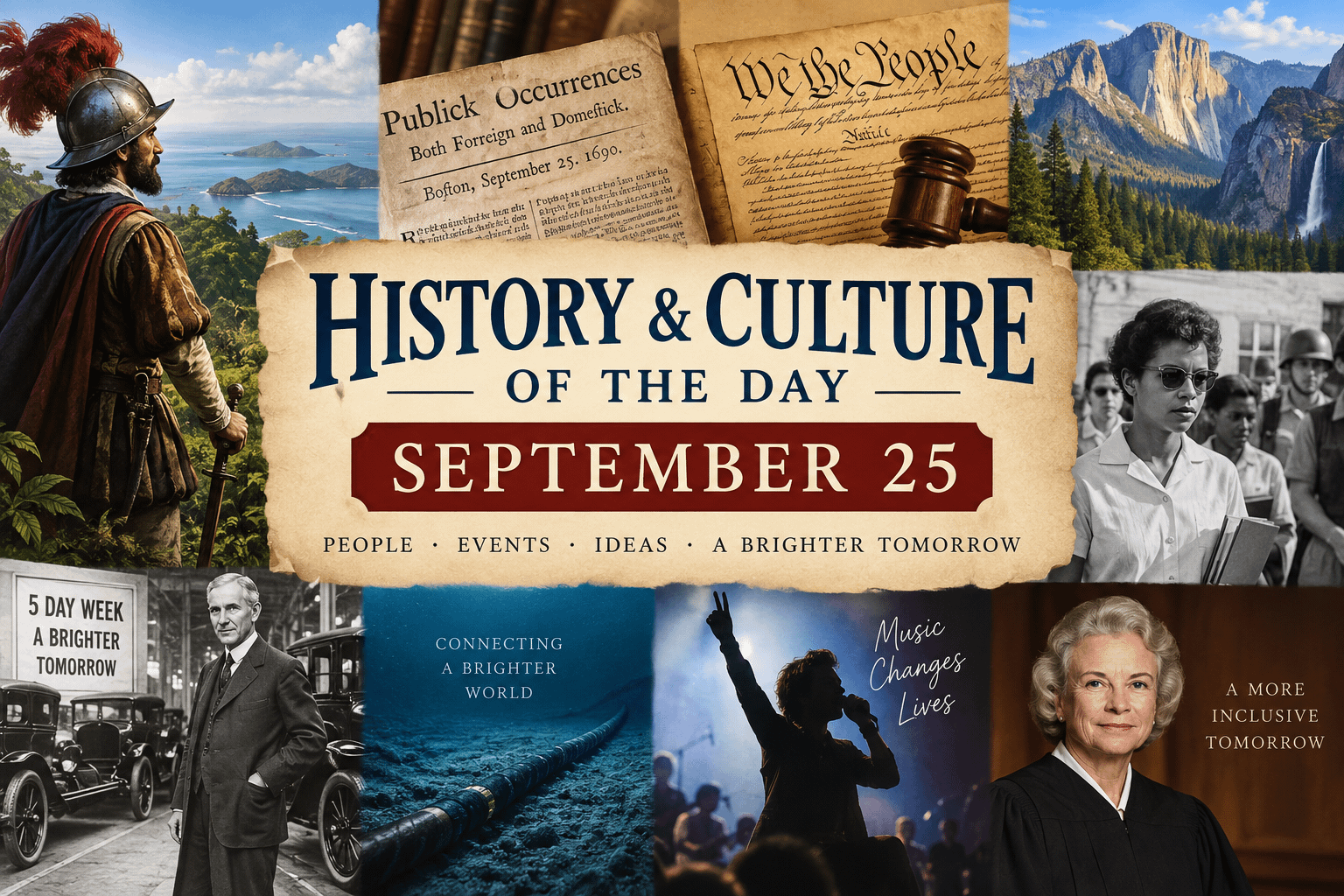
September 25 is a day filled with fascinating moments from world history, cultural change, exploration, scientific development, entertainment, and human achievement. Like every date on the calendar, September 25 offers a chance to look backward and discover how events from different generations helped create the world we know today.
Some events associated with this date changed governments and nations. Others influenced transportation, communication, music, entertainment, and popular culture. September 25 is also the birthday of several people whose work left lasting marks on society.
History is more than memorizing dates. It is the story of people making decisions, taking risks, confronting challenges, creating new ideas, and sometimes changing the course of civilization without realizing how significant their actions would eventually become.
Here is a look at some of the history and culture connected with September 25.
1513 – Vasco Núñez de Balboa Reaches the Pacific
One of the most significant events associated with September 25 occurred in 1513, during the age of European exploration.
Spanish explorer Vasco Núñez de Balboa crossed the Isthmus of Panama and became the first European known to have seen the Pacific Ocean from the Americas.
Balboa had heard stories about another great body of water beyond the mountains of Panama. He organized an expedition and traveled through extremely difficult terrain.
On September 25, he reportedly reached a mountain summit where he could see the enormous body of water stretching into the distance.
He called it the “South Sea.”
Years later, Portuguese explorer Ferdinand Magellan would give the ocean the name by which we know it today: the Pacific.
Balboa’s expedition represented an important moment in European understanding of the geography of the Americas. Europeans were gradually realizing just how enormous the newly encountered continents were—and that another vast ocean separated the Americas from Asia.
The event also represents the complicated legacy of the Age of Exploration.
European expeditions expanded geographical knowledge and created new global connections, but they were also followed by conquest, colonization, exploitation, disease, and enormous suffering among Indigenous populations.
Understanding both sides of that history gives us a more complete picture of how exploration reshaped the world.
1690 – One of America’s Earliest Newspapers Appears
September 25 also has an interesting connection to the history of journalism.
On September 25, 1690, Publick Occurrences Both Forreign and Domestick was published in Boston.
It is generally recognized as the first multi-page newspaper published in the English colonies of North America.
There was one major problem.
Colonial authorities had not approved it.
The newspaper contained reports about local and international events, and officials quickly ordered its suppression. Only one edition was published.
Although its life was extraordinarily short, the publication became an important milestone in American journalism.
It also foreshadowed a debate that would continue throughout American history: How much freedom should journalists have to report information that governments or powerful institutions would prefer to control?
Decades later, freedom of the press would become one of the fundamental principles protected by the First Amendment to the United States Constitution.
Today, news travels around the world almost instantly through websites, social media, television, podcasts, and smartphones.
The contrast with 1690 is remarkable.
A newspaper that could be shut down after a single issue helped represent the beginning of a media tradition that would eventually become a central part of American culture.
1789 – Congress Proposes the Bill of Rights
One of the most important political developments associated with September 25 occurred in 1789.
The First Congress of the United States approved twelve proposed amendments to the Constitution and sent them to the states for ratification.
Ten of those amendments were eventually ratified in 1791.
They became known collectively as the Bill of Rights.
These amendments established protections that remain central to American political and legal culture.
Among them are protections involving freedom of speech, freedom of religion, freedom of the press, peaceful assembly, due process, criminal proceedings, and other individual rights.
The Bill of Rights grew partly from concerns that the original Constitution did not provide enough explicit protection for individual liberties.
During debates over ratification of the Constitution, Anti-Federalists frequently argued that a bill of rights was necessary to protect citizens from potential abuses of federal power.
The amendments sent to the states on September 25, 1789, were an answer to many of those concerns.
More than two centuries later, Americans continue to debate exactly how these constitutional protections should be interpreted.
That ongoing debate demonstrates how documents written centuries ago can continue influencing everyday life.
1890 – Yosemite National Park Moves Closer to Protection
September 25, 1890, also played a role in the conservation history of the United States.
Congress approved legislation associated with establishing Yosemite National Park, with the measure becoming law shortly afterward.
The broader movement to protect Yosemite helped establish the idea that extraordinary natural landscapes should be preserved rather than simply developed or exploited.
Yosemite would become one of America’s most famous national parks.
Its towering granite cliffs, waterfalls, forests, giant sequoias, and dramatic valleys have inspired generations of visitors, photographers, artists, conservationists, and outdoor enthusiasts.
Naturalist John Muir became one of the most famous advocates for protecting Yosemite and other wilderness areas.
The conservation movement surrounding places like Yosemite helped change American attitudes toward wilderness.
Instead of viewing untouched land solely as territory waiting for development, conservationists argued that certain places possessed ecological, cultural, and spiritual value that deserved protection for future generations.
That philosophy eventually contributed to the growth of America’s national park system.
1926 – Henry Ford Introduces the Eight-Hour, Five-Day Workweek
September 25 also has a connection to an enormous cultural change in the American workplace.
In 1926, the Ford Motor Company adopted a five-day, 40-hour workweek for many factory employees.
At the time, six-day workweeks were common.
The shift was significant because Ford was one of the country’s most influential industrial companies.
Henry Ford understood something that went beyond factory production: workers were also consumers.
Giving employees additional leisure time created more opportunities for people to travel, shop, enjoy entertainment, and participate in recreational activities.
The five-day workweek was not created by Ford alone. Labor activists and unions had fought for shorter working hours for generations.
But Ford’s decision helped demonstrate that a major industrial corporation could operate with a shorter workweek.
Eventually, the idea of the five-day, 40-hour workweek became deeply embedded in American culture.
That is why the concept of “the weekend” carries so much cultural importance today.
Friday evening represents freedom for millions of workers because generations before them fought to reduce the amount of time people were expected to spend working.
1956 – The First Transatlantic Telephone Cable Enters Service
Imagine trying to call someone across the Atlantic Ocean before modern telecommunications.
International communication could be difficult, expensive, and unreliable.
That changed dramatically with technological advances during the twentieth century.
On September 25, 1956, the first transatlantic telephone cable system, known as TAT-1, entered service.
It connected North America and Europe through an underwater telecommunications cable.
This represented an enormous improvement in international communication.
Before submarine telephone cables, transatlantic telephone conversations relied heavily on radio technology.
The cable offered more dependable communication and helped expand the number of conversations that could occur between continents.
Today, international communication feels almost effortless.
A person can send a message, participate in a video call, share photographs, or communicate through social media with someone thousands of miles away in seconds.
TAT-1 belonged to an earlier technological revolution that helped make our interconnected world possible.
1957 – Central High School and the Struggle for Integration
September 25, 1957, became an important date in the American civil rights movement.
Nine Black students entered Little Rock Central High School in Arkansas under the protection of federal troops.
The students became known as the Little Rock Nine.
Three years earlier, the Supreme Court had ruled in Brown v. Board of Education that racial segregation in public schools was unconstitutional.
Yet implementing that ruling faced intense resistance in parts of the country.
Arkansas Governor Orval Faubus had previously used the Arkansas National Guard to prevent the students from entering Central High.
President Dwight D. Eisenhower eventually federalized the Arkansas National Guard and sent members of the 101st Airborne Division to Little Rock.
On September 25, the nine students entered the school under military protection.
The images became symbols of the struggle over school integration and civil rights.
The courage of the Little Rock Nine remains an important part of American history.
These teenagers were not simply attending classes. They were entering an environment where they faced hostility, harassment, threats, and intense public attention.
Their experiences remind us that major social changes are often carried forward by individuals willing to endure extraordinary pressure.
1965 – “Eve of Destruction” Reaches No. 1
September 25 also has an interesting place in music history.
In 1965, Barry McGuire’s protest song “Eve of Destruction” reached No. 1 on the Billboard Hot 100.
The song reflected the anxieties of the 1960s.
The Vietnam War was escalating. The Cold War created fears of nuclear conflict. Civil rights struggles were transforming American society. Younger generations were increasingly questioning political leaders and traditional institutions.
Popular music became one of the places where those frustrations were expressed.
Protest music was not simply entertainment.
Songs became cultural statements.
Artists used music to address war, racism, poverty, inequality, freedom, and political power.
That tradition continues today.
Musicians still respond to major social and political events, demonstrating that popular culture often acts as a mirror of the era in which it is created.
1976 – U2 Begins to Take Shape
September 25 also holds a special place in rock music history.
In 1976, four teenagers gathered in Dublin after drummer Larry Mullen Jr. posted a notice seeking musicians for a band.
Among those who joined were Paul Hewson, who would become known as Bono, David Evans, who became The Edge, and Adam Clayton.
The group eventually became U2.
Few people at that early rehearsal could have predicted what would follow.
U2 grew into one of the world’s most successful and recognizable rock bands.
Albums including The Joshua Tree, War, and Achtung Baby helped establish the band’s international reputation.
Their music frequently explored subjects including faith, politics, conflict, human rights, love, and personal struggle.
Their beginnings provide a wonderful reminder about creativity.
Some of the world’s biggest cultural movements start very small.
A notice asking for musicians can become a legendary rock band.
A conversation can become a company.
An idea written in a notebook can become a book.
History is often created long before anyone realizes they are making it.
1981 – Sandra Day O’Connor Becomes the First Woman on the Supreme Court
September 25, 1981, marked another historic American milestone.
Sandra Day O’Connor was sworn in as an associate justice of the United States Supreme Court.
She became the first woman to serve on the nation’s highest court.
President Ronald Reagan had nominated O’Connor earlier that year.
Her confirmation represented a significant breakthrough for women in American law and government.
For most of American history before that moment, the Supreme Court had been exclusively male.
O’Connor’s appointment demonstrated how institutions that once seemed closed to certain groups could gradually change.
She served on the Court until her retirement in 2006.
Regardless of disagreements over individual Supreme Court decisions, the historical importance of her appointment remains clear.
A barrier that had existed since the Supreme Court’s creation was finally broken.
Famous People Born on September 25
September 25 is also the birthday of several notable figures from entertainment, politics, sports, literature, and culture.
One of the most famous is actor and filmmaker Michael Douglas, born in 1944. Douglas became one of Hollywood’s most recognizable actors, appearing in movies including Wall Street, Fatal Attraction, and Basic Instinct.
Actor Will Smith was born on September 25, 1968. Smith first became widely known through music and television before developing into a major Hollywood movie star.
Writer William Faulkner was born September 25, 1897. Faulkner became one of the most influential American writers of the twentieth century and received the Nobel Prize in Literature.
Journalist and television personality Barbara Walters was born September 25, 1929. Her interviewing career helped reshape the role of women in American television journalism.
Basketball legend Scottie Pippen was born September 25, 1965. Pippen became an essential member of the Chicago Bulls teams that dominated the NBA during much of the 1990s.
Actor Catherine Zeta-Jones was born September 25, 1969—exactly 25 years after her husband, Michael Douglas.
These birthdays demonstrate the remarkable range of people connected with a single date.
How September 25 Connects Exploration, Rights, Technology, and Culture
When we examine the events connected with September 25, several themes emerge.
One is exploration.
Balboa’s expedition represented humanity’s continuing desire to discover what exists beyond the horizon.
Another is freedom.
The publication and suppression of an early American newspaper reminds us of the long struggle over freedom of the press.
The congressional approval of the amendments that became the Bill of Rights demonstrates the continuing importance of individual liberty.
The Little Rock Nine remind us that rights written into law do not automatically become reality. Sometimes people must fight—and demonstrate extraordinary courage—to make those rights meaningful.
September 25 is also about innovation.
The transatlantic telephone cable helped connect continents.
Changes in industrial working schedules contributed to the modern weekend.
And cultural developments in music demonstrated how artists can give a voice to the concerns of their generation.
Why Studying History and Culture Matters
It is easy to think of history as something finished.
It isn’t.
History continues to influence almost everything around us.
The freedoms we exercise, the technology we use, the places we protect, the music we listen to, the schools our children attend, and even the structure of the workweek have histories behind them.
Understanding those histories gives everyday life greater meaning.
The smartphone in your hand represents centuries of communication innovation.
A weekend trip to a national park connects to generations of conservation efforts.
Reading an uncensored news article connects to centuries of debate about freedom of the press.
Students attending an integrated public school are connected to young people who once needed federal troops simply to enter their classrooms.
History is never as distant as it appears.
Final Thoughts
September 25 offers an extraordinary journey through history and culture.
It takes us from Balboa looking across the Pacific in 1513 to colonial printers challenging authority in 1690. It brings us to Congress proposing amendments that would become the Bill of Rights, conservation efforts surrounding Yosemite, the development of the modern workweek, breakthroughs in international communication, the courage of the Little Rock Nine, protest music of the 1960s, the beginnings of U2, and Sandra Day O’Connor breaking a historic barrier on the Supreme Court.
Some moments changed governments.
Others changed technology.
Some changed culture.
And others changed what future generations believed was possible.
That is one of the greatest lessons history can teach us.
The world we inherit is shaped by people who came before us—but the choices we make today become part of the history inherited by those who come after us.
Which event from September 25 do you believe had the greatest impact on the world we live in today?
Leave a Reply