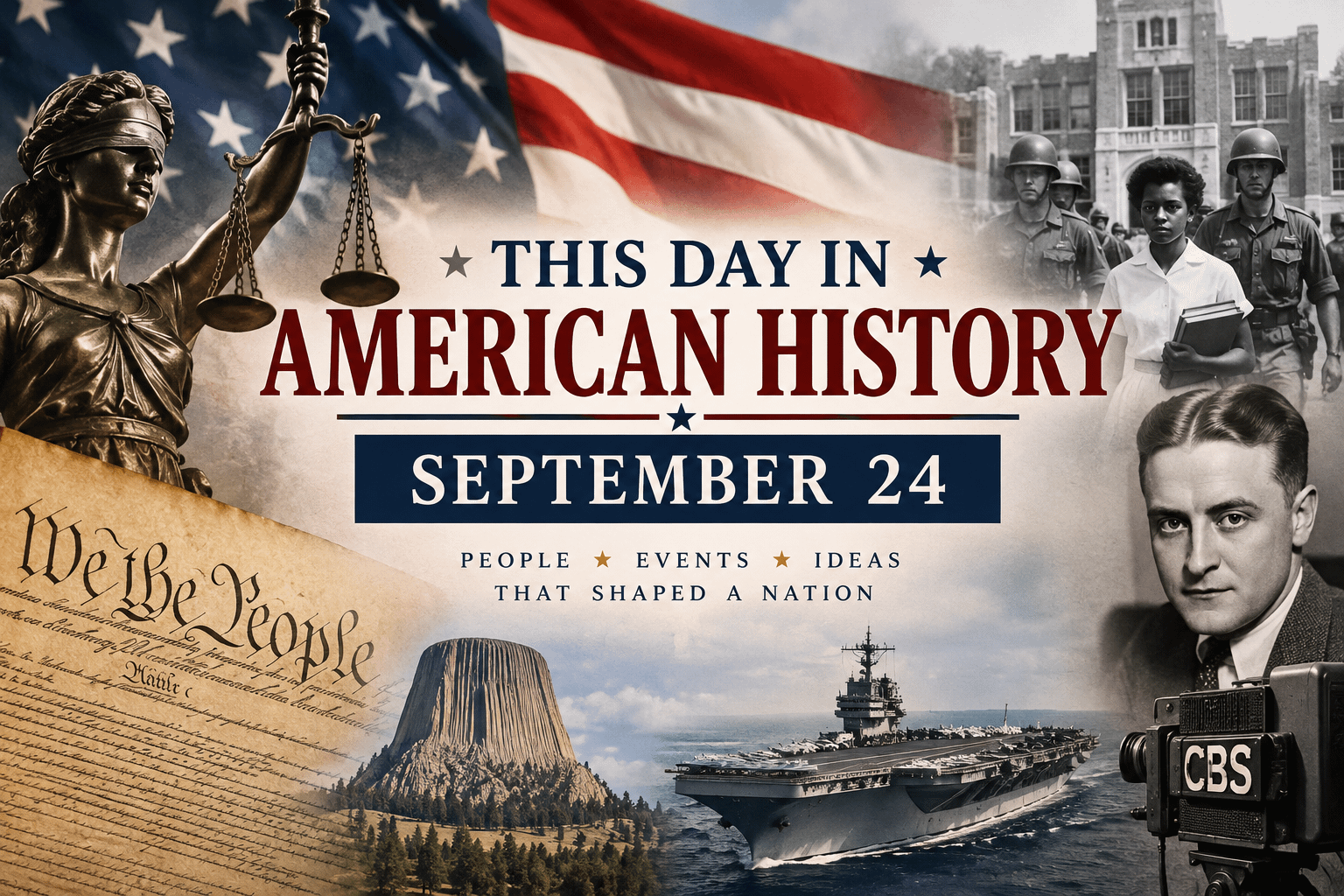
September 24 has witnessed several important moments in American history, from the creation of the federal court system to a defining confrontation during the Civil Rights Movement. It is also the birthday of one of America’s most celebrated novelists.
Looking back at September 24 shows how the United States has repeatedly wrestled with questions of law, equality, government authority, culture, and national identity.
1789 — George Washington Signs the Judiciary Act
One of the most consequential events associated with September 24 occurred in 1789, during the first year of government under the United States Constitution.
President George Washington signed the Judiciary Act of 1789 into law on September 24, providing the structure for the new nation’s federal judiciary.
The Constitution had established the judicial branch in Article III and called for a Supreme Court, but it left many important details for Congress to determine.
The Judiciary Act helped answer those questions.
The legislation established a three-part federal judiciary consisting of the Supreme Court, federal district courts, and federal circuit courts. The original Supreme Court consisted of a chief justice and five associate justices.
The law also established the office of the Attorney General of the United States.
The significance of the legislation is difficult to overstate. The Constitution may have created the judicial branch, but the Judiciary Act provided much of the framework necessary for that branch to operate.
More than two centuries later, the federal judiciary remains one of the three major branches of the United States government.
John Jay Becomes Washington’s Choice for Chief Justice
September 24, 1789, was important for another reason.
On the same day Washington signed the Judiciary Act, he nominated John Jay of New York to become the first Chief Justice of the United States. Washington also submitted nominations for the other positions on the original Supreme Court.
Jay was already a significant figure in the founding generation. He had served as president of the Continental Congress, worked as a diplomat, and helped negotiate the Treaty of Paris that formally ended the Revolutionary War.
The creation of the Supreme Court represented another important step in transforming the Constitution from a document describing a government into a government that could actually function.
Why the Judiciary Act Still Matters
It can be easy to overlook the importance of establishing courts compared with dramatic events such as wars, elections, and presidential decisions.
Yet an independent judicial system became essential to the American constitutional experiment.
Courts would eventually confront questions involving individual rights, presidential authority, congressional power, relations between states and the federal government, civil rights, elections, criminal justice, and the interpretation of the Constitution itself.
The federal court system has changed considerably since 1789, but the Judiciary Act established a basic judicial framework whose influence remains visible today.
September 24 therefore represents an important milestone in the development of American constitutional government.
1869 — Black Friday Shakes Wall Street
September 24 also became associated with one of America’s early financial panics.
On September 24, 1869, financial markets were thrown into turmoil during an episode remembered as Black Friday.
Speculators Jay Gould and James Fisk had attempted to gain control over the nation’s gold market. Their activities helped drive the price of gold upward as speculation intensified.
When the federal government intervened by selling gold, prices collapsed.
The sudden reversal created financial chaos, producing losses for investors and contributing to economic disruption.
The episode became an early demonstration of how financial speculation, political influence, government policy, and market psychology could collide with devastating consequences.
Long before the stock market crash of 1929 or the financial crisis of 2008, Black Friday of 1869 showed Americans how quickly confidence in financial markets could disappear.
1896 — F. Scott Fitzgerald Is Born
American literature also has an important connection to September 24.
F. Scott Fitzgerald was born September 24, 1896, in St. Paul, Minnesota.
Fitzgerald would eventually become one of the most recognizable American writers of the twentieth century.
His most famous novel, The Great Gatsby, published in 1925, became one of the defining literary works associated with the Jazz Age.
Through his writing, Fitzgerald explored wealth, ambition, romance, social class, disappointment, and the pursuit of the American Dream.
Interestingly, Fitzgerald was named after a distant relative: Francis Scott Key, the writer whose poem became the lyrics of “The Star-Spangled Banner.”
Fitzgerald experienced both success and struggle during his lifetime. Although his reputation declined during his later years, his literary standing increased dramatically after his death in 1940.
Today, The Great Gatsby remains widely read and studied, making Fitzgerald’s September 24 birthday another notable entry in American cultural history.
1906 — Devils Tower Becomes America’s First National Monument
September 24 also played a role in the history of conservation.
In 1906, President Theodore Roosevelt designated Devils Tower in Wyoming as the first national monument in the United States.
The designation came under the recently enacted Antiquities Act, which gave presidents authority to protect certain historic landmarks, structures, and objects of scientific or historic interest located on federal land.
The creation of the country’s first national monument represented an important development in America’s growing conservation movement.
During Theodore Roosevelt’s presidency, conservation became a significant national priority. Millions of acres of land received various forms of federal protection.
The national monument system eventually expanded across the country, protecting landscapes, archaeological sites, historic locations, and culturally important places.
What began with Devils Tower helped establish a conservation tradition that continues today.
1957 — Eisenhower Sends Federal Troops to Little Rock
One of the most dramatic events to occur on September 24 came during the struggle over school desegregation.
On September 24, 1957, President Dwight D. Eisenhower ordered members of the U.S. Army’s 101st Airborne Division into Little Rock, Arkansas, and federalized the Arkansas National Guard.
The confrontation centered on nine Black students who became known as the Little Rock Nine.
Three years earlier, the Supreme Court’s decision in Brown v. Board of Education had ruled that racial segregation in public schools was unconstitutional.
Yet implementing desegregation faced intense resistance in many communities.
Little Rock Central High School became one of the most visible battlegrounds.
Arkansas Governor Orval Faubus had previously used the Arkansas National Guard to prevent the students from entering the school.
When the Little Rock Nine entered Central High on September 23, a hostile crowd gathered outside. The situation became dangerous enough that authorities removed the students for their safety.
The crisis forced President Eisenhower to confront a fundamental question:
Would the federal government enforce federal court orders when state officials and local resistance stood in their way?
On September 24, Eisenhower acted.
He federalized the Arkansas National Guard and ordered federal soldiers into Little Rock.
That evening, Eisenhower addressed the nation from the White House and explained his decision.
The following morning, September 25, soldiers from the 101st Airborne escorted the Little Rock Nine into Central High School for their first full day of classes.
The Importance of Little Rock
The Little Rock crisis became one of the defining confrontations of the Civil Rights Movement.
It demonstrated that Supreme Court decisions alone could not necessarily guarantee change.
Court rulings sometimes required enforcement.
Eisenhower’s decision showed that the federal government was prepared to use its authority to enforce federal law and court orders despite resistance from state officials.
The images of Black students walking into school while surrounded by federal soldiers became some of the most recognizable photographs of the struggle for civil rights.
The Little Rock Nine faced harassment, threats, and hostility simply for attempting to receive an education at a previously segregated school.
Their courage helped expose the reality of segregation to Americans across the country and people around the world.
1960 — USS Enterprise Is Launched
Another important September 24 milestone involved American military and technological history.
On September 24, 1960, USS Enterprise was launched.
The ship would become famous as the world’s first nuclear-powered aircraft carrier.
Nuclear propulsion dramatically changed what was possible for large naval vessels. Instead of relying on conventional fuel in the same manner as earlier carriers, nuclear-powered ships could operate for extended periods without needing frequent refueling.
The Enterprise represented the increasing technological sophistication of the United States Navy during the Cold War.
The carrier would go on to serve for more than half a century and participate in numerous operations around the world.
Its name also carried a long naval tradition, with several American ships having previously carried the name Enterprise.
1968 — 60 Minutes Premieres
American television history changed on September 24 as well.
On September 24, 1968, CBS premiered 60 Minutes.
The program helped redefine television journalism by combining investigative reporting, interviews, profiles, and feature stories within a television newsmagazine format.
Over the decades, 60 Minutes became one of the longest-running and most recognizable news programs in American television history.
Its correspondents interviewed presidents, world leaders, celebrities, business executives, athletes, activists, whistleblowers, and ordinary people whose experiences became major national stories.
The show’s longevity demonstrates how television became an increasingly important way Americans learned about politics, culture, international affairs, and social issues during the second half of the twentieth century.
1969 — The Chicago Eight Trial Begins
On September 24, 1969, another chapter in the political and cultural turmoil of the late 1960s began when the trial commonly known as the Chicago Eight trial got underway.
The defendants had been charged following protests surrounding the 1968 Democratic National Convention in Chicago.
Demonstrations against the Vietnam War had drawn thousands of protesters to the city. Violent confrontations occurred between protesters and police, producing scenes broadcast across the nation.
The subsequent trial became almost as controversial as the protests themselves.
The defendants included prominent activists representing different parts of the antiwar and counterculture movements.
After defendant Bobby Seale’s case was separated from the others, the remaining defendants became widely known as the Chicago Seven.
The trial reflected the deep political divisions affecting the United States during the Vietnam War era.
Questions involving protest, police power, political dissent, free speech, and government authority became central to the proceedings and the larger national debate.
2017 — NFL Protests Become a National Story
September 24 also became part of a much more recent debate over protest, patriotism, race, and professional sports.
On September 24, 2017, more than 200 NFL players reportedly knelt or sat during the national anthem amid a rapidly escalating national controversy surrounding player protests.
The protests had grown from demonstrations intended to call attention to racial inequality and police treatment of Black Americans.
Supporters viewed the demonstrations as a legitimate exercise of free expression and a way to draw attention to racial injustice.
Critics argued that protesting during the national anthem showed disrespect toward the flag, military members, veterans, or the country.
The disagreement became one of the most visible cultural and political debates surrounding professional sports during the period.
Whatever one’s position, the controversy demonstrated once again how sports can become connected to much larger conversations about American identity, patriotism, race, and freedom of expression.
September 24 and the American Story
When these events are considered together, September 24 reveals several recurring themes in American history.
In 1789, the young country worked to establish a functioning federal judiciary.
In 1869, financial speculation contributed to a dramatic market panic.
In 1896, one of America’s future literary giants was born.
In 1906, the federal government took an important step toward protecting America’s natural and cultural heritage.
In 1957, federal soldiers were sent to Little Rock to enforce the constitutional rights of Black students.
In 1960, American naval technology entered a new era with USS Enterprise.
In 1968, television journalism gained a program that would become an American institution.
In 1969, the Chicago Eight trial reflected the enormous political divisions surrounding the Vietnam War and the protest movements of the era.
And in 2017, protests by professional football players became part of another national debate about race, patriotism, and freedom of expression.
History is rarely one continuous story of progress. It is made from moments when Americans disagree about what the country’s principles mean and how those principles should be applied.
September 24 offers several powerful examples.
A Day Connected by the Rule of Law
Perhaps the most striking connection can be found between the events of 1789 and 1957.
On September 24, 1789, the United States established the structure of its federal court system.
Exactly 168 years later, on September 24, 1957, a president sent federal troops into an American city in a confrontation ultimately centered on enforcing federal court orders.
Those events occurred in completely different Americas, but they share an important theme.
The rule of law matters only when the institutions created to protect it are willing to uphold it.
The founders could create courts, Congress could pass laws, judges could issue rulings, and presidents could speak about constitutional principles.
But throughout American history, the country’s greatest tests have often come when those principles had to be applied during moments of intense disagreement.
That is one reason studying history remains valuable.
History is not simply about remembering names and dates. It allows us to see how earlier generations confronted questions that continue to influence American life.
September 24 reminds us that the American story has been shaped in courtrooms, classrooms, financial markets, military institutions, television studios, literature, protest movements, and even football stadiums.
Each generation inherits institutions and ideals from the generation before it.
What happens next depends on what people choose to do with them.
Which September 24 event do you believe had the greatest impact on American history?
Leave a Reply