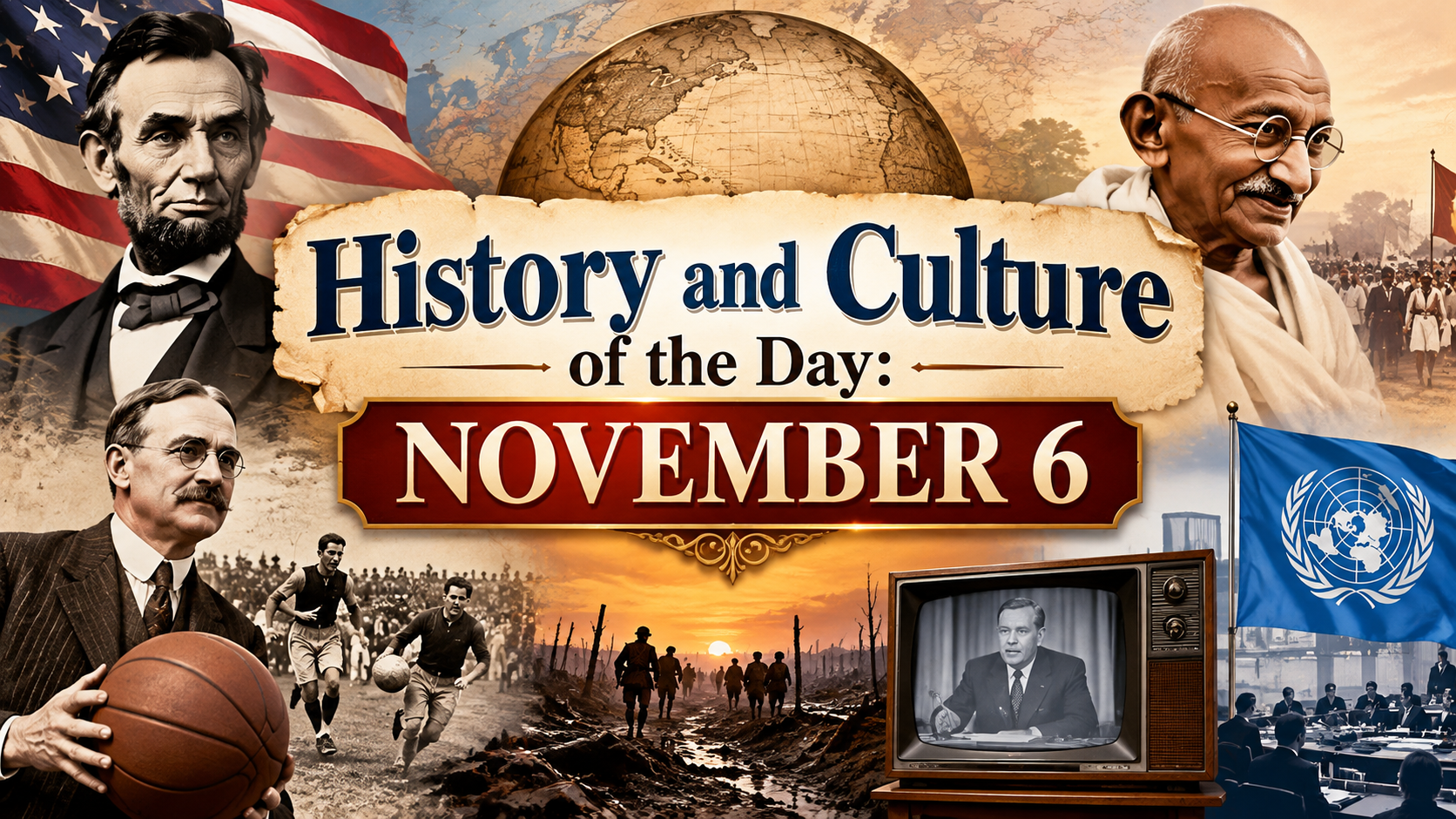
November 6 is a date filled with remarkable moments in world history. From political transformations and groundbreaking discoveries to cultural milestones and movements for equality, this day reminds us how individual decisions and collective actions can shape the future.
Throughout history, November 6 has witnessed events that changed governments, expanded human knowledge, challenged discrimination, and influenced the way people live.
Some of these moments were celebrated as victories for freedom and progress. Others revealed the struggles, conflicts, and sacrifices that accompany historical change.
Today, we explore the fascinating history and cultural significance of November 6, examining the people, events, and lasting legacies that make this date worth remembering.
1. 1860 – Abraham Lincoln Is Elected President of the United States
One of the most consequential events associated with November 6 occurred in 1860, when Abraham Lincoln was elected the 16th president of the United States.
Lincoln’s election came during a period of extraordinary national division over slavery, states’ rights, and the future of the country.
Representing the newly established Republican Party, Lincoln opposed the expansion of slavery into western territories. His victory alarmed many Southern political leaders who believed their economic and political interests were threatened.
Why Lincoln’s Election Was Important
Lincoln’s election helped accelerate the secession crisis that ultimately led to the American Civil War in 1861.
Although Lincoln’s initial position focused on preventing slavery’s expansion, the Civil War eventually became a struggle that resulted in the abolition of slavery throughout the United States.
His leadership during the war, the Emancipation Proclamation of 1863, and his support for the 13th Amendment transformed American history.
Cultural Significance
Lincoln’s presidency continues to influence discussions about democracy, equality, national unity, and leadership during difficult times.
His story also demonstrates how elections can become turning points in a nation’s history.
Historical lesson: Leadership is often tested most severely when a country faces division and uncertainty.
2. 1861 – James Naismith Is Born, the Inventor of Basketball
November 6, 1861, marks the birth of James Naismith in Almonte, Canada West, now part of Ontario.
Naismith was a physical education instructor who would eventually invent one of the world’s most popular sports.
In December 1891, while working at the International YMCA Training School in Springfield, Massachusetts, he developed basketball as an indoor activity to keep students physically active during the winter.
The original game involved peach baskets, a soccer ball, and 13 basic rules.
How Basketball Changed Sports Culture
What began as a simple indoor exercise developed into an international sport played by millions.
Basketball became an important part of school athletics, community recreation, professional entertainment, and international competition.
The sport also helped create opportunities for athletes from different backgrounds to achieve recognition.
Today, basketball influences fashion, music, entertainment, and popular culture far beyond the court.
Naismith’s Lasting Legacy
Naismith’s invention demonstrates how an ordinary problem can inspire an extraordinary solution.
His goal was simply to create an engaging winter activity, yet his idea eventually became a global cultural phenomenon.
Historical lesson: Innovation does not always begin with grand ambitions. Sometimes the smallest ideas create the greatest impact.
3. 1869 – The First College Football Game Is Played
On November 6, 1869, Rutgers College and the College of New Jersey, now Princeton University, played what is widely recognized as the first intercollegiate American football game.
The historic contest took place in New Brunswick, New Jersey, with Rutgers winning 6–4.
However, the game looked very different from modern American football.
Players used a round ball, and the rules more closely resembled soccer than the football Americans watch today.
The Beginning of a Sporting Tradition
College football gradually evolved into one of America’s most recognizable sporting traditions.
Universities developed rivalries, stadiums attracted enormous crowds, and championship games became major national events.
Football also influenced American culture through marching bands, cheerleading, homecoming celebrations, and community pride.
Why This Event Matters
The original Rutgers-Princeton contest demonstrates how sports evolve over generations.
What started as a relatively small competition between two colleges eventually helped inspire a multibillion-dollar sporting industry.
College football remains closely connected to school identity, regional traditions, and family gatherings.
Historical lesson: Traditions that bring communities together often begin with surprisingly modest events.
4. 1913 – Mahatma Gandhi Is Arrested During a Protest in South Africa
On November 6, 1913, Mahatma Gandhi was arrested while leading a protest march involving Indian workers in South Africa.
At the time, Indian communities faced discriminatory laws, restrictions on movement, and unequal treatment.
Gandhi organized peaceful resistance against these policies, encouraging people to challenge injustice without resorting to violence.
His arrest became an important moment in the development of his philosophy of nonviolent civil disobedience.
The Power of Peaceful Resistance
Gandhi believed that people could challenge unjust systems through organized noncooperation, peaceful protest, and personal sacrifice.
His experiences in South Africa helped shape the methods he later used during India’s independence movement.
Those principles would influence future civil rights leaders and movements around the world.
Cultural Significance
Gandhi’s campaigns demonstrated that resistance does not always require physical force.
Peaceful movements can challenge powerful institutions by drawing public attention to injustice and demanding accountability.
Historical lesson: Courage is not always demonstrated through confrontation. Sometimes it is demonstrated through peaceful determination.
5. 1917 – The Battle of Passchendaele Reaches Its Final Major Objective
November 6, 1917, marked the Canadian capture of Passchendaele village in Belgium during World War I.
The battle, part of the Third Battle of Ypres, became infamous for its terrible conditions.
Soldiers fought through devastated landscapes, deep mud, flooded trenches, and relentless artillery fire.
The fighting caused enormous casualties on both sides.
Why Passchendaele Is Remembered
Passchendaele became a symbol of the suffering endured by soldiers during trench warfare.
The battle highlighted the human cost of military offensives that produced relatively limited territorial gains.
For Canada, the battle remains an important chapter in military history because of the sacrifices made by Canadian troops.
Its Cultural Legacy
Today, Passchendaele is remembered through memorials, museums, literature, and annual remembrance ceremonies.
Its history encourages reflection on the experiences of ordinary soldiers and the consequences of prolonged warfare.
Historical lesson: Remembering war means recognizing not only military outcomes but also the human lives affected by them.
6. 1947 – Meet the Press Makes Its Television Debut
On November 6, 1947, Meet the Press made its television debut on NBC.
Created and initially hosted by journalist Martha Rountree, the program became one of the most influential political interview shows in American broadcasting.
Its format brought journalists and public officials together for discussions about government, national policy, and current events.
How Television Changed Political Culture
Before television became widespread, Americans relied heavily on newspapers and radio for political information.
Television introduced a new way for citizens to observe political leaders and hear their responses to difficult questions.
Programs such as Meet the Press helped establish political interviews as a regular part of American media.
Why It Matters Today
The program’s longevity demonstrates the continuing importance of political journalism.
Its history also reflects changes in media technology, public expectations, and the relationship between elected officials and the press.
Historical lesson: An informed society depends on opportunities to question leaders and examine important decisions.
7. 1962 – The United Nations Condemns Apartheid in South Africa
On November 6, 1962, the United Nations General Assembly adopted Resolution 1761, condemning South Africa’s apartheid system.
Apartheid was a government-enforced system of racial segregation and discrimination that denied South Africa’s nonwhite population fundamental political and civil rights.
The resolution called on member nations to take measures against South Africa’s discriminatory policies, including restrictions on economic and military relations.
A Global Stand Against Racial Discrimination
The resolution represented an important international statement against institutionalized racial inequality.
Although apartheid continued for decades afterward, international pressure became an important part of the broader struggle against the system.
South African activists, including Nelson Mandela and many other anti-apartheid leaders, continued working toward democratic change.
In 1994, South Africa held its first national democratic elections based on universal adult suffrage.
Cultural Significance
The international opposition to apartheid demonstrated how human rights struggles can extend beyond national borders.
Artists, athletes, students, religious organizations, and political movements participated in campaigns calling for change.
Historical lesson: Meaningful progress toward equality often requires sustained effort across generations.
8. 1975 – Morocco’s Green March Begins
November 6, 1975, marked the beginning of Morocco’s Green March into Western Sahara, then administered by Spain.
Organized by King Hassan II, the march involved approximately 350,000 Moroccan civilians.
The participants carried Moroccan flags and religious symbols in a demonstration intended to reinforce Morocco’s territorial claims.
The Historical Background
Western Sahara was approaching the end of Spanish colonial administration.
Morocco claimed sovereignty over the territory, while the Sahrawi independence movement sought self-determination.
The Green March became a major event in Morocco’s national history, but the territory’s political status remained disputed.
Cultural Significance
Morocco commemorates November 6 as Green March Day, a national occasion associated with patriotism and national identity.
For Sahrawis seeking independence, however, the same historical period represents the beginning of a prolonged struggle over sovereignty and self-determination.
The contrasting perspectives demonstrate how one historical event can carry very different meanings for different communities.
Historical lesson: Understanding history requires listening to the experiences and perspectives of everyone affected.
9. 1985 – The Palace of Justice Siege Shakes Colombia
On November 6, 1985, members of Colombia’s M-19 guerrilla movement seized the Palace of Justice in Bogotá.
The building housed the country’s Supreme Court and other judicial institutions.
The attackers took hostages, and Colombian security forces launched a military operation to retake the building.
The confrontation continued into the following day and resulted in more than 100 deaths, including 11 Supreme Court justices.
A National Tragedy
The siege became one of the most painful events in modern Colombian history.
Questions about the actions of the guerrillas, the military response, missing persons, and government accountability continued long after the fighting ended.
Families of victims spent years seeking answers and justice.
Why This Event Matters
The tragedy raised serious questions about democratic institutions, human rights, and the protection of civilians during armed conflict.
It remains an important subject in Colombian historical memory.
Historical lesson: Justice requires accountability, particularly when public institutions and human lives are at stake.
10. 1999 – Australia Votes Against Becoming a Republic
On November 6, 1999, Australians participated in a national referendum on whether the country should become a republic.
The proposed constitutional changes would have replaced the British monarch as Australia’s head of state with a president chosen by a two-thirds majority of the Australian Parliament.
Voters rejected the proposal, with approximately 55% voting against it.
Why the Referendum Was Important
The referendum reflected a continuing national conversation about Australian identity, independence, and constitutional government.
Supporters of a republic argued that Australia should have an Australian head of state.
Opponents included supporters of the existing constitutional monarchy and people who preferred a different method of selecting a president.
Cultural Significance
The vote demonstrated how a country can debate its national identity while maintaining democratic institutions.
It also highlighted the importance of the specific constitutional model being proposed, not simply the broader idea of political change.
Historical lesson: Democratic decisions often involve more than choosing between two ideas. The details of proposed reforms matter.
Famous People Born on November 6
November 6 is also the birthday of several influential individuals whose contributions helped shape sports, entertainment, literature, and culture.
| Year | Person | Known for |
|---|---|---|
| 1814 | Adolphe Sax | Inventing the saxophone |
| 1854 | John Philip Sousa | American composer and bandleader |
| 1861 | James Naismith | Inventing basketball |
| 1946 | Sally Field | Award-winning actress |
| 1955 | Maria Shriver | Journalist and author |
| 1970 | Ethan Hawke | Actor, writer, and filmmaker |
| 1969 | Colson Whitehead | Pulitzer Prize-winning novelist |
| 1988 | Emma Stone | Academy Award-winning actress |
These individuals demonstrate how cultural influence can emerge through creativity, athletic innovation, storytelling, and public service.
Cultural Traditions and Observances on November 6
Beyond historical events, November 6 carries cultural and international significance through several annual observances.
International Day for Preventing the Exploitation of the Environment in War and Armed Conflict
Recognized by the United Nations, this observance draws attention to the environmental destruction caused by warfare.
Armed conflicts can damage forests, contaminate water supplies, destroy agricultural land, and leave communities facing environmental problems for generations.
The day encourages greater awareness of environmental protection during and after conflicts.
Swedish Heritage Day in Finland
November 6 is celebrated as Swedish Heritage Day in Finland.
The observance recognizes the country’s Swedish-speaking population and the contributions of Swedish language and culture to Finnish society.
It highlights Finland’s bilingual heritage and the importance of preserving cultural diversity.
Gustavus Adolphus Day
November 6 is also associated with the remembrance of King Gustavus Adolphus of Sweden, who died during the Battle of Lützen in 1632.
The date is commemorated in Sweden and among some Swedish-speaking communities in Finland.
In parts of Sweden, traditional Gustavus Adolphus pastries are associated with the occasion.
These observances show how November 6 connects global concerns, national identity, and long-standing cultural traditions.
What November 6 Teaches Us About History
When we examine the events of November 6, several important themes emerge.
Leadership Can Change the Direction of Nations
Abraham Lincoln’s election and Australia’s constitutional referendum demonstrate how political decisions can influence national identity and future generations.
Leadership involves difficult choices, public responsibility, and an understanding of the consequences of change.
Equality Requires Persistence
Gandhi’s resistance campaigns and the international movement against apartheid remind us that equality has often required years of sacrifice and determination.
Social progress rarely happens through a single event.
It develops through sustained efforts by individuals, communities, and organizations.
Innovation Can Transform Everyday Life
James Naismith’s invention of basketball illustrates how creativity can produce cultural changes that extend far beyond an inventor’s original intentions.
New ideas can influence education, entertainment, economics, and social connections.
History Must Remember Human Suffering
The Battle of Passchendaele and Colombia’s Palace of Justice siege remind us that historical events are not merely dates and statistics.
Behind every major conflict are individuals, families, and communities whose lives were permanently changed.
Remembering those experiences is essential to understanding the past.
Culture Connects Generations
From traditional observances to sporting rivalries and television programs, cultural institutions help preserve shared memories.
They allow younger generations to understand the values, experiences, and achievements of those who came before them.
Why Learning About History and Culture Matters
History provides more than a record of past events.
It helps explain why societies function as they do, how cultural traditions develop, and why certain conflicts and debates continue today.
Studying history can encourage critical thinking, empathy, and an appreciation for different perspectives.
It also reminds us that many rights and opportunities people enjoy today emerged from difficult struggles.
Understanding those struggles helps us recognize the importance of protecting human dignity, preserving cultural heritage, and learning from past mistakes.
The history of November 6 demonstrates that progress can emerge through political leadership, peaceful resistance, creative innovation, and collective determination.
It also shows that progress is not always straightforward.
Some events create immediate change, while others begin conversations that continue for decades.
Final Thoughts: Remembering November 6
November 6 stands as a powerful reminder that every day carries stories worth remembering.
From Abraham Lincoln’s election in 1860 to the first college football game in 1869, from Gandhi’s peaceful resistance to the international condemnation of apartheid, this date connects moments of political change, cultural development, courage, and human struggle.
Some events changed nations. Others changed the way people play sports, consume news, or understand their cultural identities.
Together, they reveal how history is shaped by countless decisions, discoveries, and acts of determination.
The greatest value of remembering history is not simply knowing what happened. It is understanding why those events mattered and what they can teach us about the present.
History is more than the story of yesterday. It is a collection of lessons that can help us build a better tomorrow.
Which historical event from November 6 do you believe had the greatest impact on the world, and why?



Leave a Reply