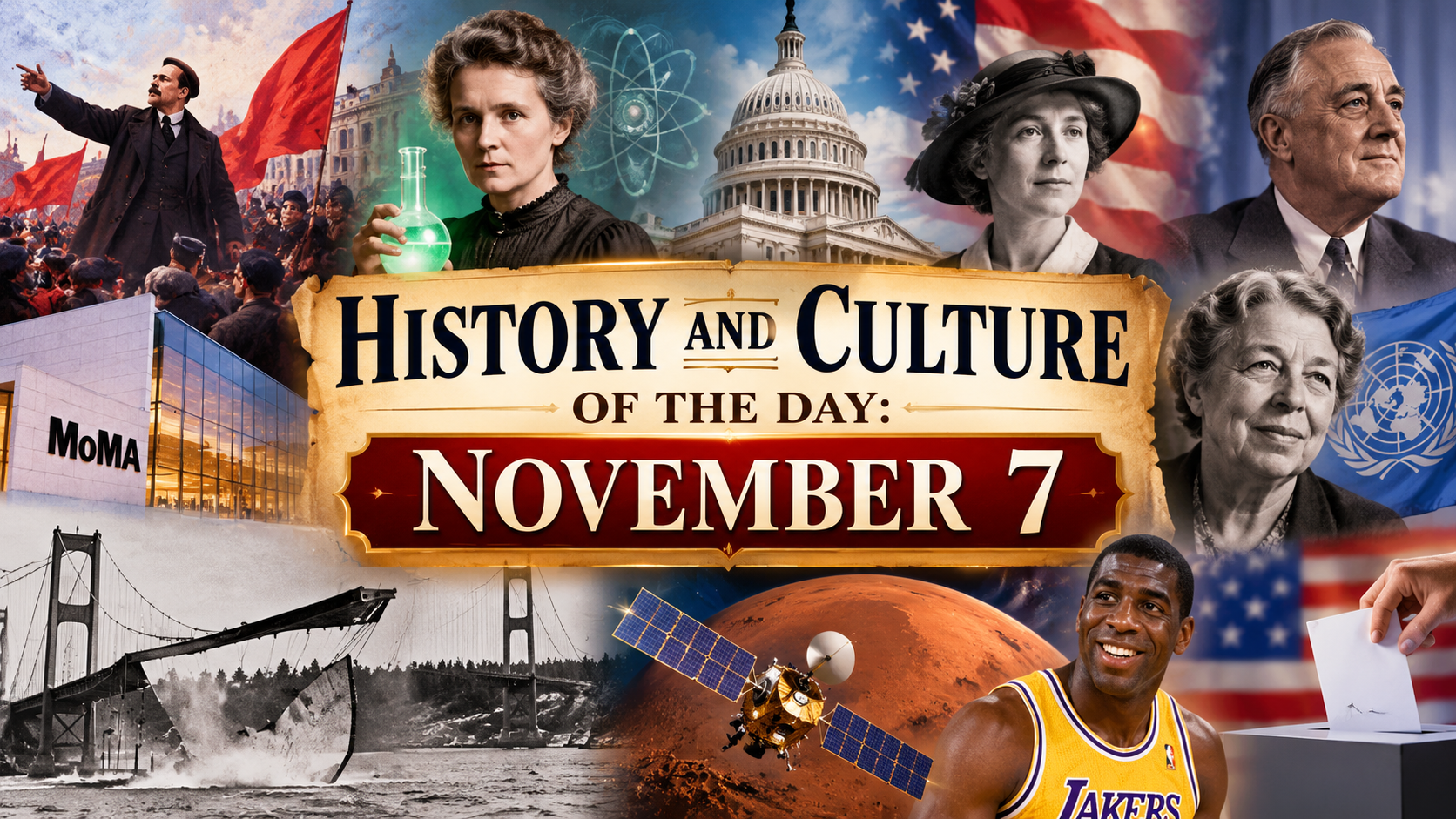
November 7 is a date filled with remarkable moments that have shaped world history, influenced cultures, challenged governments, and transformed the way people live. From political revolutions and scientific discoveries to groundbreaking achievements in literature, technology, and entertainment, this day reminds us that history is constantly being written.
Throughout the centuries, November 7 has witnessed events that changed nations, inspired generations, and left lasting marks on society. Some brought hope and progress, while others revealed the struggles and conflicts that shaped the modern world.
In today’s History and Culture of the Day, we explore the important events, influential people, and cultural milestones associated with November 7.
1. 1917 – The Russian Revolution Changes World History
One of the most significant events associated with November 7 occurred in 1917, when the Bolsheviks, led by Vladimir Lenin, seized power in Petrograd, Russia.
Known as the October Revolution because Russia was still using the Julian calendar, the uprising took place on November 7 according to the Gregorian calendar used in much of the world today.
The revolution overthrew Russia’s provisional government and paved the way for the establishment of a communist state.
Why It Matters
The Russian Revolution transformed global politics throughout the twentieth century. It eventually led to the creation of the Soviet Union in 1922 and influenced political movements across Europe, Asia, Africa, and Latin America.
Its consequences included major changes in economic systems, international relations, and political ideology.
The revolution also set the stage for decades of tension between communist and capitalist nations, particularly during the Cold War.
Historical lesson: Political movements can reshape entire societies, but the consequences of revolution often extend far beyond the original intentions of those involved.
2. 1867 – Marie Curie Is Born: A Pioneer of Modern Science
On November 7, 1867, Marie Curie was born in Warsaw, Poland, which was then under Russian rule.
Curie became one of the most influential scientists in history through her groundbreaking research into radioactivity.
Working alongside her husband, Pierre Curie, she helped discover the elements polonium and radium.
Her achievements were extraordinary during an era when women faced major barriers in higher education and scientific research.
Her Historic Accomplishments
-
In 1903, she became the first woman to receive a Nobel Prize, sharing the Nobel Prize in Physics.
-
In 1911, she received the Nobel Prize in Chemistry.
-
She became the first person to win two Nobel Prizes.
-
Her research helped establish the scientific foundations for important medical and technological advances.
Curie’s work influenced the development of cancer treatments, medical imaging, and nuclear science.
Cultural significance: Marie Curie challenged expectations about women’s roles in science and inspired generations of researchers to pursue knowledge regardless of social barriers.
3. 1916 – Jeannette Rankin Becomes the First Woman Elected to Congress
On November 7, 1916, Jeannette Rankin of Montana made history by becoming the first woman elected to the United States Congress.
Her victory occurred four years before the ratification of the Nineteenth Amendment, which prohibited denying voting rights on the basis of sex nationwide.
Rankin was a dedicated advocate for women’s rights, peace, and social reform.
She believed women deserved equal opportunities to participate in government and influence decisions affecting their communities.
Why Her Election Was Historic
Rankin’s election represented a major breakthrough in American democracy.
At a time when women were still fighting for voting rights in many states, she demonstrated that women could successfully compete for national political office.
She later became known for voting against American participation in both World War I and World War II.
Although her positions were controversial, Rankin remained committed to her beliefs.
Historical lesson: Meaningful social progress often begins with individuals willing to challenge established traditions.
4. 1929 – The Museum of Modern Art Opens in New York City
On November 7, 1929, the Museum of Modern Art opened to the public.
Known around the world as MoMA, the museum became one of the most influential institutions dedicated to modern and contemporary art.
Its founding came during a period when artistic movements were challenging traditional ideas about creativity, beauty, and expression.
A New Era for Artistic Expression
The museum helped introduce American audiences to groundbreaking artists and artistic movements.
Its collections would eventually include works by:
-
Vincent van Gogh
-
Pablo Picasso
-
Henri Matisse
-
Salvador Dalí
-
Frida Kahlo
-
Andy Warhol
MoMA expanded public appreciation for painting, sculpture, photography, architecture, film, and design.
It also encouraged people to consider art as a reflection of changing societies and cultural values.
Cultural significance: Art preserves the emotions, struggles, and ideas of different generations, helping future audiences understand the world through creative expression.
5. 1940 – The Tacoma Narrows Bridge Collapse Changes Engineering
On November 7, 1940, the original Tacoma Narrows Bridge collapsed during strong winds in Washington State.
The bridge had opened just four months earlier.
Nicknamed Galloping Gertie, it became famous for its unusual movements during windy weather.
On the morning of November 7, the bridge began twisting dramatically before sections of its roadway collapsed into the water below.
Remarkably, no human lives were lost.
What Engineers Learned
The disaster became an important case study in structural engineering.
Engineers investigated how wind interacts with large, flexible structures and how aerodynamic instability can cause catastrophic failure.
The lessons influenced future suspension bridge designs, wind testing, and construction standards.
Footage of the collapse remains widely used in engineering education.
Historical lesson: Even major failures can produce knowledge that improves safety and prevents future disasters.
6. 1944 – Franklin D. Roosevelt Wins an Unprecedented Fourth Term
On November 7, 1944, President Franklin D. Roosevelt won reelection to an unprecedented fourth presidential term.
The United States was deeply involved in World War II, and voters faced important decisions about leadership during a global conflict.
Roosevelt defeated Republican candidate Thomas E. Dewey.
His victory reflected public confidence in his wartime leadership, although Americans continued to debate his domestic and international policies.
A Presidency That Changed America
Roosevelt had already guided the country through much of the Great Depression and introduced New Deal programs that expanded the federal government’s role in economic and social affairs.
His administration also played a central role in the Allied war effort.
Roosevelt died in April 1945, only months after beginning his fourth term.
The Twenty-Second Amendment, ratified in 1951, later established a general limit of two elected presidential terms.
Historical significance: Roosevelt’s presidency reshaped expectations about presidential leadership, government responsibility, and America’s role in world affairs.
7. 1962 – Eleanor Roosevelt’s Legacy Comes to an End
On November 7, 1962, Eleanor Roosevelt died at the age of 78.
As First Lady from 1933 to 1945, she transformed the public role of the president’s spouse.
Rather than limiting herself to ceremonial responsibilities, she became an outspoken advocate for civil rights, women’s opportunities, and social justice.
After Franklin D. Roosevelt’s death, she continued working internationally.
Her Contributions to Human Rights
Eleanor Roosevelt served as chair of the United Nations Commission on Human Rights and played an important role in the development of the Universal Declaration of Human Rights, adopted in 1948.
Her advocacy helped establish the importance of human dignity and fundamental freedoms in international discussions.
She also used newspaper columns, speeches, and public appearances to encourage civic participation.
Cultural significance: Eleanor Roosevelt demonstrated that leadership can come through compassion, advocacy, and a willingness to speak for those whose voices are often overlooked.
8. 1967 – Public Broadcasting Gains a New Foundation
On November 7, 1967, President Lyndon B. Johnson signed the Public Broadcasting Act of 1967.
The legislation established the Corporation for Public Broadcasting, creating a major new framework for supporting noncommercial educational radio and television in the United States.
The law reflected a growing belief that broadcasting could serve purposes beyond entertainment and advertising.
The Cultural Impact
Public broadcasting helped expand access to educational programming, documentaries, news, children’s entertainment, and cultural productions.
The legislation laid important groundwork for the development of PBS and NPR in subsequent years.
Programs supported through public broadcasting introduced generations of Americans to science, literature, music, history, and educational storytelling.
Historical lesson: Access to educational and cultural programming can enrich communities and help people develop a deeper understanding of the world.
9. 1989 – Historic Political Victories Break Racial Barriers
November 7, 1989, marked two important milestones in American political history.
In Virginia, L. Douglas Wilder became the first African American elected governor of a U.S. state.
That same day, David Dinkins was elected New York City’s first African American mayor.
These victories represented significant advances in political representation.
Why These Elections Mattered
Both leaders achieved historic victories in a country still confronting the lasting consequences of racial discrimination.
Their elections demonstrated the growing opportunities for African Americans to hold influential positions in government.
They also reflected decades of work by civil rights activists, community organizers, and voters seeking broader representation.
While these achievements did not eliminate inequality, they marked important steps toward a more inclusive political system.
Cultural significance: Representation in leadership can challenge long-standing barriers and inspire future generations to participate in public service.
10. 1991 – Magic Johnson Changes the Conversation About HIV/AIDS
On November 7, 1991, basketball superstar Magic Johnson announced that he had tested positive for HIV.
He also announced his retirement from the Los Angeles Lakers.
The announcement shocked the sports world and brought enormous public attention to HIV/AIDS.
During the early 1990s, misinformation and stigma surrounding HIV remained widespread.
Many people incorrectly believed the virus affected only certain communities or could be transmitted through ordinary casual contact.
A Turning Point in Public Awareness
Johnson’s announcement challenged misconceptions about who could contract HIV.
He became an influential advocate for education, prevention, and public awareness.
His continued public life also helped challenge assumptions about what an HIV diagnosis meant for a person’s future.
Medical advances since 1991 have dramatically improved treatment. With effective antiretroviral therapy, many people living with HIV can enjoy long, healthy lives.
Historical lesson: Public education and compassion are essential when confronting disease, fear, and misinformation.
11. 1996 – NASA Launches the Mars Global Surveyor
On November 7, 1996, NASA launched the Mars Global Surveyor spacecraft on a mission to study Mars.
The spacecraft was designed to investigate the planet’s surface, atmosphere, magnetic properties, and geological history.
It became one of NASA’s most successful Mars exploration missions.
Expanding Humanity’s Understanding of Mars
Mars Global Surveyor produced detailed images and measurements that helped scientists better understand the Red Planet.
Its observations contributed to research into Martian landforms, climate history, and evidence of past water-related activity.
The mission also helped scientists plan future Mars exploration.
Although communication with the spacecraft ended in 2006, its scientific contributions continued to influence planetary research.
Historical significance: Space exploration demonstrates humanity’s enduring curiosity and willingness to investigate worlds beyond our own.
12. 2000 – An American Presidential Election Captures the World’s Attention
On November 7, 2000, Americans voted in one of the closest and most controversial presidential elections in modern United States history.
The race between George W. Bush and Al Gore remained unresolved on election night.
The outcome depended heavily on Florida, where extremely close vote totals led to recounts, legal challenges, and national debate.
A Defining Moment in Electoral History
The election ultimately reached the United States Supreme Court.
In December 2000, the Court’s decision in Bush v. Gore effectively ended the disputed recount, leaving Bush ahead in Florida’s certified results.
Al Gore conceded the election, and George W. Bush became the 43rd president.
The controversy sparked renewed national attention to election administration, voting equipment, recount procedures, and public confidence in democratic institutions.
Historical lesson: Elections depend not only on voter participation but also on transparent, accurate, and trusted systems for counting votes.
Famous People Born on November 7
November 7 is also the birthday of several influential figures whose contributions shaped science, literature, music, and popular culture.
| Year | Person | Historical or cultural contribution |
|---|---|---|
| 1728 | James Cook | British explorer and navigator whose voyages transformed European geographical knowledge |
| 1867 | Marie Curie | Nobel Prize-winning scientist and pioneer of radioactivity research |
| 1879 | Leon Trotsky | Revolutionary leader and influential figure in early Soviet history |
| 1888 | C. V. Raman | Nobel Prize-winning physicist known for the Raman effect |
| 1913 | Albert Camus | French-Algerian writer and philosopher, author of The Stranger |
| 1918 | Billy Graham | Influential American Christian evangelist |
| 1943 | Joni Mitchell | Celebrated Canadian singer-songwriter known for poetic lyrics and musical innovation |
| 1996 | Lorde | New Zealand singer-songwriter known for her distinctive alternative pop sound |
These individuals remind us that cultural influence takes many forms.
Scientists expand our understanding of the natural world. Writers challenge how we think. Musicians express emotions that connect people across generations. Religious leaders, explorers, and political figures influence how societies develop.
Their achievements continue to shape conversations long after their birth dates.
How November 7 Reflects Changes in World Culture
Looking across the historical events of November 7 reveals several themes that connect different generations.
The Power of Political Change
From the Russian Revolution to historic American elections, November 7 demonstrates how political decisions can alter the direction of nations.
Some changes happen through elections and democratic participation, while others emerge through revolution and conflict.
Understanding these differences helps us appreciate the complexity of political history.
The Importance of Scientific Discovery
Marie Curie’s achievements and NASA’s exploration of Mars show how scientific curiosity can transform human knowledge.
Discoveries often begin with questions that seem impossible to answer.
Over time, research, experimentation, and perseverance can lead to advances that benefit millions of people.
The Evolution of Social Equality
The achievements of Jeannette Rankin, Eleanor Roosevelt, Douglas Wilder, and David Dinkins reflect the long struggle for greater representation and equal opportunity.
Progress rarely occurs all at once.
Instead, it develops through generations of advocacy, changing attitudes, and individuals willing to challenge unfair systems.
The Influence of Art and Communication
The opening of the Museum of Modern Art and the creation of a national framework for public broadcasting highlight the importance of culture in everyday life.
Art, education, literature, and media help communities preserve their stories while encouraging new ways of thinking.
Culture is not simply entertainment. It is also a record of humanity’s beliefs, challenges, hopes, and creativity.
Why Studying History and Culture Matters
History provides more than a collection of names, dates, and famous events.
It helps explain why the world looks the way it does today.
When we study the past, we begin to understand how political systems developed, how scientific discoveries changed daily life, and how social movements challenged injustice.
We also learn that progress is rarely simple.
Some historical achievements were accompanied by conflict, controversy, or unintended consequences.
Recognizing those complexities allows us to appreciate accomplishments without overlooking the experiences of people affected by them.
History also reminds us that ordinary people contribute to extraordinary change.
Every generation inherits the achievements and challenges of those who came before it. The choices people make today will eventually become part of the historical record studied by future generations.
Lessons We Can Learn From November 7
Several valuable lessons emerge from the events remembered on this date.
1. Courage can challenge established barriers. Jeannette Rankin’s election demonstrated that determined individuals can open doors once considered closed.
2. Knowledge grows through persistence. Marie Curie’s scientific achievements show how dedication to research can change humanity’s understanding of the world.
3. Failure can inspire innovation. The Tacoma Narrows Bridge collapse helped engineers improve their understanding of structural safety.
4. Representation matters. Historic political victories in 1989 demonstrated how expanding leadership opportunities can reshape public expectations.
5. Education can overcome fear. Magic Johnson’s HIV announcement helped bring important health information into national conversations.
6. Culture connects generations. Museums, literature, music, and educational broadcasting preserve ideas and experiences that might otherwise be forgotten.
These lessons remain relevant because the challenges of the past often resemble questions societies continue to face today.
Final Thoughts: Remembering November 7
November 7 is a powerful reminder that history is shaped by discovery, determination, creativity, leadership, and change.
From the Russian Revolution to the scientific legacy of Marie Curie, from groundbreaking political victories to the exploration of Mars, this date represents many different chapters in humanity’s ongoing story.
Some moments brought extraordinary progress. Others revealed mistakes, divisions, and difficult lessons.
Together, they demonstrate why remembering history matters.
By understanding the events that shaped previous generations, we can better appreciate the freedoms, opportunities, knowledge, and cultural traditions that influence our lives today.
Every day offers an opportunity to learn from the past, contribute something meaningful to the present, and help create a better future.
Which historical event from November 7 do you believe had the greatest impact on the world, and why?


Leave a Reply