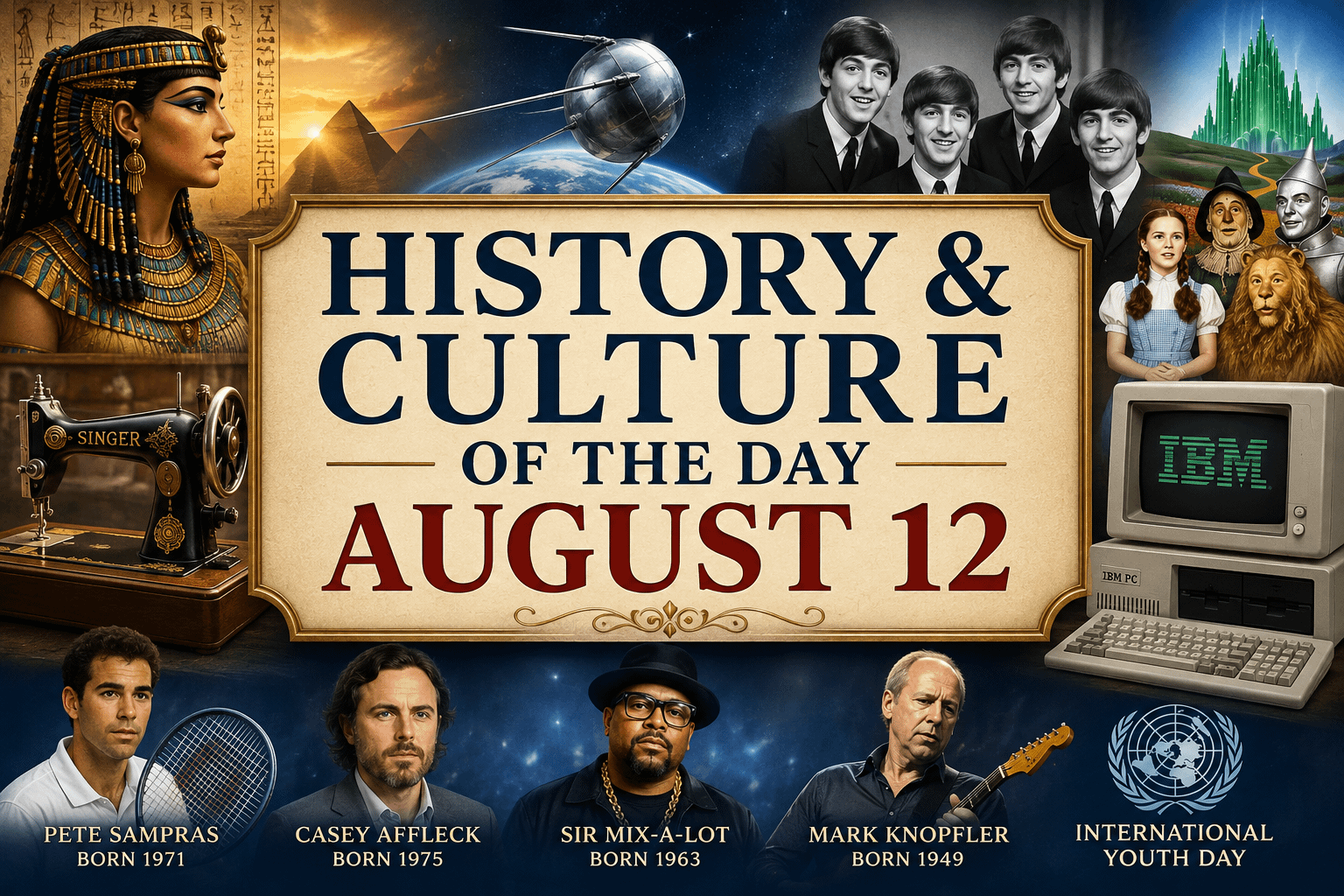
Every day carries pieces of the human story. Some dates are remembered because of wars, political changes, discoveries, or inventions. Others become important because of music, movies, sports, literature, traditions, and cultural movements that influence generations.
August 12 is a fascinating combination of all of these things.
Across centuries, August 12 has been connected with ancient rulers, groundbreaking inventions, technological milestones, entertainment history, influential musicians, legendary athletes, and an international observance dedicated to the world’s young people.
From the final days of Cleopatra’s rule in ancient Egypt to the arrival of the IBM Personal Computer, the events associated with August 12 demonstrate how dramatically human civilization has changed.
Yet they also reveal something that has remained remarkably consistent: people have always searched for new ways to communicate, create, compete, lead, entertain, and improve their lives.
Let’s explore the history and culture of August 12 and discover some of the people and events that helped make this date memorable.
🌍 International Youth Day
August 12 is recognized around the world as International Youth Day, an observance focused on young people and their role in society.
The United Nations General Assembly endorsed August 12 as International Youth Day in 1999 following a recommendation from the World Conference of Ministers Responsible for Youth.
The first International Youth Day was observed in 2000.
Since then, the annual observance has provided an opportunity to recognize both the achievements of young people and the challenges they face.
International Youth Day has highlighted subjects such as education, employment opportunities, poverty, civic participation, health, technology, environmental challenges, and social development.
These issues matter because young people aren’t simply waiting to inherit the world.
They are already shaping it.
Young entrepreneurs launch businesses. Young scientists participate in important research. Young artists create music, films, and other forms of expression. Young volunteers strengthen their communities. Young activists bring attention to issues they believe deserve greater recognition.
Throughout history, younger generations have also played major roles in cultural change.
Music movements, fashion trends, technological adoption, political activism, and new forms of communication have frequently been driven by young people.
International Youth Day reminds societies that listening to younger generations can provide insight into where the world may be heading next.
🏺 Ancient History and August 12
Some of the history associated with August 12 stretches back thousands of years.
One of the most famous names connected with the date is a ruler whose life has fascinated historians, writers, artists, and filmmakers for centuries.
👑 30 BC — The Death of Cleopatra VII
According to the traditional chronology, Cleopatra VII died around August 12, 30 BC.
Cleopatra was the final active ruler of Egypt’s Ptolemaic dynasty.
Although popular culture often focuses heavily on her relationships with Julius Caesar and Mark Antony, Cleopatra’s historical importance extends much further.
She was a monarch attempting to protect Egypt’s independence during an era when Rome was becoming increasingly powerful.
Cleopatra was educated, politically ambitious, and reportedly capable of speaking several languages. Unlike many members of the Ptolemaic royal family, she is believed to have learned the Egyptian language.
Her alliances with powerful Roman leaders placed her directly within the political struggles that ultimately transformed Rome.
After Julius Caesar’s assassination, Cleopatra formed an alliance with Mark Antony.
Their forces eventually confronted those of Octavian, Caesar’s adopted heir and the future Roman emperor Augustus.
The decisive defeat of Antony and Cleopatra’s forces at the Battle of Actium in 31 BC dramatically weakened their position.
The following year, Octavian’s forces entered Egypt.
Antony died, followed shortly afterward by Cleopatra.
Ancient accounts famously claimed Cleopatra died from the bite of an asp, although historians continue debating exactly how she died.
Her death marked the end of Ptolemaic rule.
Egypt became part of the Roman world, while Octavian eventually emerged as Augustus, Rome’s first emperor.
Cleopatra’s story has survived for more than two thousand years through literature, theater, painting, opera, television, and film.
William Shakespeare’s Antony and Cleopatra helped cement her place in Western literature, while numerous Hollywood productions transformed her into one of antiquity’s most recognizable figures.
Her story demonstrates something important about history:
The way people are remembered can become almost as influential as what actually happened during their lives.
🧵 1851 — Isaac Singer and the Sewing Machine
Jump forward nearly nineteen centuries and August 12 appears again in the history of technological innovation.
On August 12, 1851, American inventor and entrepreneur Isaac Singer received a patent connected with improvements to the sewing machine.
Singer did not invent the first sewing machine.
Various inventors had worked on mechanical sewing technology before him.
However, Singer’s improvements helped make sewing machines more practical and commercially successful.
The sewing machine dramatically changed clothing production.
Before mechanized sewing became widespread, producing clothing required enormous amounts of hand stitching.
A machine could perform repetitive stitching much faster.
This had consequences both inside households and across industry.
Garment manufacturing became increasingly mechanized, while sewing machines eventually became common household tools.
Singer’s company also became famous for innovative business strategies, including installment-payment arrangements that made expensive machines accessible to more consumers.
Today, the sewing machine may seem like a relatively ordinary invention.
During the nineteenth century, however, it represented an enormous technological change.
It serves as another reminder that some of the inventions that most transform society aren’t necessarily the most glamorous.
Sometimes they simply make everyday work faster and more efficient.
📡 1960 — Echo 1 and the Future of Global Communication
Communication underwent another transformation on August 12, 1960, when NASA launched Echo 1.
Echo 1 looked dramatically different from modern communications satellites.
It was essentially a huge metallic balloon placed into orbit.
Rather than electronically receiving and retransmitting communications, Echo acted as a passive reflector.
Signals transmitted from Earth could bounce off its surface and return to receivers at distant locations.
The experiment helped scientists and engineers explore whether satellites could become useful tools for long-distance communication.
The answer would eventually become obvious.
Satellite technology developed rapidly.
Today, satellites support television broadcasts, telecommunications, weather monitoring, navigation, mapping, scientific research, military operations, disaster response, and internet connectivity.
Think about how extraordinary this transformation has been.
For most of human history, sending information across great distances could take days, weeks, or months.
Eventually came telegraphs and telephones.
Then radio.
Then satellites.
Then digital networks.
Today, a person can send a message, photograph, document, or video across the planet almost instantly.
Echo 1 represents one of the experimental steps that helped humanity move toward that interconnected world.
🎬 1939 — The Wizard of Oz Begins Enchanting Audiences
Few movies have become as deeply embedded in popular culture as The Wizard of Oz.
On August 12, 1939, audiences in Wisconsin were among those who attended an early preview of the film before its official Hollywood premiere later that month.
Based on L. Frank Baum’s The Wonderful Wizard of Oz, the film starred Judy Garland as Dorothy Gale.
The story follows Dorothy after a tornado carries her from Kansas into the magical world of Oz.
Along the way she meets three unforgettable companions:
the Scarecrow, who wants a brain;
the Tin Man, who wants a heart;
and the Cowardly Lion, who wants courage.
Together they travel toward the Emerald City hoping the Wizard of Oz can help them.
The movie’s transition from the muted appearance of Kansas into the brilliant Technicolor world of Oz became one of cinema’s most memorable visual transformations.
But the movie’s cultural impact goes far beyond its visual style.
Characters, phrases, songs, and images from The Wizard of Oz became part of popular culture.
The song “Over the Rainbow” became especially famous and remains closely associated with Judy Garland.
Interestingly, the film’s legendary reputation grew over time.
Repeated television broadcasts introduced it to new generations, turning the movie into something families could rediscover together.
More than eight decades later, the world of Oz continues inspiring books, stage productions, movies, merchandise, adaptations, and reinterpretations.
That is cultural longevity few works of entertainment ever achieve.
🎸 1964 — Beatlemania Reaches the Movie Theater
Another major cultural moment associated with August 12 occurred during the height of Beatlemania.
On August 12, 1964, The Beatles’ film A Hard Day’s Night opened widely in the United States.
By then, John Lennon, Paul McCartney, George Harrison, and Ringo Starr had become international celebrities.
Their appearance on The Ed Sullivan Show earlier in 1964 had helped fuel Beatlemania across America.
A Hard Day’s Night allowed audiences to experience another side of the band.
Rather than simply presenting concert footage, the movie offered a humorous fictionalized version of the musicians’ chaotic lives.
The film was energetic, fast-paced, playful, and visually inventive.
Its style influenced later music films and eventually the development of music-video aesthetics.
The Beatles weren’t simply changing music.
They influenced fashion, hairstyles, youth culture, songwriting, recording techniques, celebrity culture, and attitudes toward popular music.
Their success also contributed to the British Invasion, when numerous British musicians found enormous audiences in the United States.
Groups such as The Rolling Stones, The Who, The Animals, and others benefited from America’s growing fascination with British music.
A Hard Day’s Night captured that cultural explosion as it was happening.
💻 1981 — IBM Introduces the Personal Computer
Perhaps one of the most consequential modern events connected with August 12 occurred in 1981.
On that date, IBM introduced the IBM Personal Computer, commonly called the IBM PC.
Computers already existed.
Personal computers already existed.
Companies such as Apple, Commodore, and others had been developing machines for individual users.
But IBM’s entry into the market helped accelerate the personal computer’s acceptance in the business world.
The original IBM PC used an Intel 8088 microprocessor and Microsoft’s PC DOS operating system.
More importantly, the machine’s architecture became enormously influential.
Other manufacturers began producing computers compatible with the IBM PC standard.
Over time, the PC ecosystem expanded dramatically.
Software companies created programs for business, education, entertainment, accounting, publishing, and countless other purposes.
Computers gradually moved from specialized environments into offices, schools, and homes.
Then came graphical interfaces.
Then widespread internet access.
Then laptops.
Then wireless networking.
Then smartphones, cloud computing, social media, streaming platforms, and artificial intelligence.
The IBM PC didn’t create all of these technologies.
But its arrival represents an important milestone in the evolution of personal computing.
Imagine explaining today’s world to someone standing in a computer store in 1981.
You could tell them that one day people would carry tiny computers in their pockets capable of taking photographs, recording video, providing driving directions, streaming movies, accessing libraries, conducting banking, making video calls, publishing articles, and communicating instantly with people around the world.
It would have sounded like science fiction.
Yet only a few decades later, it became ordinary life.
🎸 1949 — Mark Knopfler Is Born
August 12 also marks the birthday of Mark Knopfler, born in 1949.
Knopfler became internationally famous as the guitarist, vocalist, and songwriter for Dire Straits.
The band emerged during the late 1970s and developed a distinctive sound that stood apart from many musical trends of the era.
Knopfler became particularly recognizable for his fingerstyle guitar technique.
Dire Straits produced numerous memorable songs, including:
“Sultans of Swing,”
“Romeo and Juliet,”
“Money for Nothing,”
“Walk of Life,”
and “Brothers in Arms.”
The band’s 1985 album Brothers in Arms became enormously successful internationally.
“Money for Nothing” also became closely associated with the rise of MTV and the growing importance of music videos during the 1980s.
Knopfler later pursued extensive solo work and composed music for films.
His career demonstrates how distinctive artistic style can make a musician recognizable almost immediately.
🎤 1963 — Sir Mix-a-Lot Is Born
Another musician born on August 12 is Sir Mix-a-Lot, born Anthony Ray in 1963.
The Seattle rapper became internationally famous through the 1992 hit “Baby Got Back.”
The song reached No. 1 on the Billboard Hot 100 and became one of the era’s most recognizable hip-hop recordings.
Its influence continued for decades.
The song has been referenced, sampled, parodied, and featured throughout popular culture.
Sir Mix-a-Lot’s success also helped draw greater attention to hip-hop emerging outside traditional centers such as New York and Los Angeles.
By the 1990s, rap had developed into a major cultural and commercial force.
Its influence would continue expanding across music, fashion, advertising, movies, television, language, and youth culture.
🎾 1971 — Tennis Legend Pete Sampras Is Born
Tennis great Pete Sampras was born on August 12, 1971.
During the 1990s, Sampras became one of professional tennis’s dominant players.
His powerful serve earned him the nickname “Pistol Pete.”
Sampras was especially successful at Wimbledon, where his serve-and-volley style worked brilliantly on the tournament’s grass courts.
During his career, he won 14 Grand Slam men’s singles championships.
That total was a men’s record when he retired.
Records are eventually broken, but their historical importance remains.
Sampras helped define an era of tennis and set a standard that later champions would pursue.
His career reminds us that sports are also an important part of cultural history.
Generations are often remembered partly through the athletes they watched and admired.
🎬 1975 — Casey Affleck Is Born
Actor Casey Affleck was born on August 12, 1975.
His film career has included performances in movies such as Gone Baby Gone, The Assassination of Jesse James by the Coward Robert Ford, and Manchester by the Sea.
His performance in Manchester by the Sea earned him the Academy Award for Best Actor.
Film performances can become cultural snapshots of particular periods.
The movies audiences watch—and the stories filmmakers choose to tell—often reveal the fears, hopes, values, conflicts, and conversations occurring within society.
🔬 August 12 and the Story of Human Progress
Looking across the events connected with August 12 reveals an interesting pattern.
Many involve communication and creativity.
The sewing machine changed how clothing could be produced.
Echo 1 explored new possibilities for transmitting information across enormous distances.
The IBM PC helped transform how people worked with information.
Movies such as The Wizard of Oz demonstrated how technology and storytelling could combine to create unforgettable experiences.
The Beatles demonstrated music’s ability to cross national borders and influence entire generations.
Each development occurred in a different field, but all represent the human desire to create something new.
🎵 Music as a Historical Record
Music is one of the most powerful ways culture preserves memory.
A song can instantly transport someone back to a particular decade—or even a particular moment in their own life.
The music associated with August 12 demonstrates how dramatically popular sound has evolved.
Mark Knopfler represents rock and guitar-driven songwriting.
The Beatles represent one of popular music’s most transformative eras.
Sir Mix-a-Lot represents hip-hop’s expanding cultural influence.
Each musical generation builds upon what came before while creating something new.
That process is part of cultural history.
🎥 Movies Become Shared Memories
Movies perform a similar role.
When The Wizard of Oz appeared in 1939, audiences experienced something that would become part of generations of shared cultural memory.
Decades later, families who had watched the film as children could introduce it to their own children.
That ability to cross generations is one of culture’s most remarkable qualities.
Stories survive because people continue sharing them.
The technology used to watch them may change—from movie theaters to television to videotapes, DVDs, streaming services, and whatever comes next—but the emotional connection can remain.
💻 From the IBM PC to the Connected World
The technological transformation represented by the IBM PC is particularly striking.
In 1981, personal computing was still relatively new.
Today, digital technology touches almost every aspect of life.
People work online.
Students attend classes online.
Families communicate through video calls.
Artists distribute music digitally.
Writers publish without traditional printing presses.
Small businesses reach customers around the world.
People share photographs instantly.
Entire communities can form without their members ever meeting physically.
The personal computer helped create an environment where individuals gained direct access to powerful digital tools.
That transformation continues today.
Artificial intelligence, virtual reality, robotics, automation, and other technologies may reshape society just as dramatically.
Future historians may look at today’s technologies the same way we now look at the early personal computer.
🌎 Why International Youth Day Fits August 12
There is something fitting about International Youth Day sharing a date with milestones involving technology, music, film, and innovation.
Young people have historically been among the earliest adopters of cultural change.
They experiment with new technologies.
They create new forms of language and communication.
They introduce musical styles.
They challenge traditions.
They start businesses.
They create art.
They imagine futures previous generations may have considered impossible.
Every generation inherits a world shaped by those who came before it.
Then it changes that world before handing it to the next generation.
That cycle is one of the great engines of history.
📚 Why Learning History Matters
History isn’t simply about memorizing names and dates.
It helps explain why today’s world looks the way it does.
When we study the IBM PC, we better understand the digital revolution.
When we study Echo 1, we understand part of the journey toward global communications.
When we study Cleopatra, we encounter the political struggles that transformed the ancient Mediterranean world.
When we study musicians, movies, artists, and athletes, we understand how culture develops.
History connects generations.
It reminds us that people before us experienced uncertainty too.
They faced wars, technological changes, political conflicts, economic problems, cultural transformations, and questions about what the future might bring.
They didn’t know how their stories would end.
Neither do we.
⏳ Imagine Living Through These Moments
Imagine standing beneath the night sky in 1960 knowing a giant experimental communications balloon was orbiting high above Earth.
Imagine sitting inside a theater in 1939 and seeing Dorothy step into the colorful world of Oz for the first time.
Imagine being a teenager in 1964 watching The Beatles while Beatlemania swept across America.
Imagine walking into an electronics store in 1981 and seeing IBM’s new personal computer.
At the time, these were current events.
Today, they are history.
That distinction is worth remembering.
Everything we call history was once somebody’s present day.
People woke up, went to work, ate dinner, worried about bills, celebrated birthdays, listened to music, raised families, and wondered what tomorrow would bring.
Meanwhile, the world around them was changing.
The same thing is happening to us.
🕰️ Today’s Ordinary Moments May Become Tomorrow’s History
We often imagine historical moments as dramatic events accompanied by an immediate realization that something important has happened.
Sometimes that is true.
Often it isn’t.
Many technological and cultural changes begin quietly.
An engineer develops an idea.
A musician writes a song.
A filmmaker experiments with a new technique.
A young entrepreneur launches a small business.
A scientist asks a different question.
A child becomes fascinated with something that eventually becomes a lifelong passion.
History grows from countless decisions made by ordinary people.
Most never know exactly how far their influence will travel.
💭 Reflection for August 12
August 12 reminds us how much can change within a relatively short period of human history.
Ancient kingdoms disappeared.
Industrial machines changed how products were manufactured.
Satellites changed communication.
Computers changed how information was created and shared.
Musicians transformed popular culture.
Movies created stories that survived generations.
Athletes established records that inspired those who followed.
And young people continue preparing to shape whatever comes next.
History is not frozen in museums or locked inside textbooks.
History is alive.
It exists in our traditions, our technology, our music, our language, our communities, and our memories.
Every generation receives a story already in progress.
Then it adds another chapter.
📜 History & Culture of the Day — August 12
From Cleopatra and ancient Egypt to Isaac Singer and the sewing machine, from Echo 1 and satellite communication to The Wizard of Oz, The Beatles, and the IBM Personal Computer, August 12 offers a remarkable journey through history and culture.
It is also a day to recognize young people through International Youth Day and consider the role future generations will play in shaping what comes next.
The stories connected with August 12 span thousands of years, yet they share a common thread.
People create.
People discover.
People compete.
People communicate.
People imagine something different.
And gradually, the world changes.
Perhaps the most important lesson from looking back at August 12 is realizing that we are participating in the same process today.
Somewhere, someone is developing an idea that could transform technology.
Someone is creating music people may remember decades from now.
Someone is writing a story future generations may read.
Someone is beginning a career that could eventually influence millions.
And somewhere, a young person is imagining a future that doesn’t exist yet.
One day, future generations will look back on our era and call it history.
Until then, we continue writing it.
Because the history of tomorrow is being created by the people living today.
Leave a Reply