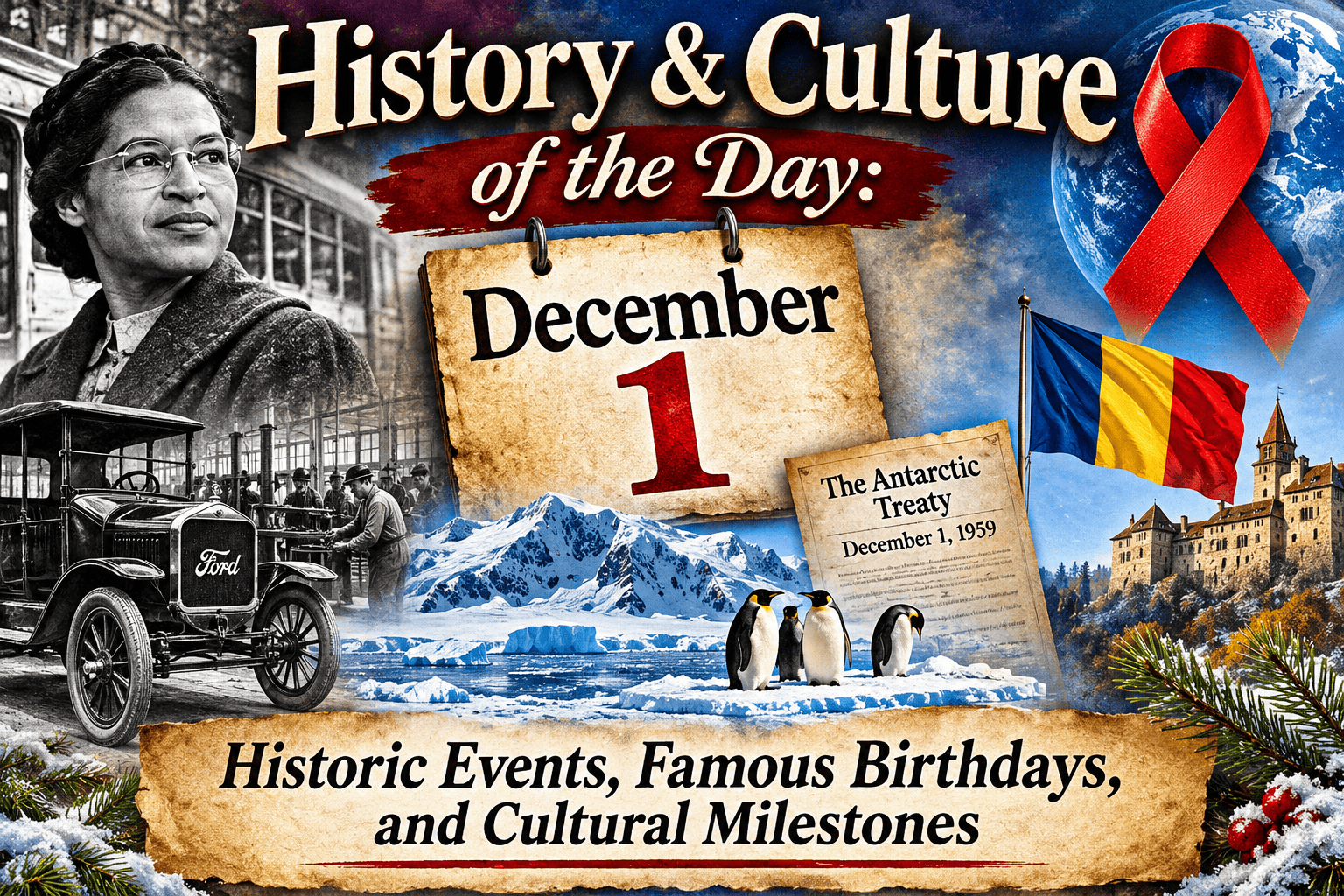
December 1 marks the beginning of the final month of the year, a time when people around the world reflect on the past, celebrate traditions, and prepare for the holiday season. Throughout history, this date has witnessed important political decisions, groundbreaking achievements, cultural transformations, and moments that helped shape the modern world.
From the civil rights movement in the United States to the development of modern technology, December 1 holds a remarkable place in history. It is also a day dedicated to global health awareness, national independence, and the preservation of cultural traditions.
In this edition of History & Culture of the Day, we explore the significant events, famous birthdays, historical milestones, and traditions associated with December 1.
Major Historical Events on December 1
1824 – The United States Presidential Election Goes to the House of Representatives
On December 1, 1824, the Electoral College met to cast its votes in one of the most controversial presidential elections in early American history.
Four major candidates competed for the presidency: Andrew Jackson, John Quincy Adams, William H. Crawford, and Henry Clay.
Although Jackson received the most electoral votes, no candidate secured the majority necessary to win.
Under the Twelfth Amendment, the election was decided by the House of Representatives on February 9, 1825, which selected John Quincy Adams as president.
The election demonstrated the complexity of America’s developing political system and helped shape future presidential campaigns.
1913 – The Ford Motor Company Introduces the Moving Assembly Line
On December 1, 1913, the Ford Motor Company introduced its moving assembly line for automobile production at its Highland Park plant in Michigan.
This manufacturing innovation transformed the automobile industry by dramatically reducing the time required to assemble vehicles.
Henry Ford’s approach made automobile production more efficient and eventually helped make cars affordable to a much larger portion of the American population.
The moving assembly line also influenced manufacturing practices worldwide, becoming one of the most important industrial developments of the twentieth century.
1955 – Rosa Parks Refuses to Give Up Her Bus Seat
One of the most significant moments in American civil rights history occurred on December 1, 1955, in Montgomery, Alabama.
Rosa Parks, a Black seamstress and civil rights activist, refused to surrender her seat to a white passenger on a segregated city bus after being ordered to do so.
Her arrest became a defining moment in the struggle against racial segregation.
The incident helped inspire the Montgomery Bus Boycott, which began on December 5, 1955, and continued for 381 days.
The boycott brought national attention to a young minister named Martin Luther King Jr., who emerged as one of the most influential leaders of the American civil rights movement.
Rosa Parks’ courage remains a powerful symbol of peaceful resistance, dignity, and the fight for equal rights.
1959 – The Antarctic Treaty Is Signed
On December 1, 1959, twelve nations signed the Antarctic Treaty in Washington, D.C.
The agreement established Antarctica as a region dedicated to peaceful purposes and scientific cooperation.
It prohibited military measures, including weapons testing and military maneuvers, while protecting freedom of scientific investigation.
The treaty became an important example of international cooperation during the Cold War.
Today, Antarctica remains a vital location for research into climate, geology, wildlife, and Earth’s environmental systems.
1990 – The Channel Tunnel Breakthrough Connects Britain and France
On December 1, 1990, British and French construction teams achieved a historic breakthrough beneath the English Channel.
Workers completed the first underground connection between the two countries as part of the Channel Tunnel project.
The tunnel, commonly called the Chunnel, officially opened in 1994.
This engineering achievement transformed transportation between Britain and mainland Europe, allowing passengers and freight to travel beneath the English Channel.
The project remains one of the most impressive transportation engineering accomplishments of the modern era.
1991 – Ukraine Votes for Independence
On December 1, 1991, Ukrainian citizens participated in a historic referendum concerning independence from the Soviet Union.
More than 90 percent of participating voters supported independence, confirming the declaration made by Ukraine’s parliament earlier that year.
The referendum was a major milestone in the dissolution of the Soviet Union and the emergence of Ukraine as an independent nation.
It also demonstrated the power of public participation in determining a country’s political future.
AP News+1
Famous Birthdays on December 1
December 1 is the birthday of several influential entertainers, artists, athletes, and cultural figures whose contributions have left lasting impressions.
Richard Pryor – Born December 1, 1940
Richard Pryor was an American comedian, actor, and writer widely regarded as one of the most influential stand-up comedians in history.
His comedy addressed race, personal struggles, relationships, and American society with an honesty that challenged traditional entertainment boundaries.
Pryor influenced generations of comedians and helped transform stand-up comedy into a platform for personal storytelling and social commentary.
He died in 2005, but his cultural influence continues.
Bette Midler – Born December 1, 1945
Bette Midler is an American singer, actress, and entertainer celebrated for her powerful voice and dynamic performances.
Throughout her career, she has achieved success in music, theater, television, and film.
Her performances in movies such as Beaches, The Rose, and Hocus Pocus helped establish her as a beloved entertainment figure.
Her musical accomplishments and theatrical personality have made her an enduring presence in American popular culture.
Lou Rawls – Born December 1, 1933
Lou Rawls was an American singer recognized for his smooth baritone voice and distinctive musical style.
His career included jazz, blues, soul, and rhythm and blues.
Songs such as You’ll Never Find Another Love Like Mine helped him become one of the recognizable voices of his generation.
Beyond entertainment, Rawls was also known for his charitable work supporting educational opportunities.
Sarah Silverman – Born December 1, 1970
Sarah Silverman is an American comedian, actress, and writer known for her satirical humor and willingness to address controversial social subjects.
Her work has included stand-up comedy, television, movies, and voice acting.
She has helped shape contemporary comedy through her distinctive approach to storytelling and social criticism.
Zoë Kravitz – Born December 1, 1988
Zoë Kravitz is an American actress, musician, and filmmaker.
She has appeared in major film and television productions, including The Batman, Big Little Lies, and Fantastic Beasts.
Her career reflects the growing influence of artists who work across multiple creative industries.
Important Cultural Observances on December 1
World AIDS Day
December 1 is internationally recognized as World AIDS Day.
First observed in 1988, World AIDS Day was established to raise awareness about HIV and AIDS, remember those who have died from AIDS-related illnesses, and encourage education, prevention, testing, treatment, and support.
It was one of the first international health awareness days.
The observance has played an important role in reducing stigma and encouraging communities to approach HIV with compassion and accurate medical information.
World AIDS Day also reminds people that public health challenges require cooperation, scientific research, and respect for human dignity.
Antarctica Day
December 1 is also celebrated as Antarctica Day, commemorating the signing of the Antarctic Treaty in 1959.
The observance highlights international scientific cooperation, environmental awareness, and the importance of protecting Earth’s polar regions.
Antarctica plays a significant role in understanding global climate patterns, ocean systems, and environmental change.
The day encourages people to appreciate the value of scientific discovery and peaceful cooperation between nations.
Romania’s Great Union Day
December 1 is Romania’s national holiday, known as Great Union Day.
It commemorates the Great National Assembly held at Alba Iulia on December 1, 1918, when representatives voted for the union of Transylvania with Romania.
The holiday celebrates Romanian national identity, history, and cultural heritage.
Throughout Romania, communities observe the occasion with ceremonies, military parades, traditional music, and national celebrations.
December 1 and the Beginning of the Holiday Season
Beyond its historical significance, December 1 holds special cultural meaning because it begins the final month of the calendar year.
For many families, this date marks the unofficial beginning of their Christmas celebrations.
Homes begin filling with decorations, festive music, seasonal foods, and traditions passed down through generations.
Advent Calendars and Christmas Countdowns
One of the most recognizable December traditions is the Advent calendar.
Originating from Christian customs in German-speaking Europe, Advent calendars became popular ways for families to count the days leading to Christmas.
Traditional calendars often contained religious pictures or messages, while modern versions may include chocolates, toys, activities, or small gifts.
Although the Christian season of Advent does not always begin on December 1, many commercial Advent calendars begin their countdown on this date.
The tradition reflects anticipation, generosity, and the joy of preparing for a meaningful celebration.
Christmas Decorations and Family Traditions
December 1 is also a popular day for families to decorate their homes.
Christmas trees, wreaths, lights, stockings, and seasonal displays begin appearing in neighborhoods and public spaces.
Many of these traditions developed through centuries of cultural exchange.
The decorated Christmas tree, for example, became especially associated with German traditions before spreading throughout Europe and North America.
Today, decorating for the holidays remains a way for families to create memories and celebrate their shared heritage.
Traditional Foods of December
Food plays an important role in December celebrations around the world.
In the United States, families often prepare Christmas cookies, gingerbread, hot chocolate, roasted meats, and traditional holiday desserts.
German households may enjoy stollen, a fruit-filled holiday bread.
Italian families prepare regional Christmas specialties, while Mexican celebrations often include tamales, ponche navideño, and other traditional foods.
These dishes are more than seasonal meals. They preserve family histories and connect generations through shared experiences.
How December 1 Helped Shape American History
Several events associated with December 1 demonstrate the evolution of American society.
The introduction of Ford’s moving assembly line represented industrial innovation and the expansion of mass production.
Rosa Parks’ refusal to surrender her bus seat represented resistance to racial injustice and the determination to secure equal rights.
The disputed presidential election of 1824 demonstrated the importance of constitutional procedures and political institutions.
Together, these moments reveal how American history has been shaped by technological progress, democratic institutions, and the courage of individuals.
They also remind us that historical change does not always begin with dramatic speeches or large public gatherings.
Sometimes, change begins with a manufacturing innovation, an ordinary citizen’s decision, or a constitutional process that determines the future of a nation.
Interesting Facts About December 1
December 1 has several interesting connections to history and culture.
December was originally the tenth month of the Roman calendar. Its name comes from the Latin word decem, meaning ten. The month retained its name even after calendar reforms placed it twelfth in the year.
December 1 falls under the zodiac sign Sagittarius. In Western astrology, Sagittarius is traditionally associated with curiosity, exploration, independence, and optimism.
The Antarctic Treaty was signed during the Cold War. Despite major political tensions, participating countries agreed to preserve Antarctica for peaceful activities and scientific investigation.
Rosa Parks was already an experienced civil rights activist. Her historic decision in 1955 was part of a much longer commitment to racial equality and community organizing.
World AIDS Day began in 1988. Its creation helped establish a model for international awareness campaigns addressing major public health issues.
December 1 marks the beginning of meteorological winter in the Northern Hemisphere. Meteorologists group December, January, and February together as winter for consistent seasonal recordkeeping.
Lessons We Can Learn From December 1
History is more than a collection of dates and events. It offers lessons about courage, innovation, cooperation, and the human desire for progress.
Rosa Parks demonstrated that one person’s willingness to challenge injustice can help inspire a national movement.
Henry Ford’s manufacturing innovations showed how new ideas can transform entire industries.
The Antarctic Treaty demonstrated that nations with different political interests can cooperate for the benefit of scientific knowledge and peaceful exploration.
World AIDS Day reminds us that compassion, education, and research are essential when confronting global health challenges.
These lessons remain relevant because the challenges of modern society often resemble those faced by earlier generations.
People continue to seek fairness, opportunity, security, understanding, and a better future for their families.
Studying history helps us recognize those shared experiences.
Why Remembering History and Culture Matters
Every date on the calendar carries stories worth remembering.
Some stories celebrate remarkable achievements, while others remind us of injustice, suffering, and the difficult struggles that helped create meaningful change.
December 1 offers examples of both.
Remembering historical events allows us to appreciate the sacrifices made by previous generations and understand how their decisions continue to influence our lives.
Cultural traditions provide another important connection to the past.
Family recipes, holiday celebrations, music, storytelling, and community gatherings preserve experiences that might otherwise disappear.
These traditions help people maintain a sense of identity and belonging, especially during times of change.
By learning about history and participating in meaningful cultural traditions, we preserve a connection between the past, present, and future.
Final Thoughts: December 1 Is a Day of Courage, Change, and Reflection
December 1 represents far more than the beginning of a new month.
It is a date connected to the fight for civil rights, major industrial innovations, international cooperation, national independence, and worldwide cultural traditions.
From Rosa Parks’ courageous stand against segregation to the signing of the Antarctic Treaty, the events of December 1 remind us that history is shaped by human choices.
As December begins, it also offers an opportunity to reflect on the year, appreciate the people who have influenced our lives, and consider the legacy we hope to leave behind.
History teaches us where we have been. Culture reminds us who we are. Together, they help us understand where we are going.
Whether December 1 is spent learning about an important historical event, celebrating a cultural tradition, or simply enjoying time with loved ones, it provides an opportunity to honor the past while looking toward the future.
And that is what makes December 1 a meaningful day in history and culture.


Leave a Reply