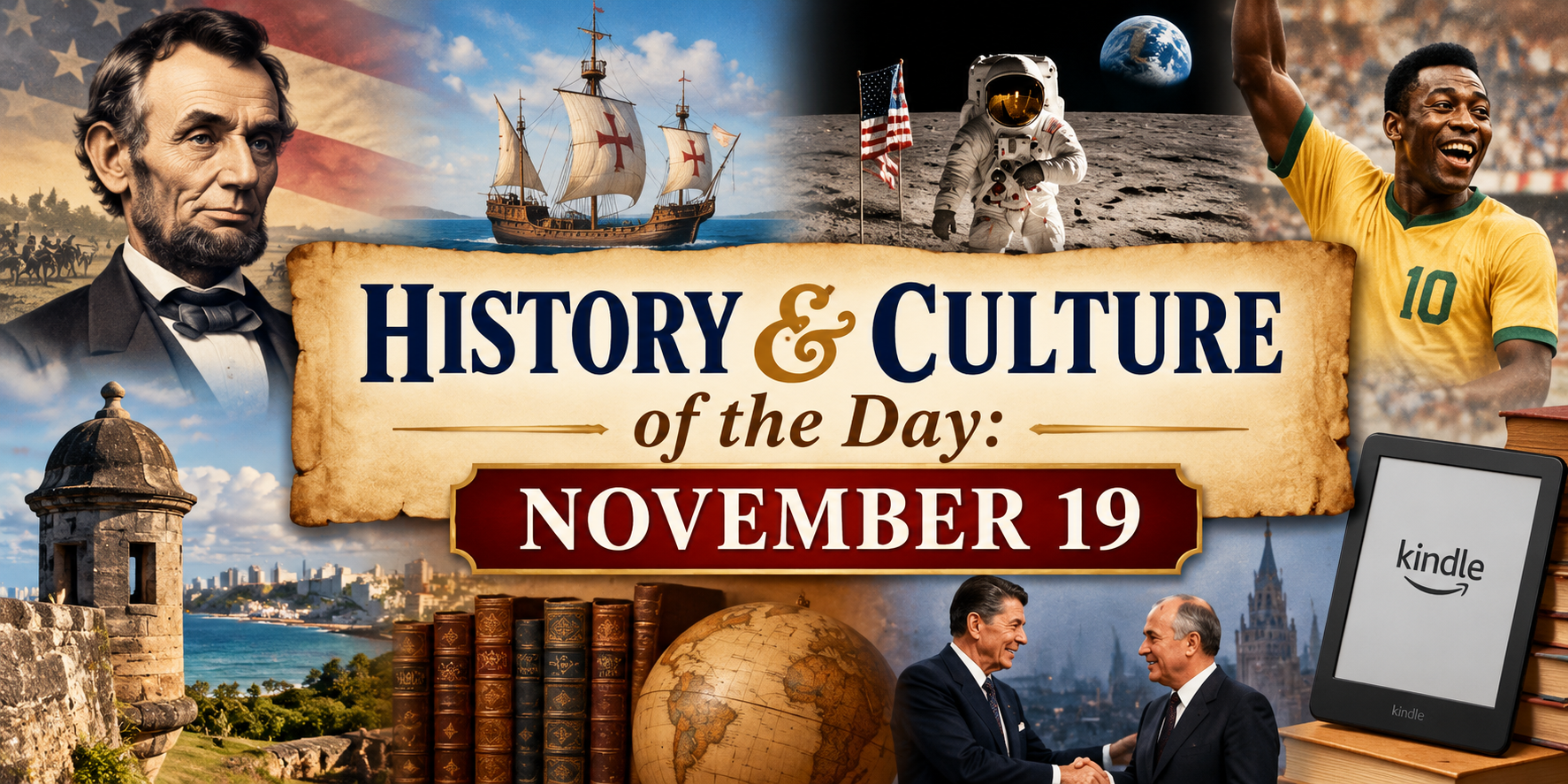
Every day on the calendar carries stories that have helped shape the world we live in today. Some dates are remembered for extraordinary achievements, others for defining moments in history, and still others for cultural traditions that continue to influence generations.
November 19 is a particularly meaningful date in world history. From one of the most famous speeches ever delivered in American history to milestones in exploration, politics, music, and international awareness, this day reminds us how individual actions can leave lasting impressions on humanity.
History is more than a collection of dates and names. It is the story of people, their struggles, their achievements, and the decisions that shaped societies. Culture gives those stories meaning by preserving traditions, beliefs, artistic expression, and shared experiences.
As we explore the history and culture of November 19, we discover remarkable events that continue to influence our world.
November 19, 1863: Abraham Lincoln Delivers the Gettysburg Address
One of the most significant events associated with November 19 occurred in 1863, when President Abraham Lincoln delivered the Gettysburg Address during the American Civil War.
The speech took place at the dedication of the Soldiers’ National Cemetery in Gettysburg, Pennsylvania, approximately four and a half months after the Battle of Gettysburg.
The battle, fought from July 1 through July 3, 1863, was among the bloodiest confrontations of the Civil War and represented a critical turning point in the conflict.
Lincoln’s address was remarkably brief, lasting only a few minutes. Yet its message about equality, sacrifice, democracy, and national unity became one of the most enduring statements in American political history.
Rather than focusing exclusively on the military victory, Lincoln challenged Americans to consider the deeper purpose of the war.
He emphasized that the nation had been founded on principles of liberty and equality and that preserving those ideals required continued dedication.
His closing words, describing government “of the people, by the people, for the people,” remain among the most recognizable expressions of democratic government.
Why the Gettysburg Address Still Matters
The Gettysburg Address continues to be studied in schools, quoted by political leaders, and remembered during national commemorations.
Its importance extends beyond the American Civil War because it addresses questions that remain relevant today.
What does equality truly mean? What responsibilities do citizens have toward their country? How can a divided nation rediscover unity?
Lincoln’s speech reminds us that democracy is not simply inherited. It must be protected, strengthened, and renewed by each generation.
November 19 therefore represents an important moment in the continuing story of American freedom and national identity.
November 19, 1493: Christopher Columbus Reaches Puerto Rico
Another significant historical event occurred on November 19, 1493, when Christopher Columbus reached the island now known as Puerto Rico during his second voyage across the Atlantic.
Columbus named the island San Juan Bautista, although the name Puerto Rico eventually became associated with the island itself.
Long before Europeans arrived, Puerto Rico was inhabited by Indigenous peoples, including the Taíno, who had developed communities, agricultural practices, spiritual traditions, and social structures.
European arrival marked the beginning of profound changes for the island and its inhabitants.
Spanish colonization brought new political systems, religious influences, economic activities, and cultural exchanges. It also resulted in violence, forced labor, disease, and severe disruption to Indigenous communities.
Puerto Rico’s Cultural Identity
Today, Puerto Rican culture reflects centuries of Indigenous, African, and European influences.
These influences can be seen in the island’s music, cuisine, language, architecture, celebrations, and artistic traditions.
Traditional musical forms such as bomba and plena demonstrate the importance of African heritage in Puerto Rican cultural expression.
Foods, festivals, and family traditions also reveal the island’s complex history.
November 19 offers an opportunity to recognize both the richness of Puerto Rican culture and the difficult historical experiences that helped shape it.
Understanding this history requires acknowledging the perspectives of the Indigenous communities who lived on the island before European colonization.
November 19, 1942: The Soviet Union Launches Operation Uranus
During World War II, November 19 became a crucial date in the struggle against Nazi Germany.
On November 19, 1942, Soviet forces launched Operation Uranus, a massive counteroffensive against German and allied Axis forces around Stalingrad.
The Battle of Stalingrad had already become one of the most brutal military confrontations in history.
German troops were attempting to capture the strategically important Soviet city, while Soviet defenders fought desperately to prevent its fall.
Operation Uranus targeted weaker Axis positions along the flanks of the German Sixth Army.
The Soviet offensive ultimately surrounded large numbers of German troops, creating a military disaster for Nazi Germany.
A Turning Point in World War II
The Soviet victory at Stalingrad, completed in February 1943, dramatically changed the direction of the war on the Eastern Front.
Germany lost enormous numbers of soldiers, equipment, and strategic resources.
The battle also demonstrated the determination and sacrifices of Soviet soldiers and civilians.
For historians, Stalingrad represents more than a military victory. It illustrates the devastating human cost of war and the resilience of communities facing extraordinary destruction.
November 19 reminds us that decisions made during wartime can alter the future of entire nations.
November 19, 1969: Apollo 12 Lands on the Moon
One of humanity’s greatest scientific achievements took place on November 19, 1969, when NASA’s Apollo 12 mission successfully landed astronauts on the Moon.
Only four months earlier, Apollo 11 had accomplished the first crewed lunar landing.
Apollo 12 demonstrated that humans could return to the lunar surface and conduct more advanced scientific exploration.
Astronauts Charles “Pete” Conrad and Alan Bean landed their lunar module, Intrepid, in the Ocean of Storms region.
They became the third and fourth people to walk on the Moon.
The mission included scientific experiments, lunar sample collection, and examination of the Surveyor 3 robotic spacecraft, which had landed on the Moon in 1967.
Why Apollo 12 Was Important
Apollo 12 demonstrated NASA’s ability to achieve a precise lunar landing.
This was essential for future missions because astronauts needed to reach specific locations of scientific interest.
The mission also provided valuable information about lunar geology and the effects of the space environment on equipment.
Beyond its scientific achievements, Apollo 12 helped inspire generations of engineers, scientists, students, and explorers.
It represented a period when technological progress was transforming humanity’s understanding of the universe.
The cultural impact of the Apollo program remains visible today through space museums, documentaries, educational programs, and renewed interest in lunar exploration.
November 19 stands as a reminder that curiosity, determination, and scientific cooperation can push humanity beyond previously imagined boundaries.
November 19, 1969: Pelé Scores His 1,000th Goal
The same day that Apollo 12 landed on the Moon, another remarkable milestone was celebrated on Earth.
Brazilian soccer legend Pelé scored what was recognized as his 1,000th career goal during a match against Vasco da Gama at Maracanã Stadium in Rio de Janeiro.
The historic goal came from a penalty kick.
Pelé was already an international sports icon, having helped Brazil win World Cup championships in 1958 and 1962.
He would later help Brazil capture another World Cup title in 1970.
Soccer as a Cultural Force
Pelé’s achievement was significant not only because of his extraordinary athletic ability but also because of soccer’s importance in Brazilian culture.
In Brazil, soccer has long served as a source of national identity, pride, and community connection.
Pelé became a symbol of excellence and helped introduce Brazilian soccer to audiences around the world.
His creativity, skill, and sportsmanship inspired generations of players.
Although historical career-goal totals can vary depending on whether exhibition and friendly matches are included, the milestone celebrated on November 19, 1969, remains an important part of soccer history.
His legacy demonstrates how sports can cross language barriers, unite communities, and become part of a nation’s cultural identity.
November 19, 1977: Egyptian President Anwar Sadat Visits Israel
November 19, 1977, marked an extraordinary moment in Middle Eastern diplomatic history.
Egyptian President Anwar Sadat arrived in Israel, becoming the first Arab head of state to make an official visit to the country.
The visit was particularly significant because Egypt and Israel had fought several wars in the preceding decades.
Sadat’s decision was controversial and represented a dramatic departure from established regional political practices.
During the visit, he addressed Israel’s parliament, the Knesset, calling for a peaceful resolution to the conflict.
A Step Toward Peace
Sadat’s diplomatic initiative helped establish the foundation for negotiations between Egypt and Israel.
In 1978, Sadat and Israeli Prime Minister Menachem Begin were awarded the Nobel Peace Prize for their efforts.
The following year, Egypt and Israel signed a peace treaty.
The agreement fundamentally changed diplomatic relations between the two countries.
However, the initiative also faced considerable opposition, and broader regional conflicts remained unresolved.
The historical importance of November 19 lies in the willingness of political leaders to engage in direct dialogue after years of hostility.
It reminds us that diplomacy often requires courage, compromise, and a willingness to challenge established expectations.
November 19, 1985: Ronald Reagan and Mikhail Gorbachev Meet in Geneva
Another major diplomatic milestone occurred on November 19, 1985, when American President Ronald Reagan and Soviet leader Mikhail Gorbachev began their first summit meeting in Geneva, Switzerland.
At the time, the United States and the Soviet Union were engaged in the Cold War, a decades-long period of political rivalry, military competition, and ideological conflict.
Both countries possessed enormous nuclear arsenals.
International tensions had raised serious concerns about the possibility of nuclear war.
The Geneva Summit created an opportunity for the two leaders to establish a working relationship and discuss issues affecting global security.
Changing the Direction of the Cold War
Although the summit did not immediately produce a major arms-control agreement, it helped improve communication between the two superpowers.
Reagan and Gorbachev discussed nuclear weapons, international security, and diplomatic relations.
Their meetings contributed to a series of later negotiations that helped reduce Cold War tensions.
The summit is remembered as an important early step toward the eventual signing of the Intermediate-Range Nuclear Forces Treaty in 1987.
The Geneva meeting demonstrated the importance of communication, even between countries with deeply opposing political systems.
November 19 reminds us that international cooperation can begin with a conversation.
November 19, 1990: Milli Vanilli Loses Its Grammy Award
November 19 also holds an unusual place in popular music history.
In 1990, the Recording Academy revoked the Best New Artist Grammy Award previously presented to the pop duo Milli Vanilli.
The decision followed revelations that the group’s public performers, Rob Pilatus and Fab Morvan, had not sung the lead vocals on the recordings that made them famous.
Milli Vanilli had achieved tremendous commercial success with popular songs and a highly recognizable public image.
However, the controversy surrounding their recordings raised questions about authenticity, artistic credit, and the commercial pressures of the entertainment industry.
How the Scandal Changed Music Culture
The Milli Vanilli controversy became one of the most widely discussed scandals in modern pop music.
It highlighted the difference between a performer’s public image and the behind-the-scenes production of commercial recordings.
The scandal also encouraged discussions about transparency in the music industry.
Today, technology makes it possible to alter vocals, digitally enhance performances, and create increasingly sophisticated music productions.
The questions raised by Milli Vanilli remain relevant in discussions about artificial intelligence, digital music, and artistic authenticity.
November 19 provides an opportunity to reflect on how entertainment culture has changed and why audiences value honesty and creative recognition.
November 19, 2007: Amazon Introduces the First Kindle
On November 19, 2007, Amazon introduced its first Kindle electronic reading device.
The original Kindle represented an important milestone in the development of digital publishing.
Although electronic books existed before the Kindle, the device helped make digital reading more accessible to a mainstream audience.
Readers could purchase and download books electronically, carry multiple titles on a single device, and adjust their reading experience.
The Cultural Transformation of Reading
The growing popularity of e-readers helped change how books were distributed, purchased, and consumed.
Digital publishing created new opportunities for independent authors to reach readers without relying exclusively on traditional publishing arrangements.
Libraries also expanded their electronic lending collections.
Readers gained greater access to books while traveling, commuting, or living far from physical bookstores.
The Kindle’s introduction was not the beginning of electronic reading, but it became a major milestone in the transition toward digital literature.
Today, printed books, audiobooks, and electronic books coexist, giving readers more ways to experience storytelling.
November 19 reminds us that technological innovation can reshape even our oldest cultural traditions.
Famous People Born on November 19
Throughout history, November 19 has also been the birthday of influential individuals whose accomplishments have shaped politics, entertainment, fashion, and culture.
James A. Garfield – Born November 19, 1831
James A. Garfield became the 20th president of the United States in 1881.
His presidency lasted only a few months before he died from complications following an assassination attempt.
Despite his brief time in office, Garfield remains an important figure in American political history.
Indira Gandhi – Born November 19, 1917
Indira Gandhi became India’s first and, to date, only female prime minister.
She served from 1966 to 1977 and again from 1980 until her assassination in 1984.
Her leadership had a profound impact on India’s political development, although her policies and use of emergency powers remain subjects of historical debate.
Calvin Klein – Born November 19, 1942
American fashion designer Calvin Klein helped shape modern fashion through minimalist designs, influential advertising, and globally recognized clothing collections.
His work became especially associated with denim, underwear, and contemporary American style.
Meg Ryan – Born November 19, 1961
Actress Meg Ryan became one of Hollywood’s most recognizable romantic-comedy stars.
Her performances in films such as When Harry Met Sally…, Sleepless in Seattle, and You’ve Got Mail helped define a popular era of American romantic cinema.
Jodie Foster – Born November 19, 1962
Academy Award-winning actress and director Jodie Foster began her career as a child performer and went on to become one of the most respected figures in American cinema.
Her performances in The Accused and The Silence of the Lambs earned her Academy Awards for Best Actress.
These individuals demonstrate the many ways people can influence history through public service, creativity, leadership, and artistic achievement.
Cultural Celebrations and Observances on November 19
In addition to historical events, November 19 is associated with several important cultural and international observances.
International Men’s Day
International Men’s Day is observed annually on November 19 in numerous countries.
The observance highlights men’s health, positive male role models, family relationships, and the contributions men make to their communities.
It also encourages conversations about mental health, fatherhood, emotional well-being, and the challenges men may experience.
One important message associated with the day is that strength includes the ability to seek help, express emotions, and support others.
World Toilet Day
World Toilet Day is a United Nations observance held annually on November 19.
Although its name may sound unusual, its purpose addresses a serious global challenge.
The observance raises awareness about inadequate sanitation and the importance of safe, accessible toilets.
Proper sanitation helps prevent disease, protects water supplies, and supports public health.
It also contributes to personal dignity, educational opportunities, and safer communities.
World Toilet Day reminds us that access to basic sanitation is essential to human well-being.
Monaco National Day
November 19 is Monaco’s National Day, also known as the Sovereign Prince’s Day.
The celebration recognizes the principality’s national identity and its monarchy.
Traditional observances include official ceremonies, religious services, and public celebrations.
The day reflects Monaco’s history, sovereignty, and cultural traditions.
Garifuna Settlement Day in Belize
November 19 is also celebrated as Garifuna Settlement Day in Belize.
The holiday honors the arrival and settlement of Garifuna people along the country’s coast in 1823.
Garifuna culture combines Indigenous Caribbean and African heritage and is known for its distinctive language, music, dance, food, and traditions.
Celebrations often feature drumming, dancing, reenactments, and community gatherings.
The holiday serves as an important expression of cultural preservation and historical identity.
What November 19 Teaches Us About History and Culture
When we examine the events of November 19, several important themes emerge.
The power of words: Abraham Lincoln’s Gettysburg Address demonstrates that a short speech can influence generations and help define a nation’s ideals.
The importance of courage: From wartime resistance to diplomatic breakthroughs, November 19 includes examples of people making difficult decisions during extraordinary circumstances.
The value of exploration: Apollo 12 represents humanity’s determination to understand the universe and expand scientific knowledge.
The influence of culture: Pelé’s soccer achievements, major developments in music, and the evolution of digital reading show how entertainment and technology shape society.
The need to preserve history: Puerto Rico’s Indigenous heritage and Belize’s Garifuna traditions remind us that cultural identity deserves recognition and protection.
The possibility of change: Diplomatic meetings between former adversaries demonstrate that relationships between nations can evolve.
These lessons help explain why studying history remains important.
History gives us the opportunity to learn from earlier generations while considering how our own choices may influence the future.
Why Remembering November 19 Matters
It is easy to think of history as something distant, disconnected from our everyday lives.
Yet the events of November 19 continue to affect modern society.
The principles expressed in the Gettysburg Address remain central to discussions about democracy and equality.
The legacy of World War II influences international relations and the importance placed on preventing global conflict.
The Apollo missions continue to inspire scientific research and space exploration.
Diplomatic breakthroughs demonstrate the value of negotiation.
Cultural milestones in sports, music, fashion, and literature remind us that human creativity can influence the world in lasting ways.
Even international observances encourage us to think about health, dignity, cultural preservation, and the well-being of others.
Every historical event began with people living through an ordinary day, unaware of how their actions might eventually be remembered.
That realization gives history a deeply human meaning.
We may not all become presidents, astronauts, world-famous athletes, or influential artists. However, our decisions, relationships, and contributions still matter.
The way we treat others, preserve family traditions, share knowledge, and support our communities becomes part of the history we leave behind.
Final Thoughts: November 19 Is a Day Worth Remembering
November 19 is filled with remarkable moments that demonstrate humanity’s capacity for courage, creativity, discovery, conflict, and progress.
From Abraham Lincoln’s unforgettable Gettysburg Address to the successful Apollo 12 Moon landing, the events of this date have influenced politics, science, culture, and international relations.
It is also a day to celebrate cultural identity, recognize important contributions, and reflect on the lessons of the past.
History is not simply about remembering what happened. It is about understanding why those events mattered and how they continue to shape our world.
Each generation inherits the achievements and mistakes of those who came before it.
What we choose to learn from that inheritance helps determine the future we create.
November 19 reminds us that history is written through human actions, and even a single day can leave a legacy that lasts for centuries.
Which historical event from November 19 do you find most fascinating, and why do you believe it still matters today?

Leave a Reply