Category: History & Culture

  • History & Culture of the Day – July 21: Celebrating Humanity’s Stories, Traditions, and Turning Points

    History & Culture of the Day – July 21: Celebrating Humanity’s Stories, Traditions, and Turning Points

    July 21 is a day that reflects the richness of human history and culture. From groundbreaking achievements in exploration and science to artistic milestones and cultural traditions that continue to shape our world, this date reminds us that history is more than a collection of dates—it is the story of people, perseverance, creativity, and progress.

    Whether you’re a history enthusiast, educator, traveler, or simply someone who enjoys learning something new each day, July 21 offers plenty of reasons to appreciate the events that have helped define civilizations across the globe.


    A Day Marked by Exploration and Discovery

    Throughout history, July 21 has been associated with remarkable moments of exploration and innovation. Human curiosity has always pushed the boundaries of what is possible, leading explorers, scientists, and pioneers to venture into unknown territories.

    One of the most iconic events remembered around this time each year is the Apollo 11 Moon mission. While Neil Armstrong and Buzz Aldrin first stepped onto the lunar surface on July 20, 1969 (U.S. time), many parts of the world observed key mission events on July 21 due to time zone differences. The successful mission remains one of humanity’s greatest achievements and symbolizes what determination, collaboration, and scientific advancement can accomplish.

    Today, museums, science centers, and educational organizations continue using this anniversary to inspire future generations to dream beyond Earth’s horizons.


    Remembering Influential Historical Figures

    July 21 is also associated with the birthdays and legacies of notable individuals whose contributions have influenced politics, literature, science, sports, and the arts.

    History is shaped not only by major events but by individuals who challenge conventions, inspire change, and leave lasting cultural footprints. Reflecting on these lives encourages us to appreciate how one person’s vision can influence millions.

    Many schools and historical societies use days like July 21 to explore biographies that demonstrate courage, innovation, and leadership.


    Cultural Heritage Around the World

    Every culture has traditions passed from one generation to the next. July offers an opportunity to celebrate festivals, local customs, music, dance, and cuisine that help preserve cultural identity.

    Across different countries, midsummer traditions continue to bring communities together through:

    • Traditional music and performances
    • Local food festivals
    • Historical reenactments
    • Artisan markets
    • Community celebrations
    • Family gatherings

    These events remind us that culture lives not only in museums but also in everyday traditions shared by families and neighborhoods.


    Appreciating Historic Landmarks

    History comes alive through places that have stood the test of time.

    Historic landmarks preserve stories of civilizations, wars, triumphs, architecture, and faith. Visiting these locations allows people to experience history firsthand rather than simply reading about it.

    Some of the world’s most significant cultural landmarks include:

    • The Great Wall of China
    • Machu Picchu
    • The Colosseum
    • The Pyramids of Giza
    • Independence Hall
    • The Statue of Liberty

    Each site represents the determination, beliefs, and creativity of those who built them.


    The Importance of Preserving History

    Historical preservation plays an essential role in helping future generations understand where we came from.

    Old photographs, family heirlooms, historic buildings, journals, newspapers, and oral histories all contribute to preserving our collective memory.

    Communities across the world invest in:

    • Restoring historic buildings
    • Protecting archaeological sites
    • Digitizing historical archives
    • Recording veterans’ stories
    • Preserving indigenous traditions
    • Teaching local history in schools

    Without preservation efforts, countless stories would disappear forever.


    Culture Through Food

    Food is one of history’s greatest storytellers.

    Recipes passed down through generations reveal migration patterns, cultural exchange, and regional traditions. Many beloved dishes have evolved over centuries while still honoring their origins.

    Sharing meals remains one of the most meaningful ways people celebrate family, friendship, and cultural heritage.


    Art That Tells History

    Artists often become historians through their work.

    Paintings, sculptures, literature, photography, music, and film preserve the emotions and experiences of different eras.

    From Renaissance masterpieces to modern documentaries, artistic expression allows each generation to better understand those who came before them.

    Art reminds us that history is not merely facts—it is human experience.


    Lessons We Continue to Learn

    History teaches valuable lessons about:

    • Leadership
    • Courage
    • Innovation
    • Compassion
    • Freedom
    • Resilience
    • Unity

    By studying the successes and failures of previous generations, societies become better equipped to face future challenges.


    Why July 21 Matters

    Although July 21 may not be associated with one single defining global event, it represents the ongoing story of humanity—a reminder that every day contributes another chapter to history.

    Every invention, cultural tradition, scientific breakthrough, artistic masterpiece, and act of kindness adds to the legacy we leave behind.

    As we reflect on this day, we’re reminded that history is constantly being written—not only by famous figures but by ordinary people making extraordinary differences in their communities.


    Ways to Celebrate History & Culture on July 21

    Here are a few meaningful ways to observe the day:

    • Visit a local history museum.
    • Read about an important historical event.
    • Explore your family’s genealogy.
    • Watch a historical documentary.
    • Cook a traditional family recipe.
    • Visit a historical landmark in your area.
    • Support a local cultural festival.
    • Learn about another country’s traditions.
    • Preserve old family photographs and stories.
    • Share a favorite historical fact with friends or family.

    Final Thoughts

    History and culture connect us across generations. They remind us of where we’ve been, celebrate who we are today, and inspire where we’re headed tomorrow.

    On July 21, take a moment to appreciate the stories preserved in monuments, museums, traditions, literature, music, and family memories. Every culture has a story worth telling, and every generation has the opportunity to preserve it for those yet to come.

    The past is never truly gone—it lives on through the people who remember it, celebrate it, and continue to build upon its legacy.
    Read More History & Culture

  • This Day in American History – July 21

    This Day in American History – July 21

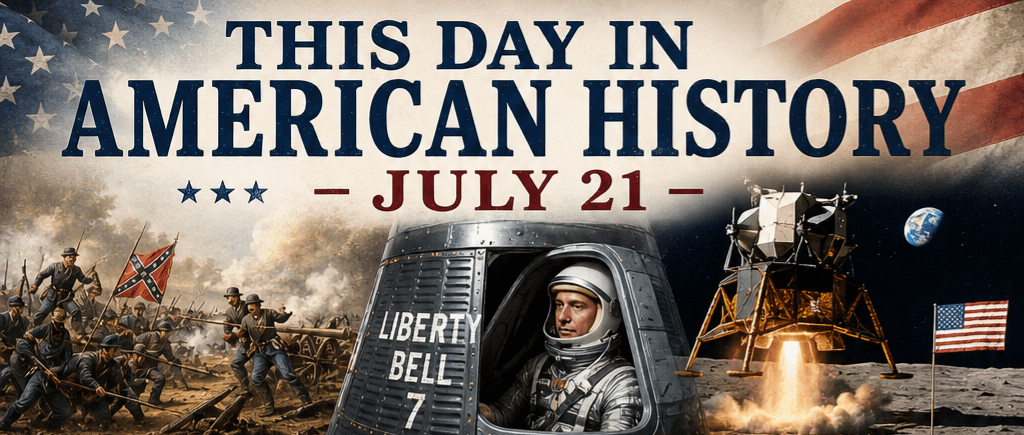
    Every day in American history tells a story of innovation, courage, exploration, and determination. July 21 is no exception. From milestones in space exploration and military history to groundbreaking achievements in transportation and technology, this day reminds us how individuals and events have shaped the United States and influenced the world.

    Let’s take a look at some of the most significant moments that happened on July 21.


    1861 – The First Battle of Bull Run Shocks the Nation

    On July 21, 1861, Union and Confederate forces clashed near Manassas, Virginia, in the First Battle of Bull Run (also known as the First Battle of Manassas). It was the first major land battle of the American Civil War.

    Many people on both sides believed the war would be short. Instead, the Confederate victory proved that the conflict would become a long and devastating struggle.

    More than 4,500 soldiers were killed, wounded, or missing during the battle. The defeat forced the Union Army to regroup and rethink its military strategy, while the Confederacy gained confidence after its first major victory.

    Why it matters:

    • First large-scale battle of the Civil War
    • Ended hopes for a quick resolution
    • Changed military planning on both sides

    1925 – The Scopes “Monkey Trial” Reaches Its Verdict

    On July 21, 1925, high school teacher John T. Scopes was found guilty of violating Tennessee’s Butler Act by teaching evolution in a public school.

    The famous trial attracted national attention and featured legendary attorneys Clarence Darrow and William Jennings Bryan.

    Although Scopes was fined $100 (later overturned on a technicality), the trial sparked an ongoing national conversation about science, education, religion, and academic freedom.

    Legacy of the trial:

    • Brought national attention to public education
    • Sparked debates that continue today
    • Became one of America’s most famous courtroom cases

    1961 – Gus Grissom Becomes America’s Second Man in Space

    On July 21, 1961, astronaut Virgil “Gus” Grissom flew aboard Liberty Bell 7 during NASA’s Mercury program.

    His 15-minute suborbital mission reached an altitude of over 118 miles before safely splashing down in the Atlantic Ocean.

    Although the spacecraft sank shortly after landing because the hatch unexpectedly blew open, Grissom survived and later became one of NASA’s most respected astronauts.

    His successful mission helped pave the way for America’s future orbital flights and ultimately the Apollo Moon landings.

    Historical significance:

    • America’s second human spaceflight
    • Demonstrated continued progress in Project Mercury
    • Advanced U.S. efforts during the Space Race

    1969 – Neil Armstrong and Buzz Aldrin Return from the Moon’s Surface

    After making history with humanity’s first Moon landing on July 20, Apollo 11 astronauts Neil Armstrong and Buzz Aldrin lifted off from the lunar surface on July 21, 1969 (UTC) in the Lunar Module Eagle to rendezvous with Michael Collins aboard the Command Module Columbia.

    The successful ascent from the Moon was another remarkable engineering achievement. It allowed the astronauts to begin their journey home after completing scientific experiments and collecting lunar samples.

    For Americans, Apollo 11 represented the culmination of years of scientific innovation, national determination, and the efforts of hundreds of thousands of engineers, scientists, technicians, and support personnel.


    1970 – Construction Begins on the Aswan High Dam’s Final Phase (U.S. Perspective)

    While occurring outside the United States, global infrastructure projects like the Aswan High Dam reflected the Cold War era in which American diplomacy, technology, and foreign policy were deeply involved in international development and geopolitical competition.

    The 1970s marked a period when America’s global influence extended far beyond its borders through science, engineering, and diplomacy.


    Birthdays on July 21

    Several notable Americans were born on this day, including:

    • Ernest Hemingway (1899) – Nobel Prize-winning author whose novels and short stories remain classics of American literature.
    • Robin Williams (1951) – Award-winning actor and comedian remembered for films including Good Will Hunting, Mrs. Doubtfire, Dead Poets Society, and Aladdin.
    • Josh Hartnett (1978) – American actor known for roles in films such as Pearl Harbor and Black Hawk Down.

    Quote of the Day

    “There is nothing noble in being superior to your fellow man; true nobility is being superior to your former self.”

    — Ernest Hemingway


    Why July 21 Matters

    July 21 reflects many of the qualities that have defined American history:

    • Courage during times of conflict
    • Scientific innovation and exploration
    • The pursuit of knowledge
    • Freedom of inquiry and debate
    • Determination to overcome extraordinary challenges

    From the battlefields of Virginia to the surface of the Moon, this day reminds us that history is shaped by ordinary people accomplishing extraordinary things.


    Final Thoughts

    Every date on the calendar carries stories that continue to influence our nation. July 21 stands out for moments that changed military history, expanded human knowledge, challenged society to think critically, and inspired generations to dream bigger.

    Whether remembering the sacrifices of Civil War soldiers, celebrating the achievements of America’s early astronauts, or honoring literary and cultural icons, July 21 serves as another reminder that the American story is one of perseverance, innovation, and hope.

    As we reflect on this day, we also remember that today’s actions become tomorrow’s history.

    Read More History & Culture

  • History & Culture of the Day – July 20

    History & Culture of the Day – July 20

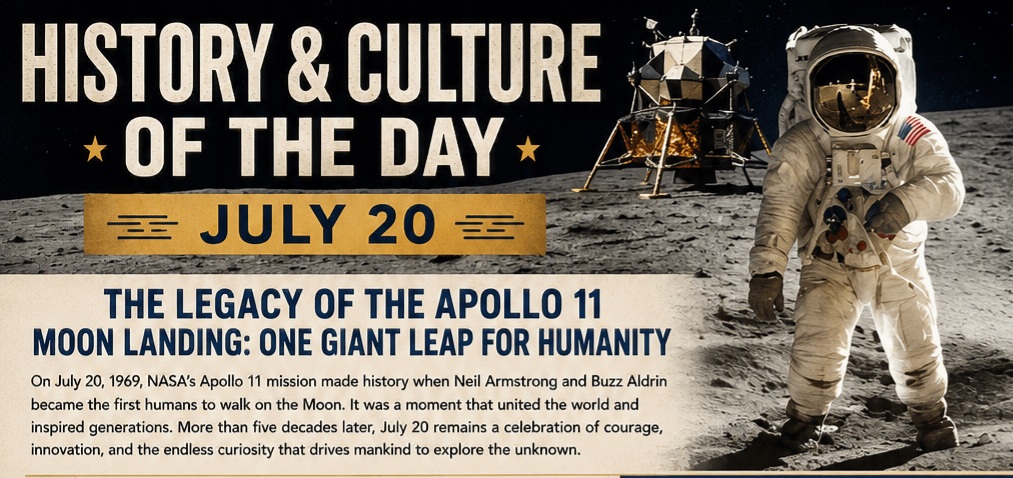
    The Legacy of the Apollo 11 Moon Landing: One Giant Leap for Humanity

    Every day in history offers a chance to remember the moments that shaped our world. On July 20, few events stand as tall as the successful landing of Apollo 11 on the Moon in 1969. It was a day that forever changed science, technology, exploration, and the way humanity viewed its place in the universe.

    What began as a daring mission during the height of the Space Race became one of the greatest achievements in human history. Millions of people around the globe gathered around televisions, radios, and newspapers, witnessing an accomplishment that united people across political, cultural, and geographic boundaries.

    More than half a century later, July 20 remains a celebration of courage, innovation, and the endless curiosity that drives mankind to explore the unknown.


    The Race to Reach the Moon

    Throughout the 1960s, the United States and the Soviet Union competed to achieve major milestones in space exploration.

    The Soviet Union had achieved several historic firsts, including:

    • The first artificial satellite (Sputnik)
    • The first human in space (Yuri Gagarin)
    • The first spacewalk

    Determined to lead the next chapter of exploration, President John F. Kennedy challenged America in 1961 to land a man on the Moon and return him safely to Earth before the decade ended.

    What seemed almost impossible quickly became a national mission involving more than 400,000 engineers, scientists, technicians, contractors, and support staff.


    Launch of Apollo 11

    Apollo 11 launched from Kennedy Space Center in Florida on July 16, 1969, aboard the massive Saturn V rocket.

    The crew consisted of:

    • Neil Armstrong – Mission Commander
    • Buzz Aldrin – Lunar Module Pilot
    • Michael Collins – Command Module Pilot

    After traveling nearly 240,000 miles through space, the spacecraft entered lunar orbit.

    The most dangerous part of the mission was still ahead.


    July 20, 1969: The Moon Landing

    On July 20, Neil Armstrong and Buzz Aldrin climbed into the Lunar Module, known as Eagle, leaving Michael Collins orbiting the Moon aboard the Command Module.

    As Eagle descended, several problems emerged.

    The onboard computer generated unexpected alarms, and Armstrong realized the automatic landing system was steering them toward a field filled with large rocks.

    Taking manual control with only seconds of fuel remaining, Armstrong carefully guided Eagle to a safe landing site.

    Mission Control received the unforgettable words:

    “Houston, Tranquility Base here. The Eagle has landed.”

    Cheers erupted inside Mission Control, while millions watching around the world celebrated one of humanity’s greatest accomplishments.


    “One Small Step”

    Several hours later, Neil Armstrong descended the ladder and became the first human being to walk on the Moon.

    His first words became among the most famous ever spoken:

    “That’s one small step for man, one giant leap for mankind.”

    Soon afterward, Buzz Aldrin joined him on the lunar surface.

    Together they:

    • Collected Moon rocks
    • Conducted scientific experiments
    • Took photographs
    • Planted the American flag
    • Left commemorative items honoring peace and exploration

    Although only two astronauts walked on the Moon that day, the achievement belonged to thousands who made the mission possible.


    Michael Collins: The Forgotten Hero

    While Armstrong and Aldrin explored the lunar surface, Michael Collins remained alone in lunar orbit.

    His responsibility was equally critical.

    If something went wrong, Collins would have been responsible for returning to Earth—or, in the worst-case scenario, returning alone.

    His professionalism and calm leadership were essential to the mission’s success.

    Today, many historians recognize Collins as one of the unsung heroes of Apollo 11.


    Technology That Changed the World

    The Apollo program accelerated innovation across countless industries.

    Technologies developed during the mission contributed to advances in:

    • Computer engineering
    • Telecommunications
    • Navigation systems
    • Materials science
    • Medical equipment
    • Water purification
    • Fire-resistant materials
    • Miniaturized electronics

    Many everyday technologies trace part of their development to innovations made possible by the space program.


    A Cultural Moment Unlike Any Other

    The Moon landing was more than a scientific achievement—it became a defining cultural event.

    People across continents paused to watch history unfold.

    Schools discussed the mission.

    Families stayed up late to witness the first Moon walk.

    Newspapers printed special editions.

    The event inspired artists, filmmakers, writers, educators, and musicians for generations.

    It reminded people that extraordinary goals become achievable when nations invest in education, research, and cooperation.


    Inspiring Future Explorers

    The Apollo 11 mission inspired millions of young people to pursue careers in:

    • Science
    • Engineering
    • Aviation
    • Astronomy
    • Medicine
    • Robotics
    • Computer programming

    Many of today’s scientists, astronauts, and innovators credit the Moon landing as the spark that ignited their passion for discovery.

    Its influence continues through modern missions to the Moon, Mars, and beyond.


    Why July 20 Still Matters

    The significance of July 20 reaches beyond space exploration.

    It represents:

    • Human determination
    • Teamwork
    • Innovation
    • Courage under pressure
    • Peaceful exploration
    • The belief that impossible dreams can become reality

    The Moon landing demonstrated that when people work together with a shared purpose, they can accomplish feats once thought unattainable.


    Lessons We Can Learn Today

    The story of Apollo 11 offers timeless lessons:

    • Great achievements require preparation.
    • Success depends on teamwork.
    • Courage often means moving forward despite uncertainty.
    • Innovation begins with curiosity.
    • History is made by those willing to attempt the impossible.

    These lessons remain just as relevant today as they were in 1969.


    Final Thoughts

    As we observe History & Culture of the Day on July 20, we remember far more than a spacecraft touching down on another world.

    We celebrate the engineers who solved impossible problems, the astronauts who accepted enormous risks, and the millions who believed humanity could reach farther than ever before.

    Apollo 11 reminds us that history is not only about remembering the past—it is about inspiring the future. Every generation faces challenges that seem beyond reach, yet the story of July 20, 1969, proves that bold vision, perseverance, and collaboration can turn the extraordinary into reality.

    More than five decades later, the footprints left on the Moon remain a powerful symbol of what humanity can achieve when it dares to dream.

    Read More History & Culture

  • This Day in American History – July 20

    This Day in American History – July 20

    Every day in American history carries stories that shaped the nation’s identity, but July 20 stands among the most remarkable. It is a date remembered for one of humanity’s greatest achievements—landing on the Moon—as well as important advances in civil rights, sports, science, and exploration.

    Let’s take a journey through some of the defining moments that occurred on this day.


    1969 – Apollo 11 Lands on the Moon

    Without question, the most famous event associated with July 20 is the Apollo 11 Moon landing.

    After traveling more than 240,000 miles through space, astronauts Neil Armstrong and Buzz Aldrin successfully landed the Lunar Module Eagle on the Moon while Michael Collins remained in lunar orbit aboard the command module Columbia.

    At 4:17 p.m. EDT, Armstrong calmly reported to Mission Control:

    “Houston, Tranquility Base here. The Eagle has landed.”

    Several hours later, Neil Armstrong became the first human to walk on the Moon, delivering one of history’s most recognizable quotes:

    “That’s one small step for man, one giant leap for mankind.”

    Buzz Aldrin followed shortly afterward, becoming the second person to walk on the lunar surface.

    Why It Matters

    The Moon landing represented:

    • The height of the Space Race.
    • A major victory for American innovation.
    • Proof that seemingly impossible goals can become reality through determination and teamwork.
    • A scientific achievement that inspired generations of engineers, scientists, and explorers.

    Apollo 11 remains one of the greatest accomplishments in American history.


    1976 – Viking 1 Sends the First Images from Mars

    Only seven years after Apollo 11, American space exploration reached another milestone.

    NASA’s Viking 1 spacecraft became the first successful mission to land on Mars and send clear photographs from the Martian surface.

    The mission dramatically increased our understanding of the Red Planet by studying:

    • Martian weather
    • Soil composition
    • Surface geology
    • The possibility of microbial life

    The Viking missions laid the foundation for today’s Mars rovers, including Spirit, Opportunity, Curiosity, and Perseverance.


    1968 – The First International Special Olympics Games

    On July 20, 1968, the first International Special Olympics Summer Games opened in Chicago.

    Founded through the vision of Eunice Kennedy Shriver, the event welcomed hundreds of athletes with intellectual disabilities from across the United States and Canada.

    The games forever changed public attitudes by demonstrating that ability matters far more than disability.

    Today, millions of athletes from more than 190 countries participate in Special Olympics competitions around the world.


    1944 – A Plot Against Adolf Hitler

    Although it occurred in Germany, July 20 is remembered internationally for the failed assassination attempt against Adolf Hitler known as the July 20 Plot.

    Colonel Claus von Stauffenberg planted a bomb during a military meeting in hopes of ending Nazi rule.

    Although Hitler survived, the event demonstrated that many Germans opposed his dictatorship from within.

    For Americans fighting in Europe during World War II, the event highlighted growing instability inside Nazi Germany.


    1977 – America Celebrates the Voyager Missions

    During the summer of 1977, NASA prepared to launch the Voyager spacecraft that would eventually become humanity’s farthest-traveling explorers.

    Around July 20, final preparations were underway for what would become one of the most successful scientific missions ever launched.

    The Voyager probes have since explored:

    • Jupiter
    • Saturn
    • Uranus
    • Neptune

    Today, both spacecraft continue sending information from interstellar space decades after launch.


    1871 – British Columbia Joins Canada

    While not an American event, the admission of British Columbia into Canada strengthened the development of North America’s Pacific Coast.

    Its growth would later influence trade, transportation, and diplomatic relationships between Canada and the United States.


    Famous Americans Born on July 20

    Several notable Americans celebrate birthdays on July 20, including:

    • Natalie Wood (1938) – Award-winning actress known for West Side Story, Rebel Without a Cause, and Splendor in the Grass.
    • Carlos Santana (1947) – Legendary guitarist whose music blends rock, blues, jazz, and Latin influences.
    • Gisele Bündchen (1980) – International supermodel, entrepreneur, and philanthropist.

    Quote of the Day

    “That’s one small step for man, one giant leap for mankind.”
    — Neil Armstrong

    Few words better capture the spirit of courage, innovation, and human determination.


    Did You Know?

    • Apollo 11 traveled nearly one million miles during its round-trip journey.
    • Neil Armstrong and Buzz Aldrin spent about 21½ hours on the Moon, with roughly 2½ hours outside the lunar module.
    • The American flag planted during Apollo 11 was later knocked over by the ascent engine as the astronauts departed.
    • The Special Olympics has grown from a few hundred athletes in 1968 to millions of participants worldwide.
    • The Voyager spacecraft carry the famous Golden Record, designed to introduce Earth and humanity to any intelligent life that might encounter them.

    The Legacy of July 20

    July 20 reminds us that history is shaped by people willing to dream beyond what seems possible. Whether it was astronauts landing on another world, scientists pushing the boundaries of exploration, or advocates creating opportunities for inclusion, this day showcases the American spirit of perseverance, curiosity, and hope.

    From the Sea of Tranquility to the playing fields of the Special Olympics, July 20 continues to inspire future generations to reach higher, explore farther, and believe that extraordinary achievements begin with bold ideas.

  • History & Culture of the Day – July 19

    History & Culture of the Day – July 19

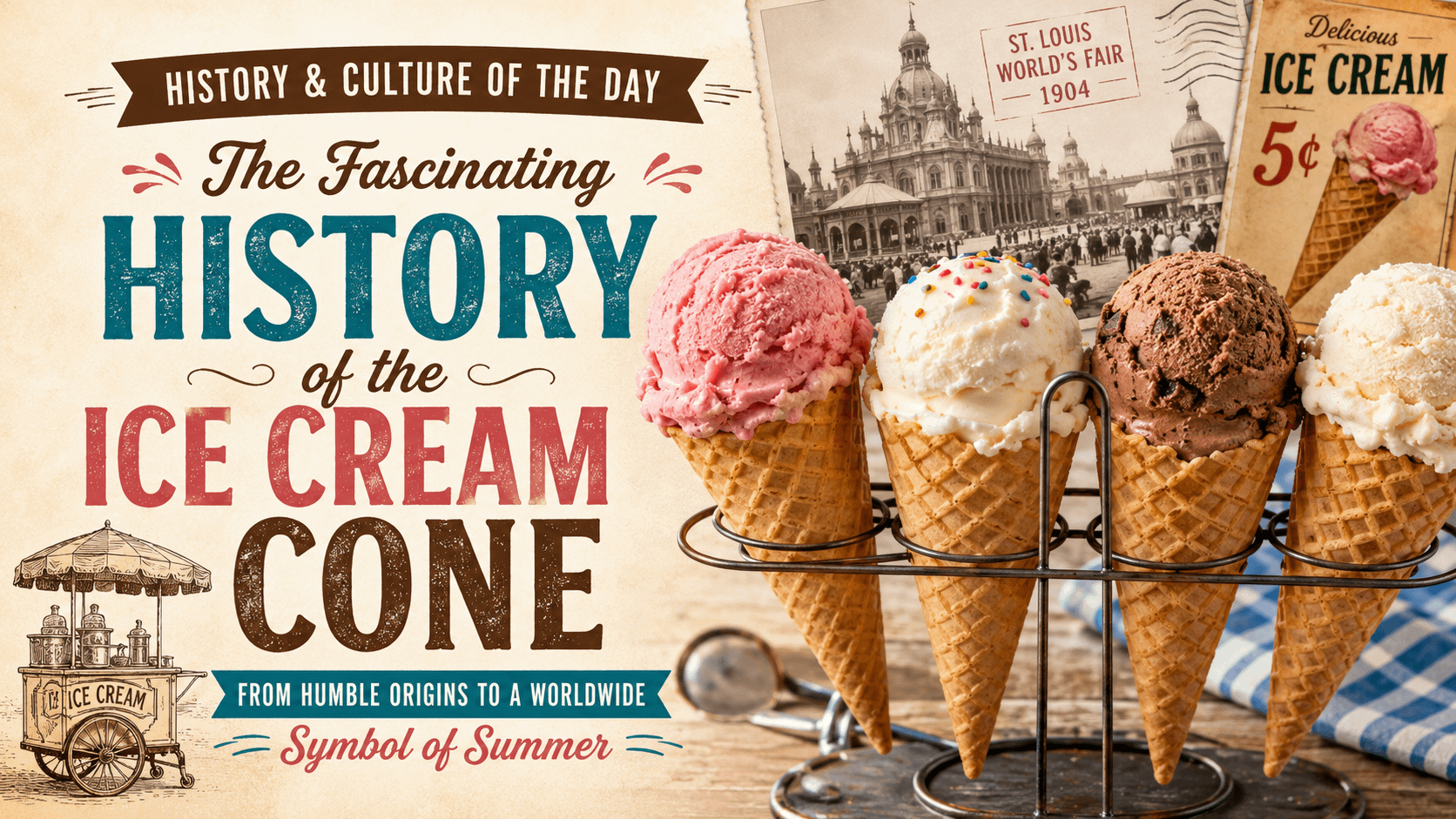
    The Fascinating History of the Ice Cream Cone: From Humble Origins to a Worldwide Symbol of Summer

    Meta Description: Discover the rich history of the ice cream cone, from its debated origins and rise in popularity at the 1904 World’s Fair to its lasting influence on cultures around the globe.


    A Simple Treat with an Extraordinary Story

    Few foods evoke feelings of happiness and nostalgia quite like an ice cream cone. Whether it’s enjoyed on a hot summer afternoon, during a family vacation, after a baseball game, or while walking through a local fair, the combination of creamy ice cream and a crunchy edible cone has become one of the world’s most beloved desserts.

    For many people, eating an ice cream cone brings back childhood memories of neighborhood ice cream trucks, family outings, county fairs, amusement parks, and celebrations with loved ones. It’s a dessert that crosses generations, cultures, and continents.

    Yet behind this simple treat lies a fascinating story filled with innovation, competition, entrepreneurship, and a little mystery. Historians still debate who truly invented the ice cream cone, but one thing is certain—it changed the dessert industry forever.

    Today’s History & Culture of the Day explores how one of the simplest inventions became one of the most recognizable symbols of summer around the world.


    Ice Cream Before the Cone

    Before cones existed, enjoying ice cream wasn’t nearly as convenient.

    Ice cream itself dates back centuries. Ancient civilizations, including the Chinese, Persians, and Romans, enjoyed frozen desserts made from snow, ice, fruit juices, and sweetened flavorings. Wealthy families often stored mountain snow underground to create primitive frozen treats long before refrigeration existed.

    By the 1700s and 1800s, ice cream had become increasingly popular in Europe and America. However, it was generally reserved for wealthy households because producing ice cream required large amounts of hand-churned labor and harvested ice.

    When ice cream became available to the public during the nineteenth century, vendors served it in several ways:

    • Glass dishes
    • Ceramic bowls
    • Tin cups
    • Paper containers
    • Reusable “penny lick” glasses

    The penny lick became especially common throughout cities.

    Customers paid a penny for a small serving of ice cream placed into a tiny thick glass. After eating the ice cream, the customer returned the glass, which was quickly rinsed—or sometimes barely cleaned at all—before being used again.

    Although economical, this practice eventually became a public health concern as cities grew and awareness of disease transmission increased.

    People wanted a disposable, sanitary alternative.


    The Search for a Better Way

    By the late nineteenth century, inventors and food vendors began experimenting with edible containers.

    Thin wafers had long been served alongside desserts throughout Europe. Bakers discovered that warm wafer cookies could be rolled into tubes or cups before they cooled and hardened.

    These edible pastries were delicious, lightweight, and eliminated the need for reusable serving dishes.

    Several entrepreneurs began selling wafer cups and edible containers before the famous 1904 World’s Fair.

    Because of this, historians generally agree that no single individual deserves complete credit for inventing the modern ice cream cone.

    Instead, the cone evolved through years of experimentation by multiple creative minds.


    The Famous 1904 St. Louis World’s Fair

    Although edible cones likely existed earlier, the event most closely associated with their popularity is the 1904 Louisiana Purchase Exposition, better known as the St. Louis World’s Fair.

    The fair celebrated the centennial of the Louisiana Purchase and welcomed nearly twenty million visitors from around the world.

    It showcased incredible innovations, architecture, cultures, foods, and inventions that would shape the twentieth century.

    Among the countless food vendors were ice cream sellers and waffle makers.

    According to the most famous story, one busy ice cream vendor unexpectedly ran out of bowls during a rush of customers.

    A nearby waffle baker stepped in to help by rolling one of his freshly baked waffles into a cone while it was still warm.

    The ice cream vendor placed scoops inside the rolled waffle.

    Customers loved it.

    Instead of returning bowls or carrying fragile dishes, they could simply eat the entire container.

    Whether completely accurate or partly legendary, this story became one of the World’s Fair’s most enduring tales.


    Who Really Invented the Ice Cream Cone?

    Like many famous inventions, several people claimed to be first.

    Italo Marchiony

    An Italian immigrant living in New York City, Italo Marchiony patented an edible ice cream cup in 1903.

    He sold frozen desserts from street carts and wanted a solution that prevented customers from walking away with his expensive serving glasses.

    His patented edible cups closely resembled early waffle cones.

    Ernest Hamwi

    Ernest Hamwi, a Syrian immigrant, sold a crispy pastry called zalabia during the 1904 World’s Fair.

    According to popular accounts, he rolled his pastries into cone shapes to help an ice cream vendor who had run out of dishes.

    Although historians question some details, Hamwi became one of the names most associated with popularizing the cone.

    Abe Doumar

    Another claimant was Abe Doumar, who reportedly served rolled waffle cones at the World’s Fair before opening a successful cone business.

    His company would later manufacture waffle cone machines and help expand commercial production throughout the United States.

    The Likely Answer

    Most historians now believe the cone wasn’t invented by one individual but instead evolved through multiple inventors, bakers, and entrepreneurs working independently.

    The World’s Fair simply introduced the concept to millions of people at exactly the right moment.


    The Rise of Commercial Ice Cream

    Following the World’s Fair, demand exploded.

    Ice cream shops quickly adopted cones because they offered several advantages:

    • Less cleanup
    • Lower serving costs
    • Faster customer service
    • No dishes to wash
    • A fun eating experience

    As mechanical refrigeration improved during the early twentieth century, ice cream became more affordable than ever before.

    Entire businesses formed around cone production.

    Factories manufactured sugar cones, waffle cones, and cake cones in enormous quantities.

    The ice cream cone had officially become part of American life.


    Ice Cream During the Great Depression

    Despite difficult economic times during the 1930s, ice cream remained one of America’s most affordable luxuries.

    For only a few cents, families could enjoy a cone together.

    Children often saved spare change to buy treats after school.

    Ice cream parlors became gathering places where neighbors socialized despite financial hardships.

    The cone represented something important during uncertain times—small moments of happiness.


    The Birth of the Ice Cream Truck

    Following World War II, suburban neighborhoods expanded rapidly across America.

    Ice cream trucks became a familiar summertime sight.

    The cheerful music announcing the truck’s arrival could send children running outside with coins in hand.

    For many families, the neighborhood ice cream truck became a treasured summer tradition.

    Today, hearing those familiar melodies still brings instant nostalgia to many adults.


    A Favorite at Fairs and Ballparks

    The ice cream cone became closely tied to American recreation.

    Visitors enjoyed cones at:

    • County fairs
    • State fairs
    • Baseball games
    • Boardwalks
    • Carnivals
    • Zoos
    • Amusement parks
    • Beaches

    These locations helped cement the cone as a symbol of fun, family, and celebration.

    Even today, many people associate eating an ice cream cone with vacations and carefree summer afternoons.


    Ice Cream Cones Around the World

    Although often viewed as an American classic, the cone has become an international favorite.

    Italy

    Italy pairs crisp cones with rich, handcrafted gelato in countless flavors, from pistachio to stracciatella.

    Japan

    Japanese shops offer beautifully crafted cones featuring matcha, black sesame, sakura, melon, and seasonal fruits.

    Presentation is considered just as important as flavor.

    Turkey

    Turkey’s famous dondurma contains natural ingredients that make the ice cream stretchy and chewy.

    Street vendors entertain customers with playful tricks before finally handing over the cone.

    Mexico

    Mexican ice cream shops often feature tropical fruits, cinnamon, chili powder, tamarind, mango, and coconut flavors.

    South Korea

    Creative soft-serve cones topped with colorful candies, flowers, cookies, and elaborate decorations have become social media favorites.


    Different Types of Ice Cream Cones

    Today’s consumers enjoy several varieties.

    Cake Cone

    Light, crispy, and slightly sweet, cake cones are made from a batter similar to a crisp cookie.

    Sugar Cone

    Sweeter and crunchier than cake cones, sugar cones hold larger scoops and remain popular at ice cream shops.

    Waffle Cone

    Made from rich waffle batter, waffle cones are thicker, more flavorful, and often baked fresh in stores where their sweet aroma fills the air.

    Chocolate-Dipped Cone

    Many specialty shops coat the rim in chocolate before adding sprinkles, nuts, or candies for an extra indulgent treat.


    Fun Facts About Ice Cream Cones

    • Americans consume billions of ice cream cones every year.
    • Vanilla remains one of the most popular ice cream flavors worldwide.
    • Waffle cones are often considered the premium option because of their buttery flavor.
    • National Ice Cream Day is celebrated each July in the United States.
    • Some giant novelty cones measure several feet tall and are displayed at festivals and museums.
    • Ice cream remains one of the world’s most popular desserts regardless of season.

    Why the Ice Cream Cone Matters

    The ice cream cone represents much more than dessert.

    It tells a story about innovation solving an everyday problem.

    It reflects how immigrants brought new baking traditions to America.

    It demonstrates how major public events like the World’s Fair helped spread new ideas across the country.

    Most importantly, it reminds us that culture is often shaped by ordinary objects that become extraordinary through everyday use.

    Countless birthdays, first dates, family vacations, Little League games, county fairs, beach walks, and summer evenings have included an ice cream cone.

    Those shared experiences transformed it into an enduring cultural icon.


    Lessons from an Everyday Invention

    History isn’t only found in wars, governments, or famous leaders.

    Sometimes the most meaningful stories are hidden within ordinary objects we use without giving them much thought.

    The ice cream cone reminds us that innovation often comes from practical needs. A simple edible container improved sanitation, reduced waste, lowered costs, and created an entirely new way to enjoy a beloved dessert.

    More than a century later, that clever idea continues to bring smiles to millions of people around the world.


    Final Thoughts

    The next time you enjoy an ice cream cone, take a moment to appreciate the remarkable journey behind it.

    From ancient frozen desserts and nineteenth-century street vendors to bustling World’s Fairs and modern ice cream shops, the cone has traveled a long road to become one of the most recognizable treats in history.

    Its story is one of creativity, entrepreneurship, cultural exchange, and joyful traditions passed from one generation to the next.

    That is what makes the ice cream cone more than just a dessert—it is a delicious piece of history and a lasting symbol of culture, celebration, and the simple pleasures that connect us all.

    Read More History & Culture

  • This Day in American History – July 19

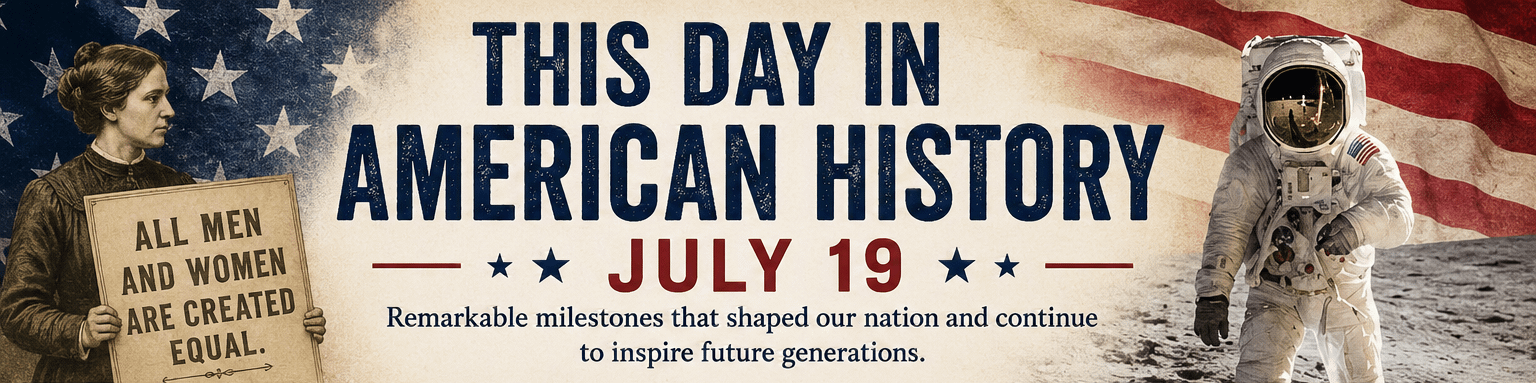
    This Day in American History – July 19

    July 19 has been a remarkable date in American history, marked by milestones in civil rights, space exploration, military achievements, and moments that shaped the nation’s future. From the fight for equality to groundbreaking discoveries beyond Earth, July 19 reminds us that history is often written by those willing to challenge the status quo and pursue a better future.

    The Seneca Falls Convention Begins (1848)

    One of the most significant events in American history took place on July 19, 1848, when the Seneca Falls Convention opened in Seneca Falls, New York. Organized by Elizabeth Cady Stanton, Lucretia Mott, and other reformers, it became the first women’s rights convention in the United States.

    Approximately 300 people attended the two-day gathering, where delegates discussed women’s legal, educational, and social inequalities. The convention produced the Declaration of Sentiments, a groundbreaking document modeled after the Declaration of Independence that boldly proclaimed:

    “All men and women are created equal.”

    The convention marked the official beginning of the organized women’s suffrage movement in America. Although women would not gain the right to vote nationally until the ratification of the 19th Amendment in 1920, the work that began on July 19, 1848, changed the course of American history forever.

    The First Tour de France Begins (1903)

    While not an American event, the inaugural Tour de France officially concluded on July 19, 1903, capturing worldwide attention and eventually inspiring generations of American cyclists. Decades later, American riders would become prominent figures in international cycling, helping grow the sport across the United States.

    World War II: Liberation of Guam Begins (1944)

    On July 19, 1944, American forces intensified their preparations for the liberation of Guam during World War II. Just two days later, U.S. Marines and Army troops landed on the island, beginning a fierce battle to reclaim American territory that had been occupied by Japanese forces since 1941.

    The successful liberation restored American control of Guam and established an important strategic base for operations across the Pacific. Today, Guam remains an important U.S. territory and military installation.

    NASA’s Apollo 11 Enters Lunar Orbit (1969)

    One of the greatest achievements in American history occurred during the Apollo 11 mission. On July 19, 1969, astronauts Neil Armstrong, Buzz Aldrin, and Michael Collins successfully entered lunar orbit aboard the spacecraft Columbia.

    The maneuver positioned the astronauts for the historic Moon landing that would occur the following day. Millions of Americans watched with anticipation as the mission demonstrated American innovation, determination, and scientific excellence during the height of the Space Race.

    Only a day later, Neil Armstrong would become the first human to walk on the Moon, fulfilling President John F. Kennedy’s challenge to land a man on the Moon before the end of the decade.

    The Atlanta Olympic Games Open (1996)

    On July 19, 1996, the Centennial Olympic Games officially opened in Atlanta, Georgia. The Opening Ceremony celebrated 100 years of the modern Olympic movement and showcased American culture to billions of viewers around the world.

    One of the most memorable moments came when legendary boxer Muhammad Ali, despite living with Parkinson’s disease, lit the Olympic cauldron. His emotional appearance became one of the most inspiring moments in Olympic history and remains one of the defining images of the Games.

    The Atlanta Olympics featured more than 10,000 athletes representing nearly every nation on Earth and demonstrated America’s ability to host one of the world’s largest sporting events.

    American Innovations Continue

    Throughout history, July 19 has represented American progress in science, equality, exploration, and perseverance. The achievements remembered on this day highlight values that continue to define the nation:

    • Fighting for equal rights and opportunity.
    • Pursuing scientific discovery.
    • Defending freedom.
    • Inspiring future generations through courage and leadership.

    Remembering July 19

    History is more than dates in a textbook—it is the story of ordinary people accomplishing extraordinary things. The events remembered on July 19 remind us that meaningful change often begins with courageous individuals willing to stand for what is right or venture into the unknown.

    Whether we reflect on the women who launched a movement for equality at Seneca Falls, the astronauts orbiting the Moon, or athletes inspiring the world in Atlanta, July 19 serves as a powerful reminder that determination and vision can change history.

    As we look back on this day, we honor those whose actions helped shape the United States and continue to inspire future generations to dream bigger, work harder, and build a better tomorrow.

    Read More History & Culture

  • This Day in American History – July 18

    This Day in American History – July 18

    History is made one day at a time. July 18 has witnessed groundbreaking achievements in space exploration, scientific discovery, military history, and civil rights. From humanity taking one of its greatest steps toward the Moon to technological breakthroughs that transformed modern life, this date reminds us that innovation, courage, and determination have always shaped the American story.

    Here are some of the most notable events that occurred on July 18.


    1863 – The Battle of Fort Wagner Continues

    During the American Civil War, Union forces launched one of the most famous assaults against Fort Wagner near Charleston, South Carolina. The attack was led in part by the 54th Massachusetts Infantry Regiment, one of the first official African American regiments in the Union Army.

    Although the assault ended in heavy casualties, the extraordinary bravery displayed by the soldiers helped change public opinion about African American troops serving in the military. Their courage inspired thousands of others to enlist and strengthened the Union cause.

    Why It Matters

    The heroism of the 54th Massachusetts demonstrated that African American soldiers were willing and able to fight for freedom and equality, influencing both military policy and the broader fight against slavery.


    1925 – Adolf Hitler Publishes Mein Kampf (Historical Context)

    On July 18, 1925, the first volume of Adolf Hitler’s Mein Kampf was published in Germany.

    While this event occurred overseas, it would eventually have enormous consequences for the United States and the world. The extremist ideology promoted in the book foreshadowed World War II and the Holocaust, events that would draw America into one of the largest conflicts in human history.

    Why It Matters

    Remembering this publication serves as a reminder of the dangers of hatred, propaganda, and authoritarianism and reinforces the importance of protecting democracy and human rights.


    1947 – The National Security Act Is Signed

    President Harry S. Truman signed the National Security Act of 1947, one of the most significant reorganizations of the U.S. government after World War II.

    The legislation created:

    • The Department of Defense
    • The United States Air Force as its own military branch
    • The National Security Council (NSC)
    • The Central Intelligence Agency (CIA)

    Why It Matters

    These institutions continue to play central roles in America’s defense, intelligence gathering, and national security planning today.


    1968 – Intel Is Incorporated

    On July 18, 1968, Intel Corporation was officially incorporated by Robert Noyce and Gordon Moore.

    Initially focused on semiconductor memory, Intel soon revolutionized computing by developing the microprocessor, laying the foundation for personal computers, smartphones, and countless modern technologies.

    Why It Matters

    Nearly every modern electronic device traces part of its technological heritage back to Intel’s innovations, making this one of the most important business milestones in American history.


    1969 – Apollo 11 Nears the Moon

    Three days after launch, Apollo 11 continued its historic journey toward the Moon on July 18, 1969.

    Astronauts Neil Armstrong, Buzz Aldrin, and Michael Collins conducted system checks and prepared the Lunar Module for the landing that would occur just two days later.

    Millions of Americans followed the mission on television as excitement built across the country.

    Why It Matters

    Apollo 11 represented the culmination of years of scientific research, engineering excellence, and national determination during the Space Race.


    1976 – Nadia Comăneci Earns Another Perfect Olympic Score

    During the Montreal Olympics, Romanian gymnast Nadia Comăneci continued making history by earning additional perfect 10 scores.

    Although not an American athlete, her performances captivated audiences across the United States and inspired generations of young gymnasts.

    Why It Matters

    Her excellence helped elevate women’s gymnastics into one of America’s most popular Olympic sports.


    1984 – Beverly Burns Makes Aviation History

    Captain Beverly Burns became the first woman to command a Boeing 747 across the Atlantic Ocean.

    Her achievement marked another important milestone for women in aviation and demonstrated the growing opportunities for female pilots in commercial airlines.

    Why It Matters

    Her success encouraged more women to pursue careers in aviation and other traditionally male-dominated professions.


    1995 – The Walt Disney Company Announces Purchase of Capital Cities/ABC

    One of the largest entertainment mergers in history was announced on July 18, 1995, when The Walt Disney Company agreed to purchase Capital Cities/ABC.

    The acquisition expanded Disney into television broadcasting and news, helping create one of the world’s largest media companies.

    Why It Matters

    The merger reshaped the American entertainment industry and influenced how millions of people receive news, sports, and family entertainment.


    Famous Americans Born on July 18

    Several notable Americans celebrate birthdays on July 18, including:

    • Richard Branson (1950) – Entrepreneur and founder of the Virgin Group (British, but influential in American business)
    • Kristen Bell (1980) – Actress known for Frozen, Veronica Mars, and The Good Place.
    • Vin Diesel (1967) – Actor and producer best known for the Fast & Furious franchise.
    • Nelson Mandela Day is also observed internationally on July 18, honoring the legacy of the South African leader and humanitarian.

    July 18 Trivia

    • Apollo 11 was only two days away from its historic Moon landing.
    • Intel’s incorporation helped launch the computer revolution.
    • The National Security Act permanently reshaped America’s military and intelligence agencies.
    • The bravery of the 54th Massachusetts remains one of the Civil War’s most inspiring stories.
    • Major media consolidation changed the future of entertainment when Disney acquired ABC.

    Reflection

    July 18 reminds us that history is driven by vision, perseverance, and the courage to push beyond what once seemed impossible. Whether it was soldiers fighting for freedom during the Civil War, engineers preparing humanity’s first Moon landing, innovators launching companies that transformed technology, or leaders reshaping national security, each event left a lasting mark on America.

    Every July 18 offers an opportunity to remember those achievements, learn from the past, and appreciate how today’s decisions may become tomorrow’s history.

    Read More History & Culture

  • This Day in American History – July 17

    This Day in American History – July 17

    July 17 has witnessed defining moments in American history that shaped politics, transportation, civil rights, science, and even the nation’s exploration of space. From tragedies that changed safety standards to remarkable achievements that inspired generations, this date reminds us that history is built from both triumph and hardship.

    Here’s a look back at some of the most significant events that happened on July 17.


    1862 – The Second Confiscation Act Is Signed

    During the American Civil War, President Abraham Lincoln signed the Second Confiscation Act, allowing Union forces to seize property belonging to Confederate supporters. More importantly, the law declared that enslaved people owned by Confederate supporters who reached Union lines would be forever free.

    Although it stopped short of ending slavery nationwide, the legislation became an important step toward the Emancipation Proclamation, issued later that year.

    Why It Matters

    The act weakened the Confederacy while laying important legal groundwork for the eventual abolition of slavery throughout the United States.


    1935 – The First Parking Meter Is Installed

    The world’s first parking meter, known as the Park-O-Meter No. 1, was installed in Oklahoma City, Oklahoma.

    At first, many drivers disliked paying to park on public streets, but city planners believed parking meters would improve traffic flow and create more available parking spaces for businesses.

    Today, paid parking is common in cities across America and around the world.


    1945 – Potsdam Conference Begins

    President Harry S. Truman, British Prime Minister Winston Churchill, and Soviet leader Joseph Stalin met in Germany for the Potsdam Conference, one of the final meetings of Allied leaders during World War II.

    The conference focused on:

    • Rebuilding Europe
    • The occupation of Germany
    • The future of Japan
    • Establishing post-war borders

    The discussions also marked the beginning of growing tensions between the United States and the Soviet Union that would later become the Cold War.


    1955 – Disneyland Opens to the Public

    One of America’s most beloved destinations officially opened its gates in Anaheim, California.

    Created by Walt Disney, Disneyland revolutionized the amusement park industry by combining storytelling, themed lands, and immersive attractions unlike anything visitors had experienced before.

    Opening Day was broadcast nationally on television and became one of the largest live television events of its time.

    Lasting Legacy

    Today Disneyland welcomes millions of visitors every year and helped inspire Disney theme parks around the globe.


    1975 – Apollo-Soyuz Mission Makes History

    The United States and the Soviet Union achieved a remarkable milestone when astronauts aboard Apollo docked with Soviet cosmonauts aboard Soyuz in Earth orbit.

    The famous handshake in space symbolized improving relations between the Cold War rivals.

    The mission also demonstrated international cooperation in space exploration and paved the way for future partnerships, including today’s International Space Station.


    1981 – The Hyatt Regency Walkway Collapse

    One of the deadliest structural engineering disasters in American history occurred at the Hyatt Regency Hotel in Kansas City, Missouri.

    Two suspended walkways collapsed during a crowded dance event.

    The Tragedy

    • 114 people lost their lives.
    • More than 200 were injured.

    Investigations revealed significant design and construction failures.

    Lasting Impact

    The disaster transformed engineering oversight and building inspection practices across the United States, leading to stricter standards for structural design and professional accountability.


    1996 – TWA Flight 800 Crash

    Trans World Airlines Flight 800 exploded shortly after taking off from New York’s John F. Kennedy International Airport on its way to Paris.

    All 230 people aboard lost their lives.

    After one of the most extensive aviation investigations ever conducted, investigators concluded that the likely cause was an explosion of fuel vapors inside the aircraft’s center fuel tank.

    Lasting Impact

    The tragedy led to major improvements in:

    • Aircraft fuel tank safety
    • Electrical wiring inspections
    • Airline maintenance standards
    • Aviation accident investigation procedures

    Other Notable July 17 Events

    1821 – Spain Cedes Florida

    Spain officially transferred Florida to the United States under the Adams–Onís Treaty, expanding American territory and strengthening the nation’s southeastern border.

    1944 – Port Chicago Explosion

    A massive ammunition explosion at the Port Chicago Naval Magazine in California killed 320 people, most of them African American sailors working under segregated conditions.

    The disaster highlighted racial inequality within the U.S. Navy and became an important milestone in the movement toward military desegregation.

    1976 – Opening of the Montreal Olympics

    American athletes competed in the Summer Olympic Games held in Montreal, where the United States earned numerous medals and showcased many future sports legends.


    Famous Birthdays – July 17

    Several notable Americans were born on this day:

    • John Jacob Astor (1763) – Businessman and America’s first multimillionaire
    • James Cagney (1899) – Academy Award-winning actor
    • Donald Sutherland (1935) – Acclaimed actor known for decades of memorable performances
    • David Hasselhoff (1952) – Actor and singer

    Quote for Today

    “History is not just about the victories we celebrate, but also the lessons we refuse to forget.”


    Why July 17 Still Matters

    July 17 reflects the remarkable range of American history. It is a day marked by innovation, courage, cooperation, tragedy, and progress. From the opening of Disneyland and historic achievements in space to aviation safety reforms and advances in civil rights, the events of this day continue to influence everyday life in America.

    Studying these moments reminds us that history is more than dates on a calendar—it is a story of people whose decisions, sacrifices, and dreams continue to shape our nation today.

    Whether remembering lives lost, celebrating milestones, or learning from past challenges, July 17 serves as another chapter in the ongoing story of the United States.

    Read More History & Culture

  • This Day in American History – July 16

    This Day in American History – July 16

    July 16 has been a day marked by scientific breakthroughs, political milestones, exploration, and defining moments that changed the course of American history. From the dawn of the atomic age to humanity’s journey to the Moon, this date reminds us of the innovation, courage, and determination that have shaped the United States.

    Let’s look back at some of the most significant events that occurred on July 16.


    1. The First Atomic Bomb Test – 1945

    The most significant event associated with July 16 is undoubtedly the Trinity Test, the world’s first successful detonation of a nuclear weapon.

    At 5:29 a.m. near Alamogordo, New Mexico, scientists working on the Manhattan Project witnessed history as the first atomic bomb exploded.

    Led by physicist J. Robert Oppenheimer, thousands of scientists and military personnel had spent years secretly developing the weapon during World War II.

    The explosion produced a blinding flash visible for hundreds of miles and forever changed military history.

    The success of the Trinity Test paved the way for the atomic bombings of Hiroshima and Nagasaki just weeks later, ultimately contributing to the end of World War II while ushering in the beginning of the nuclear age.


    2. Apollo 11 Launches to the Moon – 1969

    On July 16, 1969, millions of Americans watched as the massive Saturn V rocket lifted off from Kennedy Space Center in Florida.

    Aboard were three astronauts:

    • Neil Armstrong
    • Buzz Aldrin
    • Michael Collins

    The mission was Apollo 11, America’s historic first attempt to land humans on the Moon.

    Four days later, Armstrong would step onto the lunar surface and speak the famous words:

    “That’s one small step for man, one giant leap for mankind.”

    The successful mission fulfilled President John F. Kennedy’s ambitious goal of landing a man on the Moon before the end of the 1960s and remains one of humanity’s greatest achievements.


    3. The District of Columbia Gains Home Rule – 1973

    On July 16, 1973, the District of Columbia Self-Government and Governmental Reorganization Act, commonly known as the Home Rule Act, was signed into law.

    The legislation allowed residents of Washington, D.C. to elect their own mayor and city council instead of having Congress directly manage local affairs.

    Although Congress still maintains oversight over the District, the Home Rule Act represented an important expansion of local self-government for the nation’s capital.


    4. Babe Ruth’s Final Major League Appearance as a Player – 1935

    Baseball legend Babe Ruth made one of the final appearances of his remarkable playing career during July 1935.

    Although injuries and age had slowed him, Ruth remained one of America’s most beloved sports figures.

    His incredible career included:

    • 714 home runs
    • Seven World Series championships
    • A transformation of baseball into America’s favorite pastime

    Even decades later, Ruth remains one of the most recognizable names in sports history.


    5. The Manhattan Project Changes History

    Although the Trinity Test is the event most remembered on July 16, it also symbolizes the enormous scientific effort known as the Manhattan Project.

    More than 130,000 people worked in secrecy across the United States.

    Facilities stretched across:

    • Los Alamos, New Mexico
    • Oak Ridge, Tennessee
    • Hanford, Washington

    The project represented one of the largest scientific collaborations ever undertaken and forever changed global politics, military strategy, and international diplomacy.


    6. America Continues Exploring Space

    July 16 has become closely associated with American space exploration.

    Following Apollo 11, several later NASA missions also launched during mid-July, continuing America’s commitment to scientific discovery and human exploration beyond Earth.

    The achievements of NASA inspired generations of scientists, engineers, astronauts, and students around the world.


    Famous Americans Born on July 16

    Several notable Americans celebrate birthdays on July 16, including:

    • Will Ferrell (1967) – Actor and comedian
    • Phoebe Cates (1963) – Actress
    • Corey Feldman (1971) – Actor and musician

    Their contributions to film and entertainment have made them familiar faces in American popular culture.


    Why July 16 Matters

    Few dates combine scientific achievement, exploration, and historical significance quite like July 16.

    It represents:

    • Scientific innovation
    • Courage under uncertainty
    • American leadership in space exploration
    • Technological advancement
    • The pursuit of ambitious goals

    From unlocking the power of the atom to reaching for the Moon, July 16 showcases both the incredible possibilities and profound responsibilities that accompany human progress.


    Looking Back While Looking Forward

    History is filled with moments that redefine what is possible. July 16 reminds us that determination, innovation, and teamwork can accomplish extraordinary feats.

    Whether reflecting on the Trinity Test’s sobering legacy or celebrating Apollo 11’s inspiring journey to the Moon, this day encourages us to learn from the past while continuing to pursue discoveries that improve the future.

    As we remember July 16, we honor the scientists, explorers, leaders, and everyday Americans whose work helped shape the nation and left a lasting impact on the world.

  • This Day in American History – July 15

    This Day in American History – July 15

    July 15 has been the setting for defining moments in American history, from military triumphs and scientific discoveries to social change and remarkable achievements. Looking back at the events of this day reminds us that history is built one day at a time, with each generation leaving its mark on the nation.

    Here are some of the most significant events that occurred on July 15 throughout American history.


    1838 – Ralph Waldo Emerson Delivers the “Divinity School Address”

    On July 15, 1838, Ralph Waldo Emerson delivered his famous Divinity School Address at Harvard University.

    The speech challenged traditional religious thinking and encouraged people to seek a personal relationship with God rather than relying solely on established institutions. Although controversial at the time, Emerson’s ideas helped shape the American Transcendentalist movement and influenced generations of writers, philosophers, and civil rights leaders.

    His message continues to inspire those who value independent thought and personal freedom.


    1862 – President Lincoln Signs the Pacific Railroad Act

    During the Civil War, President Abraham Lincoln signed the Pacific Railroad Act on July 15, 1862.

    The legislation authorized construction of the nation’s first transcontinental railroad, connecting the eastern United States with the Pacific Coast. The project transformed commerce, travel, communication, and westward expansion.

    When completed in 1869, Americans could travel across the continent in days instead of months.

    The railroad became one of the greatest engineering achievements in American history.


    1916 – Boeing Is Founded

    On July 15, 1916, William Boeing founded what would become The Boeing Company in Seattle, Washington.

    Originally called Pacific Aero Products Co., the company soon became one of the world’s leading aerospace manufacturers.

    Over the next century Boeing would help shape aviation by producing military aircraft, commercial airliners, spacecraft, satellites, and technologies that expanded both national defense and civilian air travel.


    1948 – The First Flight Around the World by a Single Military Aircraft Is Completed

    On July 15, 1948, the U.S. Air Force completed Operation Around the World, demonstrating America’s growing aviation capabilities following World War II.

    The successful mission highlighted advances in aircraft technology, navigation, and aerial refueling that would become increasingly important during the Cold War.


    1965 – Mariner 4 Sends Back the First Close-Up Images of Mars

    On July 15, 1965, NASA’s Mariner 4 spacecraft transmitted humanity’s first close-up photographs of Mars.

    The flyby revealed a cratered landscape unlike the lush world many scientists had imagined.

    These groundbreaking images marked the beginning of detailed exploration of the Red Planet and laid the foundation for decades of American space exploration, eventually leading to today’s Mars rovers and future human exploration plans.


    1975 – Apollo-Soyuz Test Project Launches

    On July 15, 1975, NASA launched Apollo on a historic mission that would dock with a Soviet Soyuz spacecraft two days later.

    Known as the Apollo-Soyuz Test Project, it marked the first international human spaceflight mission and symbolized improving relations between the United States and the Soviet Union during the Cold War.

    The famous handshake in space demonstrated that even rival nations could work together in scientific exploration.

    The mission paved the way for future international cooperation aboard the International Space Station.


    1978 – The World Watches “Animal House”

    On July 15, 1978, National Lampoon’s Animal House became one of the year’s biggest box-office successes.

    The comedy transformed American filmmaking and college comedy for decades to come, launching careers and influencing countless movies that followed.

    Its cultural impact remains visible in comedy films today.


    1997 – Gianni Versace Is Murdered in Miami Beach

    On July 15, 1997, internationally renowned fashion designer Gianni Versace was murdered outside his Miami Beach home.

    Although an international event, the tragedy captivated the United States and sparked one of the nation’s largest manhunts, eventually leading to the death of suspect Andrew Cunanan.

    The case remains one of the most discussed criminal investigations of the late 20th century.


    Americans Born on July 15

    Several notable Americans celebrate birthdays on July 15, including:

    • Linda Ronstadt (1946) – Award-winning singer whose music spans rock, country, folk, and Latin genres.
    • Forest Whitaker (1961) – Academy Award-winning actor and filmmaker.
    • Diane Kruger (1976) – Actress known for numerous Hollywood films.

    Why July 15 Matters

    July 15 showcases the spirit of innovation, exploration, and determination that has helped shape America.

    From building railroads that united the country to pioneering aviation, reaching toward Mars, and fostering international cooperation in space, this day highlights how bold ideas can change history.

    It also reminds us that history is made not only through great achievements but through individuals willing to challenge convention, pursue discovery, and inspire future generations.

    Every date on the calendar holds stories worth remembering, and July 15 is filled with moments that continue to influence the United States today.


    Final Thoughts

    History connects us to the people and events that built the nation we know today. Whether through groundbreaking technology, courageous leadership, artistic influence, or scientific discovery, July 15 reminds us that progress is driven by vision, perseverance, and the willingness to explore new frontiers.

    As we reflect on this day in American history, we celebrate those whose achievements continue to shape our future while honoring the lessons left behind for generations to come.

    Read More History & Culture