Category: History & Culture

  • History & Culture of the Day — September 23

    History & Culture of the Day — September 23

    September 23 sits near one of the most noticeable turning points of the year. In the Northern Hemisphere, September brings the transition from summer toward autumn, while in the Southern Hemisphere it marks the arrival of spring. Depending on the year, the September equinox may fall on September 22 or September 23.

    But September 23 is about much more than a changing season.

    Across centuries and cultures, this date has been connected with political change, artistic expression, music, technology, national identity, and important moments that helped shape the modern world.

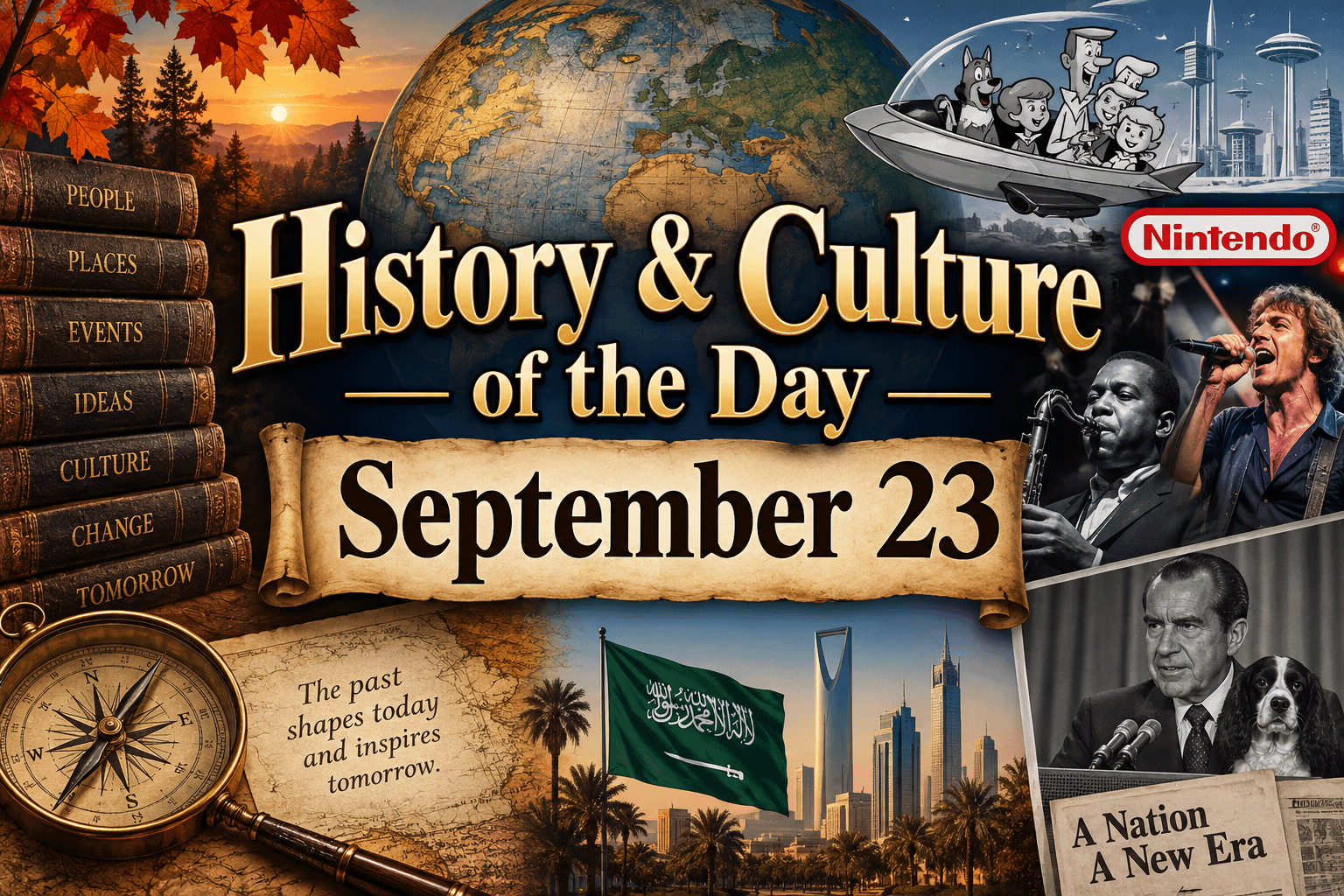
    From ancient seasonal traditions to the rise of Nintendo, the birth of jazz legend John Coltrane, the emergence of Bruce Springsteen, and the celebration of Saudi Arabia’s National Day, September 23 offers an interesting journey through history and culture.

    The September Equinox and the Changing Seasons

    One of the most important cultural themes associated with this time of September is the autumnal equinox in the Northern Hemisphere and the vernal equinox in the Southern Hemisphere.

    An equinox occurs when the Sun crosses Earth’s celestial equator. Around the equinox, day and night are close to equal in length, although they are not necessarily exactly 12 hours each.

    For people living in the Northern Hemisphere, the September equinox represents the astronomical beginning of autumn.

    Temperatures begin to cool. Leaves eventually change color. Harvest season arrives in many agricultural regions. Families begin preparing for the colder months ahead.

    In the Southern Hemisphere, the opposite transition takes place. September signals spring—a season associated with warmer weather, blooming plants, renewal, and new growth.

    Long before modern calendars and astronomy explained the movement of Earth around the Sun, civilizations carefully observed seasonal changes.

    Agricultural societies depended upon them.

    Knowing when seasons changed helped communities determine when to plant crops, harvest food, prepare livestock, and store supplies.

    Because survival was closely connected with the seasons, the equinox became culturally significant in many societies.

    Harvest Traditions Around the World

    The arrival of autumn has historically been associated with harvest celebrations.

    Farmers worked for months growing crops, and the harvest represented the reward for their labor.

    Communities often celebrated successful harvests with feasts, ceremonies, music, dancing, and religious observances.

    Different cultures developed their own traditions.

    Across Europe, harvest festivals became important community gatherings. Churches sometimes held thanksgiving services celebrating the food produced from the land.

    In parts of Asia, autumn festivals became associated with family gatherings, gratitude, food, and the moon.

    The Mid-Autumn Festival, celebrated in China and several other Asian cultures according to a lunar calendar, is one of the world’s best-known autumn celebrations. Families gather, share food such as mooncakes, and appreciate the full moon.

    Although these celebrations do not necessarily occur on September 23, they demonstrate the larger cultural importance of the seasonal transition surrounding this part of the year.

    Autumn has traditionally represented both abundance and preparation.

    People celebrate what has been gathered while recognizing that winter is approaching.

    That combination has made autumn a powerful symbol in art, literature, religion, and philosophy.

    September 23, 1889 — Nintendo Is Founded

    One of the most fascinating cultural connections to September 23 began in Kyoto, Japan.

    On September 23, 1889, Fusajiro Yamauchi founded the company that would eventually become Nintendo.

    Modern audiences immediately associate Nintendo with video games, but the company began in a completely different industry.

    Nintendo originally produced handmade hanafuda playing cards.

    Hanafuda cards feature beautifully illustrated flowers and plants representing different months of the year. The cards became popular for various traditional Japanese games.

    Nintendo spent decades operating primarily within the playing-card business before experimenting with other products and industries.

    Eventually, the company entered electronic entertainment.

    That decision transformed not only Nintendo but popular culture around the world.

    Nintendo later became responsible for some of the most recognizable characters and franchises in entertainment history.

    Mario, Luigi, Donkey Kong, Link, Princess Zelda, Kirby, and many others became internationally recognized characters.

    The Nintendo Entertainment System helped revitalize the home video game market during the 1980s.

    Later systems—including the Game Boy, Super Nintendo Entertainment System, Nintendo 64, Wii, Nintendo DS, and Nintendo Switch—continued influencing generations of players.

    What makes Nintendo’s history especially remarkable is its longevity.

    A business that began by making traditional Japanese playing cards in 1889 eventually became one of the world’s most influential entertainment companies.

    September 23 therefore holds a unique place in gaming and entertainment history.

    September 23, 1926 — John Coltrane Is Born

    September 23 is also an important date in American music history.

    Jazz saxophonist and composer John Coltrane was born on September 23, 1926, in Hamlet, North Carolina.

    Coltrane became one of the most influential musicians in jazz history.

    His career included collaborations with legendary performers such as Miles Davis and Thelonious Monk before he emerged as an innovative bandleader in his own right.

    Coltrane continually experimented with musical structure, harmony, improvisation, and spirituality.

    Albums such as Giant Steps and A Love Supreme became landmarks of jazz.

    A Love Supreme, released in 1965, became especially important because it combined extraordinary musical creativity with Coltrane’s spiritual reflections.

    His music could be intense, complicated, emotional, and deeply personal.

    Coltrane died in 1967 at only 40 years old, but his influence continued growing after his death.

    Musicians across jazz, rock, experimental music, and other genres have studied and drawn inspiration from his work.

    His birthday on September 23 provides an opportunity to remember how one musician’s willingness to explore new artistic possibilities permanently changed American music.

    September 23, 1949 — Bruce Springsteen Is Born

    Another major figure in American music was born on September 23.

    Bruce Springsteen was born in Long Branch, New Jersey, in 1949.

    Springsteen eventually became known worldwide for songs exploring working-class life, hope, frustration, love, dreams, economic hardship, and the complicated experience of pursuing the American Dream.

    His music became closely associated with New Jersey and American working-class culture.

    With the E Street Band, Springsteen developed a reputation for energetic concerts that could last for hours.

    Songs including “Born to Run,” “Thunder Road,” “Dancing in the Dark,” and “Born in the U.S.A.” became major parts of American popular music.

    But beneath the catchy melodies and arena-sized performances, many Springsteen songs contain complicated stories about ordinary people.

    Factory workers.

    Young couples.

    Veterans.

    Families.

    People trying to escape struggling towns.

    People chasing opportunities that sometimes remain just beyond their reach.

    That storytelling helped Springsteen become more than a successful rock musician. His catalog became a musical portrait of different aspects of American life.

    September 23 — Saudi National Day

    September 23 is also an important national celebration in Saudi Arabia.

    Saudi National Day commemorates the unification of the Kingdom of Saudi Arabia.

    In 1932, King Abdulaziz announced the unification of the regions under the name Kingdom of Saudi Arabia.

    September 23 became the date associated with that historic transformation.

    Today, Saudi National Day is celebrated with public events, decorations, flags, entertainment, cultural programs, and displays of national pride.

    Cities may be illuminated in green, the color strongly associated with the Saudi flag and national identity.

    The celebration provides an opportunity for people to reflect on Saudi history while also highlighting modern developments and national goals.

    Like national days around the world, it demonstrates how historical events eventually become cultural traditions passed from one generation to another.

    September 23, 1952 — Richard Nixon’s “Checkers Speech”

    September 23 also played a memorable role in American political and television history.

    During the 1952 presidential campaign, vice-presidential candidate Richard Nixon faced controversy involving a political expense fund.

    Nixon responded with a nationally televised speech on September 23, 1952.

    The address became known as the “Checkers speech.”

    The unusual nickname came from Nixon’s discussion of a gift his family had received—a black-and-white cocker spaniel named Checkers.

    Nixon said his daughters loved the dog and that the family intended to keep it.

    The speech became a significant moment in the relationship between television and American politics.

    Television was becoming an increasingly powerful medium.

    Politicians could now speak directly to millions of Americans in their homes.

    Political communication would never be quite the same.

    Later presidential debates, campaign advertisements, televised addresses, political interviews, and eventually internet and social-media campaigning continued that transformation.

    The Checkers speech demonstrated early on how television could influence a political controversy by allowing a candidate to appeal directly to the public.

    September 23, 1962 — The Jetsons Enter American Pop Culture

    September 23, 1962, introduced television audiences to one of popular culture’s most memorable visions of the future.

    The Jetsons premiered on ABC.

    Created by Hanna-Barbera, the animated television series followed George Jetson and his family as they lived in a futuristic world filled with flying cars, robots, moving sidewalks, video communication, and automated household technology.

    The show became a cultural counterpart to The Flintstones.

    While The Flintstones humorously imagined modern family life in the Stone Age, The Jetsons imagined family life in the future.

    Some of the show’s futuristic technology seemed impossible to viewers in the 1960s.

    Video calls were science fiction.

    Home automation seemed futuristic.

    Robotic household assistants belonged to cartoons.

    Today, video conferencing, smart-home devices, robotic vacuum cleaners, digital assistants, and other technologies make portions of The Jetsons feel surprisingly familiar.

    We may not commute to work in flying cars, but the program remains an interesting example of how entertainment imagines the future.

    The Cultural Meaning of Autumn

    Beyond specific historical events, September 23 represents something deeper.

    Autumn has always carried powerful symbolism.

    Spring represents beginnings.

    Summer represents growth and energy.

    Autumn often represents maturity, change, reflection, and letting go.

    Leaves that were once green begin turning yellow, orange, red, and brown before eventually falling.

    The transformation has inspired poets, painters, photographers, musicians, and writers for generations.

    Autumn reminds us that change can be beautiful even when something is ending.

    The season also encourages reflection.

    As the days become shorter and another year moves toward its final months, people often begin thinking about what has happened during the year.

    What changed?

    What did we accomplish?

    What did we lose?

    What did we learn?

    What do we still hope to accomplish before the year ends?

    These questions are part of what makes seasonal transitions culturally meaningful.

    September 23 Connects the Past With the Present

    One of the most interesting things about studying history is discovering how seemingly unrelated events can share the same calendar date.

    On September 23, we can remember a Japanese playing-card company founded in 1889 that eventually transformed global video gaming.

    We can celebrate the birth of John Coltrane and his extraordinary contribution to jazz.

    We can recognize Bruce Springsteen and the stories of American life told through his music.

    We can learn about Saudi National Day and the formation of modern Saudi Arabia.

    We can look back at Richard Nixon’s Checkers speech and see how television began changing political communication.

    We can remember the premiere of The Jetsons and smile at how yesterday’s imagined future sometimes resembles today’s everyday life.

    And around this point in September, we can look toward the changing seasons and recognize something humanity has observed for thousands of years.

    The world is always changing.

    Why History and Culture Matter

    History isn’t simply a collection of dates that students memorize.

    History is the story of people.

    Culture is what those people create, celebrate, believe, share, preserve, and pass forward.

    A playing-card company can eventually transform entertainment.

    A saxophonist can change music forever.

    A songwriter can tell stories that generations recognize themselves in.

    A television cartoon can influence how people imagine the future.

    A national celebration can preserve the memory of a country’s formation.

    And the changing seasons can connect modern people with ancestors who watched the same skies thousands of years ago.

    That is what makes studying history and culture so fascinating.

    Every date contains stories.

    Some changed nations.

    Some changed technology.

    Some changed music.

    Some changed entertainment.

    And others changed the way people understood the world around them.

    Final Thoughts

    September 23 reminds us that history and culture are constantly connected.

    The inventions we use, music we hear, traditions we celebrate, entertainment we enjoy, and even the way we understand the seasons have histories behind them.

    Some began hundreds or thousands of years ago.

    Others began with one person willing to create something different.

    As September moves deeper into the changing season, September 23 offers an opportunity to appreciate where humanity has been while wondering where we are going next.

    History tells us what happened.

    Culture tells us what those experiences meant to people.

    Together, they help tell the story of who we are.

    What piece of September 23 history or culture do you find the most interesting?
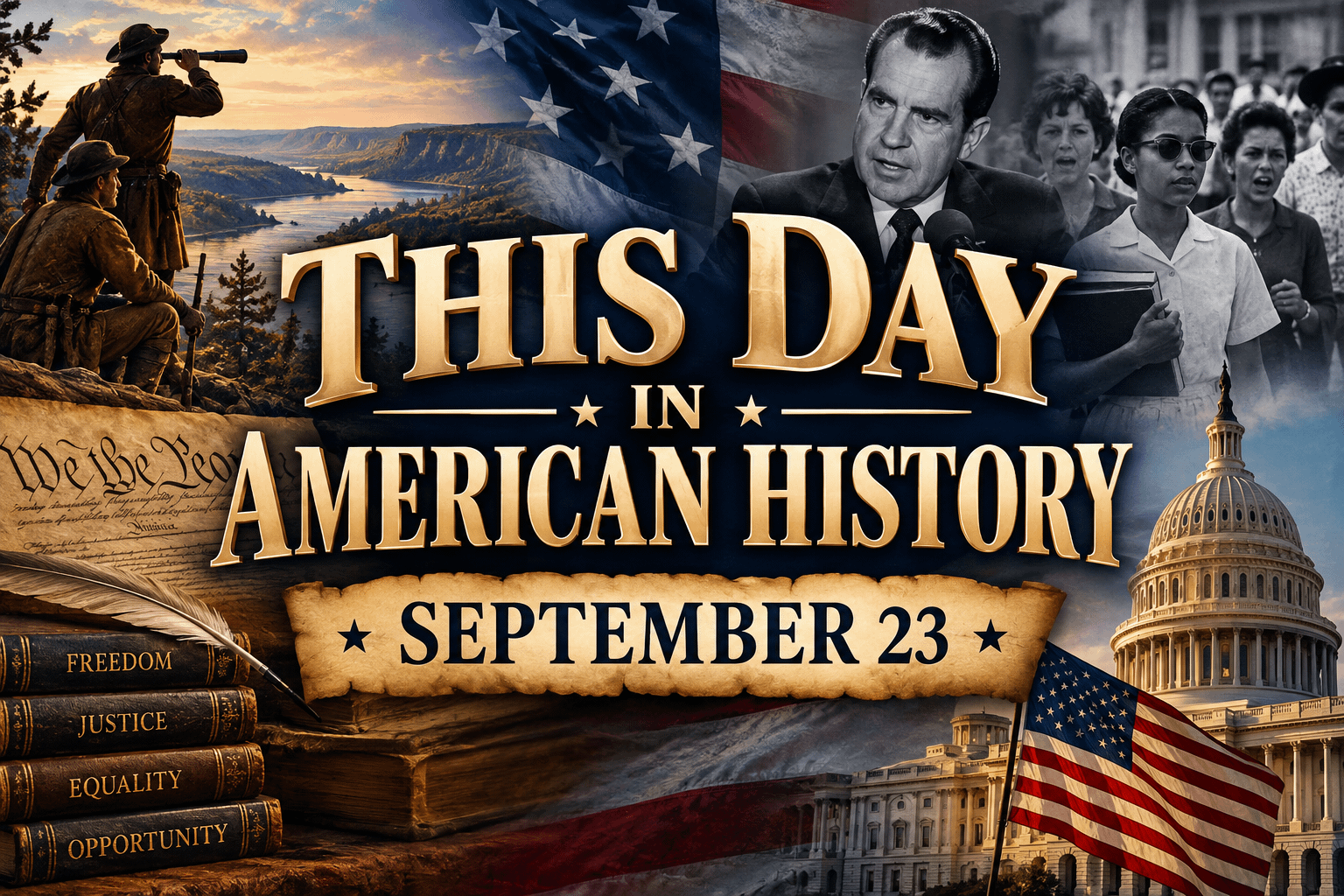
  • This Day in American History – September 23

    This Day in American History – September 23

    September 23 has witnessed exploration, political drama, struggles over civil rights, and moments that helped shape the United States. From the triumphant return of Lewis and Clark to one of the most famous televised political speeches in American history and the confrontation over school integration in Little Rock, this date offers a fascinating look at the country’s evolving story.

    Here are some of the most significant moments connected to September 23 in American history.

    1780 – The Plot to Surrender West Point Is Exposed

    One of the most infamous acts of betrayal in American history began unraveling around September 23, 1780.

    During the Revolutionary War, American General Benedict Arnold secretly negotiated with the British to surrender the strategically important American fortress at West Point, New York.

    Arnold had become frustrated with the Continental Congress and increasingly resentful over what he believed was a lack of recognition for his military accomplishments. Eventually, he began communicating with British Major John André.

    André was captured by American militiamen while carrying documents connected to Arnold’s plan. His capture exposed the conspiracy before West Point could be surrendered.

    Arnold learned that the plot had been discovered and escaped to British-controlled New York City. André was later convicted as a spy and executed.

    Benedict Arnold’s name would become synonymous with betrayal in the United States.

    The episode demonstrated just how vulnerable the American Revolution remained even several years after the Declaration of Independence. A successful British takeover of West Point could have created serious strategic problems for the Continental Army.

    1806 – Lewis and Clark Return to St. Louis

    One of America’s greatest expeditions officially reached its conclusion on September 23, 1806.

    Meriwether Lewis, William Clark, and the Corps of Discovery arrived in St. Louis after spending more than two years exploring the western portion of the North American continent.

    Their journey had begun in 1804 following the Louisiana Purchase.

    President Thomas Jefferson wanted the expedition to explore the newly acquired territory, document its geography and natural resources, establish relationships with Native American nations, and search for practical transportation routes toward the Pacific.

    The expedition eventually reached the Pacific Ocean before beginning the long journey home.

    At approximately noon on September 23, 1806, the expedition arrived back in St. Louis. According to the National Park Service, members of the expedition fired their weapons in salute as they approached the town, where residents gathered to welcome them home.

    William Clark recorded that they were greeted warmly by the inhabitants of St. Louis.

    Their return was remarkable.

    The expedition had been gone for more than two years, four months, and ten days.

    The information collected during the journey dramatically expanded American knowledge of the West. Maps, journals, observations of wildlife and plants, and descriptions of Indigenous nations became invaluable records of the early American frontier.

    The expedition also became closely connected with the story of Sacagawea, the Lemhi Shoshone woman whose knowledge, interpretation skills, and presence proved important during portions of the journey.

    September 23 therefore represents one of the great homecoming moments in early American history.

    1846 – The Discovery of Neptune

    September 23, 1846, also became an important date in the history of astronomy.

    German astronomer Johann Gottfried Galle observed the planet Neptune after calculations by French mathematician Urbain Le Verrier predicted where the unknown planet should appear.

    Although the discovery occurred in Europe, it would have a lasting impact on astronomy around the world, including scientific research in the United States.

    The discovery was especially important because Neptune’s location had essentially been predicted mathematically before the planet was directly identified.

    It demonstrated the extraordinary power of mathematics to reveal something in the universe that human eyes had not yet recognized.

    1952 – Richard Nixon Delivers the “Checkers Speech”

    On September 23, 1952, Senator Richard Nixon delivered one of the most famous political television speeches in American history.

    Nixon was Dwight D. Eisenhower’s Republican vice-presidential running mate during the 1952 presidential campaign.

    His position on the ticket came under threat following controversy surrounding a political expense fund supported by donors.

    Rather than quietly withdraw from the campaign, Nixon decided to make his case directly to the American people.

    He appeared on national television and discussed his personal finances while defending himself against allegations that the fund had been improperly used for personal benefit.

    Then came the moment that gave the speech its famous nickname.

    Nixon explained that his family had received a gift: a black-and-white cocker spaniel named Checkers.

    He made it clear that regardless of political criticism, his daughters loved the dog and the family intended to keep it.

    The emotional reference captured enormous public attention.

    The address became known simply as the “Checkers Speech.”

    The speech helped Nixon remain on Eisenhower’s ticket. Eisenhower and Nixon went on to win the 1952 presidential election, beginning Nixon’s long and complicated place in American political history.

    But the speech was significant for another reason.

    It demonstrated the enormous political power of television.

    Politicians could now speak directly to millions of Americans inside their homes rather than depending entirely on newspapers, radio reports, or campaign rallies.

    Television would soon become one of the most powerful forces in American presidential politics.

    1955 – The Emmett Till Murder Trial Ends in Acquittal

    September 23, 1955, marked a deeply painful moment in American civil rights history.

    A Mississippi jury acquitted Roy Bryant and J.W. Milam in the murder of 14-year-old Emmett Till.

    Till, a Black teenager from Chicago, had been visiting relatives in Mississippi when he was abducted and brutally murdered.

    His mother, Mamie Till-Mobley, made the courageous decision to hold an open-casket funeral so the world could see what had been done to her son.

    Photographs of Till’s body were widely circulated and created outrage across the country.

    The acquittal of the two defendants demonstrated the enormous racial injustice that existed within the American legal system during the Jim Crow era.

    The killing of Emmett Till and the failure to obtain justice became important catalysts for the growing Civil Rights Movement.

    His story continues to be remembered as part of America’s ongoing struggle over racism, equality, justice, and civil rights.

    1957 – The Little Rock Nine Enter Central High School

    Two years later, September 23 became connected with another major chapter in the Civil Rights Movement.

    Nine Black students had enrolled at Central High School in Little Rock, Arkansas, as part of the effort to desegregate American public schools following the Supreme Court’s landmark Brown v. Board of Education decision.

    They became known as the Little Rock Nine.

    On September 23, 1957, the students entered Central High School while a hostile crowd gathered outside. Violence and unrest escalated to the point that police removed the students for their safety.

    The crisis forced President Dwight D. Eisenhower to confront the question of whether the federal government would enforce court-ordered desegregation.

    Eisenhower signed Executive Order 10730 on September 23 as part of the federal response to the crisis. The confrontation ultimately led him to send soldiers from the 101st Airborne Division to Little Rock and place the Arkansas National Guard under federal authority.

    On September 25, the Little Rock Nine entered Central High School under federal military protection.

    The confrontation became one of the defining images of the Civil Rights era.

    It demonstrated that Supreme Court decisions alone were not always enough to guarantee civil rights. Federal enforcement could be necessary when state or local authorities resisted constitutional protections.

    2002 – California Establishes Paid Family Leave

    September 23 also has a place in the modern history of American workplace policy.

    In 2002, California Governor Gray Davis signed legislation establishing a statewide paid family leave insurance program.

    The law made California the first state in the country to create such a program.

    The policy allowed eligible workers to receive partial wage replacement while taking time away from work for certain family responsibilities.

    California’s action became part of a larger national conversation about balancing employment with caregiving, childbirth, family illness, and other major life events.

    Other states would eventually establish their own paid family and medical leave programs.

    A Date Filled With Turning Points

    What makes September 23 interesting is how different its major historical moments are.

    The return of Lewis and Clark represents America’s early period of exploration and territorial expansion.

    The Benedict Arnold conspiracy reminds us that the American Revolution was filled with uncertainty, internal conflict, and difficult choices.

    The Emmett Till trial and the Little Rock crisis expose painful chapters in America’s struggle with racism and equal rights.

    Richard Nixon’s “Checkers Speech” demonstrates how technology transformed American politics.

    And the creation of California’s paid family leave program reflects the continuing evolution of American social and workplace policy.

    Together, these events show that American history is rarely a simple story of uninterrupted progress.

    It is a story of exploration and discovery, courage and injustice, conflict and reform, failure and change.

    Remembering September 23

    History becomes more meaningful when we recognize that the events described in textbooks happened on ordinary days.

    September 23 was simply another date on the calendar when Lewis and Clark finally saw St. Louis again after their extraordinary journey.

    It was another September evening when millions of Americans turned on their televisions and watched a young senator named Richard Nixon fight to save his political career.

    And it was another school day when nine Black students attempted to exercise a right that should never have been denied to them.

    The people living through those moments could not always know how history would remember them.

    That is one of the greatest lessons of studying the past.

    History is not only something that happened hundreds of years ago.

    History is created every day by people responding to the challenges, opportunities, injustices, discoveries, and decisions placed before them.

    Which event from September 23 do you believe had the greatest impact on the future of the United States?

  • History & Culture of the Day — September 22

    History & Culture of the Day — September 22

    September 22 is a date filled with fascinating moments in history, cultural traditions, scientific achievements, entertainment milestones, and seasonal significance. It is also a day closely associated with one of the most recognizable transitions of the year: the arrival of autumn in the Northern Hemisphere.

    From the changing colors of leaves and centuries-old harvest traditions to important moments in American and world history, September 22 offers an opportunity to look at how people, events, traditions, and ideas have shaped the world.

    The Autumn Equinox and the Changing of the Seasons

    September 22 often falls on or very close to the autumnal equinox in the Northern Hemisphere.

    The equinox occurs when the Sun crosses the celestial equator, marking the astronomical beginning of autumn north of the equator and spring south of it.

    The word equinox comes from Latin words associated with “equal” and “night.” Although daytime and nighttime are not precisely equal everywhere on the equinox, the date represents an important seasonal turning point.

    For generations, people have watched this transition carefully.

    The long, warm days of summer begin giving way to cooler evenings. Leaves start changing from green to brilliant shades of yellow, orange, and red. Farmers prepare for harvest. Families begin thinking about pumpkins, apples, warm drinks, football, Halloween, Thanksgiving, and the approaching holiday season.

    Autumn is more than a change in weather. It has become a cultural experience.

    Harvest Traditions Around the World

    Long before modern calendars and supermarkets, seasonal changes had enormous importance.

    A successful harvest could determine whether a community had enough food to survive the winter. As a result, many cultures developed festivals, ceremonies, feasts, and religious observances centered around the harvest season.

    Communities gathered to celebrate crops being brought in from the fields. Food was shared. Gratitude was expressed. Families prepared preserved foods for the colder months ahead.

    Many modern fall traditions still reflect those ancient agricultural roots.

    Pumpkins, corn, apples, wheat, gourds, and other harvest symbols remain common autumn decorations. Hayrides, corn mazes, pumpkin patches, farmers markets, harvest festivals, and community fairs continue to connect modern life with traditions that are centuries old.

    Even people who have never worked on a farm participate in a culture influenced by the agricultural calendar.

    September 22, 1776 — Nathan Hale Is Executed

    One of the most remembered events associated with September 22 in American history occurred during the Revolutionary War.

    On September 22, 1776, Nathan Hale, an American soldier and spy, was executed by the British in New York.

    Hale had volunteered for a dangerous intelligence mission behind British lines. He was captured and sentenced to death.

    He was only 21 years old.

    Hale became an enduring symbol of patriotism and sacrifice in American history. He is traditionally remembered for declaring before his execution:

    “I only regret that I have but one life to lose for my country.”

    The precise wording has been debated by historians because there is no surviving firsthand transcript of Hale’s final speech. Nevertheless, the quotation became deeply connected with his legacy.

    His story illustrates how individuals can become cultural symbols long after their deaths.

    Hale’s name can now be found on schools, monuments, military facilities, streets, and other institutions throughout the United States.

    September 22, 1862 — Lincoln Announces the Preliminary Emancipation Proclamation

    September 22 also marks one of the most consequential moments of the American Civil War.

    On September 22, 1862, President Abraham Lincoln issued the preliminary Emancipation Proclamation.

    It warned that enslaved people in states or portions of states still rebelling against the United States on January 1, 1863, would be declared free.

    The final Emancipation Proclamation took effect on January 1, 1863.

    The proclamation did not immediately abolish slavery everywhere in the United States. Its legal reach was tied to areas in rebellion, and slavery continued in some places until constitutional abolition.

    Nevertheless, the proclamation dramatically transformed the meaning and direction of the Civil War.

    Preserving the Union remained central, but emancipation became an explicit war aim.

    It also opened the door for greater numbers of Black Americans to serve in the United States armed forces.

    The broader struggle ultimately contributed to the ratification of the 13th Amendment in 1865, which abolished slavery in the United States except as punishment for a crime.

    September 22 therefore occupies an important place in the history of American freedom and civil rights.

    September 22, 1888 — The First Issue of National Geographic Magazine

    Another cultural milestone arrived on September 22, 1888, when the first issue of National Geographic Magazine was published.

    The National Geographic Society had been founded earlier that year.

    What began as a relatively academic publication eventually became one of the world’s most recognizable magazines.

    National Geographic became particularly famous for its photography.

    Its pages introduced generations of readers to distant landscapes, wildlife, archaeological discoveries, scientific research, oceans, mountains, cultures, and communities around the world.

    Before television and the internet made images from distant places instantly accessible, magazines such as National Geographic provided people with extraordinary windows into places they might never personally visit.

    Its influence extended beyond geography.

    The publication helped popularize archaeology, anthropology, conservation, exploration, natural history, photography, and environmental awareness.

    September 22 therefore represents an important anniversary in the history of educational publishing.

    September 22, 1961 — The Peace Corps Becomes Permanent

    September 22, 1961, was also significant for the Peace Corps.

    President John F. Kennedy had established the Peace Corps earlier that year through executive action. Congress subsequently passed legislation formally authorizing the organization, which Kennedy signed on September 22.

    The idea behind the Peace Corps was ambitious.

    American volunteers would live and work in communities around the world, contributing skills in areas such as education, agriculture, health, community development, and economic opportunity.

    At the same time, volunteers would learn about the cultures and communities in which they served.

    The Peace Corps became part of a broader cultural movement during the early 1960s emphasizing public service, international cooperation, and civic responsibility.

    Thousands of Americans would eventually serve overseas through the organization.

    September 22, 1980 — The Iran-Iraq War Begins

    September 22 also marks the beginning of one of the longest and deadliest conflicts of the late 20th century.

    On September 22, 1980, Iraqi forces invaded Iran, beginning the Iran-Iraq War.

    The conflict continued until 1988.

    The war involved brutal ground fighting, missile attacks, attacks on shipping, and the use of chemical weapons by Iraq. Hundreds of thousands of people were killed, wounded, or displaced.

    The consequences extended far beyond Iran and Iraq.

    The conflict affected oil markets, international diplomacy, regional alliances, and the political future of the Middle East.

    Even decades later, the consequences of the war remain important for understanding regional history.

    September 22, 1994 — Friends Premieres

    History isn’t limited to wars, governments, and political movements.

    Popular culture can also leave a lasting mark.

    On September 22, 1994, the television sitcom Friends premiered on NBC.

    The series followed six friends living in New York City:

    Rachel, Ross, Monica, Chandler, Joey, and Phoebe.

    Few could have predicted how culturally influential the show would become.

    Friends ran for ten seasons and became one of the most recognizable television comedies of its era.

    Its influence extended into fashion, hairstyles, language, dating culture, friendship, and television comedy.

    “The Rachel” haircut associated with Jennifer Aniston became a major fashion trend during the 1990s.

    The show’s coffee-shop setting also became part of its cultural identity, with Central Perk serving almost like another character in the series.

    Decades after its premiere, new generations continued discovering the program through reruns and streaming.

    September 22, 1994, therefore represents a memorable date in modern television history.

    September 22, 2004 — Lost Premieres

    Exactly ten years after the premiere of Friends, another television phenomenon debuted.

    On September 22, 2004, Lost premiered on ABC.

    The drama followed survivors of Oceanic Flight 815 after their plane crashed on a mysterious island.

    The series combined survival drama, science fiction, mystery, mythology, romance, philosophy, and character-driven storytelling.

    It became especially important in the development of online television fandom.

    Fans gathered on message boards and websites to debate theories, examine clues, analyze episodes, and predict what would happen next.

    Today, social media makes that kind of immediate television discussion commonplace. During the 2000s, however, Lost became one of the shows demonstrating how the internet could transform television into a massive interactive cultural conversation.

    September 22 and the Culture of Fall

    Beyond historical anniversaries, September 22 carries a distinctive cultural feeling because of its connection to autumn.

    Fall has developed its own language of traditions and imagery.

    Pumpkins appear on porches.

    Apple orchards become weekend destinations.

    Football fills television screens.

    People begin wearing sweaters and jackets.

    Coffee shops introduce seasonal drinks.

    Homes are decorated with leaves, scarecrows, pumpkins, and harvest colors.

    Halloween decorations begin appearing.

    Families start discussing Thanksgiving plans.

    In many parts of the United States, fall is also associated with high school and college football, homecoming celebrations, county fairs, harvest festivals, and school activities.

    These traditions demonstrate something interesting about culture.

    Humans don’t simply experience seasons.

    We create traditions around them.

    Why Autumn Creates Such Powerful Nostalgia

    Fall can also be an emotional season.

    Certain smells, temperatures, foods, songs, and traditions can instantly bring back memories.

    The smell of leaves.

    A cool breeze through an open window.

    The first football game of the season.

    A pumpkin pie baking in the kitchen.

    Halloween decorations.

    An old sweatshirt pulled from the closet.

    A familiar autumn song.

    These small experiences can reconnect us with people and moments from years or even decades earlier.

    That is one reason seasonal traditions remain powerful.

    They provide continuity.

    Life changes. Families change. Children grow older. People move away. Loved ones may no longer be physically present.

    Yet the seasons return.

    Sometimes autumn brings happiness.

    Sometimes it brings memories.

    Sometimes it brings both at the same time.

    The Cultural Meaning of September

    September itself has always represented transition.

    Summer vacations end.

    Schools reopen.

    Sports seasons begin.

    Temperatures cool.

    Daylight becomes shorter.

    Businesses prepare for the final months of the year.

    Families begin planning holiday gatherings.

    Nature itself appears to announce that change is coming.

    That makes September 22 an appropriate day to think not only about history but about transition.

    History is ultimately a record of transitions.

    Nations rise and change.

    Technology transforms daily life.

    Cultural traditions evolve.

    Entertainment changes.

    Generations grow older.

    New ideas replace old assumptions.

    Yet traces of the past remain everywhere around us.

    What September 22 Can Teach Us

    The events connected with September 22 are remarkably different.

    Nathan Hale’s execution reminds us of sacrifice during the American Revolution.

    The preliminary Emancipation Proclamation reminds us of America’s long struggle over slavery and freedom.

    The first issue of National Geographic represents curiosity, exploration, photography, and education.

    The Peace Corps represents international service.

    The beginning of the Iran-Iraq War reminds us of the terrible human consequences of prolonged conflict.

    The premieres of Friends and Lost demonstrate the ability of entertainment to become part of a generation’s shared cultural experience.

    And the autumn equinox reminds us that history doesn’t happen separately from everyday life.

    People throughout history watched the same seasons change.

    They experienced summer turning into autumn.

    They gathered food.

    They celebrated harvests.

    They watched the days grow shorter.

    They spent time with their families.

    They experienced love, loss, hope, uncertainty, and change.

    Technology may change dramatically, but many parts of the human experience remain surprisingly familiar.

    History Is More Than Famous Dates

    When we study history, it can be tempting to focus entirely on presidents, wars, inventions, and famous events.

    But culture tells another part of the story.

    Culture includes the food people eat, the music they hear, the programs they watch, the traditions they celebrate, the clothes they wear, the stories they tell, and the memories they pass from one generation to another.

    That is why a single date can contain so many different kinds of history.

    September 22 includes stories of revolution, emancipation, exploration, international service, war, television, seasonal traditions, and ordinary human experiences.

    Together, those stories create a richer picture of the past.

    September 22 — A Day of History, Culture, and Change

    September 22 reminds us that history is constantly being created.

    Some moments become major entries in history books.

    Others become cultural memories.

    And countless others become personal stories remembered only by families and individuals.

    The arrival of autumn makes the date especially meaningful.

    Nature reminds us every year that change is unavoidable.

    Leaves change.

    Days shorten.

    Seasons pass.

    Years move forward.

    Yet each new season also brings another beginning.

    Perhaps that is one of the most valuable lessons September 22 can offer.

    We can remember what came before without remaining trapped in the past.

    We can honor history while continuing to create new stories.

    And just as one season gives way to another, we can recognize that change—whether historical, cultural, seasonal, or personal—is one of the few constants shared by every generation.

    What piece of history, fall tradition, or cultural memory do you most associate with September 22?

  • This Day in American History – September 22

    This Day in American History – September 22

    September 22 is a date connected to some of the most consequential moments in American history. It carries stories of sacrifice during the American Revolution, a turning point in the fight against slavery during the Civil War, and a dramatic assassination attempt on a U.S. president nearly two centuries later.

    Perhaps no September 22 event was more transformative than President Abraham Lincoln’s issuance of the Preliminary Emancipation Proclamation in 1862. Yet the date also reminds Americans of Nathan Hale, the young Revolutionary War officer executed by the British in 1776, and President Gerald Ford’s narrow escape from an assassination attempt in San Francisco in 1975.

    Together, these events make September 22 a remarkable day in the American story.

    1776 — Nathan Hale Is Executed by the British

    On September 22, 1776, 21-year-old Continental Army Captain Nathan Hale was hanged by the British for spying.

    Hale had been born in Coventry, Connecticut, in 1755 and graduated from Yale College in 1773. He initially became a teacher, but after fighting began between the American colonies and Great Britain, he joined the revolutionary cause.

    By 1776, the Continental Army faced a dangerous situation around New York.

    General George Washington desperately needed intelligence about British troop positions and movements. Someone would have to cross behind enemy lines, gather information, and return without being discovered.

    It was an extraordinarily dangerous assignment.

    Nathan Hale volunteered.

    Disguised as a schoolteacher looking for work, Hale entered British-controlled territory and attempted to gather military intelligence. His mission ended when he was captured. Papers found in his possession provided evidence of his espionage activities, and British General William Howe ordered his execution.

    On September 22, Hale was hanged without the kind of trial that would be expected in modern America.

    Nathan Hale’s Famous Final Words

    Hale became immortalized in American history because of the words traditionally attributed to him shortly before his execution:

    “I only regret that I have but one life to lose for my country.”

    The statement became one of the most famous expressions of patriotism associated with the American Revolution.

    However, there is an important historical qualification. The exact wording was not documented in a surviving contemporary eyewitness account, and historians have questioned whether Hale spoke precisely those words. The sentiment was reported afterward, and the famous wording appears to have been influenced by Joseph Addison’s popular play Cato.

    Whether the quotation is exact or not, there is little doubt about Hale’s willingness to risk his life.

    He knew that espionage behind British lines could lead to execution if he was captured.

    He volunteered anyway.

    Nathan Hale was only 21 years old when he died, but his sacrifice made him one of the enduring symbols of the American Revolution.

    Why Nathan Hale’s Story Still Matters

    Wars are remembered through battles, generals, victories, and defeats, but they are also shaped by individuals whose names may never appear on a battlefield monument.

    Intelligence gathering was essential during the Revolutionary War.

    Washington needed to understand where British troops were positioned, how many soldiers they had, and what they intended to do next. Hale’s unsuccessful mission demonstrated both the importance and danger of early American military intelligence.

    His death also created something powerful for the struggling revolutionary movement: a martyr.

    The Americans were attempting something extraordinary—defeating one of the world’s most powerful empires and creating an independent nation.

    Stories of sacrifice helped strengthen the belief that independence was worth fighting and dying for.

    Nathan Hale became one of those stories.

    1862 — Abraham Lincoln Issues the Preliminary Emancipation Proclamation

    Eighty-six years after Hale’s execution, another historic event occurred on September 22.

    On September 22, 1862, President Abraham Lincoln issued the Preliminary Emancipation Proclamation.

    The United States was deep in the Civil War.

    The conflict had begun primarily as a struggle to preserve the Union, although slavery was at the center of the sectional crisis that led to secession and war.

    Lincoln’s proclamation fundamentally changed the direction and meaning of the conflict.

    The preliminary proclamation warned that on January 1, 1863, enslaved people in states or designated portions of states that remained in rebellion against the United States would be declared free.

    It was an extraordinary declaration.

    The Civil War would increasingly become not only a fight to restore the Union but also a fight directly connected to destroying slavery.

    Why Lincoln Waited

    Lincoln had discussed emancipation with members of his Cabinet earlier in 1862.

    But Secretary of State William Seward reportedly advised Lincoln that announcing such a dramatic policy while Union armies were struggling militarily might make the proclamation appear to be an act of desperation.

    Lincoln waited for a military opportunity.

    That opportunity arrived following the Battle of Antietam in Maryland on September 17, 1862.

    Antietam was one of the bloodiest days in American military history. Although the battle was not the overwhelming Union victory Lincoln might have hoped for, Confederate General Robert E. Lee’s army withdrew back toward Virginia.

    Lincoln now had the opportunity he needed.

    Five days later, on September 22, he issued the preliminary proclamation. The National Archives notes that Lincoln had presented the idea to his Cabinet in July and waited for a Union military victory before formally issuing it.

    A 100-Day Warning

    The Preliminary Emancipation Proclamation was effectively a warning to the Confederate states.

    Lincoln declared that enslaved people in areas remaining in rebellion on January 1, 1863, would be declared free.

    The Confederate rebellion continued.

    One hundred days later, Lincoln followed through.

    On January 1, 1863, he issued the final Emancipation Proclamation.

    It declared enslaved people within designated rebellious areas to be free.

    The proclamation did not immediately free every enslaved person in the United States. Its application was tied to areas in rebellion and therefore did not apply in the same way to slaveholding border states loyal to the Union or certain areas already under Union control.

    Nevertheless, its significance was enormous.

    As Union armies advanced through Confederate territory, emancipation could increasingly be enforced.

    The National Archives describes the proclamation as adding moral force to the Union cause while strengthening it politically and militarily.

    Black Americans Join the Fight for Freedom

    One of the most important consequences of emancipation was the expanded role of Black Americans in the Union war effort.

    The final Emancipation Proclamation explicitly opened the door for Black men to serve in the United States armed forces.

    By the end of the Civil War, almost 200,000 Black soldiers and sailors had served the Union cause.

    Their service changed the war.

    Men who had themselves experienced slavery—or whose families and communities had lived under slavery—could now take up arms against the system.

    Black soldiers fought in numerous battles, guarded strategic positions, supported military operations, and helped deliver the final defeat of the Confederacy.

    Their participation demonstrated something fundamental about emancipation.

    Freedom was not simply handed down from Washington.

    Enslaved people had been pursuing their own freedom throughout the war by escaping slavery, reaching Union lines, assisting Union forces, sharing intelligence, and forcing federal leaders to confront the question of slavery.

    The Emancipation Proclamation gave federal authority to a transformation already being driven in significant part by enslaved Americans themselves.

    From Emancipation to the Thirteenth Amendment

    The Emancipation Proclamation was not the final step in abolishing slavery throughout the United States.

    That required a constitutional amendment.

    The Thirteenth Amendment, ratified in December 1865, abolished slavery throughout the country, except as punishment for a crime after conviction.

    But September 22, 1862, remains one of the critical milestones on the path toward nationwide abolition.

    The Preliminary Emancipation Proclamation signaled that the federal government was preparing to use the powers of the presidency and the military to strike directly against slavery in rebellious territory.

    The meaning of the Civil War had changed.

    Preserving the Union and destroying slavery were becoming inseparable parts of the nation’s struggle.

    1975 — President Gerald Ford Survives an Assassination Attempt

    More than a century later, September 22 became the date of another dramatic event.

    On September 22, 1975, President Gerald Ford was leaving the St. Francis Hotel in San Francisco when Sara Jane Moore attempted to assassinate him.

    Moore raised a handgun and fired toward the president.

    She missed.

    Bystander Oliver Sipple, a former Marine, intervened and helped disrupt the attack. Ford was quickly rushed away by Secret Service agents.

    The incident would have been shocking under any circumstances.

    What made it even more extraordinary was what had happened only 17 days earlier.

    Two Assassination Attempts in 17 Days

    On September 5, 1975, President Ford had survived another assassination attempt in Sacramento, California.

    Lynette “Squeaky” Fromme, a follower of Charles Manson, approached Ford carrying a handgun.

    The weapon did not fire.

    Secret Service agents immediately restrained her.

    Ford survived.

    Then, just 17 days later, another woman attempted to shoot him—this time in San Francisco.

    The Gerald R. Ford Presidential Library and Museum preserves photographs documenting both September 1975 assassination attempts, including images taken immediately around the moment Moore fired at Ford.

    Two separate attempts on the life of a sitting president in less than three weeks demonstrated the unpredictable dangers surrounding the presidency.

    Ford survived both.

    Gerald Ford and a Difficult Era in America

    Ford’s presidency came during one of the most unsettled periods in modern American history.

    The Vietnam War was ending.

    The Watergate scandal had shattered public confidence in government.

    President Richard Nixon had resigned on August 9, 1974.

    Vice President Gerald Ford then became president despite never having been elected nationally as either president or vice president.

    A month later, Ford pardoned Nixon.

    The decision became enormously controversial and damaged Ford politically, although he argued that continuing the national conflict surrounding Nixon would prevent the country from moving forward.

    Against this tense political background came the two assassination attempts of September 1975.

    Ford continued making public appearances despite the danger.

    His survival on September 22 became another remarkable episode in an already unusual presidency.

    September 22 Across Three Different American Eras

    One of the fascinating things about studying a single day in history is discovering connections between events separated by generations.

    September 22 takes us into three dramatically different Americas.

    September 22, 1776 takes us to a nation that did not officially exist yet as an independent country recognized by Britain. Nathan Hale died while Americans were fighting for the survival of their revolution.

    September 22, 1862 takes us to a nation tearing itself apart during the Civil War. Abraham Lincoln’s Preliminary Emancipation Proclamation helped redefine what Union victory would mean.

    September 22, 1975 takes us to a modern United States shaken by political scandal, social unrest, the aftermath of Vietnam, and violence directed toward its president.

    The circumstances were entirely different, yet each moment reveals Americans confronting uncertainty about the country’s future.

    Courage, Freedom, and the American Story

    History rarely moves in a straight line.

    The ideals expressed during the American Revolution did not immediately apply equally to everyone.

    The Declaration of Independence proclaimed human equality in 1776 while slavery remained deeply embedded in American society.

    Generations later, the nation fought a devastating Civil War in which slavery became a central issue.

    Then came Reconstruction, constitutional amendments, segregation, the long civil rights struggle, and continuing debates about what equality and freedom should mean in practice.

    That is why dates like September 22 are valuable.

    They allow us to see American history not as isolated facts but as an ongoing story.

    Nathan Hale represents sacrifice for the idea of an independent America.

    Abraham Lincoln’s Preliminary Emancipation Proclamation represents a major transformation in America’s definition of freedom.

    Gerald Ford’s experience reminds us of the vulnerabilities of democratic leadership even in the modern era.

    Each event belongs to its own historical circumstances, but together they show how dramatically the United States changed between 1776 and 1975.

    Remembering September 22

    September 22 deserves a significant place on the American historical calendar.

    On this date in 1776, Nathan Hale was executed after volunteering for a dangerous intelligence mission behind British lines.

    On this date in 1862, Abraham Lincoln issued the Preliminary Emancipation Proclamation, giving the rebellious states until January 1 to return to the Union before the proclamation’s emancipation policy took effect.

    And on this date in 1975, Gerald Ford survived the second assassination attempt against him in only 17 days.

    These aren’t merely dates to memorize.

    They are reminders that American history has repeatedly been shaped by individual decisions made during moments of extraordinary pressure.

    A young soldier volunteered for a mission knowing he might never return.

    A president facing civil war made a decision that transformed the conflict and helped place emancipation at the center of Union victory.

    Another president walked away unharmed after a gun was fired toward him on a San Francisco street.

    Different centuries. Different struggles. Different Americans.

    One date.

    September 22.

    And together, their stories remind us that America’s history has been shaped by courage and sacrifice, but also by conflict, contradiction, and an unfinished pursuit of the ideals of liberty and equality.

    Which September 22 event do you believe had the greatest impact on the course of American history?

  • History & Culture of the Day – September 21

    History & Culture of the Day – September 21

    September 21 is a date filled with moments that connect history, culture, literature, entertainment, science, and the continuing pursuit of peace around the world. Like every day on the calendar, September 21 carries stories from different generations—some famous, some nearly forgotten, and others that continue to influence the way we live today.

    From the birth of influential writers and entertainers to major developments in publishing, science, and international cooperation, September 21 provides an opportunity to look beyond a single historical event and explore the people, ideas, and cultural changes associated with this date.

    Perhaps most importantly, September 21 has become internationally associated with the hope that humanity can resolve disagreements without violence. It is observed as the International Day of Peace, giving the date a meaning that reaches far beyond any one country or culture.

    Let’s explore the history and culture connected with September 21.

    September 21 and the International Day of Peace

    One of the most important modern associations with September 21 is the International Day of Peace.

    The United Nations General Assembly established the International Day of Peace in 1981. Two decades later, the observance was designated as September 21 each year.

    The purpose of the day is simple in principle but enormously challenging in practice: encourage peace among people and nations.

    Around the world, communities, schools, governments, religious organizations, humanitarian groups, and individuals use the occasion to promote ideas such as nonviolence, cooperation, understanding, reconciliation, and respect.

    Peace does not only refer to ending wars.

    It can also mean finding peaceful solutions to disagreements within communities, treating people with dignity, helping those who are suffering, and refusing to allow hatred to determine how we treat one another.

    September 21 therefore represents something unusual on the historical calendar. Instead of only remembering something that happened in the past, the date encourages people to think about what kind of future they want to create.

    1780 – Benedict Arnold’s Treasonous Plot Moves Forward

    September 21, 1780, became an important date in one of the most infamous episodes of the American Revolution.

    American General Benedict Arnold had secretly agreed to help the British obtain control of West Point, an enormously important American fortification on the Hudson River.

    Arnold met with British Major John André during the night of September 21 into September 22 to discuss the plan.

    The conspiracy ultimately failed.

    André was captured while carrying documents related to West Point, exposing Arnold’s betrayal. Arnold escaped to British-controlled territory and later served with British forces.

    His name would become synonymous with betrayal in American culture.

    Calling someone a “Benedict Arnold” eventually became a way of describing a traitor, demonstrating how historical figures can become part of everyday language long after their deaths.

    1792 – A New Political Era Begins in France

    September 21, 1792, marked an extraordinary political transformation in France.

    During the French Revolution, the newly assembled National Convention abolished the monarchy.

    France was moving away from centuries of royal government and toward the establishment of a republic.

    The French Revolution would become one of the defining events of modern history. Its consequences spread far beyond France, influencing political movements and debates about citizenship, equality, liberty, government, and individual rights.

    The revolution also demonstrated the dangers of political instability and extreme violence.

    Its legacy remains complicated.

    Ideas associated with the revolution helped inspire democratic and republican movements, while the bloodshed of the revolutionary period demonstrated how quickly political upheaval could descend into terror.

    September 21 therefore stands near an important turning point in European political history.

    1866 – H. G. Wells Is Born

    On September 21, 1866, Herbert George Wells—better known as H. G. Wells—was born in England.

    Wells became one of the most influential writers associated with early science fiction.

    His novels included works such as The Time Machine, The War of the Worlds, The Invisible Man, and The Island of Doctor Moreau.

    What made Wells particularly important was his ability to combine imaginative storytelling with questions about science, society, morality, class, and humanity’s future.

    His stories were entertaining, but they also encouraged readers to consider the consequences of scientific and technological progress.

    Could humans travel through time?

    What might happen if Earth encountered an advanced extraterrestrial civilization?

    What ethical limits should exist when scientists experiment with living creatures?

    What happens when extraordinary power is placed in the hands of an individual?

    Those questions helped establish themes that continue to appear throughout modern science fiction.

    Movies, television programs, novels, comics, and video games still explore ideas that writers such as Wells helped popularize more than a century ago.

    1897 – The Famous “Yes, Virginia, There Is a Santa Claus” Editorial Appears

    September 21, 1897, is associated with one of the most famous newspaper editorials in American cultural history.

    Eight-year-old Virginia O’Hanlon wrote to The Sun, a New York newspaper, asking whether Santa Claus really existed.

    The newspaper responded with an editorial written by Francis Pharcellus Church.

    The response became famous for the line:

    “Yes, Virginia, there is a Santa Claus.”

    But the editorial was about considerably more than Christmas.

    It discussed childhood wonder, faith, generosity, imagination, and the importance of believing in things that cannot always be physically seen or scientifically measured.

    The editorial became a holiday tradition and has been reprinted countless times.

    More than a century later, the phrase “Yes, Virginia” remains recognizable in American popular culture.

    1934 – Leonard Cohen Is Born

    September 21, 1934, was the birthday of Canadian poet, novelist, songwriter, and singer Leonard Cohen.

    Cohen became known for deeply reflective writing that explored love, loneliness, spirituality, desire, loss, faith, and the complicated nature of human relationships.

    Before becoming internationally recognized as a musician, Cohen had already established himself as a writer and poet.

    His transition into music produced a distinctive body of work characterized by poetic lyrics and an unmistakable voice.

    One of his most famous compositions, “Hallelujah,” eventually became one of the most widely interpreted songs of the modern era, recorded and performed by numerous artists.

    Cohen’s cultural influence demonstrates how poetry and popular music can intersect.

    His work frequently addressed subjects that people struggle to explain in ordinary conversation—the tension between love and heartbreak, belief and doubt, hope and despair.

    That emotional complexity helped his writing survive across generations.

    1937 – J. R. R. Tolkien’s The Hobbit Is Published

    September 21, 1937, became a landmark date in fantasy literature with the publication of J. R. R. Tolkien’s The Hobbit in Britain.

    The story introduced readers to Bilbo Baggins, a seemingly ordinary hobbit who is pulled into an extraordinary adventure involving dwarves, trolls, goblins, a dragon, and a mysterious ring.

    The success of The Hobbit helped lead Tolkien toward the creation and publication of The Lord of the Rings.

    Together, those works transformed modern fantasy literature.

    Tolkien’s influence can be seen throughout books, movies, television, tabletop games, role-playing games, and video games.

    Entire generations of writers and creators have drawn inspiration from the detailed worlds, languages, histories, and mythology he developed.

    What began as a children’s fantasy novel ultimately helped establish one of the largest cultural movements in modern entertainment.

    1947 – Stephen King Is Born

    Another enormously influential writer was born on September 21, 1947.

    Stephen King became one of the world’s most recognizable authors, particularly in horror, suspense, supernatural fiction, and psychological drama.

    His books have included Carrie, The Shining, It, Misery, Pet Sematary, The Stand, and many others.

    King’s influence extends far beyond books.

    Numerous novels and stories have been adapted into movies and television productions, making his characters and ideas familiar even to people who have never read one of his novels.

    Part of King’s cultural importance comes from his ability to place frightening or supernatural events inside recognizable everyday settings.

    Small towns, families, friendships, childhood fears, addiction, grief, isolation, and ordinary human weaknesses often become just as important as the supernatural threats.

    His work demonstrates that some of the most powerful stories are not simply about monsters.

    They are about people.

    1947 – Don Felder Is Born

    September 21, 1947, was also the birthday of guitarist and songwriter Don Felder.

    Felder became widely known through his work with the Eagles, one of the most successful rock bands of the 1970s.

    He played an important role in the creation of “Hotel California,” one of the most recognizable songs in rock history.

    The song’s famous guitar work helped make it a defining recording of its era.

    Classic rock continues to occupy a significant place in American cultural memory, and songs from this period remain staples of radio, streaming services, concerts, movies, and television.

    1950 – Bill Murray Is Born

    Actor and comedian Bill Murray was born on September 21, 1950.

    Murray became one of the most recognizable figures in American comedy through television and movies.

    After appearing on Saturday Night Live, he built a film career that included movies such as Caddyshack, Stripes, Ghostbusters, Groundhog Day, and later more dramatic and unconventional roles.

    His career illustrates an interesting feature of American entertainment culture.

    Performers initially known primarily for comedy sometimes evolve into actors capable of portraying complicated, melancholy, or reflective characters.

    Groundhog Day, for example, became more than a comedy. Its story about a man repeatedly living the same day has inspired discussions about personal growth, purpose, morality, and what it means to change your life.

    1981 – Sandra Day O’Connor Is Confirmed by the Senate

    September 21, 1981, was an important date in American legal and cultural history.

    The U.S. Senate unanimously confirmed Sandra Day O’Connor to serve on the Supreme Court.

    She subsequently became the first woman to serve as a justice of the United States Supreme Court.

    Her appointment represented an important milestone for women in American public life.

    For much of American history, the country’s most powerful legal and political institutions were overwhelmingly occupied by men.

    O’Connor’s appointment demonstrated how those institutions were changing.

    Regardless of disagreements surrounding individual Supreme Court decisions, the historical significance of her appointment remains substantial.

    1980s and Beyond – September 21 Becomes a Cultural Date of Peace

    As the International Day of Peace became more established, September 21 gained an additional identity.

    It became a day when people around the world were encouraged to think beyond national boundaries.

    That is significant because history is often taught through conflict.

    We remember wars.

    We remember invasions.

    We remember political struggles.

    We remember revolutions.

    But history is also created by cooperation.

    Peace agreements, humanitarian organizations, community leaders, educators, volunteers, families, and ordinary individuals all contribute to history even if their actions rarely receive the same attention as battles.

    The International Day of Peace reminds us that preventing conflict can be just as historically meaningful as winning one.

    The Cultural Power of September 21

    Looking across the events and people associated with September 21 reveals several recurring themes.

    One is imagination.

    H. G. Wells imagined extraordinary technological possibilities.

    J. R. R. Tolkien imagined an entire mythology and world.

    Stephen King transformed ordinary places into extraordinary stories.

    Leonard Cohen turned complicated emotions into poetry and music.

    Another theme is change.

    France experienced a dramatic political transformation in 1792.

    Sandra Day O’Connor broke an important barrier in American government nearly two centuries later.

    And the International Day of Peace represents humanity’s continuing hope that conflict does not have to determine the future.

    These stories come from different centuries and different areas of life, yet they share something important.

    Culture is built through ideas.

    A book can change literature.

    A song can become part of a generation’s memories.

    A political decision can reshape a nation.

    An appointment can break a barrier.

    And a simple idea like dedicating one day to peace can encourage millions of people to reconsider how they treat one another.

    Why History and Culture Matter

    Studying history is not simply about memorizing names and dates.

    It is about understanding how people before us confronted the same fundamental questions humanity still faces.

    How should societies be governed?

    What responsibilities do people have toward one another?

    How should technology be used?

    What makes a story survive for generations?

    How do people respond to fear?

    How do cultures change?

    And perhaps most importantly, can humanity learn from its past?

    Culture gives us another way to explore those questions.

    Books, music, movies, art, traditions, and celebrations preserve the emotions and ideas of generations.

    Sometimes a novel tells us as much about an era as a political speech.

    Sometimes a song captures feelings that historical documents cannot.

    Sometimes a movie becomes part of the shared language of an entire generation.

    History records what happened.

    Culture helps us understand what those experiences meant to people.

    A Day to Remember the Past and Think About the Future

    September 21 offers an interesting combination of history and culture.

    It connects revolutionary politics with fantasy literature.

    It connects science fiction with horror.

    It connects music with poetry.

    It connects entertainment with political milestones.

    And through the International Day of Peace, it connects the lessons of the past with hopes for the future.

    Every generation inherits a world shaped by people who came before it.

    But every generation also gets an opportunity to decide what it will contribute.

    The writers, musicians, leaders, artists, and ordinary people remembered throughout history did not necessarily know how far their influence would travel.

    Some simply wrote a book.

    Some wrote a song.

    Some challenged an established barrier.

    Some imagined a different future.

    Their stories remind us that history is not something that only happened centuries ago.

    History is being created every day.

    September 21 encourages us to remember the people and events that shaped our world while considering what kind of history we are creating ourselves.

    If people look back on our generation 100 years from now, what do you hope they will say we contributed to history and culture?

  • This Day in American History – September 21

    This Day in American History – September 21

    September 21 has witnessed moments of betrayal, disaster, innovation, entertainment, and historic progress in the United States. From Benedict Arnold’s infamous plot during the American Revolution to the confirmation of the first woman to serve on the U.S. Supreme Court, the date offers a fascinating look at how individual decisions and major events have shaped the country.

    Some September 21 events are remembered as national milestones. Others are reminders of tragedy and destruction. Together, they show that American history is not a simple story of uninterrupted progress. It is a collection of victories, failures, disasters, breakthroughs, and people whose choices changed what came next.

    1780 – Benedict Arnold’s Betrayal Unfolds

    Few names in American history are as closely associated with betrayal as Benedict Arnold.

    That reputation is especially connected to events unfolding around September 21, 1780.

    Arnold had once been considered one of the Continental Army’s most courageous commanders. He played an important role in several battles during the American Revolution and suffered serious injuries while fighting for the American cause.

    Yet Arnold became increasingly bitter.

    He believed that he had been overlooked for promotions and insufficiently recognized for his military achievements. Financial problems and political disputes added to his resentment.

    Eventually, Arnold began secretly communicating with the British.

    At the time, Arnold commanded West Point, an enormously important American military position overlooking the Hudson River in New York. Control of the Hudson was strategically valuable because British possession of the river corridor could potentially divide New England from the other American states.

    Arnold developed a plan to surrender West Point to the British.

    British Major John André became one of the central figures in the conspiracy. Arnold provided the British with sensitive information concerning West Point’s defenses, forces, and vulnerabilities.

    Their secret dealings came to a head in September 1780.

    The conspiracy ultimately failed after André was captured while carrying incriminating documents. Arnold learned that his plot had been exposed and escaped to British-controlled territory.

    He later served with British forces against the Americans he had once commanded.

    His name would live on in American culture for an entirely different reason than his early battlefield accomplishments.

    To this day, calling someone a “Benedict Arnold” is another way of calling that person a traitor.

    The story remains one of the most dramatic examples of how quickly a historical reputation can change. A man once celebrated for bravery became remembered primarily for betrayal.

    1893 – An Early American Automobile Takes to the Road

    September 21 also has a place in the early history of the American automobile.

    In 1893, Frank Duryea reportedly took an early gasoline-powered automobile for a test drive in Springfield, Massachusetts. Frank and his brother Charles Duryea became important pioneers in America’s developing automobile industry.

    Their work came at a time when the idea of replacing horses with gasoline-powered machines still seemed extraordinary to many people.

    The transformation that followed would be enormous.

    Automobiles changed where Americans lived, how they worked, where they shopped, how cities were designed, and how people traveled across the country.

    Road networks expanded. Gas stations appeared. Motels and roadside restaurants developed. Suburbs grew. Entire industries were eventually created around manufacturing, selling, maintaining, and fueling automobiles.

    The early Duryea experiments therefore represented much more than an unusual mechanical invention.

    They were part of the beginning of a transportation revolution that would reshape American life.

    1938 – The Great New England Hurricane

    September 21, 1938, brought one of the most devastating hurricanes ever experienced in New England.

    The Great New England Hurricane—sometimes called the Long Island Express—struck Long Island and southern New England with tremendous speed and power.

    The storm made landfall on Long Island before racing into Connecticut and the rest of New England. According to the National Weather Service, hurricane-force winds affected much of southern New England, while an enormous storm surge devastated coastal communities.

    At Blue Hill Observatory in Massachusetts, sustained winds reached 121 mph and a peak gust of 186 mph was recorded. Downtown Providence, Rhode Island, was submerged beneath a storm tide approaching 20 feet.

    Thousands of homes, cottages, and other buildings were destroyed or damaged.

    Boats were smashed or swept away.

    Electrical lines fell.

    Floodwaters overwhelmed communities.

    The National Weather Service records 564 deaths and more than 1,700 injuries in southern New England alone.

    The hurricane became an enduring reminder of how dangerous rapidly moving storms can be, particularly when communities have little time to prepare.

    1970 – Monday Night Football Makes Its Debut

    September 21, 1970, also changed the relationship between American sports and television.

    That evening, ABC aired the first regular-season broadcast of Monday Night Football.

    The Cleveland Browns defeated the New York Jets 31–21.

    The significance of the broadcast went far beyond the final score.

    Professional football was already growing rapidly in popularity, but placing a major NFL game in prime time on Monday night turned football into a weekly television event.

    Families, friends, coworkers, and football fans had something to discuss at the beginning of the workweek.

    The program blended sports with entertainment and helped demonstrate the enormous commercial potential of live professional football on television.

    Decades later, nationally televised football remains one of the biggest forces in American broadcasting.

    What began on September 21, 1970, helped establish the model.

    1981 – Sandra Day O’Connor Makes History

    One of the most important events associated with September 21 occurred in 1981.

    On that day, the United States Senate confirmed Sandra Day O’Connor to the U.S. Supreme Court.

    The vote was 99–0.

    Her confirmation was historic.

    O’Connor would become the first woman to serve as a justice of the United States Supreme Court.

    President Ronald Reagan had nominated her to replace retiring Justice Potter Stewart. Following hearings before the Senate Judiciary Committee, her nomination went before the full Senate.

    Her confirmation shattered a barrier that had existed throughout nearly two centuries of Supreme Court history.

    O’Connor ultimately served on the Court for approximately a quarter century and became an influential figure in American law. Because of the Court’s ideological balance during portions of her tenure, her vote sometimes became decisive in closely divided cases.

    But her influence extended beyond individual rulings.

    Her appointment demonstrated to generations of women that positions once effectively closed to them were becoming attainable.

    The National Archives notes that women represented about 36 percent of law students when O’Connor was appointed. By the time she retired in 2006, that figure had risen to approximately 48 percent.

    September 21, 1981, therefore stands as an important date not only in Supreme Court history but also in the broader history of women in American public life.

    1989 – Hurricane Hugo Strikes South Carolina

    Just over half a century after the devastating New England hurricane of 1938, September 21 was again associated with a major American hurricane.

    Hurricane Hugo struck the South Carolina coast in 1989.

    The powerful hurricane caused severe destruction in and around Charleston and across other parts of the Carolinas.

    According to the National Weather Service, downtown Charleston recorded sustained winds of 87 mph with gusts reaching 108 mph.

    Hugo caused extensive coastal flooding, destroyed homes, knocked down trees and power lines, and left communities facing a massive recovery effort.

    The storm became one of the defining natural disasters of its era.

    Interestingly, the fact that two historically significant hurricanes struck parts of the United States on September 21—51 years apart—makes the date especially notable in American weather history.

    September 21 and the Many Sides of American History

    Looking across these events reveals just how different the stories contained within a single date can be.

    September 21 includes the betrayal of Benedict Arnold during America’s struggle for independence.

    It includes early experiments with an invention that would eventually transform transportation.

    It includes natural disasters that destroyed communities and claimed hundreds of lives.

    It includes the beginning of a television tradition that became part of American popular culture.

    And it includes a groundbreaking moment for women in American government and law.

    History rarely follows one theme.

    Some moments demonstrate courage.

    Others reveal ambition or betrayal.

    Some remind us of humanity’s ability to innovate.

    Others remind us how vulnerable people remain to the forces of nature.

    And occasionally, history records a moment when a barrier that stood for generations finally falls.

    Why Remember September 21?

    Studying history is about more than memorizing dates.

    The value comes from understanding the people, circumstances, choices, and consequences behind those dates.

    Benedict Arnold’s story demonstrates how resentment and personal ambition can alter a person’s legacy.

    The early automobile experiments remind us that technologies capable of transforming society often begin as uncertain ideas.

    The hurricanes of 1938 and 1989 remind us that disaster preparedness and weather forecasting can become matters of life and death.

    The debut of Monday Night Football demonstrates how entertainment and technology can reshape American culture.

    Sandra Day O’Connor’s confirmation shows how an appointment involving one person can symbolize a much larger change in society.

    Each story contributes another piece to the complicated American experience.

    Remembering the Past

    September 21 is a day filled with dramatically different chapters of American history.

    There are stories of betrayal and innovation, devastation and entertainment, tragedy and progress.

    Perhaps that is one of the most important lessons history provides.

    America’s story has never been written through one event, one generation, or one type of experience. It has been shaped by millions of choices and countless moments—some famous and others nearly forgotten.

    When we look back at September 21, we are reminded that today’s events will eventually become tomorrow’s history.

    The question is not simply what happened before us.

    It is what we will learn from it—and what kind of history we are creating now.

    Which September 21 event do you think had the greatest impact on American history?

  • History & Culture of the Day — September 20

    History & Culture of the Day — September 20

    Every date on the calendar carries pieces of the human story, and September 20 is no exception. Across centuries, this day has witnessed exploration, warfare, political change, scientific achievement, entertainment milestones, and moments that influenced popular culture.

    From Ferdinand Magellan beginning one of history’s most famous voyages to the Battle of the Sexes between Billie Jean King and Bobby Riggs, September 20 connects dramatically different eras of history.

    It is a day that reminds us that history is not simply a collection of dates. It is the continuing story of people challenging boundaries, competing for change, creating new ideas, and leaving their influence on generations that follow.

    1519 — Ferdinand Magellan Begins His Historic Expedition

    One of the most significant voyages in the history of exploration began on September 20, 1519.

    Portuguese navigator Ferdinand Magellan, sailing on behalf of Spain, departed with a fleet on an expedition intended to find a westward route to the Spice Islands.

    The journey would become much more important than anyone aboard could have imagined.

    Magellan himself would not survive the expedition. He was killed in the Philippines in 1521. However, one of the ships, the Victoria, eventually returned to Spain under the command of Juan Sebastián Elcano in September 1522.

    The expedition became the first recorded circumnavigation of the Earth.

    The voyage demonstrated in practical terms the enormous scale of the planet and showed that the world’s oceans were interconnected.

    Only a small portion of the original crew completed the entire journey.

    Today, the Magellan-Elcano expedition remains one of the most remarkable accomplishments of the Age of Exploration.

    At the same time, modern discussions of European exploration also recognize its darker consequences. Voyages of exploration helped accelerate European colonial expansion, conquest, exploitation, and dramatic changes for Indigenous populations around the world.

    The expedition therefore represents both extraordinary human navigation and the beginning of profound global transformations.

    1870 — Rome Is Captured During Italian Unification

    September 20, 1870, became an important date in the history of modern Italy.

    Italian forces entered Rome after breaking through the city’s defenses at Porta Pia.

    The event effectively ended the Papal States as a major territorial political power and helped complete the long process of Italian unification known as the Risorgimento.

    Rome was soon incorporated into the Kingdom of Italy and became the nation’s capital the following year.

    The relationship between the Italian government and the papacy remained complicated for decades afterward.

    The dispute was eventually addressed through the Lateran Treaty of 1929, which established Vatican City as an independent sovereign state.

    September 20 therefore represents a major turning point in the creation of modern Italy.

    1881 — Chester A. Arthur Becomes President

    American politics experienced an unexpected transition on September 20, 1881.

    Vice President Chester A. Arthur was sworn in as the 21st president of the United States following the death of President James A. Garfield.

    Garfield had been shot by Charles Guiteau on July 2, 1881. He survived for more than two months before dying on September 19.

    Arthur’s rise to the presidency surprised many Americans.

    Before becoming vice president, he had been associated with New York’s political machine and the patronage system. Critics therefore expected his administration to continue traditional machine politics.

    Instead, Arthur surprised some of those critics by supporting civil service reform.

    During his administration, the Pendleton Civil Service Reform Act was signed into law in 1883.

    The legislation helped establish a federal employment system in which certain government positions were awarded based on competitive examinations rather than simply political loyalty.

    Arthur’s presidency became an example of how unexpected circumstances can reshape both political careers and public perceptions.

    1946 — The First Cannes Film Festival Begins

    September 20, 1946, marked the opening of the first Cannes Film Festival in Cannes, France.

    The festival had originally been planned before World War II, but the outbreak of war disrupted those plans.

    After the war ended, filmmakers, actors, critics, and representatives from numerous countries gathered on the French Riviera to celebrate international cinema.

    The festival eventually became one of the most prestigious film events in the world.

    Its highest honor, the Palme d’Or, has become one of cinema’s most respected awards.

    Cannes has also played an important cultural role beyond simply presenting awards.

    The festival has introduced international audiences to filmmakers and cinematic movements they might otherwise never have encountered.

    Independent films, experimental filmmaking, international productions, and emerging directors have all found important audiences through Cannes.

    The festival demonstrates how cinema can cross borders and allow stories created in one culture to connect with people living thousands of miles away.

    1954 — The First FORTRAN Program Is Successfully Run

    September 20 also has an important connection to the history of computing.

    During the 1950s, IBM researchers led by John Backus worked on a revolutionary programming language known as FORTRAN, short for Formula Translation.

    FORTRAN was designed to make programming scientific and mathematical calculations easier.

    Before high-level programming languages became common, programmers frequently had to work much closer to the machine’s underlying instructions.

    FORTRAN helped change that.

    It allowed scientists, engineers, mathematicians, and programmers to write instructions in a form that was easier for humans to understand while a compiler translated those instructions into machine code.

    FORTRAN became enormously influential in scientific computing and helped demonstrate the potential of high-level programming languages.

    Remarkably, descendants of FORTRAN continue to be used for certain scientific and engineering applications decades later.

    Its development represents one of the important steps toward the software-driven world we live in today.

    1973 — Billie Jean King Wins the “Battle of the Sexes”

    One of the most famous sporting events of the twentieth century took place on September 20, 1973.

    Tennis champion Billie Jean King faced former men’s tennis star Bobby Riggs at the Houston Astrodome in an exhibition match famously promoted as the Battle of the Sexes.

    Riggs had publicly claimed that even at his age he could defeat leading female tennis players.

    The match became much larger than tennis.

    Millions of people watched as King defeated Riggs in straight sets:

    6–4, 6–3, 6–3.

    King’s victory became an important cultural moment during a period when women were fighting for greater equality in employment, education, athletics, and society.

    King had already become an outspoken advocate for equal prize money in professional tennis.

    Her victory over Riggs gave that broader conversation an enormous international platform.

    The Battle of the Sexes remains one of the clearest examples of a sporting event becoming a cultural event.

    The final score mattered, but what the match represented mattered even more.

    1977 — Television Audiences Meet Fonzie’s Famous Shark Jump

    Popular culture also remembers September 20 because of a television moment that eventually created a phrase still used today.

    An episode of the hit television series Happy Days aired in September 1977 featuring Arthur “Fonzie” Fonzarelli, played by Henry Winkler, waterskiing over a shark.

    Fonzie was even wearing his famous leather jacket while doing it.

    Years later, the scene inspired the expression “jumping the shark.”

    The phrase is now commonly used when a television series—or sometimes another creative project—introduces an increasingly unbelievable gimmick in an attempt to maintain excitement or popularity.

    Ironically, Happy Days continued successfully for years afterward.

    Still, the phrase became permanently embedded in entertainment culture.

    Today someone might say a television series “jumped the shark” when they believe it passed its creative peak.

    It is an interesting example of how a single television scene can eventually create an expression recognized far beyond the original program.

    1984 — The Cosby Show Premieres

    September 20, 1984, marked the premiere of The Cosby Show on NBC.

    The sitcom centered on the Huxtable family and became one of the highest-rated television programs of the 1980s.

    Its portrayal of an affluent Black American family was especially significant in the television landscape of the era.

    Cliff Huxtable was portrayed as a physician, while Clair Huxtable was an attorney.

    The show helped broaden mainstream television portrayals of Black family life and influenced generations of family sitcoms that followed.

    Its cultural legacy has become more complicated because of the later criminal cases and sexual assault allegations involving its star, Bill Cosby.

    That complicated history illustrates an important part of studying popular culture: the cultural impact of a work can sometimes become inseparable from later revelations involving the people associated with it.

    1985 — Walt Disney World Welcomes Its 200 Millionth Guest

    By the mid-1980s, Walt Disney World had become one of the world’s most recognizable vacation destinations.

    On September 20, 1985, the Florida resort welcomed its 200 millionth guest.

    The milestone demonstrated how dramatically theme parks had grown as a form of American entertainment and tourism.

    Disney had transformed the idea of an amusement park into something much larger—a carefully designed environment built around storytelling, characters, architecture, music, technology, hospitality, and immersive experiences.

    The influence of Disney’s parks can now be seen throughout the global entertainment and tourism industries.

    Theme parks increasingly became destinations where families might spend several days rather than simply visiting for an afternoon.

    September 20 and the Evolution of Popular Culture

    One fascinating aspect of September 20 is how many different forms of culture intersect on this date.

    Cinema appears through the Cannes Film Festival.

    Television appears through programs such as Happy Days and The Cosby Show.

    Sports and social change intersect through Billie Jean King’s Battle of the Sexes.

    Technology appears through the development of programming languages such as FORTRAN.

    Exploration appears through Magellan’s expedition.

    Politics appears through Italian unification and the unexpected presidency of Chester A. Arthur.

    Together, these events demonstrate that culture is constantly being created.

    Something that appears to be ordinary entertainment today may become a cultural reference decades later.

    A sporting event can influence social attitudes.

    A new technology can change how future generations work.

    A political event can redefine an entire nation.

    And an expedition can permanently change humanity’s understanding of the world.

    Notable People Born on September 20

    September 20 is also the birthday of several people who left their mark on entertainment, literature, sports, politics, and popular culture.

    Upton Sinclair — Born in 1878

    American author and social reformer Upton Sinclair became famous for exposing difficult working and living conditions through his writing.

    His 1906 novel The Jungle examined the lives of immigrant workers in Chicago’s meatpacking industry.

    The book shocked readers with its descriptions of working conditions and food production practices and contributed to public pressure for stronger food safety regulations.

    Red Auerbach — Born in 1917

    Basketball coach and executive Red Auerbach became one of the most influential figures in NBA history.

    He is most closely associated with the Boston Celtics dynasty and helped shape professional basketball through coaching, management, and talent development.

    Sophia Loren — Born in 1934

    Italian actress Sophia Loren became one of the great international film stars of the twentieth century.

    Her career crossed linguistic and cultural boundaries, and she became widely recognized for performances in both Italian and international productions.

    Her Academy Award-winning performance in Two Women helped demonstrate that international-language performances could achieve major recognition in Hollywood.

    George R. R. Martin — Born in 1948

    American author George R. R. Martin is best known for the fantasy series A Song of Ice and Fire.

    The books became the foundation for the enormously successful television series Game of Thrones.

    Martin’s work helped reshape modern fantasy storytelling through complicated characters, political conflict, moral ambiguity, and unpredictable plot developments.

    Why September 20 Matters

    The historical events associated with September 20 span more than five centuries.

    They include ships crossing unknown oceans, armies entering Rome, an unexpected presidential transition, filmmakers gathering after a devastating world war, programmers creating new ways to communicate with computers, and a female tennis champion stepping onto a court knowing that millions of people viewed her match as something much larger than sports.

    These moments seem unrelated at first.

    But together they reveal something important about history.

    Human civilization continually changes because people explore, compete, invent, challenge traditions, tell stories, and imagine different possibilities.

    Sometimes history changes through dramatic political events.

    Sometimes it changes through technology.

    Sometimes it changes through art.

    And sometimes millions of people watch a tennis match that becomes a symbol of an entire social movement.

    Final Thoughts

    September 20 reminds us that history and culture are deeply connected.

    The voyage that began under Ferdinand Magellan helped reshape global exploration. The capture of Rome helped complete Italian unification. Chester A. Arthur entered the White House under tragic circumstances and became associated with civil service reform. Cannes developed into one of cinema’s great international gatherings. Advances in programming helped prepare the way for modern computing.

    And in 1973, Billie Jean King walked onto a tennis court and demonstrated how sports can become a stage for something much larger than competition.

    History is not only found in textbooks, monuments, or museums.

    It lives in the technology we use, the expressions we repeat, the films we watch, the sports we celebrate, and the political institutions that shape our societies.

    Every day adds another chapter.

    September 20 has already written many of its own.

    Which September 20 moment do you think had the greatest impact on history or culture?

  • This Day in American History – September 20

    This Day in American History – September 20

    September 20 has witnessed moments that changed American politics, exploration, literature, civil rights, sports, national security, and the continuing struggle for equality. From the return of Lewis and Clark to the presidency of Chester A. Arthur, from Billie Jean King’s historic tennis victory to the national response following September 11, this date offers a fascinating look at the many forces that have shaped the United States.

    Here are some of the most significant events connected to September 20 in American history.

    1806 – Lewis and Clark Near the End of Their Historic Expedition

    On September 20, 1806, Meriwether Lewis, William Clark, and the Corps of Discovery reached La Charrette, a small settlement along the Missouri River.

    It was an emotional milestone.

    For more than two years, the expedition had traveled through enormous stretches of territory largely unfamiliar to Americans of European descent. The explorers had crossed mountains, followed rivers, encountered numerous Native American nations, endured brutal weather, faced shortages of food and supplies, and finally reached the Pacific Ocean.

    Now they were approaching civilization again.

    La Charrette was the first permanent settlement the expedition had encountered on its return journey after spending months in the wilderness.

    Three days later, on September 23, Lewis and Clark arrived back in St. Louis.

    Their return completed one of the most famous exploratory journeys in American history.

    The expedition dramatically expanded American geographic knowledge of the West. Its members documented plants, animals, rivers, mountains, landscapes, and Native American communities while searching for practical transportation routes across the continent.

    Their journals eventually became an invaluable historical record of early 19th-century North America.

    The expedition also became closely associated with the nation’s westward expansion—a process that brought enormous changes and severe consequences for the Indigenous peoples who had inhabited these lands for generations.

    September 20 therefore represents one of the final chapters of a journey that would profoundly influence America’s understanding of the continent.

    1863 – The Battle of Chickamauga Ends

    September 20, 1863, marked the second and final day of the Battle of Chickamauga during the American Civil War.

    The battle was fought in northern Georgia between Confederate forces under General Braxton Bragg and Union forces commanded by Major General William Rosecrans.

    It became one of the bloodiest battles of the entire Civil War.

    During the fighting on September 20, a mistaken Union troop movement created a dangerous opening in the Federal lines. Confederate forces under Lieutenant General James Longstreet exploited the gap and launched a powerful assault.

    Part of the Union army collapsed and retreated toward Chattanooga.

    However, Union General George H. Thomas organized a determined defense that helped prevent the retreat from becoming an even greater disaster.

    His stand earned him the famous nickname:

    “The Rock of Chickamauga.”

    The Confederacy had achieved an important battlefield victory, but it was unable to turn Chickamauga into a decisive strategic triumph.

    Union forces eventually maintained control of Chattanooga, which became an important base for later campaigns into the Deep South.

    The Battle of Chickamauga demonstrated once again the extraordinary human cost of the Civil War and the difficulty either side faced in achieving a decisive victory.

    1878 – Upton Sinclair Is Born

    Upton Sinclair was born in Baltimore, Maryland, on September 20, 1878.

    He would become one of America’s most famous investigative writers and social reformers.

    Sinclair wrote dozens of books, but none became more influential than his 1906 novel The Jungle.

    The novel focused on immigrant workers and the brutal working conditions they faced in Chicago’s meatpacking industry.

    Sinclair intended the book largely as a criticism of worker exploitation and economic inequality.

    Instead, many readers became particularly horrified by his descriptions of unsanitary conditions in food production.

    Public reaction helped increase pressure for federal regulation of the food and meat industries.

    In 1906, President Theodore Roosevelt signed the Meat Inspection Act and the Pure Food and Drug Act.

    Sinclair continued writing about political corruption, economic inequality, labor conditions, and social reform throughout his long career.

    His work demonstrated something that remains true today:

    Writing can do more than entertain.

    It can expose problems, influence public opinion, and sometimes help change laws.

    1881 – Chester A. Arthur Becomes President

    One of the most unusual presidential transitions in American history occurred during the early morning hours of September 20, 1881.

    Vice President Chester A. Arthur took the presidential oath of office following the death of President James A. Garfield.

    Garfield had been shot on July 2, 1881, by Charles Guiteau at a railroad station in Washington, D.C.

    He survived for more than two months before dying on September 19.

    News of Garfield’s death reached Arthur in New York.

    At approximately 2:15 a.m. on September 20, Arthur took the oath of office inside his New York City home.

    New York Supreme Court Judge John R. Brady administered the oath.

    Arthur later took the oath again publicly in Washington.

    He became the 21st president of the United States.

    Arthur’s rise to the presidency surprised many Americans.

    He had been closely associated with New York’s political machine and the patronage system, in which government positions were frequently awarded based on political loyalty rather than qualifications.

    Yet as president, Arthur became associated with an important reform of that very system.

    In 1883, he signed the Pendleton Civil Service Reform Act, which helped establish a merit-based system for certain federal government jobs.

    Arthur’s presidency is an interesting reminder that political leaders do not always govern exactly as people expect them to.

    1962 – James Meredith Is Blocked From the University of Mississippi

    September 20, 1962, became another important date in the struggle to desegregate American higher education.

    James Meredith, a Black Air Force veteran, had been attempting to enroll at the University of Mississippi.

    Despite federal court orders supporting his admission, Mississippi officials resisted integration.

    On September 20, Meredith was prevented from completing his enrollment.

    The confrontation became part of a much larger constitutional struggle between federal authority and state resistance to desegregation.

    President John F. Kennedy’s administration eventually intervened.

    Federal marshals were sent to protect Meredith, and violent riots erupted on the university campus.

    Two people were killed and many others were injured.

    On October 1, 1962, James Meredith finally registered for classes.

    His enrollment became an important milestone in the American civil rights movement.

    The confrontation demonstrated that court decisions alone could not instantly dismantle segregation. Enforcing constitutional rights sometimes required direct federal intervention against determined resistance.

    1973 – Billie Jean King Wins the “Battle of the Sexes”

    One of the most famous sporting events in American history took place on September 20, 1973.

    Tennis champion Billie Jean King faced former men’s champion Bobby Riggs at the Houston Astrodome.

    The event was promoted as the “Battle of the Sexes.”

    Riggs had publicly claimed that even at age 55 he could defeat leading female tennis players.

    King understood that the match had become about much more than tennis.

    At a time when women were fighting for greater opportunities, recognition, and equal treatment in American society, millions viewed the contest as a symbolic test of women’s athletic abilities.

    The spectacle attracted an enormous audience.

    More than 30,000 spectators packed the Astrodome, while tens of millions watched on television.

    Then King took control.

    She defeated Riggs in straight sets:

    6–4, 6–3, 6–3.

    Her victory became one of the defining moments in women’s sports.

    King was already advocating for equal treatment and greater prize money for female athletes, but the enormous publicity surrounding the match gave those efforts an even larger national platform.

    The contest took place during a period of rapid change in American sports and society, shortly after the passage of Title IX in 1972.

    King’s victory did not create equality by itself.

    But it became a powerful symbol of a much larger movement.

    2001 – President George W. Bush Addresses Congress After September 11

    Only nine days after the terrorist attacks of September 11, 2001, President George W. Bush addressed a joint session of Congress on September 20.

    The country was still grieving.

    Nearly 3,000 people had been killed after hijacked commercial airplanes struck the World Trade Center in New York and the Pentagon outside Washington, while another hijacked aircraft crashed in Pennsylvania after passengers and crew members resisted the attackers.

    Americans were looking for answers about who was responsible and what would happen next.

    President Bush used the September 20 address to explain the government’s response and prepare the nation for what would become known as the War on Terror.

    He honored victims, passengers, rescuers, and ordinary Americans who had responded to the attacks.

    The speech also made clear that the United States intended to pursue those responsible for the attacks and those who supported them.

    The decisions that followed would reshape American foreign policy for decades.

    The United States invaded Afghanistan in October 2001 with the objective of dismantling al-Qaeda and removing the Taliban government that had provided sanctuary to the organization.

    The broader response to September 11 also transformed airport security, intelligence operations, military policy, surveillance laws, immigration procedures, and America’s relationships with countries around the world.

    Looking back, September 20, 2001, stands as one of the defining political moments of the early 21st century.

    2011 – “Don’t Ask, Don’t Tell” Officially Ends

    Another significant change in American military policy occurred on September 20, 2011.

    The military’s “Don’t Ask, Don’t Tell” policy officially ended.

    The policy had been implemented during the Clinton administration in the 1990s.

    It allowed gay and lesbian Americans to serve in the military only if they did not openly disclose their sexual orientation.

    Service members could still be discharged for openly identifying as gay or lesbian.

    After years of political debate, Congress voted to repeal the policy in December 2010.

    The repeal officially took effect on September 20, 2011.

    Its end represented a major change in U.S. military policy and an important milestone in the broader history of LGBTQ rights in America.

    2017 – Hurricane Maria Devastates Puerto Rico

    On September 20, 2017, Hurricane Maria made landfall in Puerto Rico.

    The Category 4 hurricane brought catastrophic winds and rainfall.

    Communities across the island experienced severe flooding, destroyed homes, damaged roads, collapsed communications networks, and widespread power outages.

    Puerto Rico’s electrical system suffered catastrophic damage.

    Some communities remained without electricity for months.

    The disaster also created a humanitarian crisis involving shortages of clean water, medical care, fuel, transportation, and other essential services.

    The official death toll was eventually revised dramatically upward as researchers examined deaths associated with the storm and its aftermath.

    Maria became one of the deadliest natural disasters in modern American history.

    The hurricane also sparked major debates over infrastructure, emergency preparedness, federal disaster response, Puerto Rico’s political status, and the responsibilities of the federal government toward U.S. citizens living in the territory.

    Years later, the effects of Hurricane Maria remain an important part of Puerto Rico’s modern history.

    September 20 Through the Years

    Few dates demonstrate the range of American history as clearly as September 20.

    On this date, explorers neared the end of an extraordinary continental journey.

    Soldiers fought one of the Civil War’s bloodiest battles.

    A future investigative journalist was born.

    A vice president unexpectedly became president.

    A Black veteran challenged segregation at one of America’s major universities.

    A female tennis champion stepped onto a court carrying the expectations of millions.

    A president addressed a frightened nation following one of the deadliest attacks in American history.

    A discriminatory military policy officially ended.

    And millions of Americans in Puerto Rico endured one of the most destructive hurricanes in the island’s history.

    These events may seem unrelated, but together they reveal something important about studying history.

    American history is not one story.

    It is thousands of stories overlapping one another—stories of exploration, war, leadership, injustice, courage, reform, disaster, resistance, equality, and change.

    Why September 20 Matters

    History becomes more meaningful when we look beyond dates and ask what those events changed.

    Lewis and Clark’s expedition influenced America’s understanding and expansion into the West.

    Chickamauga showed the terrible price Americans paid during the Civil War.

    Upton Sinclair demonstrated the power of journalism and literature to expose injustice.

    Chester A. Arthur’s unexpected presidency contributed to civil service reform.

    James Meredith challenged institutional segregation.

    Billie Jean King used sports as a platform for equality.

    The events following September 11 transformed American national security and foreign policy.

    The repeal of “Don’t Ask, Don’t Tell” reflected changing attitudes toward who could openly serve in the U.S. military.

    Hurricane Maria exposed the vulnerability of infrastructure and raised difficult questions about disaster preparedness and recovery.

    That is what makes looking back at a single day so fascinating.

    A date on the calendar can contain centuries of human experience.

    Remembering September 20

    When we study September 20, we are not simply memorizing names and dates.

    We are remembering people who explored unknown territory, soldiers who endured battle, writers who challenged powerful institutions, citizens who fought discrimination, athletes who broke barriers, leaders who faced national crises, and communities that survived unimaginable destruction.

    Every generation inherits the consequences of decisions made by the generations before it.

    Understanding those decisions helps us better understand the country we live in today.

    History reminds us where America has succeeded.

    It reminds us where America has failed.

    And perhaps most importantly, it reminds us that the American story is still being written.

    Which event from September 20 do you think had the greatest impact on American history?

  • History & Culture of the Day — September 19

    History & Culture of the Day — September 19

    Every date on the calendar carries stories that helped shape the world we know today. September 19 is no exception. Across centuries, this date has witnessed military victories, political turning points, movements toward equality, cultural milestones, and the births of people whose work influenced generations.

    History is more than memorizing names and dates. It is the story of people making decisions—sometimes courageous, sometimes destructive, and sometimes seemingly insignificant—that eventually became part of something much larger.

    September 19 gives us an opportunity to look backward, remember those stories, and consider what they can teach us about the present.

    1356 — The Battle of Poitiers

    One of the major battles of the Hundred Years’ War took place on September 19, 1356, when English and French forces fought near Poitiers, France.

    The Hundred Years’ War was a long series of conflicts between England and France over territory, political power, and claims to the French throne.

    At Poitiers, forces commanded by Edward, the Black Prince, achieved a major English victory despite facing a larger French army. King John II of France was captured during the battle.

    The king’s capture created enormous political problems for France and strengthened England’s position in the conflict.

    The Battle of Poitiers also demonstrated how military tactics were changing during the medieval period. Traditional ideas about heavily armored knights dominating the battlefield were increasingly challenged by disciplined formations and weapons such as the English longbow.

    1777 — The First Battle of Saratoga

    On September 19, 1777, American and British forces fought at Freeman’s Farm in New York during the American Revolution.

    The engagement became known as the First Battle of Saratoga.

    British General John Burgoyne was attempting to move south from Canada as part of a campaign designed to divide New England from the other American colonies.

    American forces resisted his advance.

    Although British forces held the battlefield after the fighting at Freeman’s Farm, their losses weakened Burgoyne’s army. Another major confrontation followed in October at Bemis Heights.

    Burgoyne eventually surrendered.

    The American victory in the Saratoga campaign became one of the most important turning points of the Revolutionary War because it helped convince France that the American rebellion had a realistic chance of succeeding.

    French support would become critical to the eventual American victory.

    September 19 therefore represents the beginning of a sequence of events that changed not only American history but international politics.

    1796 — George Washington’s Farewell Address Is Published

    September 19, 1796, is associated with one of the most influential political documents in early American history.

    George Washington’s Farewell Address was published in the American Daily Advertiser in Philadelphia.

    Washington had served as the first president of the United States and established many traditions that would influence future presidents.

    Instead of seeking another term, Washington decided to retire.

    His Farewell Address offered advice about the future of the young nation.

    Washington warned Americans about intense political divisions, permanent foreign alliances, and regional rivalries that could weaken national unity.

    The address became one of the most frequently discussed documents of the early American republic.

    Its importance extends beyond Washington himself. His voluntary departure from power strengthened the principle that political leadership should not become permanent personal rule.

    That tradition became an important part of American political culture.

    1881 — President James A. Garfield Dies

    On September 19, 1881, President James A. Garfield died after suffering for weeks from wounds caused by an assassin.

    Garfield had been shot on July 2, 1881, by Charles Guiteau at a railroad station in Washington, D.C.

    The bullet itself was not immediately fatal.

    Garfield survived for more than two months while doctors attempted to locate and treat his injuries.

    Medical practices at the time were far different from modern standards. Doctors repeatedly examined Garfield’s wound, and infection became a serious problem.

    He ultimately died on September 19.

    Garfield had been president for only a few months.

    His assassination contributed to growing demands for reform of the federal government’s patronage system. Those pressures eventually helped produce the Pendleton Civil Service Reform Act of 1883.

    Garfield’s death is therefore remembered not only as a national tragedy but also as part of a broader political struggle over corruption and government employment.

    1893 — New Zealand and Women’s Voting Rights

    September 19, 1893, became a landmark date in the history of women’s political rights.

    On this day, New Zealand Governor Lord Glasgow signed the Electoral Act into law.

    The legislation gave women the right to vote in parliamentary elections, making New Zealand the first self-governing country in the world where women won that right on a national basis.

    The achievement came after years of activism.

    Kate Sheppard became one of the most recognizable leaders of New Zealand’s women’s suffrage movement.

    Campaigners organized petitions, public meetings, letters, and political pressure to convince lawmakers that women deserved an equal voice at the ballot box.

    Their victory became internationally significant.

    Women’s suffrage movements were developing across many countries during this period, and New Zealand provided an important example of what activists elsewhere believed could be achieved.

    The struggle for women’s voting rights would continue around the world for decades.

    September 19 remains an important date in the global history of political equality.

    1946 — The First Cannes Film Festival Begins

    Culture also has an important place in September 19 history.

    On September 19, 1946, the first Cannes Film Festival began in Cannes, France.

    The festival had originally been planned before World War II, but the war disrupted those plans.

    When the festival finally opened after the conflict, it became part of a broader cultural rebuilding effort in Europe.

    Filmmakers and artists from different nations gathered to celebrate cinema.

    Over time, Cannes developed into one of the world’s most prestigious film festivals.

    The event became famous not only for movies but also for filmmakers, actors, fashion, international media attention, and the glamorous red-carpet culture surrounding the festival.

    More importantly, Cannes helped establish cinema as a truly international art form.

    Films created in one language or culture could suddenly reach audiences, critics, and distributors from around the world.

    The festival continues to symbolize the ability of storytelling to cross national and cultural boundaries.

    1952 — Charlie Chaplin and a Controversial Return Journey

    September 19, 1952, also marked an important moment in the life of legendary filmmaker and comedian Charlie Chaplin.

    Chaplin left the United States aboard a ship bound for Europe.

    While he was traveling, U.S. authorities revoked his re-entry permit amid political controversy surrounding his views and activities.

    Chaplin had become one of the greatest stars of the silent-film era.

    Through his famous character, the Little Tramp, he created comedy that could be understood by audiences around the world.

    But Chaplin was also politically outspoken.

    During the intense anti-communist atmosphere of the early Cold War, his political beliefs and associations attracted government scrutiny.

    Chaplin eventually settled in Switzerland.

    His experience remains part of the larger cultural history of the Red Scare, when entertainers, writers, directors, and other public figures could face serious professional and personal consequences because of suspected political affiliations.

    1957 — The United States Conducts an Underground Nuclear Test

    The Cold War also shaped September 19 history.

    On September 19, 1957, the United States conducted the Rainier nuclear test at the Nevada Test Site.

    Rainier became historically significant as the first fully contained underground nuclear explosion.

    During the early decades of the Cold War, nuclear weapons testing became an important part of the military competition between the United States and Soviet Union.

    Above-ground nuclear tests created serious concerns about radioactive fallout.

    Underground testing was seen as one way to reduce the release of radioactive material into the atmosphere, although nuclear testing continued to carry significant environmental and health concerns.

    The nuclear era permanently changed international relations.

    For the first time in history, humanity possessed weapons capable of destroying cities within moments and potentially causing devastation on an unimaginable scale.

    The legacy of that era continues to influence debates about nuclear weapons, arms control, national security, and international diplomacy.

    1970 — The First Glastonbury Festival

    September 19 also holds an important place in modern music culture.

    On September 19, 1970, a music festival was held at Worthy Farm in Somerset, England.

    The event was originally known as the Pilton Pop, Blues & Folk Festival.

    It would eventually evolve into the famous Glastonbury Festival.

    The first event was far smaller than the enormous festival known today. Tickets reportedly cost only £1 and included free milk from the farm.

    Over the decades, Glastonbury grew into one of the world’s best-known music and performing arts festivals.

    Major artists from rock, pop, electronic music, hip-hop, folk, and other genres have performed there.

    But Glastonbury became more than a concert.

    It developed its own cultural identity involving music, art, activism, environmental awareness, counterculture, fashion, and community.

    Its humble beginnings on September 19 demonstrate how small cultural gatherings can sometimes grow into traditions recognized around the world.

    1982 — The Emoticon Changes Digital Communication

    One of the most unusual cultural milestones associated with September 19 occurred in 1982.

    Computer scientist Scott Fahlman proposed using the symbols 🙂 and 🙁 to help distinguish jokes from serious comments on an online message board at Carnegie Mellon University.

    It was a simple idea.

    But it became incredibly influential.

    Text-based computer communication lacked many of the signals people normally use when speaking face-to-face.

    There was no facial expression, tone of voice, or body language.

    The sideways smiling face offered a solution.

    Users could indicate that a comment was intended humorously.

    That simple collection of punctuation marks became one of the ancestors of modern emoji culture.

    Today, billions of people use emojis, reaction icons, GIFs, stickers, and other visual symbols to communicate emotions online.

    The technology has changed dramatically, but the basic problem Fahlman was attempting to solve remains familiar: How do we communicate emotion through a screen?

    Sometimes cultural history begins with something as small as three keyboard characters.

    1985 — The Mexico City Earthquake

    September 19 also carries painful memories.

    On September 19, 1985, a massive earthquake struck Mexico.

    Mexico City suffered catastrophic destruction.

    Buildings collapsed, neighborhoods were devastated, and thousands of people lost their lives.

    Yet the disaster also produced remarkable examples of ordinary citizens helping one another.

    Residents organized rescue efforts, searched through rubble, distributed supplies, and supported survivors.

    The earthquake became an important moment in Mexican civic history because grassroots organizations played a major role in the response.

    The tragedy demonstrated both the vulnerability of large cities to natural disasters and the extraordinary power of communities when people work together during a crisis.

    September 19 later became associated with another devastating Mexican earthquake in 2017, giving the date an especially emotional meaning for many people in Mexico.

    1991 — Ötzi the Iceman Is Discovered

    One of history’s most remarkable archaeological discoveries occurred on September 19, 1991.

    Hikers in the Ötztal Alps discovered a human body emerging from melting ice.

    Initially, people believed the remains belonged to someone who had died relatively recently.

    Instead, researchers discovered that the body was thousands of years old.

    The man became known as Ötzi the Iceman.

    He lived more than 5,000 years ago during the Copper Age.

    Because his body and possessions had been preserved by ice, researchers were given an extraordinary window into prehistoric European life.

    His clothing, tools, weapons, food, physical condition, tattoos, and injuries have all been studied.

    Scientists have even investigated what he ate shortly before his death.

    Ötzi transformed our understanding of prehistoric life because archaeology rarely provides such a complete picture of an individual human being from that distant era.

    Instead of only examining pottery, weapons, or ruins, researchers could study an actual person.

    It is one of those discoveries that makes ancient history suddenly feel remarkably close.

    International Talk Like a Pirate Day

    September 19 also has a much lighter cultural tradition.

    It is widely celebrated as International Talk Like a Pirate Day.

    The unofficial observance encourages people to spend the day using exaggerated pirate expressions such as “Arrr!” and “Ahoy!”

    The celebration began as a joke between friends John Baur and Mark Summers in the 1990s and later gained international attention after humor columnist Dave Barry wrote about it.

    The day demonstrates an interesting feature of modern culture.

    Not every tradition needs centuries of history behind it.

    Some traditions begin because people simply find them entertaining.

    Through the internet, social media, television, radio, and word of mouth, a private joke can become an international celebration.

    Famous People Born on September 19

    September 19 is also the birthday of several notable figures from entertainment, literature, music, sports, and popular culture.

    English novelist and playwright William Golding, author of Lord of the Flies, was born September 19, 1911.

    Actress Frances Farmer was born September 19, 1913.

    Actor Adam West, famous for portraying Batman in the 1960s television series, was born September 19, 1928.

    Singer and songwriter Cass Elliot, widely known as Mama Cass and a member of the Mamas & the Papas, was born September 19, 1941.

    Actor Jeremy Irons was born September 19, 1948.

    Model and actress Twiggy, one of the defining fashion icons of the 1960s, was born September 19, 1949.

    Television host and comedian Jimmy Fallon was born September 19, 1974.

    Their careers represent very different parts of modern culture, from literature and cinema to music, fashion, comedy, and television.

    What September 19 Teaches Us

    Looking across the history of September 19 reveals something fascinating about the way civilization develops.

    There isn’t one single theme.

    There are battles and revolutions.

    There are movements for political equality.

    There are scientific discoveries.

    There are natural disasters.

    There are films and music festivals.

    There are presidents and activists.

    There is even a smiling face created from punctuation marks.

    Together, these events remind us that history isn’t created only by kings, presidents, generals, or governments.

    Culture is history too.

    A song can influence a generation.

    A movie can challenge society.

    A political petition can expand freedom.

    A scientific discovery can change what we know about humanity.

    A community responding to tragedy can demonstrate extraordinary courage.

    And sometimes three characters typed onto a computer screen can influence the way billions of people communicate.

    Remembering the Past While Building the Future

    September 19 reminds us that the world we inherited was built through countless moments of courage, conflict, creativity, tragedy, discovery, and change.

    Some people on this date fought battles.

    Others fought for the right to vote.

    Some created art.

    Others discovered pieces of humanity’s distant past.

    Some experienced terrible loss.

    Others created traditions that continue to bring people together.

    History cannot be changed, but it can be studied.

    It can be remembered.

    And most importantly, it can teach us.

    Every generation receives the stories of those who came before it and then adds another chapter.

    Someday, the decisions we make today will become somebody else’s history.

    The question is:

    What kind of history are we creating for the generations that will come after us?

  • This Day in American History – September 19

    This Day in American History – September 19

    September 19 has witnessed moments that helped determine the outcome of the American Revolution, shaped the traditions of the presidency, tested the nation during times of war, and influenced American politics and culture.

    Perhaps the two most historically significant events associated with September 19 occurred only 19 years apart. In 1777, American and British troops fought the first Battle of Saratoga at Freeman’s Farm. Then, in 1796, President George Washington’s Farewell Address was published, giving Americans advice about national unity, political division, and foreign affairs that would be discussed for generations.

    From the battlefields of the Revolution to the development of the presidency and beyond, September 19 provides another opportunity to look back at the people and events that helped shape the United States.

    1777 – The First Battle of Saratoga Begins at Freeman’s Farm

    One of the most important military campaigns of the American Revolution reached a critical point on September 19, 1777.

    British General John Burgoyne had marched south from Canada as part of an ambitious British strategy. The goal was to move toward Albany, New York, and gain control of the Hudson River corridor. Such a victory could help isolate New England from the other American colonies.

    American forces were determined to stop him.

    On September 19, Burgoyne’s army advanced south in three columns. Around midday, troops from Colonel Daniel Morgan’s corps encountered part of the British force near Freeman’s Farm.

    What followed was hours of intense fighting.

    The battle moved through fields and wooded terrain as the Americans repeatedly challenged the British advance. The British eventually held the battlefield, making Freeman’s Farm technically a British tactical victory.

    But the larger picture told a different story.

    The National Park Service estimates that British forces suffered approximately 580 casualties compared with about 320 American casualties. More importantly, Burgoyne had failed to break through the American position and continue toward Albany.

    The Americans remained in his way.

    That made the battle strategically important for the Patriot cause.

    A British Victory That Helped Lead to Defeat

    Sometimes winning a battle comes at a cost so great that it weakens the victor.

    Freeman’s Farm was one of those battles.

    Burgoyne could not easily replace the soldiers he had lost. Meanwhile, American reinforcements and militia continued arriving.

    Instead of opening the road to Albany, the September 19 battle left the British army increasingly vulnerable.

    The two armies would clash again on October 7 at Bemis Heights.

    This time, the Americans achieved a decisive victory.

    Ten days later, on October 17, Burgoyne surrendered his army.

    The Battles of Saratoga became one of the major turning points of the American Revolution. The American victory helped convince France that the young United States had a realistic chance of defeating Britain, contributing to crucial international support for the American cause.

    What happened on September 19 was therefore much more than an isolated battle.

    It was the beginning of a sequence of events that dramatically changed the Revolution.

    Benedict Arnold’s Role at Saratoga

    The Saratoga campaign also reminds us how complicated history can be.

    Today, Benedict Arnold’s name is almost synonymous with betrayal because of his later decision to defect to the British.

    But before becoming America’s most infamous traitor, Arnold was an accomplished Continental Army officer.

    During the fighting surrounding Saratoga, Arnold played an important military role.

    At Freeman’s Farm, American troops under commanders including Daniel Morgan fought aggressively against Burgoyne’s advancing army. The National Park Service notes that Morgan’s riflemen were among the troops sent against the British on September 19.

    Arnold’s later actions would permanently change how Americans remembered him, but his participation in the Saratoga campaign remains part of the complicated story of the Revolution.

    History is rarely as simple as heroes and villains.

    People can play dramatically different roles at different moments.

    1796 – George Washington’s Farewell Address Is Published

    Nineteen years after the Battle of Freeman’s Farm, September 19 became associated with another defining moment in American history.

    On September 19, 1796, George Washington’s Farewell Address was published in the American Daily Advertiser in Philadelphia.

    Washington announced that he would not seek another term as president.

    After leading the Continental Army during the Revolution and serving as the nation’s first president, Washington was ready to leave public office.

    But his decision carried enormous importance.

    There was no long-established American tradition for presidential transitions.

    Washington was creating one.

    By voluntarily leaving the presidency, he helped reinforce the principle that political leadership should not become permanent personal rule.

    The Library of Congress describes the Farewell Address as both an announcement of Washington’s retirement and an opportunity for the president to offer political advice to the country.

    Washington Warns About Political Division

    One of the most remembered parts of Washington’s Farewell Address involved political factions.

    America’s political system was already becoming increasingly divided.

    Washington feared that intense loyalty to political parties could place partisan interests ahead of the interests of the country.

    He was particularly concerned that political divisions could create hostility between Americans and weaken national unity.

    That warning became especially interesting because political parties soon became a permanent part of American government.

    The Federalists and Democratic-Republicans competed fiercely during the early years of the republic, and political parties have remained central to American elections ever since.

    More than two centuries later, Washington’s warnings about political division continue to be discussed whenever Americans debate polarization and national unity.

    Washington’s Advice About Foreign Affairs

    Washington also addressed America’s relationship with other nations.

    The young United States existed in a dangerous international environment dominated by powerful European empires.

    Washington believed the country should be cautious about becoming permanently tied to the political conflicts of foreign powers.

    The Library of Congress notes that Washington urged the country to avoid permanent alliances while maintaining appropriate relations with other nations.

    His ideas would influence American foreign-policy debates for generations.

    The United States eventually became deeply involved in global affairs, but arguments about military alliances, overseas commitments, intervention, and America’s responsibilities abroad remain part of national political debate.

    Washington could not have predicted the modern world.

    But the fundamental question he raised remains recognizable:

    How should America protect its interests while dealing with conflicts beyond its borders?

    Washington Establishes a Presidential Tradition

    Washington’s decision not to seek another term also created an influential precedent.

    The Constitution originally placed no limit on the number of presidential terms.

    Washington could potentially have attempted to remain president.

    Instead, he retired.

    For generations afterward, presidents generally respected the two-term tradition Washington had established.

    Franklin D. Roosevelt eventually broke that tradition when he won four presidential elections beginning in 1932.

    After Roosevelt’s presidency, the Twenty-Second Amendment was ratified in 1951, formally limiting presidents to two elected terms, with additional constitutional provisions covering presidential succession.

    What began as Washington’s voluntary decision eventually became part of constitutional law.

    That demonstrates just how influential the actions of the first president were.

    Washington understood that he wasn’t simply occupying an office.

    He was helping define what that office would become.

    The Farewell Address Was a Collaborative Effort

    Although the Farewell Address expressed Washington’s ideas, he did not prepare the final document entirely alone.

    Alexander Hamilton played an important role in drafting it.

    James Madison had also prepared an earlier draft in 1792 when Washington had considered retiring after his first presidential term.

    Washington ultimately remained president for a second term, but the earlier work contributed to the process that eventually produced the famous 1796 address.

    According to the Library of Congress, Hamilton wrote a substantial portion of the final address while Washington revised and approved the document before publication.

    The story demonstrates how some of America’s most important founding documents emerged through collaboration among several influential figures.

    Two September 19 Events That Helped Shape America

    The events of September 19, 1777, and September 19, 1796, represent two very different stages in America’s development.

    The first was about winning independence.

    The second was about preserving the republic that independence had created.

    At Freeman’s Farm, American soldiers were fighting to prevent a British army from cutting through New York.

    Nineteen years later, Washington was thinking about a different kind of threat—the possibility that political division, sectional rivalry, and international conflict could weaken the country from within.

    One moment involved muskets, artillery, and soldiers.

    The other involved words, political principles, and presidential leadership.

    Yet both concerned the survival of the American experiment.

    The Importance of Remembering September 19

    Studying history isn’t simply about memorizing names and dates.

    It is about understanding how individual decisions create consequences that can stretch across generations.

    The soldiers who fought at Freeman’s Farm could not know exactly what their battle would eventually mean.

    They knew only that a British army was attempting to advance and that they had been ordered to stop it.

    Yet their resistance contributed to the larger Saratoga campaign that helped transform the Revolutionary War.

    Likewise, Washington could not know exactly how American politics would develop after his retirement.

    He could only offer the lessons he believed his experience had taught him.

    Some of his warnings were followed.

    Others were not.

    But Americans are still discussing them.

    September 19 and the American Story

    September 19 represents something fundamental about American history: the country was shaped both by battles fought on the battlefield and by arguments over what the nation should become.

    The Revolution created the opportunity for independence.

    The generation that followed had to determine whether that independence could survive.

    The Battle of Freeman’s Farm reminds us that American independence was never guaranteed. The British remained one of the world’s great military powers, and victory required years of sacrifice, persistence, foreign assistance, and battlefield success.

    Washington’s Farewell Address reminds us of a different challenge.

    Winning independence was only the beginning.

    Maintaining a republic required citizens and leaders to think beyond themselves, protect institutions, manage disagreements, and preserve a sense of national purpose.

    Final Thoughts

    On September 19, 1777, American soldiers confronted British forces at Freeman’s Farm in the first Battle of Saratoga. Although the British held the battlefield, their heavy losses and inability to break through helped set the stage for the American victory at Saratoga.

    On September 19, 1796, George Washington’s Farewell Address appeared in print, announcing that America’s first president would leave office and offering advice about political unity, partisan division, and America’s relationships with foreign nations.

    One event helped change the direction of the American Revolution.

    The other helped shape expectations surrounding the American presidency.

    Together, they make September 19 a remarkable date in the American story.

    History reminds us that nations are shaped not only during their greatest victories, but also by the choices people make after those victories have been won.

    Which lesson from September 19 do you think remains more important today—the determination shown at Saratoga or George Washington’s warning about political division?