Category: History & Culture

  • History & Culture of the Day: September 13

    History & Culture of the Day: September 13

    September 13 is a date filled with moments that have influenced politics, literature, music, science, entertainment, and international relations. From battles that changed the future of nations to the birth of one of the world’s most imaginative children’s authors, the events connected to September 13 reveal how history and culture constantly shape one another.

    It is the 256th day of the year in a non-leap year, leaving 109 days before the beginning of a new year.

    Here is a journey through some of the most fascinating history and culture associated with September 13.

    1609 — Henry Hudson Reaches the River That Would Bear His Name

    One of the earliest major events associated with September 13 occurred in 1609, when English explorer Henry Hudson reached the river that would eventually become known as the Hudson River.

    Hudson was sailing aboard the Half Moon while searching for a navigable route to Asia. Instead of discovering the passage he hoped for, his expedition explored the waterway running through what is now New York.

    The river would eventually become enormously important to the development of the region. Settlements grew along its banks, trade expanded, and New York became one of the most economically significant areas in North America.

    Hudson’s voyage is also part of the much larger and more complicated history of European colonization. Indigenous peoples had inhabited and traveled throughout the Hudson River Valley for generations before Europeans arrived.

    Today, the Hudson remains both a geographic landmark and a cultural symbol closely associated with New York.

    1759 — The Battle of the Plains of Abraham

    September 13, 1759, brought one of the decisive battles of the Seven Years’ War in North America.

    British forces commanded by General James Wolfe defeated French troops under General Louis-Joseph de Montcalm near Quebec City in what became known as the Battle of the Plains of Abraham.

    Although the battle itself was relatively brief, its consequences were enormous.

    The British victory helped pave the way for Britain’s conquest of New France. The eventual outcome of the larger war fundamentally changed the political map of North America.

    Yet the cultural consequences were equally significant.

    French language, traditions, religion, and identity did not disappear with British rule. Instead, French-speaking communities maintained a powerful cultural presence, particularly in Quebec.

    That mixture of French and British historical influences remains one of the defining characteristics of modern Canada.

    1788 — America Prepares for Its First Presidential Election

    On September 13, 1788, the Congress of the Confederation took important steps toward establishing the new government created by the United States Constitution.

    Congress set dates connected with the country’s first presidential election and designated New York City as the temporary national capital.

    The following year, George Washington would become the first president of the United States.

    This period represented an extraordinary political experiment. The young nation was attempting to create a federal government capable of balancing national authority with the rights and responsibilities of individual states.

    Many of the institutions established during this era continue to influence American government more than two centuries later.

    1814 — The Bombardment That Inspired “The Star-Spangled Banner”

    One of the most culturally significant events associated with September 13 began during the War of 1812.

    On the evening of September 13, 1814, British forces began bombarding Fort McHenry while attempting to capture Baltimore.

    American lawyer Francis Scott Key witnessed the attack from a vessel in Baltimore Harbor.

    Throughout the night, British ships fired rockets and artillery toward the fort. When daylight arrived the following morning, Key saw that the American flag was still flying over Fort McHenry.

    The sight inspired him to write a poem originally titled “Defence of Fort M’Henry.”

    The words were later paired with an existing melody and became known as “The Star-Spangled Banner.” The song gradually became a national symbol before Congress officially recognized it as the United States national anthem in 1931.

    What began as one man’s reaction to a battle eventually became part of American ceremonies, sporting events, schools, military traditions, and public life.

    1847 — The Niños Héroes and the Battle of Chapultepec

    September 13 holds particular historical significance in Mexico.

    During the Mexican-American War, American forces attacked Chapultepec Castle outside Mexico City in 1847.

    Mexican tradition particularly remembers six young military cadets who died defending the castle. They became known as the Niños Héroes — the Heroic Children.

    Their story became an important symbol of courage and national sacrifice in Mexican culture.

    September 13 is consequently commemorated in Mexico as Día de los Niños Héroes, honoring those remembered for defending Chapultepec.

    The event demonstrates something important about history: nations are shaped not only by victories but also by the stories they choose to remember about sacrifice, courage, and identity.

    1848 — The Remarkable Survival of Phineas Gage

    September 13 also includes one of the most famous cases in the history of neuroscience.

    On September 13, 1848, railroad worker Phineas Gage survived an extraordinary accident in Vermont.

    An iron tamping rod was driven through his skull during an explosion.

    Remarkably, Gage survived.

    Reports about changes in his personality and behavior following the accident became influential in discussions about how different areas of the brain may affect personality, decision-making, and behavior.

    Modern scholars continue to debate aspects of the traditional story surrounding Gage, but his case remains one of the best-known episodes in the history of brain science.

    His survival helped encourage questions that neuroscience continues exploring today: How does the physical brain influence personality? What happens when particular areas are damaged? And how adaptable is the human brain?

    1862 — Union Soldiers Discover Robert E. Lee’s Battle Plans

    During the American Civil War, an extraordinary intelligence discovery occurred on September 13, 1862.

    Union soldiers near Frederick, Maryland, discovered a lost copy of Confederate General Robert E. Lee’s Special Order 191.

    The document revealed important details about the movements of Confederate forces.

    Suddenly, Union commander George B. McClellan possessed information military commanders rarely receive: insight into an opponent’s operational plans.

    The discovery helped set the stage for the Battle of Antietam, fought several days later.

    Antietam became the bloodiest single day in American military history and gave President Abraham Lincoln the opportunity he had been waiting for to announce the preliminary Emancipation Proclamation.

    A few pieces of paper accidentally left behind helped influence one of the most consequential periods of the Civil War.

    1916 — Roald Dahl Is Born

    September 13 also holds a special place in literary history.

    Roald Dahl was born September 13, 1916, in South Wales.

    He would eventually become one of the world’s best-known children’s authors.

    His books included beloved titles such as:

    • Charlie and the Chocolate Factory
    • Matilda
    • James and the Giant Peach
    • Fantastic Mr Fox
    • The BFG
    • The Witches

    Dahl’s stories frequently combined imagination, strange characters, dark humor, mischievous children, frightening adults, and unexpected lessons.

    His influence expanded far beyond books.

    Many of his stories became movies, stage productions, musicals, and television adaptations.

    Dahl also worked as a screenwriter, including on Chitty Chitty Bang Bang and the James Bond film You Only Live Twice.

    Roald Dahl Day

    Because Dahl was born on September 13, the date is celebrated as Roald Dahl Day.

    The observance encourages readers to revisit his stories and celebrate imagination, reading, and children’s literature.

    It is especially popular among schools, libraries, bookstores, teachers, parents, and young readers.

    The celebration is a reminder that literature can become part of culture long after a writer is gone.

    Characters imagined by one person can eventually become familiar to millions.

    1933 — Elizabeth McCombs Makes Political History in New Zealand

    Another significant milestone for women in politics occurred on September 13, 1933.

    Elizabeth McCombs became the first woman elected to New Zealand’s Parliament.

    The achievement was particularly meaningful because New Zealand had already become a global leader in women’s political rights. In 1893, it became the first self-governing country in which women won the right to vote in parliamentary elections.

    McCombs’ election demonstrated another important step: women were not simply voters but political leaders capable of directly representing citizens in national government.

    1948 — Margaret Chase Smith Makes U.S. Political History

    September 13 also produced an important milestone for women in American government.

    In 1948, Margaret Chase Smith of Maine was elected to the United States Senate.

    Having already served in the House of Representatives, she became the first woman elected to both chambers of Congress.

    Smith eventually became one of the most prominent women in American political life during the mid-20th century.

    Her career helped demonstrate that women could build long-term careers at the highest levels of American government during an era when national politics remained overwhelmingly dominated by men.

    1971 — The Attica Prison Uprising Ends

    September 13, 1971, marks one of the most controversial events in the history of the American prison system.

    Several days earlier, incarcerated people at Attica Correctional Facility in New York had taken control of part of the prison and demanded reforms involving conditions and treatment.

    On September 13, authorities moved to retake the facility.

    The confrontation ended with 43 people dead, including incarcerated people and hostages.

    Attica became a lasting part of American discussions surrounding prisoners’ rights, incarceration, government power, law enforcement, and criminal justice reform.

    Decades later, the name “Attica” still carries cultural and political meaning far beyond the prison itself.

    1985 — Super Mario Bros. Arrives in Japan

    History isn’t limited to wars, elections, and political movements.

    Sometimes cultural history begins with a video game.

    On September 13, 1985, Super Mario Bros. was released in Japan for Nintendo’s Family Computer, commonly known as the Famicom.

    The game’s influence would be enormous.

    Mario evolved into one of the most recognizable fictional characters in entertainment.

    The franchise helped transform Nintendo into a global entertainment powerhouse while contributing to the revival and expansion of the home video game industry.

    Generations of players grew up exploring the Mushroom Kingdom, rescuing Princess Peach, collecting coins, jumping on Goombas, and hearing some of the most recognizable music in gaming history.

    Video games eventually became one of the world’s largest entertainment industries, and Mario became one of its defining cultural icons.

    1993 — The Oslo Accord Is Signed at the White House

    September 13, 1993, produced one of the most recognizable political images of the late 20th century.

    At the White House, Israeli Prime Minister Yitzhak Rabin and Palestine Liberation Organization Chairman Yasser Arafat participated in the ceremony surrounding the signing of the Declaration of Principles commonly known as the Oslo Accord.

    The agreement established a framework for Palestinian interim self-government and negotiations concerning the Israeli-Palestinian conflict.

    The famous handshake between Rabin and Arafat, with U.S. President Bill Clinton standing behind them, became an international symbol of hopes for peace.

    The peace process ultimately encountered profound obstacles, and many of the conflict’s central disputes remained unresolved.

    That makes September 13, 1993, both historically important and complicated: it represents the possibilities of diplomacy while also demonstrating how difficult lasting peace can be.

    1996 — The Death of Tupac Shakur

    September 13 also occupies a major place in modern music history.

    American rapper, actor, and cultural figure Tupac Shakur died on September 13, 1996, several days after being shot in Las Vegas.

    He was only 25 years old.

    Despite his short life, Tupac became one of the most influential figures in hip-hop history.

    His music frequently explored poverty, racism, violence, inequality, ambition, family relationships, street life, and personal vulnerability.

    His cultural influence continued growing after his death.

    Decades later, his music remains widely listened to and discussed, while his image has become deeply embedded in hip-hop culture.

    Famous People Born on September 13

    September 13 has produced notable figures across literature, entertainment, business, sports, and music.

    Among them are children’s author Roald Dahl, born in 1916; composer and pianist Clara Schumann, born in 1819; and Australian cricket legend Shane Warne, born in 1969.

    Other notable September 13 birthdays include chocolate entrepreneur Milton Hershey, born in 1857, and actor, writer, director, and producer Tyler Perry, born in 1969.

    The variety itself is remarkable — literature, classical music, chocolate, filmmaking, sports, and popular entertainment all have connections to this single calendar date.

    September 13 in Popular Culture

    Several lighter observances also fall on September 13.

    Along with Roald Dahl Day, the date is associated with Positive Thinking Day and Hug Your Hound Day.

    These modern observances illustrate how calendars evolve.

    A date can simultaneously carry memories of battles hundreds of years old, political breakthroughs, literary anniversaries, scientific discoveries, entertainment milestones, and playful contemporary celebrations.

    That combination is exactly what makes exploring history and culture day by day so interesting.

    What September 13 Teaches Us

    September 13 demonstrates that history isn’t one continuous story.

    It is thousands of interconnected stories.

    A battle in Quebec helped reshape North America.

    A bombardment in Baltimore inspired words that eventually became America’s national anthem.

    An extraordinary railroad accident contributed to discussions about the human brain.

    A writer born in Wales created imaginary worlds enjoyed by generations of children.

    A plumber named Mario became an international entertainment icon.

    Political leaders stood together at the White House hoping diplomacy could overcome decades of conflict.

    And musicians such as Tupac created art that continued influencing culture long after their deaths.

    Some events changed governments. Others changed science, literature, entertainment, or popular culture.

    Together, they demonstrate the extraordinary range of human experience contained within a single date.

    Remembering September 13

    Looking back at September 13 reminds us that history isn’t simply something stored in textbooks.

    We encounter it constantly.

    It appears when we stand for “The Star-Spangled Banner.”

    It appears when children open Charlie and the Chocolate Factory.

    It appears when someone starts a classic Mario game.

    It appears in debates about criminal justice, political representation, diplomacy, and war.

    And it appears in the music people continue playing decades after an artist is gone.

    Every generation inherits pieces of the past and decides what those stories mean for the future.

    Which September 13 moment do you think has had the greatest impact on the world we live in today?
  • This Day in American History – September 13

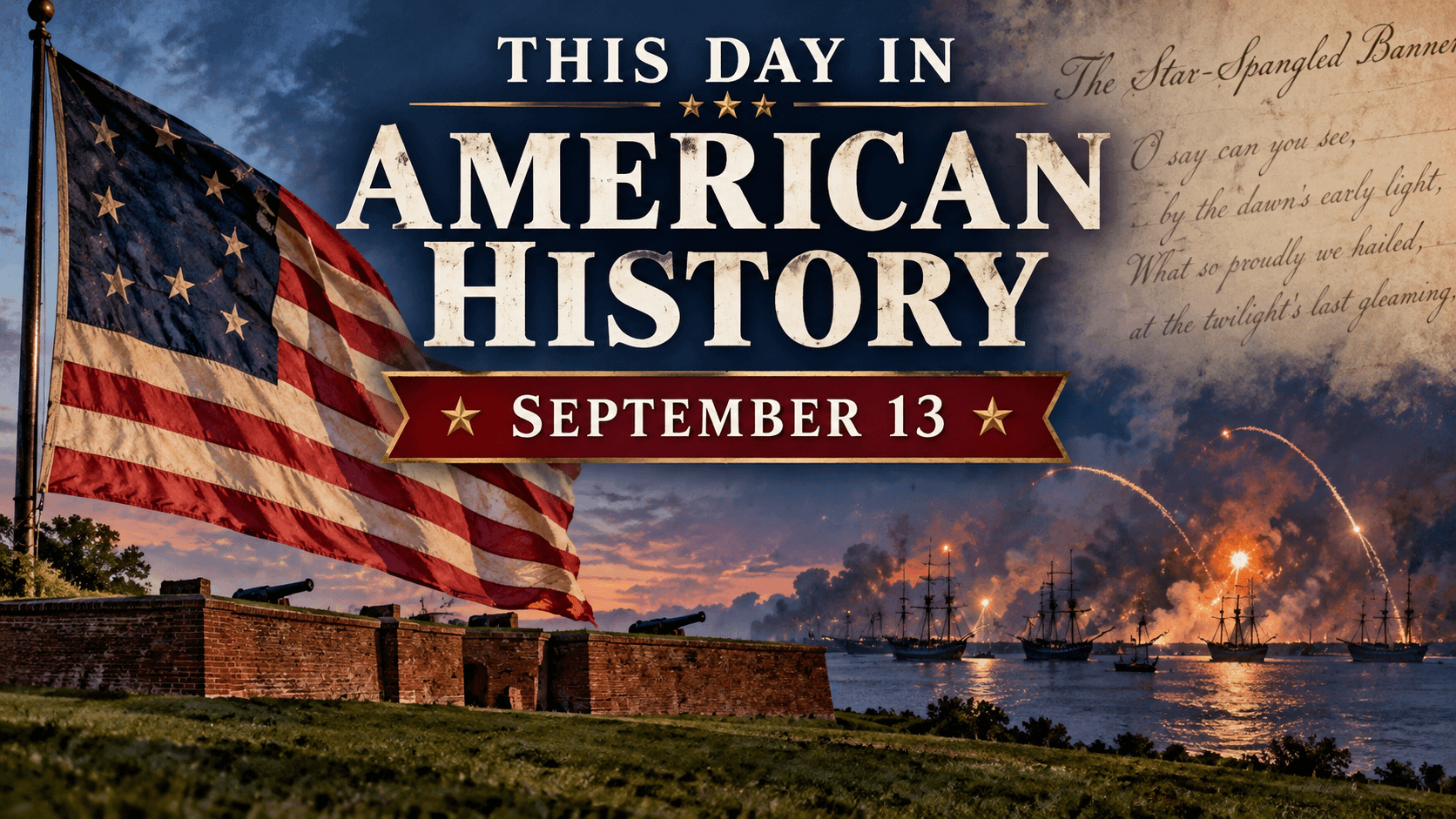
    This Day in American History – September 13

    September 13 holds a special place in American history. It was on this date that one of the most dramatic battles of the War of 1812 unfolded, creating the scene that would inspire the words of the United States national anthem.

    From British warships firing rockets and exploding shells toward Fort McHenry in 1814 to major legislation signed nearly two centuries later, September 13 has witnessed moments connected to American identity, resilience, law, security, and national recovery.

    Here is a look back at some of the important events connected to September 13 in American history.

    1814 – The Bombardment of Fort McHenry Begins

    The defining American historical event associated with September 13 occurred during the War of 1812.

    On the morning of September 13, 1814, British naval forces began an intense bombardment of Fort McHenry, which guarded the entrance to Baltimore Harbor.

    Baltimore was an important American port and commercial center. After British forces had invaded Washington and burned important government buildings only weeks earlier, Baltimore became their next major target.

    American defenders knew that losing Fort McHenry could leave Baltimore vulnerable.

    The British fleet began bombarding the fort at approximately 6:30 in the morning. Rockets and mortar shells rained toward the American defenses during an attack that continued for roughly 25 hours.

    Inside Fort McHenry, approximately 1,000 defenders under the command of Major George Armistead endured the attack.

    The British possessed weapons capable of firing from distances that initially placed much of their fleet beyond the effective range of the fort’s cannons.

    American forces nevertheless refused to surrender.

    Throughout September 13 and into the night, British rockets streaked across the sky while exploding shells illuminated Baltimore Harbor.

    Those terrifying sights would soon become some of the most recognizable words in American history.

    Francis Scott Key Watches the Battle

    Among those witnessing the bombardment was a 35-year-old American lawyer named Francis Scott Key.

    Key had traveled with American prisoner-exchange agent John Stuart Skinner to negotiate the release of Dr. William Beanes, who was being held by the British.

    The Americans succeeded in securing Beanes’ release, but because Key and his companions had learned information about the planned attack on Baltimore, they were not immediately permitted to return to shore.

    As a result, Key found himself watching the attack from a vessel in Baltimore Harbor.

    From his position several miles away, he could see rockets and exploding shells over Fort McHenry.

    Throughout the night, an enormous question remained:

    Had the fort surrendered?

    As long as the American flag remained above Fort McHenry, Key knew the defenders were still holding their position.

    But darkness, smoke and bad weather made it difficult to determine what was happening.

    The battle continued through the night.

    The Rockets’ Red Glare

    Today, millions of Americans recognize the phrase about the rockets’ red glare from “The Star-Spangled Banner.”

    Those words weren’t simply poetic imagery.

    They described something Key had actually witnessed.

    British forces used Congreve rockets during their attack on Fort McHenry, while mortar vessels fired explosive shells high into the air.

    The flashes from those weapons helped Key determine during the darkness that the battle was continuing.

    The Smithsonian notes that the rockets and bombs described in the national anthem reflect the real weapons being used against Fort McHenry on the night of September 13, 1814.

    Every explosion meant the American defenders were still under attack.

    Yet Fort McHenry did not surrender.

    A Massive American Flag Waited at Fort McHenry

    The flag associated with the battle had been created before the British attack.

    Major George Armistead wanted an American flag large enough that approaching forces would have no trouble recognizing who controlled Fort McHenry.

    Baltimore flagmaker Mary Pickersgill and others created the enormous garrison flag.

    It measured approximately 30 feet by 42 feet.

    The flag contained 15 stars and 15 stripes, representing the states recognized under the flag design used at the time.

    Because heavy rain accompanied much of the bombardment, a smaller storm flag was flown during the battle.

    But the enormous garrison flag would soon have its historic moment.

    September 14 – The Flag Was Still There

    Although the bombardment began on September 13, the moment that completed the story occurred the following morning.

    By dawn on September 14, British forces had failed to force Fort McHenry into surrender.

    The bombardment ended, and the British fleet began withdrawing.

    At Fort McHenry, the smaller storm flag was lowered and the enormous garrison flag was raised.

    From his distant position, Francis Scott Key saw the American flag flying above the fort.

    Baltimore had survived.

    The fort had held.

    The British had failed to capture the city.

    For Key, the sight was overwhelming.

    The Library of Congress describes how Key saw the American flag still flying after the nightlong bombardment, inspiring the words that became “The Star-Spangled Banner.”

    The Birth of “The Star-Spangled Banner”

    Inspired by what he had witnessed, Key began writing words describing the experience.

    His poem was originally titled “Defence of Fort M’Henry.”

    Its opening asked whether the American flag could still be seen after the violent night of battle.

    The imagery reflected the uncertainty Key had experienced aboard the vessel.

    Could he see the flag?

    Had Fort McHenry survived?

    Was Baltimore still in American hands?

    The answer came with the morning light.

    Yes.

    The flag was still there.

    Key’s words were eventually set to the melody of a popular tune of the era, and the song became increasingly associated with American patriotism.

    More than a century later, in 1931, Congress officially recognized “The Star-Spangled Banner” as the national anthem of the United States.

    What began as one man’s description of a terrifying night in Baltimore had become part of America’s national identity.

    Why the Battle of Baltimore Mattered

    The importance of the defense of Baltimore extended far beyond the creation of the national anthem.

    Only weeks earlier, Americans had experienced the humiliation of seeing British troops enter Washington.

    The British burned several public buildings, including the Capitol and the President’s House, later known as the White House.

    Baltimore presented another opportunity for Britain to deliver a devastating blow.

    But American defenses were considerably stronger.

    Thousands of defenders had prepared positions around the city while Fort McHenry protected the harbor.

    British troops encountered American resistance on land at the Battle of North Point on September 12. The following day, the naval assault against Fort McHenry began.

    Neither effort succeeded in capturing Baltimore.

    The National Park Service describes the bombardment of Fort McHenry on September 13–14 as one of the longest bombardments in North American history.

    The British eventually abandoned their attempt to capture the city.

    For Americans who had recently watched their capital attacked, the successful defense of Baltimore provided an important boost in morale.

    The Original Star-Spangled Banner Survives

    The flag that inspired Francis Scott Key survived as well.

    Today, the original Star-Spangled Banner is preserved by the Smithsonian’s National Museum of American History in Washington, D.C.

    Its age, enormous size and fragile fibers require careful conservation.

    More than two centuries after the Battle of Baltimore, Americans can still see the actual flag connected to the creation of their national anthem.

    Few historical artifacts provide such a direct connection between a famous piece of American music and the event that inspired it.

    The anthem isn’t merely describing an imaginary battlefield.

    The flag existed.

    The fort exists.

    The battle happened.

    And the enormous banner that Key saw over Fort McHenry remains part of America’s national collection.

    1994 – The Violence Against Women Act Is Signed

    Another major event in American history occurred on September 13, 1994, exactly 180 years after the bombardment of Fort McHenry began.

    President Bill Clinton signed the Violence Against Women Act, commonly known as VAWA, as part of broader federal crime legislation.

    The law represented a major change in the federal government’s approach to domestic violence, sexual assault and stalking.

    It strengthened federal criminal provisions, supported victim services and provided funding to communities working to address violence and assist survivors.

    The U.S. Department of Justice notes that the legislation was signed on September 13, 1994, and helped establish a more coordinated national response to domestic violence, sexual assault and stalking.

    VAWA has subsequently been reauthorized and modified over the years, becoming an important part of federal policy surrounding violence prevention and victim assistance.

    2001 – America Begins Reopening Its Skies After September 11

    September 13 also carries significance in the aftermath of one of America’s darkest days.

    Following the terrorist attacks of September 11, 2001, civilian air traffic across the United States was brought to an extraordinary halt.

    Thousands of aircraft had been grounded as the nation attempted to understand what had happened and authorities reassessed aviation security.

    On September 13, 2001, most U.S. airports began reopening and limited commercial air travel started returning.

    The reopening occurred under dramatically heightened security procedures and on a case-by-case basis.

    Travel was far from normal.

    Passengers faced new restrictions, delays and uncertainty as the aviation system attempted to restart after an unprecedented nationwide grounding.

    The changes that followed September 11 would ultimately transform airport security and the experience of flying in the United States.

    September 13 therefore became one of the first days in America’s difficult effort to resume ordinary life after the attacks.

    A Date Connected to American Resilience

    When looking across the history of September 13, one theme appears repeatedly:

    resilience.

    In 1814, American soldiers inside Fort McHenry endured hours of bombardment while refusing to surrender.

    Their defense helped save Baltimore and inspired the words that became the national anthem.

    In 1994, federal legislation attempted to strengthen America’s response to domestic violence, sexual assault and stalking.

    In 2001, Americans began the difficult process of reopening the nation’s aviation system only two days after terrorist attacks had shocked the country.

    These events occurred in completely different eras and circumstances, but each reflects moments when Americans faced serious challenges and responded to them.

    The Lasting Meaning of September 13, 1814

    Of all the events connected to this date, however, the bombardment of Fort McHenry remains the most iconic.

    Imagine standing aboard a vessel in Baltimore Harbor on that September night.

    The sky flashes.

    Rockets streak overhead.

    Explosions illuminate the darkness.

    Rain falls.

    Smoke hangs over the harbor.

    Somewhere in the distance stands Fort McHenry.

    Francis Scott Key could not know exactly what was happening inside the fort. He could only watch and wait.

    Then morning arrived.

    Through the early light, he could see an American flag.

    That single sight answered the question he had been asking throughout the night.

    The fort had survived.

    Baltimore had survived.

    And the flag was still there.

    More than two centuries later, Americans continue singing about that night.

    At sporting events, military ceremonies, schools, national celebrations and countless public gatherings, the opening notes of “The Star-Spangled Banner” bring people back—whether they realize it or not—to September 13, 1814.

    They return to Fort McHenry.

    They return to the rockets illuminating Baltimore Harbor.

    They return to Francis Scott Key searching through the darkness for a flag.

    Remembering September 13

    History often becomes easier to understand when we remember that famous events were once uncertain moments experienced by real people.

    The defenders of Fort McHenry did not know they were creating the story behind America’s future national anthem.

    Francis Scott Key did not know that generations of Americans would eventually stand for the words he was inspired to write.

    They were simply living through an uncertain night.

    That is part of what makes September 13 such a fascinating day in American history.

    A battle became a poem.

    A poem became a song.

    And a song became a national anthem.

    The flag that survived the bombardment became one of America’s most treasured historical artifacts, while the words inspired by its survival became familiar to generations.

    If you had the opportunity to witness one moment from September 13 in American history firsthand, which event would you choose and why?

  • History & Culture of the Day: September 12 – Ancient Art, a Race to the Moon, and Breaking Barriers in Space

    History & Culture of the Day: September 12 – Ancient Art, a Race to the Moon, and Breaking Barriers in Space

    September 12 is a date filled with moments that remind us how human beings have always been driven to create, explore, compete, love, and push beyond established boundaries.

    On this day, a remarkable prehistoric discovery opened a window into humanity’s artistic past. Two celebrated poets took a dramatic step in one of literature’s most famous romances. Future Olympic legend Jesse Owens was born. John F. Kennedy delivered one of the defining speeches of the Space Age. Singer Barry White entered the world and eventually helped create a soundtrack for romance. And decades later, Dr. Mae Jemison made history by becoming the first Black woman to travel into space.

    From paintings created thousands of years ago to astronauts orbiting hundreds of miles above Earth, September 12 connects some very different chapters of the human story.

    Here is a look at the history and culture that make September 12 a fascinating day to remember.

    1846 – Elizabeth Barrett and Robert Browning Eloped

    One of the great literary love stories reached a dramatic turning point on September 12, 1846, when poets Elizabeth Barrett and Robert Browning secretly married and eloped.

    Elizabeth Barrett was already an accomplished and respected poet. Her work had gained considerable attention, but her personal life was complicated by the controlling influence of her father.

    Then Robert Browning entered her life.

    Their relationship began through correspondence after Browning admired Barrett’s poetry. Letters turned into meetings, and the connection between the two writers deepened.

    Because Barrett’s father strongly opposed his children marrying, the couple decided to marry secretly.

    Their relationship would become one of the most famous romances in literary history.

    Their story is especially memorable because words were at the center of their relationship. These were two people whose lives revolved around language, poetry and expression, and their personal correspondence provides an extraordinary glimpse into their growing affection.

    Elizabeth Barrett Browning would eventually produce some of the most recognizable romantic poetry in the English language.

    Their marriage also allowed Elizabeth to establish a life away from her father’s control. The couple settled in Italy, where she continued writing and became involved with political and social issues of her era.

    September 12 therefore holds a special place in literary history—not simply as a date connected with two famous poets, but as a reminder that some of literature’s greatest love stories happened beyond the pages of books.

    1913 – Jesse Owens Was Born

    James Cleveland “Jesse” Owens was born on September 12, 1913, in Oakville, Alabama.

    He would grow into one of the most celebrated athletes of the 20th century.

    Owens became internationally famous at the 1936 Olympic Games in Berlin, where he won four gold medals in track and field.

    His accomplishments were extraordinary under any circumstances, but the political environment surrounding those Olympics gave his victories even greater historical significance.

    Nazi Germany attempted to use the Games as an international showcase for Adolf Hitler’s regime and its racist ideology. Owens, a Black American athlete, became one of the Games’ biggest stars.

    He won gold in the 100 meters, 200 meters, long jump and 4-by-100-meter relay.

    His performance demonstrated something far more powerful than propaganda.

    Excellence could not be confined by racial ideology.

    Owens returned home as an international sports hero, although he still lived in an America deeply affected by racial discrimination and segregation.

    That contradiction is an important part of his story.

    A man celebrated around the world for representing the United States could still encounter racial barriers within his own country.

    Over time, Owens became remembered not only as a legendary athlete but as a cultural figure whose achievements transcended sports.

    His September 12 birthday gives us an opportunity to remember the ability of sports to challenge assumptions, cross cultural boundaries and inspire generations.

    1940 – The Lascaux Cave Paintings Were Discovered

    One of the most extraordinary archaeological discoveries of the 20th century occurred on September 12, 1940, near Montignac in southwestern France.

    The Lascaux cave paintings were discovered.

    Inside the cave system were remarkable prehistoric images, many depicting animals such as horses, deer and wild cattle.

    The paintings date back thousands of years to the Upper Paleolithic period and are among the world’s most famous examples of prehistoric art.

    Their discovery transformed understanding of early human artistic ability.

    It can be tempting to imagine prehistoric people primarily through the lens of survival—finding food, building shelter, avoiding predators and adapting to difficult environments.

    Lascaux tells a richer story.

    Human beings were also observing.

    They were imagining.

    They were communicating.

    And they were creating art.

    The sophistication of the paintings demonstrates that artistic expression has extraordinarily deep roots in human culture.

    Long before museums, galleries, books, photography, movies or digital media existed, people were finding ways to preserve images and ideas.

    The walls of Lascaux became a canvas across thousands of years.

    That is one reason the discovery remains culturally important.

    Technology changes.

    Civilizations rise and fall.

    Languages evolve.

    But the desire to create appears to be one of humanity’s most enduring characteristics.

    1944 – Barry White Was Born

    September 12 also marks the birthday of one of the most recognizable voices in popular music.

    Barry White was born on September 12, 1944, in Galveston, Texas.

    His deep, unmistakable voice would eventually become associated with soul, R&B, disco and especially romantic music.

    White developed a successful career as a singer, songwriter, arranger and producer. His lush orchestral arrangements combined with his distinctive vocals helped create a musical style that listeners could identify almost immediately.

    During the 1970s, he became particularly associated with the era’s soul and disco sound.

    Songs such as “Can’t Get Enough of Your Love, Babe” helped establish his reputation as one of popular music’s great romantic performers.

    His influence extended beyond individual hits.

    Barry White became a cultural personality.

    His voice was so distinctive that it became instantly recognizable across generations, appearing throughout popular culture in television, movies and comedy.

    Music has always played an important role in the way people experience emotion.

    Certain songs become connected with relationships, celebrations, heartbreaks and memories.

    Barry White built an extraordinary career around that connection.

    His September 12 birthday represents another chapter in the day’s remarkable cultural history.

    1953 – John F. Kennedy Married Jacqueline Bouvier

    On September 12, 1953, future U.S. President John F. Kennedy married Jacqueline Bouvier in Newport, Rhode Island.

    At the time, Kennedy was serving as a U.S. senator from Massachusetts.

    Seven years later, he would win the presidency.

    Jacqueline Kennedy would become one of the most influential first ladies in American history, admired for her fashion, interest in the arts and efforts to preserve the historical character of the White House.

    The Kennedy family quickly became a major presence in American popular culture.

    Their youth, style and public image helped create a fascination that extended far beyond politics.

    The marriage therefore became part of a larger cultural story surrounding the Kennedy era.

    Interestingly, September 12 would become significant in John F. Kennedy’s life for another reason nine years later.

    That moment would help define his presidency.

    1962 – President Kennedy Challenged America to Reach the Moon

    On September 12, 1962, President John F. Kennedy stood before a crowd at Rice University in Houston, Texas, and delivered one of the most memorable speeches of the Space Age.

    America was competing with the Soviet Union in the rapidly developing space race.

    The challenge was enormous.

    Kennedy had previously committed the United States to landing a person on the Moon before the decade ended. At Rice University, he strongly reaffirmed that goal before an audience of approximately 40,000 people.

    The speech became famous for Kennedy’s explanation of why difficult challenges were worth attempting.

    He argued that reaching the Moon mattered precisely because the task was difficult.

    The speech transformed a technical and political objective into something larger.

    It became a statement about ambition.

    Exploration.

    Innovation.

    Courage.

    And human possibility.

    The idea of sending astronauts approximately a quarter-million miles from Earth sounded almost impossible.

    NASA still had enormous technological challenges ahead.

    Rockets had to become more powerful.

    Spacecraft had to become more sophisticated.

    Astronauts needed to learn how to operate safely in space.

    Engineers needed to solve problems that had never existed before.

    Thousands of people across government, universities and private industry would eventually contribute to the effort.

    Seven years after Kennedy’s Rice University speech, Apollo 11 astronauts Neil Armstrong and Buzz Aldrin walked on the Moon.

    Kennedy did not live to see that achievement.

    But the challenge he articulated on September 12, 1962, became permanently connected with one of humanity’s greatest technological accomplishments.

    The speech remains relevant because its message extends beyond space exploration.

    Some goals are worth pursuing not because they are guaranteed to succeed, but because pursuing them forces people to discover what they are capable of accomplishing.

    1980 – Basketball Star Yao Ming Was Born

    Another major figure in international sports was born on September 12, 1980.

    Yao Ming was born in Shanghai, China.

    At 7 feet 6 inches tall, Yao eventually became one of the most recognizable basketball players in the world.

    He played professionally in China before joining the Houston Rockets in the NBA.

    His arrival generated enormous international attention.

    Yao wasn’t simply another talented basketball player entering the NBA. He represented an important bridge between American professional basketball and a rapidly growing basketball audience in China.

    Millions of fans followed his career.

    His presence helped expand the international reach of the sport and demonstrated how dramatically basketball had evolved from an American game into a truly global cultural phenomenon.

    Sports frequently create connections that politics and geography cannot.

    Fans thousands of miles apart can celebrate the same players, debate the same games and experience the same unforgettable moments.

    Yao Ming’s career became part of that global transformation.

    1992 – Mae Jemison Became the First Black Woman in Space

    Thirty years after Kennedy’s famous Rice University address, September 12 produced another major milestone in space history.

    On September 12, 1992, Space Shuttle Endeavour launched on mission STS-47.

    Among the seven crew members was Dr. Mae C. Jemison.

    With that launch, Jemison became the first Black woman to travel into space.

    Her background was already remarkable.

    Jemison was a physician and engineer who had also served as a Peace Corps medical officer in Sierra Leone and Liberia before being selected by NASA as an astronaut candidate in 1987.

    STS-47 was a joint American-Japanese Spacelab mission focused on materials science and life-science research.

    Jemison served as a science mission specialist and participated in scientific experiments during the flight.

    NASA’s records show the mission launched aboard Endeavour on September 12, 1992, and lasted nearly eight days.

    Her achievement carried enormous cultural significance.

    For generations, women and people of color had been underrepresented in many areas of science and engineering.

    Jemison’s journey provided a powerful and highly visible example of barriers being broken.

    There was also an interesting connection between science fiction and reality.

    Jemison has spoken about being inspired by Nichelle Nichols, who portrayed Lieutenant Uhura on “Star Trek.” Nichols herself later worked with NASA efforts encouraging women and minorities to apply to the astronaut program.

    The connection demonstrates how culture and science can influence each other.

    A fictional character can inspire a child.

    That child can become a scientist.

    That scientist can become an astronaut.

    And that astronaut can inspire another generation.

    History doesn’t always move in a straight line.

    Sometimes imagination comes first.

    September 12 and Humanity’s Desire to Explore

    There is an interesting connection running through several of September 12’s historical events.

    It is exploration.

    The people who created the Lascaux cave paintings explored artistic expression thousands of years before modern civilization.

    Elizabeth Barrett Browning and Robert Browning explored the power of language, poetry and love.

    Jesse Owens explored the limits of human athletic performance.

    Barry White explored emotion through music.

    John F. Kennedy challenged a nation to explore another world.

    Mae Jemison physically left Earth and traveled into space.

    Even though these stories occurred in completely different eras, each demonstrates something fundamental about human culture.

    We rarely remain satisfied with where we are.

    We create.

    We question.

    We compete.

    We imagine.

    We travel.

    We discover.

    And occasionally we accomplish something that previous generations would have considered impossible.

    The Cultural Importance of September 12

    History isn’t simply a collection of dates.

    It is the accumulated story of human choices.

    Someone decided to paint an animal on a cave wall.

    Someone decided to write a poem.

    Someone trained for a race.

    Someone composed a song.

    Someone challenged a nation to reach the Moon.

    Someone climbed aboard a spacecraft and broke a barrier.

    Each action eventually became part of history.

    That is what makes September 12 such an interesting date.

    Its stories stretch from prehistoric caves to outer space.

    Few combinations could illustrate the journey of human civilization more dramatically.

    Thousands of years ago, people looked at animals around them and painted their images on stone walls.

    By the 20th century, humans were building machines capable of escaping Earth’s atmosphere.

    And through all those centuries, art, music, literature, competition, curiosity and imagination remained central parts of human life.

    Remembering September 12

    September 12 reminds us that history and culture are constantly intertwined.

    The greatest scientific achievement can become part of popular culture.

    An athlete can become a symbol of social change.

    A singer can create music that becomes connected with millions of personal memories.

    A poet’s relationship can become a literary legend.

    A prehistoric painting can survive long enough to communicate across thousands of years.

    And one astronaut can change the way countless young people imagine their own possibilities.

    The people responsible for these moments probably could not fully understand how their actions would eventually be remembered.

    That is another fascinating part of history.

    We recognize important moments more clearly when looking backward.

    But every generation is creating tomorrow’s history right now.

    September 12 gives us an extraordinary timeline—from ancient artistic expression to the exploration of space—and reminds us just how far humanity has traveled while continuing to ask the same timeless question:

    What might we discover if we are willing to go a little farther than anyone has gone before?

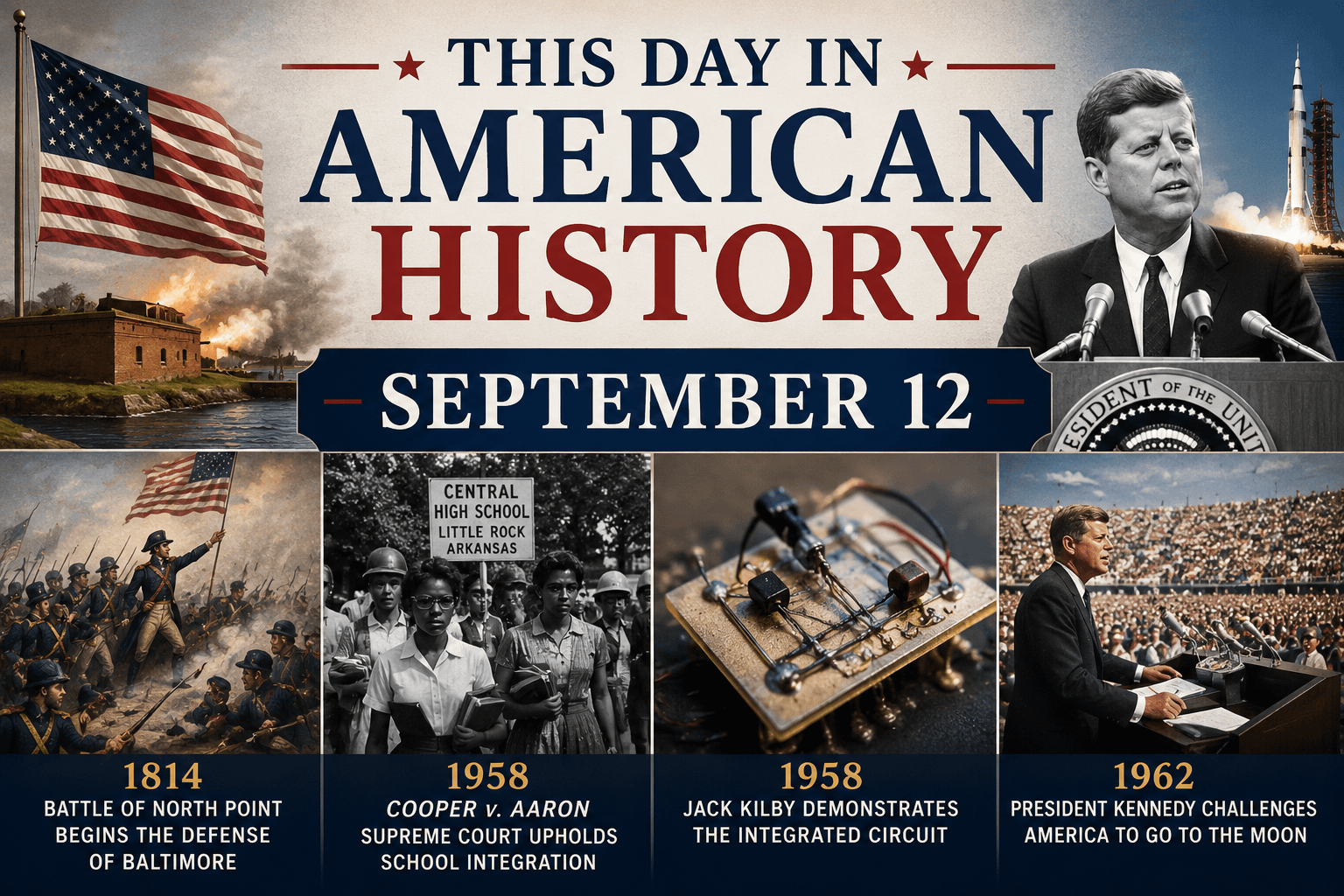
  • This Day in American History – September 12

    This Day in American History – September 12

    September 12 has witnessed moments that helped shape the United States through war, civil rights, technology, politics, and space exploration. From American defenders standing against British troops outside Baltimore during the War of 1812 to President John F. Kennedy challenging the nation to reach the Moon, the date offers several powerful chapters in the American story.

    Some September 12 events produced immediate consequences. Others became more important with the passage of time. Together, they demonstrate a recurring theme in American history: periods of uncertainty have often been followed by moments of courage, innovation, determination, and change.

    Here is a look back at some of the most significant events associated with September 12 in American history.

    1814 – The Battle of North Point Begins the Defense of Baltimore

    One of the most consequential events to occur on September 12 came during the War of 1812.

    On September 12, 1814, British troops landed at North Point, Maryland, and advanced toward Baltimore. The attack came only weeks after British forces had captured Washington, D.C., and burned several public buildings in the nation’s capital.

    Baltimore represented an important next target.

    The city was a major commercial and shipbuilding center, and its capture would have delivered another serious blow to American morale.

    According to the National Park Service, a British fleet of more than 30 warships and transports arrived near Baltimore, and approximately 5,000 British troops landed on the North Point peninsula before beginning their march toward the city.

    American forces were waiting.

    Roughly 3,200 Americans under Brigadier General John Stricker moved forward to slow the British advance.

    The resulting confrontation became known as the Battle of North Point.

    Americans Make Their Stand at North Point

    The American troops faced a formidable opponent.

    Britain possessed one of the world’s most powerful military forces, and its soldiers had extensive combat experience from years of warfare in Europe.

    The Americans nevertheless chose to confront the advancing British army rather than simply remain behind Baltimore’s defensive positions.

    The Battle of North Point began on the afternoon of September 12.

    Although the British ultimately controlled the battlefield and the Americans withdrew, the battle accomplished something extremely important: it delayed the British advance.

    The fighting also inflicted significant casualties on the British.

    Among those killed was British Major General Robert Ross, who had commanded the force involved in the campaign against Washington and Baltimore.

    The National Park Service notes that although North Point was technically a British victory, the American resistance slowed the British advance, strengthened American morale, and contributed to the defense of Baltimore.

    Those additional hours mattered.

    Baltimore had spent weeks preparing defenses, and thousands of Americans were ready to protect the city.

    The British soon discovered that capturing Baltimore would be far more difficult than capturing Washington had been.

    The Battle Leads Toward the Star-Spangled Banner

    The fighting on September 12 was only the beginning of the Battle of Baltimore.

    As American troops withdrew from North Point toward the city’s defenses, British warships moved into position along the Patapsco River.

    Their next major obstacle was Fort McHenry.

    During the night of September 12 and into the following morning, British vessels moved closer to Baltimore’s harbor defenses. The naval bombardment of Fort McHenry would begin on September 13 and continue into September 14.

    Watching these events from aboard a vessel in the harbor was American lawyer Francis Scott Key.

    Key had traveled with John Stuart Skinner to negotiate the release of Dr. William Beanes, an American physician who had been detained by the British.

    Because Key had learned information about British military plans, he and his companions were temporarily prevented from returning to Baltimore.

    That placed Key in a remarkable position to witness the attack.

    When morning came after the bombardment, the enormous American flag was still flying above Fort McHenry.

    The sight inspired Key to write the words that eventually became “The Star-Spangled Banner.”

    More than a century later, the song officially became the national anthem of the United States.

    The events beginning on September 12, therefore, were connected not only to the defense of Baltimore but also to one of America’s most enduring national symbols.

    Why the Defense of Baltimore Mattered

    The Battle of Baltimore demonstrated that the British advance through the Chesapeake region could be stopped.

    After burning Washington, British forces might have appeared unstoppable.

    Baltimore changed that perception.

    American soldiers, sailors, militia members, and civilians had spent weeks preparing the city’s defenses. Free and enslaved African Americans were among those who contributed to the defensive effort.

    By September 14, the British had failed to break through Baltimore’s defenses and withdrew.

    The city survived.

    The National Park Service describes the Battle of Baltimore, fought from September 12 through September 14, 1814, as a defining moment of the War of 1812.

    The victory also gave Americans a powerful symbol of national resilience.

    A battle that began on September 12 helped create the circumstances that inspired the words Americans would eventually sing before sporting events, ceremonies, military observances, and national celebrations.

    1953 – John F. Kennedy Marries Jacqueline Bouvier

    Another memorable September 12 moment occurred nearly 140 years later.

    On September 12, 1953, future President John F. Kennedy married Jacqueline Lee Bouvier at St. Mary’s Church in Newport, Rhode Island.

    Kennedy was serving as a United States senator from Massachusetts at the time.

    The couple would eventually become one of the most recognizable political couples of the twentieth century.

    Seven years after their wedding, Kennedy won the 1960 presidential election and became the 35th president of the United States.

    Jacqueline Kennedy became one of America’s most famous first ladies, known for her interest in art, history, culture, and the restoration of the White House.

    Remarkably, another defining moment in John F. Kennedy’s public life would occur on the exact same date nine years after his wedding.

    1958 – The Supreme Court Acts in Cooper v. Aaron

    September 12 also holds an important place in the history of the American civil rights movement.

    On September 12, 1958, the United States Supreme Court acted in the landmark school desegregation case Cooper v. Aaron.

    The dispute emerged from the battle over integration at Central High School in Little Rock, Arkansas.

    Following the Supreme Court’s 1954 decision in Brown v. Board of Education, public schools were constitutionally required to end racial segregation.

    Resistance remained intense in many communities.

    In Little Rock, nine Black students—the Little Rock Nine—attempted to integrate Central High School in 1957.

    The confrontation became a national crisis.

    Arkansas Governor Orval Faubus initially used the Arkansas National Guard to prevent the students from entering the school. President Dwight D. Eisenhower eventually federalized the Guard and sent federal troops to enforce the students’ right to attend.

    The conflict did not disappear after the 1957–1958 school year.

    Little Rock school officials sought to postpone implementation of the integration plan.

    On September 12, 1958, the Supreme Court issued an order preventing that delay. The Court’s journal records its action that day in the litigation involving the Little Rock school board and the students challenging segregation.

    The Constitution Cannot Simply Be Ignored

    Cooper v. Aaron became a major constitutional decision.

    The Supreme Court unanimously rejected efforts to avoid complying with its interpretation of the Constitution.

    The case reinforced an essential principle of the American constitutional system: state governments and officials cannot simply disregard federal constitutional requirements because they disagree with them.

    The struggle over Little Rock demonstrated how difficult enforcing civil rights could be even after the Supreme Court had ruled segregation unconstitutional.

    Court decisions could establish rights.

    Making those rights meaningful often required continued legal action, political leadership, federal enforcement, and extraordinary courage from ordinary citizens.

    The Little Rock Nine became lasting symbols of that courage.

    September 12, 1958, therefore represents another important step in America’s long and unfinished struggle to live up to the principle of equal protection under the law.

    1958 – Jack Kilby Demonstrates the Integrated Circuit

    While one historic development was unfolding in the Supreme Court, another was taking place in a laboratory.

    On September 12, 1958, engineer Jack Kilby, working at Texas Instruments, demonstrated an early working integrated circuit.

    At first glance, that might not sound as dramatic as a battle or presidential speech.

    Its consequences, however, were enormous.

    Before integrated circuits, electronic equipment relied heavily on individual components connected together. These systems could become large, complicated, expensive, and difficult to manufacture.

    The integrated circuit offered a revolutionary alternative by placing multiple electronic components together on a small piece of semiconductor material.

    The technology became one of the foundations of modern electronics.

    Integrated circuits eventually helped make possible increasingly powerful and compact computers, calculators, communications equipment, medical devices, automobiles, smartphones, spacecraft, and countless other technologies.

    The modern digital world depends heavily on the semiconductor revolution that followed.

    It is an excellent reminder that American history is not shaped exclusively in battlefields, courtrooms, and presidential offices.

    Sometimes history changes on a laboratory workbench.

    1962 – President Kennedy Challenges America to Go to the Moon

    Four years after the events of 1958, September 12 became associated with one of the most famous speeches of the Space Age.

    On September 12, 1962, President John F. Kennedy addressed approximately 40,000 people at Rice University Stadium in Houston, Texas.

    His purpose was to strengthen public support for America’s ambitious effort to send astronauts to the Moon.

    Kennedy had already proposed the lunar goal to Congress in May 1961.

    The challenge was extraordinary.

    Human spaceflight was still in its infancy.

    The Soviet Union had placed Yuri Gagarin into orbit in April 1961, making him the first human to orbit Earth. The United States was determined to demonstrate that it could compete with—and ultimately surpass—the Soviet space program.

    By September 1962, enormous technical obstacles remained.

    NASA needed rockets far more powerful than anything previously flown.

    Engineers needed spacecraft capable of carrying astronauts hundreds of thousands of miles through space.

    Scientists and mission planners had to determine how astronauts would navigate to the Moon, land safely, launch from its surface, rendezvous in lunar orbit, return to Earth, and survive reentry.

    Failure was entirely possible.

    Kennedy nevertheless argued that difficulty was precisely why the challenge mattered.

    “We Choose to Go to the Moon”

    Kennedy’s Rice University address produced one of the most famous lines of his presidency:

    “We choose to go to the Moon.”

    The speech framed space exploration as more than a technological competition.

    Kennedy presented the Moon program as a national challenge capable of organizing American talent, scientific knowledge, industrial capacity, and determination toward an extraordinary goal.

    NASA records that Kennedy used the September 12 speech to reaffirm America’s commitment to achieving a crewed lunar landing before the decade ended.

    It was a bold promise.

    No human had traveled anywhere close to the Moon.

    John Glenn had only become the first American to orbit Earth earlier that year.

    Yet Kennedy was asking the country to move from brief Earth-orbit missions to landing human beings on another world within several years.

    The challenge required an unprecedented national effort.

    From Kennedy’s Speech to Apollo 11

    Kennedy would not live to see the goal achieved.

    He was assassinated on November 22, 1963.

    NASA continued pursuing the lunar objective.

    Thousands of engineers, scientists, technicians, mathematicians, astronauts, contractors, administrators, and workers contributed to the Apollo program.

    The road was not easy.

    The Apollo 1 fire in January 1967 killed astronauts Virgil “Gus” Grissom, Edward White II, and Roger Chaffee during a launch-pad test.

    The tragedy led to major spacecraft redesigns and safety improvements.

    NASA continued.

    Apollo 8 carried humans around the Moon in December 1968.

    Apollo 10 conducted a full dress rehearsal of the lunar landing mission in May 1969.

    Then came Apollo 11.

    On July 20, 1969, astronauts Neil Armstrong and Buzz Aldrin landed the lunar module Eagle on the Moon while Michael Collins remained aboard the command module Columbia in lunar orbit.

    Armstrong became the first human to step onto the lunar surface.

    The goal Kennedy had publicly championed was accomplished before the 1960s ended.

    NASA notes that the September 12, 1962, Rice University speech helped reaffirm the commitment that ultimately culminated in Apollo 11’s successful Moon landing.

    September 12 Connects Two Very Different American Frontiers

    There is an interesting historical connection between two of September 12’s biggest stories.

    In 1814, Americans were fighting to defend Baltimore from invasion.

    In 1962, Americans were preparing to explore another world.

    The circumstances could hardly have been more different.

    Yet both moments involved a nation confronting an uncertain future.

    The defenders at North Point could not know whether Baltimore would fall.

    The engineers building America’s early spacecraft could not know with certainty whether Kennedy’s lunar challenge could actually be accomplished.

    Both stories ultimately became associated with national determination.

    One helped inspire the national anthem.

    The other helped inspire the Moon landing.

    From Battlefields to Microchips to the Moon

    September 12 also demonstrates how dramatically the United States changed over roughly a century and a half.

    In 1814, the young nation was struggling to defend one of its major cities against the British Empire.

    By 1958, American engineers were helping create technology that would transform electronics and computing.

    That same year, Americans were confronting the constitutional and moral struggle over racial segregation.

    Four years later, the United States was committing enormous resources toward sending human beings to the Moon.

    These stories reveal different sides of American history.

    There is conflict.

    There is injustice.

    There is courage.

    There is innovation.

    There is ambition.

    And there is change.

    Understanding history requires acknowledging all of those elements rather than reducing the past to a collection of famous names and dates.

    Why September 12 Matters in American History

    September 12 deserves recognition because events occurring on this date touched several fundamental parts of the American experience.

    The Battle of North Point helped protect Baltimore during the War of 1812 and contributed to the events that inspired “The Star-Spangled Banner.”

    The struggle surrounding Cooper v. Aaron reinforced the authority of the Constitution and the federal courts during one of the most important civil rights battles of the twentieth century.

    Jack Kilby’s integrated circuit demonstration helped launch technological developments that eventually transformed everyday life.

    And President Kennedy’s Rice University speech gave memorable expression to America’s determination to reach the Moon.

    Each event involved people facing challenges whose outcomes were not guaranteed.

    That uncertainty is something easily forgotten when looking backward.

    History can make major achievements appear inevitable.

    They rarely were.

    Remembering September 12

    Looking back at September 12 reminds us that American history has been shaped by people willing to defend, challenge, invent, explore, and persevere.

    The soldiers outside Baltimore did not know their resistance would become part of the story surrounding America’s future national anthem.

    The students fighting segregation in Little Rock could not know exactly how their courage would influence generations that followed.

    Engineers experimenting with early integrated circuits could only begin to imagine the digital revolution ahead.

    And the thousands of people listening to President Kennedy at Rice University in 1962 could look into the night sky and see the Moon, but few could fully comprehend what would be required to place American astronauts there only seven years later.

    History is filled with moments like these.

    Some appear important immediately.

    Others reveal their importance slowly.

    September 12 contains both.

    From the defenses of Baltimore to the struggle for constitutional equality, from the birth of revolutionary technology to America’s journey toward the Moon, this date provides a remarkable snapshot of the larger American story.

    Which September 12 event do you think had the greatest lasting impact on the United States?

  • History & Culture of the Day – September 11

    History & Culture of the Day – September 11

    September 11 is a date that carries extraordinary weight in modern history, particularly in the United States. For millions of people, the date immediately brings to mind the terrorist attacks of September 11, 2001—a tragedy that took thousands of lives and permanently changed American society, national security, foreign policy, and the way people around the world thought about terrorism.

    Yet September 11 also has a much longer history. Across centuries, the date has witnessed battles, political changes, cultural developments, scientific milestones, and moments that shaped nations.

    Today, September 11 is both a day for remembering the past and reflecting on the values that emerge during difficult times: courage, service, compassion, unity, and remembrance.

    September 11, 2001: A Day That Changed America

    No discussion of September 11 can begin anywhere else.

    On the morning of September 11, 2001, 19 terrorists affiliated with al-Qaeda hijacked four commercial airplanes in a coordinated attack against the United States.

    American Airlines Flight 11 was flown into the North Tower of the World Trade Center in New York City.

    United Airlines Flight 175 struck the South Tower shortly afterward.

    American Airlines Flight 77 crashed into the Pentagon in Arlington, Virginia.

    The fourth aircraft, United Airlines Flight 93, never reached its intended target. Passengers and crew members, after learning what had happened elsewhere, attempted to regain control of the aircraft. Flight 93 ultimately crashed in a field near Shanksville, Pennsylvania.

    Nearly 3,000 people were killed in the attacks.

    The victims came from many different backgrounds, professions, religions, nationalities, and walks of life. Office workers, airline passengers and crews, firefighters, police officers, emergency medical personnel, military personnel, and many others lost their lives.

    September 11 became one of the defining moments of the early 21st century.

    The World Trade Center Attacks

    When American Airlines Flight 11 struck the North Tower of the World Trade Center at 8:46 a.m., many people initially struggled to understand what had happened.

    Seventeen minutes later, at 9:03 a.m., United Airlines Flight 175 crashed into the South Tower.

    The second impact made the nature of the attack unmistakable.

    Television networks around the world began broadcasting live images from Lower Manhattan. Millions watched as smoke poured from the towers while firefighters, police officers, emergency workers, and civilians rushed toward the disaster.

    The South Tower collapsed at 9:59 a.m.

    The North Tower followed at 10:28 a.m.

    The skyline of New York City was transformed within a matter of hours.

    But amid the devastation were countless acts of courage.

    First responders climbed stairways while thousands of people were evacuating in the opposite direction. Coworkers helped one another escape. Strangers assisted injured people. Boat operators helped evacuate people from Lower Manhattan by water.

    These individual acts of humanity became an important part of how September 11 would be remembered.

    The Attack on the Pentagon

    At 9:37 a.m., American Airlines Flight 77 crashed into the Pentagon.

    The Pentagon is the headquarters of the United States Department of Defense and one of the most recognizable symbols of American military power.

    The crash caused extensive destruction and fires.

    The attack demonstrated that September 11 was not simply an assault on New York City. It was a coordinated attack against major symbols of American economic and military power.

    Emergency personnel immediately responded to the Pentagon, beginning rescue and recovery operations under extremely dangerous conditions.

    The Heroes of Flight 93

    United Airlines Flight 93 has become one of the most powerful stories of courage associated with September 11.

    After the hijacking began, passengers and crew members were able to communicate with people on the ground. Through those conversations, they learned that other hijacked airplanes had already been used as weapons.

    Realizing their aircraft was likely part of the same coordinated attack, passengers and crew members made the decision to fight back.

    They attempted to regain control of the airplane.

    Flight 93 crashed near Shanksville, Pennsylvania, at approximately 10:03 a.m.

    Everyone aboard was killed.

    Investigators concluded that the hijackers intended to strike a target in Washington, D.C. The passengers’ resistance prevented the aircraft from reaching that destination.

    Their actions have since been remembered as an extraordinary example of courage under unimaginable circumstances.

    The First Responders of September 11

    Among the most enduring images of September 11 are firefighters, police officers, paramedics, and other emergency workers heading directly toward danger.

    New York City’s firefighters suffered devastating losses.

    Members of the New York City Police Department, Port Authority Police Department, emergency medical services, and numerous other organizations were also killed.

    Thousands more participated in rescue, recovery, cleanup, and rebuilding operations during the weeks and months that followed.

    For many responders, the consequences did not end when the recovery operation concluded.

    Exposure to toxic dust and debris at Ground Zero contributed to serious long-term illnesses among responders, recovery workers, survivors, and residents.

    Their experiences are another reason the consequences of September 11 continue decades later.

    Patriot Day and National Remembrance

    September 11 is officially observed in the United States as Patriot Day.

    Each year, Americans are encouraged to remember the victims and honor those who responded to the attacks.

    Flags are traditionally flown at half-staff.

    Communities hold memorial ceremonies, moments of silence, religious services, educational programs, and volunteer events.

    Moments of silence are often observed at times corresponding with major events from the attacks, including the moments when the planes struck and the towers fell.

    The observance is not simply about remembering tragedy.

    It is also about remembering people.

    Behind the number of nearly 3,000 victims were thousands of individual lives—parents, children, spouses, siblings, friends, coworkers, and neighbors.

    The September 11 Memorial & Museum

    The former World Trade Center site has become one of America’s most important places of remembrance.

    The National September 11 Memorial features two enormous reflecting pools located within the footprints of the original Twin Towers.

    The names of those killed in the September 11 attacks and the February 26, 1993, World Trade Center bombing are inscribed around the memorial pools.

    Nearby, the National September 11 Memorial & Museum preserves artifacts, photographs, recordings, personal stories, and historical materials connected to the attacks.

    The memorial helps ensure that future generations understand not only what happened but also who was lost.

    How September 11 Changed American Culture

    The attacks affected far more than government policy.

    They changed American culture.

    In the weeks following September 11, American flags appeared on homes, vehicles, businesses, clothing, and public buildings throughout the country.

    Patriotism surged.

    Communities organized blood drives, fundraisers, memorial services, and assistance programs.

    People thanked firefighters, police officers, military personnel, and other public servants.

    The phrase “Never Forget” became permanently associated with September 11.

    Music, television, movies, books, photography, journalism, and art all attempted to process what had happened.

    For an entire generation, September 11 became a dividing line between life before the attacks and life afterward.

    Changes to Air Travel

    Anyone who traveled by airplane before September 11, 2001, experienced a very different security environment.

    The attacks resulted in dramatic changes to aviation security.

    The Transportation Security Administration was established following the attacks, and airport screening procedures became significantly more extensive.

    Cockpit doors were strengthened.

    Passenger screening increased.

    Restrictions were introduced regarding what travelers could bring aboard aircraft.

    Security procedures continued evolving during subsequent years.

    Many practices modern travelers consider routine are directly connected to the security changes that followed September 11.

    The Beginning of the War on Terror

    The political consequences of September 11 were enormous.

    The United States launched what became known as the War on Terror.

    In October 2001, American and allied forces began military operations in Afghanistan after the Taliban government refused U.S. demands concerning al-Qaeda and its leadership.

    The conflict would become America’s longest war.

    The broader response to September 11 also affected intelligence operations, surveillance policies, international alliances, immigration procedures, airport security, and military strategy.

    Debates surrounding these policies—including questions about civil liberties, military intervention, intelligence practices, and national security—continued for decades.

    September 11 therefore changed not only America’s immediate response to terrorism but also its long-term political landscape.

    The Spirit of September 12

    One cultural memory connected to September 11 is what happened the following day.

    September 12, 2001, is sometimes remembered as a moment when Americans felt unusually united.

    Political disagreements did not disappear, but for a time many people experienced a strong sense of shared national identity.

    Neighbors helped neighbors.

    People donated blood.

    Businesses provided supplies.

    Volunteers traveled to New York and other affected communities.

    People gathered for candlelight vigils and religious services.

    The unity was imperfect and did not extend equally to everyone; Muslim, Arab, Sikh, and South Asian Americans, among others, experienced harassment and hate crimes in the aftermath. Remembering that reality is also an important part of understanding the period.

    The better lesson from the days after September 11 is therefore not simply patriotism.

    It is the importance of compassion without prejudice.

    Other Historical Events on September 11

    Although the events of 2001 dominate the modern meaning of September 11, other significant events have occurred on this date throughout history.

    1297 – The Battle of Stirling Bridge

    On September 11, 1297, Scottish forces led by William Wallace and Andrew Moray defeated a larger English army at the Battle of Stirling Bridge.

    The battle became one of the most famous victories of the First War of Scottish Independence.

    William Wallace later became one of Scotland’s most recognizable historical figures and a symbol of resistance and independence.

    1609 – Henry Hudson Reaches the Region of Manhattan

    During his exploration of North America’s Atlantic coast, English navigator Henry Hudson entered the waters around what is now New York Harbor in September 1609.

    His voyage helped establish Dutch claims in the region and eventually contributed to the creation of the colony of New Netherland.

    The settlement of New Amsterdam would later become New York City.

    Centuries later, that same city would become central to the historical meaning of September 11.

    1777 – The Battle of Brandywine

    During the American Revolutionary War, British and American forces fought the Battle of Brandywine on September 11, 1777.

    General George Washington’s Continental Army attempted to stop British forces commanded by General William Howe from advancing toward Philadelphia.

    The British won the battle, and Philadelphia was captured later that month.

    Despite the defeat, Washington preserved much of his army, allowing the Continental forces to continue fighting.

    1814 – The Battle of Lake Champlain

    September 11, 1814, brought an important American victory during the War of 1812.

    American naval forces commanded by Thomas Macdonough defeated a British fleet during the Battle of Plattsburgh, also known as the Battle of Lake Champlain.

    The victory helped stop a major British invasion from Canada and strengthened the American position during peace negotiations.

    1857 – The Mountain Meadows Massacre

    September 11 is also associated with one of the darker episodes of American westward expansion.

    In September 1857, a wagon train traveling through Utah Territory was attacked in what became known as the Mountain Meadows Massacre.

    Approximately 120 members of the emigrant party were killed.

    The massacre remains a painful and controversial chapter in the history of the American West.

    1941 – Construction Begins on the Pentagon

    September 11 has an unusual historical connection to the Pentagon.

    Groundbreaking for construction of the Pentagon took place on September 11, 1941.

    Exactly 60 years later, the building became one of the targets of the September 11 terrorist attacks.

    The Pentagon was built during World War II as the United States rapidly expanded its military infrastructure.

    It remains the headquarters of the Department of Defense.

    September 11 in Popular Culture

    September 11 has had a profound influence on American popular culture.

    Musicians wrote songs inspired by loss, patriotism, fear, grief, and resilience.

    Filmmakers produced documentaries and dramatic works exploring the attacks and their consequences.

    Authors wrote memoirs, historical studies, novels, biographies, and children’s books.

    Photographers and journalists created some of the most recognizable images of modern American history.

    Television changed as well.

    In the immediate aftermath of the attacks, entertainment programming was interrupted or postponed. Over time, television programs began incorporating themes involving terrorism, national security, military service, grief, and the experiences of first responders.

    The cultural impact remains visible more than two decades later.

    Teaching September 11 to New Generations

    An important transition is taking place in how September 11 is remembered.

    Millions of Americans alive today were born after 2001.

    For them, September 11 is history rather than personal memory.

    That makes museums, schools, documentaries, oral histories, photographs, memorials, and survivor accounts increasingly important.

    There is a difference between knowing that an event occurred and understanding what it meant to the people who experienced it.

    Teaching September 11 responsibly means discussing the victims, first responders, survivors, political consequences, military conflicts, cultural changes, and difficult questions that followed.

    It also means remembering that history involves individual human beings—not simply dates and statistics.

    Remembering the People Behind the History

    History often reduces enormous events to numbers.

    September 11 cannot be understood that way alone.

    Every person who died had a story.

    Someone was expecting them home.

    Someone loved them.

    Someone had spoken with them that morning without realizing it would be their final conversation.

    Children lost parents.

    Parents lost children.

    People lost spouses, siblings, coworkers, friends, and neighbors.

    Thousands of families entered a life of grief they had never expected.

    That human reality is what makes remembrance so important.

    The buildings can be reconstructed.

    Cities can rebuild.

    Policies can change.

    But the people who were lost cannot be replaced.

    A Day of Service

    In addition to remembrance, September 11 has increasingly become associated with volunteerism.

    The federally recognized September 11 National Day of Service and Remembrance encourages Americans to honor those who were killed and those who served by helping others.

    People participate in food drives, neighborhood projects, charitable activities, support for veterans, disaster preparedness programs, blood donations, and other forms of community service.

    It transforms remembrance into action.

    Rather than allowing tragedy to have the final word, people can choose to respond through kindness and service.

    What September 11 Can Teach Us

    History matters most when we allow it to teach us something.

    September 11 teaches us how quickly ordinary life can change.

    It reminds us that courage does not always belong to famous people.

    Sometimes courage is a firefighter climbing a staircase.

    Sometimes it is a police officer directing people toward safety.

    Sometimes it is an airline passenger deciding to fight back.

    Sometimes it is a stranger helping another stranger through smoke and confusion.

    Sometimes it is a family finding the strength to continue living after an unimaginable loss.

    September 11 also reminds us to resist hatred and prejudice. Tragedy can bring people together, but fear can also cause people to turn against innocent neighbors.

    Remembering both responses helps future generations understand the responsibility that comes with remembrance.

    Never Forget

    September 11 will forever occupy a unique place in American history.

    The images of the Twin Towers, the Pentagon, and the field near Shanksville remain powerful reminders of what happened.

    But September 11 should never be remembered only through images of destruction.

    Remember the firefighters climbing upward while others escaped downward.

    Remember the police officers and emergency workers who entered danger.

    Remember the passengers and crew members aboard Flight 93.

    Remember the people who opened their doors to strangers.

    Remember the volunteers who showed up when help was needed.

    Remember the families who carried unimaginable grief into every September that followed.

    And above all, remember the nearly 3,000 people whose ordinary Tuesday morning became their final day.

    History & Culture of the Day – September 11

    From medieval Scotland and the American Revolution to the construction of the Pentagon and the events of September 11, 2001, this date contains centuries of history.

    But some dates become more than entries on a calendar.

    September 11 is one of them.

    It is a day of remembrance.

    A day of history.

    A day of service.

    A day to honor courage.

    And a day to remember how precious an ordinary day can be.

    Never forget the lives lost. Never forget the courage shown. Never forget the families who continue carrying their memories.

    What does September 11 mean to you, and what lesson from that day do you believe future generations should never forget?

  • This Day in American History – September 11

    This Day in American History – September 11

    September 11 is one of the most solemn and unforgettable dates in American history. While many significant events have taken place on this date over the centuries, September 11 will forever be most closely associated with the terrorist attacks of 2001, when nearly 3,000 people were killed in New York City, at the Pentagon, and aboard United Airlines Flight 93.

    The date is now observed as Patriot Day, a time to remember those who lost their lives, honor the courage of first responders and ordinary citizens, and reflect on the resilience demonstrated by Americans in the aftermath of tragedy.

    But September 11 also has a broader place in the American story. From events during the American Revolution to milestones in transportation and American culture, this date offers several moments worth remembering.

    September 11, 1777 – The Battle of Brandywine

    During the American Revolutionary War, American and British forces fought the Battle of Brandywine on September 11, 1777.

    The battle took place near Chadds Ford, Pennsylvania, as British General Sir William Howe attempted to capture Philadelphia, which was then serving as the American capital.

    General George Washington commanded the Continental Army.

    The British successfully maneuvered around the American position and eventually forced Washington’s troops to retreat. Although the Americans were defeated, the Continental Army remained intact and continued fighting.

    The British later entered Philadelphia, but capturing the city did not bring the Revolution to an end.

    The Battle of Brandywine was one of the largest battles of the Revolutionary War and demonstrated the enormous challenges Washington and the Continental Army faced while fighting one of the world’s most powerful military forces.

    September 11, 1789 – Alexander Hamilton Becomes Secretary of the Treasury

    On September 11, 1789, Alexander Hamilton became the first Secretary of the Treasury of the United States.

    President George Washington selected Hamilton for the position during the earliest days of the new federal government.

    Hamilton would become one of the most influential figures in shaping America’s financial system.

    He advocated for the federal government to assume state Revolutionary War debts, supported the creation of a national bank, and worked to establish confidence in the young nation’s credit.

    Hamilton believed that a strong financial system was essential to America’s long-term economic and political stability.

    Many of the debates surrounding federal power, taxation, banking, debt, and economic development that emerged during Hamilton’s tenure would continue throughout American history.

    His appointment on September 11, 1789, therefore represents an important moment in the development of the United States government and economy.

    September 11, 1814 – The Battle of Lake Champlain

    Another important military event occurred on September 11, 1814, during the War of 1812.

    American and British forces fought the Battle of Lake Champlain, also known as the Battle of Plattsburgh.

    A British invasion force moved south from Canada toward Plattsburgh, New York. Control of Lake Champlain was essential because the lake provided an important transportation and supply route.

    American naval forces commanded by Thomas Macdonough confronted the British fleet.

    The Americans won a decisive naval victory.

    Without control of the lake, British ground forces could not safely maintain their supply lines and withdrew toward Canada.

    The victory strengthened the American negotiating position as diplomats worked toward ending the War of 1812.

    The conflict officially ended several months later with the ratification of the Treaty of Ghent.

    September 11, 1857 – The Mountain Meadows Massacre

    September 11 is also connected to one of the darker episodes in the history of the American West.

    In September 1857, a wagon train known as the Baker-Fancher party was traveling through Utah Territory toward California.

    Following several days of siege at Mountain Meadows, approximately 120 members of the wagon train were killed on September 11.

    The massacre was carried out by members of a local Mormon militia with involvement from some Native American participants.

    Only young children considered too small to describe what had happened were spared.

    The Mountain Meadows Massacre remains one of the most disturbing episodes associated with America’s westward expansion and the tensions that existed in Utah Territory during the 1850s.

    Today, historians continue to study the massacre, the motivations of those involved, and the efforts that followed to determine responsibility.

    September 11, 1906 – Gandhi Begins a Movement That Would Influence America

    On September 11, 1906, Mohandas Gandhi participated in a mass meeting in Johannesburg, South Africa, that became an important moment in the development of his philosophy of nonviolent resistance.

    Although the event did not occur in the United States, its influence would eventually become deeply connected to American history.

    Gandhi’s methods of peaceful resistance later influenced leaders of the American Civil Rights Movement, particularly Dr. Martin Luther King Jr.

    King studied Gandhi’s philosophy and incorporated nonviolent resistance into campaigns against segregation and racial discrimination.

    This historical connection demonstrates how events occurring far beyond America’s borders can eventually influence social and political movements within the United States.

    September 11, 1941 – Construction Begins on the Pentagon

    On September 11, 1941, construction began on one of America’s most recognizable government buildings: the Pentagon.

    The massive building in Arlington, Virginia, was constructed to consolidate offices of the U.S. War Department, which had been spread among numerous buildings.

    Construction moved extraordinarily quickly as the United States prepared for the possibility of entering World War II.

    Just months later, the Japanese attack on Pearl Harbor on December 7, 1941, brought the United States directly into the war.

    The Pentagon eventually became the headquarters of the United States Department of Defense.

    Exactly 60 years after construction began, the building would become one of the targets of the September 11 terrorist attacks.

    That coincidence gives September 11 an especially striking connection to the Pentagon’s history.

    September 11, 1954 – The Miss America Pageant Makes Television History

    September 11 also includes moments from American popular culture.

    On September 11, 1954, the Miss America pageant was televised nationally and attracted an enormous television audience.

    The pageant had existed for decades, but television transformed it into a nationally watched cultural event.

    The broadcast demonstrated the rapidly growing influence of television during the 1950s.

    Television was becoming a central part of American family life, changing entertainment, advertising, politics, news, sports, and popular culture.

    Events that previously attracted regional audiences could suddenly be watched by millions of Americans simultaneously.

    September 11, 1967 – The Carol Burnett Show Premieres

    American television history reached another milestone on September 11, 1967, when The Carol Burnett Show premiered on CBS.

    Starring Carol Burnett, the variety and sketch comedy program became one of the most celebrated television shows of its era.

    The series combined comedy sketches, musical performances, guest stars, and Burnett’s distinctive interaction with her studio audience.

    The show remained on television for 11 seasons and earned numerous awards.

    Its comedy sketches continued to be watched and celebrated long after the original series ended.

    September 11, therefore, also marks the beginning of an influential chapter in American entertainment history.

    September 11, 2001 – A Day America Will Never Forget

    Everything associated with September 11 changed on the morning of Tuesday, September 11, 2001.

    Nineteen terrorists associated with al-Qaeda hijacked four commercial airplanes in a coordinated attack against the United States.

    At 8:46 a.m., American Airlines Flight 11 crashed into the North Tower of the World Trade Center in New York City.

    Initially, many watching the unfolding disaster believed that a terrible aviation accident had occurred.

    Then, at 9:03 a.m., United Airlines Flight 175 crashed into the South Tower.

    The second impact made it clear that the United States was under attack.

    Millions of Americans watched the events unfold live on television.

    The Attack on the Pentagon

    A third hijacked aircraft, American Airlines Flight 77, was flown toward Washington, D.C.

    At 9:37 a.m., the plane crashed into the Pentagon in Arlington, Virginia.

    The impact caused severe destruction and fires inside the building.

    Military personnel and civilian employees immediately began helping one another escape while emergency crews rushed toward the Pentagon.

    The fact that construction on the Pentagon had begun exactly 60 years earlier—on September 11, 1941—became a remarkable historical coincidence attached to the tragedy.

    The Collapse of the World Trade Center Towers

    Back in New York City, firefighters, police officers, emergency medical personnel, Port Authority officers, and other responders entered the World Trade Center complex.

    Thousands of people attempted to evacuate the buildings.

    At 9:59 a.m., the South Tower collapsed.

    Less than half an hour later, at 10:28 a.m., the North Tower collapsed.

    The images of the towers falling became some of the most recognizable and heartbreaking images in modern American history.

    Entire neighborhoods of Lower Manhattan were covered in smoke, ash, and debris.

    Yet even amid the destruction, countless acts of courage occurred.

    First responders ran toward danger while others were trying to escape.

    Coworkers helped coworkers.

    Strangers helped strangers.

    People carried injured individuals away from the disaster.

    Some sacrificed their lives attempting to save people they had never met.

    United Airlines Flight 93

    The fourth hijacked aircraft was United Airlines Flight 93.

    Passengers and crew members learned through phone calls that other hijacked airplanes had already been used as weapons.

    Realizing that their aircraft was likely part of the same attack, passengers and crew members decided to fight back against the hijackers.

    The plane crashed into a field near Shanksville, Pennsylvania, at approximately 10:03 a.m.

    Everyone aboard was killed.

    Investigators concluded that the hijackers intended to strike another target in Washington, D.C.

    The actions of the passengers and crew prevented the aircraft from reaching its intended destination.

    Their courage became one of the defining stories of September 11.

    Nearly 3,000 Lives Lost

    Nearly 3,000 people were killed in the September 11 attacks.

    The victims came from many backgrounds, occupations, communities, and countries.

    They were office workers.

    Firefighters.

    Police officers.

    Military personnel.

    Flight crews.

    Travelers.

    Parents.

    Children.

    Brothers.

    Sisters.

    Husbands.

    Wives.

    Friends.

    Coworkers.

    Every number represented a person whose absence would be carried by family members and loved ones for years to come.

    Thousands more were injured, and many survivors, first responders, recovery workers, and residents later developed serious illnesses associated with exposure to hazardous materials at the attack sites.

    The human consequences of September 11 did not end when the smoke cleared.

    For many families, September 11 became a permanent dividing line between life before the attacks and life afterward.

    The Heroism of First Responders

    One of the most enduring memories of September 11 is the extraordinary courage demonstrated by first responders.

    While thousands of people evacuated the World Trade Center, firefighters climbed stairwells carrying heavy equipment toward the burning floors.

    Police officers helped direct people away from danger.

    Paramedics treated the injured.

    Port Authority officers assisted with evacuations.

    Many responders knew the danger was enormous, yet they continued their efforts to help others.

    Hundreds of first responders died that day.

    Their sacrifice became a powerful symbol of courage and service.

    In the years that followed, additional responders and recovery workers died from illnesses connected to their work at Ground Zero and other affected locations.

    Remembering September 11 means remembering not only those who died that morning but also those whose health and lives were permanently changed by the rescue and recovery effort.

    America Comes Together

    In the immediate aftermath of the attacks, Americans experienced something that many still remember vividly: an extraordinary sense of national unity.

    People donated blood.

    Volunteers traveled to New York to help.

    Communities organized vigils.

    American flags appeared outside homes, businesses, schools, fire stations, and along highways.

    Churches and houses of worship opened their doors.

    People checked on neighbors.

    Strangers comforted one another.

    Political disagreements temporarily seemed less important than the shared realization that the country had experienced an enormous tragedy.

    The phrase “United We Stand” became visible across the nation.

    For many Americans who lived through September 11, the unity that followed remains one of the most powerful memories associated with those difficult days.

    How September 11 Changed America

    The attacks transformed American life in ways that continue to be felt decades later.

    Airport security changed dramatically.

    The federal government created the Transportation Security Administration (TSA) and later established the Department of Homeland Security.

    Security procedures were strengthened at government buildings, transportation centers, major public events, and other potential targets.

    American foreign policy also changed dramatically.

    The United States launched military operations in Afghanistan after the Taliban government refused American demands concerning al-Qaeda and Osama bin Laden.

    The broader War on Terror would shape American foreign and domestic policy for years.

    Thousands of American service members would serve in Afghanistan and other military operations connected to the post-9/11 era.

    The consequences of September 11 extended far beyond the attack sites themselves.

    September 11 Becomes Patriot Day

    September 11 is officially observed in the United States as Patriot Day.

    Each year, Americans are encouraged to remember those who died and honor those who responded.

    Flags are flown at half-staff.

    Memorial ceremonies take place across the country.

    Names of victims are read aloud.

    Families gather at memorial sites.

    Communities hold moments of silence.

    At the National September 11 Memorial & Museum in New York City, the footprints of the former Twin Towers have been transformed into memorial pools surrounded by the names of those who died.

    The Flight 93 National Memorial in Pennsylvania honors the passengers and crew members who fought back against the hijackers.

    The Pentagon Memorial honors those killed at the Pentagon and aboard Flight 77.

    These memorials ensure that future generations have places where they can learn, remember, and reflect.

    September 11 National Day of Service and Remembrance

    September 11 has also become a National Day of Service and Remembrance.

    The idea carries an important message.

    Remembering tragedy does not have to mean remembering only destruction.

    It can also mean choosing to help someone.

    Americans participate in volunteer projects, food drives, community cleanups, blood donations, charitable programs, and other acts of service.

    Service provides a meaningful way to honor people whose lives were taken.

    It reflects one of the strongest lessons to emerge from that terrible day: when people are hurting, helping one another matters.

    Teaching September 11 to New Generations

    One of the challenges America now faces is teaching September 11 to generations who were not alive when it happened.

    For people who experienced the attacks, September 11 is a memory.

    They may remember where they were when they first heard the news.

    They may remember watching television coverage.

    They may remember calling relatives.

    They may remember the silence of grounded airplanes or the American flags that appeared everywhere afterward.

    For younger Americans, however, September 11 is history.

    That makes education increasingly important.

    Future generations should understand what happened, who was lost, how people responded, and how the attacks changed the country.

    History remains alive when its stories continue to be told.

    Remembering the People, Not Just the Tragedy

    When discussing September 11, it is easy to focus entirely on collapsing buildings, burning wreckage, and terrorism.

    But remembrance should also focus on people.

    People went to work that morning expecting an ordinary Tuesday.

    Passengers boarded airplanes expecting to reach their destinations.

    Firefighters began their shifts.

    Police officers reported for duty.

    Families said goodbye without realizing those words would become their final conversations.

    Thousands of individual stories became connected forever to one historic day.

    Remembering those stories keeps September 11 from becoming simply another date in a history book.

    A Date With Many Chapters in American History

    September 11 had a long history before 2001.

    It witnessed battles during the American Revolution and War of 1812.

    It marked Alexander Hamilton’s appointment as America’s first Treasury secretary.

    It marked the beginning of construction on the Pentagon.

    It witnessed moments in American television and popular culture.

    But the events of 2001 permanently transformed the meaning of the date.

    Today, when Americans hear “September 11,” there is little confusion about what it means.

    It means remembrance.

    It means sacrifice.

    It means courage.

    It means grief.

    It means service.

    And it means honoring people whose lives were forever connected to one of America’s darkest days.

    We Will Never Forget

    September 11, 2001 demonstrated humanity at its worst through the deliberate murder of innocent people.

    But it also revealed humanity at its best.

    Firefighters climbed stairs toward danger.

    Police officers guided people to safety.

    Passengers aboard Flight 93 fought back.

    Medical professionals treated the injured.

    Volunteers arrived from across the country.

    Neighbors helped neighbors.

    Strangers comforted strangers.

    Families carried the memories of those they lost.

    America mourned together.

    More than two decades later, the responsibility to remember belongs not only to those who witnessed September 11 but also to the generations that follow.

    Remember the innocent people who went to work or boarded airplanes that morning and never returned home.

    Remember the first responders who ran toward danger.

    Remember the passengers and crew of Flight 93.

    Remember the families who received devastating phone calls.

    Remember the survivors.

    Remember those who spent months searching through the rubble.

    Remember the service members whose lives were changed by the wars that followed.

    Remember the moments of kindness and unity that emerged from unimaginable tragedy.

    History is not only about remembering what happened.

    It is about remembering the people who lived it.

    On September 11, we remember the lives lost, honor the heroes who answered the call, and carry forward a promise that has echoed across America for generations: We will never forget.

    Where were you on September 11, 2001, and what do you remember most about that day?

  • History & Culture of the Day: September 10

    History & Culture of the Day: September 10

    September 10 is a date filled with turning points in war, politics, invention, science, literature, music, art, and social awareness. Across centuries, events on this day have changed nations, transformed everyday life, and influenced popular culture.

    From the struggles of the early Jamestown settlement and an important American naval victory to the invention of the sewing machine, the return of Pablo Picasso’s Guernica to Spain, the rise of grunge music, and the launch of one of humanity’s most ambitious scientific experiments, September 10 offers a remarkable journey through history.

    1608 – John Smith Takes Leadership at Jamestown

    On September 10, 1608, Captain John Smith became president of the governing council at Jamestown, Virginia, the first permanent English settlement in what would eventually become the United States.

    Jamestown had been established only the year before, and survival was far from guaranteed. Disease, food shortages, internal disagreements, difficult environmental conditions, and conflicts with Indigenous peoples threatened the colony.

    Smith became known for imposing stricter organization and encouraging greater self-sufficiency among the colonists.

    His life would eventually become intertwined with the story of Pocahontas, daughter of Powhatan, although historians have long debated portions of Smith’s later account of their encounter.

    Smith eventually explored and mapped portions of the northeastern coastline of North America and helped popularize the name “New England.”

    His leadership at Jamestown remains one of the earliest chapters in the complicated history of permanent English colonization in North America.


    1813 – The Battle of Lake Erie

    One of the most famous naval victories of the War of 1812 occurred on September 10, 1813.

    American naval commander Oliver Hazard Perry led a squadron against British forces during the Battle of Lake Erie.

    After hours of fighting, Perry’s forces defeated the British squadron and gained control of Lake Erie.

    The victory helped secure American control of the lake and disrupted British supply routes in the region.

    Perry’s report following the battle became one of the best-known statements in American military history:

    “We have met the enemy and they are ours.”

    The victory strengthened the American position in the Northwest and helped prepare the way for further military successes during the war.


    1846 – Elias Howe Receives a Sewing Machine Patent

    Something that seems ordinary today represented a technological revolution in the 19th century.

    On September 10, 1846, American inventor Elias Howe received a U.S. patent for his lockstitch sewing machine design.

    Before mechanized sewing became widespread, producing clothing required enormous amounts of hand labor.

    The sewing machine dramatically increased the speed at which garments and other textile products could be produced.

    Howe initially struggled to profit from his invention. Similar machines eventually appeared on the market, leading to patent disputes, including conflicts involving machines associated with Isaac Singer.

    Howe ultimately successfully defended his patent rights.

    The broader development of the sewing machine helped transform the clothing industry and became part of the expanding industrialization of everyday life.


    1897 – The Lattimer Massacre

    September 10 also carries a darker chapter in American labor history.

    On September 10, 1897, striking immigrant coal miners participating in a march near Lattimer, Pennsylvania, encountered a sheriff’s posse.

    The confrontation became known as the Lattimer Massacre.

    Nineteen unarmed striking miners were killed.

    The event became an important episode in the history of American labor, immigration, workplace conditions, and the long struggle by workers to organize for better treatment.

    Industrial expansion created enormous wealth during the late 19th century, but workers frequently faced dangerous conditions, long hours, low wages, and limited legal protections.

    Events such as Lattimer demonstrate that many workplace rights now considered normal emerged only after generations of conflict and sacrifice.


    1919 – A Changing Europe After World War I

    On September 10, 1919, the Treaty of Saint-Germain-en-Laye was signed between the Allied powers and Austria following World War I.

    The agreement helped formalize the breakup of the former Austro-Hungarian Empire and reshaped the political map of Central Europe.

    New national borders and political arrangements emerged from the ruins of the empire.

    But the postwar settlements also created grievances and political tensions that would influence European affairs for decades.

    The treaty reminds us that wars rarely end simply because the fighting stops. Their political, cultural, economic, and territorial consequences can continue for generations.


    1919 – New York Welcomes Home World War I Soldiers

    The same day also produced a very different scene across the Atlantic.

    On September 10, 1919, New York City held a massive parade honoring American soldiers returning from World War I.

    General John J. Pershing, commander of the American Expeditionary Forces, participated along with approximately 25,000 soldiers of the 1st Division.

    Crowds gathered to celebrate the troops who had served on the Western Front.

    The parade reflected both relief that the war had ended and the enormous cultural impact World War I had made on American society.

    Millions of families had been affected by the conflict, and returning veterans faced the challenge of transitioning from military service back into civilian life.


    1939 – Canada Enters World War II

    On September 10, 1939, Canada declared war on Germany, officially entering World War II.

    Britain and France had declared war several days earlier following Germany’s invasion of Poland.

    Canada’s declaration demonstrated its increasing political independence. Rather than automatically entering the conflict alongside Britain, the Canadian government made its own decision through its parliamentary process.

    Canada would make major contributions to the Allied war effort on land, at sea, and in the air.

    The war would also profoundly change Canadian society, industry, international influence, and national identity.


    1960 – Hurricane Donna Strikes the Florida Keys

    Nature made history on September 10, 1960, when Hurricane Donna struck the Florida Keys as a Category 4 hurricane.

    Donna became one of the most destructive hurricanes of its era.

    The storm had already traveled through parts of the Caribbean before reaching Florida and eventually moving northward along the United States.

    According to historical accounts, the hurricane caused approximately 150 deaths from Puerto Rico through New England during its destructive journey.

    The storm remains part of the long history of major Atlantic hurricanes that helped improve awareness of forecasting, emergency planning, evacuation, and disaster preparedness.


    1960 – The Baghdad Conference Begins

    September 10, 1960, also marked the beginning of a meeting that would significantly influence the global economy.

    Representatives from major oil-producing nations gathered in Baghdad.

    The five-day conference resulted in the creation of the Organization of the Petroleum Exporting Countries, better known as OPEC.

    The original participating countries were Iran, Iraq, Kuwait, Saudi Arabia, and Venezuela.

    Oil had already become essential to transportation, industry, military power, and economic growth.

    OPEC’s emergence demonstrated that petroleum-producing nations wanted greater influence over their natural resources and the international oil market.

    Over subsequent decades, decisions involving oil production would affect inflation, transportation costs, international relations, and economies around the world.


    1977 – France Conducts Its Last Guillotine Execution

    September 10, 1977, marked the end of a grim historical era.

    Hamida Djandoubi was executed in Marseille, becoming the last person executed by guillotine in France.

    For centuries, the guillotine had become closely associated with France, particularly because of its extensive use during the French Revolution.

    Its final use in 1977 can seem surprisingly recent.

    France abolished the death penalty in 1981.

    The September 10 execution therefore represents both the end of the guillotine’s history and the closing years of capital punishment in modern France.


    1981 – Picasso’s Guernica Returns to Spain

    Art history experienced an important moment on September 10, 1981.

    Pablo Picasso’s monumental painting Guernica arrived in Spain after spending decades outside the country.

    Picasso created the painting after the bombing of the Basque town of Guernica during the Spanish Civil War.

    The enormous black, white, and gray composition depicts suffering, chaos, terror, and destruction.

    It became one of the most recognizable anti-war artworks ever created.

    Picasso had wanted the painting kept away from Spain while the dictatorship of Francisco Franco remained in power.

    Its eventual return therefore carried significance far beyond the art world.

    Guernica had become a symbol of war’s devastation—and its return represented Spain’s transition into a new political era.


    1991 – Nirvana Releases “Smells Like Teen Spirit”

    Few songs altered popular music in the early 1990s as dramatically as Nirvana’s “Smells Like Teen Spirit.”

    The single was released on September 10, 1991.

    Nirvana was still relatively unknown to mainstream audiences at the time.

    That changed quickly.

    The song became closely associated with the rise of grunge, a musical movement centered largely around Seattle that combined elements of punk, alternative rock, and heavy rock.

    Frontman Kurt Cobain unexpectedly became one of the defining cultural figures of his generation.

    The success of Nirvana also changed what major record companies and radio stations were willing to promote.

    Alternative rock moved from the edges of popular culture directly into the mainstream.

    September 10, 1991, therefore represents more than the release of a successful single—it marks an important moment in the cultural transition from the glossy pop and rock aesthetics of the 1980s toward the alternative culture of the 1990s.


    2008 – The Large Hadron Collider Powers Up

    Humanity’s effort to understand the universe reached another milestone on September 10, 2008.

    Scientists at CERN successfully circulated the first proton beams through the Large Hadron Collider, located near Geneva along the French-Swiss border.

    The enormous underground particle accelerator was constructed to help physicists investigate some of the most fundamental questions about matter and the universe.

    Scientists use powerful particle accelerators to collide particles at extraordinarily high energies and study what happens.

    Research performed with the LHC would eventually contribute to one of modern physics’ greatest discoveries: confirmation of a particle consistent with the long-predicted Higgs boson in 2012.

    The machine represents something remarkable about human civilization.

    Thousands of scientists from many nations cooperate on experiments designed not necessarily to produce immediate commercial products but to answer a fundamental question:

    What is the universe made of?


    World Suicide Prevention Day

    September 10 is also recognized internationally as World Suicide Prevention Day.

    The observance is organized by the International Association for Suicide Prevention, with the World Health Organization as a co-sponsor. Its purpose is to raise global awareness that suicide can be prevented.

    For 2026, the continuing theme is “Changing the Narrative on Suicide.”

    The day encourages communities to challenge stigma surrounding suicide and mental health, create environments where people feel able to speak openly about emotional pain, and recognize the importance of human connection.

    History is often told through wars, presidents, inventions, and political movements. But culture is also shaped by how societies respond to suffering.

    World Suicide Prevention Day reminds us that listening to someone, taking their pain seriously, and helping them find support can matter enormously.


    Famous People Born on September 10

    September 10 has also produced influential figures from literature, entertainment, music, science, fashion, and dance.

    Among them are paleontologist and evolutionary biologist Stephen Jay Gould, born in 1941; singer and guitarist José Feliciano, born in 1945; Aerosmith guitarist Joe Perry, born in 1950; actor Colin Firth, born in 1960; and ballet dancer Misty Copeland, born in 1982.

    Two particularly interesting cultural figures connected with the date are poet Mary Oliver, born in 1935, and fashion designer Karl Lagerfeld, born in 1933.

    Oliver became celebrated for poetry exploring nature, spirituality, mortality, wonder, and the experience of being alive.

    Lagerfeld became one of the most recognizable figures in international fashion, particularly through his long association with Chanel.

    Together, the September 10 birthdays represent just how broadly culture can be shaped—from poetry and science to film, music, fashion, and dance.


    September 10: A Day of Change

    Looking across the centuries, a common theme emerges from September 10:

    change.

    Leadership changed in Jamestown.

    Control of Lake Erie changed during the War of 1812.

    The sewing machine helped change how clothing was produced.

    World War I changed the map of Europe.

    World War II changed the global balance of power.

    The guillotine disappeared from French history.

    Guernica returned to a changing Spain.

    Nirvana helped change popular music.

    The Large Hadron Collider changed humanity’s ability to investigate the smallest building blocks of the universe.

    And World Suicide Prevention Day continues trying to change the way society talks about emotional pain, mental health, and suicide.

    History isn’t simply a collection of dates.

    It is the accumulated story of people making decisions, creating things, surviving disasters, challenging old systems, expressing themselves through art and music, and trying to understand both humanity and the universe around us.

    September 10 gives us examples of all of them.

    Which September 10 moment do you think had the greatest impact on the world we live in today?
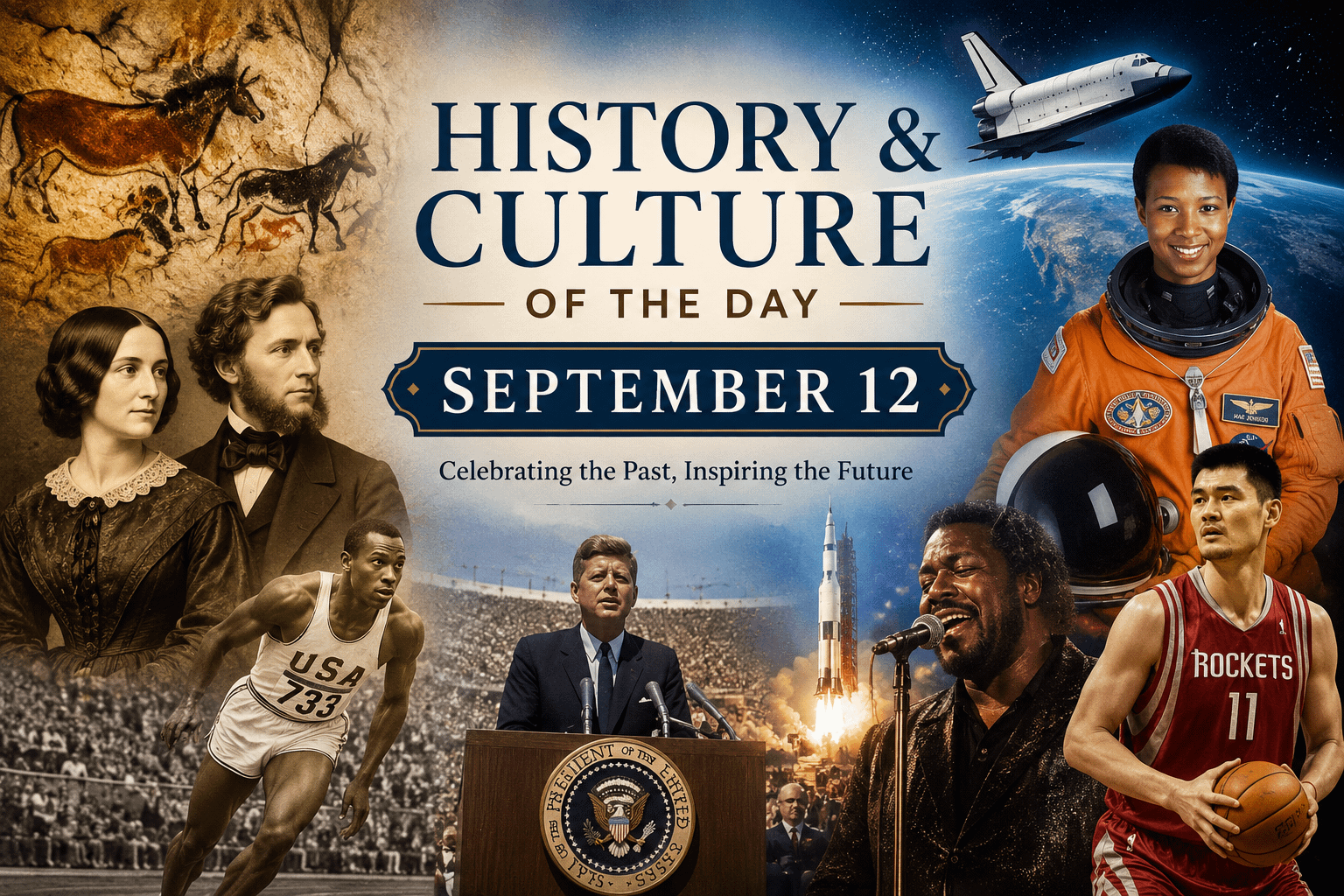
  • This Day in American History – September 10

    This Day in American History – September 10

    September 10 has witnessed moments of courage, innovation, political change, and military victory throughout American history. From a decisive naval battle during the War of 1812 to an invention that helped transform American manufacturing, the events connected to this date remind us that history is often shaped by people willing to take risks, solve problems, and persevere when the outcome is uncertain.

    One of the most important events associated with September 10 occurred on the waters of Lake Erie in 1813, when Commodore Oliver Hazard Perry and his sailors fought a battle that would become one of the most celebrated American naval victories of the War of 1812.

    Decades later, September 10 would become significant in the history of American innovation when Elias Howe received a patent for improvements to the sewing machine. The date also marked an important milestone for the newly admitted state of California when its first two U.S. senators officially took their seats.

    Together, these events offer a fascinating look at America’s military history, technological development, and political growth.

    1813 – The Battle of Lake Erie

    On September 10, 1813, American and British naval forces met on Lake Erie during the War of 1812.

    The conflict between the United States and Great Britain had begun the previous year. Control of the Great Lakes was strategically important because the waterways served as vital transportation and supply routes.

    Whoever controlled Lake Erie could move troops and supplies more effectively throughout the region.

    The United States placed Master Commandant Oliver Hazard Perry in charge of building and commanding an American naval force on Lake Erie. Perry was only 28 years old, but he would soon become one of the best-known naval heroes of his generation.

    On the morning of September 10, Perry’s squadron encountered a British fleet commanded by Captain Robert Heriot Barclay.

    According to the U.S. Naval History and Heritage Command, Perry’s force consisted of nine vessels facing six British warships.

    The battle would be fierce.

    “Don’t Give Up the Ship”

    One of the most memorable symbols of the Battle of Lake Erie was the flag flying aboard Perry’s flagship, the Lawrence.

    The banner carried the words:

    “Don’t Give Up the Ship.”

    The phrase honored Captain James Lawrence, an American naval officer who had been mortally wounded earlier in the War of 1812.

    Perry adopted Lawrence’s words as a battle cry.

    As cannon fire erupted across Lake Erie, the Lawrence became the focus of intense British fire.

    The ship suffered devastating damage and heavy casualties.

    Eventually, Perry realized that his flagship could no longer effectively continue the fight.

    But he refused to surrender.

    Instead, Perry transferred from the heavily damaged Lawrence to another American vessel, the Niagara.

    That decision helped change the course of the battle.

    Perry Turns the Battle Around

    After reaching the Niagara, Perry took command and moved aggressively against the British fleet.

    The American ships broke through the British line and unleashed devastating broadsides.

    The British vessels had already suffered significant damage, and Perry’s renewed attack overwhelmed them.

    The British squadron surrendered.

    The United States had won control of Lake Erie.

    The Naval History and Heritage Command describes the Battle of Lake Erie as a major American naval victory that helped reverse the course of the campaign in the Northwest and forced the British to abandon Detroit.

    The victory also produced one of the most famous messages in American military history.

    After the battle, Perry sent a message to Major General William Henry Harrison announcing the victory.

    He wrote:

    “We have met the enemy and they are ours.”

    Those words became permanently associated with Perry and the Battle of Lake Erie.

    Why the Battle of Lake Erie Mattered

    The victory was much more than a symbolic achievement.

    Control of Lake Erie gave American forces an important strategic advantage.

    British forces could no longer depend upon the lake as a secure supply route. The loss contributed to the British withdrawal from Detroit and helped American forces regain momentum in the region.

    General William Henry Harrison’s army later pursued retreating British and Native American forces into Canada.

    On October 5, 1813, Harrison’s forces won the Battle of the Thames, another significant American victory.

    The Lake Erie victory had helped make that campaign possible.

    Perry became a national hero, and his reputation became permanently connected with American naval history.

    Today, his famous battle flag and the words “Don’t Give Up the Ship” remain powerful symbols of determination and perseverance.

    1846 – Elias Howe Receives a Sewing Machine Patent

    September 10 also marks an important day in the history of American invention.

    On September 10, 1846, inventor Elias Howe Jr. received U.S. Patent No. 4,750 for improvements to the sewing machine.

    The development may not sound as dramatic as a naval battle, but its long-term influence on American life was enormous.

    Before mechanized sewing became widespread, producing clothing required tremendous amounts of manual labor.

    Garments were largely sewn by hand.

    A skilled person could work for hours completing stitches that a machine would eventually accomplish far more quickly.

    Howe spent years trying to develop a practical method of mechanizing the sewing process.

    According to the Smithsonian’s National Museum of American History, Howe worked as a journeyman machinist while attempting to solve the problem. His family’s financial struggles also influenced his work; his wife earned money sewing by hand, giving Howe a firsthand view of how labor-intensive sewing could be.

    In 1845, Howe built an early sewing machine and later developed an improved version.

    His machine used an eye-pointed needle and a second thread carried by a shuttle to create a lockstitch.

    On September 10, 1846, his invention received its American patent.

    Changing the Way America Made Clothing

    Howe’s machine was not the first attempt to mechanize sewing, nor would it immediately dominate the marketplace.

    Other inventors were also developing sewing machines.

    What followed was a complicated period of innovation, competition, patent disputes, and lawsuits.

    Howe eventually defended his patent rights and collected royalties from manufacturers using technology covered by his patent.

    The Smithsonian notes that in 1856, Howe and several major sewing-machine companies became part of an arrangement known as the Sewing Machine Combination, sometimes described as an early patent pool in American industry.

    The broader development of practical sewing machines helped transform clothing production.

    Tasks that once required long hours of hand stitching could increasingly be completed mechanically.

    The technology contributed to the growth of garment manufacturing while also bringing sewing machines into American homes.

    Eventually, the sewing machine became one of the most recognizable household and industrial inventions of the nineteenth century.

    The September 10 patent issued to Elias Howe therefore represents more than the story of one inventor.

    It represents America’s rapidly changing industrial landscape.

    1850 – California’s First U.S. Senators Take Office

    September 10 also played an important role in California’s early political history.

    California officially entered the Union as the 31st state on September 9, 1850, as part of the political agreements associated with the Compromise of 1850.

    Just one day later, on September 10, California’s first two United States senators presented their credentials and took the oath of office.

    They were John C. Frémont and William M. Gwin.

    According to the U.S. Senate’s historical records, both men were from San Francisco. After taking the oath, they drew lots to determine their Senate class assignments.

    It was an important step in California’s transition from a rapidly developing western territory into full participation in the federal government.

    California’s Rapid Rise

    California’s admission to the Union was extraordinary because of how rapidly the region had changed.

    The discovery of gold at Sutter’s Mill in 1848 triggered the California Gold Rush.

    Thousands upon thousands of people headed west hoping to find opportunity.

    Settlements expanded.

    San Francisco grew dramatically.

    Businesses opened to serve miners and newcomers.

    Transportation routes developed.

    The population increased rapidly enough that California soon sought statehood.

    But California’s admission became tangled in the growing national argument over slavery.

    The country was becoming increasingly divided between free states and slave states, and adding another state threatened to disrupt the political balance.

    The Compromise of 1850 attempted to address several of these disputes.

    California entered the Union as a free state.

    Its arrival gave the United States a major Pacific state and further demonstrated how quickly the nation’s center of population and economic ambition was moving westward.

    When Frémont and Gwin took their Senate oaths on September 10, California formally gained its first representation in one of the most powerful institutions of the federal government.

    John C. Frémont’s Larger Role in American History

    John C. Frémont would become an especially notable figure in American political history.

    Known for his western expeditions, Frémont became closely associated with American expansion into the West.

    Only a few years after becoming one of California’s first senators, he reached another historical milestone.

    In 1856, Frémont became the first presidential nominee of the newly formed Republican Party.

    He ultimately lost the election to Democrat James Buchanan, but his campaign demonstrated the rapid rise of the Republican Party during the growing national conflict over slavery.

    Within a few years, Abraham Lincoln would become the party’s presidential nominee and win the election of 1860.

    September 10 and the Growth of America

    When we look at these September 10 events together, a larger story begins to emerge.

    The Battle of Lake Erie in 1813 represents America’s struggle to defend itself and establish control over its territory during the nation’s early years.

    The sewing-machine patent issued to Elias Howe in 1846 represents the technological and industrial transformation that was changing how Americans worked and produced goods.

    The arrival of California’s first senators in 1850 represents America’s enormous westward expansion and the increasingly complicated political questions that expansion created.

    These stories are very different.

    One happened aboard wooden warships surrounded by cannon smoke.

    Another happened through years of experimentation by a struggling inventor.

    Another unfolded inside the halls of the United States Senate.

    Yet each helped shape the country.

    The Power of Determination

    There is also a shared theme running through much of September 10’s American history: perseverance.

    Oliver Hazard Perry watched his flagship become nearly destroyed but refused to surrender.

    Elias Howe struggled financially while spending years developing an invention that he believed could change the way people worked.

    California’s rapid transformation showed how quickly the boundaries, population, and political identity of the United States were changing during the nineteenth century.

    History rarely moves forward in a straight line.

    Progress often comes through failure, uncertainty, conflict, experimentation, and persistence.

    Sometimes the people who eventually make history have no way of knowing how important their actions will become.

    Remembering September 10

    September 10 reminds us that American history is made up of far more than presidents, elections, and famous speeches.

    It is also the history of sailors fighting aboard damaged ships.

    It is the history of inventors working in shops and experimenting with machines.

    It is the history of states entering the Union and sending representatives thousands of miles away to Washington.

    It is the history of ordinary decisions that eventually produce extraordinary consequences.

    More than two centuries after the Battle of Lake Erie, Oliver Hazard Perry’s determination remains part of American naval tradition.

    More than a century and a half after Elias Howe received his patent, mechanized sewing is so ordinary that it can be difficult to appreciate how revolutionary the technology once seemed.

    And California, whose first senators took their oaths on September 10, 1850, would grow into the most populous state in the nation and become enormously influential in American culture, agriculture, technology, entertainment, and commerce.

    That is what makes studying a single day in history so fascinating.

    One date can connect warships, inventors, politicians, industrial change, western expansion, and the continuing development of the United States.

    On September 10, we remember the people who fought, invented, represented, persevered, and helped write another chapter in the American story.

    Which September 10 event do you think had the greatest long-term impact on the United States: the Battle of Lake Erie, Elias Howe’s sewing-machine patent, or California gaining its first representation in the U.S. Senate?

  • History & Culture of the Day – September 9

    History & Culture of the Day – September 9

    Every date on the calendar carries stories from the past, and September 9 is filled with moments that have influenced politics, exploration, science, entertainment, technology, and popular culture.

    From the creation of a new American state and the birth of one of literature’s most famous writers to the rise of rock-and-roll royalty and major developments in computing, September 9 offers a fascinating look at how individual moments become part of our shared history.

    Here is a journey through some of the notable events, people, achievements, and cultural milestones associated with September 9.

    California Becomes the 31st State – 1850

    One of the most significant events in American history connected to September 9 occurred in 1850, when California officially became the 31st state of the United States.

    California’s path to statehood was accelerated dramatically by the discovery of gold at Sutter’s Mill in 1848. The California Gold Rush brought hundreds of thousands of people to the region from across the United States and around the world.

    Towns expanded almost overnight. San Francisco transformed from a relatively small settlement into a booming commercial center, while mining communities appeared throughout the Sierra Nevada foothills.

    The rapid population growth made the question of California’s political future increasingly important.

    California was admitted to the Union as a free state as part of the Compromise of 1850, a collection of laws intended to address growing tensions between free and slave states.

    Its admission changed the political balance of the country and added another layer to the national conflict over slavery that would eventually contribute to the Civil War.

    Today, September 9 is recognized in California as Admission Day, commemorating the state’s entrance into the Union.

    California would eventually become the most populous state in the country and one of the world’s most influential centers of agriculture, entertainment, technology, trade, and cultural innovation.

    The Compromise of 1850 Reshapes American Politics

    California’s admission was part of a much larger political struggle.

    On September 9, 1850, several measures associated with the Compromise of 1850 became law. The compromise attempted to resolve disputes over whether slavery would be permitted in territories acquired after the Mexican-American War.

    The measures included California’s admission as a free state and changes involving Texas and territories in the American West.

    Additional legislation connected with the compromise followed during September.

    Rather than permanently solving the nation’s disagreements over slavery, however, the compromise largely postponed the conflict.

    Within little more than a decade, the United States would be engulfed in the Civil War.

    September 9 therefore represents not only California’s beginning as a state but also an important chapter in the complicated political events leading toward one of the defining periods in American history.

    Washington, D.C., Is Named for George Washington – 1791

    Another important American milestone occurred on September 9, 1791, when commissioners overseeing the creation of the new federal capital announced that the city would be called Washington, honoring President George Washington.

    The surrounding federal district became known as the District of Columbia.

    The establishment of a permanent national capital had been authorized through the Residence Act of 1790.

    George Washington selected an area along the Potomac River for the new federal district.

    French-born engineer and architect Pierre Charles L’Enfant developed an ambitious plan for the city featuring broad avenues, public spaces, and monumental government buildings.

    Washington, D.C., would eventually become one of the world’s most recognizable capital cities.

    Today it is home to the White House, United States Capitol, Supreme Court, Smithsonian museums, national monuments, memorials, and countless institutions representing American government and history.

    The name announced in 1791 remains permanently connected with the nation’s first president.

    Leo Tolstoy Is Born – 1828

    September 9 is also the birthday of one of the most influential writers in world literature.

    Leo Tolstoy was born on September 9, 1828, according to the modern Gregorian calendar, at Yasnaya Polyana in the Russian Empire.

    Tolstoy became internationally famous for novels exploring human relationships, morality, war, society, faith, and the meaning of life.

    His best-known works include:

    • War and Peace
    • Anna Karenina
    • The Death of Ivan Ilyich
    • Resurrection

    War and Peace remains one of literature’s most celebrated novels, blending fictional characters with historical events surrounding Napoleon’s invasion of Russia.

    Tolstoy’s influence extended far beyond literature.

    Later in life, his writings increasingly focused on religion, nonviolence, morality, social inequality, and resistance to oppression.

    His philosophy of nonviolent resistance influenced future leaders and activists around the world.

    More than a century after his death, Tolstoy’s novels continue to be read, studied, translated, adapted, and debated.

    Colonel Sanders Is Born – 1890

    One of the most recognizable figures in American food culture was born on September 9, 1890.

    Harland David Sanders, better known as Colonel Sanders, was born near Henryville, Indiana.

    His life is particularly remarkable because his greatest business success came relatively late.

    Sanders worked numerous jobs throughout his life before becoming known for serving fried chicken at a roadside restaurant in Kentucky.

    He developed a distinctive method of preparing chicken and promoted a recipe featuring a secret blend of herbs and spices.

    Instead of building restaurants entirely on his own, Sanders traveled around the country offering restaurant owners the opportunity to sell chicken using his recipe in exchange for a franchise fee or royalty arrangement.

    That approach helped create what eventually became Kentucky Fried Chicken, better known worldwide as KFC.

    Colonel Sanders became the public face of the company.

    His white suit, black string tie, white hair, and goatee became instantly recognizable elements of American advertising.

    His story also became an enduring example of achieving significant success later in life.

    The First Computer “Bug” Becomes a Famous Technology Story – 1947

    September 9 has an unusual place in computer history because of one of technology’s most famous stories.

    On September 9, 1947, engineers working with the Harvard Mark II computer documented a moth discovered inside part of the machine.

    The insect had become trapped in a relay and was taped into a logbook with a note referring to it as the “first actual case of bug being found.”

    The incident is frequently associated with computer pioneer Grace Hopper, although she did not personally coin the term “bug.”

    The word had already been used for years to describe technical or mechanical problems.

    What made the Mark II incident memorable was that engineers had literally found an insect inside the computer.

    The story became part of computing folklore.

    Today, programmers routinely use the terms bug and debugging when referring to errors in software and the process of correcting them.

    The moth incident remains a humorous reminder of the early days of computing, when computers filled entire rooms and mechanical components could sometimes be disrupted by something as small as an insect.

    Elvis Presley Makes His First Appearance on The Ed Sullivan Show – 1956

    American popular culture experienced an unforgettable television moment on September 9, 1956.

    That evening, Elvis Presley appeared for the first time on The Ed Sullivan Show.

    Elvis was already becoming a sensation among young audiences, but his television appearances helped transform him into a national cultural phenomenon.

    His energetic performance style, distinctive voice, fashion, and stage presence represented a dramatic shift from many mainstream entertainers of the era.

    Millions of viewers reportedly watched the broadcast.

    Interestingly, Ed Sullivan himself was recovering from injuries suffered in an automobile accident, so actor Charles Laughton served as guest host.

    Elvis performed from Hollywood rather than appearing in the New York studio.

    His appearance represented more than simply another television performance.

    It demonstrated the growing power of television to create national celebrities almost instantly.

    Elvis would become one of the most influential performers in popular music history and a defining figure in the development of rock and roll.

    The Cultural Revolution of Rock and Roll

    The rise of Elvis Presley reflected broader changes occurring throughout American society during the 1950s.

    Rock and roll combined influences from rhythm and blues, country music, gospel, and other musical traditions.

    Young listeners embraced the new sound enthusiastically.

    Parents, broadcasters, religious leaders, and cultural critics sometimes viewed the music with suspicion because it challenged traditional expectations surrounding entertainment, youth behavior, fashion, and race.

    Television accelerated the cultural transformation.

    A performance that once might have reached hundreds or thousands of people in a concert venue could suddenly be watched by millions of families across the country.

    Elvis’ September 9 appearance became one of the clearest examples of television’s growing ability to shape American popular culture.

    The Beatles Reach America Through Their Music – 1963

    September 9 also has a connection with another group that transformed popular music.

    In 1963, the Beatles’ recording of “She Loves You” was released as a single in the United States by Swan Records.

    At the time, the song initially received relatively little attention from American audiences.

    That situation would change dramatically.

    By early 1964, Beatlemania had crossed the Atlantic, and the Beatles became one of the biggest musical sensations in American history.

    Their arrival helped launch the British Invasion, during which numerous British rock groups became enormously popular in the United States.

    The Beatles influenced music, fashion, hairstyles, youth culture, songwriting, recording techniques, and attitudes toward celebrity.

    The early American release of “She Loves You” offers an interesting reminder that cultural revolutions do not always become obvious immediately.

    Sometimes history-changing trends begin quietly.

    The Sony PlayStation Launches in North America – 1995

    A major moment in video game culture occurred on September 9, 1995, when Sony released the original PlayStation in North America.

    The console entered a competitive gaming market dominated by established companies such as Nintendo and Sega.

    Sony’s PlayStation helped push gaming further into the era of three-dimensional graphics and CD-based games.

    The system became associated with popular franchises and titles including Final Fantasy VII, Resident Evil, Metal Gear Solid, Gran Turismo, Crash Bandicoot, and Tekken.

    The PlayStation brand eventually became one of the most successful names in video gaming.

    Its arrival also reflected a larger cultural shift.

    Video games were becoming more than children’s entertainment. Gaming increasingly developed into a mainstream entertainment industry attracting teenagers and adults as well as younger players.

    Today, the video game industry rivals or exceeds many traditional entertainment industries in cultural and economic influence.

    Adam Sandler Is Born – 1966

    Actor, comedian, writer, and producer Adam Sandler was born on September 9, 1966, in Brooklyn, New York.

    Sandler became widely known during the early 1990s as a cast member on Saturday Night Live.

    He later became one of Hollywood’s most commercially successful comedy stars.

    His films include:

    • Billy Madison
    • Happy Gilmore
    • The Wedding Singer
    • The Waterboy
    • Big Daddy
    • 50 First Dates
    • Grown Ups

    While best known for comedy, Sandler has also received praise for dramatic performances in movies such as Punch-Drunk Love, Uncut Gems, and Hustle.

    His career demonstrates the lasting influence of comedy on American popular culture, particularly during the 1990s and 2000s.

    Michael Bublé Is Born – 1975

    Canadian singer Michael Bublé was born on September 9, 1975, in Burnaby, British Columbia.

    Bublé became internationally known for blending traditional pop standards, jazz influences, and contemporary music.

    His success helped introduce classic songs and big-band-inspired arrangements to younger generations.

    His recordings of standards associated with artists such as Frank Sinatra, Dean Martin, and Tony Bennett helped renew interest in traditional pop music during the 2000s.

    Bublé has also become closely associated with Christmas music, with his holiday recordings becoming seasonal favorites around the world.

    Hugh Grant Is Born – 1960

    British actor Hugh Grant, born September 9, 1960, became one of the most recognizable romantic-comedy actors of the 1990s and early 2000s.

    His international breakthrough came with Four Weddings and a Funeral.

    He later appeared in films including Notting Hill, Bridget Jones’s Diary, Love Actually, and About a Boy.

    Grant’s performances helped define the modern British romantic comedy and made him an internationally recognized figure in film culture.

    Later in his career, he increasingly moved toward darker, comedic, and character-driven roles.

    Otis Redding Is Born – 1941

    Soul music legend Otis Redding was born on September 9, 1941, in Dawson, Georgia.

    Redding became one of the defining voices of 1960s soul music.

    His passionate singing style influenced generations of performers.

    Among his most famous recordings are Try a Little Tenderness, I’ve Been Loving You Too Long, and (Sittin’ On) The Dock of the Bay.

    Tragically, Redding died in a plane crash in December 1967 at only 26 years old.

    “(Sittin’ On) The Dock of the Bay” was released after his death and became one of his most enduring recordings.

    Despite his short career, Redding left an extraordinary musical legacy and remains one of the most respected performers in American soul music history.

    Why September 9 Matters

    September 9 connects remarkably different chapters of history.

    It represents the expansion of the United States through California statehood.

    It recalls the establishment of Washington, D.C.’s identity as the nation’s capital.

    It marks the birth of literary greatness through Leo Tolstoy.

    It celebrates cultural figures ranging from Colonel Sanders and Otis Redding to Hugh Grant, Adam Sandler, and Michael Bublé.

    It reminds us of the transformation of American popular culture through Elvis Presley and rock and roll.

    It even connects with the evolution of technology through the famous computer moth of 1947 and the arrival of the Sony PlayStation in North America in 1995.

    Each event belongs to a different world, yet together they illustrate something important about history.

    History is not created only through wars, presidents, and political decisions.

    It is also created through books people read, music they dance to, inventions they use, foods they share, movies they watch, games they play, and ideas that change how society thinks.

    September 9 Through the Years

    Here is a quick look at several notable September 9 milestones:

    1791 – The name Washington is selected for the new federal capital of the United States.

    1828 – Russian author Leo Tolstoy is born.

    1850 – California becomes the 31st state of the United States.

    1890 – Harland “Colonel” Sanders is born.

    1941 – Soul singer Otis Redding is born.

    1947 – A moth found in the Harvard Mark II computer becomes part of the famous story behind the term “computer bug.”

    1956 – Elvis Presley makes his first appearance on The Ed Sullivan Show.

    1960 – Actor Hugh Grant is born.

    1963 – The Beatles’ “She Loves You” is released in the United States by Swan Records.

    1966 – Actor and comedian Adam Sandler is born.

    1975 – Singer Michael Bublé is born.

    1995 – Sony launches the original PlayStation in North America.

    A Day Connecting Politics, Literature, Music, Technology, and Entertainment

    Few things demonstrate the richness of history better than looking closely at a single date.

    September 9 contains stories stretching from America’s earliest years as a nation to the modern digital entertainment era.

    The political decisions of 1791 and 1850 helped shape the physical and political landscape of the United States.

    The literary achievements of Tolstoy influenced generations of readers.

    The music of Otis Redding, Elvis Presley, the Beatles, and Michael Bublé reflects how musical styles continuously evolve while borrowing inspiration from earlier generations.

    The computer moth of 1947 represents the beginnings of a technological revolution that would eventually transform almost every part of modern life.

    And the arrival of the PlayStation in 1995 shows how rapidly new forms of entertainment can become major parts of global culture.

    Final Thoughts

    History is often remembered through enormous events, but culture is built through countless moments—some political, some technological, some artistic, and some simply entertaining.

    September 9 reminds us that history and culture are constantly being created together.

    A state joining the Union can reshape a nation.

    A writer can influence generations through words.

    A singer appearing on television can help redefine popular culture.

    A moth trapped inside a computer can become part of technology folklore.

    And a new video game console can help transform how millions of people experience entertainment.

    Looking back at September 9 gives us more than a collection of interesting facts. It provides a snapshot of how politics, creativity, innovation, music, literature, entertainment, and everyday life combine to create the larger story of human history.

    Which September 9 moment do you think had the greatest influence on the world we live in today?
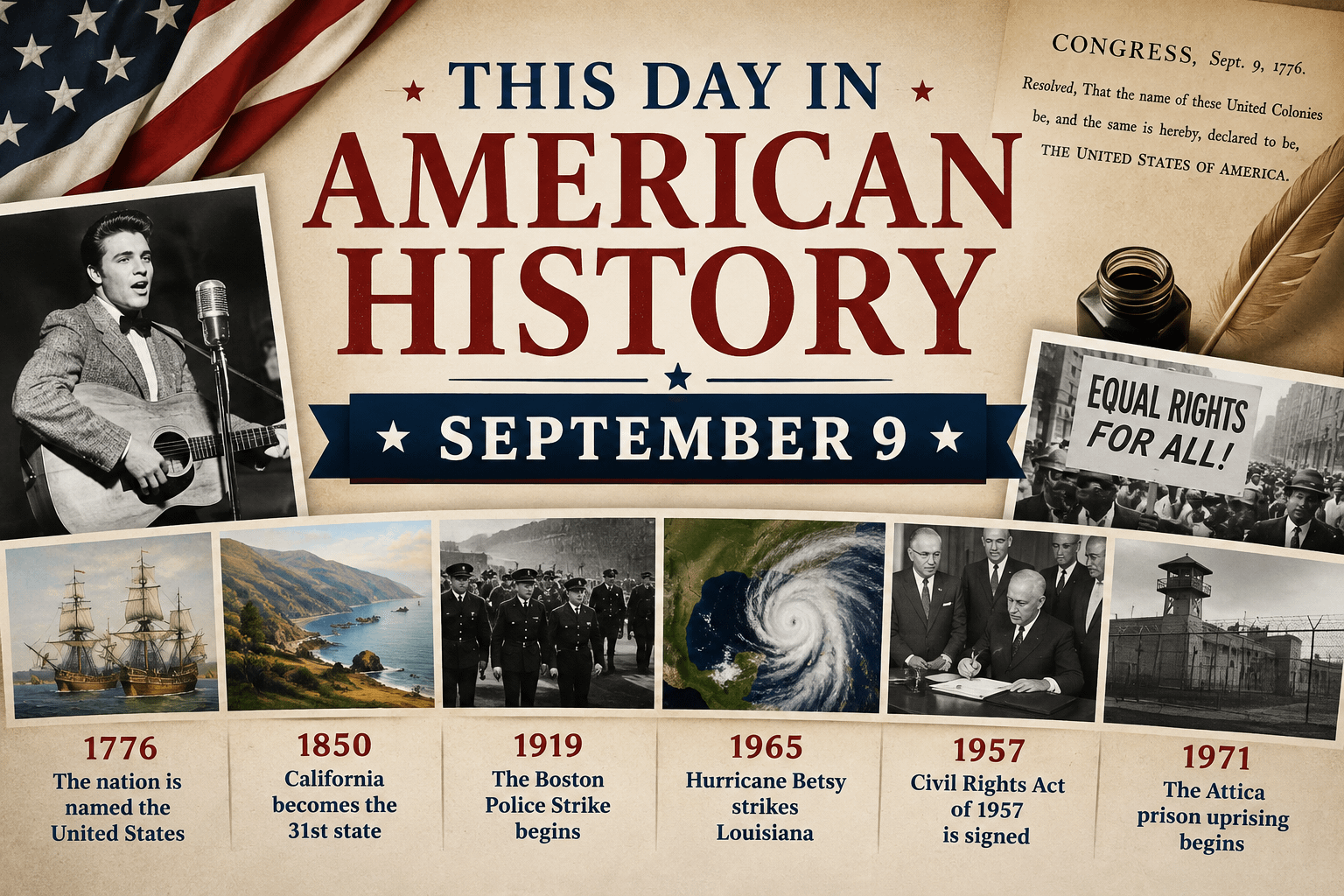
  • This Day in American History – September 9

    This Day in American History – September 9

    September 9 has witnessed moments that helped define the United States politically, culturally, and socially. From the young nation officially adopting the name “United States” during the American Revolution to California becoming the 31st state, Elvis Presley transforming popular culture on national television, landmark civil rights legislation, and the beginning of the Attica prison uprising, this date offers a fascinating look at the forces that have shaped America.

    History is more than a collection of dates. Each event represents people making decisions, confronting challenges, and sometimes changing the direction of the country. On September 9, those changes have ranged from the very name Americans use for their nation to the music they listen to and the laws designed to protect their rights.

    1776 – The Nation Becomes the “United States”

    One of the most important September 9 events occurred during the American Revolution.

    On September 9, 1776, the Continental Congress formally changed the terminology used to describe the newly independent nation. Instead of referring to the former British colonies collectively as the “United Colonies,” Congress directed that official documents use the name “United States.”

    The change came only a little more than two months after the Declaration of Independence had been adopted on July 4, 1776.

    The colonies were no longer simply British territories cooperating in a rebellion. They were attempting to establish themselves as independent states joined together in a new political experiment.

    The new name reflected that transformation.

    The words United States of America would eventually become recognized around the world, but in September 1776, the country bearing that name was still fighting for its survival.

    George Washington and the Continental Army faced one of the world’s strongest military powers. Independence had been declared, but victory was far from guaranteed.

    That makes the September 9 decision especially meaningful. America’s founders were not waiting until the war was won to begin defining their new country. They were already building the identity of the nation they hoped would survive.

    Today, the name seems permanent and inevitable. In 1776, however, it represented an extraordinary declaration of confidence in America’s future.

    1850 – California Becomes the 31st State

    Another defining moment occurred on September 9, 1850, when California officially entered the Union as the 31st state.

    California’s admission was part of the broader Compromise of 1850, a collection of measures designed to address growing national disagreements over slavery and the status of territories acquired after the Mexican-American War.

    California entered the Union as a free state, meaning slavery would not be permitted there.

    The decision had national consequences because the balance between free states and slave states was one of the most politically explosive issues of the era.

    California itself was also undergoing an extraordinary transformation.

    The discovery of gold at Sutter’s Mill in 1848 triggered the California Gold Rush. Thousands of people traveled west hoping to find wealth and opportunity.

    Communities expanded rapidly. San Francisco grew dramatically, businesses appeared to serve miners and settlers, and people arrived from across the United States and around the world.

    The population increase accelerated California’s path toward statehood.

    California would eventually become America’s most populous state and one of the world’s largest economic centers, playing major roles in agriculture, entertainment, technology, aerospace, international trade, and countless other industries.

    Yet its official journey as a state began on September 9, 1850.

    1919 – The Boston Police Strike Begins

    On September 9, 1919, most members of the Boston Police Department went on strike.

    Police officers had been seeking improvements in wages and working conditions and wanted greater freedom to organize.

    When hundreds of officers walked off the job, Boston suddenly faced a serious public safety crisis.

    Looting and disorder occurred in parts of the city, and Massachusetts Governor Calvin Coolidge eventually called in the state militia.

    Coolidge’s response gained national attention.

    The controversy surrounding the strike helped establish his reputation as a politician willing to take a firm position during a public emergency. His growing national profile contributed to his selection as Warren G. Harding’s running mate in the 1920 presidential election.

    Coolidge became vice president and later became president following Harding’s death in 1923.

    The Boston Police Strike became part of the broader labor struggles occurring throughout the United States after World War I.

    The country was experiencing economic uncertainty, inflation, labor disputes, political tensions, and fears surrounding radical political movements.

    September 9, 1919, therefore represents more than a dispute involving one city’s police department. It reflects a period when Americans were debating the power of organized labor and the responsibilities of public employees.

    1942 – A Japanese Aircraft Bombs the Continental United States

    World War II brought another unusual chapter to September 9 history.

    On September 9, 1942, a Japanese aircraft launched from a submarine attempted to start forest fires in Oregon.

    The attack became notable because it represented one of the rare occasions during World War II when the continental United States was bombed by an enemy aircraft.

    Japan hoped incendiary bombs dropped over forests could ignite large fires that would consume resources and create fear.

    The attack caused limited damage and failed to produce the devastating fires planners had hoped for.

    Nevertheless, it demonstrated that the Pacific War could occasionally reach the American mainland.

    For Americans living along the West Coast during World War II, the possibility of attack was a genuine concern. Coastal communities maintained blackouts and other defensive measures while military officials prepared for the possibility of further attacks.

    1956 – Elvis Presley Takes Over American Television

    American history isn’t shaped only by presidents, wars, and legislation. Culture can transform a country too.

    On September 9, 1956, 21-year-old Elvis Presley made his first appearance on The Ed Sullivan Show.

    It became one of the most famous television appearances in American popular culture.

    An estimated 60 million viewers watched the broadcast, giving Presley exposure to an enormous national audience.

    Interestingly, Ed Sullivan himself wasn’t there.

    Sullivan was recovering from injuries suffered in a serious automobile accident, so actor Charles Laughton served as guest host.

    Presley performed remotely from Los Angeles, where he was working on his first movie, Love Me Tender.

    During the program, Elvis performed songs including “Don’t Be Cruel,” “Ready Teddy,” “Love Me Tender,” and “Hound Dog.”

    His energetic performance style fascinated younger viewers while alarming some older Americans.

    Rock and roll represented something different.

    It was louder, more energetic, and more rebellious than much of the mainstream popular music that had dominated American entertainment.

    Elvis became one of the performers who brought that cultural transformation directly into millions of American homes.

    His September 9 appearance wasn’t the beginning of his career, but it dramatically expanded his national visibility.

    Elvis would become one of the most recognizable entertainers in American history, and rock and roll would permanently transform popular music.

    1957 – Eisenhower Signs the Civil Rights Act of 1957

    Exactly one year after Elvis Presley’s historic television appearance, September 9 witnessed an important moment in the American civil rights movement.

    On September 9, 1957, President Dwight D. Eisenhower signed the Civil Rights Act of 1957.

    It was the first major federal civil rights legislation enacted since Reconstruction.

    The legislation focused heavily on protecting voting rights.

    African Americans, particularly in the South, faced numerous barriers designed to prevent them from registering and voting. These could include literacy tests, intimidation, discriminatory registration practices, economic retaliation, and violence.

    The Civil Rights Act of 1957 created a Civil Rights Division within the Department of Justice and represented renewed federal involvement in protecting civil rights.

    The law was limited compared with the sweeping legislation that would follow during the 1960s.

    However, its importance was partly symbolic.

    After decades in which the federal government had largely failed to confront systematic discrimination, Congress had again passed major civil rights legislation.

    The struggle continued.

    The Civil Rights Act of 1964 and Voting Rights Act of 1965 would later become far stronger tools for combating racial discrimination and protecting voting rights.

    The legislation signed on September 9, 1957, helped establish momentum toward those future changes.

    1965 – The Department of Housing and Urban Development Is Established

    September 9 also played a role in the expansion of America’s federal government during the 1960s.

    In 1965, the United States established the Department of Housing and Urban Development, commonly known as HUD.

    Its creation came during President Lyndon B. Johnson’s administration and his broader Great Society agenda.

    American cities were changing rapidly.

    Urban poverty, housing discrimination, deteriorating neighborhoods, transportation problems, and suburban expansion were becoming major political issues.

    Creating a cabinet-level department focused on housing and urban development reflected the federal government’s increasing involvement in addressing those challenges.

    HUD would eventually oversee programs involving affordable housing, community development, housing assistance, and fair housing protections.

    1965 – Hurricane Betsy Strikes Louisiana

    September 9, 1965, also brought tragedy to the Gulf Coast.

    Hurricane Betsy made landfall near New Orleans as a powerful hurricane, producing devastating winds, flooding, and storm surge.

    The storm became historically significant for the enormous economic destruction it caused.

    Betsy became the first hurricane in United States history to cause more than $1 billion in damage without adjusting for inflation, earning it the nickname “Billion-Dollar Betsy.”

    Large sections of New Orleans flooded after levees failed or were overtopped.

    Thousands of homes were damaged or destroyed, and communities across Louisiana faced a long recovery.

    Hurricane Betsy became an important event in the history of American disaster response and Gulf Coast hurricane preparedness.

    Four decades later, Hurricane Katrina would once again demonstrate the extraordinary vulnerability of New Orleans and surrounding communities to powerful storms.

    1966 – A Major Step Toward Safer American Cars

    On September 9, 1966, President Lyndon B. Johnson signed the National Traffic and Motor Vehicle Safety Act.

    The legislation represented a major change in America’s approach to automobile safety.

    By the 1960s, cars had become essential to American life. Interstate highways expanded, suburban communities grew, and millions of Americans depended on automobiles every day.

    But traffic deaths were also a serious national problem.

    The new legislation gave the federal government greater authority to establish vehicle safety standards.

    Over time, federal safety requirements helped influence the development and widespread adoption of features designed to protect drivers and passengers.

    Automobile safety continued evolving through improvements involving seat belts, crash protection, airbags, braking systems, child restraints, vehicle construction, and other technologies.

    The law signed in 1966 helped establish the principle that automobile manufacturers had an obligation to meet national safety standards.

    1971 – The Attica Prison Uprising Begins

    One of the darkest events associated with September 9 began in 1971 at Attica Correctional Facility in New York.

    Prisoners took control of significant portions of the maximum-security prison and held 42 staff members hostage while demanding improvements in prison conditions and treatment.

    The uprising developed amid longstanding complaints involving living conditions, racial tensions, medical treatment, religious freedom, and prisoners’ rights.

    Negotiations continued for several days.

    On September 13, New York authorities ordered the prison retaken.

    The operation ended catastrophically.

    Thirty-nine people were killed during the retaking of the prison, including prisoners and hostages.

    Attica became one of the most controversial episodes in the history of the American prison system.

    The words “Attica” and “Remember Attica” eventually became cultural references associated with prisoners’ rights, government authority, and demands for criminal justice reform.

    More than five decades later, the uprising remains an important part of discussions surrounding incarceration and prison conditions in the United States.

    September 9 and the Changing Story of America

    Few dates demonstrate the diversity of American history quite like September 9.

    The events associated with this date reach into politics, geography, entertainment, civil rights, transportation, natural disasters, labor relations, and criminal justice.

    In 1776, Americans officially began calling their new nation the United States.

    In 1850, California became the 31st state.

    In 1919, the Boston Police Strike became a national controversy surrounding labor and public safety.

    In 1956, Elvis Presley entered millions of American living rooms and helped accelerate a cultural revolution.

    In 1957, the federal government took an important step toward renewed civil rights enforcement.

    During the 1960s, Americans confronted questions involving housing, urban development, automobile safety, and natural disasters.

    And in 1971, the Attica prison uprising forced the nation to confront difficult questions about incarceration, authority, and prisoners’ rights.

    These events might appear unrelated, but together they demonstrate how American history develops.

    Some changes happen through laws.

    Others happen through war, migration, protest, tragedy, technology, or culture.

    Sometimes a decision made in a government chamber changes the country. Other times, a young singer standing in front of a television camera changes it.

    Why September 9 Matters

    Perhaps the most fitting event associated with September 9 is the one that happened first.

    On September 9, 1776, Americans officially began using the words “United States” to describe their new nation.

    At that moment, no one could have known exactly what those United States would become.

    The country would expand across a continent. New states such as California would join the Union. Americans would endure civil war, economic crises, social movements, natural disasters, political conflict, and dramatic cultural transformations.

    Generations would continually debate what America’s founding ideals should mean and who should fully benefit from them.

    That story continues today.

    September 9 reminds us that the United States has never been a finished project. American history is a continuing story shaped by people who challenged existing systems, created new ideas, demanded change, entertained millions, survived disasters, and attempted to build something better for the generations that followed.

    History allows us to see not only where America has been, but how decisions made decades or centuries ago continue to influence the country today.

    Which September 9 moment do you think had the greatest impact on the course of American history?