Category: History & Culture

  • History & Culture of the Day – September 18

    History & Culture of the Day – September 18

    September 18 is a date filled with fascinating moments in world history, cultural milestones, political developments, scientific achievements, and unforgettable people. Like every day on the calendar, it carries stories that stretch across centuries and continents.

    From the Roman Empire to the development of modern institutions, September 18 reminds us that history is not simply a collection of dates. It is the story of people—their ambitions, discoveries, conflicts, creativity, and determination to shape the world around them.

    Here is a look at some of the history and culture connected to September 18.

    96 AD – Emperor Domitian Is Assassinated

    One of the earliest major historical events associated with September 18 occurred in ancient Rome.

    On September 18, 96 AD, Roman Emperor Domitian was assassinated after approximately 15 years in power.

    Domitian had become emperor in 81 AD and was the final ruler of the Flavian dynasty. His reign was complicated. He strengthened the Roman economy, supported construction projects, and reinforced the empire’s borders, but his increasingly authoritarian style created powerful enemies.

    A conspiracy eventually formed within the imperial court.

    Domitian was assassinated in his palace, bringing his reign to a sudden end.

    Following his death, Nerva became emperor. His accession began the period traditionally associated with the rulers known as the Five Good Emperors.

    The event demonstrates one of the recurring realities of Roman history: enormous political power could come with enormous personal danger.

    1502 – Christopher Columbus Reaches Costa Rica

    During his fourth and final voyage to the Americas, Christopher Columbus reached the coast of what is now Costa Rica in September 1502, traditionally associated with September 18.

    Columbus had departed Spain earlier that year in another attempt to explore the region and search for a passage connecting the Atlantic to waters leading toward Asia.

    The voyage took him along portions of the Central American coastline.

    For Europeans, these expeditions expanded geographical knowledge of the Americas. For Indigenous peoples already living throughout the region, however, European exploration represented the beginning of profound and often devastating changes.

    Disease, colonization, forced labor, warfare, and cultural disruption would transform communities throughout the Americas.

    Today, the voyages of Columbus are therefore examined from a broader historical perspective—one that considers European exploration alongside the experiences of the Indigenous civilizations whose lands were being entered and eventually colonized.

    1759 – Quebec Surrenders During the Seven Years’ War

    September 18, 1759, marked an important moment in the struggle between Britain and France for control of North America.

    Following the Battle of the Plains of Abraham near Quebec City several days earlier, French forces surrendered Quebec to the British.

    The battle itself had taken place on September 13.

    Both commanding generals—British Major General James Wolfe and French commander Louis-Joseph de Montcalm—were mortally wounded.

    The surrender of Quebec was a major turning point in the North American theater of the Seven Years’ War, often known in American history as the French and Indian War.

    British control of Canada would eventually be formalized through the Treaty of Paris in 1763.

    The consequences extended far beyond the battlefield.

    The changing balance of power in North America helped create new tensions between Britain and its American colonies. Those tensions would eventually contribute to the conditions surrounding the American Revolution.

    1793 – George Washington Lays the U.S. Capitol Cornerstone

    September 18 also has an important place in American architectural and political history.

    On September 18, 1793, President George Washington participated in the ceremony laying the cornerstone of the United States Capitol in Washington, D.C.

    The young United States was still establishing the physical institutions that would represent its new government.

    Washington, D.C., had been selected as the permanent national capital, and the Capitol would become the home of the United States Congress.

    Construction took years, and the building would undergo numerous expansions, renovations, and restorations throughout American history.

    It would also survive one of the most dramatic moments in the nation’s early history.

    During the War of 1812, British troops burned portions of Washington in 1814, including the Capitol.

    The structure was rebuilt and expanded.

    Today, the U.S. Capitol is one of the most recognizable symbols of American representative government.

    Its history began, in part, with that cornerstone ceremony on September 18, 1793.

    1810 – Chile Begins Its Path Toward Independence

    September 18 is one of the most important dates in Chilean history.

    On September 18, 1810, Chile established its First Government Junta.

    Although Chile would not immediately achieve full independence from Spain, the event became a crucial step in the country’s independence movement.

    September 18 eventually became associated with Chile’s national celebration known as Fiestas Patrias.

    The celebration extends beyond politics and history.

    It is deeply connected to Chilean culture.

    Families and communities celebrate with traditional foods, music, dancing, festivals, rodeos, and gatherings.

    The cueca, Chile’s national dance, is an important part of the festivities.

    Traditional foods such as empanadas are also closely associated with the celebration.

    For Chileans, September 18 is therefore both a historical anniversary and a celebration of national identity.

    1851 – The First Issue of The New-York Daily Times Is Published

    September 18 has an important connection to journalism.

    On September 18, 1851, the first issue of The New-York Daily Times was published.

    The newspaper was founded by Henry Jarvis Raymond and George Jones.

    Its name would later be shortened to The New York Times.

    Over the decades, the publication became one of the world’s most influential newspapers, covering wars, elections, economic changes, scientific discoveries, cultural movements, and major international events.

    The newspaper’s history also reflects the transformation of journalism itself.

    Newspapers once depended almost entirely on printed editions delivered to homes, businesses, and newsstands. Modern journalism increasingly operates through websites, mobile applications, podcasts, video, newsletters, and social media.

    The tools have changed dramatically.

    The basic purpose of journalism—informing people about events affecting their communities and the wider world—remains essential.

    1870 – Old Faithful Receives Its Famous Name

    September 18 also has a connection to one of America’s most famous natural landmarks.

    During the Washburn-Langford-Doane Expedition of 1870, members of the expedition encountered the spectacular geyser that would become known as Old Faithful.

    The geyser was given its famous name because of the apparent regularity of its eruptions.

    Old Faithful is located in what is now Yellowstone National Park.

    Two years later, in 1872, Yellowstone became the world’s first national park.

    Today, Old Faithful remains one of Yellowstone’s best-known attractions.

    Its powerful eruptions provide visitors with a visible reminder of the enormous geothermal forces beneath Yellowstone.

    1895 – Booker T. Washington Delivers the Atlanta Exposition Address

    On September 18, 1895, educator and leader Booker T. Washington delivered one of the most famous speeches of his career at the Cotton States and International Exposition in Atlanta, Georgia.

    The speech became known as the Atlanta Exposition Address.

    Washington was one of the most prominent Black leaders in the United States during the late 19th and early 20th centuries.

    Born into slavery, he eventually became an educator and the influential leader of the Tuskegee Institute.

    His approach emphasized education, vocational training, economic advancement, and institution-building.

    However, his strategy toward racial discrimination became the subject of significant debate.

    Critics, including W.E.B. Du Bois, argued that African Americans should demand immediate political and civil rights rather than accommodate segregation and discrimination.

    The disagreement became one of the most important debates in African American political thought during the era.

    Washington’s September 18 speech therefore remains significant not only for what he said but also for the larger national discussion it helped shape.

    1927 – The Columbia Broadcasting System Begins a New Era

    September 18, 1927, is associated with the launch of the radio network that would become the Columbia Broadcasting System—better known as CBS.

    Radio was rapidly transforming American culture during the 1920s.

    For the first time, millions of people could experience news, entertainment, music, sports, comedy, and drama almost simultaneously from their homes.

    Radio created shared national experiences.

    Families gathered around their radios to hear presidential speeches, baseball games, comedy programs, breaking news, and popular music.

    CBS eventually expanded beyond radio into television and became one of the major broadcasting networks in the United States.

    The growth of national broadcasting fundamentally changed entertainment, advertising, politics, journalism, and popular culture.

    1947 – The United States Air Force Is Established

    September 18 is especially significant in American military history.

    On September 18, 1947, the United States Air Force officially became an independent branch of the U.S. Armed Forces.

    Military aviation had already played an enormous role during World War II.

    Aircraft had become essential for reconnaissance, transportation, strategic bombing, air defense, and battlefield operations.

    After the war, American leaders recognized that air power would be increasingly important in national defense.

    The National Security Act of 1947 reorganized the country’s military and national security structure, and the Air Force became a separate military service.

    September 18 is now recognized as the birthday of the United States Air Force.

    1960 – Fidel Castro Arrives in New York

    On September 18, 1960, Cuban leader Fidel Castro arrived in New York City ahead of the United Nations General Assembly.

    His visit became one of the most memorable political episodes of the early Cold War.

    The Cuban Revolution had brought Castro to power the previous year.

    Relations between Cuba and the United States were rapidly deteriorating as Cuba moved closer to the Soviet Union.

    Castro and the Cuban delegation eventually stayed at the Hotel Theresa in Harlem, where he met with several prominent figures, including Malcolm X.

    The episode demonstrated how international politics, race, revolutionary movements, and Cold War diplomacy could intersect within a single highly publicized visit.

    1970 – The Death of Jimi Hendrix

    September 18 is also remembered as a sad day in music history.

    On September 18, 1970, legendary guitarist Jimi Hendrix died in London at only 27 years old.

    Despite his remarkably short recording career, Hendrix transformed the possibilities of the electric guitar.

    His performances combined blues, rock, psychedelic music, distortion, feedback, and experimental techniques in ways audiences had rarely heard before.

    His performance at the 1969 Woodstock festival became especially famous, including his unconventional interpretation of “The Star-Spangled Banner.”

    Hendrix’s influence extended far beyond his own generation.

    Rock, blues, metal, funk, and experimental guitarists continue to study and draw inspiration from his playing.

    His death at such a young age remains one of rock music’s great tragedies.

    1975 – Patty Hearst Is Captured

    On September 18, 1975, newspaper heiress Patty Hearst was captured by the FBI after more than a year as a fugitive.

    Hearst had been kidnapped in 1974 by the Symbionese Liberation Army, a radical militant group.

    The case soon became one of the strangest and most heavily publicized criminal stories in American history.

    After her kidnapping, Hearst appeared to participate in activities with her captors, including a bank robbery.

    Her case sparked intense debates over coercion, psychological manipulation, trauma, personal responsibility, and what would later commonly be discussed in relation to concepts such as Stockholm syndrome.

    She was convicted of bank robbery in 1976.

    President Jimmy Carter later commuted her sentence, and President Bill Clinton granted her a pardon in 2001.

    The case continues to fascinate historians, psychologists, journalists, and true-crime audiences.

    1977 – Voyager 1 Captures an Historic View of Earth and the Moon

    The Voyager missions represent one of humanity’s greatest achievements in space exploration.

    Voyager 1 had launched on September 5, 1977, beginning an extraordinary journey through the outer solar system.

    Later that month, on September 18, Voyager 1 captured an image showing Earth and the Moon together.

    At the time, seeing our planet and its natural satellite together from such a distant perspective was extraordinary.

    Voyager 1 would continue traveling outward, eventually exploring Jupiter and Saturn before heading toward interstellar space.

    Decades after its launch, the spacecraft’s journey has continued to symbolize human curiosity.

    Voyager represents something deeply cultural as well as scientific—the desire to discover what exists beyond the world we know.

    2001 – The Anthrax Attacks Begin

    Just one week after the September 11 terrorist attacks, another frightening chapter began in the United States.

    On September 18, 2001, letters containing anthrax spores were mailed to several media organizations.

    Additional letters were later sent to two U.S. senators.

    Five people died, and 17 others became ill.

    The attacks intensified an already overwhelming atmosphere of fear following September 11.

    Government buildings and postal facilities adopted new security procedures, while Americans became increasingly concerned about the possibility of biological terrorism.

    The investigation lasted for years and became one of the most complex cases in FBI history.

    Famous People Born on September 18

    September 18 is also the birthday of several notable people who left their mark on culture, entertainment, politics, and the arts.

    Greta Garbo was born on September 18, 1905. The Swedish-born actress became one of Hollywood’s greatest stars during the transition from silent films to talking pictures.

    Actor Robert Blake was born on September 18, 1933 and became known for a long career in American film and television.

    Singer and actor Frankie Avalon was born on September 18, 1940. He became a teenage idol during the late 1950s and early 1960s and later appeared in popular beach movies.

    Actor James Gandolfini was born on September 18, 1961. He became internationally famous for portraying Tony Soprano on The Sopranos, a performance widely regarded as one of television’s most influential dramatic roles.

    Actress Jada Pinkett Smith was born on September 18, 1971 and built a career spanning film, television, music, producing, and talk programming.

    Actor Jason Sudeikis was born on September 18, 1975. He became known for comedy and later earned acclaim for his role as the optimistic title character in Ted Lasso.

    September 18 in Music and Popular Culture

    September 18 carries an especially powerful connection to music because of Jimi Hendrix.

    Hendrix’s career demonstrates how cultural influence cannot always be measured by longevity.

    His mainstream career lasted only a few years, yet his impact continues more than half a century later.

    That is one of the remarkable qualities of culture.

    A musician can create a sound that influences generations. A filmmaker can change how stories are told. A writer can introduce an idea that survives for centuries. A photograph can permanently change how people remember an event.

    Culture becomes another form of history.

    Sometimes a song can tell us as much about an era as a political speech.

    September 18 in Chilean Culture

    For millions of people in Chile and Chilean communities around the world, September 18 is much more than another historical date.

    It is a celebration.

    Fiestas Patrias brings together history, family, food, music, dancing, and national traditions.

    People gather at celebrations often known as fondas or ramadas, where traditional foods, drinks, games, music, and dancing are enjoyed.

    The cueca plays an especially important cultural role.

    Traditional clothing may also be worn during celebrations, particularly clothing associated with Chile’s huaso traditions.

    The festivities show how historical anniversaries can evolve into living cultural traditions.

    History is not always something found only in museums.

    Sometimes it is danced.

    Sometimes it is cooked.

    Sometimes it is sung.

    And sometimes it is celebrated around a table surrounded by family and friends.

    A Day Connecting Politics, Exploration, Journalism, Music, and Culture

    Few dates belong to only one chapter of history.

    September 18 demonstrates that perfectly.

    Ancient Rome experienced the violent end of an emperor’s reign.

    Explorers traveled along the coast of Central America.

    Britain and France struggled for control of North America.

    George Washington helped mark the beginning of construction on the United States Capitol.

    Chile began a political transformation that would eventually lead toward independence.

    A newspaper that would become one of the world’s best-known publications released its first edition.

    Booker T. Washington delivered a speech that became central to debates over race and civil rights.

    Radio broadcasting helped create a new form of mass culture.

    The United States established the Air Force as an independent military branch.

    Fidel Castro arrived in New York during a tense period of Cold War politics.

    The world lost Jimi Hendrix.

    Voyager 1 looked back toward Earth and the Moon.

    And generations of people born on September 18 went on to make their own contributions to culture and society.

    Why September 18 Matters

    History becomes more meaningful when we understand that major events rarely exist in isolation.

    One decision leads to another.

    One invention creates possibilities for future inventions.

    One conflict changes borders.

    One speech influences a political movement.

    One musician inspires thousands of future musicians.

    One spacecraft changes humanity’s perspective of its own planet.

    September 18 gives us examples of all of these things.

    The date connects ancient empires with modern democracy, colonial exploration with independence movements, newspapers with broadcasting, military aviation with space exploration, and political history with popular culture.

    That is what makes studying history so fascinating.

    Every date contains countless human stories.

    Final Thoughts

    September 18 reminds us just how much can happen on a single date across centuries.

    Some events brought celebration and independence. Others brought conflict, tragedy, or controversy. Some changed governments, while others transformed music, journalism, technology, or culture.

    Together, these stories form pieces of the much larger human experience.

    Learning about history is not simply about memorizing what happened.

    It is about understanding how people lived, what they believed, what challenges they faced, what mistakes they made, and how their actions helped create the world inherited by later generations.

    Tomorrow will eventually become history too.

    The choices people make today—the discoveries they pursue, the art they create, the people they help, and the ideas they share—may become the stories future generations tell about their own History & Culture of the Day.

    Which September 18 moment do you think had the greatest impact on the world we live in today?
  • This Day in American History – September 18

    This Day in American History – September 18

    September 18 has witnessed events that helped shape the government, laws, military, culture, and identity of the United States. From George Washington laying the cornerstone of the U.S. Capitol to the creation of the United States Air Force, this date connects some of the earliest years of the republic with the emergence of modern America.

    It is also a date that reminds us that American history contains both moments of achievement and painful chapters that should never be forgotten.

    Here is a look back at some of the important events connected to September 18 in American history.

    1793 – George Washington Lays the Cornerstone of the U.S. Capitol

    One of the most symbolic events associated with September 18 occurred in 1793, when President George Washington laid the cornerstone of the United States Capitol.

    The federal government was still young, and Washington, D.C., was only beginning to take shape as the permanent capital of the nation.

    The Capitol was intended to become much more than another government building. It would become the home of the United States Congress and one of the country’s most recognizable symbols of representative government.

    On September 18, Washington participated in a large procession to the Capitol construction site. The ceremony included military participants, musicians, spectators, and members of Masonic lodges.

    Washington placed the cornerstone during a Masonic ceremony, marking an important milestone in the construction of the new nation’s seat of legislative government.

    The Capitol would not be ready immediately. Construction continued for years, and when Congress moved to Washington in 1800, portions of the building were still unfinished.

    Over the centuries, the Capitol would be expanded, damaged, rebuilt, renovated, and transformed.

    Yet September 18, 1793, remains one of the defining dates in its history.

    A Building That Became a National Symbol

    Few buildings are as closely associated with the American government as the Capitol.

    Presidents have been inaugurated there. Historic legislation has been debated within its chambers. Members of Congress have gathered there during wars, economic crises, political conflicts, and moments of national celebration.

    The building Washington helped begin in 1793 eventually became one of the most recognizable symbols of the United States.

    Interestingly, the exact location of Washington’s original cornerstone remains uncertain. More than two centuries after the ceremony, historians and officials have continued trying to determine precisely where it was placed.

    That mystery adds another fascinating layer to the story of September 18.


    1850 – The Fugitive Slave Act Is Approved

    September 18 also marks one of the darker chapters in American history.

    On September 18, 1850, President Millard Fillmore approved the Fugitive Slave Act of 1850.

    The law was part of the larger Compromise of 1850, a collection of measures intended to address growing tensions between free states and slave states as the nation expanded westward.

    Rather than resolving the conflict over slavery, however, the Fugitive Slave Act intensified it.

    The law strengthened the federal system for capturing people who had escaped slavery and returning them to those claiming ownership over them.

    Its reach extended into free states, meaning that escaping slavery did not necessarily guarantee freedom.

    The law also placed free Black Americans at increased risk of kidnapping and wrongful seizure.

    For many people in the North who had previously viewed slavery primarily as a Southern institution, the law made the issue much more immediate.

    Citizens were forced to confront a difficult question: Would they cooperate with a system designed to return human beings to slavery?

    Many refused.

    Growing Resistance to Slavery

    Resistance to the Fugitive Slave Act became part of the growing abolitionist movement.

    Networks of activists helped people escaping slavery find shelter, transportation, food, and routes toward safer destinations. Communities sometimes resisted attempts by authorities and slave catchers to seize alleged fugitives.

    The controversy surrounding the law demonstrated just how deeply divided the United States had become.

    Instead of creating lasting peace between North and South, the political compromises of 1850 largely postponed a confrontation that was becoming increasingly difficult to avoid.

    Eleven years later, the Civil War began.

    The events surrounding September 18, 1850, remind us that history is not only about celebrating national accomplishments. It also requires confronting injustice and understanding how laws and institutions can profoundly affect human lives.


    1851 – The New York Times Begins Publication

    September 18 also has an important connection to the history of American journalism.

    On September 18, 1851, the newspaper that would eventually become known as The New York Times published its first edition.

    Originally called the New-York Daily Times, the newspaper was founded by journalist Henry Jarvis Raymond and banker George Jones.

    The newspaper entered a rapidly changing American media landscape.

    During the nineteenth century, newspapers were becoming increasingly influential. Improvements in printing, transportation, and communication allowed information to travel farther and faster than ever before.

    Newspapers informed Americans about elections, wars, business, crime, international affairs, and everyday community life.

    Over the following decades, The New York Times grew into one of the country’s most influential newspapers.

    Its September 18 beginning therefore represents an important milestone in the development of American journalism.


    1947 – The United States Air Force Becomes an Independent Military Service

    Another major milestone occurred on September 18, 1947, when the United States Air Force began its existence as an independent military service.

    Before that time, America’s military aviation forces had operated under the Army.

    Aviation had changed dramatically during the first half of the twentieth century.

    When airplanes first appeared, their potential military importance was uncertain. World War I demonstrated that aircraft could play an important role in reconnaissance and combat.

    By World War II, aviation had become essential.

    Bombers could strike targets hundreds or thousands of miles away. Fighters battled for control of the skies. Transport aircraft moved troops and supplies across enormous distances.

    The Army Air Forces became a massive military organization during World War II.

    After the war, American leaders recognized that airpower had become important enough to justify an independent military branch.

    President Harry S. Truman signed the National Security Act of 1947 on July 26. The legislation created the Department of the Air Force and established the United States Air Force under it. On September 18, W. Stuart Symington was sworn in as the first Secretary of the Air Force, marking the department’s formal establishment.

    A New Era of American Defense

    The creation of the Air Force came at an important moment.

    World War II had ended only two years earlier, but tensions between the United States and Soviet Union were rapidly increasing.

    The Cold War was beginning.

    Aircraft—and eventually missiles, satellites, advanced surveillance systems, and other technologies—would become central to America’s national defense strategy.

    The Air Force would play major roles in the Berlin Airlift, Korean War, Vietnam War, Persian Gulf War, Afghanistan, Iraq, and numerous other American military operations.

    September 18 therefore became recognized as the birthday of the United States Air Force.

    From early propeller-driven military aircraft to supersonic jets and advanced aerospace technology, the history of the Air Force reflects the extraordinary transformation of aviation during the twentieth and twenty-first centuries.


    September 18 and the Evolution of America

    Looking at these events together reveals something interesting about September 18.

    Each represents a different part of America’s development.

    1793 represented the construction of American democracy.

    George Washington laying the Capitol cornerstone symbolized the physical creation of the new federal government.

    1850 represented America’s struggle over slavery.

    The Fugitive Slave Act exposed the moral and political divisions that would eventually contribute to the Civil War.

    1851 represented the growing influence of American journalism.

    The emergence of major newspapers reflected a nation becoming more connected and increasingly dependent on rapidly distributed information.

    1947 represented America’s emergence as a modern military and global power.

    The establishment of the Air Force demonstrated how dramatically warfare and technology had changed.

    Together, these events span more than 150 years of American development.


    History Is More Than Dates

    It is easy to think of history as a collection of names, dates, wars, presidents, and laws.

    But history becomes much more meaningful when we consider the people who lived through these events.

    Imagine standing in the unfinished federal city in 1793 as George Washington participated in the Capitol cornerstone ceremony.

    The United States Constitution had been in operation for only a few years. No one standing there could know whether the young American experiment would survive.

    Imagine living in 1850 and watching the national argument over slavery grow more intense.

    For someone escaping slavery, the passage of the Fugitive Slave Act was not simply a political event. It could mean the difference between freedom and being forced back into bondage.

    Imagine picking up the first edition of a new newspaper in New York City in 1851 without knowing that it would continue publishing generations later.

    Or imagine serving in the Army Air Forces during World War II and discovering just two years after the war that military aviation would become its own independent service.

    People living through history rarely know which moments future generations will consider important.

    They are simply living their lives.

    Only later do we understand how those moments fit into the larger American story.


    Remembering September 18

    September 18 offers an opportunity to reflect on how dramatically the United States has changed since its earliest years.

    The America of George Washington was a young republic still constructing its capital.

    The America of 1850 was increasingly divided over whether slavery would continue expanding.

    The America of the late nineteenth and early twentieth centuries experienced enormous growth in journalism, industry, transportation, immigration, and technology.

    By 1947, the United States had emerged from World War II as one of the world’s leading military and economic powers.

    Each generation inherited a different America.

    And each generation helped shape what came next.

    That is one of the most important lessons history can teach us.

    The country we know today was not created during a single moment. It developed through millions of decisions, conflicts, sacrifices, inventions, failures, achievements, and acts of courage stretching across generations.


    Final Thoughts

    September 18 is a remarkable date in American history.

    It marks the day George Washington laid the cornerstone of the U.S. Capitol, beginning another chapter in the construction of the young nation’s government.

    It marks the approval of the Fugitive Slave Act of 1850, a painful reminder of slavery’s reach and the growing divisions that pushed the country toward Civil War.

    It marks an important date in the development of American journalism.

    And it marks the establishment of the United States Air Force as an independent military service, opening a new chapter in American defense and aviation history.

    Some events deserve celebration.

    Others demand reflection.

    Both deserve to be remembered.

    Because understanding American history means recognizing the country’s greatest achievements while also acknowledging its darkest chapters.

    Every date on the calendar holds stories.

    And on September 18, those stories stretch from the foundations of the U.S. Capitol to the skies above America.

    Which September 18 event do you think had the greatest impact on the course of American history?

  • History & Culture of the Day — September 17

    History & Culture of the Day — September 17

    September 17 is a date filled with moments that have influenced government, freedom, exploration, communication, entertainment, and popular culture. Some dates are remembered because of one defining event, while others connect many different chapters of history. September 17 is especially significant in the United States because it marks the signing of the U.S. Constitution, but the day’s story stretches far beyond that historic moment.

    From the creation of one of the world’s most influential governing documents to battles, technological milestones, television history, and cultural achievements, September 17 offers an opportunity to look back at how decisions and discoveries from the past continue to shape our lives today.

    1787 — The United States Constitution Is Signed

    The most important American event associated with September 17 occurred in 1787, when delegates to the Constitutional Convention signed the United States Constitution in Philadelphia.

    After gaining independence from Great Britain, the young United States operated under the Articles of Confederation. The system created a relatively weak national government, and disagreements over taxation, commerce, representation, and federal authority revealed serious problems.

    Delegates gathered in Philadelphia during the summer of 1787 intending to address those weaknesses. Their discussions ultimately resulted in something much larger: an entirely new framework for the nation’s government.

    On September 17, 1787, the final document was signed by 39 delegates.

    Among the best-known figures associated with the Constitutional Convention were George Washington, Benjamin Franklin, James Madison, Alexander Hamilton, and Gouverneur Morris.

    The Constitution established three branches of the federal government—the legislative, executive, and judicial branches—and created a system of checks and balances intended to prevent any single part of government from gaining unchecked power.

    However, signing the Constitution did not immediately make it the law of the land. The document still had to be ratified by the states.

    The debate over ratification became one of the most important political discussions in early American history.

    Supporters argued that a stronger federal government was necessary for the country to survive and prosper. Opponents worried that the new Constitution gave too much authority to the national government and did not sufficiently protect individual liberties.

    Those concerns eventually contributed to the adoption of the Bill of Rights.

    More than two centuries later, the Constitution remains the foundation of the United States federal government.

    Constitution Day

    Because of the events of September 17, 1787, the date is now observed in the United States as Constitution Day and Citizenship Day.

    It provides an opportunity to reflect not only on the Constitution itself but also on the responsibilities and privileges connected with American citizenship.

    The Constitution is more than a historical artifact preserved behind glass. Its words continue to influence debates over individual rights, presidential authority, congressional power, the courts, elections, federalism, and the relationship between citizens and government.

    One reason the Constitution has endured is its ability to be amended.

    The amendment process has allowed later generations to address issues the original document either left unresolved or handled in ways that society eventually rejected.

    The abolition of slavery, expansion of voting rights, direct election of senators, presidential term limits, and numerous protections of individual liberty became part of constitutional law through amendments.

    September 17 therefore represents both the creation of a government and the continuing evolution of the American democratic experiment.

    1778 — The Treaty of Fort Pitt

    Nine years before the Constitution was signed, another significant event in early American history occurred on September 17.

    In 1778, during the American Revolutionary War, representatives of the United States and the Lenape, also known as the Delaware people, signed the Treaty of Fort Pitt.

    It is generally recognized as the first formal written treaty between the newly formed United States and a Native American nation.

    The agreement was connected to military strategy during the Revolutionary War, as American leaders hoped to secure cooperation and safe passage through Indigenous territory.

    Like many later agreements between the United States and Native nations, however, the relationship became complicated by competing territorial ambitions, broken expectations, warfare, and westward expansion.

    Today, studying treaties such as the Treaty of Fort Pitt provides a broader understanding of American history—one that includes the perspectives and sovereignty of Indigenous nations alongside the development of the United States.

    1862 — The Battle of Antietam

    September 17 also marks one of the darkest days in American military history.

    On September 17, 1862, Union and Confederate forces fought the Battle of Antietam near Sharpsburg, Maryland, during the American Civil War.

    The battle involved the Union Army of the Potomac under Major General George B. McClellan and Confederate General Robert E. Lee’s Army of Northern Virginia.

    The fighting was extraordinarily intense.

    Locations such as the Cornfield, Dunker Church, the Sunken Road—later called Bloody Lane—and Burnside Bridge became associated with some of the day’s most devastating combat.

    By the end of the battle, approximately 23,000 soldiers had been killed, wounded, or reported missing.

    Antietam is widely remembered as the bloodiest single day in American military history.

    The battle ended Lee’s first invasion of the North and provided President Abraham Lincoln with the opportunity he had been waiting for to announce the preliminary Emancipation Proclamation.

    Just days later, Lincoln issued the preliminary proclamation, warning that enslaved people in states still in rebellion on January 1, 1863, would be declared free.

    Antietam therefore became connected not only with the military struggle of the Civil War but also with the transformation of the war into a broader fight against slavery.

    1908 — The First Fatal Airplane Crash

    The early history of aviation also includes an important September 17 milestone.

    On September 17, 1908, Orville Wright was demonstrating a Wright aircraft at Fort Myer, Virginia.

    His passenger was U.S. Army Lieutenant Thomas E. Selfridge.

    During the flight, the aircraft suffered a mechanical failure and crashed.

    Orville Wright was seriously injured, while Selfridge died from his injuries.

    Selfridge is remembered as the first person to die in a powered-airplane crash.

    The tragedy demonstrated the enormous risks faced by aviation pioneers.

    At the beginning of the 20th century, powered flight was still experimental. Engineers, inventors, military officials, and pilots were learning through both successes and devastating failures.

    Within only a few decades, aviation would completely transform transportation, warfare, commerce, exploration, and global culture.

    1920 — The National Football League’s Origins

    September 17 also holds an important place in American sports history.

    On September 17, 1920, representatives from several professional football teams met in Canton, Ohio, and organized what became known as the American Professional Football Association.

    The organization was renamed the National Football League in 1922.

    Professional football looked very different in those early years.

    Teams frequently struggled financially, schedules were inconsistent, and college football was often more popular than the professional game.

    Over time, however, professional football grew into one of America’s most powerful sports institutions.

    The NFL eventually became deeply embedded in American culture, with Sunday football becoming a weekly tradition for millions of families and fans.

    The Super Bowl later developed into far more than a championship game. It became an enormous cultural event involving music, advertising, food, parties, and entertainment.

    The humble organizational meetings of professional football’s early years helped lay the foundation for that transformation.

    1939 — World War II Expands as the Soviet Union Invades Poland

    September 17, 1939, was also a pivotal date during the opening weeks of World War II.

    Just over two weeks after Nazi Germany invaded Poland from the west, Soviet forces entered Poland from the east.

    Poland suddenly faced two powerful invading armies.

    The invasion followed secret provisions connected with the German-Soviet Molotov-Ribbentrop Pact, which divided spheres of influence in Eastern Europe.

    The consequences for Poland were catastrophic.

    The country was occupied and divided, while millions of Polish citizens experienced displacement, imprisonment, deportation, persecution, and death during the years that followed.

    September 17 remains an important date in Polish historical memory and in understanding the complicated alliances and territorial ambitions that shaped the early stages of World War II.

    1976 — NASA Unveils the Space Shuttle Enterprise

    On September 17, 1976, NASA publicly unveiled its first Space Shuttle orbiter prototype.

    It was named Enterprise.

    The name carried a fascinating connection to popular culture.

    The spacecraft was originally expected to receive a different name, but fans of the television series Star Trek organized a letter-writing campaign asking that it be named Enterprise after the fictional starship USS Enterprise.

    The campaign succeeded.

    Members of the Star Trek cast and creator Gene Roddenberry attended the unveiling ceremony.

    Enterprise never traveled into space. Instead, it was used for important atmospheric and landing tests that helped engineers prepare for future shuttle missions.

    The story remains one of the most memorable examples of science fiction influencing real-world space exploration.

    A fictional spacecraft inspired generations to imagine humanity traveling among the stars, while an actual spacecraft carrying its name helped prepare NASA for the next chapter of human spaceflight.

    1983 — Vanessa Williams Makes History

    September 17, 1983, became an important date in American pageant and cultural history when Vanessa Williams was crowned Miss America 1984.

    Williams became the first Black woman to receive the Miss America crown.

    Her victory represented a significant milestone for representation in an institution that had historically excluded Black contestants.

    Her reign later became controversial when she resigned the title in 1984 following the publication of unauthorized nude photographs.

    Yet that controversy did not define the remainder of her career.

    Williams went on to build a successful career as a singer, actress, and performer, earning recognition across music, television, film, and theater.

    Decades later, the Miss America organization publicly apologized to Williams for how the situation had been handled.

    Her story became one of perseverance and reinvention, demonstrating how a person’s life and legacy can extend far beyond one painful chapter.

    1991 — Guns N’ Roses Releases Use Your Illusion I and II

    September 17 also has a memorable place in rock music history.

    In 1991, Guns N’ Roses released Use Your Illusion I and Use Your Illusion II simultaneously.

    Releasing two major albums on the same day was an ambitious move, especially for a band already experiencing enormous worldwide popularity.

    The albums expanded the band’s musical style beyond the raw hard rock associated with its earlier work.

    Songs such as “November Rain,” “Don’t Cry,” “Civil War,” and “You Could Be Mine” became enduring parts of the band’s catalog.

    The releases also captured a fascinating transitional period in rock music.

    The polished, theatrical hard-rock era of the 1980s was beginning to collide with the emerging alternative and grunge movements of the early 1990s.

    Within days of the albums’ release, Nirvana’s Nevermind would arrive and help dramatically reshape mainstream rock culture.

    September 17 Birthdays

    Many notable people from entertainment, sports, literature, and public life were born on September 17.

    Country music legend Hank Williams was born on September 17, 1923. Although his life was tragically short, his influence on country music has endured for generations.

    Actor Roddy McDowall was born in 1928 and became known for a long career in film and television.

    Anne Bancroft, born in 1931, became one of America’s most respected actresses and is especially remembered for her performance as Mrs. Robinson in The Graduate.

    Baseball great Orlando Cepeda was born in 1937. Known as the “Baby Bull,” Cepeda became one of Major League Baseball’s most celebrated Latino stars.

    Singer-songwriter Fee Waybill of The Tubes was born in 1950.

    Actor and comedian Cassandra Peterson, famous for creating the character Elvira, Mistress of the Dark, was born in 1951.

    Director Baz Luhrmann, known for his visually distinctive films, was born in 1962.

    Actor Kyle Chandler was born in 1965 and became widely recognized for television and film roles, including his acclaimed performance in Friday Night Lights.

    These birthdays demonstrate the variety of cultural figures connected with September 17.

    A Day of Government, Sacrifice, Innovation, and Culture

    Few dates bring together as many different parts of history as September 17.

    It is the anniversary of the signing of the United States Constitution, one of the defining documents in American history.

    It is also the anniversary of the Battle of Antietam, a brutal reminder of the human cost of the Civil War and the struggle that eventually destroyed legal slavery in the United States.

    September 17 takes us into the experimental days of aviation, the beginnings of professional football, the devastation of World War II, the development of the Space Shuttle program, breakthroughs in cultural representation, and memorable moments in music.

    That combination is what makes studying history so interesting.

    History is not simply a collection of dates.

    Every date represents people making decisions without knowing exactly how those decisions will be remembered decades or centuries later.

    The delegates who gathered in Philadelphia could not fully know how long the Constitution they signed would endure.

    The soldiers walking toward Antietam’s Cornfield could not know how historians would describe that terrible day generations later.

    The aviation pioneers testing experimental aircraft could only imagine a future in which millions of people would routinely fly around the world.

    And science-fiction fans asking NASA to name a spacecraft Enterprise probably could not have imagined how perfectly their enthusiasm would symbolize the connection between imagination and exploration.

    September 17 reminds us that today’s decisions eventually become tomorrow’s history.

    The world we inherited was shaped by people who lived through their own uncertain present—just as the choices we make today will help shape the world inherited by generations still to come.

    What moment from September 17 history do you think had the greatest impact on the world we live in today?

  • This Day in American History – September 17

    This Day in American History – September 17

    September 17 holds a special place in American history. It is a date connected to the creation of the United States government, one of the bloodiest days of the Civil War, important moments in American aviation and diplomacy, and events that continued to shape the nation well into the modern era.

    Most importantly, September 17 is remembered as Constitution Day, commemorating the signing of the United States Constitution in Philadelphia in 1787. But that is only one chapter in the history of this remarkable date.

    Here is a look back at some of the most significant events that happened on September 17 in American history.

    1787 – The United States Constitution Is Signed

    The defining American event of September 17 occurred in Philadelphia, Pennsylvania, in 1787, when delegates to the Constitutional Convention gathered for the final time to sign the United States Constitution.

    The delegates had originally assembled to revise the Articles of Confederation, the nation’s first governing framework. It soon became clear, however, that simply modifying the Articles would not solve the young country’s problems. Instead, the delegates created an entirely new system of government.

    Throughout the summer of 1787, delegates debated some of the most difficult questions facing the new nation.

    How much power should the federal government have?

    How should states be represented in Congress?

    What powers should belong to the president?

    How could the government be strong enough to function while still protecting individual liberty?

    There were intense disagreements, compromises, and competing visions for America’s future.

    Finally, on September 17, the completed Constitution was ready.

    Thirty-nine delegates ultimately placed their names on the document. Thirty-eight signed in person, while George Read signed on behalf of the absent John Dickinson. George Washington, who served as president of the Constitutional Convention, signed first.

    Not everyone supported the final document.

    George Mason, Edmund Randolph, and Elbridge Gerry refused to sign. Among their concerns was the Constitution’s failure to include a bill of rights protecting individual liberties. A Bill of Rights would eventually be added after ratification.

    The Constitution did not immediately become the law of the land. Nine of the thirteen states had to ratify it before the new government could take effect. What followed was a nationwide political debate between Federalists, who generally supported ratification, and Anti-Federalists, who feared excessive centralized power.

    Eventually, the Constitution was ratified.

    More than two centuries later, it remains the foundation of the American system of government.

    The Meaning Behind “We the People”

    Perhaps no three words from the Constitution are more recognizable than:

    “We the People.”

    Those words represent one of the central principles of American government—the idea that governmental authority ultimately comes from the people.

    The Constitution established three branches of the federal government: legislative, executive, and judicial. The system was designed so that power would be divided rather than concentrated entirely in one institution or individual.

    Congress would make laws.

    The president would execute the laws.

    The courts would interpret the laws and Constitution.

    Checks and balances were built into the system so that each branch could limit certain powers of the others.

    The Constitution was never intended to make political disagreement disappear. In many ways, it created a structure in which disagreement could occur while the government continued to function.

    That system has been tested repeatedly throughout American history.

    September 17 Is Constitution Day

    Because of what happened in Philadelphia in 1787, September 17 is now officially recognized as Constitution Day and Citizenship Day in the United States.

    The observance commemorates the signing of the Constitution while encouraging Americans to learn more about the document and the responsibilities and rights associated with citizenship.

    Schools, government agencies, historical organizations, museums, and communities across the country often use the day to teach people about American government and constitutional history.

    The original Constitution is preserved by the National Archives and displayed in Washington, D.C.

    It remains one of the most important documents in American history.

    1862 – The Battle of Antietam

    Exactly 75 years after the Constitution was signed, September 17 became associated with another defining moment in American history.

    On September 17, 1862, Union and Confederate armies fought the Battle of Antietam near Sharpsburg, Maryland.

    The battle occurred during the American Civil War as Confederate General Robert E. Lee’s Army of Northern Virginia attempted its first major invasion of the North.

    Union forces under Major General George B. McClellan confronted Lee’s army near Antietam Creek.

    The fighting that followed was devastating.

    Battle erupted early in the morning around locations that would become infamous, including Miller’s Cornfield, the Dunker Church, the Sunken Road and Burnside Bridge.

    Soldiers repeatedly attacked and counterattacked across fields, roads and wooded areas.

    By the end of approximately 12 hours of fighting, around 23,000 soldiers had been killed, wounded or were missing.

    Antietam remains the single bloodiest day in American military history.

    Antietam and the Emancipation Proclamation

    The Battle of Antietam was not a clear tactical victory for either side, but Confederate forces eventually withdrew back across the Potomac River.

    That gave President Abraham Lincoln the opportunity he had been waiting for.

    Five days after the battle, Lincoln issued the Preliminary Emancipation Proclamation.

    The proclamation announced that enslaved people in areas still rebelling against the United States would be declared free beginning January 1, 1863.

    Antietam therefore became more than a military confrontation.

    It helped transform the meaning of the Civil War.

    Preserving the Union remained essential, but emancipation increasingly became central to the Union war effort as well. The National Park Service recognizes Antietam as the battle that led Lincoln to issue the preliminary proclamation.

    1908 – America’s First Fatal Powered-Airplane Accident

    September 17 also has a tragic connection to the early history of aviation.

    On September 17, 1908, Orville Wright was demonstrating a Wright Flyer at Fort Myer, Virginia.

    Army Lieutenant Thomas E. Selfridge was aboard as a passenger.

    During the flight, the aircraft experienced a mechanical failure and crashed.

    Wright survived but suffered serious injuries.

    Selfridge died from his injuries, becoming the first person to die in a powered-airplane crash. The accident came only a few years after Orville and Wilbur Wright’s famous 1903 flights at Kitty Hawk had demonstrated controlled powered flight.

    The tragedy illustrated both the extraordinary promise and enormous dangers of early aviation.

    Within decades, airplanes would transform warfare, transportation, commerce and everyday life.

    1944 – Operation Market Garden Begins

    On September 17, 1944, during World War II, Allied forces launched Operation Market Garden in the Netherlands.

    The ambitious operation combined airborne troops with a ground offensive.

    American, British and Polish airborne forces were sent behind German lines with the goal of capturing important bridges. Ground forces were then supposed to advance rapidly along the captured route.

    American paratroopers played an important role in the operation.

    The Allies hoped the plan would provide a pathway into Germany and potentially help bring the war in Europe to a faster conclusion.

    Although several objectives were achieved, the operation ultimately failed to secure the crucial bridge at Arnhem.

    The war in Europe continued until May 1945.

    1978 – The Camp David Accords

    Another major event connected with September 17 occurred in American diplomacy.

    On September 17, 1978, Egyptian President Anwar Sadat and Israeli Prime Minister Menachem Begin signed agreements resulting from negotiations mediated by President Jimmy Carter.

    The negotiations had taken place at Camp David, the presidential retreat in Maryland, from September 5 through September 17.

    Carter devoted extraordinary attention to bringing the two leaders toward an agreement.

    The resulting Camp David Accords created a framework that eventually led to the Egypt-Israel Peace Treaty in March 1979.

    The agreement became one of the most significant diplomatic achievements of Carter’s presidency.

    It also demonstrated the potential role of the United States as a mediator in Middle Eastern diplomacy.

    2001 – Wall Street Reopens After September 11

    September 17, 2001, occurred less than a week after the terrorist attacks of September 11.

    After being closed for several days, the New York Stock Exchange and other U.S. financial markets reopened.

    The reopening carried significance beyond economics.

    America was still mourning the nearly 3,000 people killed during the terrorist attacks, and New York City remained deeply affected by the destruction of the World Trade Center.

    The reopening of Wall Street became one symbol of the country’s attempt to resume everyday life while confronting an enormous national tragedy.

    2011 – Occupy Wall Street Begins

    Ten years later, September 17 again became connected to Wall Street.

    On September 17, 2011, demonstrators began what became known as the Occupy Wall Street movement in New York City.

    The movement focused attention on economic inequality, corporate influence, wealth concentration and the relationship between money and political power.

    Its phrase “We are the 99%” became nationally recognized.

    Although the original demonstrations eventually ended, debates surrounding economic inequality, wages, corporate power and wealth distribution continued long afterward.

    A Date That Connects Different Chapters of America

    Few dates demonstrate the complexity of American history quite like September 17.

    In 1787, Americans created a constitutional framework intended to govern a new republic.

    In 1862, Americans fought Americans at Antietam during a Civil War that threatened the country’s survival and forced the nation to confront slavery.

    In 1908, the dangers of a revolutionary new technology became painfully clear.

    In 1944, Americans joined Allied forces fighting across Europe against Nazi Germany.

    In 1978, an American president helped negotiate an agreement between two longtime Middle Eastern adversaries.

    And in the 21st century, September 17 became associated with both national recovery following terrorism and public debate over economic inequality.

    History rarely follows a straight line.

    Instead, it is built from moments of progress, conflict, courage, tragedy, disagreement and change.

    Why September 17 Still Matters

    Of all the events associated with this date, the signing of the Constitution remains its defining moment.

    The Constitution created a government that has survived wars, assassinations, economic crises, social upheaval, political conflict and enormous technological change.

    But its survival has never meant that American democracy is automatic.

    Every generation has debated what the Constitution means and how its principles should be applied.

    Questions involving freedom, equality, federal authority, states’ rights, voting, privacy, presidential power and individual liberty continue to reach courts, legislatures and voters.

    That makes Constitution Day more than simply the anniversary of an old document.

    It is an opportunity to remember that American government remains an ongoing experiment—one that depends on informed citizens participating in the democratic process.

    Remembering September 17

    September 17 reminds us that the history of the United States is made up of decisions whose consequences can stretch across generations.

    The delegates gathered in Philadelphia in 1787 could not have known exactly what America would become.

    The soldiers entering the fields around Antietam in 1862 could not have known how that day’s terrible sacrifice would influence Lincoln’s decision to announce emancipation.

    The pioneers of aviation in 1908 could only imagine how dramatically airplanes would change the world.

    And the diplomats negotiating at Camp David in 1978 could not know precisely how their agreements would influence decades of Middle Eastern politics.

    Yet each became part of the larger American story.

    September 17 is a day to remember the Constitution, honor those who came before us, learn from the struggles of the past, and recognize that the history being made today will become the story future generations inherit.

    What part of September 17’s American history do you believe had the greatest impact on the country we know today?

  • History & Culture of the Day – September 16

    History & Culture of the Day – September 16

    Every date on the calendar carries stories from the past, and September 16 is filled with moments that have influenced politics, culture, science, entertainment, exploration, and the way people around the world understand one another.

    From the beginning of Mexico’s struggle for independence to the creation of influential organizations, famous birthdays, scientific milestones, and moments in popular culture, September 16 offers an opportunity to look back at events whose effects can still be felt today.

    Here is a journey through the history and culture of September 16.

    September 16, 1810 – Mexico’s Fight for Independence Begins

    One of the most important events associated with September 16 occurred in 1810, when the movement that would eventually lead to Mexican independence gained momentum.

    Early that morning, Catholic priest Miguel Hidalgo y Costilla issued the famous call traditionally known as the Grito de Dolores, rallying people against Spanish colonial rule.

    The uprising began a long and difficult struggle.

    Mexico would not achieve independence immediately. Years of fighting followed, and independence was ultimately secured in 1821.

    Today, September 16 is celebrated as Mexican Independence Day.

    The occasion is marked by ceremonies, parades, music, fireworks, traditional foods, flags, and gatherings throughout Mexico and in Mexican communities around the world.

    On the evening of September 15, Mexico’s president traditionally reenacts the independence cry from the National Palace in Mexico City, followed by the ringing of a bell and cheers from the crowd.

    The celebration is much more than a remembrance of a military or political event. It represents national identity, cultural pride, independence, and the sacrifices made by generations seeking self-determination.

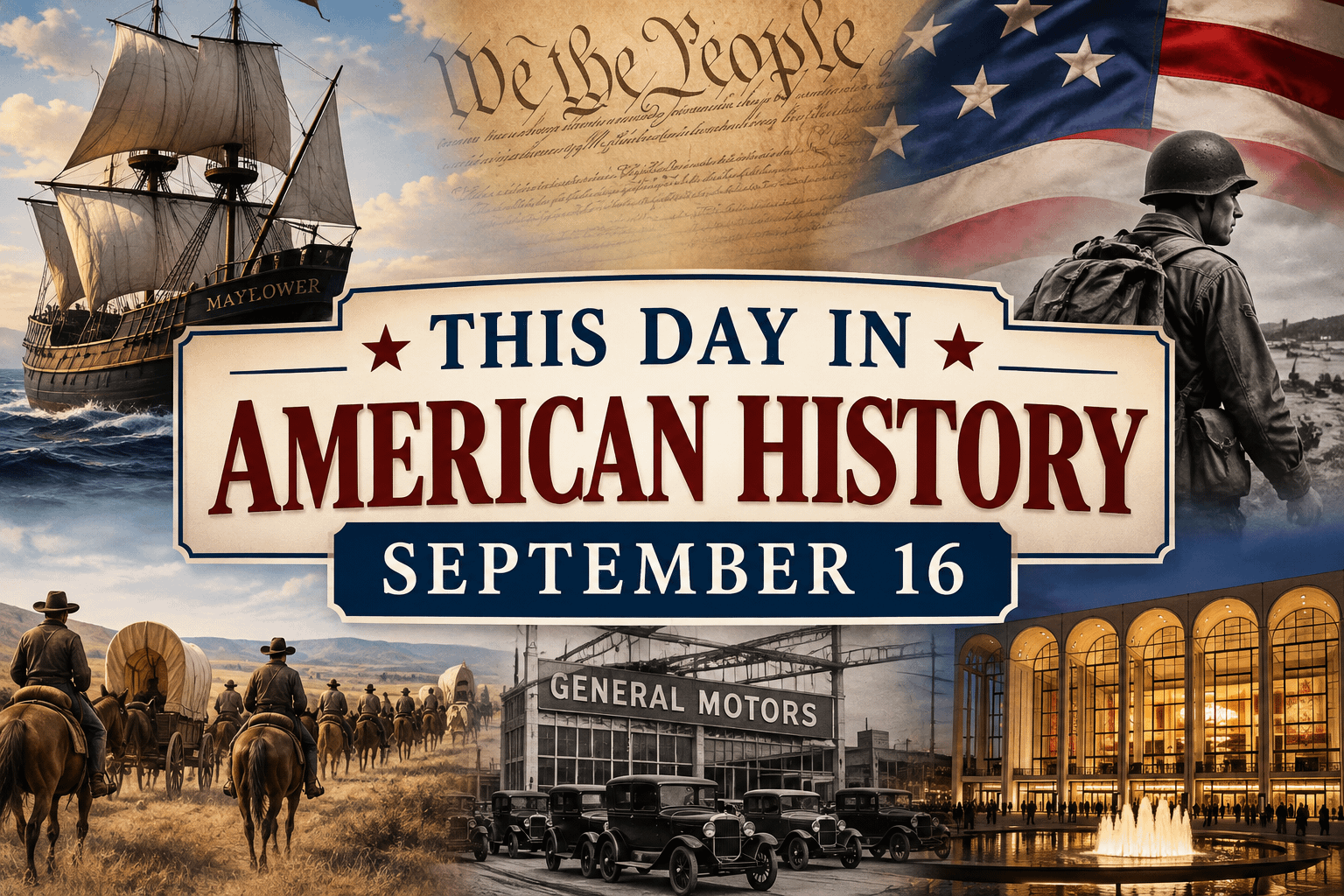
    1620 – The Mayflower Begins Its Historic Journey

    September 16 is also associated with one of the most famous voyages in early American history.

    On September 16, 1620, according to the modern Gregorian calendar, the Mayflower departed Plymouth, England, carrying passengers who hoped to establish a new life across the Atlantic.

    The voyage became an important part of the story of colonial America.

    After a difficult journey lasting more than two months, the Mayflower reached the area of present-day Massachusetts.

    Before establishing their settlement, male passengers signed the Mayflower Compact, an agreement establishing a framework for self-government.

    The story of the Mayflower has become deeply embedded in American culture, especially in traditional narratives surrounding Plymouth Colony and Thanksgiving.

    Modern historians also place the story within the larger history of European colonization and its devastating consequences for Indigenous peoples.

    Understanding both perspectives provides a more complete picture of how events from centuries ago continue to influence American culture and identity.

    1908 – General Motors Is Founded

    Transportation and American industry changed dramatically during the early 20th century.

    On September 16, 1908, General Motors was founded under the leadership of William C. Durant.

    The automobile industry was still relatively young, but cars were quickly transforming American life.

    Over time, General Motors brought together numerous automotive brands and grew into one of the world’s largest automobile manufacturers.

    The rise of the automobile changed much more than transportation.

    Cars influenced where people lived, how cities developed, where businesses were located, how families traveled, and how Americans spent their leisure time.

    The growth of automobile ownership also contributed to the development of highways, suburbs, motels, roadside restaurants, gas stations, drive-in theaters, and countless other pieces of American culture.

    Few technologies shaped everyday American life during the 20th century as dramatically as the automobile.

    1920 – The Wall Street Bombing

    September 16 also witnessed one of the most shocking acts of violence in early 20th-century America.

    At approximately noon on September 16, 1920, a horse-drawn wagon containing explosives detonated in New York City’s Financial District.

    The explosion occurred near Wall Street, killing dozens of people and injuring many more.

    The bombing created widespread fear and became one of the deadliest acts of terrorism in the United States up to that point.

    Investigators suspected that anarchist extremists may have been responsible, but the crime was never definitively solved.

    The bombing reflected a period of intense political and social tension following World War I, when Americans were confronting fears about radical political movements, labor unrest, immigration, and political violence.

    1940 – The United States Establishes Its First Peacetime Draft

    With World War II already raging in Europe, the United States faced growing concerns about military preparedness.

    On September 16, 1940, President Franklin D. Roosevelt signed the Selective Training and Service Act.

    It established the first peacetime military draft in United States history.

    America had not yet entered World War II, but events overseas were making the possibility of American involvement increasingly difficult to ignore.

    The draft dramatically expanded the country’s ability to prepare its armed forces.

    Following the Japanese attack on Pearl Harbor in December 1941, the United States officially entered the war.

    Millions of Americans would ultimately serve in uniform during World War II.

    The war profoundly changed American society, influencing manufacturing, employment, technology, women’s roles in the workforce, migration patterns, civil rights activism, and America’s position in world affairs.

    1959 – The First Successful Photocopier Is Introduced

    It might seem ordinary today, but the ability to quickly reproduce documents was once revolutionary.

    In 1959, Xerox introduced its landmark Xerox 914 copier, helping transform offices, schools, libraries, and businesses.

    Photocopying allowed information to be duplicated and distributed faster than ever before.

    Before widespread photocopiers, reproducing documents could be time-consuming and expensive.

    The copier became a defining piece of office technology during the second half of the 20th century.

    Eventually, digital scanners, printers, email, cloud storage, and smartphones would reduce society’s dependence on traditional photocopying.

    Still, the photocopier played an important role in the evolution of modern information sharing.

    1963 – Malaysia Is Formed

    September 16 is a major national date in Malaysia.

    On September 16, 1963, the Federation of Malaysia was established through the union of Malaya, North Borneo—now Sabah—Sarawak, and Singapore.

    Singapore later separated from Malaysia in 1965 and became an independent nation.

    Today, September 16 is observed as Malaysia Day.

    The holiday commemorates the formation of the country and celebrates Malaysia’s diverse cultural heritage.

    Malaysia is home to numerous ethnic, linguistic, and religious communities, and its culture reflects centuries of trade, migration, regional traditions, and international influence.

    1978 – The Camp David Accords Are Nearing Completion

    September 16, 1978, fell during one of the most significant diplomatic negotiations in modern Middle Eastern history.

    U.S. President Jimmy Carter, Egyptian President Anwar Sadat, and Israeli Prime Minister Menachem Begin were meeting at Camp David in Maryland.

    Their negotiations resulted in the Camp David Accords, which were formally signed on September 17.

    The agreements helped establish a framework that eventually led to the Egypt-Israel Peace Treaty of 1979.

    The negotiations demonstrated both the possibilities and difficulties of diplomacy in regions shaped by decades of conflict.

    1987 – The Montreal Protocol Is Signed

    One of the most important environmental agreements in modern history was signed on September 16, 1987.

    The Montreal Protocol on Substances that Deplete the Ozone Layer brought nations together to reduce the production and consumption of chemicals responsible for damaging Earth’s protective ozone layer.

    The agreement became a remarkable example of international environmental cooperation.

    Because of its significance, September 16 is now recognized by the United Nations as the International Day for the Preservation of the Ozone Layer, commonly called World Ozone Day.

    The story of the Montreal Protocol offers an important lesson: when scientific evidence identifies a global threat, international cooperation can produce meaningful results.

    1992 – Black Wednesday Shakes European Financial Markets

    September 16, 1992, became known as Black Wednesday in Britain.

    The British government was forced to withdraw the pound sterling from the European Exchange Rate Mechanism after intense pressure in currency markets.

    The event became one of the most dramatic financial episodes in modern British history.

    It also had long-term political consequences, influencing debates about Britain’s relationship with European economic institutions.

    Black Wednesday remains an important case study in economics, currency markets, government policy, and the limits of attempts to control exchange rates.

    September 16 in Music and Popular Culture

    September 16 has also played a role in entertainment history.

    As television, movies, recorded music, radio, and later digital entertainment became central parts of everyday life, dates like September 16 became associated with premieres, releases, performances, and cultural milestones.

    The entertainment industry has changed enormously over the past century.

    Families once gathered around radios for nightly programming. Television later became the dominant form of home entertainment. Cable television expanded viewing options, and eventually streaming services transformed how audiences consumed movies and television.

    Music followed a similar transformation—from records and radio to cassette tapes, CDs, digital downloads, and streaming.

    Looking back at cultural history reminds us how quickly everyday technology can change while the human desire for stories, music, laughter, and shared experiences remains remarkably consistent.

    Famous People Born on September 16

    Several notable figures in entertainment, music, sports, and public life were born on September 16.

    B.B. King – Born in 1925

    Legendary blues musician B.B. King became one of the most influential guitarists of the 20th century.

    Known for his expressive guitar playing and his beloved guitars named “Lucille,” King helped bring blues music to audiences around the world.

    His influence can be heard across blues, rock, soul, and popular music.

    Peter Falk – Born in 1927

    Actor Peter Falk became famous for portraying the seemingly absent-minded but remarkably clever detective Lieutenant Columbo.

    His performance turned Columbo into one of television’s most recognizable detective series.

    Mickey Rourke – Born in 1952

    Actor Mickey Rourke has appeared in numerous films across several decades and became known for performances ranging from crime dramas to critically acclaimed character roles.

    David Copperfield – Born in 1956

    Illusionist David Copperfield became one of the world’s best-known stage magicians.

    His large-scale illusions and television specials helped transform modern magic into major mainstream entertainment.

    Amy Poehler – Born in 1971

    Comedian, actress, writer, and producer Amy Poehler became widely known through Saturday Night Live and later for playing Leslie Knope on Parks and Recreation.

    Her work has made her an influential figure in modern American television comedy.

    Nick Jonas – Born in 1992

    Singer and actor Nick Jonas rose to fame as a member of the Jonas Brothers before also developing a solo music and acting career.

    His career reflects the increasingly interconnected nature of modern music, television, film, and social media culture.

    September 16 Around the World

    While many historical dates are remembered primarily for individual events, September 16 demonstrates how one date can hold very different meanings across cultures.

    In Mexico, it represents independence and national pride.

    In Malaysia, it celebrates the formation of the modern nation.

    Around the world, World Ozone Day highlights environmental protection and international cooperation.

    In the United States, September 16 is connected with stories involving colonization, industrial growth, military preparedness, political violence, and economic development.

    Together, these events demonstrate that history is not simply one story.

    It is thousands of interconnected stories happening simultaneously across different countries and cultures.

    Why September 16 Matters

    September 16 reminds us that history is constantly shaping the world around us.

    The call for Mexican independence demonstrates the enduring desire for freedom and self-determination.

    The Mayflower voyage represents an important—and complicated—chapter in the history of European settlement in North America.

    The founding of General Motors reflects the rise of modern industry and the automobile culture that transformed everyday American life.

    The Selective Training and Service Act illustrates how nations prepare for uncertain and dangerous moments.

    Malaysia Day celebrates national identity and cultural diversity.

    The Montreal Protocol demonstrates what international cooperation can accomplish when nations unite around scientific evidence and a shared global challenge.

    And the cultural figures born on September 16 remind us that history isn’t made only by governments, armies, and political leaders.

    Musicians, actors, comedians, artists, inventors, athletes, writers, and everyday people also shape the culture inherited by future generations.

    Looking Back Helps Us Understand Today

    Studying history is not simply about memorizing names and dates.

    It is about understanding how decisions made years—or centuries—ago continue to influence our lives.

    Our borders, governments, technologies, traditions, entertainment, transportation systems, and cultural identities all carry pieces of the past.

    September 16 offers a perfect example.

    One date connects independence movements, migration, industrial development, war preparations, diplomacy, environmental cooperation, economic turmoil, music, entertainment, and national celebrations.

    Tomorrow will bring another collection of stories.

    But today, September 16 reminds us to appreciate where we came from, learn from the successes and mistakes of those who came before us, and recognize that the choices being made today will someday become history themselves.

    Which September 16 moment do you think has had the greatest impact on the world we live in today?
  • This Day in American History – September 16

    This Day in American History – September 16

    September 16 has witnessed events that helped shape the United States long before it became an independent nation and continued to influence its politics, military, business, culture, and national identity for centuries afterward.

    From the voyage of the Mayflower and the settlement of the American West to the creation of General Motors, America’s first peacetime military draft, and the difficult effort to heal the divisions left by the Vietnam War, September 16 offers a fascinating look at the forces that have shaped the country.

    Here are some of the most important moments connected to September 16 in American history.

    1620 – The Mayflower Begins Its Historic Journey to America

    On September 16, 1620, according to the modern Gregorian calendar, the Mayflower departed Plymouth, England, carrying approximately 102 passengers on a voyage across the Atlantic Ocean.

    Few voyages would become more closely associated with the story of early America.

    The passengers were a mixture of religious Separatists, often referred to today as Pilgrims, and other colonists seeking economic opportunities or a new beginning in the English colonies.

    Their destination was originally farther south, in territory associated with the Virginia colony. Difficult weather and navigational circumstances eventually brought the Mayflower to the coast of what is now Massachusetts.

    The Atlantic crossing was miserable.

    Passengers spent weeks crowded into the ship while dealing with storms, seasickness, cold temperatures, poor sanitation, limited food, and uncertainty about what awaited them.

    After more than two months at sea, the travelers finally reached Cape Cod.

    Before establishing their settlement, a group of male passengers signed what became known as the Mayflower Compact. The agreement established a basic framework for governing the community and is often remembered as an early example of self-government in colonial America.

    The settlers eventually established Plymouth Colony.

    Their survival was far from guaranteed. Disease, exposure, malnutrition, and harsh winter conditions killed many of the settlers during their first months in America.

    The familiar story of Plymouth also cannot be told without recognizing the Native peoples who had lived in the region for generations. Interactions between European settlers and Indigenous nations would become an enormously important—and frequently tragic—part of American history.

    The Mayflower’s departure on September 16 therefore represents much more than the beginning of one voyage.

    It became part of the larger story of European colonization, religious freedom, immigration, self-government, conflict, survival, and the complicated origins of what eventually became the United States.

    1810 – Mexico’s Fight for Independence Begins

    Although this event occurred in Mexico, what happened on September 16, 1810 would eventually have enormous consequences for the United States.

    Early that morning, Catholic priest Miguel Hidalgo y Costilla called people in the town of Dolores to rise against Spanish rule.

    The event became known as the Grito de Dolores, or Cry of Dolores.

    Hidalgo’s call helped launch the Mexican War of Independence.

    The struggle continued for more than a decade before Mexico achieved independence from Spain in 1821. September 16 is now celebrated as Mexican Independence Day.

    Mexico’s independence ultimately changed the political map of North America.

    At the time Mexico became independent, its territory extended far beyond the borders of modern Mexico and included enormous areas that are now part of the United States.

    California, Nevada, Utah, most of Arizona and New Mexico, and portions of several other present-day states were once Mexican territory.

    Texas also belonged to Mexico before the Texas Revolution.

    Growing tensions between Mexico and the United States eventually contributed to the Mexican-American War from 1846 to 1848. The conflict ended with the Treaty of Guadalupe Hidalgo and dramatically expanded U.S. territory.

    For that reason, Mexico’s independence movement is also an important chapter in the story of America’s westward expansion and the development of the modern United States.

    1893 – The Largest Land Run in American History

    On September 16, 1893, more than 100,000 settlers gathered along the boundaries of the Cherokee Outlet in present-day Oklahoma.

    At noon, the race began.

    Settlers rushed into the territory on horseback, in wagons, on bicycles, and even on foot, hoping to claim available land.

    The event became known as the Cherokee Strip Land Run and was the largest land run in American history.

    More than six million acres were opened for settlement.

    For settlers hoping to own land, the event represented opportunity and the possibility of building a new life.

    But there was another side to the story.

    The territory had been connected to the Cherokee Nation, and the federal government’s acquisition and opening of Indigenous lands reflected the broader displacement of Native American peoples that accompanied U.S. westward expansion.

    Land runs have often been portrayed romantically as examples of frontier adventure.

    The complete history is considerably more complicated.

    America’s expansion westward created farms, towns, businesses, railroads, and new states, but it also came at an enormous cost to Native American communities whose lands and sovereignty were repeatedly reduced.

    The September 16 land run demonstrates how a single historical event can represent opportunity for one group while representing profound loss for another.

    1908 – General Motors Is Founded

    American history isn’t shaped only by presidents, wars, and political movements.

    Business and technology have transformed the country as well.

    On September 16, 1908, General Motors was founded, beginning the development of what would become one of the largest automobile companies in the world.

    The automobile was still relatively new, but Americans were quickly discovering how dramatically cars could change everyday life.

    Automobiles eventually transformed where people lived, where they worked, how they traveled, and how American cities and suburbs were designed.

    GM grew by bringing multiple automobile brands together under one corporate organization.

    During the following decades, automobiles became deeply connected to American culture.

    Cars represented transportation, independence, economic opportunity, personal freedom, and sometimes social status.

    The automobile industry also created enormous numbers of manufacturing jobs.

    Detroit became synonymous with American car production, and the industry’s factories helped make the Midwest one of the country’s great manufacturing centers.

    During World War II, America’s automobile manufacturing capacity became an important part of the nation’s industrial war effort as factories shifted toward producing military equipment and supplies.

    After the war, rising automobile ownership helped fuel suburban expansion and construction of the interstate highway system.

    Few industries have influenced the physical landscape of the United States as profoundly as the automobile industry.

    The founding of General Motors on September 16, 1908 therefore represents an important milestone in America’s transformation into an industrial and automotive powerhouse.

    1940 – America Establishes Its First Peacetime Draft

    On September 16, 1940, President Franklin D. Roosevelt signed the Selective Training and Service Act.

    The legislation created the first peacetime military draft in United States history.

    The timing was critical.

    World War II had already begun in Europe.

    Nazi Germany had invaded Poland in September 1939, and by 1940 German forces had conquered or occupied large portions of Europe.

    France had fallen.

    Britain was fighting for survival.

    The United States had not yet formally entered the war, and many Americans remained strongly opposed to becoming involved in another European conflict.

    But American leaders increasingly believed the country needed to prepare for the possibility of war.

    Under the new law, millions of American men became subject to military registration.

    According to the National Park Service, more than 16 million men were registered within roughly a month of the law taking effect.

    The decision represented a dramatic change in American military policy.

    The United States was beginning to build the manpower and industrial capacity necessary for a massive national defense effort even before officially entering World War II.

    That preparation became crucial little more than a year later.

    On December 7, 1941, Japan attacked Pearl Harbor.

    The following day, the United States declared war on Japan. Germany and Italy soon declared war on the United States, bringing America fully into World War II.

    Millions of Americans would eventually serve in uniform.

    The Selective Training and Service Act signed on September 16, 1940 helped lay the groundwork for that enormous mobilization.

    1940 – Sam Rayburn Becomes Speaker of the House

    September 16, 1940 also marked an important moment in congressional history when Sam Rayburn of Texas was elected Speaker of the U.S. House of Representatives.

    Rayburn would become one of the most influential congressional leaders of the 20th century.

    Known for his ability to work behind the scenes and build relationships across political divisions, Rayburn served as Speaker for a total of more than 17 years across three separate periods.

    His leadership spanned some of America’s most consequential years, including World War II, the early Cold War, the Korean War, and the beginning of the modern civil rights era.

    His unusually long tenure made him one of the defining figures in congressional history.

    1966 – The Metropolitan Opera Opens at Lincoln Center

    September 16 also holds an important place in American cultural history.

    On September 16, 1966, the Metropolitan Opera opened its new home at Lincoln Center in New York City.

    Lincoln Center became one of America’s most prominent performing arts complexes, bringing together major institutions dedicated to music, theater, dance, and opera.

    The opening reflected the continuing growth of New York City as one of the world’s great cultural capitals.

    American history is often told through wars, elections, laws, and economic changes, but art and culture are also fundamental parts of the country’s identity.

    The opening of the Metropolitan Opera’s Lincoln Center home represented America’s growing influence in the international performing arts.

    1974 – President Gerald Ford Offers Conditional Clemency to Vietnam-Era Draft Evaders

    One of the most politically sensitive events to occur on September 16 came in 1974.

    The Vietnam War had left the United States deeply divided.

    Millions of Americans had served in the military, tens of thousands of American service members had died, and countless families had been changed forever.

    At the same time, thousands of young Americans had resisted the draft or deserted from military service.

    Some fled to countries such as Canada rather than participate in the war.

    After becoming president following Richard Nixon’s resignation, President Gerald Ford faced the difficult question of what should happen to those Americans.

    On September 16, 1974, Ford announced a clemency program for Vietnam-era draft evaders and military deserters.

    Under the program, eligible individuals could return and work toward clemency by reaffirming allegiance to the United States and completing a period of alternative public service, potentially lasting as long as two years.

    Ford presented the program as part of an effort to heal the nation’s divisions.

    The policy was controversial.

    Some Americans believed those who had refused military service should face punishment, particularly out of respect for those who had served and sacrificed.

    Others believed Ford’s program did not go far enough and called for unconditional amnesty.

    The debate demonstrated how deeply the Vietnam War continued to divide the country even after America’s direct military involvement had ended.

    A few years later, President Jimmy Carter took a different approach.

    On his first full day as president in January 1977, Carter granted a pardon to most Vietnam-era draft evaders, although the action did not generally extend to military deserters.

    The contrasting approaches of Ford and Carter reflected America’s continuing struggle to reconcile after one of the most divisive periods in modern American history.

    Why September 16 Matters in American History

    Looking across the centuries, September 16 reveals several recurring themes in the American story.

    There is exploration and settlement.

    There is immigration and the search for a new beginning.

    There is expansion across the continent.

    There is the complicated and painful history of Native American displacement.

    There is industrial growth.

    There is military preparation.

    There is political leadership.

    There is cultural achievement.

    And there is the difficult challenge of bringing a divided country back together.

    The Mayflower’s journey helped create one of America’s most enduring origin stories.

    Mexico’s independence movement helped reshape North America and eventually influenced the borders of the United States.

    The Cherokee Strip Land Run became a dramatic symbol of westward settlement while also illustrating the enormous losses suffered by Native peoples.

    The creation of General Motors helped usher America deeper into the automobile age.

    The Selective Training and Service Act prepared the country for a global conflict that would transform the United States into a military and economic superpower.

    And Gerald Ford’s Vietnam-era clemency program demonstrated just how difficult national reconciliation can be after years of political and social division.

    History rarely fits neatly into categories of triumph or tragedy.

    Often, it contains both.

    Understanding events like those that occurred on September 16 means looking beyond famous names and dates and considering how decisions made generations ago continue to influence the country today.

    That is one of the reasons studying history remains important.

    Every generation inherits a country shaped by the decisions, sacrifices, conflicts, successes, and failures of those who came before.

    September 16 is another reminder that America’s story was not created in a single moment.

    It has been built—sometimes painfully—one day at a time.

    Which September 16 event do you think had the greatest impact on the United States, and why?

  • History & Culture of the Day – September 15

    History & Culture of the Day – September 15

    September 15 is a date filled with moments that have influenced nations, culture, science, entertainment, and the way people understand the world around them. From independence movements in Central America to the birth of an internationally celebrated writer, September 15 offers a fascinating look at how individual events can leave lasting marks on history.

    It is also a day that reminds us that history is more than wars, governments, and famous leaders. History is created through books, music, inventions, social movements, exploration, traditions, and ordinary people whose actions eventually become part of a much larger story.

    Here is a look back at some of the memorable events, cultural milestones, famous birthdays, and historical developments connected to September 15.


    1821 – Central American Nations Declare Independence

    One of the most important events associated with September 15 occurred in 1821, when much of Central America declared independence from Spanish rule.

    The Act of Independence of Central America was signed in Guatemala City, beginning a major political transformation for the region.

    Today, Costa Rica, El Salvador, Guatemala, Honduras, and Nicaragua all celebrate their independence on September 15.

    The independence movement was part of a much larger transformation taking place throughout Latin America during the early 19th century. For centuries, Spain had controlled enormous territories in the Americas. Political unrest in Europe, changing economic conditions, Enlightenment ideas, and successful independence movements elsewhere encouraged people throughout Latin America to challenge colonial rule.

    September 15 therefore represents much more than a historical date. Across Central America, it remains a celebration of national identity and heritage.

    Independence Day celebrations often include parades, music, traditional clothing, dancing, patriotic ceremonies, food, flags, and community gatherings.

    One particularly memorable tradition is the carrying of the Torch of Independence, which symbolizes the spread of the news of independence through Central America.

    More than two centuries later, September 15 remains one of the most culturally significant dates in the region.


    1830 – The Liverpool and Manchester Railway Opens

    September 15, 1830, marked an important moment in transportation history with the formal opening of the Liverpool and Manchester Railway in England.

    Railways existed before this event, but the Liverpool and Manchester line became an important milestone in the development of modern passenger and freight rail transportation.

    The railway connected two major industrial cities and demonstrated how steam-powered transportation could move people and goods efficiently over significant distances.

    The Industrial Revolution was already transforming Britain, and railroads accelerated those changes.

    Factories could receive raw materials faster. Finished products could reach markets more efficiently. People could travel farther and more quickly than previous generations had imagined.

    Railroads would eventually reshape entire countries.

    Cities expanded around railway stations. New communities developed along transportation routes. Commerce accelerated, and travel became accessible to growing numbers of people.

    The opening was also marked by tragedy. British politician William Huskisson was struck by George Stephenson’s locomotive Rocket during the opening ceremonies and later died from his injuries.

    Despite the tragedy, the railway demonstrated the enormous potential of steam transportation.

    Within decades, railroad networks would spread across Europe, North America, and other parts of the world.


    1857 – William Howard Taft Is Born

    William Howard Taft was born on September 15, 1857, in Cincinnati, Ohio.

    Taft would eventually become the 27th president of the United States, serving from 1909 to 1913.

    His place in history is particularly unusual because the presidency was not the only major national office he would hold.

    Years after leaving the White House, Taft became Chief Justice of the United States, serving from 1921 until 1930.

    He remains the only person in American history to have served both as president of the United States and as chief justice of the Supreme Court.

    Taft’s career demonstrates how public service can take many different forms. Although presidents often dominate historical discussions, Taft reportedly felt more comfortable in the legal world than in electoral politics.

    His life therefore connects two of America’s most powerful institutions: the presidency and the Supreme Court.


    1890 – Agatha Christie Is Born

    One of the world’s most famous mystery writers was born on September 15, 1890.

    Agatha Christie was born in Torquay, England, and would eventually become one of the most successful authors in literary history.

    Christie’s stories introduced readers to legendary fictional detectives including Hercule Poirot and Miss Marple.

    Her novels became famous for carefully constructed mysteries, unexpected clues, suspicious characters, and endings that often surprised readers.

    Among her best-known works are:

    • Murder on the Orient Express
    • Death on the Nile
    • The Murder of Roger Ackroyd
    • And Then There Were None
    • The ABC Murders

    Her influence extended beyond novels.

    Christie’s stage play The Mousetrap became famous for its extraordinarily long theatrical run in London’s West End.

    Her work has also inspired countless movies, television adaptations, radio productions, stage performances, and modern mystery writers.

    The popularity of Agatha Christie demonstrates something important about culture: a great story can survive long after the era in which it was written.

    Generations continue discovering her mysteries and trying to solve them before the final pages reveal the truth.


    1916 – Tanks Enter Battle

    September 15, 1916, became a significant date in military history when tanks were used in battle during the Battle of the Somme in World War I.

    The battlefield of World War I had become dominated by trenches, machine guns, barbed wire, and artillery.

    Military leaders searched for ways to break through heavily defended enemy positions.

    The tank represented a new approach.

    Early tanks were slow, mechanically unreliable, uncomfortable, and extremely difficult to operate. Many broke down or became stuck.

    Yet their appearance suggested how warfare was beginning to change.

    Over the following decades, armored vehicles became increasingly important to military strategy.

    By World War II, tanks had become central to major land campaigns.

    The first battlefield appearance of tanks on September 15 therefore represents an early stage in a technological transformation that would dramatically influence modern warfare.


    1928 – Alexander Fleming and the Discovery That Led to Penicillin

    September 1928 is closely associated with one of the most important medical discoveries of the modern era.

    Scottish scientist Alexander Fleming returned to his laboratory after time away and noticed something unusual in a dish containing bacteria.

    Mold had contaminated the dish.

    Instead of simply throwing it away, Fleming observed that bacteria surrounding the mold were being destroyed.

    The mold belonged to the Penicillium genus.

    Fleming’s observation eventually contributed to the development of penicillin, the world’s first widely effective antibiotic.

    The discovery would eventually transform medicine.

    Before antibiotics, bacterial infections that are routinely treated today could become deadly. Pneumonia, infected wounds, and many other infections posed enormous risks.

    Penicillin eventually saved countless lives, particularly after methods were developed to manufacture it on a large scale.

    The story has also become an enduring example of scientific curiosity.

    An unexpected observation became important because someone stopped to investigate it.


    1935 – The Nuremberg Laws Are Announced

    Not every historical anniversary represents progress.

    September 15, 1935, is associated with one of the darkest developments in Nazi Germany.

    During the Nazi Party rally in Nuremberg, the regime introduced laws that stripped German Jews of important citizenship rights and prohibited marriages and certain relationships between Jews and people classified as being of “German or related blood.”

    These measures became known as the Nuremberg Laws.

    They helped transform antisemitic ideology into government policy.

    The laws demonstrate how discrimination can become increasingly dangerous when prejudice is supported and enforced by institutions.

    In the years that followed, persecution intensified dramatically, eventually contributing to the systematic murder of six million Jews during the Holocaust.

    Remembering events like this is an essential part of studying history.

    History does not exist only to celebrate human achievement. It also provides warnings about what can happen when hatred, dehumanization, authoritarianism, and discrimination are allowed to grow unchecked.


    1940 – The Battle of Britain Reaches a Critical Day

    September 15, 1940, became one of the most famous days of the Battle of Britain during World War II.

    German forces launched major air attacks against Britain, and the Royal Air Force responded.

    The fighting that day became so significant that September 15 is now commemorated as Battle of Britain Day in the United Kingdom.

    The broader battle was crucial because Nazi Germany hoped to gain air superiority over Britain.

    British resistance prevented Germany from achieving that goal.

    The Battle of Britain became a powerful cultural symbol of endurance and national determination.

    It also highlighted the growing importance of aircraft, radar, intelligence, communications, and coordinated air defense in modern warfare.


    1949 – The Lone Ranger Comes to Television

    On September 15, 1949, The Lone Ranger premiered on American television.

    The masked Western hero had already become popular through radio, but television introduced the character to a new audience.

    With his horse Silver and his companion Tonto, the Lone Ranger became one of the recognizable heroes of early American television.

    The character’s famous cry of “Hi-Yo, Silver!” became part of popular culture.

    Western programs would become enormously popular during television’s early decades.

    Cowboys, frontier towns, sheriffs, outlaws, horses, and open landscapes filled American television screens.

    Although modern audiences often examine older Westerns more critically—particularly their portrayals of Native Americans and the mythology surrounding westward expansion—the genre remains an important part of American entertainment history.


    1963 – Birmingham Church Bombing

    September 15, 1963, became one of the most heartbreaking dates of the American Civil Rights Movement.

    A bomb exploded at the 16th Street Baptist Church in Birmingham, Alabama.

    Four Black girls were killed:

    Addie Mae Collins, Cynthia Wesley, Carole Robertson, and Denise McNair.

    The church had served as an important gathering place for civil rights activists.

    The bombing shocked the country and became a devastating example of the racist violence faced by Black Americans and those fighting segregation.

    Rather than stopping the movement, the tragedy increased national attention on racial injustice.

    The bombing remains an important part of American history because it reminds us that major social changes often come with enormous human costs.

    The four girls are remembered not simply as names in a history book, but as children whose lives were taken by hatred.

    Their memory became intertwined with the continuing struggle for equality and civil rights.


    1971 – Greenpeace Begins Its First Major Protest Voyage

    September 15, 1971, is closely associated with the beginnings of Greenpeace.

    A group of activists sailed from Vancouver aboard a vessel called the Phyllis Cormack, hoping to protest a planned U.S. nuclear test near Amchitka Island in Alaska.

    The group originally operated under the name “Don’t Make a Wave Committee,” but the idea of combining environmental concern with peace activism helped inspire the Greenpeace identity.

    The voyage helped create an organization that would later become internationally known for environmental activism.

    Over the decades, environmental movements have influenced public discussions about nuclear testing, pollution, wildlife conservation, climate change, forests, oceans, and energy.

    Whatever one’s views on individual environmental organizations or campaigns, the rise of environmental activism became a major cultural and political development during the second half of the 20th century.


    September 15 and Hispanic Heritage Month

    September 15 also holds major cultural importance in the United States because it marks the beginning of National Hispanic Heritage Month, which runs from September 15 through October 15.

    The starting date was deliberately chosen because September 15 is the independence anniversary of Costa Rica, El Salvador, Guatemala, Honduras, and Nicaragua.

    Mexico celebrates its independence on September 16, while Chile celebrates on September 18.

    Hispanic Heritage Month recognizes the history, cultures, achievements, and contributions of Americans whose families have roots in Spain, Mexico, the Caribbean, Central America, and South America.

    The month celebrates contributions in countless areas, including:

    music, art, literature, science, sports, military service, business, education, government, agriculture, entertainment, food, and community leadership.

    Hispanic and Latino cultures have profoundly influenced American life.

    You can hear that influence in music.

    You can taste it in food.

    You can see it in architecture and art.

    You can find it in language, festivals, neighborhoods, literature, family traditions, and everyday American culture.

    The observance is therefore not simply about looking backward at history.

    It is also about recognizing living cultures that continue shaping the United States.


    Famous People Born on September 15

    September 15 has also been the birthday of numerous influential figures from politics, literature, entertainment, sports, and other areas.

    William Howard Taft – 1857

    The 27th president of the United States and later Chief Justice of the United States.

    Agatha Christie – 1890

    Legendary British mystery writer and creator of Hercule Poirot and Miss Marple.

    Roy Acuff – 1903

    American country music performer who became one of the influential figures associated with the Grand Ole Opry.

    Fay Wray – 1907

    Actress remembered especially for her role in the 1933 film King Kong.

    Jackie Cooper – 1922

    Actor whose career stretched from childhood stardom into decades of film and television work.

    Cannonball Adderley – 1928

    Influential American jazz saxophonist known for his energetic performances and important contributions to jazz.

    Tommy Lee Jones – 1946

    Academy Award-winning American actor known for films including The Fugitive, Men in Black, No Country for Old Men, and Lincoln.

    Oliver Stone – 1946

    American filmmaker known for movies including Platoon, Wall Street, Born on the Fourth of July, and JFK.

    Dan Marino – 1961

    Legendary NFL quarterback best known for his career with the Miami Dolphins.

    Tom Hardy – 1977

    English actor known for roles in Inception, The Dark Knight Rises, Mad Max: Fury Road, The Revenant, and Venom.

    Prince Harry – 1984

    Born on September 15, 1984, the younger son of King Charles III and Diana, Princess of Wales.


    A Day of Independence, Discovery, Culture, and Remembrance

    Looking across the centuries, September 15 tells several very different stories.

    It is a story of independence, as Central American nations celebrate freedom from Spanish colonial rule.

    It is a story of innovation, represented by the development of rail transportation and the scientific observations that helped lead to penicillin.

    It is a story of culture, through writers such as Agatha Christie and entertainers who shaped literature, television, film, jazz, country music, and sports.

    It is a story of courage and resistance, from the Battle of Britain to the American Civil Rights Movement.

    And it is also a story of warning and remembrance, particularly when we look back at the Nuremberg Laws and the bombing of Birmingham’s 16th Street Baptist Church.

    History contains moments worth celebrating and moments that should never be forgotten.

    Both matter.

    The achievements of previous generations can inspire us, while their mistakes can warn us.

    That is one of the reasons learning about history remains so important.


    Why September 15 Still Matters

    A date on a calendar can appear ordinary until we begin exploring what happened on it.

    September 15 connects us with independence celebrations throughout Central America, the beginning of Hispanic Heritage Month in the United States, advances in transportation and medicine, unforgettable cultural figures, and defining moments in struggles for freedom and equality.

    These events happened in different countries, centuries, and circumstances, yet they share something important.

    Each became part of the world inherited by later generations.

    History is not simply a collection of old dates.

    It is the accumulated story of decisions, discoveries, struggles, creativity, courage, tragedy, and change.

    Every generation adds another chapter.

    And when we take a few minutes to look back, we gain a better understanding of how the world we know today came to be.

    Which September 15 moment do you think had the greatest impact on history or culture—and why?

  • This Day in American History – September 15

    This Day in American History – September 15

    September 15 has witnessed moments in American history that shaped the federal government, introduced a future president, demonstrated American military power overseas, and exposed the terrible violence faced by Americans fighting for civil rights.

    From the earliest years of the United States to the Civil Rights Movement of the 20th century, September 15 reminds us that American history is a combination of progress, conflict, courage, tragedy, and change.

    Here is a look back at some of the most significant events connected to September 15 in American history.

    1789 – The Department of State Gets Its Name

    On September 15, 1789, during the first year of George Washington’s presidency, the young United States continued building the institutions necessary to operate its new federal government.

    Congress passed legislation changing the name of the Department of Foreign Affairs to the Department of State. The change reflected the department’s expanded responsibilities, which included several domestic duties in addition to handling foreign relations.

    Among its early responsibilities were preserving federal laws and important government records, handling presidential commissions, and maintaining custody of the Great Seal of the United States.

    The department had originally been established as the Department of Foreign Affairs in July 1789. The September legislation helped transform it into the institution we recognize today as the Department of State.

    Thomas Jefferson would become the nation’s first Secretary of State.

    More than two centuries later, the Department of State remains one of the most important departments in the federal government, representing the United States diplomatically around the world.

    September 15, therefore, marks an important milestone in the creation of America’s federal government.

    1857 – Future President William Howard Taft Is Born

    William Howard Taft was born in Cincinnati, Ohio, on September 15, 1857.

    Taft would eventually become one of the most unusual figures in American political history.

    He served as the 27th President of the United States from 1909 to 1913, succeeding Theodore Roosevelt.

    But the presidency was not the only major position Taft would hold.

    His career included service as a judge, U.S. Solicitor General, governor in the Philippines, Secretary of War, president, and eventually Chief Justice of the United States.

    That final position made Taft unique.

    He remains the only person in American history to have served as both President of the United States and Chief Justice of the United States Supreme Court.

    Taft became Chief Justice in 1921 and served until shortly before his death in 1930.

    His life demonstrated something rare in American history: reaching the highest levels of both the executive and judicial branches of government.

    1950 – The Inchon Landing During the Korean War

    September 15 also became an important date in American military history.

    On September 15, 1950, United Nations forces led by the United States launched the amphibious landing at Inchon, South Korea, during the Korean War.

    The operation was directed by General Douglas MacArthur and involved U.S. Navy and Marine forces.

    The landing was extremely risky.

    Inchon presented military planners with difficult tides, narrow waterways, fortified positions, and other geographic challenges. Despite those obstacles, American forces successfully landed and began securing the area.

    The operation dramatically changed the momentum of the war.

    North Korean forces had pushed South Korean and United Nations troops into a relatively small defensive area around Pusan. The Inchon landing placed forces behind North Korean lines and helped create an opportunity for UN troops to break out of their defensive positions.

    Seoul was subsequently recaptured.

    The Korean War would continue for nearly three more years, but the Inchon landing remains one of the most famous amphibious operations in U.S. military history.

    1963 – The 16th Street Baptist Church Bombing

    One of the darkest events associated with September 15 occurred in Birmingham, Alabama.

    On Sunday morning, September 15, 1963, a bomb exploded at the 16th Street Baptist Church, a prominent African American church and an important gathering place for Birmingham’s Civil Rights Movement.

    Members of the Ku Klux Klan had planted dynamite at the church.

    Four young girls were killed:

    Addie Mae Collins, age 14
    Denise McNair, age 11
    Carole Robertson, age 14
    Cynthia Wesley, age 14

    The girls were preparing for the church’s Youth Day activities when the explosion occurred.

    Many others were injured.

    The attack shocked Americans across the country.

    The bombing wasn’t simply an attack against a building. The church had become an important center for Birmingham’s African American community and the struggle against segregation.

    Civil rights leaders and community members frequently gathered there, making the church a symbol of the movement.

    The bombing demonstrated the extreme violence that could be directed against people challenging racial segregation.

    But the attackers failed to destroy the movement.

    Instead, the deaths of the four girls became another powerful symbol of why change was urgently needed.

    The National Park Service notes that the attack shocked the nation and helped galvanize the Civil Rights Movement. The struggle in Birmingham and events surrounding it contributed to growing public pressure for federal civil rights legislation.

    The Civil Rights Act would eventually be signed into law on July 2, 1964.

    Remembering Addie Mae, Denise, Carole, and Cynthia

    When discussing September 15, it is important that the four girls are remembered as more than names in a history book.

    They were children.

    They had families.

    They had friends, dreams, personalities, and futures that should have been theirs to experience.

    They had gone to church that Sunday morning expecting an ordinary day.

    Instead, they became victims of racial terrorism.

    Their deaths remain among the most heartbreaking reminders of the human cost of segregation and racial hatred in the United States.

    Remembering them keeps the focus where it belongs—not only on the political consequences of the bombing but also on the lives that were stolen.

    A Date That Shows Different Sides of the American Story

    September 15 offers a striking cross-section of American history.

    In 1789, Americans were building the institutions of their new constitutional government.

    In 1857, William Howard Taft was born, a man who would eventually lead two of America’s three branches of government at different points in his career.

    In 1950, American troops participated in the daring Inchon landing during the Korean War.

    And in 1963, four young girls were murdered while attending church because racial hatred and resistance to integration had turned Birmingham into a battleground in the struggle for civil rights.

    These events are very different, but together they reveal something important about studying history.

    History isn’t simply a collection of dates.

    It is the story of decisions and their consequences.

    It is about institutions being created, wars being fought, people seeking power, ordinary citizens demanding equality, and families experiencing moments that permanently change their lives.

    Why September 15 Still Matters

    Studying American history requires us to remember achievements without ignoring failures.

    There are moments worth celebrating.

    There are moments worth honoring.

    And there are moments that should make us uncomfortable because they reveal how badly Americans have sometimes failed to live up to the nation’s ideals.

    All of them belong in the story.

    The creation of the Department of State demonstrates the work required to build a functioning republic.

    William Howard Taft’s life shows the many ways individuals can influence America’s institutions.

    The Inchon landing reminds us of the sacrifices made by American service members during the Korean War—a conflict sometimes overshadowed by World War II and Vietnam.

    And the bombing of the 16th Street Baptist Church reminds us that progress toward equality has often come at an enormous human cost.

    History becomes valuable when we do more than memorize it.

    We should ask what happened, why it happened, who was affected, and what lessons can still be carried forward.

    Final Thoughts

    September 15 is a day containing both achievement and tragedy in American history.

    It reminds us of a young nation creating its government, a future president and Chief Justice beginning his life, American troops undertaking a daring military operation, and four innocent girls whose deaths became forever connected to America’s struggle for civil rights.

    Some historical moments inspire pride.

    Others demand reflection.

    Both deserve to be remembered.

    Because understanding America’s history means looking at the entire story—the victories, the sacrifices, the injustice, the courage, and the people whose lives helped shape the country we know today.

    Which September 15 event do you believe had the greatest impact on American history, and why?

  • History & Culture of the Day: September 14

    History & Culture of the Day: September 14

    September 14 is a date filled with moments that changed nations, inspired music, pushed humanity farther into space, reshaped global economics, and left lasting marks on popular culture. From the flag flying over Fort McHenry that inspired what would become the United States national anthem to the first human-made object reaching the Moon, September 14 reminds us that history is often created in moments when people refuse to surrender, dare to explore, or change the way the world works.

    1812 – Napoleon Enters Moscow

    On September 14, 1812, Napoleon Bonaparte and his Grande Armée entered Moscow during his disastrous invasion of Russia.

    Napoleon had expected the capture of Moscow to force Russia to negotiate. Instead, he found a largely abandoned city. The Russian army had withdrawn, much of the population had left, and fires soon consumed significant portions of Moscow.

    What initially appeared to be one of Napoleon’s greatest accomplishments quickly became a nightmare.

    Without the surrender he expected and with winter approaching, Napoleon eventually ordered his army to retreat. The journey back west became one of history’s most devastating military withdrawals as French forces battled hunger, freezing temperatures, disease, exhaustion, and Russian attacks.

    Only a fraction of the enormous army that entered Russia returned.

    September 14 therefore became part of one of history’s greatest lessons about ambition, logistics, weather, and the danger of assuming that capturing a city automatically means winning a war.

    1814 – The Morning That Inspired “The Star-Spangled Banner”

    One of the most important moments associated with September 14 occurred during the War of 1812.

    British forces had been bombarding Fort McHenry in Baltimore Harbor for roughly 25 hours. American lawyer Francis Scott Key watched the attack from a ship several miles away after helping negotiate the release of American physician William Beanes.

    Throughout the night, British rockets and exploding shells illuminated the sky.

    Key had no way of knowing whether the fort would survive.

    Then morning came.

    As daylight appeared on September 14, 1814, Key saw an enormous American flag still flying above Fort McHenry.

    The fort had not surrendered.

    The British attack had failed.

    Inspired by what he witnessed, Key began writing a poem originally titled “Defence of Fort M’Henry.” The poem would eventually be paired with the melody of an existing song and become known as “The Star-Spangled Banner.”

    The flag itself was enormous. Baltimore flagmaker Mary Pickersgill had created the garrison flag in 1813. It originally measured about 30 feet by 42 feet and contained 15 stars and 15 stripes.

    At dawn, as British forces began withdrawing, the large flag was raised over the fort, where it could be seen from miles away.

    That sight became one of the most famous images in American history.

    From Battlefield Poem to National Anthem

    Francis Scott Key’s poem quickly circulated in newspapers and was sung to the tune of “To Anacreon in Heaven,” a melody associated with English composer John Stafford Smith.

    Over time, Americans increasingly referred to the song as “The Star-Spangled Banner.”

    More than a century would pass before it officially became the national anthem.

    Congress formally designated “The Star-Spangled Banner” as the national anthem of the United States in 1931.

    Today, the original Fort McHenry flag is preserved by the Smithsonian’s National Museum of American History.

    It is more than simply an old flag.

    It represents a moment when a symbol, a military battle, music, poetry, and national identity became permanently connected.

    Few dates demonstrate the relationship between history and culture better than September 14.

    1847 – American Forces Enter Mexico City

    September 14 also holds an important place in the history of the Mexican-American War.

    On September 14, 1847, American forces commanded by General Winfield Scott entered Mexico City following a lengthy military campaign.

    Scott’s army had landed near Veracruz months earlier and fought its way inland toward the Mexican capital.

    The capture of Mexico City effectively brought the major military campaign toward its conclusion, although peace negotiations continued afterward.

    The Mexican-American War ultimately transformed the territorial boundaries of North America. Its consequences influenced political debates inside the United States for years afterward, particularly arguments surrounding the expansion of slavery into newly acquired territories.

    Those disputes would become part of the growing sectional tensions that eventually contributed to the American Civil War.

    1901 – Theodore Roosevelt Becomes President

    Another major turning point occurred on September 14, 1901.

    President William McKinley had been shot by assassin Leon Czolgosz at the Pan-American Exposition in Buffalo, New York, on September 6.

    Initially, McKinley’s condition appeared to improve.

    Then complications developed.

    McKinley died on September 14.

    Vice President Theodore Roosevelt was immediately summoned and sworn in as the 26th president of the United States that afternoon.

    At 42 years old, Roosevelt became the youngest person ever to assume the American presidency.

    His presidency would become one of the most influential of the early 20th century.

    Roosevelt championed what became known as the Square Deal, supported stronger regulation of large corporations, promoted conservation of America’s natural resources, and dramatically expanded the international influence of the presidency.

    The events of September 14, 1901, therefore did much more than transfer power from one president to another.

    They helped begin a new political era.

    1959 – Humanity Reaches the Moon

    Long before astronauts walked across the lunar surface, humanity first reached the Moon with a machine.

    On September 14, 1959, the Soviet Union’s Luna 2 became the first human-made spacecraft to reach another celestial body.

    The spacecraft intentionally crashed into the Moon.

    It may sound like a failure by modern standards, but at the time it was an extraordinary technological achievement.

    For thousands of years, human beings had looked at the Moon from Earth.

    Now something built by human hands had actually reached it.

    Luna 2 became the first spacecraft to impact another celestial body, marking an important milestone in the early Space Age.

    The achievement also intensified the Cold War space race between the Soviet Union and the United States.

    During the following decade, the two nations would compete through satellites, robotic missions, human spaceflight, and eventually attempts to place astronauts on the Moon.

    Ten years after Luna 2, Apollo 11 astronauts Neil Armstrong and Buzz Aldrin would walk across the lunar surface.

    September 14, 1959, helped demonstrate that reaching another world was no longer science fiction.

    It was possible.

    1960 – OPEC Is Founded

    Another event on September 14 would influence international economics for decades.

    Representatives from Iran, Iraq, Kuwait, Saudi Arabia, and Venezuela gathered in Baghdad in September 1960 to discuss the relationship between oil-producing nations and major international petroleum companies.

    On September 14, the Organization of the Petroleum Exporting Countries — OPEC — was established.

    The organization sought greater cooperation among petroleum-producing countries and increased control over their natural resources and oil policies.

    Few commodities have influenced modern civilization as dramatically as petroleum.

    Oil powers transportation, manufacturing, shipping, and enormous portions of the global economy.

    Because of that, decisions made by major oil-producing countries can affect fuel prices, inflation, international relations, and economic growth around the world.

    The founding of OPEC was therefore not simply an organizational meeting.

    It helped reshape the balance of power within the global energy industry.

    1982 – The Death of Princess Grace of Monaco

    September 14 also carries a sad place in entertainment and royal history.

    Grace Kelly had become one of Hollywood’s most glamorous stars during the 1950s before leaving acting after marrying Prince Rainier III of Monaco.

    She became Princess Grace of Monaco, creating one of the most famous intersections between Hollywood celebrity and European royalty.

    After suffering a medical emergency while driving, Grace was involved in a serious automobile crash. She died on September 14, 1982.

    Her death stunned admirers around the world.

    Grace Kelly’s relatively short movie career produced several memorable performances, while her transformation from Academy Award-winning actress to European princess became part of popular culture.

    Decades later, she remains one of Hollywood’s enduring style icons.

    1994 – Baseball Loses the World Series

    For American sports fans, September 14, 1994, is remembered very differently.

    A Major League Baseball players’ strike had begun in August amid a bitter labor dispute between players and team owners.

    Then came the announcement baseball fans had feared.

    On September 14, Major League Baseball canceled the remainder of the season, including the postseason and the World Series.

    It marked the first time since 1904 that an MLB season ended without a champion being crowned.

    The cancellation was especially painful because several historic performances were underway.

    Tony Gwynn was batting .394 and pursuing the extremely rare possibility of finishing a season above .400.

    Matt Williams had 43 home runs and Ken Griffey Jr. had 40 as both chased Roger Maris’ then-record of 61 home runs.

    The Montreal Expos had one of baseball’s best teams.

    None of those stories received their expected conclusion.

    The strike lasted into 1995 and damaged the relationship between professional baseball and many of its fans.

    It remains one of the most controversial labor disputes in American sports history.

    September 14 in Music Culture – Nas Is Born

    September 14 has also produced influential figures in music.

    Nasir Jones, better known as Nas, was born September 14, 1973, in Queens, New York.

    Growing up in Queensbridge, Nas developed a style built around vivid storytelling, observations about street life, and complex lyricism.

    His 1994 debut album Illmatic became one of the most respected albums in hip-hop history and helped establish Nas as one of rap’s most influential lyricists.

    His career illustrates the way hip-hop evolved from a neighborhood-based cultural movement into one of the world’s dominant forms of popular music.

    September 14 in Music History – Amy Winehouse Is Born

    British singer-songwriter Amy Winehouse was born September 14, 1983, in London.

    Winehouse developed a distinctive sound influenced by jazz, soul, R&B, and other styles.

    Her deeply personal songwriting and instantly recognizable voice helped make her one of the most memorable performers of her generation.

    Her album Back to Black achieved international success and earned widespread critical acclaim.

    Winehouse died in 2011 at only 27 years old, but her music continues to influence artists and listeners around the world.

    Her story is one of enormous artistic talent combined with a tragically short life.

    Why September 14 Matters

    When we examine September 14 across centuries, one theme becomes clear: seemingly individual moments can have consequences far beyond the day on which they occur.

    A flag surviving a bombardment inspired a poem that eventually became America’s national anthem.

    Napoleon’s arrival in Moscow appeared to represent victory but instead became part of a catastrophic military campaign.

    The death of one president placed Theodore Roosevelt in the White House and changed the direction of American politics.

    A small Soviet spacecraft crashing into the Moon demonstrated that humanity could reach another world.

    Five oil-producing countries meeting in Baghdad created an organization that would influence the global economy for generations.

    A labor dispute stopped the World Series.

    Artists born on this date later helped shape film and music culture.

    That is what makes studying history valuable.

    History is not simply a collection of names and dates.

    It is the story of decisions, ideas, conflicts, discoveries, creativity, tragedy, and perseverance.

    A Day of Flags, Presidents, Spacecraft, Music and Change

    Perhaps no image represents September 14 better than the American flag flying above Fort McHenry on that September morning in 1814.

    After hours of explosions and uncertainty, it remained visible.

    Francis Scott Key saw it and transformed that moment into words.

    Those words eventually became something generations of Americans would hear before sporting events, national ceremonies, military gatherings, and countless public occasions.

    Yet September 14 extends far beyond that single story.

    It connects battlefields with concert halls, presidents with astronauts, royal palaces with baseball stadiums, and 19th-century warfare with 20th-century space exploration.

    Every generation adds another chapter.

    And when September 14 arrives each year, it offers another opportunity to look backward—not simply to memorize what happened, but to understand how the events of yesterday continue shaping the culture and world we experience today.

    Which September 14 event do you find the most fascinating: the story behind “The Star-Spangled Banner,” Theodore Roosevelt becoming president, Luna 2 reaching the Moon, or another moment from this date?

  • This Day in American History – September 14

    This Day in American History – September 14

    September 14 holds a special place in American history. It is a date connected to one of the nation’s most recognizable patriotic symbols, the transition of presidential power after an assassination, an important Civil War battle, the Mexican-American War, and events that helped shape American culture and foreign policy.

    Most notably, September 14, 1814, gave the United States the words that would eventually become its national anthem.

    September 14, 1814 – Francis Scott Key Writes “The Star-Spangled Banner”

    The most famous American event associated with September 14 happened during the War of 1812.

    British forces had been attacking Baltimore, Maryland, and during the night of September 13 into the morning of September 14, British warships bombarded Fort McHenry for roughly 25 hours.

    Watching the attack from aboard a vessel in Baltimore Harbor was Washington-area attorney and amateur poet Francis Scott Key.

    Key had traveled with American prisoner-exchange official John Stuart Skinner to negotiate the release of Dr. William Beanes, an American civilian who had been taken prisoner by the British. After securing Beanes’ release, Key and the others were temporarily prevented from returning to shore because they had learned details about the planned British attack.

    That placed Key in a remarkable position to witness the bombardment of Fort McHenry.

    The Flag Was Still Flying

    Throughout the night, Key could see flashes from rockets, cannon fire, and explosions around Fort McHenry.

    When daylight arrived on the morning of September 14, 1814, he saw something that would become one of the most famous images in American history: an American flag was still flying above the fort.

    Major George Armistead ordered a large American flag raised over Fort McHenry that morning to signal that the Americans had successfully resisted the British attack. The flag had been made the previous year by Baltimore flagmaker Mary Pickersgill and her assistants.

    The sight inspired Key to begin writing a poem.

    Originally titled “Defence of Fort M’Henry,” the four-stanza poem was eventually paired with the melody of the popular tune “Anacreon in Heaven.” It became widely known as “The Star-Spangled Banner.”

    From Battlefield Poem to National Anthem

    Key could not have known that the words he wrote in 1814 would eventually become part of American life for generations.

    The song became increasingly popular at patriotic ceremonies, military occasions, sporting events, and other public gatherings.

    More than a century later, Congress officially designated “The Star-Spangled Banner” as the national anthem of the United States on March 3, 1931.

    The original Fort McHenry flag that inspired Key survives today and is preserved by the Smithsonian’s National Museum of American History.

    For Americans, September 14 therefore marks more than a military victory. It marks the moment when an event witnessed during wartime produced words that would eventually represent the country itself.

    September 14, 1847 – American Forces Capture Mexico City

    Another major American military event occurred on September 14 during the Mexican-American War.

    American troops commanded by General Winfield Scott entered Mexico City following a series of battles surrounding the Mexican capital.

    Scott’s campaign had begun months earlier with an amphibious landing near Veracruz. His army then fought its way inland toward Mexico City.

    By September 1847, American troops had overcome Mexican defenses around the capital. On September 14, U.S. forces entered Mexico City and raised the American flag there.

    The capture effectively demonstrated that Mexico could no longer prevent American forces from occupying its capital.

    The war formally ended the following year with the Treaty of Guadalupe Hidalgo in 1848.

    The territorial consequences were enormous. Mexico ceded a vast region to the United States encompassing present-day California, Nevada, Utah, and portions of several other western states.

    The Mexican-American War therefore played an enormous role in shaping the modern map of the United States, while also intensifying political arguments over whether slavery would expand into newly acquired western territories.

    Those arguments would become one of the major forces pushing the nation toward the Civil War.

    September 14, 1862 – The Battle of South Mountain

    September 14 was also an important day during the American Civil War.

    On September 14, 1862, Union and Confederate troops fought the Battle of South Mountain in Maryland.

    Confederate General Robert E. Lee had launched an invasion of Maryland after victories in Virginia. His campaign presented a potentially historic opportunity for the Confederacy.

    A major Confederate victory on Northern soil could have damaged Northern morale, influenced upcoming elections, and possibly encouraged European governments to consider recognizing the Confederacy.

    But Lee’s army had been divided.

    Union commander Major General George B. McClellan gained an extraordinary advantage after Union soldiers discovered a lost copy of Lee’s Special Order 191, which revealed information about Confederate troop movements.

    Union forces moved toward passes through South Mountain, where Confederate soldiers attempted to slow them.

    Fighting occurred around locations including Turner’s Gap, Fox’s Gap, and Crampton’s Gap.

    The Confederates were eventually forced to withdraw, but they succeeded in delaying Union forces long enough for Lee to concentrate much of his army near Sharpsburg, Maryland.

    Just three days later came one of the most famous battles in American history.

    Antietam

    On September 17, 1862, Union and Confederate armies fought the Battle of Antietam.

    The battle became the bloodiest single day in American military history.

    Lee eventually withdrew back into Virginia.

    The result gave President Abraham Lincoln enough of a military advantage to announce the preliminary Emancipation Proclamation, dramatically changing the meaning and direction of the Civil War.

    South Mountain therefore helped set the stage for one of the most consequential moments of the entire conflict.

    September 14, 1901 – President William McKinley Dies

    Another major turning point in American history came on September 14, 1901.

    President William McKinley died from complications caused by gunshot wounds suffered eight days earlier.

    McKinley had been attending the Pan-American Exposition in Buffalo, New York, when he was shot on September 6 by anarchist Leon Czolgosz.

    At first, doctors believed McKinley might recover.

    His condition later deteriorated as infection and gangrene developed around his wounds.

    McKinley died on September 14.

    He was 58 years old.

    His death suddenly placed Vice President Theodore Roosevelt in the presidency.

    Theodore Roosevelt Becomes President

    Roosevelt was only 42 years old when he took the presidential oath of office, making him the youngest person ever to become president of the United States.

    His presidency would significantly reshape American government.

    Roosevelt promoted what became known as his Square Deal, emphasizing greater regulation of corporations, consumer protection, and conservation.

    He also expanded America’s international influence.

    During his presidency, the United States became increasingly active in world affairs, including the construction of the Panama Canal and diplomatic involvement in conflicts abroad.

    Roosevelt also became one of America’s most influential conservation presidents.

    Millions of acres of land were placed under federal protection through national forests, wildlife refuges, monuments, and other conservation programs.

    McKinley’s death therefore produced one of the most significant presidential transitions of the early twentieth century.

    September 14, 1960 – OPEC Is Established

    September 14 also became important to American economic and foreign-policy history because of an event that occurred thousands of miles from the United States.

    Representatives from major oil-producing nations met in Baghdad, Iraq, from September 10 through September 14, 1960.

    Five countries became founding members of the new Organization of the Petroleum Exporting Countries, better known as OPEC:

    Iran, Iraq, Kuwait, Saudi Arabia, and Venezuela.

    The organization was designed to coordinate petroleum policies among oil-producing nations and protect their interests in dealings with international oil companies.

    At the time, the full impact of OPEC on the United States was not yet apparent.

    That would change dramatically.

    During the following decades, OPEC became enormously influential in global energy markets.

    Americans experienced that influence directly during the 1973 oil embargo and energy crisis, when fuel shortages, rising gasoline prices, and long lines at gas stations became national concerns.

    The organization established in September 1960 would therefore become an important factor in American economic policy, international relations, and debates about energy independence.

    September 14, 1985 – “The Golden Girls” Premieres

    Not every important historical event involves wars or presidents.

    September 14 also has a place in American television history.

    On September 14, 1985, NBC premiered a sitcom about four older women sharing a home in Miami.

    That show was “The Golden Girls.”

    Starring Bea Arthur, Betty White, Rue McClanahan, and Estelle Getty, the series became one of the most popular television comedies of its era.

    The show was unusual because its central characters were older women—people who had often been given limited leading roles in American television.

    Through comedy, the program explored aging, relationships, friendship, family, health, sexuality, and independence.

    It ran for seven seasons and became a lasting part of American popular culture.

    Decades later, reruns continue to attract audiences.

    The Historic Importance of September 14

    Few dates demonstrate the variety of American history as clearly as September 14.

    On this date, Americans witnessed events involving war, music, politics, presidential succession, energy policy, and popular culture.

    Yet one event stands above all others.

    The morning of September 14, 1814 produced a symbol that Americans continue to experience more than two centuries later.

    Francis Scott Key looked toward Fort McHenry and saw the American flag still flying after a night of bombardment.

    From that moment came a poem.

    From the poem came a song.

    And from that song eventually came America’s national anthem.

    September 14 Timeline

    1814 — Francis Scott Key begins writing the poem that becomes “The Star-Spangled Banner.”

    1847 — General Winfield Scott’s American forces enter Mexico City during the Mexican-American War.

    1862 — Union and Confederate forces fight the Battle of South Mountain in Maryland.

    1901 — President William McKinley dies from wounds suffered in an assassination attempt, and Theodore Roosevelt becomes president.

    1960 — The Baghdad conference establishing OPEC concludes.

    1985 — “The Golden Girls” premieres on American television.

    Remembering September 14

    History becomes more meaningful when we realize that the traditions, institutions, and symbols surrounding us often began with individual moments.

    A flag surviving a bombardment inspired a poem.

    A presidential assassination unexpectedly placed a young Theodore Roosevelt in the White House.

    A Civil War battle in the Maryland mountains helped lead to Antietam and eventually the Emancipation Proclamation.

    A meeting of oil-producing nations in Baghdad created an organization that would later influence what Americans paid at the gas pump.

    And a television comedy challenged assumptions about who could occupy center stage in American popular culture.

    September 14 reminds us that American history is not one single story. It is a collection of military struggles, political transitions, cultural changes, and ordinary moments that eventually become extraordinary.

    Of all the events that happened on September 14, which one do you think had the greatest lasting impact on the United States?