Category: History & Culture

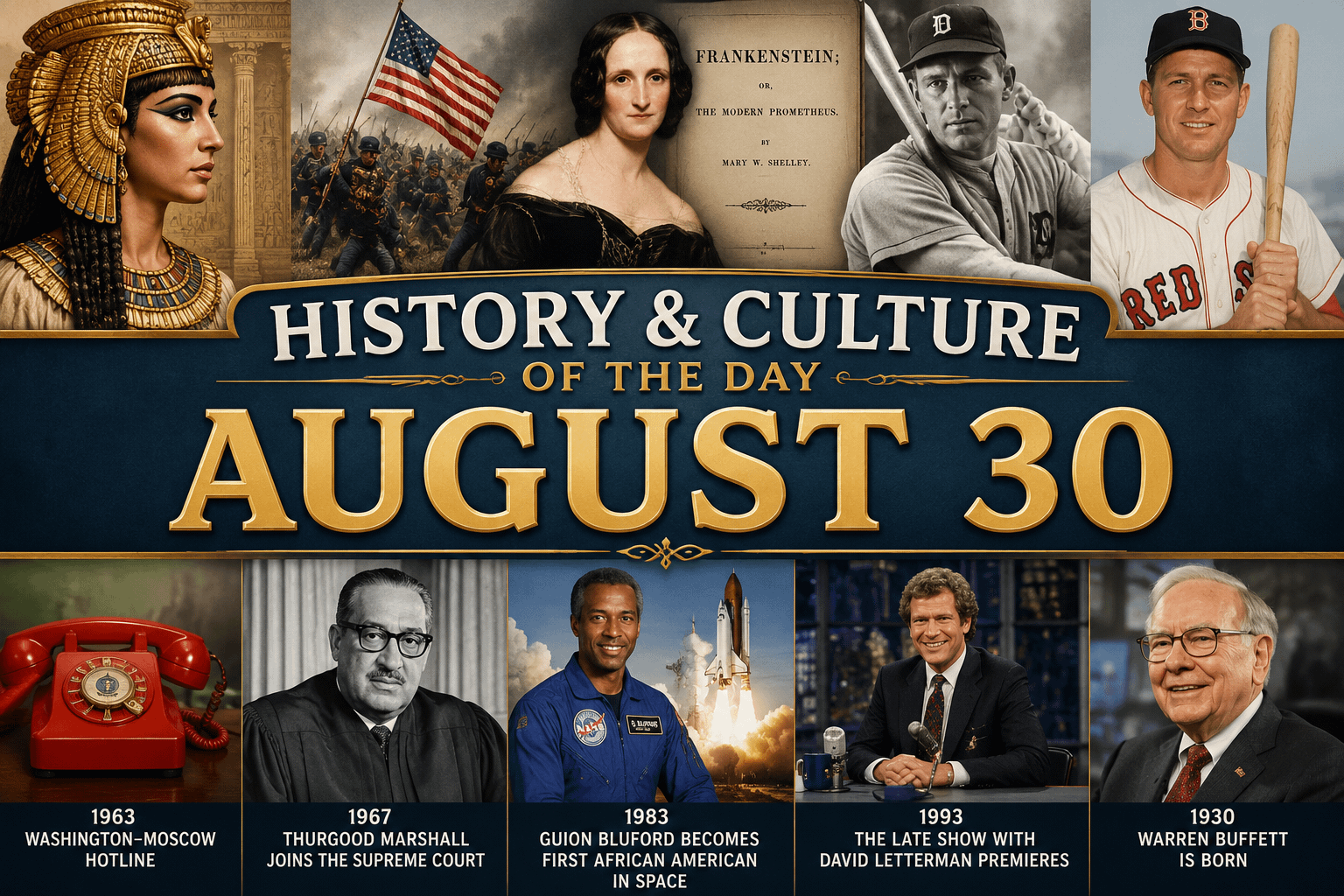
  • History & Culture of the Day – August 30

    History & Culture of the Day – August 30

    Every date on the calendar carries pieces of the human story, and August 30 is no exception. Across centuries, this date has been connected with war and peace, civil rights, literature, sports, business, space exploration, television, and cultural change.

    August 30 takes us from the ancient Mediterranean world to the battlefields of the American Civil War, from Major League Baseball diamonds to the United States Supreme Court, and from the tensions of the Cold War to the frontier of space.

    It is also the birthday of influential figures such as Mary Shelley, Ted Williams, and Warren Buffett, each of whom left a very different mark on culture.

    Looking back at August 30 reminds us that history isn’t simply a collection of dates. It is a record of people making decisions, confronting challenges, creating new ideas, and sometimes changing the direction of society.

    Here is an expanded journey through the history and culture of August 30.


    30 BC – Cleopatra and the End of Ptolemaic Egypt

    Few ancient rulers have captured the imagination of later generations as completely as Cleopatra VII.

    The final active ruler of Egypt’s Ptolemaic dynasty died in 30 BC following the defeat of her forces and those of Mark Antony by Octavian, the future Roman emperor Augustus. Ancient chronologies place her death in August, though the precise date remains uncertain.

    Cleopatra ruled during an extraordinarily dangerous period.

    Rome was becoming the dominant power of the Mediterranean, and internal struggles among Roman leaders threatened Egypt’s independence.

    Cleopatra first became politically connected with Julius Caesar. After Caesar’s assassination in 44 BC, she later formed an alliance and relationship with Mark Antony.

    Their political fortunes became tied together.

    When Octavian defeated Antony and Cleopatra’s forces at the Battle of Actium in 31 BC, their position became increasingly desperate.

    Antony and Cleopatra died the following year.

    Octavian subsequently brought Egypt under Roman control.

    Cleopatra Becomes a Cultural Legend

    Cleopatra’s political importance alone would have secured her place in history, but her cultural legacy became even larger.

    Writers and artists repeatedly reinvented her.

    William Shakespeare’s Antony and Cleopatra transformed her story into one of literature’s great tragedies.

    Painters depicted her death.

    Novelists reimagined her life.

    Hollywood eventually turned Cleopatra into one of cinema’s most recognizable historical figures, most famously with Elizabeth Taylor portraying her in the massive 1963 production Cleopatra.

    The historical Cleopatra was a sophisticated monarch navigating an extraordinarily complicated political environment.

    The Cleopatra of popular culture became something even larger—a symbol of beauty, power, romance, ambition, tragedy, and political intrigue.


    1813 – The Fort Mims Massacre

    On August 30, 1813, one of the most devastating events of the Creek War occurred at Fort Mims, located in present-day Alabama.

    Hundreds of settlers, militia members, enslaved people, and Creek allies had gathered inside the fortified settlement.

    Red Stick Creek warriors attacked the fort.

    The fighting became extraordinarily violent, and hundreds of people were killed.

    News of the attack quickly spread.

    Fear and anger intensified throughout the American frontier, and military forces were mobilized against the Red Sticks.

    The conflict eventually helped propel Andrew Jackson to greater national prominence.

    The Larger Creek War

    The Fort Mims attack cannot be understood without recognizing the broader conflict taking place among Creek communities.

    The Creek War involved divisions within the Creek Nation as well as increasing pressure from American expansion.

    Some Creek people attempted to accommodate growing American influence, while others resisted.

    The Red Stick movement represented those who wanted to defend traditional Creek culture and resist American territorial expansion.

    The conflict eventually became intertwined with the larger War of 1812.

    Andrew Jackson’s forces defeated the Red Sticks at the Battle of Horseshoe Bend in 1814.

    The resulting Treaty of Fort Jackson forced the Creek Nation to surrender enormous amounts of territory.

    Those lands later became part of the expanding American South.

    The events surrounding Fort Mims therefore remain an important chapter in both American and Native American history.


    1862 – The Second Battle of Bull Run Reaches Its Climax

    On August 30, 1862, Union and Confederate armies fought the final major phase of the Second Battle of Bull Run, also called the Second Battle of Manassas.

    The battle took place near Manassas, Virginia.

    It was remarkably close to the location of the First Battle of Bull Run, where the Civil War’s first major land battle had occurred in July 1861.

    But by 1862, the war had changed dramatically.

    Both armies were larger.

    Commanders were more experienced.

    Casualties were increasing.

    And hopes that the conflict would end quickly had largely disappeared.

    Confederate General Robert E. Lee faced Union forces commanded by Major General John Pope.

    After intense fighting, Confederate forces launched a major counterattack that forced the Union army to retreat.

    The Confederate victory strengthened Lee’s position.

    Soon afterward, he moved his army north into Maryland.

    That campaign eventually led to the Battle of Antietam in September 1862—the bloodiest single day in American military history.

    America Realizes the War Will Not End Quickly

    The Second Battle of Bull Run represented something larger than another Confederate victory.

    It demonstrated the increasing scale of the Civil War.

    The romantic ideas about warfare that had existed when the conflict began were disappearing.

    Families across the country were receiving casualty reports.

    Communities were losing sons, fathers, brothers, and friends.

    The Civil War was becoming a national tragedy whose consequences would reshape the United States permanently.


    1797 – Mary Shelley Is Born

    On August 30, 1797, Mary Wollstonecraft Shelley was born in London.

    Few writers could have imagined that a novel written while they were still a teenager would influence literature and popular culture for more than two centuries.

    Yet that is exactly what happened with Mary Shelley’s Frankenstein; or, The Modern Prometheus.

    Shelley grew up surrounded by intellectual ideas.

    Her father was political philosopher William Godwin, while her mother was pioneering writer and women’s rights advocate Mary Wollstonecraft.

    Mary Wollstonecraft died shortly after giving birth to her daughter.

    Mary Shelley later became involved with poet Percy Bysshe Shelley, whom she eventually married.

    The Famous Birth of Frankenstein

    The origins of Frankenstein have become almost as famous as the novel itself.

    During the unusually cold and rainy summer of 1816, Mary Shelley spent time near Lake Geneva with Percy Shelley, Lord Byron, and others.

    The group challenged one another to write ghost stories.

    Mary began imagining the horrifying possibility of a scientist discovering how to create life.

    That idea eventually became Frankenstein.

    The novel was published anonymously in 1818.

    Mary Shelley was only about 20 years old.

    More Than a Monster Story

    Modern popular culture often reduces Frankenstein to a monster story.

    Shelley’s novel is far more complicated.

    It asks questions that remain surprisingly modern:

    What responsibilities do creators have toward what they create?

    Should science pursue everything it is capable of achieving?

    What happens when people are rejected by society?

    How much responsibility does society have for creating the people it fears?

    What are the consequences of uncontrolled ambition?

    Those questions have become increasingly relevant as humanity develops technologies Shelley could never have imagined.

    Frankenstein Takes Over Popular Culture

    The creature eventually escaped the pages of Shelley’s novel and became one of the world’s most recognizable fictional characters.

    Stage productions adapted the story.

    Then Hollywood transformed it.

    The 1931 film Frankenstein, starring Boris Karloff as the creature, helped establish the visual image most people recognize today.

    The flattened head, heavy boots, laboratory machinery, electrical equipment, and towering creature became permanent pieces of horror culture.

    Frankenstein now appears in movies, cartoons, comic books, Halloween decorations, toys, television programs, advertisements, and countless parodies.

    Mary Shelley’s creation became larger than the original book.


    1905 – Ty Cobb Makes His Major League Baseball Debut

    On August 30, 1905, a young baseball player named Ty Cobb made his Major League debut for the Detroit Tigers.

    Few people watching that game could have known they were witnessing the beginning of one of baseball’s most famous careers.

    Cobb became one of the dominant hitters of the early 20th century.

    He was known for his remarkable ability to reach base, steal bases, hit for average, and pressure opposing teams.

    His aggressive style became legendary.

    Baseball During the Dead-Ball Era

    Cobb played much of his career during what became known as baseball’s dead-ball era.

    Home runs were relatively uncommon compared with later decades.

    Teams relied heavily on strategy.

    Players bunted.

    They stole bases.

    They attempted hit-and-run plays.

    Pitchers often dominated games.

    Cobb became one of the masters of that style.

    His career helped define an era when professional baseball was becoming deeply embedded in American culture.

    Baseball stadiums became community gathering places, players became national celebrities, and newspapers devoted enormous space to the sport.

    Cobb remains one of the most recognizable names from baseball’s early history.


    1918 – Ted Williams Is Born

    Another baseball legend connected with August 30 arrived thirteen years after Cobb’s debut.

    Ted Williams was born on August 30, 1918, in San Diego, California.

    Williams eventually became one of baseball’s greatest hitters.

    Playing for the Boston Red Sox, he developed an almost scientific approach to hitting.

    He studied pitchers.

    He understood the strike zone.

    He practiced relentlessly.

    And he became famous for refusing to swing at pitches he believed he could not hit effectively.

    The Legendary 1941 Season

    Williams achieved one of baseball’s most famous accomplishments in 1941.

    He finished the season with a batting average above .400.

    No qualified Major League Baseball player has finished a season at .400 or better since.

    The achievement became one of baseball’s legendary benchmarks.

    Baseball Career Interrupted by War

    Williams’ life was about more than baseball.

    His career was interrupted by military service during World War II.

    He later returned to military duty during the Korean War.

    Williams served as a Marine aviator and flew combat missions.

    Those years removed significant playing time from what was already an extraordinary baseball career.

    Despite those interruptions, Williams remains one of the most celebrated hitters in baseball history.


    1930 – Warren Buffett Is Born

    On August 30, 1930, future investor and philanthropist Warren Buffett was born in Omaha, Nebraska.

    Buffett developed an interest in money and business while still young.

    He reportedly experimented with small entrepreneurial ventures and became fascinated by investing.

    That interest eventually developed into one of the most successful investment careers in modern history.

    Buffett became closely associated with Berkshire Hathaway, transforming it into a massive holding company with investments and ownership interests spanning numerous industries.

    The Oracle of Omaha

    Buffett became known as the “Oracle of Omaha.”

    Rather than constantly chasing financial trends, he became famous for emphasizing patience and long-term value.

    His investment philosophy generally focused on understanding businesses, evaluating their long-term prospects, and avoiding unnecessary speculation.

    Buffett also became culturally unusual because of the contrast between his enormous wealth and his comparatively modest public lifestyle.

    His annual Berkshire Hathaway shareholder meetings became major events, attracting investors from around the world.

    A Legacy of Philanthropy

    Buffett also pledged to give away most of his fortune.

    Along with Bill and Melinda Gates, he helped launch the Giving Pledge, encouraging wealthy individuals to commit significant portions of their fortunes to charitable causes.

    His legacy therefore extends beyond investing into philanthropy and discussions about the responsibilities associated with extraordinary wealth.


    1963 – The Washington–Moscow Hotline Begins Operation

    One of the most important Cold War communication developments became operational on August 30, 1963.

    The United States and Soviet Union established a direct communications link between Washington and Moscow.

    The decision followed one of the most dangerous moments in human history.

    In October 1962, the Cuban Missile Crisis brought the United States and Soviet Union frighteningly close to nuclear war.

    Soviet nuclear missiles had been discovered in Cuba.

    President John F. Kennedy’s administration demanded their removal.

    For nearly two weeks, the world waited while two nuclear superpowers confronted each other.

    Communication Could Mean Survival

    One major problem became painfully obvious during the crisis.

    Messages between the governments could take too long.

    When nuclear weapons were involved, delays or misunderstandings could have catastrophic consequences.

    The hotline provided a more reliable way for American and Soviet leaders to communicate during emergencies.

    Popular culture later imagined the hotline as a dramatic red telephone sitting on the president’s desk.

    Reality was less cinematic.

    The original system relied primarily on written communication.

    Still, the cultural image of the red phone became enormously powerful.

    Movies, television shows, political cartoons, and advertisements repeatedly used it as shorthand for emergency communication between superpowers.

    The hotline represented something profoundly important:

    Even enemies need to communicate.


    1967 – Thurgood Marshall Is Confirmed to the Supreme Court

    On August 30, 1967, the United States Senate confirmed Thurgood Marshall as an associate justice of the U.S. Supreme Court.

    Marshall became the first Black justice in Supreme Court history.

    His confirmation represented an extraordinary milestone.

    But Marshall’s influence on American law had begun decades earlier.

    The Lawyer Who Challenged Segregation

    Before becoming a judge, Marshall worked as an attorney fighting racial discrimination.

    He became one of the country’s leading civil rights lawyers.

    His most famous case was Brown v. Board of Education.

    In 1954, the Supreme Court ruled that racial segregation in public schools violated the Constitution.

    The decision became one of the defining legal victories of the Civil Rights Movement.

    Marshall later served as a federal appeals court judge and U.S. solicitor general before President Lyndon B. Johnson nominated him to the Supreme Court.

    A Historic Moment for Representation

    Marshall’s arrival on the Supreme Court carried enormous cultural significance.

    For generations, Black Americans had been excluded from many of the nation’s most powerful institutions.

    Now a Black American would sit on the country’s highest court.

    Marshall served until 1991.

    His life remains closely connected with America’s continuing struggle to fulfill its promises of equality and justice under the law.


    1983 – Guion Bluford Becomes the First African American in Space

    On August 30, 1983, another barrier in American history was broken.

    NASA astronaut Guion S. Bluford Jr. became the first African American to travel into space.

    Bluford launched aboard the Space Shuttle Challenger during the STS-8 mission.

    Before joining NASA, Bluford had already built an impressive career.

    He was an Air Force pilot, engineer, and Vietnam War veteran.

    Representation Beyond Earth

    Bluford’s flight carried significance far beyond the technical objectives of the mission.

    Millions of Americans saw an African American astronaut traveling into space.

    For young people watching the launch—particularly Black children interested in science and engineering—the moment demonstrated that careers once seemingly closed to them were becoming possible.

    Bluford eventually completed four space shuttle missions.

    His career became part of the broader story of America’s space program and its gradual expansion to include people from increasingly diverse backgrounds.


    1993 – David Letterman Begins a New Era of Late-Night Television

    On August 30, 1993, American television entered another memorable chapter when Late Show with David Letterman premiered on CBS.

    Letterman had already developed a loyal audience during his years hosting Late Night with David Letterman on NBC.

    After Johnny Carson retired from The Tonight Show, many observers expected Letterman to become Carson’s successor.

    Instead, the position went to Jay Leno.

    Letterman moved to CBS.

    The result was one of television history’s most famous rivalries.

    Letterman vs. Leno

    Throughout the 1990s, audiences and entertainment journalists constantly compared Letterman and Leno.

    Ratings became news.

    Celebrity appearances became competitive.

    Monologues were analyzed.

    The rivalry demonstrated how culturally important late-night television had become.

    Letterman’s Influence

    David Letterman’s humor often rejected the polished conventions of traditional television.

    He embraced awkwardness.

    He made fun of television itself.

    He introduced strange characters and unusual comedy segments.

    His famous Top Ten Lists became part of American popular culture.

    Letterman’s influence can still be seen in generations of comedians and late-night hosts who followed him.

    He remained at CBS until his retirement in 2015.


    2003 – Charles Bronson Dies

    Actor Charles Bronson died on August 30, 2003, at the age of 81.

    Bronson became one of Hollywood’s most recognizable tough-guy actors.

    His career included appearances in several classic films, including:

    • The Magnificent Seven
    • The Great Escape
    • The Dirty Dozen
    • Once Upon a Time in the West
    • Death Wish

    Bronson’s quiet, rugged screen presence became his trademark.

    He rarely needed long speeches to communicate danger or determination.

    During the 1970s and 1980s, he became especially associated with action and revenge films.

    The success of the Death Wish series helped shape the vigilante-action genre that would become increasingly common in Hollywood.


    Famous Birthdays on August 30

    August 30 has produced an impressive collection of influential figures from literature, sports, entertainment, music, business, and athletics.

    Mary Shelley – 1797

    Author of Frankenstein, Shelley helped establish many of the ideas associated with modern science fiction.

    Ted Williams – 1918

    The Boston Red Sox legend became one of baseball’s greatest hitters and remains the last qualified MLB player to finish a season batting .400 or better.

    Kitty Wells – 1919

    Known as one of country music’s pioneering female stars, Kitty Wells helped open doors for generations of women in country music.

    Warren Buffett – 1930

    One of the world’s best-known investors, Buffett became famous for long-term investing and philanthropy.

    John Phillips – 1935

    Musician John Phillips became closely associated with the 1960s group The Mamas & the Papas.

    Their music became part of the soundtrack of the counterculture era.

    Jean-Claude Killy – 1943

    French skier Jean-Claude Killy became one of alpine skiing’s greatest champions and won three gold medals at the 1968 Winter Olympics.

    Peggy Lipton – 1946

    Actress Peggy Lipton became famous through The Mod Squad and later appeared in the cult television series Twin Peaks.

    Lewis Black – 1948

    Comedian Lewis Black became known for his distinctive style of frustrated, energetic observational comedy.

    Michael Chiklis – 1963

    Actor Michael Chiklis became widely recognized through television series including The Commish and The Shield, as well as his portrayal of The Thing in Fantastic Four films.

    Cameron Diaz – 1972

    Actress Cameron Diaz became one of Hollywood’s most recognizable stars of the 1990s and 2000s, appearing in films including The Mask, There’s Something About Mary, Charlie’s Angels, and Shrek.


    August 30 and the Evolution of American Culture

    When the events of August 30 are viewed together, several important themes emerge.

    Communication Can Prevent Conflict

    The Washington–Moscow hotline reminds us that communication is sometimes more important when people disagree than when they agree.

    During the Cold War, misunderstandings could potentially have triggered nuclear conflict.

    Creating reliable communication between rival governments was therefore not simply diplomatic—it was potentially lifesaving.

    That lesson continues to matter today.


    Representation Changes What Future Generations Believe Is Possible

    Thurgood Marshall’s confirmation to the Supreme Court and Guion Bluford’s journey into space occurred sixteen years apart.

    Both moments represented barriers being broken.

    Marshall entered an institution where no Black justice had previously served.

    Bluford traveled somewhere no African American had previously gone.

    Representation alone cannot erase inequality, but visible milestones can change expectations.

    A child watching Bluford launch into space could imagine becoming an astronaut.

    A young student studying Marshall could imagine becoming a lawyer or Supreme Court justice.

    Historical milestones can become invitations for future generations.


    Sports Become Part of National Identity

    The stories of Ty Cobb and Ted Williams demonstrate how deeply baseball became intertwined with American culture.

    Baseball was never merely a game.

    It became connected with childhood, neighborhoods, cities, family traditions, radio broadcasts, newspapers, summer afternoons, and national memory.

    Generations of Americans could identify players simply by hearing their names.

    Cobb represented baseball’s early professional era.

    Williams became one of the defining stars of the game’s mid-20th-century period.

    Their careers helped transform athletes into national cultural figures.


    Literature Can Outlive Its Creator

    Mary Shelley could never have known exactly what would happen to Frankenstein.

    She created a story.

    Culture created an icon.

    That transformation demonstrates one of the fascinating aspects of art.

    Once writers, musicians, filmmakers, and artists release their work into the world, future generations reinterpret it.

    Sometimes the creation becomes more famous than the creator.

    Today, millions of people recognize Frankenstein’s creature even if they have never read Shelley’s novel.

    Yet behind every Halloween costume and movie adaptation remains the imagination of a young woman born on August 30, 1797.


    Television Creates Shared Cultural Moments

    David Letterman’s CBS debut represents another kind of cultural transformation.

    Before streaming services and social media fragmented entertainment audiences, television programs could become enormous shared experiences.

    Millions of people watched the same programs.

    They discussed the same interviews.

    They repeated the same jokes.

    They recognized the same personalities.

    Late-night television became particularly influential because it blended entertainment with current events.

    Hosts commented on politicians, celebrities, scandals, movies, sports, and everyday life.

    Those shows became informal historical records of American culture.


    August 30 Through the Centuries

    One of the most fascinating things about studying a single date is seeing how dramatically civilization changes.

    Imagine traveling through the August 30s represented in this article.

    In the ancient world, Egypt was being absorbed into Roman power.

    By 1797, Mary Shelley was being born into an age of political revolution and intellectual experimentation.

    By 1862, Americans were fighting one another during the Civil War.

    By 1905, professional baseball was becoming a national obsession.

    By 1963, nuclear weapons had made global communication a matter of human survival.

    By 1967, the Civil Rights Movement was transforming American institutions.

    By 1983, human beings were routinely traveling beyond Earth’s atmosphere aboard reusable spacecraft.

    By 1993, television networks were battling for millions of viewers during the late-night hours.

    Each generation believes its world is modern.

    History reminds us how quickly “modern” becomes the past.


    What August 30 Can Teach Us

    The history of August 30 contains several lessons worth remembering.

    Progress often requires someone to go first.

    Thurgood Marshall and Guion Bluford stepped into places where African Americans had previously been excluded.

    Communication matters.

    The Cold War hotline existed because leaders recognized that misunderstanding could have catastrophic consequences.

    Creativity can survive for centuries.

    Mary Shelley’s Frankenstein remains culturally relevant more than 200 years after its publication.

    Sports can become history.

    Players such as Ty Cobb and Ted Williams became part of America’s cultural memory.

    Entertainment reflects its era.

    David Letterman’s television career provides a window into American humor and popular culture during the late 20th and early 21st centuries.

    And perhaps most importantly:

    History is still being written.

    The people living through these moments rarely knew exactly how future generations would remember them.

    Neither do we.


    Remembering August 30

    August 30 connects remarkably different pieces of the human experience.

    It carries stories of conflict and reconciliation.

    It reminds us of the dangers of war and the importance of communication.

    It celebrates achievements in literature, sports, civil rights, science, business, and entertainment.

    From Mary Shelley’s imagination to Ted Williams’ legendary swing, from Thurgood Marshall’s place on the Supreme Court to Guion Bluford looking down at Earth from space, the date contains stories of people pushing against boundaries.

    Some boundaries were political.

    Some were social.

    Some were technological.

    Others existed only in the imagination.

    That is what makes studying history so valuable.

    History allows us to see that the world we know today was not inevitable. It was created through countless choices, struggles, discoveries, failures, victories, and ideas.

    Tomorrow will be shaped in much the same way.


    History & Culture Question of the Day

    If you could travel back in time and witness one event or meet one person connected with August 30, which would you choose?

    Would you meet Mary Shelley and ask what inspired Frankenstein?

    Would you watch Ted Williams step into the batter’s box?

    Would you witness Thurgood Marshall’s historic confirmation?

    Would you watch Guion Bluford launch into space aboard Challenger?

    Or would you choose another moment entirely?

    Share your answer and tell us why that piece of August 30 history interests you most.

    Final Thought

    Every day has a history.

    Every generation adds another chapter.

    And every person living today is participating in events that future generations may someday study.

    August 30 reminds us to look backward with curiosity, understand the struggles and achievements that brought us here, and recognize that the history of tomorrow is being created today.
  • This Day in American History – August 30

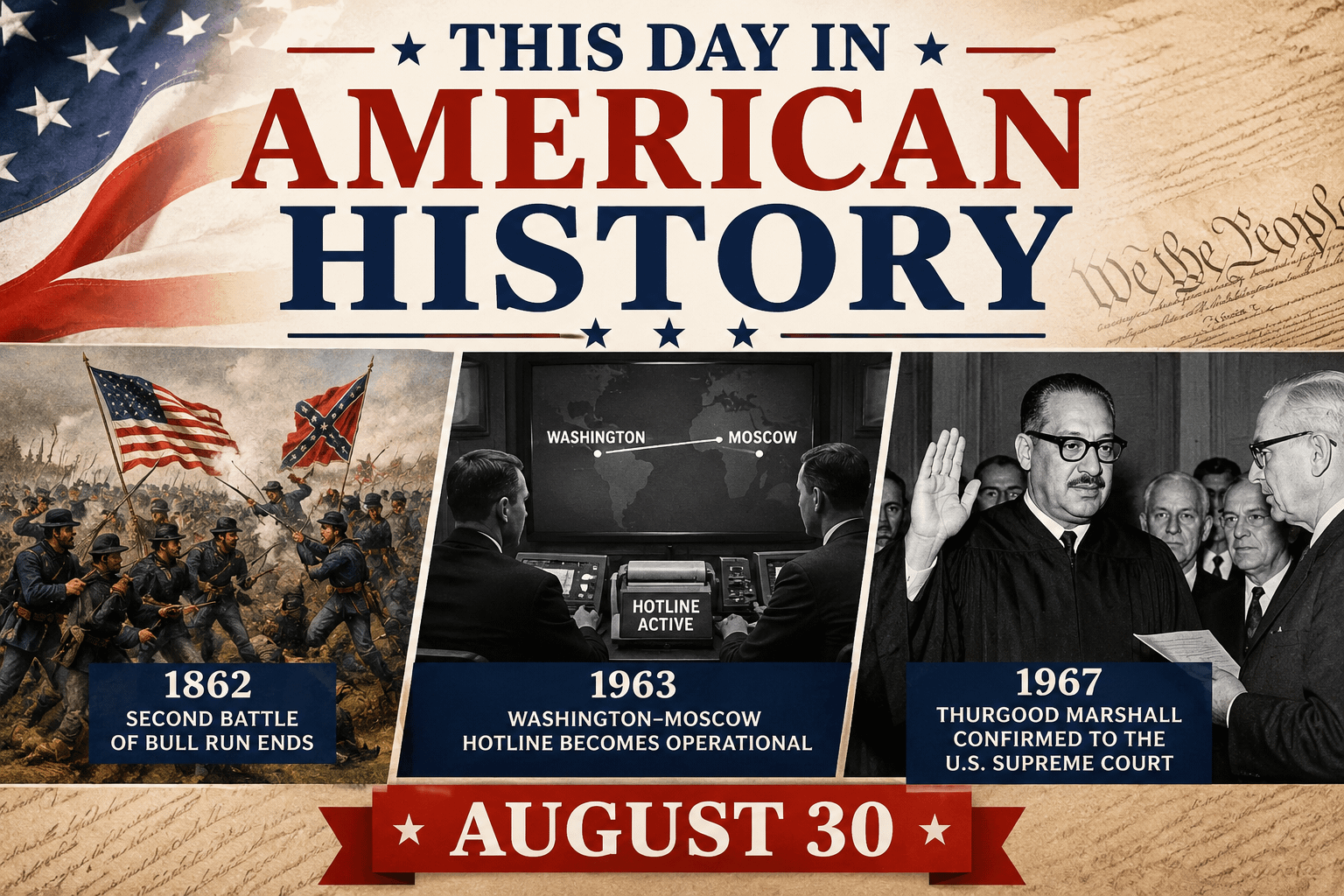
    This Day in American History – August 30

    Every date on the calendar carries stories from America’s past, but August 30 stands out for several events that helped shape the nation’s military history, foreign policy, civil rights movement, and highest court.

    From the bloody fields of the Civil War to the tense nuclear rivalry of the Cold War and the historic confirmation of the first African American Supreme Court justice, August 30 offers a fascinating look at how the United States has changed across generations.

    Some moments were defined by conflict. Others demonstrated the importance of communication, diplomacy, persistence, and equality.

    Here is a deeper look at what happened on August 30 in American history.


    1862 – The Second Battle of Bull Run Reaches Its Climax

    On August 30, 1862, one of the most significant battles of the American Civil War reached its dramatic conclusion.

    The Second Battle of Bull Run, also known as the Second Battle of Manassas, had begun on August 28 near Manassas, Virginia.

    It was fought only about 13 months after the First Battle of Bull Run had taken place across much of the same countryside.

    But the second battle was considerably larger and bloodier. The National Park Service describes Second Manassas as four times larger and four times bloodier than the first battle.

    By the summer of 1862, the Civil War had already become something far different from the relatively short conflict many Americans had initially imagined.

    Both Union and Confederate armies had gained experience.

    Their commanders understood the enormous stakes.

    And the casualty lists were growing.


    Robert E. Lee Takes the Initiative

    Confederate General Robert E. Lee had assumed command of the Army of Northern Virginia earlier that summer.

    Lee quickly demonstrated his willingness to take risks and seize the initiative.

    His Confederate forces confronted the Union Army of Virginia commanded by Major General John Pope.

    One of Lee’s most important commanders, Major General Thomas “Stonewall” Jackson, had moved behind Union positions and established a defensive line near an unfinished railroad.

    Meanwhile, Lieutenant General James Longstreet’s forces arrived to strengthen Lee’s army.

    Pope incorrectly believed that Jackson might be preparing to retreat.

    That misunderstanding would prove costly.


    August 30: The Union Attacks

    On August 30, Pope ordered another major Union assault against Jackson’s position.

    The attack initially placed pressure on Confederate troops, but the Union soldiers were attacking a strong defensive position.

    Confederate artillery and infantry eventually stopped the assault.

    Then the battle changed dramatically.

    Lee and Longstreet launched a massive counterattack against the exposed Union left.

    According to the American Battlefield Trust, Longstreet’s wing—reinforced by Lee and numbering nearly 30,000 men—swept eastward toward Henry Hill as Confederate commanders attempted to cut off Pope’s escape.

    Union soldiers desperately attempted to slow the Confederate advance.

    Fierce resistance on Chinn Ridge bought valuable time for Union forces to establish another defensive position around Henry Hill.

    As darkness approached, the Confederate advance finally lost momentum.

    Pope ordered his defeated army to retreat across Bull Run.


    A Major Confederate Victory

    The Second Battle of Bull Run became one of the most important Confederate victories of 1862.

    The fighting had been devastating.

    Historical estimates cited by the National Park Service place Federal losses during the Second Manassas campaign at more than 14,000 killed, wounded, captured, or missing, with thousands of Confederate casualties as well.

    Beyond the human cost, the battle changed the strategic situation in the eastern theater of the Civil War.

    Lee had pushed Union forces away from Richmond and toward Washington.

    Confederate confidence was rising.

    The victory helped open the way for Lee’s first major offensive campaign north of the Potomac River.

    Within days, Lee’s army would begin moving into Maryland.

    That campaign would eventually lead to another historic confrontation.

    The Battle of Antietam would be fought on September 17, 1862.


    1963 – The Washington–Moscow Hotline Becomes Operational

    Jump forward almost exactly a century, and America faced an entirely different kind of threat.

    Instead of armies confronting one another across a battlefield, two nuclear superpowers faced one another across the world.

    The United States and Soviet Union were locked in the Cold War.

    By the early 1960s, both countries possessed nuclear arsenals capable of causing destruction on a scale previously unimaginable.

    Then came the Cuban Missile Crisis.


    The World Comes Close to Nuclear War

    In October 1962, American intelligence discovered Soviet nuclear missile installations being constructed in Cuba.

    Cuba sits only about 90 miles from Florida.

    President John F. Kennedy demanded that the missiles be removed and announced a naval quarantine around the island.

    For nearly two weeks, the world watched as Washington and Moscow moved dangerously close to military confrontation.

    One of the problems exposed during the crisis was surprisingly simple:

    Communication was too slow.

    Messages between Kennedy and Soviet Premier Nikita Khrushchev could take hours to transmit, translate, deliver, and answer.

    When nuclear weapons were involved, hours mattered.

    A delayed message, misunderstood statement, or military action taken without political approval could potentially trigger catastrophe.


    A Better Way to Communicate

    After the Cuban Missile Crisis, American and Soviet officials recognized the need for a faster method of communication during emergencies.

    The two governments negotiated an agreement establishing a direct communications link between Washington and Moscow.

    The agreement was signed in June 1963.

    On August 30, 1963, the hotline became operational.

    The U.S. State Department’s historical records identify August 30, 1963, as the date the hotline was established to provide rapid communication between American and Soviet leaders.


    It Wasn’t Actually a Red Telephone

    Popular culture often depicts the Cold War hotline as a bright red telephone sitting on the president’s desk.

    That’s a memorable image.

    But it isn’t how the original system worked.

    The first Washington–Moscow hotline relied primarily on written communications transmitted electronically, rather than direct voice conversations between the president and Soviet premier.

    There was an important reason for using written messages.

    Written communication gave leaders time to carefully compose, translate, and review extremely sensitive messages without the possibility that an incorrectly heard word or poor telephone connection could create additional confusion.

    The goal wasn’t casual conversation.

    The hotline was designed for emergencies.


    Why the Hotline Mattered

    The hotline represented an important lesson learned from the Cuban Missile Crisis.

    Sometimes preventing war requires something as basic as making sure opposing leaders can communicate quickly.

    The system reduced the time required to exchange urgent messages and provided another safeguard against accidental escalation.

    It was eventually used during later international crises.

    The hotline became one of the enduring symbols of Cold War diplomacy—a reminder that even bitter rivals recognized the importance of maintaining communication when the consequences of misunderstanding could be catastrophic.


    1967 – Thurgood Marshall Makes Supreme Court History

    Only four years after the Washington–Moscow hotline became operational, another historic event occurred on August 30.

    This time the story wasn’t about war or international diplomacy.

    It was about civil rights, justice, and the changing face of America’s institutions.

    On August 30, 1967, the United States Senate confirmed Thurgood Marshall as an associate justice of the Supreme Court.

    The vote was 69–11.

    Marshall became the first African American justice in the history of the United States Supreme Court.

    It was an extraordinary milestone.

    But Marshall’s journey to the Supreme Court had begun decades earlier.


    Thurgood Marshall Before the Supreme Court

    Marshall was born in Baltimore, Maryland, in 1908.

    He developed an interest in law and eventually attended Howard University School of Law, where he studied under influential civil rights lawyer and educator Charles Hamilton Houston.

    Marshall would become one of the most important civil rights attorneys in American history.

    Rather than simply arguing that segregation was unfair, Marshall and other civil rights attorneys systematically challenged discriminatory laws through the American court system.

    Their strategy required patience.

    Case by case.

    Court by court.

    Precedent by precedent.

    They worked to dismantle the legal structure supporting racial segregation.


    Brown v. Board of Education

    Marshall’s most famous legal victory came in Brown v. Board of Education of Topeka.

    The case challenged racial segregation in America’s public schools.

    In 1954, the Supreme Court unanimously ruled that state-mandated racial segregation in public education violated the Constitution.

    The decision became one of the most important civil rights rulings in American history.

    For Marshall, the victory represented years of legal work challenging segregation.

    But his career was far from over.


    From Advocate to Federal Judge

    Marshall’s accomplishments eventually led him into federal service.

    President John F. Kennedy nominated him to the United States Court of Appeals for the Second Circuit.

    Marshall later became Solicitor General of the United States, representing the federal government before the Supreme Court.

    Then President Lyndon B. Johnson nominated him to the Supreme Court on June 13, 1967.

    The nomination itself was historic.

    After Senate consideration, Marshall was confirmed on August 30.

    The official Senate record lists his nomination date as June 13, his confirmation vote as 69–11, and his confirmation date as August 30, 1967.


    A Powerful Symbol of Change

    Marshall’s confirmation carried enormous historical significance.

    For generations, African Americans had been denied equal protection under laws and institutions that were supposed to represent every American.

    Now an African American lawyer who had spent much of his professional life challenging discrimination would sit on the country’s highest court.

    Think about the historical transformation represented by that moment.

    In 1862, Americans were fighting a Civil War deeply connected to slavery and the future of freedom in the United States.

    In 1967, only 105 years later, Thurgood Marshall was confirmed as the first African American justice of the Supreme Court.

    Those two August 30 events were separated by slightly more than a century.

    Yet they belong to interconnected chapters of the American story.


    Marshall’s Years on the Supreme Court

    Marshall would serve on the Supreme Court for approximately 24 years.

    Throughout his judicial career, he remained strongly associated with issues involving civil rights, constitutional protections, equality, criminal justice, and individual liberties.

    His presence on the Court also carried significance beyond individual decisions.

    For generations of Americans who had rarely seen African Americans represented in the country’s most powerful institutions, Marshall’s appointment demonstrated that change—however slow—was possible.


    Three August 30 Events, Three Different Americas

    Looking at the major events of August 30 together provides an unusual snapshot of American history.

    August 30, 1862: A Nation Divided

    The Second Battle of Bull Run represents one of America’s darkest periods.

    Americans were fighting Americans.

    Families were divided.

    Communities were devastated.

    Thousands of soldiers were killed, wounded, captured, or missing.

    The survival and future character of the United States remained uncertain.

    August 30, 1963: A World Facing Nuclear Danger

    One hundred and one years later, America’s greatest military danger came not from another American army but from the possibility of nuclear confrontation with another superpower.

    The Washington–Moscow hotline represented an attempt to prevent misunderstanding from turning political confrontation into nuclear war.

    August 30, 1967: Breaking a Historic Barrier

    Four years later, Thurgood Marshall’s confirmation represented another type of transformation.

    An institution that had once issued decisions supporting racial inequality now welcomed its first African American justice.

    History had not erased America’s racial divisions, but Marshall’s confirmation represented a significant milestone in the country’s long struggle toward equality under the law.


    The Connections Between These Events

    At first glance, a Civil War battle, a Cold War communications system, and a Supreme Court confirmation might seem completely unrelated.

    But each tells us something about the challenges faced by the United States.

    The Second Battle of Bull Run demonstrates the terrible consequences of national division.

    The Washington–Moscow hotline demonstrates the importance of communication when conflict threatens to spiral beyond anyone’s control.

    Thurgood Marshall’s confirmation demonstrates how people can challenge institutions and eventually help transform them.

    Together, these events illustrate three recurring themes in American history:

    Conflict. Communication. Change.


    History Is More Than Dates

    It can be easy to think of history as a collection of names, dates, presidents, battles, and court decisions.

    But history becomes more meaningful when we consider the people living through those events.

    Imagine being a Union soldier retreating across Bull Run on the night of August 30, 1862.

    Imagine working inside the Kennedy administration only months after the Cuban Missile Crisis, knowing how close the world had come to nuclear confrontation.

    Imagine being an African American child in 1967 and hearing that Thurgood Marshall had just become the first Black Supreme Court justice.

    For the people living through those moments, these weren’t historical facts.

    They were current events.

    Nobody knew exactly what would happen next.

    That is one of the most valuable lessons history can teach us.

    The people of the past experienced uncertainty just as we do.


    Why Studying American History Matters

    Understanding history helps us recognize how the America of today was created.

    Our laws did not appear overnight.

    Our institutions evolved.

    Our freedoms were debated, challenged, defended, and expanded.

    Our foreign policy was shaped by moments when leaders made decisions under enormous pressure.

    Our national identity developed through triumphs as well as tragedies.

    Studying history doesn’t require believing that everything America has done was right.

    Nor does it require viewing every historical event only through the mistakes that were made.

    It means examining the past carefully enough to understand both achievement and failure.

    That allows future generations to learn from both.


    What August 30 Can Teach Us

    The events associated with August 30 leave several lessons worth remembering.

    Leadership matters.

    The decisions made by commanders, presidents, diplomats, senators, attorneys, and judges can affect generations.

    Communication matters.

    The Washington–Moscow hotline demonstrated that sometimes keeping people talking can help prevent catastrophe.

    Persistence matters.

    Thurgood Marshall spent years challenging discriminatory laws before eventually joining the country’s highest court.

    History is connected.

    The Civil War, Reconstruction, segregation, the Civil Rights Movement, and Marshall’s confirmation were not isolated chapters. Each developed from circumstances created by what came before.

    Progress is rarely simple.

    American history contains advances and setbacks, victories and tragedies, moments of unity and periods of profound division.

    Understanding all of them gives us a fuller picture of the country.


    August 30 in American History: A Timeline

    1862 — Second Battle of Bull Run:
    Confederate forces under Robert E. Lee defeat Major General John Pope’s Union army in northern Virginia. The victory helps open the way for Lee’s Maryland Campaign.

    1963 — Washington–Moscow Hotline:
    A direct communications link between the governments of the United States and Soviet Union becomes operational following lessons learned during the Cuban Missile Crisis.

    1967 — Thurgood Marshall Confirmed:
    The U.S. Senate confirms Marshall to the Supreme Court by a 69–11 vote, making him the first African American justice in Supreme Court history.


    Remembering August 30

    August 30 demonstrates just how much American history can be contained within a single date.

    On one August 30, soldiers fought desperately across the fields of Virginia.

    On another, American and Soviet officials established a communications system designed to help prevent nuclear war.

    And on another, Thurgood Marshall broke one of the most significant racial barriers in the American judiciary.

    Different centuries.

    Different challenges.

    Different Americans.

    Yet each moment became part of the same continuing national story.


    Final Thoughts

    August 30 is a day that reminds us how dramatically America can change across generations.

    The soldiers fighting at Second Manassas in 1862 could never have imagined nuclear superpowers communicating instantly across continents a century later.

    Americans living through the segregation era might have struggled to imagine an African American justice sitting on the Supreme Court.

    And those of us studying these events today already know something the people living through them did not:

    what happened next.

    That perspective is one of history’s greatest gifts.

    It allows us to look backward and see consequences that were invisible at the time.

    It allows us to recognize turning points.

    And perhaps most importantly, it reminds us that the events happening in our own time will someday become history too.

    The decisions we make, the challenges we confront, and the lessons we pass to future generations all become part of the story.

    Because American history isn’t merely a record of where we’ve been.

    It is a continuing story of conflict, courage, change, and the ongoing effort to determine what America will become next.

    Question of the Day

    If you could witness one August 30 moment firsthand—the final day of the Second Battle of Bull Run, the opening of the Washington–Moscow hotline, or Thurgood Marshall’s historic Supreme Court confirmation—which would you choose, and why?

  • History & Culture of the Day – August 29

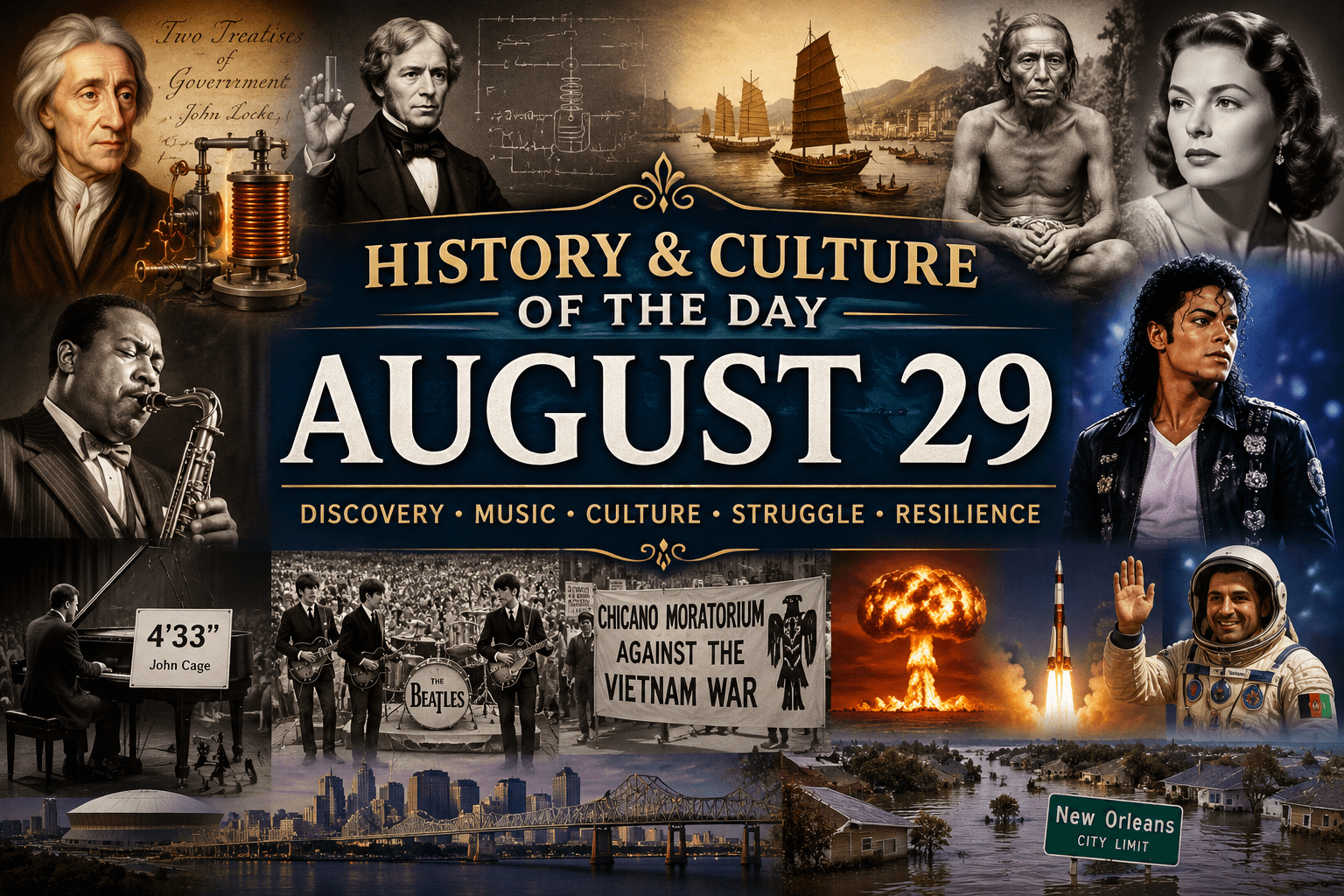
    History & Culture of the Day – August 29

    Every date on the calendar carries stories, but August 29 is especially rich with events that helped shape science, politics, music, civil rights, entertainment, and modern culture.

    Across several centuries, August 29 has witnessed groundbreaking scientific discoveries, international treaties, cultural milestones, legendary birthdays, social movements, technological achievements, and devastating tragedy.

    It is the date associated with Michael Faraday’s experiments with electromagnetic induction, the end of the First Opium War, the emergence of Ishi in California, the birth of jazz legend Charlie Parker, the Soviet Union’s first successful atomic bomb test, the premiere of John Cage’s controversial 4’33”, the birth of Michael Jackson, the Beatles’ final scheduled concert before a paying audience, the Chicano Moratorium, and the devastating landfall of Hurricane Katrina.

    Taken together, these moments show how history is not simply a collection of dates.

    History is the story of people making discoveries, challenging traditions, fighting for change, creating art, surviving disasters, and leaving behind ideas that continue influencing generations.

    Let’s travel through the remarkable history and culture connected to August 29.


    1632 – Philosopher John Locke Is Born

    Our journey begins on August 29, 1632, with the birth of English philosopher John Locke.

    Locke would become one of the most influential thinkers of the Enlightenment.

    His writings explored questions that remain central to political life today:

    What rights belong naturally to individuals?

    Where does government receive its authority?

    When does a government lose the right to govern?

    What responsibilities do governments have toward their citizens?

    Locke argued that people possess natural rights and that legitimate government depends upon the consent of the governed.

    His political philosophy influenced Enlightenment thinkers throughout Europe and eventually helped shape political ideas in America.

    Concepts involving individual liberty, representative government, property, religious tolerance, and limitations on political authority became increasingly important during the 17th and 18th centuries.

    More than three centuries after Locke’s birth, debates about liberty, government authority, individual rights, and political responsibility continue.

    That lasting influence demonstrates one of history’s most powerful truths:

    Ideas can survive far longer than the people who first expressed them.


    1831 – Michael Faraday and the Discovery That Helped Power the Modern World

    On August 29, 1831, British scientist Michael Faraday carried out experiments that demonstrated the principle of electromagnetic induction.

    At first glance, this may seem like a scientific event belonging primarily in textbooks.

    In reality, Faraday’s work helped lay the foundation for the electrical civilization surrounding us today.

    Faraday discovered that a changing magnetic field could generate an electric current.

    That relationship between electricity and magnetism became fundamental to the development of generators and transformers.

    Consider how dependent modern civilization has become on electricity.

    Homes are illuminated by it.

    Hospitals depend upon it.

    Factories operate with it.

    Computers require it.

    Communication networks depend upon it.

    Transportation increasingly relies upon it.

    Phones, televisions, refrigerators, air conditioners, medical equipment, data centers, traffic systems, and countless other technologies all depend upon electrical power.

    Faraday could not have imagined every device that would eventually emerge from the scientific principles he studied.

    Yet his work demonstrates how a discovery made in a laboratory can eventually transform everyday human life.

    Scientific progress often happens this way.

    One person discovers a principle.

    Another improves upon it.

    Engineers find practical applications.

    Businesses develop new technologies.

    Infrastructure is built.

    Eventually something that once seemed extraordinary becomes so ordinary that people barely think about it.

    Today, flipping a light switch feels effortless.

    Behind that simple action lies centuries of experimentation, discovery, engineering, and innovation.


    1842 – The Treaty of Nanking Changes Relations Between China and Britain

    On August 29, 1842, representatives of Britain and China’s Qing dynasty signed the Treaty of Nanking, bringing the First Opium War to an end.

    The agreement became one of the most consequential treaties in modern Chinese history.

    Under its terms, China ceded Hong Kong Island to Britain and opened several ports to British trade.

    The treaty also imposed significant financial and commercial obligations on China.

    It became the first in a series of agreements later remembered in China as the “unequal treaties.”

    The consequences stretched far beyond the immediate end of the war.

    Foreign influence within China expanded.

    Traditional systems governing international trade were disrupted.

    Chinese sovereignty came under increasing pressure from foreign powers.

    Additional conflicts and agreements followed.

    The treaty also began a long chapter in Hong Kong’s history.

    Hong Kong remained under British rule for more than a century before sovereignty was transferred to China in 1997.

    Understanding the Treaty of Nanking helps explain why events from the 19th century remain important to discussions of Chinese national identity and China’s relationships with Western nations.

    History does not always stay safely in the past.

    Treaties, wars, borders, occupations, and political decisions can influence how nations understand one another generations later.


    1911 – Ishi Appears Near Oroville, California

    One of the most moving events associated with August 29 occurred in California.

    On August 29, 1911, a Native American man later widely known as Ishi emerged near Oroville.

    His appearance attracted considerable public attention.

    He was identified with the Yahi people, whose population had been devastated during the violent expansion of settlers into California.

    Ishi eventually became connected with anthropologists associated with the University of California.

    Researchers documented aspects of his language, stories, traditions, knowledge, and craftsmanship.

    For many years, popular accounts referred to him as the “last wild Indian” or the “last Yahi.”

    Those descriptions are now approached more critically.

    They can oversimplify Indigenous history and reduce a human being and an entire culture to a dramatic label.

    Ishi’s story should instead encourage deeper reflection on what happened to Native peoples during California’s development.

    Indigenous communities experienced displacement, violence, disease, forced assimilation, destruction of traditional lands, and enormous population losses.

    These were not abstract historical processes.

    They happened to families and communities.

    Languages disappeared.

    Traditions were threatened.

    Generations were separated from ancestral lands.

    Ishi’s story therefore represents more than the story of one man appearing outside Oroville.

    It is connected to the much larger history of Indigenous survival, cultural preservation, colonial expansion, and the consequences of violence against Native communities.


    1915 – Ingrid Bergman Is Born

    On August 29, 1915, actress Ingrid Bergman was born in Stockholm, Sweden.

    She would become one of the most respected and recognizable performers of Hollywood’s golden age.

    Bergman possessed a screen presence that could communicate vulnerability, intelligence, strength, uncertainty, and emotional depth.

    Her international career eventually brought her to Hollywood, where she appeared in several celebrated films.

    Among them were:

    Casablanca

    Gaslight

    Spellbound

    Notorious

    Anastasia

    Her performance opposite Humphrey Bogart in Casablanca became one of the defining performances of classic American cinema.

    Released in 1942 during World War II, the film combined romance, sacrifice, political tension, and moral responsibility.

    Decades later, Casablanca remains one of the most frequently celebrated films in cinema history.

    Bergman eventually won three Academy Awards during her career.

    In an extraordinary coincidence, she died on August 29, 1982, her 67th birthday.

    She therefore entered and left the world on the same calendar date.

    Her films, however, ensured that her performances would continue long afterward.


    August 29 and the Transformation of Music

    August 29 has an unusually strong connection to music history.

    Jazz, experimental composition, rock and roll, and global pop culture all intersect with this single date.

    Four moments in particular stand out.


    1920 – Charlie Parker Is Born and Jazz Will Never Be the Same

    On August 29, 1920, legendary saxophonist Charlie Parker was born in Kansas City, Kansas.

    Known as “Bird,” Parker became one of the most influential musicians in jazz history.

    During the 1940s, Parker and musicians including Dizzy Gillespie helped develop the revolutionary jazz style known as bebop.

    Earlier forms of jazz had become enormously popular as dance music.

    Bebop moved jazz toward something different.

    The music emphasized sophisticated harmony, fast tempos, complicated melodic lines, rhythmic experimentation, and extraordinary improvisational ability.

    For musicians, bebop demanded enormous technical skill.

    For listeners, it opened new possibilities for what jazz could become.

    Parker’s saxophone playing influenced generations of musicians.

    His phrasing, harmonic imagination, speed, creativity, and improvisational vocabulary became essential areas of study for aspiring jazz musicians.

    His personal life was troubled, and he died in 1955 at only 34 years old.

    His musical influence, however, greatly exceeded his short lifetime.

    Today, Charlie Parker remains one of the foundational figures of modern jazz.


    1949 – The Soviet Union Tests Its First Atomic Bomb

    August 29 also marks one of the most consequential moments of the early Cold War.

    On August 29, 1949, the Soviet Union successfully tested its first atomic bomb at the Semipalatinsk test site in what is now Kazakhstan.

    The event shocked the United States.

    Since the end of World War II, America had possessed the world’s only operational nuclear arsenal.

    That monopoly was now over.

    The Soviet test fundamentally changed global politics.

    Two competing superpowers now possessed nuclear weapons.

    The development accelerated the arms race between the United States and Soviet Union.

    Both countries would eventually produce increasingly powerful nuclear weapons, including hydrogen bombs.

    Military planners faced a terrifying new reality.

    A future war between major powers could potentially destroy entire cities within minutes.

    Eventually, the concept of nuclear deterrence became central to Cold War strategy.

    Each side built enough nuclear weapons to make attacking the other potentially suicidal.

    The terrifying logic was that the possibility of mutual destruction might prevent either side from launching a nuclear attack.

    The nuclear age also affected popular culture.

    Movies imagined atomic destruction.

    Schools practiced emergency drills.

    Families considered fallout shelters.

    Scientists warned about radiation.

    Political leaders negotiated arms-control agreements.

    Entire generations grew up knowing that nuclear war was possible.

    The Soviet test of August 29, 1949, therefore represented far more than a successful weapons experiment.

    It announced that the nuclear arms race had truly begun.


    1952 – John Cage’s 4’33” Asks: What Is Music?

    On August 29, 1952, composer John Cage introduced audiences to one of the most unusual compositions in modern music.

    The piece was titled 4’33”.

    Pianist David Tudor performed the work at the Maverick Concert Hall in Woodstock, New York.

    But instead of playing a traditional piano composition, Tudor intentionally produced no conventional musical notes during the work’s three movements.

    The audience instead heard the sounds already present around them.

    Movement.

    Breathing.

    Coughing.

    Rustling.

    Wind.

    Rain.

    The shifting sounds of the environment.

    Cage’s composition challenged listeners to reconsider the boundary between music and sound.

    Does music require melody?

    Does it require an instrument?

    Does a composer need to create every sound?

    Can silence itself become part of a musical experience?

    4’33” remains controversial.

    Some listeners consider it brilliant.

    Others consider it absurd.

    But that disagreement is part of its cultural importance.

    Art sometimes becomes influential not because everyone likes it, but because it forces people to ask questions they had never considered before.


    1958 – Michael Jackson Is Born

    On August 29, 1958, Michael Jackson was born in Gary, Indiana.

    Few entertainers would have a greater impact on worldwide popular culture.

    Jackson began performing professionally as a child with his brothers in the Jackson 5.

    The group produced a remarkable string of hits, and Michael quickly became its most recognizable member.

    As he grew older, Jackson developed a solo career that eventually turned him into a global superstar.

    Albums including Off the Wall, Thriller, Bad, and Dangerous became major cultural events.

    His influence went beyond record sales.

    Jackson helped transform the music video into a major entertainment medium.

    Productions such as “Thriller” approached music videos as short films rather than simple promotional clips.

    His dancing became equally influential.

    The moonwalk became one of the most recognizable dance moves in popular culture.

    His stage performances influenced generations of singers, dancers, choreographers, and concert producers.

    His fashion became recognizable.

    His concerts became global events.

    His celebrity crossed national and cultural boundaries.

    His life and legacy also became complicated by controversy and serious allegations, making his place in popular culture the subject of continuing discussion.

    Still, from the standpoint of musical and entertainment history, his influence remains enormous.

    His birthday makes August 29 one of the most recognizable dates on the popular-music calendar.


    1966 – The Beatles Play Their Final Scheduled Concert for Paying Fans

    Eight years after Michael Jackson’s birth, another extraordinary musical event occurred on August 29.

    On August 29, 1966, the Beatles performed at Candlestick Park in San Francisco.

    It became their final scheduled concert before a paying audience.

    The Beatles had spent several years at the center of worldwide Beatlemania.

    Their concerts attracted enormous crowds.

    Fans screamed so loudly that the musicians often struggled to hear themselves.

    The sound equipment available for stadium concerts was primitive compared with modern concert technology.

    Touring also brought security problems, exhaustion, controversy, and constant pressure.

    By 1966, the Beatles had grown increasingly frustrated with performing live.

    Candlestick Park became the end of that chapter.

    But stopping touring did not mean stopping music.

    Instead, the Beatles turned their attention toward the recording studio.

    Without having to reproduce every song onstage, they could experiment more freely with instruments, tape effects, arrangements, orchestration, and recording techniques.

    That creative freedom contributed to some of their most ambitious later work.

    In that sense, the August 29 concert represents both an ending and a beginning.

    The touring Beatles were finished.

    The studio era of the Beatles was accelerating.

    Their decision helped reinforce the idea that a record could be more than documentation of a live performance.

    The recording studio itself could become an instrument.


    1970 – The Chicano Moratorium

    On August 29, 1970, tens of thousands of people gathered in East Los Angeles for one of the most significant demonstrations of the Chicano movement.

    The event became known as the National Chicano Moratorium Against the Vietnam War.

    Mexican American activists had become increasingly concerned about the number of young Chicanos being sent to fight and die in Vietnam.

    But the demonstration represented more than opposition to the war.

    It reflected broader frustrations involving discrimination, political representation, education, policing, economic inequality, and cultural identity.

    Participants marched through East Los Angeles before gathering at Laguna Park.

    The event initially had a peaceful atmosphere.

    Later, confrontations involving law enforcement erupted.

    Chaos followed.

    Three people died.

    Among them was Rubén Salazar, a respected journalist who had written extensively about the Mexican American community.

    Salazar’s death became one of the most remembered events associated with the Chicano movement.

    The Chicano Moratorium remains historically important because it illustrates how the Vietnam War intersected with America’s ongoing civil rights struggles.

    Different communities experienced the war differently.

    For many Mexican American activists, opposition to Vietnam could not be separated from demands for equality and justice at home.


    1982 – Meitnerium Is Created

    Science returned to the August 29 timeline in 1982.

    Researchers working in Darmstadt, West Germany, successfully synthesized element 109.

    The element would eventually receive the name meitnerium, with the chemical symbol Mt.

    It was named in honor of physicist Lise Meitner.

    Meitner played an important role in the scientific understanding of nuclear fission, although recognition of her contributions was complicated by the politics, discrimination, and upheaval surrounding 20th-century European science.

    Meitnerium does not exist naturally in quantities that can simply be collected from the Earth.

    Scientists create it artificially by colliding atomic nuclei under carefully controlled conditions.

    Only tiny numbers of atoms can be produced, and they decay rapidly.

    Why create something that exists for such a short time?

    Because exploring superheavy elements helps scientists understand the structure of matter itself.

    It pushes human knowledge toward the outer boundaries of the periodic table.


    1988 – Afghanistan Reaches Space

    On August 29, 1988, Abdul Ahad Mohmand launched aboard the Soviet spacecraft Soyuz TM-6.

    He became the first Afghan citizen to travel into space.

    Mohmand’s journey took him to the Soviet Mir space station.

    For Afghanistan, his mission represented an extraordinary national milestone.

    It also reflected the international dimension of Soviet space exploration.

    During the Cold War, spaceflight was closely connected to international politics.

    The United States and Soviet Union competed fiercely for technological prestige, but their programs also became symbols of scientific achievement.

    Having citizens from allied or partner countries participate in space missions extended that prestige internationally.

    For Mohmand, however, the achievement remains simple and remarkable:

    He became the first person from Afghanistan to look down upon Earth from space.


    2005 – Hurricane Katrina Devastates the Gulf Coast

    August 29 is remembered not only for discovery and culture but also for tragedy.

    On August 29, 2005, Hurricane Katrina struck the Gulf Coast of the United States.

    Communities in Louisiana, Mississippi, Alabama, and surrounding areas suffered catastrophic damage.

    New Orleans became the most visible symbol of the disaster.

    After Katrina struck, failures within the levee and floodwall system contributed to catastrophic flooding throughout large portions of the city.

    Entire neighborhoods disappeared beneath water.

    Residents became trapped in homes.

    People waited on rooftops for rescue.

    Families were separated.

    Hospitals struggled to operate.

    Thousands sought refuge in large public facilities.

    Images from New Orleans were broadcast around the world.

    The disaster ultimately killed nearly 1,400 people according to later official accounting, displaced enormous numbers of residents, and caused roughly $200 billion in damage.

    But Katrina was not simply a weather story.

    It became a national conversation about infrastructure, emergency preparedness, poverty, race, government responsibility, evacuation planning, housing, environmental vulnerability, and inequality.

    Some people had transportation and resources that allowed them to evacuate.

    Others did not.

    The disaster demonstrated how the same hurricane can affect communities very differently depending upon wealth, transportation, housing, infrastructure, age, disability, and access to assistance.


    The Cultural Losses of Hurricane Katrina

    Katrina also threatened something that cannot easily be measured in dollars.

    Culture.

    New Orleans is one of America’s most culturally distinctive cities.

    Jazz.

    Blues.

    Brass bands.

    Creole traditions.

    Cajun influences.

    Mardi Gras.

    Neighborhood restaurants.

    Second-line parades.

    Historic architecture.

    Family traditions.

    Local dialects.

    Church communities.

    Generations of residents had created a culture unlike anywhere else in the United States.

    When Katrina displaced residents, many feared that parts of that culture might disappear permanently.

    Musicians relocated.

    Families moved to other states.

    Neighborhood populations changed.

    Businesses never reopened.

    Homes that had belonged to families for generations were destroyed.

    Yet New Orleans also demonstrated remarkable cultural resilience.

    Musicians continued playing.

    Restaurants reopened.

    Festivals returned.

    Communities rebuilt.

    Mardi Gras continued.

    People fought to preserve the traditions that made their city unique.

    Katrina therefore became both a story of enormous loss and a story of cultural survival.


    August 29: An Extraordinary Day in Music History

    When the events of August 29 are viewed together, its connection to music is remarkable.

    1920: Charlie Parker is born.

    1952: John Cage’s 4’33” premieres.

    1958: Michael Jackson is born.

    1966: The Beatles play their final scheduled concert for paying fans.

    Each event represents a completely different musical tradition.

    Charlie Parker helped reinvent jazz.

    John Cage challenged audiences to reconsider what music could be.

    The Beatles transformed songwriting, recording, youth culture, and rock music.

    Michael Jackson helped redefine the global pop superstar.

    Very few dates connect so many influential musical developments.


    Famous Birthdays on August 29

    August 29 has also produced several notable figures whose influence extends across philosophy, politics, entertainment, science, and culture.

    John Locke – Born August 29, 1632

    The English philosopher helped shape Enlightenment thinking about government, liberty, natural rights, and political authority.

    Ingrid Bergman – Born August 29, 1915

    The acclaimed actress became one of the defining performers of classic international cinema and Hollywood’s golden age.

    Charlie Parker – Born August 29, 1920

    The legendary saxophonist helped create bebop and changed the direction of modern jazz.

    John McCain – Born August 29, 1936

    McCain served as a U.S. naval aviator, became a prisoner of war in Vietnam, later represented Arizona in the U.S. Senate, and was the Republican presidential nominee in 2008.

    Temple Grandin – Born August 29, 1947

    Grandin became internationally known for her work in animal science and livestock handling as well as her writing and public advocacy concerning autism.

    Michael Jackson – Born August 29, 1958

    Jackson became one of the world’s most recognizable entertainers and one of the most influential figures in modern popular music.


    What August 29 Teaches Us About History

    One fascinating aspect of studying a single date is discovering how many unrelated stories can intersect on the calendar.

    August 29 contains science and philosophy.

    It contains war and peace.

    It contains jazz and rock.

    It contains civil rights and political protest.

    It contains cinema and experimental art.

    It contains space exploration.

    It contains natural disaster.

    Some August 29 events represent humanity’s extraordinary creativity.

    Others represent humanity’s capacity for conflict.

    Still others demonstrate our vulnerability when confronted by forces beyond our control.

    Together they provide several larger lessons.


    Discovery Can Change Everyday Life

    Michael Faraday could not possibly have predicted every modern technology influenced by electromagnetic induction.

    Scientific discovery frequently begins without knowing exactly where it will lead.

    Curiosity creates knowledge.

    Knowledge creates possibilities.

    Possibilities eventually create technologies that reshape civilization.


    Music Can Change Culture

    Charlie Parker, John Cage, the Beatles, and Michael Jackson approached music in completely different ways.

    Yet each challenged expectations.

    Parker changed improvisation.

    Cage challenged the definition of music.

    The Beatles pushed popular recording into new territory.

    Jackson transformed performance, dance, music videos, and global pop celebrity.

    Culture evolves because artists are willing to experiment.


    Political Decisions Can Echo for Generations

    The Treaty of Nanking was signed in 1842, yet its consequences influenced relations between China and Western powers for generations.

    The Soviet atomic test occurred in 1949, yet nuclear weapons remain central to international security today.

    Political events rarely disappear when the headlines fade.

    Their consequences can stretch across centuries.


    Protest Is Part of the American Story

    The Chicano Moratorium reminds us that American history is shaped not only by presidents, generals, and government institutions.

    It is also shaped by ordinary people who gather together and demand change.

    Civil rights movements often begin because people believe existing institutions are failing to hear them.

    Understanding those movements helps us understand how American democracy has changed over time.


    Disasters Reveal the Strengths and Weaknesses of Society

    Hurricane Katrina demonstrated the destructive power of nature.

    But it also revealed weaknesses in infrastructure, emergency planning, communication, and government response.

    Disasters often expose problems that existed long before the emergency began.

    At the same time, they reveal another side of humanity.

    Neighbors rescue neighbors.

    Volunteers arrive.

    Communities organize.

    Families rebuild.

    Artists preserve traditions.

    People return home.

    Recovery becomes part of history too.


    August 29 Through the Centuries

    Imagine looking at the date August 29 across nearly four hundred years.

    In 1632, John Locke was born into a world without electricity, automobiles, airplanes, telephones, or modern democracy.

    By 1831, Faraday was uncovering principles that would help make an electrical world possible.

    By 1842, global empires were reshaping international trade and territory.

    By 1911, America was confronting the devastating consequences of its treatment of Indigenous peoples.

    By 1920, jazz was entering a period of remarkable transformation.

    By 1949, humanity possessed weapons capable of destroying entire cities.

    By 1952, artists were questioning whether silence itself could be music.

    By 1958, a future global superstar named Michael Jackson had entered the world.

    By 1966, the Beatles were demonstrating how dramatically popular culture had changed.

    By 1970, Chicano activists were demanding equality and questioning America’s war in Vietnam.

    By 1982, scientists were manufacturing elements that nature barely allows to exist.

    By 1988, an Afghan citizen was traveling beyond Earth.

    And by 2005, Hurricane Katrina demonstrated that even a technologically advanced society remained vulnerable to catastrophic natural disasters and infrastructure failure.

    That is the extraordinary thing about history.

    Human civilization can change enormously within only a few generations.


    Remembering August 29

    History is not valuable simply because it tells us what happened.

    It matters because it helps explain why the world looks the way it does today.

    Electricity did not simply appear.

    Democratic ideas did not simply appear.

    Jazz did not simply appear.

    Civil rights did not simply appear.

    Space exploration did not simply appear.

    Every achievement grew from earlier discoveries, struggles, experiments, failures, risks, and sacrifices.

    August 29 gives us a remarkable cross-section of that human journey.

    It reminds us that one person’s experiment can eventually power cities.

    One philosopher’s ideas can influence governments centuries later.

    One musician can change an entire genre.

    One concert can mark the end of a cultural era.

    One march can become part of a larger movement for equality.

    One storm can permanently change communities.

    And one date on the calendar can contain hundreds of years of human experience.


    Final Thoughts: History & Culture of the Day – August 29

    August 29 is a day of discovery, creativity, transformation, struggle, tragedy, and remembrance.

    It connects Michael Faraday’s laboratory experiments to the electrical world of today.

    It connects John Locke’s philosophical ideas to continuing debates about individual liberty and government.

    It connects Charlie Parker’s saxophone to the evolution of jazz.

    It connects John Cage’s silence to continuing debates about art.

    It connects the Beatles’ final scheduled concert at Candlestick Park to a new era of studio experimentation.

    It connects Michael Jackson’s birth to decades of global popular culture.

    It connects the Chicano Moratorium to America’s continuing story of civil rights activism.

    And it connects Hurricane Katrina to questions about disaster preparedness, inequality, community, resilience, and cultural survival.

    Some moments on this date deserve celebration.

    Others demand reflection.

    Others should never be forgotten.

    Together, they demonstrate why exploring history one day at a time can be so fascinating.

    Behind every date are people.

    Behind every event are consequences.

    Behind every cultural milestone is a story.

    And behind August 29 is an extraordinary collection of stories that continue to influence the world around us.

    History & Culture Question of the Day

    If you could travel back in time and witness one August 29 moment firsthand, which would you choose: Michael Faraday’s experiments, Charlie Parker during the rise of bebop, John Cage’s unusual 4’33” premiere, the Beatles at Candlestick Park, Michael Jackson’s rise as a cultural icon, or another moment from August 29 history?

    Share your choice and why—you may be surprised by which moments other people would want to witness.

  • This Day in American History – August 29

    This Day in American History – August 29

    Every date on the calendar holds stories that helped shape the United States, and August 29 is no exception. Across more than two centuries of American history, this day has been connected to political unrest, Civil War battles, technological experimentation, the Cold War, the struggle for civil rights, military education, space exploration, and one of the most devastating natural disasters the nation has ever experienced.

    Some August 29 events happened directly on American soil. Others occurred thousands of miles away but changed American foreign policy and the lives of millions of Americans.

    From the unrest of Shays’ Rebellion in the young United States to the destruction caused by Hurricane Katrina in 2005, August 29 offers a fascinating window into the triumphs, tragedies, conflicts, and transformations that have defined the American experience.

    Here is a deeper look at This Day in American History – August 29.


    1786 – Shays’ Rebellion Challenges the Young American Republic

    Only a few years after Americans had won their independence from Great Britain, the new nation faced another serious challenge—this time from within.

    On August 29, 1786, protesters in Massachusetts began preventing courts from conducting business as tensions intensified over taxes, debt, and the threat of property foreclosures.

    The unrest became known as Shays’ Rebellion, named after Daniel Shays, a Revolutionary War veteran who became one of its most prominent leaders.

    America After the Revolution

    Victory in the American Revolution did not immediately bring prosperity.

    Many farmers had served in the Continental Army and returned home to discover that they were deeply in debt. Taxes were high, hard currency was scarce, and creditors demanded payment.

    Farmers who could not pay their debts risked losing their land or even being imprisoned.

    For men who had recently fought a war in the name of liberty, the situation seemed deeply unfair.

    Groups of farmers began organizing protests and shutting down courts so judges could not order farms and property seized.

    The rebellion eventually escalated into armed confrontation.

    A Government Too Weak to Respond?

    At the time, the United States operated under the Articles of Confederation.

    The national government possessed far less power than the federal government Americans know today. It could not easily raise money, regulate commerce, or maintain the kind of military force necessary to respond quickly to domestic emergencies.

    Shays’ Rebellion frightened many political leaders because it demonstrated how difficult it could be for the Confederation government to maintain stability.

    The rebellion was eventually suppressed by a privately funded Massachusetts militia, but the larger political questions remained.

    How could the United States survive if its national government lacked the power to respond effectively to major crises?

    The unrest became one of several developments that strengthened calls for political reform.

    The following year, delegates gathered in Philadelphia for the Constitutional Convention of 1787.

    Instead of simply revising the Articles of Confederation, they created an entirely new framework of government—the United States Constitution.

    Why It Matters

    Shays’ Rebellion reminds us that the creation of the United States did not end with the Declaration of Independence or the Revolutionary War.

    Americans still had to determine what kind of government their new nation would have.

    The debate between individual liberty and effective government would become one of the defining debates of American history.


    1862 – The Second Battle of Bull Run Rages in Virginia

    Nearly eight decades later, the United States faced a much greater internal crisis.

    The nation had been torn apart by the Civil War.

    On August 29, 1862, Union and Confederate armies fought fiercely near Manassas, Virginia, during the Second Battle of Bull Run, also known as the Second Battle of Manassas.

    The battle was fought over several days, but August 29 became one of its most intense periods.

    Confederate General Robert E. Lee commanded the Army of Northern Virginia.

    Among his most important commanders were Thomas “Stonewall” Jackson and James Longstreet.

    Facing them was the Union Army of Virginia under Major General John Pope.

    Fighting on Familiar Ground

    The battlefield carried special significance.

    Only about a year earlier, Union and Confederate forces had fought the First Battle of Bull Run in roughly the same area.

    That battle had shattered early expectations that the Civil War would be short and relatively easy.

    Now the armies had returned.

    But they were larger, more experienced, and far deadlier.

    On August 29, Union forces repeatedly attacked Jackson’s position.

    The fighting became brutal.

    Soldiers exchanged volleys at close range as units struggled for control of the battlefield.

    Pope believed that Jackson’s forces were vulnerable and that the Confederate army might be retreating.

    Instead, Lee was preparing something much more dangerous.

    Longstreet’s troops were positioned to launch a massive counterattack.

    On August 30, Confederate forces struck the Union left flank.

    The Union army was forced into retreat.

    Lee Gains Momentum

    The Confederate victory at Second Bull Run dramatically strengthened Robert E. Lee’s position.

    Lee had demonstrated that his army could defeat a major Union force near Washington.

    He soon made an even bolder decision.

    Rather than remain on the defensive in Virginia, Lee moved his army north into Maryland.

    That campaign eventually led to the Battle of Antietam on September 17, 1862, the bloodiest single day in American military history.

    Why It Matters

    Second Bull Run demonstrated how dramatically the Civil War had changed during its first year.

    What many Americans once believed might be a short conflict had become a massive war involving hundreds of thousands of soldiers.

    The conflict would continue for nearly three more years.


    1863 – The H.L. Hunley Sinks During Testing

    The Civil War was also producing extraordinary technological experimentation.

    On August 29, 1863, the Confederate submarine H.L. Hunley sank during testing near Charleston, South Carolina.

    Most of the crew aboard the vessel died.

    The disaster might have ended the experiment.

    Instead, the submarine was recovered.

    And its remarkable story continued.

    An Underwater Weapon

    Submarines were still highly experimental during the Civil War.

    The idea of traveling beneath the surface of the water and attacking enemy ships sounded almost futuristic.

    The Hunley was manually powered. Crew members turned a crank connected to the submarine’s propeller.

    Conditions inside were cramped, uncomfortable, and extremely dangerous.

    The submarine suffered multiple accidents during testing.

    Yet Confederate officials continued experimenting with it because Charleston Harbor was being blockaded by Union naval forces.

    A successful submarine attack offered the possibility of breaking through those defenses.

    The Hunley Makes History

    On February 17, 1864, the Hunley attacked the Union warship USS Housatonic.

    The submarine successfully sank the ship.

    It was an extraordinary achievement.

    For the first time in history, a submarine had sunk an enemy warship during combat.

    But the victory came at a terrible price.

    The Hunley also disappeared after the attack, killing its crew.

    Why It Matters

    The Hunley demonstrated that underwater warfare was possible.

    Decades later, submarines would become essential weapons of modern naval warfare.

    During both World Wars, submarines played enormous roles in military strategy.

    Today, nuclear-powered submarines can remain submerged for extended periods and form a major part of America’s strategic defense capabilities.

    The dangerous experiments of Civil War inventors helped begin that technological journey.


    1949 – The Soviet Union Tests Its First Atomic Bomb

    More than eight decades after the Civil War, another type of weapon transformed America’s understanding of national security.

    On August 29, 1949, the Soviet Union successfully detonated its first atomic bomb.

    The explosion occurred at the Semipalatinsk test site in what is now Kazakhstan.

    Although the test happened thousands of miles from the United States, its impact on America was enormous.

    America’s Nuclear Monopoly Ends

    The United States had developed the world’s first atomic weapons during World War II through the Manhattan Project.

    Atomic bombs were dropped on Hiroshima and Nagasaki in August 1945.

    Japan surrendered shortly afterward.

    For several years, the United States remained the world’s only nuclear-armed nation.

    American leaders understood that the Soviet Union was attempting to develop its own atomic weapon.

    But the successful Soviet test arrived sooner than many expected.

    American monitoring eventually detected evidence of the nuclear explosion.

    President Harry S. Truman publicly announced in September 1949 that the Soviet Union had successfully tested an atomic device.

    The world had entered a new and far more dangerous stage of the Cold War.

    The Nuclear Arms Race Accelerates

    The United States responded by accelerating development of even more powerful weapons.

    Scientists began working on the hydrogen bomb, which could produce explosions vastly more powerful than the atomic bombs used during World War II.

    The United States tested its first full-scale thermonuclear device in 1952.

    The Soviet Union soon developed thermonuclear weapons of its own.

    From that point forward, both superpowers accumulated enormous nuclear arsenals.

    Nuclear Fear Becomes Part of American Life

    The nuclear arms race affected ordinary Americans.

    Schoolchildren practiced civil-defense drills.

    Families considered building fallout shelters.

    Government films explained what citizens should do during a nuclear attack.

    Military planners developed strategies for nuclear deterrence.

    Cities prepared emergency plans.

    The possibility of nuclear war became part of American culture.

    Movies, books, television programs, political campaigns, and public debates reflected the fear that conflict between the United States and Soviet Union could destroy entire cities—or possibly civilization itself.

    Why It Matters

    August 29, 1949 marked the end of America’s exclusive possession of nuclear weapons.

    From that moment forward, the United States had to confront another nuclear superpower.

    That reality shaped American foreign policy for the next four decades and continues to influence international security today.


    1957 – Strom Thurmond Ends His 24-Hour Civil Rights Filibuster

    Another major August 29 event occurred inside the United States Senate.

    On the evening of August 28, 1957, South Carolina Senator Strom Thurmond began speaking in opposition to the Civil Rights Act of 1957.

    He continued through August 29.

    By the time Thurmond stopped speaking at 9:12 p.m. on August 29, he had held the Senate floor for 24 hours and 18 minutes.

    At the time, it established the record for the longest individual speech in Senate history. That speech record stood until Senator Cory Booker spoke for 25 hours and 5 minutes in April 2025.

    The Battle Over Voting Rights

    The Civil Rights Act of 1957 focused heavily on protecting voting rights.

    Nearly a century had passed since the Civil War, yet Black Americans throughout much of the South continued to face discriminatory barriers designed to prevent them from voting.

    Southern politicians frequently resisted federal efforts to intervene.

    Thurmond’s marathon speech represented that resistance.

    Despite the filibuster, the legislation passed.

    President Dwight D. Eisenhower signed the Civil Rights Act of 1957 into law.

    A Beginning Rather Than an Ending

    The legislation was not as strong as many civil rights advocates wanted.

    But historically it was important because it represented the first major federal civil rights legislation passed since Reconstruction.

    More powerful legislation followed.

    The Civil Rights Act of 1964 prohibited discrimination in many areas of public life.

    The Voting Rights Act of 1965 attacked discriminatory voting practices.

    Together, these laws dramatically expanded the federal government’s role in protecting civil rights.

    Why It Matters

    The events of August 29, 1957 illustrate how difficult the struggle for civil rights was.

    Political resistance could delay change, but the growing civil rights movement continued pushing the country toward stronger legal protections for equality and voting rights.


    1958 – The U.S. Air Force Academy Moves to Its Permanent Home

    On August 29, 1958, cadets began moving into the permanent campus of the United States Air Force Academy near Colorado Springs, Colorado.

    The Academy had previously operated from temporary facilities at Lowry Air Force Base near Denver.

    Ultimately, 1,145 cadets moved from Denver to the permanent Colorado Springs site.

    Building a New Military Tradition

    The United States Air Force had only become an independent military branch in 1947.

    Before that, American military aviation had operated primarily under the Army.

    But World War II demonstrated the enormous importance of air power.

    Bombers, fighters, transport aircraft, reconnaissance planes, and eventually nuclear weapons transformed military strategy.

    As aviation became increasingly important to national defense, the United States needed an institution dedicated specifically to educating future Air Force officers.

    The Air Force Academy was established to meet that need.

    Its first class of cadets entered training in 1955 while the permanent campus was still under construction.

    Why It Matters

    The Academy became one of America’s major federal service academies.

    Its graduates would go on to serve as pilots, engineers, commanders, astronauts, scientists, and military leaders.

    The institution also reflected a larger transformation in warfare.

    Air power—and eventually space power—had become central to American national security.


    1965 – Gemini V Returns From Space

    The 1960s produced one of America’s greatest technological challenges: reaching the Moon.

    On August 29, 1965, astronauts Gordon Cooper and Pete Conrad returned safely to Earth after completing the Gemini V mission.

    The mission lasted nearly eight days.

    That duration was enormously important.

    NASA needed to prove that humans could survive and function in space long enough to complete a journey to the Moon and return home.

    The Bridge Between Mercury and Apollo

    America’s first human spaceflight program was Project Mercury.

    Mercury proved that American astronauts could travel into space.

    But reaching the Moon required far more.

    NASA needed astronauts to remain in space longer.

    Spacecraft needed to maneuver precisely.

    Astronauts needed to learn how to rendezvous and dock with other spacecraft.

    Engineers needed to understand how equipment performed after days in orbit.

    The Gemini program was designed to answer those questions.

    Gemini missions became the training ground for Apollo.

    Eight Days Above Earth

    Gemini V’s endurance helped demonstrate that astronauts could remain in space for approximately the amount of time necessary for a lunar mission.

    That might sound routine today, when astronauts can spend months aboard a space station.

    In 1965, it was extraordinary.

    Every extended mission pushed human spaceflight into unknown territory.

    Scientists needed to understand how weightlessness affected the human body.

    Engineers needed to determine whether spacecraft systems would continue operating reliably.

    Astronauts had to learn how to eat, sleep, work, and function inside an extremely small spacecraft.

    Each answer moved America closer to the Moon.

    Four Years Later

    On July 20, 1969, Apollo 11 astronauts Neil Armstrong and Buzz Aldrin became the first humans to walk on the Moon while Michael Collins orbited above them.

    The achievement did not happen because of a single mission.

    It was built step by step.

    Gemini V was one of those crucial steps.


    2005 – Hurricane Katrina Strikes the Gulf Coast

    The most devastating modern event associated with August 29 occurred in 2005.

    On the morning of August 29, 2005, Hurricane Katrina slammed into the Gulf Coast.

    Louisiana and Mississippi experienced catastrophic destruction.

    New Orleans suffered an additional disaster when levees and floodwalls failed, allowing enormous amounts of water to pour into the city.

    Eventually, roughly 80 percent of New Orleans flooded.

    Entire neighborhoods disappeared beneath the water.

    Katrina Approaches

    Katrina had already crossed Florida before moving into the Gulf of Mexico.

    Warm Gulf waters allowed the storm to strengthen dramatically.

    At one point Katrina reached Category 5 intensity over the Gulf.

    Residents throughout the region were warned to evacuate.

    Many left.

    Others could not.

    Some lacked transportation.

    Others had nowhere to go.

    Still others underestimated the danger.

    When Katrina reached the Gulf Coast on August 29, communities faced powerful winds, storm surge, flooding, and destruction.

    New Orleans Floods

    New Orleans was especially vulnerable because large portions of the city lie below sea level.

    The city depended on an extensive system of levees, floodwalls, pumps, and drainage infrastructure.

    When parts of that system failed, water poured into neighborhoods.

    Homes flooded rapidly.

    Residents climbed into attics or onto rooftops.

    People waited desperately for rescue.

    The Louisiana Superdome became an emergency shelter for thousands.

    Conditions deteriorated as electricity failed, supplies became limited, and emergency services struggled to respond to the enormous scale of the disaster.

    Communities Across the Gulf Coast Suffer

    Although New Orleans received much of the national attention, Katrina devastated a much larger region.

    Communities along the Mississippi Gulf Coast were virtually destroyed by storm surge.

    Homes, businesses, churches, schools, and historic buildings disappeared.

    Families lost nearly everything.

    People were displaced across the United States.

    Some eventually returned home.

    Others never did.

    Questions About Government Response

    Katrina quickly became more than a natural disaster.

    It became a national debate about emergency preparedness and government responsibility.

    Americans questioned whether local, state, and federal agencies had prepared adequately.

    Criticism focused on evacuation planning, communication failures, disaster coordination, levee protection, emergency supplies, and the speed of the response.

    The disaster exposed how vulnerable major American cities could be when infrastructure, extreme weather, poverty, and emergency-management failures collided.

    The Human Side of Katrina

    Statistics can describe the scale of a disaster, but they cannot fully explain the human experience.

    Families were separated.

    People lost homes containing generations of memories.

    Children were relocated to unfamiliar schools.

    Businesses disappeared.

    Entire communities were scattered across the country.

    For survivors, Katrina created a dividing line in life—before the storm and after the storm.

    Rebuilding the Gulf Coast

    Yet Katrina also produced countless examples of courage and compassion.

    First responders risked their lives rescuing strangers.

    Neighbors helped neighbors escape flooded homes.

    Volunteers traveled from across America to assist with cleanup and rebuilding.

    Churches, charities, community organizations, businesses, and individuals donated money, supplies, food, clothing, and labor.

    New Orleans gradually recovered.

    Homes were rebuilt.

    Businesses reopened.

    Music returned.

    Restaurants returned.

    Parades returned.

    Families returned.

    The recovery took years, and the effects of Katrina can still be seen and felt.

    Why Katrina Still Matters

    Hurricane Katrina changed the way Americans think about disaster preparedness.

    Emergency planners studied what went wrong.

    Infrastructure received renewed attention.

    Evacuation procedures were reconsidered.

    Communication systems were improved.

    Government agencies revised disaster-response plans.

    Katrina became a warning that natural disasters can quickly become humanitarian catastrophes when infrastructure and emergency systems fail.

    It also demonstrated the importance of preparing before disaster arrives.


    What August 29 Teaches Us About America

    When these events are viewed together, August 29 becomes more than another date on the calendar.

    It tells several different chapters of the American story.

    Shays’ Rebellion shows a young nation struggling to create a stable government.

    Second Bull Run reveals a country tearing itself apart during the Civil War.

    The H.L. Hunley demonstrates how war can accelerate technological innovation.

    The Soviet atomic test shows how quickly global events can transform American national security.

    The 1957 civil rights filibuster reminds us of the political resistance encountered during the long struggle for equal rights.

    The opening of the Air Force Academy’s permanent campus represents America’s growing investment in aviation and military education.

    Gemini V demonstrates the power of exploration, science, engineering, and ambitious national goals.

    And Hurricane Katrina reminds us of both America’s vulnerability to catastrophe and the resilience communities can demonstrate afterward.


    History Is Made by People

    One of the most important lessons from studying history is that major events do not happen in isolation.

    Behind every date are people.

    Farmers worried about losing their land.

    Soldiers frightened on a battlefield.

    Inventors risking their lives testing experimental machines.

    Political leaders making decisions with consequences they could not completely predict.

    Civil rights activists demanding freedoms that had long been denied.

    Astronauts climbing into spacecraft that had never been tested under exactly the conditions they were about to experience.

    Families preparing for a hurricane without knowing whether they would have a home when it passed.

    History becomes more meaningful when we remember the human beings behind the dates.


    The Decisions of One Generation Shape the Next

    Another lesson from August 29 is that the consequences of historical events often continue long after the people involved are gone.

    The weaknesses exposed during Shays’ Rebellion influenced debates surrounding the Constitution.

    Civil War military innovations helped shape future warfare.

    The Soviet atomic test accelerated an arms race that influenced American foreign policy for generations.

    Civil rights battles helped determine what rights future Americans would possess.

    Gemini missions helped make the Moon landing possible.

    Hurricane Katrina changed emergency-management policies and conversations about infrastructure and preparedness.

    History moves forward because one generation inherits the consequences of decisions made by those who came before it.

    That is one reason learning history remains so important.


    Remembering August 29

    From the uncertain early years of the American republic to the devastation of Hurricane Katrina, August 29 has witnessed events that helped shape the United States.

    Some were victories.

    Some were tragedies.

    Some represented extraordinary innovation.

    Others exposed deep divisions within American society.

    Together they remind us that the history of the United States has never followed a simple path.

    America’s story has been shaped by conflict and cooperation, courage and failure, innovation and destruction, progress and resistance.

    Understanding those moments gives us a better understanding of the country we live in today.

    Because history isn’t simply about remembering what happened.

    It is about understanding why it happened, what changed because of it, and what lessons future generations can carry forward.

    Question of the Day

    Which event from August 29 do you believe had the greatest impact on the United States—the early struggles that helped shape the Constitution, the events of the Civil War, the beginning of the nuclear arms race, the fight over civil rights, America’s journey toward the Moon, or Hurricane Katrina? Why?

  • History & Culture of the Day – August 28

    History & Culture of the Day – August 28

    August 28 is a remarkable date on the historical calendar—a day connected to abolition, scientific publishing, American business, civil rights, music, politics, natural disasters, and major cultural change.

    Some dates become important because of one defining event. August 28 stands apart because several events connected to this day seem almost to speak to one another across generations.

    On August 28, 1955, 14-year-old Emmett Till was murdered in Mississippi, an atrocity that helped awaken millions of Americans to the brutality of racial injustice. Exactly eight years later, on August 28, 1963, hundreds of thousands of people gathered in Washington, D.C., where Dr. Martin Luther King Jr. delivered his legendary “I Have a Dream” speech.

    Then, 45 years after King’s speech, on August 28, 2008, Barack Obama accepted the Democratic presidential nomination, becoming the first Black presidential nominee of a major political party in the United States.

    Those three August 28 moments alone tell an extraordinary story about America—tragedy, protest, hope, progress, and the continuing struggle to live up to the country’s ideals.

    But there is much more to the history and culture of August 28.

    From the abolition of slavery throughout much of the British Empire to the birth of Scientific American, the beginnings of Pepsi-Cola and UPS, the political turmoil of the 1960s, and devastating hurricanes in the twenty-first century, August 28 offers a fascinating window into how societies change.

    Let’s travel through the history and culture of August 28.


    1833 – Britain Takes a Major Step Toward Abolishing Slavery

    One of the earliest major historical events associated with August 28 occurred in 1833, when Britain’s Slavery Abolition Act received royal assent.

    The legislation represented the culmination of decades of campaigning by abolitionists who had fought against the institution of slavery throughout the British Empire.

    Britain had previously abolished its participation in the transatlantic slave trade in 1807, but slavery itself continued in many British colonies.

    Abolitionists continued pushing for complete emancipation.

    The 1833 legislation became an important milestone in that struggle.

    When the law took effect in 1834, hundreds of thousands of enslaved people were legally emancipated throughout much of the British Empire.

    However, emancipation was not immediate or completely just.

    Many formerly enslaved people were forced into an apprenticeship system that required them to continue working for their former enslavers for a period of time.

    Another disturbing aspect of the legislation was compensation.

    The British government compensated slave owners for the supposed loss of their “property,” while the people who had actually endured enslavement received no comparable compensation for generations of forced labor and suffering.

    The contradictions surrounding the legislation demonstrate something important about studying history.

    Progress does not always arrive perfectly.

    A society may take an enormous step forward while continuing to carry the injustices of its past.

    Nevertheless, August 28, 1833, remains an important date in the international history of abolition.


    1845 – Scientific American Publishes Its First Issue

    On August 28, 1845, the first issue of Scientific American appeared.

    The publication was founded by Rufus Porter, an inventor, painter, and publisher with a fascination for technological innovation.

    Its earliest editions looked very different from the modern magazine.

    Rather than focusing primarily on major scientific research, the publication initially devoted considerable attention to inventions, patents, machinery, and technological developments.

    That emphasis reflected the extraordinary changes occurring during the nineteenth century.

    Industrialization was transforming society.

    Railroads were expanding.

    Factories were changing manufacturing.

    Steam power was revolutionizing transportation.

    Telegraph systems were beginning to transform communication.

    Inventors were creating machines that promised to make work faster and more efficient.

    People were fascinated by technology.

    Scientific American helped bring information about those developments to a growing audience.

    Over time, the publication evolved into one of the world’s best-known sources of accessible scientific information.

    Its story demonstrates how important communication is to scientific progress.

    Discoveries become even more powerful when people can understand them.


    1898 – Pepsi-Cola Gets Its Famous Name

    August 28 also holds a place in the history of American consumer culture.

    In 1898, pharmacist Caleb Bradham renamed the beverage he had been serving customers at his drugstore in New Bern, North Carolina.

    The drink had originally been called “Brad’s Drink.”

    Bradham changed the name to Pepsi-Cola.

    Like several early soft drinks, the beverage was initially associated with pharmacies and soda fountains.

    During the late nineteenth and early twentieth centuries, drugstores were important gathering places in many American communities. Soda fountains became popular social destinations where customers could enjoy flavored drinks while meeting friends and neighbors.

    Bradham’s creation eventually grew far beyond a local pharmacy beverage.

    Pepsi became one of the most recognizable brands in the world.

    Its history also reflects the rise of modern advertising.

    As companies developed national distribution networks, branding became increasingly important.

    Businesses were no longer simply selling products.

    They were selling names, logos, identities, lifestyles, and experiences.

    That transformation helped create modern consumer culture.

    What began with a renamed pharmacy drink on August 28, 1898, eventually became part of global popular culture.


    1907 – The Beginnings of UPS

    Another enormous American company traces its origins to August 28.

    In 1907, 19-year-old James E. Casey and Claude Ryan established the American Messenger Company in Seattle, Washington.

    The company operated from modest beginnings.

    Messengers delivered packages, notes, food, and other items throughout the city, often traveling by bicycle or on foot.

    Few people at the time could have imagined what the small operation would eventually become.

    The American Messenger Company evolved into United Parcel Service—UPS.

    Its growth reflected dramatic changes in American society.

    Cities expanded.

    Automobiles transformed transportation.

    Mail-order businesses became increasingly popular.

    National retailers emerged.

    Eventually, computers and the internet revolutionized shopping.

    By the twenty-first century, online commerce had made package delivery an essential part of everyday life.

    The journey from bicycle messengers to massive global logistics networks illustrates how businesses evolve alongside technology and society.


    1955 – The Murder of Emmett Till

    August 28, 1955, is remembered for one of the most horrific and consequential crimes of the American Civil Rights era.

    Emmett Till was a 14-year-old Black teenager from Chicago who had traveled to Mississippi to visit relatives.

    While there, he was accused of offending a white woman.

    In the deeply segregated Mississippi of the 1950s, even an accusation involving a Black teenager and a white woman could place that teenager in enormous danger.

    During the early morning hours of August 28, Till was abducted from the home where he was staying.

    He was brutally beaten and murdered.

    His body was later discovered in the Tallahatchie River.

    Emmett Till was only 14 years old.


    Mamie Till-Mobley’s Courage Changed America

    After her son’s body was returned to Chicago, Emmett’s mother, Mamie Till-Mobley, made an extraordinarily courageous decision.

    She chose to hold an open-casket funeral.

    She wanted people to see what racial hatred had done to her child.

    Photographs of Emmett’s body appeared in Black newspapers and magazines, particularly Jet magazine.

    The images shocked Americans.

    For many people living outside the segregated South, racial violence had previously seemed distant or abstract.

    Now they were confronted with its reality.

    A mother had lost her teenage son because of racial hatred.

    The tragedy became impossible to ignore.


    The Trial That Shocked the Nation

    Two white men were charged with Till’s murder.

    Their trial received national attention.

    An all-white jury acquitted them.

    Because constitutional protections prevented them from being tried again for the same murder, the men later publicly admitted their involvement in the killing in a paid magazine interview.

    The injustice surrounding the case created outrage.

    Emmett Till became more than the victim of a terrible crime.

    His name became a symbol.


    Emmett Till and the Civil Rights Movement

    Many historians and civil rights leaders have described Till’s murder as an important catalyst for the modern Civil Rights Movement.

    Only months after his death, another defining moment occurred.

    On December 1, 1955, Rosa Parks refused to surrender her bus seat to a white passenger in Montgomery, Alabama.

    The Montgomery Bus Boycott followed.

    Across America, Black citizens and their allies increasingly challenged segregation and discrimination.

    Sit-ins would follow.

    Freedom Rides would follow.

    Voter registration campaigns would follow.

    Mass demonstrations would follow.

    And eventually, the March on Washington would follow.

    Remarkably, that march would take place exactly eight years after Emmett Till’s murder.


    1963 – The March on Washington for Jobs and Freedom

    On August 28, 1963, approximately 250,000 people gathered in Washington, D.C.

    They came from across America.

    They traveled by bus.

    They traveled by train.

    They traveled by automobile.

    Some traveled enormous distances simply to participate.

    Their destination was the Lincoln Memorial.

    Their purpose was equality.

    The March on Washington for Jobs and Freedom became one of the largest civil rights demonstrations in American history.

    Participants demanded an end to racial discrimination while also calling attention to employment, wages, economic opportunity, voting rights, and equal treatment under the law.


    The People Behind the March

    Although Dr. Martin Luther King Jr. became the figure most closely associated with the event, the March on Washington was the result of enormous organizational effort.

    Civil rights leader A. Philip Randolph had dreamed of organizing a massive march on Washington for decades.

    Bayard Rustin became one of the principal organizers responsible for transforming that vision into reality.

    Civil rights organizations, churches, labor unions, student groups, community organizations, and activists worked together.

    The coalition represented an extraordinary level of cooperation.

    The march demonstrated that social movements rarely belong to a single person.

    Behind famous speeches and iconic photographs are thousands of people organizing transportation, printing signs, raising money, coordinating volunteers, contacting politicians, arranging security, and encouraging ordinary citizens to participate.


    Martin Luther King Jr. Delivers “I Have a Dream”

    The most famous moment of the March on Washington came when Dr. Martin Luther King Jr. approached the microphone at the Lincoln Memorial.

    Behind him stood the enormous statue of Abraham Lincoln.

    Before him stretched a massive crowd surrounding the Reflecting Pool.

    King delivered what became known as his “I Have a Dream” speech.

    His message combined frustration with hope.

    He acknowledged America’s history of racial injustice while calling upon the nation to fulfill its promises of liberty and equality.

    Rather than simply describing what was wrong with America, King offered a vision of what America could become.

    That distinction helped make the speech timeless.

    King invited listeners to imagine a better future.


    Why the Speech Became So Powerful

    Great speeches often become memorable because they speak to a particular moment while also reaching beyond it.

    King’s speech accomplished both.

    The speech directly addressed racial segregation and discrimination in 1963.

    But its larger themes—justice, freedom, dignity, equality, hope, and peaceful change—could be understood by generations that had not yet been born.

    Television played an important role as well.

    Millions of Americans could watch the demonstration.

    The Civil Rights Movement was increasingly unfolding in people’s living rooms.

    Images of peaceful demonstrators, police violence, marches, speeches, and protests forced Americans to confront issues that could once have been ignored.

    Media had become part of the movement.


    Music at the March on Washington

    The March on Washington wasn’t simply a political gathering.

    It was also an important cultural event.

    Music played a major role.

    Performers included some of the most influential voices associated with folk music, gospel music, and the Civil Rights Movement.

    Music had always been deeply connected to movements for social change.

    Songs could unite crowds.

    They could provide courage.

    They could express grief.

    They could communicate hope.

    And they could carry political messages far beyond a demonstration.


    Bob Dylan at the March on Washington

    Among the performers was a young Bob Dylan.

    Dylan was becoming one of the leading voices of America’s folk music revival.

    His songwriting frequently explored injustice, war, poverty, racism, and social change.

    His presence at the march demonstrated the growing relationship between popular culture and political activism.

    Musicians were no longer expected simply to entertain.

    Many artists believed they had a responsibility to speak about the world around them.

    That idea became especially powerful during the 1960s.


    Joan Baez and the Sound of Protest

    Joan Baez also performed during the March on Washington.

    Baez had already established herself as both a respected folk musician and a committed activist.

    Her involvement in civil rights causes became an important part of her public identity.

    Baez represented a generation of artists who believed music could contribute to social change.

    During the 1960s, folk songs, gospel songs, rock music, and soul music increasingly became connected to political movements.

    Music became part of the soundtrack of change.


    The March Helps Change American History

    The March on Washington did not immediately eliminate discrimination.

    But it helped build national support for civil rights legislation.

    The following year, President Lyndon B. Johnson signed the Civil Rights Act of 1964.

    The legislation prohibited discrimination in numerous areas of American public life.

    Then came the Voting Rights Act of 1965, which attacked discriminatory voting practices that had prevented many Black Americans from exercising their constitutional rights.

    These laws resulted from years of activism, sacrifice, organizing, protest, litigation, journalism, and political struggle.

    The March on Washington became one of the most visible symbols of that movement.


    1968 – Chicago Erupts During the Democratic National Convention

    Five years after the March on Washington, America looked dramatically different.

    The year 1968 had already been traumatic.

    Martin Luther King Jr. had been assassinated in April.

    Senator Robert F. Kennedy had been assassinated in June.

    The Vietnam War continued.

    Cities had experienced unrest.

    Young Americans increasingly questioned government institutions.

    Against this background, the Democratic National Convention opened in Chicago.


    August 28, 1968 – Protesters and Police Clash

    Thousands of antiwar demonstrators gathered in Chicago during the convention.

    On August 28, tensions exploded into violent confrontations between demonstrators and police.

    Television cameras captured the chaos.

    Americans watched officers strike protesters while demonstrators filled the streets.

    For viewers across the country, the scenes were disturbing.

    Political conventions had traditionally been carefully controlled events designed to demonstrate party unity.

    Chicago showed something very different.

    America’s political divisions were unfolding publicly and sometimes violently.


    Television Changes Politics

    The events of August 1968 demonstrated the growing power of television.

    Earlier generations often learned about political events through newspapers and radio.

    Now Americans could watch history happening.

    Television transformed the relationship between citizens and government.

    Images became politically powerful.

    A photograph or television broadcast could influence public opinion in ways that pages of written reporting sometimes could not.

    This transformation would permanently change politics, journalism, war coverage, activism, and culture.


    1996 – Prince Charles and Princess Diana Officially Divorce

    On August 28, 1996, the divorce between Prince Charles and Princess Diana became final.

    Although it involved the British royal family, the event attracted worldwide attention.

    Princess Diana had become an international celebrity.

    Millions followed her fashion, charitable work, marriage, motherhood, and personal struggles.

    The intense media attention surrounding Diana represented a changing celebrity culture.

    By the 1990s, television networks, magazines, newspapers, and photographers competed aggressively for celebrity stories.

    Royalty had become entertainment.


    Diana and Modern Celebrity Culture

    Princess Diana’s popularity also demonstrated how public attitudes toward royalty were changing.

    People did not simply view her as a royal figure.

    They felt emotionally connected to her.

    Her humanitarian work, particularly her efforts involving AIDS patients and landmine awareness, helped reshape perceptions of what a modern royal public figure could accomplish.

    Her personal struggles also made her seem more relatable than traditional images of monarchy.

    Only a little more than a year after her divorce became final, Diana died following a car crash in Paris.

    Her death triggered an extraordinary worldwide expression of grief.

    The public response demonstrated just how powerful modern celebrity culture had become.


    2005 – Hurricane Katrina Approaches the Gulf Coast

    August 28, 2005, became a day of growing fear along the American Gulf Coast.

    Hurricane Katrina had intensified dramatically.

    New Orleans faced a potentially catastrophic threat.

    Officials urged residents to evacuate, and Mayor Ray Nagin issued a mandatory evacuation order.

    Thousands attempted to leave.

    Others could not.

    Some lacked transportation.

    Some had nowhere to go.

    Some underestimated the danger.

    The following day, Katrina made landfall.


    Hurricane Katrina Becomes an American Tragedy

    Katrina devastated communities across Louisiana, Mississippi, and other parts of the Gulf Coast.

    New Orleans experienced catastrophic flooding after failures in the city’s levee and flood protection systems.

    Neighborhoods disappeared beneath water.

    Families became trapped.

    Thousands sought shelter inside the Louisiana Superdome.

    Television networks broadcast images of desperate residents waiting for assistance.

    The disaster quickly became more than a weather story.

    It became a national conversation about poverty, race, infrastructure, emergency preparedness, government responsibility, and inequality.

    Katrina exposed vulnerabilities that had existed long before the hurricane arrived.


    Natural Disasters Become Cultural Events

    Major disasters frequently change societies in ways that extend beyond physical destruction.

    They produce stories that communities remember for generations.

    People remember where they were.

    They remember photographs.

    They remember television broadcasts.

    They remember rescues.

    They remember failures.

    They remember acts of courage.

    Katrina became part of the cultural identity of New Orleans and the Gulf Coast.

    It also changed national discussions about disaster preparedness and emergency response.


    2008 – Barack Obama Makes Political History

    August 28 once again became connected to the history of American race relations in 2008.

    Barack Obama formally accepted the Democratic Party’s presidential nomination.

    He became the first Black presidential nominee representing a major American political party.

    The date carried extraordinary symbolism.

    Obama accepted the nomination exactly 45 years after Martin Luther King Jr.’s “I Have a Dream” speech.

    For Americans who remembered segregation, the historical connection was impossible to ignore.


    From the Lincoln Memorial to a Presidential Nomination

    Consider the timeline.

    August 28, 1955:

    Emmett Till is murdered.

    August 28, 1963:

    Martin Luther King Jr. delivers “I Have a Dream.”

    August 28, 2008:

    Barack Obama accepts a major party’s presidential nomination.

    Those moments do not mean America’s struggles with racism disappeared.

    They did not.

    But the progression illustrates the dramatic changes that occurred within several generations.

    History sometimes becomes especially powerful when dates align in unexpected ways.

    August 28 provides one of the clearest examples.


    Obama’s Nomination and American Culture

    Obama’s campaign also demonstrated how dramatically American political culture had changed.

    The internet was becoming increasingly important to campaigns.

    Social media was emerging as a powerful political tool.

    Online fundraising allowed enormous numbers of people to make relatively small contributions.

    Campaign videos could spread online.

    Political organizing was becoming digital.

    The 2008 election represented a transition between traditional twentieth-century campaigning and the social-media-driven political world that would follow.

    Obama ultimately won the November election and became the first Black president of the United States.


    2017 – Hurricane Harvey Floods Texas

    August 28 also became associated with another catastrophic American hurricane.

    Hurricane Harvey made landfall in Texas on August 25, 2017.

    Instead of quickly moving inland and weakening, the storm stalled and produced extraordinary amounts of rainfall.

    By August 28, enormous areas of southeastern Texas were experiencing catastrophic flooding.

    Houston was particularly devastated.

    Roadways became rivers.

    Homes filled with water.

    Families climbed onto roofs.

    Emergency services struggled to respond to thousands of calls for assistance.


    Ordinary People Become Rescuers

    One of the defining cultural stories of Hurricane Harvey involved ordinary citizens helping strangers.

    People arrived with fishing boats.

    Others brought kayaks.

    Truck owners transported people through flooded areas.

    Neighbors checked on neighbors.

    Volunteers rescued pets.

    Businesses opened their doors to displaced families.

    Groups of civilian boat owners participated in rescue operations alongside professional emergency responders.

    These stories demonstrated something repeatedly seen during disasters.

    When systems become overwhelmed, ordinary people frequently step forward.


    August 28 and the Power of Civil Rights

    Among all the events associated with August 28, civil rights remains the day’s strongest historical theme.

    The connection between Emmett Till and the March on Washington is especially powerful.

    Till’s murder represented the horrifying reality activists were fighting against.

    The March represented the determination to change that reality.

    King’s speech represented hope that America could become something better.

    Obama’s nomination decades later represented one example of how dramatically American political possibilities had changed.

    Together, these events demonstrate that history isn’t simply a collection of isolated moments.

    One generation influences another.


    The Role of Young People in History

    August 28 also reminds us how frequently young people become central to major historical change.

    Emmett Till was only 14.

    Many participants in the Civil Rights Movement were teenagers and young adults.

    College students organized sit-ins.

    Young activists joined Freedom Rides.

    Students participated in voter registration campaigns.

    Young Americans protested the Vietnam War.

    History is often portrayed as something created by older political leaders.

    But young people repeatedly challenge societies to reconsider accepted traditions.

    Their willingness to question the world they inherit can become a powerful force for change.


    Music as a Historical Record

    Music is another important part of understanding August 28.

    The performers at the March on Washington remind us that songs can become historical documents.

    Music captures emotion.

    A political speech might explain what people demanded.

    A newspaper article might describe what happened.

    A photograph might show what a demonstration looked like.

    But music can reveal how a generation felt.

    Fear.

    Anger.

    Hope.

    Love.

    Defiance.

    Grief.

    Optimism.

    Those emotions become part of history too.


    The Power of Photography

    August 28 also demonstrates how photography can change public consciousness.

    The photographs of Emmett Till’s body shocked Americans.

    Images of the March on Washington revealed the enormous scale of the Civil Rights Movement.

    Television images from Chicago in 1968 exposed political unrest.

    Images from Hurricane Katrina revealed human suffering.

    Photographs from Hurricane Harvey showed both devastation and rescue.

    Modern history cannot be separated from visual media.

    A single photograph can sometimes communicate what thousands of words cannot.


    How Media Shapes Historical Memory

    We often remember history through images.

    The Lincoln Memorial behind Martin Luther King Jr.

    Crowds surrounding the Reflecting Pool.

    Flooded neighborhoods in New Orleans.

    Rescue boats moving through Houston streets.

    Princess Diana surrounded by photographers.

    Political candidates standing before enormous crowds.

    These images influence how future generations understand events.

    But they also remind us to look beyond the photograph.

    Every famous image contains thousands of individual stories that may never become widely known.


    August 28 and the Evolution of American Business

    The history of August 28 isn’t limited to politics and social movements.

    Pepsi and UPS represent another side of cultural history.

    Businesses tell us how everyday life changes.

    Pepsi’s story reflects the growth of branding, advertising, consumer products, and mass marketing.

    UPS reflects transportation, logistics, commerce, and eventually online shopping.

    What people buy, how they buy it, and how products reach them are all parts of culture.

    Future historians studying our own era will undoubtedly examine online shopping, smartphones, streaming services, social media, delivery apps, and digital payments.

    Everyday habits eventually become history.


    Science Is Culture Too

    The first publication of Scientific American reminds us that scientific discovery is also part of cultural history.

    Science changes how people understand the universe.

    It changes medicine.

    It changes transportation.

    It changes communication.

    It changes agriculture.

    It changes warfare.

    It changes entertainment.

    It changes everyday life.

    Consider how dramatically technology has transformed society since 1845.

    Telegraphs became telephones.

    Telephones became smartphones.

    Steam locomotives gave way to automobiles and airplanes.

    Printed publications expanded into radio, television, websites, podcasts, and social media.

    Scientific progress changes culture because it changes what humans are capable of doing.


    History Is More Than Famous People

    When studying August 28, it is easy to focus on famous names.

    Martin Luther King Jr.

    Barack Obama.

    Princess Diana.

    Bob Dylan.

    Joan Baez.

    But history is rarely created by famous people alone.

    Hundreds of thousands marched in Washington.

    Countless activists organized civil rights campaigns.

    Ordinary families struggled to survive hurricanes.

    Volunteers rescued strangers.

    Scientists conducted experiments.

    Workers built companies.

    Journalists documented events.

    Teachers explained them.

    Parents told their children about them.

    History belongs to everyone who participates in it.


    The Connection Between Tragedy and Change

    Many important changes throughout history have emerged from tragedy.

    That does not mean tragedy is necessary for progress.

    It means people sometimes respond to terrible events by refusing to allow them to be forgotten.

    Emmett Till’s murder inspired outrage.

    Images from Hurricane Katrina forced conversations about emergency response and inequality.

    Political violence during the 1960s intensified demands for change.

    Disasters expose weaknesses.

    Injustice exposes contradictions.

    And sometimes those revelations create pressure for reform.


    Progress Is Never a Straight Line

    One of the most important lessons from August 28 is that progress rarely happens smoothly.

    The abolition of slavery did not immediately create equality.

    Civil rights legislation did not eliminate racism.

    Political representation did not erase discrimination.

    Improved disaster planning cannot prevent every tragedy.

    Scientific discoveries often create new ethical questions.

    Technological advancement solves some problems while creating others.

    History moves forward, backward, and sideways.

    That is why understanding the past matters.

    History helps societies recognize patterns.


    What August 28 Teaches Us About Courage

    Courage appears repeatedly throughout the stories connected to this date.

    There was the courage of abolitionists challenging slavery.

    There was Mamie Till-Mobley’s courage in forcing America to confront what happened to her son.

    There was the courage of civil rights demonstrators traveling to Washington.

    There was the courage of activists confronting discrimination.

    There was the courage of artists using their voices for social causes.

    There was the courage of residents helping strangers during natural disasters.

    Courage does not always mean standing before thousands of people.

    Sometimes courage means making one difficult decision when no one knows what the consequences will be.


    The Power of Ordinary Decisions

    History often looks inevitable when we read about it decades later.

    It wasn’t.

    People had choices.

    Someone decided to publish a scientific newspaper.

    Someone decided to start a messenger business.

    Someone decided to organize a march.

    Someone decided to board a bus to Washington.

    Someone decided to take a photograph.

    Someone decided to publish that photograph.

    Someone decided to sing.

    Someone decided to speak.

    Someone decided to rescue a stranger from a flooded home.

    Small decisions accumulate.

    Eventually, they become history.


    History and Culture Are Always Connected

    History is sometimes taught as a sequence of presidents, wars, elections, laws, and dates.

    But culture gives history its human dimension.

    What music were people listening to?

    What were they watching?

    What were they eating and drinking?

    What products were becoming popular?

    What inventions were changing their lives?

    What were families discussing around the dinner table?

    What frightened people?

    What inspired them?

    What did they believe the future would look like?

    Those questions transform history from a timeline into a human story.


    Imagine August 28 Across the Generations

    Imagine experiencing August 28 in different eras.

    In 1845, you might have picked up the first issue of a publication devoted to inventions and scientific progress.

    In 1898, you might have walked into a pharmacy and encountered a newly renamed soft drink.

    In 1907, you might have seen teenage messengers delivering packages around Seattle.

    In 1955, newspapers would eventually carry the horrifying story of Emmett Till.

    In 1963, you might have stood among hundreds of thousands of people in Washington listening to Martin Luther King Jr.

    In 1968, you might have watched frightening images from Chicago on television.

    In 1996, international media would have been discussing Princess Diana.

    In 2005, television networks would have been warning about Hurricane Katrina.

    In 2008, millions would have watched Barack Obama accept the Democratic presidential nomination.

    In 2017, social media would have filled with videos and photographs of Hurricane Harvey rescues.

    The technology changes.

    The people change.

    But the human desire to understand major events remains.


    Why We Remember Dates

    Dates help organize history.

    But dates themselves are not what truly matter.

    What matters are the people and stories connected to them.

    August 28 matters because people lived through these moments.

    Families were changed.

    Communities were changed.

    Laws were changed.

    Businesses were created.

    Movements grew.

    Ideas spread.

    Technology advanced.

    Culture evolved.

    Every historical date represents millions of individual experiences.


    A Day Connected to America’s Continuing Story

    Perhaps more than anything, August 28 represents America’s unfinished story.

    The country has repeatedly wrestled with the meaning of its founding ideals.

    Freedom.

    Equality.

    Opportunity.

    Justice.

    Those words sound simple.

    Living up to them has been far more difficult.

    The Civil Rights Movement forced America to confront the difference between its ideals and reality.

    That conversation continues.

    Every generation must decide how those principles apply to its own time.


    From Emmett Till to the Lincoln Memorial

    The eight years separating August 28, 1955, and August 28, 1963, represent one of the most extraordinary transformations in modern American history.

    In 1955, a teenager’s murder revealed the brutality of segregation.

    By 1963, hundreds of thousands were standing publicly in the nation’s capital demanding change.

    The movement did not appear overnight.

    Between those dates came years of organizing.

    The Montgomery Bus Boycott.

    School desegregation battles.

    Sit-ins.

    Freedom Rides.

    Voter registration campaigns.

    Court cases.

    Arrests.

    Violence.

    Sacrifice.

    Faith.

    Persistence.

    By the time King stood at the Lincoln Memorial, countless people had already risked everything.


    From King’s Dream to Obama’s Nomination

    Then came another historical connection.

    Forty-five years after King’s speech, Barack Obama stood before an enormous crowd and accepted the Democratic presidential nomination.

    It would be inaccurate to suggest that Obama’s nomination represented the completion of King’s dream.

    History does not work that neatly.

    But the symbolism was undeniable.

    A Black American accepting the presidential nomination of a major political party would have seemed nearly unimaginable to many Americans living under segregation.

    The moment demonstrated both how much had changed and how deeply the Civil Rights Movement had influenced the country.


    Every Generation Inherits History

    We do not choose the history we inherit.

    But we choose what we do with it.

    Every generation receives achievements worth protecting.

    Every generation inherits mistakes worth correcting.

    Every generation encounters new challenges.

    And every generation leaves something behind for the next.

    That may be the most important lesson contained within August 28.

    History isn’t finished.


    History & Culture of the Day – Why August 28 Matters

    August 28 has witnessed abolition, invention, entrepreneurship, racial violence, peaceful protest, unforgettable speeches, political conflict, celebrity culture, natural disasters, historic political milestones, and extraordinary acts of community.

    It contains some of humanity’s worst behavior.

    It also contains examples of humanity at its best.

    Hatred appears.

    But so does courage.

    Disaster appears.

    But so does compassion.

    Injustice appears.

    But so does resistance.

    Division appears.

    But so does unity.

    That combination is what makes history worth studying.


    Final Thought

    History & Culture of the Day – August 28 reminds us that history isn’t simply something that happened long ago.

    History is the accumulated result of human choices.

    A mother refusing to let the world look away.

    A teenager delivering packages through the streets of Seattle.

    An inventor sharing new ideas.

    An activist organizing a demonstration.

    A musician singing for change.

    A quarter-million people standing together.

    A civil rights leader describing a dream.

    A volunteer climbing into a boat to rescue strangers.

    Each person may have seen only the moment directly in front of them.

    They could not always know how history would remember what they were doing.

    Neither can we.

    The ordinary choices people make today may become the stories future generations study tomorrow.

    That is why history matters.

    It teaches us where we have been.

    Culture teaches us how people experienced the journey.

    And together, history and culture remind us that every generation receives an opportunity—and a responsibility—to influence what comes next.

    August 28 is a powerful reminder that history is not merely written by the people whose names appear in textbooks. It is created every day by ordinary people who choose to speak, act, create, help, persevere, and stand for something greater than themselves.

  • This Day in American History – August 28

    This Day in American History – August 28

    Every date on the calendar carries pieces of America’s story, but August 28 stands out as a day connected to some of the nation’s most consequential struggles, achievements, tragedies, and movements for change.

    Across different generations, August 28 has witnessed Civil War battles, scientific publishing milestones, the growth of an iconic American brand, heartbreaking racial violence, political resistance to civil-rights legislation, massive demonstrations for equality, anti-war unrest, and preparations for one of the most devastating natural disasters in modern American history.

    Above all, August 28 holds an extraordinary place in the history of the American Civil Rights Movement.

    On August 28, 1955, 14-year-old Emmett Till was abducted in Mississippi and murdered.

    Exactly eight years later, on August 28, 1963, more than 250,000 people gathered in Washington, D.C., for the March on Washington for Jobs and Freedom, where Dr. Martin Luther King Jr. delivered his historic “I Have a Dream” speech.

    Those two moments alone make August 28 a date worth remembering.

    But there is much more to its story.


    1845 – Scientific American Publishes Its First Issue

    On August 28, 1845, the first issue of Scientific American appeared.

    Founded by inventor and publisher Rufus Porter, the publication initially focused heavily on inventions, patents, mechanical devices, manufacturing techniques, and technological developments.

    This was an important period in American history.

    The United States was rapidly expanding, industrialization was transforming the economy, railroads were connecting communities, factories were growing, and inventors were developing machines that changed how Americans worked and lived.

    Public interest in new technology was enormous.

    Scientific American helped provide inventors, entrepreneurs, engineers, and curious readers with information about developments taking place across the country.

    Over time, the publication evolved into a broader magazine covering science, medicine, engineering, technology, astronomy, physics, biology, and other fields.

    Its debut on August 28 represents something larger than the beginning of a publication.

    It reflects America’s long fascination with invention, experimentation, discovery, and technological progress.


    1862 – The Second Battle of Bull Run Begins

    On August 28, 1862, fighting began in what became the Second Battle of Bull Run, also called the Second Battle of Manassas, in Virginia.

    The battle took place during one of the most difficult periods of the American Civil War.

    The Confederacy’s Army of Northern Virginia, led by General Robert E. Lee, faced Union forces commanded by Major General John Pope.

    The fighting continued through August 30.

    The battle ended in a major Confederate victory and a painful defeat for the Union Army.

    The significance went far beyond the battlefield.

    The Confederate victory strengthened Lee’s position and helped open the way for his first major invasion of the North—the campaign that eventually led to the Battle of Antietam in Maryland.

    Federal historical records describe Second Manassas as an important Confederate victory that helped bring the Confederacy to a high point of military power in 1862.

    For Americans living through the war, battles like Second Bull Run made it increasingly clear that the conflict would not be short or easily resolved.

    The Civil War would continue for nearly three more years, claiming hundreds of thousands of lives and permanently changing the nation.


    1898 – Pepsi-Cola Gets Its Name

    August 28 also holds a place in American business and popular culture.

    On August 28, 1898, pharmacist Caleb Bradham renamed the carbonated beverage he had created Pepsi-Cola.

    Bradham operated a pharmacy in New Bern, North Carolina, where he served customers a sweet carbonated beverage originally known as “Brad’s Drink.”

    Like many pharmacists of the era, Bradham experimented with beverages served at the pharmacy’s soda fountain.

    Eventually, his creation received a new name.

    Pepsi-Cola.

    Few people enjoying the beverage at Bradham’s pharmacy could have imagined what the name would eventually represent.

    Over the following century, Pepsi developed into one of America’s most recognizable consumer brands and became part of an enormous global beverage industry.

    The story is a reminder that American history isn’t limited to presidents, wars, elections, and legislation.

    History can also be found in restaurants, stores, factories, pharmacies, advertising campaigns, inventions, and products that become part of everyday culture.


    1955 – The Murder of Emmett Till

    One of the most heartbreaking events associated with August 28 occurred in Mississippi in 1955.

    Emmett Till was a 14-year-old Black teenager from Chicago who had traveled to Mississippi to visit relatives.

    During his visit, Till went with other young people to Bryant’s Grocery and Meat Market in Money, Mississippi.

    Several days later, during the early morning hours of August 28, 1955, Till was abducted from the home of his great-uncle, Mose Wright.

    His cousins Wheeler Parker and Simeon Wright witnessed the kidnapping.

    Till was brutally beaten and murdered.

    His body was later discovered in the Tallahatchie River.

    He was only fourteen years old.


    A Mother’s Decision That Forced America to Look

    The tragedy might have remained largely hidden from much of the country if not for the courage and determination of Emmett’s mother, Mamie Till-Mobley.

    When her son’s body was returned to Chicago, she made a decision that would become one of the defining moments of the emerging Civil Rights Movement.

    She held an open-casket funeral.

    She wanted people to see what had happened to her son.

    Photographs showing the brutality inflicted upon Emmett were published and circulated widely.

    The images shocked Americans and attracted international attention.

    The Library of Congress notes that the murder, newspaper coverage, and subsequent trial galvanized a generation of young Black Americans to participate in the Civil Rights Movement.

    Mamie Till-Mobley’s decision transformed private grief into a public demand for justice.

    Her son’s story became impossible for the country to ignore.


    Emmett Till and Rosa Parks

    The impact of Emmett Till’s murder continued to spread.

    Only a few months later, on December 1, 1955, Rosa Parks refused to surrender her seat on a segregated bus in Montgomery, Alabama.

    Parks later connected Till’s murder to her own determination.

    According to the Library of Congress, when Jesse Jackson later asked Parks why she refused to move to the back of the bus, she recalled thinking about Emmett Till.

    Her arrest helped spark the Montgomery Bus Boycott, which became another defining chapter in the Civil Rights Movement.

    History often works this way.

    One event influences another.

    One person’s courage inspires someone else.

    One tragedy awakens people who had previously remained silent.

    The murder of Emmett Till became part of a growing movement that would challenge segregation across the United States.


    1957 – Strom Thurmond’s Marathon Filibuster

    Two years after Till’s murder, civil rights were once again at the center of national politics on August 28.

    On August 28, 1957, South Carolina Senator Strom Thurmond began a marathon filibuster opposing the Civil Rights Act of 1957.

    He continued speaking for 24 hours and 18 minutes.

    For decades, it stood as the longest individual speech in Senate history, until Senator Cory Booker exceeded that duration in 2025.

    The Civil Rights Act of 1957 represented the first federal civil-rights legislation enacted since Reconstruction.

    Although the legislation was limited compared with the stronger civil-rights laws that followed in the 1960s, its passage demonstrated that the federal government was beginning to confront voting discrimination and racial inequality again.

    Thurmond’s lengthy opposition also demonstrated how intense resistance to civil-rights legislation remained.


    1963 – The March on Washington for Jobs and Freedom

    Then came the most famous August 28 in American history.

    On August 28, 1963, more than 250,000 people traveled to Washington, D.C., for the March on Washington for Jobs and Freedom.

    It became one of the largest demonstrations for human rights the United States had ever witnessed.

    People arrived from cities and communities across America.

    They traveled by buses.

    They came by trains.

    They drove cars.

    Some traveled enormous distances simply because they believed they were witnessing—and participating in—a turning point in American history.

    The march brought together civil-rights organizations, churches, religious leaders, labor unions, activists, entertainers, students, families, and ordinary Americans.

    They demanded greater racial equality, economic opportunity, voting rights, fair employment, and stronger federal civil-rights protections.


    The Leaders Behind the March

    The March on Washington didn’t simply happen.

    It required extraordinary organization.

    Labor and civil-rights leader A. Philip Randolph had envisioned a massive march on Washington years earlier.

    Organizer Bayard Rustin played a crucial role in coordinating the enormous logistical operation required to bring hundreds of thousands of people together peacefully.

    Other prominent civil-rights leaders participated, including:

    • Dr. Martin Luther King Jr.
    • John Lewis
    • Roy Wilkins
    • Whitney Young
    • James Farmer
    • A. Philip Randolph
    • Bayard Rustin

    Religious leaders, labor leaders, entertainers, and musicians also participated.

    The official program included performances and appearances by figures including Marian Anderson and Mahalia Jackson.

    The march represented a remarkable coalition of Americans united around the belief that the country needed meaningful change.


    A Quarter-Million People at the Lincoln Memorial

    Participants gathered around the Reflecting Pool and Lincoln Memorial.

    The location itself carried enormous symbolism.

    Nearly a century earlier, President Abraham Lincoln had signed the Emancipation Proclamation during the Civil War.

    Now hundreds of thousands of Americans stood before his memorial demanding that the promises of freedom and equality become reality.

    The National Archives estimates that more than 250,000 demonstrators participated in the March on Washington.

    Despite fears among some officials that such a massive gathering could lead to violence, the demonstration remained overwhelmingly peaceful.

    And then Dr. Martin Luther King Jr. approached the microphone.


    Martin Luther King Jr. Delivers “I Have a Dream”

    Standing on the steps of the Lincoln Memorial, Dr. Martin Luther King Jr. delivered the speech that would become forever associated with the Civil Rights Movement.

    Today it is remembered simply as the “I Have a Dream” speech.

    King spoke about America’s founding promises.

    He spoke about freedom.

    He spoke about racial injustice.

    He spoke about the urgency of change.

    And he spoke about a future in which Americans would be judged by their character rather than the color of their skin.

    The National Archives identifies King’s address as the highlight of the March on Washington program and one of the most remembered moments of the event.

    King’s words reached far beyond the people standing before him.

    Television and radio carried the speech across America.

    Generations later, it remains one of the most famous speeches in United States history.


    John Lewis Speaks to the Nation

    Another important speaker that day was a young civil-rights activist named John Lewis.

    Lewis was only 23 years old.

    As chairman of the Student Nonviolent Coordinating Committee, he represented a younger generation of activists who were demanding immediate action against segregation and racial injustice.

    Lewis would continue fighting for civil rights throughout his life.

    He later served for decades in the United States House of Representatives and became one of the country’s most respected civil-rights figures.

    His presence at the March on Washington demonstrates how the movement included multiple generations of leaders.


    The March Was About Jobs Too

    The event is frequently remembered primarily as a civil-rights demonstration, but its full name is important:

    The March on Washington for Jobs and Freedom.

    Economic opportunity was a major part of the movement’s demands.

    Organizers understood that legal equality meant little if people continued facing discrimination in employment, housing, education, wages, and economic opportunity.

    The march therefore connected racial justice with economic justice.

    Participants weren’t simply asking for segregation signs to disappear.

    They wanted Americans to have genuine opportunities to build better lives.


    The March Helps Build Momentum for Civil-Rights Legislation

    The March on Washington did not instantly change American law.

    But it helped transform public discussion surrounding civil rights.

    The National Archives notes that the demonstration encouraged many Americans to reconsider their perspectives on the Civil Rights Movement.

    After the march, civil-rights leaders met with President John F. Kennedy at the White House.

    The movement continued.

    President Kennedy was assassinated less than three months later.

    President Lyndon B. Johnson then pushed Congress to act on civil-rights legislation.

    The result was the landmark Civil Rights Act of 1964.

    The following year brought the Voting Rights Act of 1965.

    Government records note that both pieces of legislation reflected major demands raised during the March on Washington.

    The march had demonstrated the extraordinary power of peaceful mass participation.


    The Remarkable Connection Between 1955 and 1963

    Perhaps the most powerful part of August 28’s history is the connection between two events separated by exactly eight years.

    August 28, 1955:

    Emmett Till was abducted and murdered.

    August 28, 1963:

    More than 250,000 Americans gathered peacefully in Washington demanding jobs, freedom, justice, and equality.

    The Civil Rights Movement was already developing before Till’s murder, and many people and organizations had spent decades fighting segregation.

    But Till’s death became one of the events that galvanized a new generation.

    Eight years later, that movement stood visibly before the nation at the Lincoln Memorial.

    The coincidence of the dates creates one of the most striking historical connections associated with August 28.

    One date represents terrible injustice.

    The other represents hundreds of thousands of people standing together and demanding change.


    1968 – Violence at the Democratic National Convention

    Only five years after the March on Washington, August 28 again became associated with mass protest.

    This time, the setting was Chicago.

    The year 1968 was one of the most turbulent in modern American history.

    The Vietnam War divided the country.

    Dr. Martin Luther King Jr. had been assassinated in April.

    Senator Robert F. Kennedy had been assassinated in June.

    Cities had experienced unrest.

    Young Americans were increasingly questioning political institutions and the Vietnam War.

    Against that background, the Democratic National Convention opened in Chicago.

    Thousands of anti-war protesters gathered in the city.


    “The Whole World Is Watching”

    On August 28, 1968, confrontations between police and demonstrators escalated dramatically.

    Television cameras captured scenes of officers and protesters clashing in the streets.

    Americans watching television saw political unrest unfolding almost in real time.

    During the chaos, demonstrators famously chanted:

    “The whole world is watching.”

    In many ways, they were correct.

    Television had transformed American politics.

    Events that might once have been described through newspaper articles the following morning could now be witnessed by millions of Americans.

    The scenes from Chicago became lasting images of America’s divisions over the Vietnam War and the political turmoil of the late 1960s.


    2005 – New Orleans Orders an Evacuation Before Hurricane Katrina

    On August 28, 2005, another very different American crisis was developing.

    Hurricane Katrina was approaching the Gulf Coast.

    The hurricane had strengthened dramatically, threatening Louisiana, Mississippi, Alabama, and surrounding areas.

    With New Orleans facing potentially catastrophic conditions, Mayor Ray Nagin ordered a mandatory evacuation of the city.

    Residents began leaving.

    Highways filled with vehicles.

    Others remained behind because they lacked transportation, resources, somewhere to go, or the ability to evacuate.

    The following day, Katrina made landfall along the Gulf Coast.


    Hurricane Katrina Changes New Orleans

    The disaster that followed became one of the most devastating natural catastrophes in modern American history.

    New Orleans experienced catastrophic flooding after failures in the city’s levee and flood-protection systems.

    Entire neighborhoods were submerged.

    Residents became trapped.

    Thousands sought refuge in locations including the Superdome.

    Communities across the Gulf Coast suffered enormous destruction.

    More than the story of a hurricane, Katrina became a national conversation about:

    • disaster preparedness,
    • emergency response,
    • poverty,
    • infrastructure,
    • housing,
    • inequality,
    • evacuation planning,
    • and the responsibilities of local, state, and federal government.

    August 28 represents the final critical day of preparation before catastrophe struck.


    August 28 and the Continuing American Story

    When we examine these events together, August 28 becomes much more than another date.

    It becomes a snapshot of America itself.

    There is innovation.

    There is war.

    There is entrepreneurship.

    There is injustice.

    There is resistance.

    There is courage.

    There is peaceful protest.

    There is political conflict.

    There is natural disaster.

    And there is change.

    American history has never moved in a straight line.

    Progress has often come after struggle.

    Rights that seem obvious today were frequently won because previous generations refused to accept injustice.


    Ordinary People Make History

    One of the most important lessons of August 28 is that history isn’t created only by presidents, generals, senators, and famous leaders.

    Consider the people standing around the Reflecting Pool in 1963.

    Most were not famous.

    They were teachers.

    Students.

    Factory workers.

    Parents.

    Ministers.

    Union members.

    Veterans.

    Young activists.

    Families.

    Ordinary Americans.

    Yet together they became part of one of the most recognizable moments in American history.

    The same principle can be seen throughout the country’s story.

    History changes when ordinary people decide that something matters enough to act.


    The Power of Courage

    August 28 also demonstrates that courage can take many forms.

    For soldiers in 1862, courage meant facing battle.

    For Mamie Till-Mobley, courage meant allowing the world to see the devastating consequences of racial hatred.

    For civil-rights activists, courage meant peacefully confronting segregation even when doing so could result in arrest, violence, or death.

    For the hundreds of thousands who traveled to Washington in 1963, courage meant publicly standing for change.

    For residents evacuating New Orleans in 2005, courage meant facing enormous uncertainty as a powerful hurricane approached.

    History’s greatest acts of courage don’t always look the same.

    Sometimes courage is loud.

    Sometimes it is quiet.

    Sometimes it is one person standing alone.

    Sometimes it is 250,000 people standing together.


    History Is Connected

    Perhaps the greatest lesson from August 28 is that historical events are rarely isolated.

    The Civil War influenced Reconstruction.

    Reconstruction influenced America’s later battles over segregation and civil rights.

    Decades of segregation created the conditions civil-rights activists fought against.

    The murder of Emmett Till helped galvanize activists.

    The Montgomery Bus Boycott strengthened the movement.

    Sit-ins followed.

    Freedom Rides followed.

    The Birmingham Campaign followed.

    The March on Washington followed.

    Federal civil-rights legislation followed.

    Each event became another link in a much larger chain.

    Understanding history means understanding those connections.


    Why August 28 Still Matters

    The events of August 28 continue to influence America.

    Scientific innovation remains central to the country’s future.

    The consequences of the Civil War still shape conversations about American identity and equality.

    The story of Emmett Till remains essential to understanding racial violence and the Civil Rights Movement.

    The March on Washington continues to inspire peaceful movements for social change.

    The political unrest of 1968 reminds Americans how deeply war can divide a country.

    Hurricane Katrina continues to influence conversations about disaster preparedness and infrastructure.

    History isn’t simply about what happened.

    It is about understanding how what happened continues to shape what comes next.


    Remembering August 28

    On this day in American history, we remember both painful chapters and inspiring ones.

    We remember soldiers fighting during a nation-dividing Civil War.

    We remember the beginning of a publication dedicated to scientific discovery.

    We remember a pharmacist whose beverage eventually became an international brand.

    We remember Emmett Till, a 14-year-old boy whose murder shocked the country.

    We remember Mamie Till-Mobley, a grieving mother who forced America to confront what hatred had done to her son.

    We remember hundreds of thousands of Americans gathering peacefully in Washington.

    We remember John Lewis, young and determined.

    We remember A. Philip Randolph and Bayard Rustin, whose organizing helped make the March on Washington possible.

    We remember Dr. Martin Luther King Jr. standing before the Lincoln Memorial and describing his dream for America’s future.

    We remember the unrest in Chicago in 1968.

    And we remember the people along the Gulf Coast preparing for Hurricane Katrina.

    August 28 contains some of America’s darkest moments.

    It also contains some of its most hopeful.

    That contrast is part of what makes studying history so important.

    History reminds us how far society has traveled while also reminding us that progress has often required sacrifice, persistence, courage, and people willing to stand for something greater than themselves.

    Final Thought

    August 28 reminds us that history is not simply something that happened long ago.

    History is the accumulated story of people making decisions—sometimes courageous, sometimes tragic—that shape the lives of generations who come after them.

    From the battlefields of the Civil War to the steps of the Lincoln Memorial, the events of August 28 demonstrate the complicated American journey toward becoming a more equal and just nation.

    And perhaps the greatest lesson from this day is simple:

    Change becomes possible when people refuse to believe that the world must always remain the way it is.

    Question of the Day

    Which August 28 event do you believe had the greatest impact on the United States—the murder of Emmett Till, the March on Washington, Dr. King’s historic speech, the Second Battle of Bull Run, or another event—and why?

  • History & Culture of the Day – August 27

    History & Culture of the Day – August 27

    Every date on the calendar carries stories from the past, and August 27 is especially rich with moments of conflict, discovery, innovation, exploration, cultural change, and human achievement.

    Across several centuries, events occurring on this date have influenced the way nations developed, how people traveled, how scientists explored the universe, and how generations experienced music and popular culture.

    On August 27, American soldiers fought one of the largest battles of the Revolutionary War. A Pennsylvania oil well helped launch an industry that would transform the global economy. Krakatoa unleashed one of history’s most devastating volcanic eruptions. An experimental jet aircraft demonstrated a technology that would eventually revolutionize aviation. A spacecraft left Earth on a historic journey toward Venus. And some of the biggest names in popular music became forever connected to this date.

    The individual events may seem unrelated, but together they tell a larger story.

    They show humanity struggling, experimenting, discovering, creating, rebuilding, and continually trying to understand what might be possible next.

    Let’s travel through the history and culture of August 27.


    1776 – The Battle of Long Island Tests the American Revolution

    On August 27, 1776, the young American independence movement faced one of its first enormous military challenges during the Battle of Long Island, also commonly called the Battle of Brooklyn.

    The timing made the battle particularly significant.

    The Declaration of Independence had been adopted only weeks earlier on July 4, 1776. Americans had formally declared that the thirteen colonies were independent states, but declaring independence and successfully defending it were two very different things.

    Great Britain possessed one of the world’s most powerful military forces.

    The Americans were attempting to build an army while simultaneously fighting a war.

    General George Washington understood that New York was strategically important. British control of the region could allow their forces to divide the colonies and establish a powerful military base.

    British forces under General William Howe launched a major offensive against American positions on Long Island.

    The Americans fought bravely, but British forces successfully maneuvered around portions of the Continental defenses.

    The result was a major British victory.

    Thousands of American troops were killed, wounded, captured, or otherwise removed from the fighting.

    Yet one of the most important parts of the story happened after the battle.

    Washington recognized that remaining in Brooklyn could lead to the destruction or capture of much of his army.

    Under cover of darkness, American troops quietly evacuated across the East River from Brooklyn to Manhattan.

    The operation saved a large portion of the Continental Army.

    Had Washington’s army been destroyed during the opening months following the Declaration of Independence, the American Revolution might have developed very differently.

    Instead, the army survived.

    Washington would experience additional defeats before achieving important victories at Trenton and Princeton later that year.

    The Battle of Long Island therefore represents more than a military defeat.

    It illustrates one of history’s enduring lessons:

    Sometimes survival is itself a victory.

    The Americans lost the battlefield on August 27, but they lived to continue the larger struggle for independence.


    1859 – Edwin Drake Helps Launch America’s Oil Industry

    On August 27, 1859, an event near Titusville, Pennsylvania, helped transform the American economy.

    Edwin Drake and his operation successfully demonstrated the commercial potential of drilling for petroleum.

    People had encountered naturally occurring petroleum long before Drake’s work. Oil sometimes seeped naturally from the ground and had been used for various purposes.

    The challenge was finding an efficient way to obtain significant quantities of it.

    Drake experimented with drilling techniques similar to those used for extracting saltwater.

    Eventually, his operation reached an underground petroleum deposit.

    The discovery helped prove that oil could be commercially extracted through drilling.

    The consequences were enormous.

    Oil quickly became an increasingly valuable commodity.

    Early petroleum products were particularly useful for producing kerosene, which became widely used for lighting.

    Later, the development of automobiles and internal combustion engines dramatically increased demand for gasoline.

    Eventually petroleum became deeply connected to:

    • transportation,
    • aviation,
    • manufacturing,
    • plastics,
    • chemicals,
    • heating,
    • electricity generation,
    • international trade,
    • military power,
    • and global politics.

    Entire cities and industries developed around petroleum production.

    Companies became economic giants.

    Oil discoveries influenced international relations and helped shape the modern global economy.

    At the same time, society eventually became increasingly aware of the environmental consequences associated with fossil fuels.

    The story that began around a relatively modest Pennsylvania drilling operation therefore became one of the most consequential industrial stories of the modern age.


    1883 – Krakatoa Unleashes a Catastrophic Eruption

    Few natural disasters demonstrate the enormous power of Earth as dramatically as the eruption of Krakatoa.

    Located in the Sunda Strait between Java and Sumatra in present-day Indonesia, Krakatoa had been experiencing volcanic activity before the disaster reached its devastating climax.

    On August 27, 1883, enormous explosions tore through the volcanic island.

    The eruption generated catastrophic tsunamis that struck nearby coastlines.

    Communities were destroyed.

    Tens of thousands of people died, with most deaths resulting from the enormous waves generated by the eruption and collapse of the volcano.

    The explosions themselves were extraordinary.

    The sound of Krakatoa’s eruption traveled tremendous distances and became one of the most famous examples of a natural event being heard far from its source.

    But Krakatoa’s influence did not remain confined to Indonesia.

    Material blasted high into the atmosphere spread around the planet.

    For months afterward, observers in distant parts of the world reported spectacular sunsets and unusual atmospheric colors.

    Scientists studied these effects, contributing to a growing understanding of how volcanic eruptions can influence the atmosphere.

    The eruption eventually became an important case study in volcanology, geology, atmospheric science, and tsunami research.

    Krakatoa remains a powerful reminder that Earth is not a static planet.

    Beneath our feet are enormous geological forces capable of reshaping landscapes and affecting environments thousands of miles away.


    1896 – The Anglo-Zanzibar War Becomes History’s Shortest War

    Wars are usually remembered as conflicts lasting months, years, or even decades.

    One conflict beginning on August 27, 1896, became famous for the opposite reason.

    The Anglo-Zanzibar War is widely described as the shortest recorded war in history.

    The conflict involved the United Kingdom and the Sultanate of Zanzibar.

    Political tensions had developed following the death of Sultan Hamad bin Thuwaini. Khalid bin Barghash assumed control, but British authorities opposed his succession.

    An ultimatum was issued demanding that Khalid step down.

    When the deadline passed, British forces opened fire.

    The conflict lasted less than an hour.

    British naval fire quickly overwhelmed the defenses surrounding the palace.

    Although the extraordinary length of the conflict often receives the most attention, the larger historical context is more important.

    The war occurred during an era when European powers were exercising extensive colonial influence throughout Africa.

    European governments competed for territory, trade routes, natural resources, and political control.

    The Anglo-Zanzibar War therefore offers a small but revealing glimpse into the broader history of imperialism.

    Sometimes a seemingly unusual historical event becomes more meaningful when examined within the political world surrounding it.


    1928 – Nations Attempt to Outlaw War

    The devastation of World War I left millions of people searching for ways to prevent another global catastrophe.

    Entire communities had lost generations of young people.

    Cities and economies had been devastated.

    Political boundaries had changed.

    The psychological scars of the conflict remained across Europe and beyond.

    Against that background, international leaders pursued agreements intended to reduce the possibility of future wars.

    On August 27, 1928, representatives of several nations signed the Kellogg-Briand Pact in Paris.

    The agreement sought to renounce war as an instrument of national policy.

    It represented an ambitious idea:

    Could nations agree that aggressive warfare should no longer be considered an acceptable way to resolve international disputes?

    Unfortunately, the pact lacked strong enforcement mechanisms.

    Within little more than a decade, the world would again descend into catastrophic conflict during World War II.

    It would therefore be easy to dismiss the agreement as a failure.

    However, history is rarely that simple.

    The principle that aggressive warfare should be considered illegitimate continued influencing international legal thinking.

    After World War II, the international community created new institutions and legal structures designed to discourage military aggression and encourage diplomacy.

    The Kellogg-Briand Pact reminds us that unsuccessful attempts at peace can still influence future generations.


    1939 – The Jet Age Begins to Take Shape

    For thousands of years, humans dreamed about flying.

    By the early twentieth century, that dream had become reality.

    Following the Wright brothers’ successful powered flights in 1903, aviation technology developed at astonishing speed.

    Aircraft became larger, faster, and more capable.

    But most airplanes continued relying on piston engines and propellers.

    Engineers began experimenting with a dramatically different idea: jet propulsion.

    On August 27, 1939, the German experimental aircraft Heinkel He 178 made its first flight.

    Powered by a turbojet engine, the aircraft demonstrated the enormous possibilities of jet propulsion.

    The flight itself was relatively brief, but its technological significance was enormous.

    Within the following decades, jet engines would transform aviation.

    Military aircraft became dramatically faster.

    Then commercial passenger jets revolutionized civilian transportation.

    Travel that once required long ocean voyages could eventually be completed in hours.

    Families could cross continents.

    Businesses could operate internationally with unprecedented speed.

    Tourism expanded.

    International travel became increasingly accessible.

    The experimental flight of the He 178 was therefore one small moment in the much larger transformation of the world into an increasingly connected global society.


    1962 – Mariner 2 Launches Toward Venus

    August 27 also holds an important place in the history of space exploration.

    On August 27, 1962, NASA launched Mariner 2 toward Venus.

    During the early years of the Space Age, sending a spacecraft to another planet was an extraordinarily ambitious undertaking.

    Scientists and engineers had to calculate trajectories across millions of miles.

    Communication systems had to function across enormous distances.

    Spacecraft had to survive the harsh environment beyond Earth.

    There was no guarantee of success.

    Mariner 2 traveled toward Venus and successfully flew past the planet later that year.

    It became the first successful spacecraft mission to another planet.

    The spacecraft gathered important information about Venus, including data supporting the understanding that the planet possesses extremely high surface temperatures.

    This was particularly significant because Venus had long fascinated astronomers.

    From Earth, Venus is often one of the brightest objects visible in the night sky.

    Because thick clouds permanently conceal much of its surface, earlier generations had speculated about what might exist beneath them.

    Mariner 2 helped replace speculation with scientific measurement.

    The mission demonstrated that robotic spacecraft could successfully travel to other worlds and transmit valuable information back to Earth.

    That achievement helped establish the foundation for future planetary exploration.


    From Mariner 2 to Modern Space Exploration

    The significance of Mariner 2 becomes even greater when viewed from today’s perspective.

    Humanity has since sent spacecraft throughout the solar system.

    Robotic explorers have landed on Mars.

    Spacecraft have photographed Jupiter’s enormous storms.

    Probes have explored Saturn and its moons.

    Other missions have studied Mercury, Venus, asteroids, comets, and distant dwarf planets.

    Some spacecraft have traveled farther from Earth than any human-made objects in history.

    Every major technological journey begins somewhere.

    Mariner 2 was one of those beginnings.

    Its success helped demonstrate that another planet was not beyond humanity’s reach.


    1963 – W.E.B. Du Bois Dies on the Eve of the March on Washington

    On August 27, 1963, influential scholar and civil rights leader W.E.B. Du Bois died at the age of 95.

    Du Bois had spent much of his life confronting racism and advocating for equality.

    Born in 1868, he lived through an extraordinary period of American history.

    He witnessed Reconstruction’s aftermath, segregation, racial violence, industrialization, two world wars, and the growth of the modern civil rights movement.

    Du Bois became an influential writer, historian, sociologist, intellectual, and activist.

    He was also among the founders of the NAACP.

    The timing of his death carried remarkable historical symbolism.

    Du Bois died just one day before the March on Washington for Jobs and Freedom on August 28, 1963.

    Hundreds of thousands of people would gather in Washington, D.C., where Dr. Martin Luther King Jr. delivered his famous “I Have a Dream” speech.

    The movement Du Bois had helped advance across decades was entering one of its most historic moments.

    His death on the eve of the march symbolized the connection between generations of civil rights activism.

    Social progress rarely begins with one person or one moment.

    It develops through generations of people willing to continue pushing for change.


    1965 – Elvis Presley Meets The Beatles

    Imagine bringing together two of the biggest forces in popular music history.

    That happened on August 27, 1965, when Elvis Presley met The Beatles at Presley’s California home.

    By then, Elvis was already an international icon.

    During the 1950s, he had helped transform American popular culture.

    His performances combined influences from rhythm and blues, country, gospel, and rock and roll.

    Then came The Beatles.

    John Lennon, Paul McCartney, George Harrison, and Ringo Starr became international sensations during the 1960s.

    Their arrival in America helped launch the British Invasion and contributed to enormous changes in music, fashion, youth culture, and entertainment.

    The Beatles had been influenced by American rock-and-roll performers, including Elvis.

    Their meeting therefore represented something larger than a gathering of celebrities.

    It symbolized the way culture moves between generations.

    One generation inspires another.

    That generation then creates something new.

    The next generation builds upon that.

    Music constantly evolves through this exchange.


    1990 – The Music World Loses Stevie Ray Vaughan

    August 27 became a tragic date in music history in 1990.

    Legendary blues-rock guitarist Stevie Ray Vaughan died following a helicopter crash in Wisconsin.

    He was only 35 years old.

    Vaughan had become one of the most celebrated guitarists of his generation.

    His style combined traditional blues influences with the power and energy of rock music.

    Artists such as Jimi Hendrix, Albert King, B.B. King, and other blues legends helped influence his approach.

    But Vaughan developed a sound that was unmistakably his own.

    His success helped introduce blues music to new audiences during the 1980s.

    His death shocked fans and fellow musicians.

    Yet his influence continued growing.

    Young guitarists continued studying his recordings, techniques, tone, and performances.

    His life demonstrates another important cultural truth:

    Artists can continue influencing the world long after their final performance.


    2003 – Mars Makes an Extraordinary Close Approach to Earth

    On August 27, 2003, humanity’s fascination with the night sky received another memorable chapter.

    Mars made an exceptionally close approach to Earth, coming within roughly 34.6 million miles.

    It was the closest the two planets had been in tens of thousands of years.

    For observers on Earth, Mars appeared unusually bright.

    Astronomers and amateur skywatchers turned telescopes toward the Red Planet.

    The event captured widespread public attention.

    Mars has fascinated humans for thousands of years.

    Ancient civilizations watched its unusual reddish appearance.

    Later astronomers mapped its movements.

    Early telescope observations fueled speculation about its surface.

    Science fiction writers imagined civilizations living there.

    Eventually spacecraft transformed Mars from a distant point of light into a world humanity could examine in extraordinary detail.

    Orbiters photographed its surface.

    Landers touched down.

    Rovers traveled across its rocky terrain.

    Scientists discovered evidence that liquid water existed on ancient Mars.

    The close approach of 2003 therefore represented a beautiful connection between ancient curiosity and modern science.

    Humanity had watched Mars for thousands of years.

    Now we were actively exploring it.


    August 27 Through the Lens of American History

    Several events associated with August 27 tell important stories about the development of the United States.

    The Battle of Long Island represents the struggle to create the nation.

    Drake’s Pennsylvania oil well represents America’s industrial transformation.

    Mariner 2 represents America’s growing scientific and technological ambitions during the Space Age.

    The death of W.E.B. Du Bois connects the date with the continuing struggle for civil rights.

    Stevie Ray Vaughan represents America’s enormous influence on modern music.

    Each belongs to a different era.

    Yet together they illustrate how dramatically America changed over less than three centuries.

    The country evolved from thirteen colonies fighting for survival into an industrial and technological power capable of sending spacecraft to other planets.

    At the same time, the struggle to ensure that America’s promises of freedom and equality applied to everyone continued across generations.

    History contains both achievement and contradiction.

    Understanding both gives us a more complete picture of the past.


    August 27 Through the Lens of World History

    The date also connects us to events far beyond the United States.

    Krakatoa demonstrates the extraordinary forces of nature.

    The Anglo-Zanzibar War reveals aspects of European colonialism.

    The Kellogg-Briand Pact demonstrates humanity’s continuing search for international peace.

    The Heinkel He 178 represents technological innovation that eventually transformed worldwide transportation.

    Together these events show how deeply connected world history has become.

    An invention developed in one country can transform transportation everywhere.

    A volcanic eruption in Indonesia can affect skies thousands of miles away.

    A political agreement signed in Europe can influence international law.

    A musical style developed in one culture can inspire musicians on another continent.

    History constantly crosses borders.


    Technology Has Changed How Quickly Culture Travels

    One particularly interesting lesson from August 27 is how dramatically communication and transportation have changed.

    Consider the world of 1776.

    News traveled at the speed of a horse, ship, or messenger.

    An event occurring in another country might not become widely known for weeks or months.

    By the nineteenth century, railroads and telegraphs dramatically accelerated communication.

    By the twentieth century, radio and television allowed millions of people to experience events almost simultaneously.

    Jet aircraft made international travel faster.

    Satellites allowed information to travel around the planet nearly instantly.

    Then came the internet.

    Today, a cultural moment occurring on one side of the planet can become a worldwide conversation within minutes.

    Music can reach millions of listeners almost instantly.

    Photographs can circle the world seconds after they are taken.

    Historical events can unfold before a global audience in real time.

    The contrast between George Washington’s world in 1776 and today’s interconnected society is extraordinary.


    Music as a Historical Record

    The musical events connected with August 27 also remind us that history isn’t only preserved in government documents and textbooks.

    It is preserved in culture.

    Music captures the emotions, struggles, dreams, frustrations, and attitudes of generations.

    Elvis Presley represented a major cultural shift during the 1950s.

    The Beatles became symbols of the rapidly changing culture of the 1960s.

    Stevie Ray Vaughan helped preserve and reinvent blues traditions for a new generation.

    Their music became part of the soundtrack of people’s lives.

    Someone hearing a particular song decades later may instantly remember where they were, who they were with, or what life felt like at the time.

    That makes music a form of cultural memory.


    Science Changes What Humanity Believes Is Possible

    Mariner 2 and the Heinkel He 178 share another important theme.

    Both began with people attempting something that once seemed impossible.

    Humans dreamed of flying for centuries.

    Then powered flight became reality.

    Soon engineers were developing jet aircraft.

    Humans stared at Venus for thousands of years.

    Then scientists built a machine capable of traveling millions of miles through space to study it.

    This pattern repeats throughout history.

    Ideas become experiments.

    Experiments become breakthroughs.

    Breakthroughs become everyday technology.

    What seems extraordinary to one generation can become normal to the next.


    The Human Side of History

    It is easy to view history as a collection of famous names and important dates.

    But behind every event were ordinary people.

    Soldiers at the Battle of Long Island were frightened, exhausted, and uncertain about whether they would survive.

    Families near Krakatoa experienced unimaginable destruction.

    Engineers working on early jet aircraft faced technological problems that had never been solved before.

    Scientists responsible for Mariner 2 waited anxiously to discover whether their spacecraft would succeed.

    Musicians stepped onto stages without knowing whether audiences would remember their songs decades later.

    History becomes more meaningful when we remember the human beings inside it.

    They experienced uncertainty just as we do.

    They didn’t know how their stories would end.

    They were simply living their lives.


    What August 27 Teaches Us

    When we examine the history associated with August 27, several lessons emerge.

    Perseverance Matters

    George Washington’s army suffered defeat but continued fighting.

    The Revolution survived because people refused to believe one setback determined the final outcome.

    Innovation Can Transform Civilization

    Oil drilling, jet engines, and spacecraft all began as experiments.

    Eventually they transformed entire industries and changed everyday life.

    Nature Remains Powerful

    Krakatoa demonstrated that humanity’s technology does not eliminate our vulnerability to natural forces.

    Peace Requires More Than Good Intentions

    The Kellogg-Briand Pact represented a sincere desire to prevent war, but agreements require institutions, enforcement, diplomacy, and continued commitment.

    Culture Builds Across Generations

    Elvis influenced musicians who followed him.

    The Beatles transformed those influences into something new.

    Stevie Ray Vaughan carried earlier blues traditions forward.

    Culture is an ongoing conversation between past and present.

    Exploration Begins With Curiosity

    Mariner 2 began with a basic human instinct:

    What is out there?

    That question continues driving scientific discovery today.


    History Is Closer Than We Think

    History can sometimes feel distant.

    1776 seems like another world.

    1883 feels impossibly far away.

    Even 1962 may seem like ancient history to younger generations.

    Yet the consequences of these events remain around us.

    We fly aboard jet aircraft.

    We use petroleum-based products.

    Scientists continue exploring Venus and Mars.

    Musicians still perform songs influenced by Elvis, The Beatles, blues legends, and Stevie Ray Vaughan.

    Civil rights debates continue shaping society.

    International organizations continue attempting to prevent wars.

    The past never completely disappears.

    It becomes part of the foundation upon which the present is built.


    Imagine the World of August 27, 1776

    One fascinating way to understand history is to imagine standing in the world of an earlier generation.

    Imagine August 27, 1776.

    There are no automobiles.

    No airplanes.

    No electric lights.

    No telephones.

    No radio.

    No television.

    No internet.

    No spacecraft.

    Most people will never travel far from where they were born.

    Communication across oceans takes weeks.

    Now jump forward less than two centuries.

    Humans are launching spacecraft toward another planet.

    A few decades later, people carry devices in their pockets capable of communicating instantly across the world.

    The pace of technological change is one of the most remarkable stories in human history.

    And it raises an interesting question:

    What technology that seems impossible today will appear ordinary 100 years from now?


    Why We Should Continue Learning About History

    History doesn’t provide a perfect instruction manual for the future.

    Circumstances change.

    Technology changes.

    Societies change.

    But human behavior often contains familiar patterns.

    People compete for power.

    People create alliances.

    People invent.

    People explore.

    People make mistakes.

    People recover.

    People challenge injustice.

    People create art.

    People dream about possibilities beyond their current world.

    Understanding those patterns helps us better understand both the present and ourselves.

    History reminds us that today’s world wasn’t inevitable.

    It was created through countless decisions made by people who came before us.


    August 27: A Day of Conflict, Discovery, and Culture

    From 1776 to the modern era, August 27 has witnessed extraordinary moments.

    It has seen armies fighting for control of New York.

    It has seen petroleum emerge from Pennsylvania soil.

    It has witnessed one of Earth’s most devastating volcanic eruptions.

    It has seen an extraordinarily brief war.

    It has seen nations attempt to reject warfare.

    It has watched the beginning of the jet age.

    It has watched humanity launch a spacecraft toward another world.

    It has marked the passing of an important civil rights pioneer.

    It brought Elvis Presley and The Beatles together.

    It became a tragic date for fans of Stevie Ray Vaughan.

    And it gave millions of people an unusually close look at Mars.

    Each story represents a different part of the human experience.

    War.

    Peace.

    Nature.

    Technology.

    Exploration.

    Justice.

    Music.

    Curiosity.

    Together, they form another chapter in the enormous story of civilization.


    Final Thoughts

    August 27 reminds us that history is not simply a collection of events—it is the ongoing story of people confronting challenges, pursuing ideas, making discoveries, creating culture, and trying to build a better future.

    George Washington could not have imagined spacecraft traveling toward Venus.

    Edwin Drake could not have fully understood how dramatically petroleum would transform civilization.

    The engineers developing early jet engines could only begin to imagine a future in which millions of people routinely crossed oceans by air.

    The scientists who launched Mariner 2 helped open a new frontier that humanity continues exploring today.

    And musicians such as Elvis Presley, The Beatles, and Stevie Ray Vaughan created sounds that continue reaching listeners generations later.

    That is one of the most fascinating things about studying history.

    People rarely know when they are creating it.

    They simply make decisions, take chances, solve problems, pursue dreams, survive difficult moments, and move forward.

    Only later do future generations look back and recognize which moments changed the world.

    The same is true today.

    Somewhere right now, someone is developing an invention that may transform everyday life.

    A scientist may be making a discovery that changes what humanity understands about the universe.

    An artist may be creating something that inspires millions.

    A leader may be making a decision future generations will study.

    And ordinary people everywhere are living stories that will become part of their families’ histories.

    Yesterday created today.

    Today is creating tomorrow.

    And that may be the greatest lesson history can teach us.

    History & Culture Question of the Day

    Which August 27 story interests you most—the Battle of Long Island, Edwin Drake’s oil well, Krakatoa, the beginning of jet aviation, Mariner 2’s journey to Venus, the meeting between Elvis and The Beatles, Stevie Ray Vaughan’s legacy, or another moment in history?

    Share your choice and why it stands out to you.

  • This Day in American History – August 27

    This Day in American History – August 27

    Every date on the calendar holds stories from America’s past, but August 27 is connected to an especially diverse collection of events. It is a date tied to the American Revolution, Native American history, the birth of the modern petroleum industry, advances in medicine and public health, presidential history, the civil-rights struggle, and one of the most devastating natural disasters in modern American history.

    Some August 27 events produced immediate change. Others seemed smaller at the time but eventually influenced generations.

    From George Washington’s desperate struggle to preserve the Continental Army in 1776 to Edwin Drake’s successful Pennsylvania oil well in 1859, August 27 reminds us that American history is often shaped by moments when people face uncertainty without knowing what their decisions will ultimately mean.

    Here is a deeper look at August 27 in American history.


    1776 – The Battle of Long Island Tests the New Nation

    On August 27, 1776, American and British forces fought the Battle of Long Island, also known as the Battle of Brooklyn, during the American Revolutionary War.

    The timing made the battle especially significant.

    Less than two months earlier, on July 4, 1776, the Continental Congress had adopted the Declaration of Independence. The colonies were no longer simply fighting over their rights within the British Empire. They had declared themselves independent states.

    Now they had to defend that independence on the battlefield.

    The British understood the strategic importance of New York. Control of the city and its waterways could provide an important military base and potentially help separate New England from the other colonies.

    British General William Howe brought an enormous military force to the New York area.

    George Washington attempted to defend both Manhattan and Long Island, but his army faced experienced British regulars as well as Hessian troops serving with the British.

    The National Park Service notes that Washington was badly outnumbered in the New York area, with roughly 19,000 troops stretched between Manhattan and Brooklyn while the British had more than 32,000 trained troops available.

    The British Find a Weakness

    One of the greatest problems facing the Americans was the difficulty of defending several routes through the heights of western Long Island.

    British commanders discovered that Jamaica Pass was poorly defended.

    During the night of August 26, British troops quietly moved toward the pass. By the following morning, they had maneuvered around the American flank.

    Early on August 27, thousands of British soldiers under commanders including Henry Clinton and Charles Cornwallis advanced through the area while other British and Hessian forces attacked American positions elsewhere.

    The result was devastating.

    The Americans suddenly found themselves attacked from multiple directions.

    According to the National Park Service, British forces attacked the Americans from the rear while Hessian troops pressed them from the front.

    American units struggled desperately to avoid being surrounded.

    The Courage of the Maryland 400

    Among the most famous stories from the Battle of Long Island is the stand made by soldiers of the Maryland regiment.

    As American forces attempted to escape, Maryland troops repeatedly attacked British positions, helping give other American soldiers valuable time to withdraw.

    These soldiers became popularly remembered as the Maryland 400.

    Their stand became one of the Revolution’s early stories of battlefield sacrifice. The exact numbers involved have been debated, but their role in delaying the British advance became an enduring part of the battle’s history.

    The Americans had suffered a serious defeat.

    But the Continental Army still existed.

    And that became enormously important.


    Washington’s Remarkable Escape from Brooklyn

    The Battle of Long Island could have become far more disastrous than it ultimately was.

    After the fighting, Washington and thousands of American troops were concentrated around Brooklyn Heights with the East River behind them.

    If the British had destroyed or captured Washington’s army, the American Revolution could have suffered a potentially catastrophic blow.

    Instead, Washington made one of the most important decisions of his military career.

    He ordered the army evacuated.

    During the night of August 29–30, American troops quietly crossed the East River from Brooklyn to Manhattan.

    The operation required secrecy.

    Campfires were reportedly left burning while soldiers attempted to conceal preparations for withdrawal. Wagon wheels were muffled, and troops were ordered to remain quiet.

    Weather also helped the Americans.

    A thick fog covered the final stages of the evacuation, allowing the remaining troops to cross safely.

    By morning, Washington’s army had escaped.

    The National Park Service describes Washington’s decision to evacuate as the move that saved the Continental Army and, potentially, the Patriot cause.

    The British had won the battlefield.

    But they had failed to destroy Washington’s army.

    That distinction mattered enormously.

    The Continental Army would survive to fight another day.


    The Battle Changed Washington’s Approach to Intelligence

    The defeat also taught George Washington important lessons.

    American commanders had failed to properly identify and defend important approaches, particularly Jamaica Pass.

    British forces successfully exploited that weakness.

    A U.S. Army historical account notes that problems involving reconnaissance, terrain analysis, and understanding British intentions contributed to the American defeat. The experience helped convince Washington of the importance of developing stronger intelligence networks.

    Washington would increasingly rely on intelligence gathering throughout the Revolution.

    The lesson was simple but powerful:

    Knowing what your enemy is doing can be as important as the size of your army.


    1832 – Black Hawk Surrenders After the Black Hawk War

    August 27 is also associated with the closing chapter of the Black Hawk War of 1832.

    Black Hawk was a Sauk leader who resisted the growing displacement of Native peoples from their traditional lands.

    The conflict developed amid decades of American expansion into Indigenous territory.

    Black Hawk and a group that included Sauk, Meskwaki, and other Native people crossed east of the Mississippi River into Illinois in 1832.

    American officials viewed their return as a threat.

    Militia and federal troops were mobilized, and what followed became known as the Black Hawk War.

    The conflict ended disastrously for Black Hawk’s followers.

    After weeks of pursuit and fighting, many Native men, women, and children were killed.

    Black Hawk eventually surrendered to American authorities in late August 1832.

    A Larger Story of American Expansion

    The Black Hawk War cannot be understood only as a military conflict.

    It was part of the much larger transformation of the United States during the 19th century.

    As American settlement expanded westward, Indigenous nations faced enormous pressure to surrender territory, relocate, or resist.

    Treaties were frequently disputed.

    Traditional hunting grounds and settlements disappeared.

    Entire communities were displaced.

    Black Hawk became one of the most recognizable Native leaders associated with resistance to that expansion.

    His story reminds us that American growth came with profound consequences for the Indigenous peoples who had lived on these lands for generations.


    1859 – Edwin Drake Helps Launch America’s Oil Industry

    One of the most economically important events connected to August 27 happened not on a battlefield, but in a small Pennsylvania community.

    On August 27, 1859, a drilling operation associated with Edwin L. Drake reached petroleum near Titusville, Pennsylvania.

    The well reached oil at roughly 69 feet underground.

    It would become one of the most famous wells in American history.

    Oil had been known long before Drake arrived in Pennsylvania. People had encountered naturally occurring petroleum and sometimes used it for medicinal and practical purposes.

    The challenge was obtaining large quantities efficiently.

    Drake and his associates believed petroleum could be commercially extracted by drilling.

    Their success helped demonstrate that they were right.

    The Pennsylvania Oil Rush

    Once word spread that petroleum could be successfully drilled from the ground, entrepreneurs rushed into the region.

    Land values changed.

    New wells appeared.

    Businesses developed around drilling, transportation, storage, and refining.

    Towns expanded.

    Fortunes were made—and sometimes lost just as quickly.

    Pennsylvania became the center of America’s emerging petroleum industry.

    In many ways, the excitement resembled earlier gold rushes.

    But instead of searching rivers and mountains for gold, entrepreneurs were drilling into the earth for what would eventually become known as black gold.


    Oil Changes Everyday American Life

    The earliest petroleum industry looked very different from the modern oil industry.

    Automobiles did not yet dominate American transportation.

    One of petroleum’s most important early products was kerosene.

    Kerosene became a widely used fuel for lamps, providing an alternative to other lighting fuels.

    But petroleum’s importance would grow enormously.

    With the development of internal-combustion engines and the automobile industry, gasoline became increasingly valuable.

    Eventually, oil became deeply connected to:

    • Transportation
    • Manufacturing
    • Agriculture
    • Aviation
    • Shipping
    • Military power
    • Plastics
    • Chemicals
    • Electricity and energy production
    • International trade
    • American foreign policy

    Few people standing near Drake’s Pennsylvania well in 1859 could have imagined how dramatically petroleum would reshape the world.

    The modern American landscape—with highways, automobiles, airplanes, trucking networks, suburbs, factories, and global supply chains—would become deeply connected to petroleum.

    August 27 therefore marks more than the success of one oil well.

    It represents an important moment in America’s transformation into an industrial and energy powerhouse.


    1900 – The Fight Against Yellow Fever Reaches a Turning Point

    August 27 also has an important connection to American medical history.

    In 1900, U.S. Army doctors were investigating one of the world’s most feared diseases:

    yellow fever.

    For generations, yellow fever epidemics had devastated cities and communities.

    Victims could experience fever, headaches, vomiting, jaundice, bleeding, organ failure, and death.

    Outbreaks caused widespread fear.

    Cities sometimes experienced economic disruption as residents fled infected areas.

    Yet doctors struggled to understand exactly how yellow fever spread.

    Some believed contaminated clothing or objects carried the disease.

    Others suspected environmental causes.

    But another possibility was gaining attention.

    Mosquitoes.


    Walter Reed and the Yellow Fever Commission

    The U.S. Army created a commission led by Dr. Walter Reed to investigate yellow fever in Cuba.

    The researchers examined the theory that mosquitoes could transmit the disease from infected individuals to healthy people.

    Their work helped provide convincing scientific evidence supporting mosquito transmission.

    The Library of Congress highlights August 27, 1900, in connection with the yellow-fever commission’s work.

    Understanding the method of transmission transformed disease prevention.

    If mosquitoes were spreading yellow fever, public-health officials could fight the disease by attacking mosquito breeding areas and limiting human exposure.

    That meant measures such as reducing standing water, controlling mosquito populations, installing screens, and protecting patients from mosquito bites.

    The research became an important milestone in public health.

    Why the Discovery Was So Important

    Understanding how a disease spreads can completely change how society fights it.

    Before transmission is understood, people may spend enormous effort on measures that accomplish little.

    Once the transmission route becomes clear, prevention can become far more targeted.

    The yellow-fever research demonstrated the growing power of scientific investigation to solve public-health mysteries.

    It also helped strengthen mosquito-control programs that would become important in tropical regions and during major engineering projects.

    The story remains an important chapter in the history of American medicine.


    1908 – Lyndon B. Johnson Is Born in Texas

    On August 27, 1908, Lyndon Baines Johnson was born near Stonewall, Texas.

    Few could have imagined that the child born in the Texas Hill Country would eventually occupy the most powerful political office in the United States.

    Johnson entered politics and developed a reputation as an ambitious and highly effective political operator.

    He served in the U.S. House of Representatives and later the U.S. Senate.

    Eventually, Johnson became Senate majority leader.

    His understanding of Congress—and his ability to persuade, pressure, negotiate, and build coalitions—became central to his political career.

    In 1960, John F. Kennedy selected Johnson as his vice-presidential running mate.

    Kennedy won the election.

    Three years later, tragedy transformed Johnson’s life and the country.


    Johnson Becomes President

    On November 22, 1963, President John F. Kennedy was assassinated in Dallas, Texas.

    Johnson was sworn in as the 36th president of the United States aboard Air Force One.

    He inherited a grieving nation.

    But Johnson quickly began pushing an ambitious domestic agenda.

    His presidency would eventually become associated with the Great Society, a collection of programs and legislation intended to address poverty, education, health care, civil rights, and economic opportunity.

    Among the most significant achievements associated with Johnson’s presidency were:

    • The Civil Rights Act of 1964
    • The Voting Rights Act of 1965
    • Medicare
    • Medicaid
    • Federal education initiatives
    • Anti-poverty programs
    • Environmental and consumer protections

    Johnson used his knowledge of Congress to push legislation through a political system he understood exceptionally well.


    Civil Rights and Johnson’s Legacy

    Some of the most important civil-rights legislation in modern American history became law during Johnson’s presidency.

    The Civil Rights Act of 1964 prohibited discrimination in major areas of public life and employment.

    The Voting Rights Act of 1965 attacked discriminatory practices that had prevented many Black Americans from exercising their constitutional right to vote.

    These laws represented major victories produced by decades of activism, protest, organizing, court battles, sacrifice, and political pressure from the broader Civil Rights Movement.

    Johnson’s ability to push legislation through Congress became part of that larger historical transformation.

    But his presidency also had another defining issue.

    Vietnam.


    The Vietnam War Shadows Johnson’s Presidency

    American involvement in Vietnam escalated dramatically under President Johnson.

    Hundreds of thousands of American troops were eventually deployed.

    As casualties increased and the war continued without a clear resolution, public opposition grew.

    Anti-war demonstrations spread.

    Political divisions intensified.

    Television brought disturbing images of the conflict into American homes.

    Johnson’s domestic achievements increasingly competed with the war for attention.

    By 1968, the political pressure had become enormous.

    Johnson announced that he would not seek another term as president.

    His legacy remains complicated.

    He is remembered both as a president who signed transformative civil-rights and social legislation and as the president who dramatically escalated America’s involvement in Vietnam.

    That complexity is one reason Lyndon Johnson remains such an important figure in American history.


    1963 – W.E.B. Du Bois Dies One Day Before the March on Washington

    On August 27, 1963, scholar, author, sociologist, historian, and civil-rights activist W.E.B. Du Bois died at age 95 in Ghana.

    Du Bois had spent much of his long life confronting racial discrimination and advocating for equality.

    Born in Massachusetts in 1868, he became one of America’s most influential Black intellectuals.

    In 1895, Du Bois became the first African American to earn a Ph.D. from Harvard University.

    His academic work challenged racist assumptions and examined the realities of Black life in America.

    His writings influenced generations.

    Among his most famous works was the 1903 book The Souls of Black Folk.

    Du Bois was also among the founders of the NAACP and became an important voice in the early American civil-rights movement.


    An Extraordinary Historical Coincidence

    The timing of Du Bois’s death carried remarkable symbolism.

    He died on August 27, 1963.

    The following day, August 28, hundreds of thousands of people gathered in Washington, D.C., for the March on Washington for Jobs and Freedom.

    It became one of the defining demonstrations of the Civil Rights Movement.

    During the gathering, Dr. Martin Luther King Jr. delivered his historic “I Have a Dream” speech from the steps of the Lincoln Memorial.

    Du Bois did not live to witness the march.

    But the movement gathering in Washington represented many of the principles for which he had spent decades fighting.

    His death on the eve of the march created a powerful connection between generations of civil-rights activism.

    The struggle had not begun in the 1960s.

    People like Du Bois had been laying intellectual, political, and organizational foundations for decades.


    2005 – Hurricane Katrina Grows More Dangerous

    On August 27, 2005, residents along the Gulf Coast were watching an increasingly threatening hurricane.

    Its name was Katrina.

    The storm had already crossed Florida and entered the Gulf of Mexico.

    Warm Gulf waters helped Katrina strengthen rapidly.

    By August 27, concerns were growing that the storm could threaten Louisiana, Mississippi, and surrounding areas.

    The danger to New Orleans was especially serious because large portions of the city sat below sea level and depended on levees, floodwalls, pumps, and other infrastructure for protection.

    Officials began preparing for what could become a catastrophic storm.

    Two days later, on August 29, Katrina made its devastating Gulf Coast landfall.


    The Catastrophe That Followed

    Hurricane Katrina became one of the most destructive natural disasters in American history.

    Communities along the Mississippi Gulf Coast suffered devastating storm surge and destruction.

    New Orleans experienced catastrophic flooding after failures in the city’s levee and floodwall system.

    Neighborhoods disappeared beneath floodwater.

    Thousands of people became stranded.

    Families were separated.

    Homes, businesses, schools, churches, and entire communities were destroyed or severely damaged.

    Images from the disaster shocked the nation.

    Americans watched people waiting for rescue from rooftops.

    Thousands gathered at the Superdome and convention center.

    Emergency services struggled to meet overwhelming needs.

    The disaster eventually raised serious questions about disaster preparation and the response of local, state, and federal authorities.


    Katrina’s Lasting Lessons

    Hurricane Katrina became more than a weather disaster.

    It became a national discussion about:

    Infrastructure.

    How well were levees and flood-protection systems designed and maintained?

    Emergency preparedness.

    Were evacuation and disaster-response plans adequate?

    Poverty.

    Why were some residents able to evacuate while others had few transportation or financial options?

    Government response.

    Why did assistance appear so slow and disorganized in many areas?

    Community resilience.

    How do cities rebuild when entire neighborhoods have been devastated?

    The effects of Katrina lasted long after the floodwaters disappeared.

    Families relocated permanently.

    Neighborhood populations changed.

    Businesses closed.

    Communities rebuilt.

    The storm became a defining event for New Orleans and the entire Gulf Coast.

    August 27 represents the frightening period when Americans were beginning to realize just how dangerous Katrina might become.


    What Connects These August 27 Events?

    At first glance, the Battle of Long Island, an oil well in Pennsylvania, yellow-fever research, Lyndon Johnson, W.E.B. Du Bois, and Hurricane Katrina seem to have almost nothing in common.

    Yet together they reveal something important about history.

    History is shaped by turning points.

    Sometimes the turning point occurs during battle.

    Sometimes it happens when someone drills into the earth.

    Sometimes it happens inside a laboratory.

    Sometimes it occurs when legislation is signed.

    Sometimes it comes through decades of activism.

    And sometimes it arrives in the form of a hurricane.

    People living through historical moments rarely understand their full significance at the time.

    Edwin Drake could not have known exactly how petroleum would transform the global economy.

    The soldiers fighting in Brooklyn could not know whether the American Revolution would succeed.

    Researchers studying mosquitoes could not fully foresee how their discoveries would transform public health.

    W.E.B. Du Bois could not witness the enormous March on Washington that took place the day after his death.

    Residents watching Hurricane Katrina strengthen could not fully understand how dramatically their communities were about to change.

    That is one of history’s greatest lessons.

    The importance of a moment is not always obvious while we are living through it.


    Lessons From August 27 in American History

    The events associated with August 27 offer several lessons that remain relevant.

    Survival Can Be a Victory

    George Washington lost the Battle of Long Island.

    Yet preserving his army allowed the Revolution to continue.

    Sometimes success does not mean winning immediately.

    Sometimes it means surviving long enough to keep going.

    Innovation Can Change the World

    Edwin Drake’s oil well demonstrated how one technological breakthrough can create an entirely new industry.

    Innovation rarely stops with the original invention or discovery.

    It creates new industries, jobs, challenges, opportunities, and consequences.

    Science Saves Lives

    The investigation of yellow fever demonstrated the importance of understanding disease through evidence.

    Scientific discoveries can transform public health and protect generations of people.

    Progress Often Takes Generations

    W.E.B. Du Bois spent decades fighting racial injustice.

    The massive Civil Rights Movement of the 1950s and 1960s built upon work performed by generations before it.

    Major social change rarely happens overnight.

    Leadership Leaves Complicated Legacies

    Lyndon Johnson demonstrates that historical figures cannot always be easily categorized.

    The same president associated with landmark civil-rights and anti-poverty legislation was also responsible for dramatically expanding American involvement in Vietnam.

    History requires us to examine both achievements and failures.

    Preparation Matters

    Hurricane Katrina demonstrated the devastating consequences that can occur when extreme natural hazards collide with vulnerable infrastructure and inadequate preparedness.

    Disasters often reveal weaknesses that were already present.


    August 27: A Day of Courage, Discovery, Conflict, and Change

    When we study August 27 in American history, we find much more than a collection of dates and names.

    We find people making difficult decisions.

    We find soldiers trying to survive.

    We find Native peoples confronting displacement.

    We find entrepreneurs experimenting with new technology.

    We find scientists searching for answers.

    We find activists demanding equality.

    We find political leaders making decisions that affect millions.

    And we find ordinary families confronting extraordinary disasters.

    These stories remind us that history is not simply something preserved inside textbooks.

    History is the accumulated story of human decisions.

    Every generation inherits a country shaped by the choices of those who came before.

    Then that generation makes choices of its own.


    Remembering August 27

    On August 27, 1776, America’s newly declared independence faced one of its first enormous military tests.

    On August 27, 1859, petroleum discovered through a Pennsylvania drilling operation helped launch an industry that would transform the United States and the world.

    Around the turn of the 20th century, American medical researchers were helping unlock the mystery of yellow fever.

    On August 27, 1908, future President Lyndon B. Johnson was born.

    On August 27, 1963, America lost W.E.B. Du Bois just one day before one of the greatest demonstrations of the Civil Rights Movement.

    And on August 27, 2005, Hurricane Katrina was strengthening in the Gulf of Mexico as communities prepared for a disaster whose consequences would be felt for years.

    Different centuries.

    Different people.

    Different challenges.

    But each belongs to the larger story of the United States.

    That is what makes exploring history one day at a time so fascinating.

    Behind almost every date on the calendar are stories of courage, sacrifice, discovery, tragedy, leadership, perseverance, and change.

    And August 27 is no exception.

    Final Thought

    History does more than tell us where America has been.

    It helps explain how the country became what it is today.

    The defeats teach lessons alongside the victories. The tragedies reveal weaknesses alongside acts of courage. Scientific breakthroughs remind us of the value of curiosity. Social movements show what can happen when generations refuse to stop demanding change.

    By remembering the events of August 27, we are doing more than looking backward.

    We are recognizing the countless decisions, discoveries, struggles, and sacrifices that continue to influence American life.

    History is yesterday’s story—but its consequences are still being written today.

    Which August 27 event do you believe had the greatest impact on the future of the United States, and why?

  • History & Culture of the Day – August 26

    History & Culture of the Day – August 26

    Every day on the calendar carries stories from the past, but August 26 is especially rich in moments involving equality, science, humanitarian service, politics, literature, natural history, sports, and technological change.

    Perhaps the most important American event connected to the date occurred in 1920, when the 19th Amendment to the United States Constitution was formally certified, marking a monumental victory in the decades-long campaign for women’s voting rights.

    But the history of August 26 extends far beyond one event.

    It is also connected with one of the most famous volcanic disasters in recorded history, the birth of a founder of modern chemistry, the birth of Mother Teresa, an important milestone in televised sports, and the lives of writers and political figures who helped change culture.

    Together, these stories show us something important about history: the world we know today was built through generations of struggle, discovery, courage, creativity, tragedy, and change.

    Let’s travel through some of the people, events, and cultural moments that make August 26 a fascinating date in history.


    August 26, 1920 – The 19th Amendment Is Formally Certified

    One of the defining events associated with August 26 happened in 1920, when the 19th Amendment to the United States Constitution was formally certified.

    The amendment declares:

    “The right of citizens of the United States to vote shall not be denied or abridged by the United States or by any State on account of sex.”

    Those words represented the culmination of an enormous political and social movement stretching across generations.

    Women had spent decades organizing conventions, circulating petitions, delivering speeches, lobbying politicians, publishing newspapers, marching through American cities, enduring arrest, participating in hunger strikes, and challenging deeply rooted assumptions about women’s role in American society.

    The victory did not happen overnight.

    It was the result of persistence.


    The Long Road Toward Women’s Suffrage

    The organized American women’s rights movement is often traced to the Seneca Falls Convention of 1848 in New York.

    Organizers and participants demanded greater legal, social, educational, economic, and political rights for women.

    Among the most controversial demands was voting rights.

    At the time, the idea of women voting in national elections was considered radical by much of American society.

    Yet activists continued pushing the issue.

    Important figures associated with the broader suffrage movement included Elizabeth Cady Stanton, Susan B. Anthony, Lucy Stone, Sojourner Truth, Ida B. Wells, Alice Paul, Carrie Chapman Catt, Lucy Burns, and many others.

    Different organizations sometimes disagreed about strategies.

    Some activists concentrated on winning voting rights state by state.

    Others demanded a constitutional amendment.

    Some used traditional lobbying.

    Others organized highly visible demonstrations and protests.

    Despite those differences, generations of activists gradually changed public opinion.


    The Final Push Toward the 19th Amendment

    By the early 20th century, the women’s suffrage movement had become increasingly visible.

    Women marched through major American cities.

    They protested outside the White House.

    Some were arrested.

    Others participated in hunger strikes while imprisoned.

    Meanwhile, political organizations continued lobbying lawmakers and building support throughout the country.

    Congress eventually approved the proposed 19th Amendment in 1919, sending it to the states for ratification.

    Thirty-six states were required.

    The decisive moment came when Tennessee ratified the amendment on August 18, 1920, becoming the 36th state needed for adoption.

    Eight days later, on August 26, 1920, U.S. Secretary of State Bainbridge Colby certified the amendment.

    A political struggle that had consumed generations had reached a historic milestone.


    Voting Equality Was Still Incomplete

    The passage of the 19th Amendment was revolutionary, but it did not mean that every American woman could immediately vote freely.

    Women of color continued facing significant barriers.

    Black women in many Southern states encountered poll taxes, literacy tests, intimidation, discriminatory registration practices, and violence.

    Native American women faced additional obstacles involving citizenship and state voting laws.

    Asian American women were also affected by discriminatory citizenship and immigration laws.

    As a result, the history of women’s voting rights continued long after 1920.

    The Voting Rights Act of 1965 would become another major milestone in confronting discriminatory voting practices.

    Understanding this fuller history does not diminish the importance of the 19th Amendment.

    Instead, it demonstrates that progress often arrives in stages.

    One generation opens a door.

    Another pushes it wider.


    Women’s Equality Day

    August 26 eventually became known nationally as Women’s Equality Day.

    The observance was established by Congress in 1973, following efforts associated with Representative Bella Abzug and women’s rights advocates.

    Women’s Equality Day commemorates the certification of the 19th Amendment while also encouraging reflection on the broader struggle for equality.

    Today, discussions surrounding Women’s Equality Day often extend beyond voting rights.

    They can include issues involving education, economic opportunity, political representation, workplace leadership, entrepreneurship, public service, and other areas of society.

    The observance is therefore both historical and contemporary.

    It asks us to remember how far society has traveled while recognizing that questions surrounding equality continue evolving.


    August 26, 1883 – Krakatoa Enters Its Catastrophic Eruption

    Thousands of miles from the United States, another dramatic historical event unfolded around August 26.

    In 1883, the volcanic island of Krakatoa, located in the Sunda Strait between Java and Sumatra in present-day Indonesia, entered the catastrophic phase of one of the most famous volcanic eruptions in recorded history.

    The eruption had been building for months.

    By August 26, activity had intensified dramatically.

    Then, on August 27, enormous explosions devastated much of the island.

    The disaster produced massive tsunami waves that struck surrounding coastal communities.

    Tens of thousands of people were killed.

    Entire settlements were destroyed.


    An Explosion Heard Across Enormous Distances

    The Krakatoa eruption became famous not only because of its destruction but because of its extraordinary physical effects.

    The explosions were heard thousands of miles away.

    Atmospheric pressure waves traveled around the globe.

    Ash and volcanic material rose high into the atmosphere.

    For months afterward, observers around the world reported unusually brilliant sunsets.

    Artists, scientists, and ordinary citizens documented strange colors appearing in the sky.

    The eruption demonstrated that a disaster occurring in one relatively small part of the planet could create effects experienced around the world.


    Krakatoa and the Birth of Modern Disaster Science

    Krakatoa occurred during an era when global communication networks were expanding.

    Telegraph technology allowed news of the disaster to travel internationally faster than would have been possible during previous centuries.

    Scientists were also increasingly capable of gathering observations from distant locations.

    Reports of atmospheric disturbances, sea-level changes, pressure waves, and unusual skies could be compared.

    The catastrophe therefore became an important event in the development of scientific understanding surrounding volcanoes, tsunamis, atmospheric effects, and global climate.

    Today, scientists continue studying major volcanic eruptions because they can influence weather and climate far beyond the immediate eruption zone.

    Krakatoa remains one of history’s clearest reminders that Earth’s systems are deeply interconnected.


    August 26, 1743 – Antoine Lavoisier Is Born

    August 26 is also the birthday of one of the most important scientists in the history of chemistry.

    Antoine-Laurent de Lavoisier was born in Paris, France, on August 26, 1743.

    Lavoisier helped transform chemistry into a modern experimental science.

    Before scientists such as Lavoisier, chemistry still contained ideas inherited from earlier scientific traditions.

    Lavoisier emphasized something that seems obvious today but was revolutionary in practice:

    Measure carefully.

    He weighed substances before and after chemical reactions.

    He recorded results.

    He tested assumptions.

    And he used quantitative evidence to determine what was actually happening.


    The Conservation of Mass

    One of the scientific principles closely associated with Lavoisier is the conservation of mass.

    In simplified terms, matter does not simply disappear during an ordinary chemical reaction.

    The substances may change form.

    They may combine.

    They may separate.

    A solid may become a gas.

    But the total amount of matter remains accounted for within a closed system.

    This principle became foundational to modern chemistry.

    Lavoisier also helped explain the role of oxygen in combustion and challenged the older phlogiston theory that had dominated scientific thinking about burning.

    His work contributed to a fundamental restructuring of chemistry.


    Creating the Language of Chemistry

    Science depends on language.

    Researchers need common names and definitions so discoveries can be understood and reproduced.

    Lavoisier helped establish a more systematic approach to chemical terminology.

    The development of standardized chemical naming allowed scientists to communicate more precisely.

    That may sound less dramatic than discovering a new element, but standardized language is essential to scientific progress.

    Without common terminology, knowledge becomes difficult to organize and share.

    Lavoisier helped give chemistry both an experimental foundation and a clearer vocabulary.


    A Scientist Caught in Revolution

    Lavoisier lived during one of the most turbulent periods in French history.

    When the French Revolution transformed the country, his previous involvement with the tax-collection system made him politically vulnerable.

    He was arrested, tried, and executed by guillotine in 1794.

    He was only 50 years old.

    His life ended abruptly, but his scientific legacy continued.

    Today, Lavoisier is widely regarded as one of the central figures in the development of modern chemistry.


    August 26, 1910 – Mother Teresa Is Born

    Another internationally recognized figure born on August 26 was Mother Teresa.

    She was born Agnes Gonxha Bojaxhiu on August 26, 1910, in Skopje, then part of the Ottoman Empire.

    As a young woman, she entered religious life and eventually traveled to India.

    She became a teacher and later devoted herself more directly to serving people experiencing severe poverty.

    In 1950, she founded the Missionaries of Charity in Calcutta, now Kolkata.


    A Life Associated With Service

    The Missionaries of Charity became known for working with people experiencing poverty, homelessness, serious illness, disability, and abandonment.

    Mother Teresa’s work gradually gained international attention.

    Photographs and television reports introduced audiences around the world to her ministry.

    Her public image became closely connected with compassion and service.

    In 1979, she received the Nobel Peace Prize.

    During her lifetime, she became one of the most recognizable religious figures in the world.


    A Complicated Legacy

    Historical figures are often more complicated than their public reputations suggest.

    Mother Teresa’s work received enormous praise, but it also attracted criticism.

    Critics raised concerns about medical practices and conditions in some facilities associated with her organization, as well as aspects of her philosophy regarding suffering.

    Supporters emphasized the willingness of the Missionaries of Charity to care for people whom society had often ignored.

    Examining both perspectives provides a more complete understanding of her historical legacy.

    Mother Teresa died in 1997.

    In 2016, the Catholic Church canonized her as Saint Teresa of Calcutta.

    Her birthday remains a significant date in religious and humanitarian history.


    August 26, 1904 – Christopher Isherwood Is Born

    Writer Christopher Isherwood was born on August 26, 1904, in England.

    His experiences in Germany during the final years of the Weimar Republic became the foundation for some of his most influential writing.

    Isherwood lived in Berlin during a period of extraordinary political and cultural change.

    The city was known for vibrant nightlife and artistic experimentation.

    But beneath that cultural energy, political extremism was growing.

    The Nazi Party was gaining power.

    German democracy was collapsing.

    Isherwood witnessed this transformation firsthand.


    From Berlin Stories to Cabaret

    Isherwood’s writings about Berlin helped inspire later theatrical and cinematic adaptations.

    His work contributed to the source material behind Cabaret, the famous musical exploring life in Berlin as Nazi power rises.

    Through literature, audiences generations later could experience something of the atmosphere surrounding Germany’s transformation.

    This demonstrates one of literature’s greatest cultural functions.

    Writers do more than tell stories.

    They preserve moments.

    They document attitudes, fears, relationships, prejudices, hopes, and social changes that might otherwise disappear.


    August 26, 1935 – Geraldine Ferraro Is Born

    American political history also has an important connection with August 26.

    Geraldine Ferraro was born on August 26, 1935, in Newburgh, New York.

    Ferraro became an attorney, prosecutor, and member of the U.S. House of Representatives.

    But her most famous political moment came during the 1984 presidential election.

    Democratic presidential nominee Walter Mondale selected Ferraro as his running mate.

    She became the first woman nominated for vice president by a major American political party.


    Breaking a Political Barrier

    Today, women serving in prominent political positions is familiar.

    In 1984, Ferraro’s nomination represented something unprecedented.

    Millions of Americans watched a woman campaign for one of the two highest elected offices in the United States.

    The Mondale-Ferraro ticket ultimately lost overwhelmingly to incumbent President Ronald Reagan and Vice President George H. W. Bush.

    But elections can have cultural consequences beyond victory or defeat.

    Ferraro had crossed a barrier.

    Future generations of women pursuing national political office could point to her campaign as evidence that another boundary had been challenged.


    August 26, 1939 – Baseball Enters the Television Era

    Imagine watching Major League Baseball today without television.

    No nationally televised World Series.

    No instant replay.

    No streaming.

    No highlight shows.

    No enormous broadcast contracts.

    For most baseball fans during the sport’s early decades, following a team meant attending games, listening to radio broadcasts, or reading newspaper accounts.

    That began changing on August 26, 1939.

    On that day, a Major League Baseball doubleheader between the Brooklyn Dodgers and Cincinnati Reds at Ebbets Field was televised.

    It is generally recognized as the first televised Major League Baseball games.


    A Tiny Audience Watching the Future

    The broadcast audience was extremely small compared with modern sports audiences.

    Television was still experimental.

    Few households owned television sets.

    Yet historically, the size of the audience mattered less than what the broadcast represented.

    Sports were beginning to enter the television age.

    Within decades, television would completely transform professional athletics.

    Teams could reach audiences far beyond their stadiums.

    Players could become national celebrities.

    Advertisers could reach millions of viewers.

    Leagues could generate enormous broadcasting revenues.

    Major sporting events could become shared national experiences.

    The small 1939 broadcast offered a glimpse of that future.


    August 26, 1961 – The Hockey Hall of Fame Opens in Toronto

    Sports history also appears on August 26 through hockey.

    In 1961, the Hockey Hall of Fame officially opened its permanent exhibition home in Toronto.

    Hockey occupies an extraordinary place within Canadian culture.

    For generations, the sport has been connected with community identity, childhood memories, national pride, and family traditions.

    The Hall of Fame became a place where those memories could be preserved.

    Its collections celebrate legendary players, championship teams, coaches, officials, and individuals who helped build the sport.

    Perhaps its most famous attraction is the Stanley Cup, one of the most recognizable trophies in professional sports.


    August 26 and the Evolution of Mass Culture

    The sports events connected with August 26 reveal something larger about the 20th century.

    Modern culture increasingly became mass culture.

    Radio allowed millions of people to hear the same events.

    Television allowed millions to watch them.

    Movies created international stars.

    Recorded music crossed national boundaries.

    Later, cable television, satellite broadcasting, the internet, smartphones, social media, and streaming platforms accelerated the process.

    A baseball broadcast that once reached a tiny number of television sets represented the beginning of something enormous.

    Today, a sports moment can be recorded, uploaded, shared, and viewed around the world within seconds.

    Culture has become increasingly immediate and global.


    What August 26 Teaches Us About Social Change

    When we place the events of August 26 beside one another, an interesting pattern emerges.

    Change rarely happens all at once.

    The 19th Amendment followed decades of activism.

    Modern chemistry emerged through generations of experiments and discoveries.

    Television developed through years of technological experimentation.

    Women’s participation in national politics expanded through generations of political involvement.

    Scientific understanding of volcanoes and climate improved as researchers collected observations from disasters such as Krakatoa.

    History often looks sudden when summarized in a textbook.

    A date appears.

    An amendment passes.

    A discovery happens.

    A technology arrives.

    A barrier falls.

    But behind those dates are usually years—or generations—of effort.


    Culture Is More Than Entertainment

    When people hear the word culture, they sometimes think primarily about movies, music, food, fashion, or entertainment.

    Those things are certainly part of culture.

    But culture is much broader.

    Culture includes the values societies pass from one generation to another.

    It includes political traditions.

    Scientific knowledge.

    Religious beliefs.

    Sports.

    Language.

    Literature.

    Technology.

    Social expectations.

    Family traditions.

    Ideas about equality and justice.

    Even the way people remember historical events becomes part of culture.

    That is why studying history and culture together can be so valuable.

    History tells us what happened.

    Culture helps us understand what those events meant to people—and why they still matter.


    History Is Made by Ordinary People Too

    When studying dates such as August 26, attention naturally falls on famous names.

    Presidents.

    Scientists.

    Activists.

    Writers.

    Religious leaders.

    Politicians.

    But history is rarely created by famous people alone.

    Thousands of women whose names never appeared in textbooks worked for voting rights.

    Ordinary families rebuilt communities after natural disasters.

    Unknown scientists and assistants contributed to discoveries.

    Teachers introduced generations of students to new ideas.

    Workers built new technologies.

    Fans transformed sports into cultural traditions.

    History belongs to ordinary people as much as it belongs to famous ones.

    Sometimes the people creating history do not realize they are doing it.


    The Power of Persistence

    One of the strongest lessons running through the history of August 26 is persistence.

    The suffrage movement demonstrates it clearly.

    Imagine working for a political change that might not happen during your lifetime.

    Some early women’s rights advocates did exactly that.

    They planted seeds that later generations harvested.

    Scientific progress works similarly.

    One discovery becomes the foundation for another.

    One experiment raises a question that another scientist answers decades later.

    Cultural progress frequently follows the same pattern.

    A writer influences another writer.

    A political candidate breaks a barrier.

    A technological experiment becomes an industry.

    One courageous decision creates possibilities for people who come afterward.


    The World Can Change Faster Than We Expect

    August 26 also reminds us how dramatically the world can change within a single lifetime.

    Someone born when television was experimental could eventually live in a world filled with cable networks, satellites, computers, and the internet.

    Someone born when women were denied voting rights across much of the United States could eventually witness women becoming senators, governors, Supreme Court justices, presidential candidates, and vice president.

    Scientific ideas once considered revolutionary eventually became standard classroom lessons.

    Technologies once considered impossible became ordinary household objects.

    History constantly transforms yesterday’s extraordinary achievements into today’s everyday realities.


    Remembering the Past Without Living in It

    Learning history is not about believing everything in the past was better.

    Nor is it about judging every previous generation solely by modern standards.

    History is about understanding.

    Why did people believe what they believed?

    Why did societies change?

    What caused progress?

    What caused suffering?

    Which decisions created unexpected consequences?

    What lessons can we carry forward?

    The greatest value of history may be its ability to provide perspective.

    Human beings have faced enormous challenges before.

    Societies have changed before.

    Ideas once considered impossible have become reality.

    And people who appeared powerless have sometimes changed the direction of nations.


    Why August 26 Still Matters Today

    More than a century after the certification of the 19th Amendment, voting rights remain an important subject of American civic life.

    More than a century after Krakatoa, scientists continue studying volcanoes and monitoring natural disasters.

    More than two centuries after Lavoisier’s birth, students around the world continue learning scientific principles his work helped establish.

    Mother Teresa’s legacy continues generating conversations about compassion, faith, charity, poverty, and humanitarian responsibility.

    Christopher Isherwood’s writing continues introducing readers to a society undergoing political transformation.

    Geraldine Ferraro’s historic campaign remains part of the story of women breaking barriers in American politics.

    And the first televised Major League Baseball games remind us that technologies that begin as experiments can eventually transform society.

    The past remains connected to the present.


    A Question Worth Asking

    When studying history, perhaps one of the most interesting questions is not:

    “What happened on this date?”

    Instead, ask:

    “How did what happened then help create the world we live in now?”

    That question transforms history from a collection of facts into a living story.

    The certification of the 19th Amendment changed American democracy.

    Scientific discoveries changed our understanding of nature.

    Television changed entertainment.

    Literature preserved societies undergoing transformation.

    Political breakthroughs changed expectations about leadership.

    Humanitarian movements changed conversations about compassion.

    Each event created ripples extending far beyond the moment itself.


    Final Thoughts: August 26 Is a Day of Change

    August 26 is a remarkable date in history and culture because so many of its stories revolve around transformation.

    It reminds us of women who refused to accept political exclusion.

    It remembers scientists who challenged established explanations.

    It recalls humanitarian efforts focused on people living in desperate circumstances.

    It preserves stories of writers documenting societies in transition.

    It celebrates political barriers being challenged.

    It marks technological experiments that eventually transformed entertainment and sports.

    And through Krakatoa, it reminds us that even with all humanity’s accomplishments, nature remains extraordinarily powerful.

    Perhaps the greatest lesson from August 26 is that change often begins long before the world notices it.

    A protest may appear unsuccessful.

    An experiment may seem insignificant.

    A new technology may attract only a tiny audience.

    A political campaign may end in defeat.

    A writer may simply record what is happening around them.

    Yet years later, those moments can take on enormous historical significance.

    History is not created only in grand moments.

    It is built slowly through decisions, discoveries, sacrifices, failures, victories, and the determination of people who believe tomorrow can be different from today.

    That is what makes studying history worthwhile.

    It does more than show us where humanity has been.

    It helps us understand where we are—and reminds us that the story is still being written.

  • This Day in American History – August 26

    This Day in American History – August 26

    American history is filled with dates that represent turning points—moments when inventions opened new possibilities, citizens demanded greater rights, and new technologies transformed everyday life.

    August 26 is one of those dates.

    Across more than two centuries, August 26 has been associated with American innovation, women’s suffrage, civil rights, political activism, and the transformation of sports through television.

    The most historically significant event connected with the date occurred in 1920, when the ratification of the 19th Amendment to the United States Constitution was officially certified, prohibiting the denial of voting rights on account of sex.

    But that is only part of the story.

    From competing steamboat inventors in the early republic to the first televised Major League Baseball game and the massive Women’s Strike for Equality, August 26 provides a fascinating snapshot of how America has continually changed.

    Here is a deeper look at this day in American history—August 26.


    1791 – John Fitch and James Rumsey Receive Steamboat Patents

    Long before automobiles, airplanes, interstate highways, and railroads connected the United States, rivers were among America’s most important transportation routes.

    That made the development of reliable steam-powered boats potentially revolutionary.

    On August 26, 1791, rival American inventors John Fitch and James Rumsey were each granted federal patents related to steamboat technology.

    The two men had developed different approaches to steam propulsion and competed over who deserved recognition for advancing the technology.

    The Library of Congress notes that Fitch had demonstrated a steamboat on the Delaware River four years earlier, in 1787, in the presence of delegates attending the Constitutional Convention. Rumsey pursued a different propulsion system.

    Their rivalry illustrates something that would become a recurring feature of American history: competition between inventors attempting to transform an emerging technology into something practical.

    Why Steamboats Were So Important

    America was geographically enormous and still expanding.

    Moving people and goods over land could be slow, expensive, and difficult. Rivers offered natural transportation corridors, but boats traveling upstream faced obvious challenges.

    Steam power promised to change that.

    Instead of depending entirely on currents, sails, or human labor, vessels could eventually travel more reliably in either direction.

    The technology continued developing after Fitch and Rumsey.

    By the early 19th century, commercially successful steamboats helped transform transportation along major waterways such as the Mississippi, Missouri, Ohio, and Hudson rivers.

    Farm products could reach markets more quickly.

    Manufactured goods could move inland.

    Passengers could travel farther.

    Communities along rivers grew into important commercial centers.

    Fitch and Rumsey did not single-handedly create the American steamboat industry, but their August 26 patents represent an important stage in the experimentation that helped make that transportation revolution possible.


    1920 – The 19th Amendment Is Officially Certified

    The most important event associated with August 26 in American history occurred in 1920.

    On August 26, 1920, Secretary of State Bainbridge Colby certified the ratification of the 19th Amendment to the United States Constitution.

    The amendment established that voting rights could not be denied or abridged by the United States or a state on account of sex.

    It was the culmination of a political struggle that had stretched across generations.

    The amendment had passed Congress in 1919 before being sent to the states for ratification.

    The National Archives identifies the amendment’s certification on August 26, 1920, as the conclusion of this constitutional ratification process. National Archives – 19th Amendment


    The Fight for Women’s Suffrage Took Generations

    It is easy to look backward and treat the adoption of the 19th Amendment as inevitable.

    It wasn’t.

    Women and their allies spent decades campaigning for voting rights.

    They organized conventions.

    They circulated petitions.

    They published newspapers and pamphlets.

    They gave speeches.

    They formed political organizations.

    They lobbied state legislatures and Congress.

    They marched through American cities.

    Some protesters were arrested and imprisoned.

    Others faced ridicule, hostility, and intense political opposition.

    The suffrage movement also contained disagreements over strategy, race, political priorities, and whether activists should pursue voting rights state by state or concentrate on a federal constitutional amendment.

    Despite those divisions, the movement continued.

    Generation after generation pushed the issue forward.


    The Amendment Had Been Proposed Decades Earlier

    The constitutional amendment that eventually became the 19th Amendment had a remarkably long journey.

    A federal woman-suffrage amendment was introduced in Congress in 1878.

    It would take more than four decades before it became part of the Constitution.

    Congress finally approved the proposed amendment in June 1919.

    But congressional approval was not enough.

    Under the Constitution, an amendment must also be ratified by three-fourths of the states.

    At the time, that meant supporters needed 36 states.

    State by state, the campaign continued.

    Eventually, everything came down to Tennessee.


    Tennessee Becomes the Deciding State

    In August 1920, national attention turned toward the Tennessee legislature.

    Supporters and opponents of women’s suffrage descended on the state.

    Both sides intensely lobbied legislators.

    The vote became extraordinarily close.

    On August 18, 1920, Tennessee provided the decisive 36th state ratification needed for the amendment to become part of the Constitution.

    Eight days later, on August 26, Secretary of State Bainbridge Colby certified the result.

    One fascinating aspect of the story is how understated the final official act was.

    After decades of demonstrations, campaigns, speeches, elections, lobbying, and political conflict, the certification itself occurred without a grand public celebration.

    The Library of Congress describes Colby’s signing as occurring without the elaborate ceremony some suffrage leaders had hoped to see.

    History sometimes changes quietly.


    What the 19th Amendment Changed

    The amendment fundamentally altered American political life.

    Women had already obtained voting rights in some states before 1920, particularly in parts of the West, but the constitutional amendment created a nationwide prohibition against denying voting rights because of sex.

    Millions of women were now constitutionally protected from sex-based disenfranchisement.

    That meant politicians had to recognize women as an enormous electoral constituency.

    Political campaigns changed.

    Political organizations changed.

    Public policy debates changed.

    The American electorate changed.

    But an important qualification belongs in this history.


    Voting Equality Was Still Incomplete

    The 19th Amendment represented extraordinary progress, but it did not eliminate every barrier to voting.

    Many women—particularly Black women in the South—continued facing discriminatory practices that prevented or discouraged them from voting.

    Poll taxes, literacy tests, intimidation, violence, discriminatory registration procedures, and other mechanisms were used to suppress Black voting.

    Native Americans and other groups also faced legal and practical obstacles to full political participation.

    The struggle for voting rights therefore continued long after 1920.

    The National Archives notes that although the 19th Amendment expanded voting rights dramatically, many women remained unable to exercise those rights fully because of discriminatory laws and practices.

    Later civil-rights legislation, especially the Voting Rights Act of 1965, would attack many of those barriers.

    That larger history provides important context.

    The 19th Amendment was both a monumental victory and another stage in America’s continuing struggle to fulfill its democratic ideals.


    August 26 Becomes Connected With Women’s Equality

    The events of 1920 permanently connected August 26 with women’s rights.

    That connection became even stronger exactly 50 years later.

    On August 26, 1970, women across the country participated in what became known as the Women’s Strike for Equality.

    The demonstration deliberately occurred on the 50th anniversary of the certification of the 19th Amendment.

    It connected one generation’s fight for voting rights with another generation’s demands for broader equality.

    But before reaching 1970, another important August 26 event changed an entirely different part of American culture.


    1939 – Major League Baseball Is Televised for the First Time

    Imagine watching baseball without television.

    For generations of Americans, that would be difficult.

    Professional sports and television are now so closely connected that televised games seem completely ordinary.

    But someone had to broadcast the first one.

    That happened on August 26, 1939.

    A Major League Baseball game between the Cincinnati Reds and Brooklyn Dodgers was televised from Ebbets Field in Brooklyn, New York.

    Broadcaster Red Barber called the game.

    It was the first televised Major League Baseball game.


    Television Was Still Experimental

    The broadcast occurred in a completely different technological world from the one Americans know today.

    Television was still in its infancy.

    Only a small number of television sets existed in the New York area.

    There were no enormous nationwide audiences watching baseball in high definition.

    No instant replay.

    No digital scoreboards.

    No dozens of camera angles.

    No streaming apps.

    No smartphones.

    The historic broadcast reportedly relied on only a small number of cameras.

    Yet something revolutionary was happening.

    For the first time, viewers could watch Major League Baseball from somewhere other than the ballpark.


    The 1939 World’s Fair Helped Introduce Television

    The timing was not accidental.

    The 1939 New York World’s Fair had helped introduce Americans to new technologies, including television.

    The fair presented visitors with visions of what the future might look like.

    Television was one of those futuristic technologies.

    The Dodgers-Reds broadcast offered another opportunity to demonstrate its possibilities.

    Few Americans watching could have imagined what sports television would eventually become.

    Within decades, television would transform professional sports into a massive national industry.


    Television Changed the Relationship Between Fans and Sports

    Before television, fans generally experienced baseball in two major ways.

    They attended games personally or followed them through radio broadcasts and newspapers.

    Radio announcers became masters of description because listeners had to imagine the action.

    Television changed everything.

    Fans could actually see the pitch.

    See the swing.

    See the catch.

    See the runner sliding into home.

    See the crowd react.

    Sports became visual entertainment that could enter the American living room.

    Eventually, television revenue would become enormously important to professional sports.

    Baseball, football, basketball, hockey, college sports, and the Olympic Games all benefited from the ability to reach huge television audiences.

    Today, major sporting events attract millions of viewers simultaneously.

    That entire broadcasting culture can trace part of its history back to experiments such as the August 26, 1939, baseball broadcast.


    1964 – Civil Rights Takes Center Stage at the Democratic Convention

    August 26 also falls within one of the most significant political conventions of the civil-rights era.

    The 1964 Democratic National Convention was held in Atlantic City, New Jersey, from August 24 through August 27.

    President Lyndon B. Johnson was preparing to run for a full presidential term.

    But one of the convention’s most consequential controversies involved the Mississippi Freedom Democratic Party, or MFDP.

    The organization challenged Mississippi’s regular Democratic delegation.

    Why?

    Because Black Mississippians had been systematically excluded from meaningful participation in the state’s political process.

    The MFDP attempted to demonstrate that a supposedly representative political delegation could not legitimately represent Mississippi while much of its Black population was effectively shut out of political participation.

    The Library of Congress describes how the MFDP challenged Mississippi’s all-white Democratic Party delegation during the convention. A proposed compromise would have seated two Black delegates alongside the regular delegation, but MFDP representatives rejected the arrangement.

    The dispute exposed the enormous political tensions surrounding race, voting rights, and party politics during the civil-rights era.

    It also demonstrated something that connects strongly with the history of August 26:

    Having a theoretical right to participate in democracy means little if people face systems designed to prevent them from exercising it.

    That theme connects the women’s suffrage struggle, the civil-rights movement, and later voting-rights battles.


    1970 – The Women’s Strike for Equality

    Exactly 50 years after the certification of the 19th Amendment, another enormous women’s-rights demonstration occurred.

    On August 26, 1970, the Women’s Strike for Equality brought protesters into streets and public spaces across the United States.

    The event was associated with the National Organization for Women (NOW) and feminist leader Betty Friedan.

    The date was chosen intentionally.

    The activists wanted Americans to remember the victory achieved in 1920 while recognizing that the campaign for equality had not ended.

    Women were seeking greater opportunities in employment and education, access to childcare, reproductive rights, and broader social and economic equality.

    Demonstrations occurred across the country.

    The largest was in New York City.

    Historical accounts describe tens of thousands of people marching down Fifth Avenue.


    From Suffrage to a Broader Equality Movement

    The symbolism of holding the strike on August 26 was powerful.

    The women of the suffrage movement had fought for political equality.

    The activists of 1970 argued that voting rights were only one part of equality.

    Women also wanted equal opportunities in education.

    Equal opportunities in employment.

    Fair treatment in the workplace.

    Greater political representation.

    Access to childcare.

    Greater control over decisions affecting their own lives.

    The Women’s Strike for Equality became one of the defining public demonstrations of the emerging second-wave feminist movement.

    According to the New-York Historical Society’s Women & the American Story project, the strike took many forms around the country, while the New York City march attracted an estimated crowd exceeding 50,000.


    August 26 and Women’s Equality Day

    The historical connection between August 26 and women’s rights eventually led to another American observance.

    August 26 became Women’s Equality Day.

    The date commemorates the certification of the 19th Amendment while recognizing the continuing pursuit of equality.

    The National Women’s History Museum notes that the observance developed in the aftermath of the 1970 Women’s Strike for Equality, with Representative Bella Abzug of New York playing an important role in establishing the congressional designation.

    That means August 26 carries multiple generations of women’s-rights history.

    1920: certification of the 19th Amendment.

    1970: Women’s Strike for Equality.

    Today: Women’s Equality Day.

    Few dates on the American calendar are so closely connected with the history of women’s political and social equality.


    A Common Theme: Expanding What Is Possible

    At first glance, steamboats, voting rights, baseball broadcasts, civil-rights activists, and women’s-rights demonstrations might seem completely unrelated.

    But look closer.

    They share an important theme:

    People challenging the limits of what society believed was possible.

    John Fitch and James Rumsey imagined machines moving vessels through America’s waterways using steam power.

    Women’s suffrage activists imagined an America where women could participate fully in elections.

    Television pioneers imagined people watching live sporting events from miles away.

    Civil-rights activists imagined a political system in which Black Americans could participate without systematic exclusion.

    Women’s-rights activists in 1970 imagined equality extending beyond voting and into workplaces, schools, families, and public life.

    Each generation confronted a different barrier.

    Each asked essentially the same question:

    Why does the future have to look exactly like the past?


    Progress Rarely Happens Overnight

    Another lesson emerges from the history of August 26.

    Major change usually takes time.

    Steamboat technology required years of experimentation before becoming commercially transformative.

    Women’s suffrage required generations of activism.

    Television took decades to move from experimental broadcasts into nearly every American household.

    The civil-rights movement built upon generations of resistance, organizing, litigation, journalism, protest, and political action.

    The women’s movement of the 1970s inherited battles from the suffrage generation while beginning new ones.

    History often looks neat when reduced to dates.

    1791.

    1920.

    1939.

    1964.

    1970.

    But the people living through those moments did not know exactly how the story would end.

    They experienced setbacks.

    They faced opposition.

    They disagreed among themselves.

    They made mistakes.

    They continued anyway.

    That is what makes studying history valuable.

    The final victory may fit into a single sentence in a history book, but achieving it often requires decades of work.


    The Power of Persistence

    The women’s suffrage movement provides perhaps the clearest example.

    The proposed federal amendment that eventually became the 19th Amendment was introduced decades before its ratification.

    Many early suffrage activists never lived to see the final victory.

    Yet others continued their work.

    Organizations grew.

    Strategies changed.

    New leaders emerged.

    State campaigns were fought.

    Political pressure increased.

    Eventually Congress acted.

    Then states ratified.

    Finally, on August 26, 1920, the amendment was certified.

    That sequence is a reminder that progress can sometimes feel invisible while it is happening.

    One petition may appear insignificant.

    One speech may appear forgotten.

    One protest may appear unsuccessful.

    One vote may appear too small to matter.

    But accumulated over years, those actions can change a country.


    Technology Can Change Culture Just as Powerfully

    The 1939 baseball broadcast offers another lesson.

    Nobody watching that experimental television broadcast could have fully predicted the relationship between sports and television that would develop.

    Television eventually changed when games were played.

    It changed advertising.

    It changed athlete celebrity.

    It changed sports journalism.

    It changed professional leagues financially.

    It allowed fans thousands of miles away to develop emotional connections with teams they had never seen in person.

    Later came cable television.

    Satellite broadcasting.

    Digital video.

    Internet streaming.

    Mobile devices.

    Today, a person can watch a live baseball game on a phone while standing thousands of miles from the stadium.

    What seems normal today once sounded futuristic.

    That is worth remembering whenever a new technology appears.


    Democracy Is an Ongoing Project

    Perhaps the strongest lesson of August 26 comes from the intertwined histories of women’s suffrage and civil rights.

    American democracy has continually expanded through struggles over who gets to participate.

    The nation’s founding documents expressed extraordinary ideals about liberty and representative government.

    But those ideals were not equally available to everyone from the beginning.

    American history has therefore included a continuing struggle between ideals and reality.

    Voting rights expanded.

    Citizens challenged discriminatory laws.

    Constitutional amendments changed the nation’s legal framework.

    Congress enacted civil-rights legislation.

    Courts heard challenges.

    Citizens organized.

    The process has never been simple.

    The history of August 26 reminds us that democracy is not merely something inherited.

    It is something each generation participates in maintaining.


    Ordinary People Make History

    History books naturally focus on famous individuals.

    Presidents.

    Inventors.

    Generals.

    Activists.

    Politicians.

    Celebrities.

    But enormous historical movements depend upon people whose names may never appear in textbooks.

    The suffrage movement included thousands of local organizers.

    The civil-rights movement depended upon volunteers registering voters and ordinary citizens risking their livelihoods and safety.

    The Women’s Strike for Equality included people who simply decided to show up and march.

    Technological revolutions depended upon engineers, mechanics, broadcasters, technicians, factory workers, and entrepreneurs.

    History is not created exclusively in the White House or Congress.

    It is created in communities.

    Churches.

    Schools.

    Workplaces.

    Laboratories.

    Newsrooms.

    Courtrooms.

    Homes.

    Streets.

    And sometimes baseball stadiums.


    Why August 26 Matters in American History

    August 26 deserves recognition because several events associated with the date illustrate different sides of the American experience.

    Innovation is represented by the steamboat patents of 1791.

    Democratic expansion is represented by the certification of the 19th Amendment in 1920.

    Technological transformation is represented by the first televised Major League Baseball game in 1939.

    The struggle for civil rights and political representation is reflected in the events surrounding the 1964 Democratic National Convention.

    The continuing pursuit of women’s equality is represented by the Women’s Strike for Equality in 1970.

    Together, these stories reveal something important about America.

    The country has continually reinvented itself.

    Sometimes through technology.

    Sometimes through politics.

    Sometimes through protest.

    Sometimes through constitutional change.

    And frequently through ordinary people refusing to accept that things must always remain the way they are.


    Remembering August 26

    When we remember August 26 in American history, the certification of the 19th Amendment deserves special recognition.

    It represented the culmination of generations of struggle and dramatically expanded participation in American democracy.

    But August 26 offers more than one historical lesson.

    It reminds us of inventors experimenting with steam-powered transportation.

    It reminds us of a baseball game transmitted through a revolutionary new technology.

    It reminds us of Black activists demanding meaningful political representation during the civil-rights era.

    It reminds us of tens of thousands of women marching for equality 50 years after the suffrage victory.

    And ultimately, it reminds us that American history is not simply a record of what happened.

    It is a record of people trying to change what would happen next.


    The Legacy of August 26

    Perhaps that is the greatest lesson we can take from this day.

    History moves forward because people move it forward.

    Someone experiments with an invention everyone else thinks will fail.

    Someone demands a right society has denied.

    Someone speaks when remaining silent would be easier.

    Someone walks into a voting booth after generations before them were prevented from doing so.

    Someone marches because they believe their children should inherit something better.

    Someone turns on an experimental television camera and unknowingly helps begin a new era.

    The people involved rarely know exactly how history will remember them.

    They simply recognize that something can be different.

    August 26 shows us America at several moments of transformation.

    From the waterways of the young republic to the voting booth, from Ebbets Field to Fifth Avenue, the date reflects innovation, persistence, equality, and the continuing evolution of the American experiment.

    More than two centuries of events associated with August 26 leave us with a simple reminder:

    The future is shaped by people willing to challenge the limitations of the present.

    Reflection Question

    Which August 26 event do you believe had the greatest long-term impact on the United States—the development of steamboat technology, certification of the 19th Amendment, the beginning of televised Major League Baseball, the civil-rights battles of 1964, or the Women’s Strike for Equality?