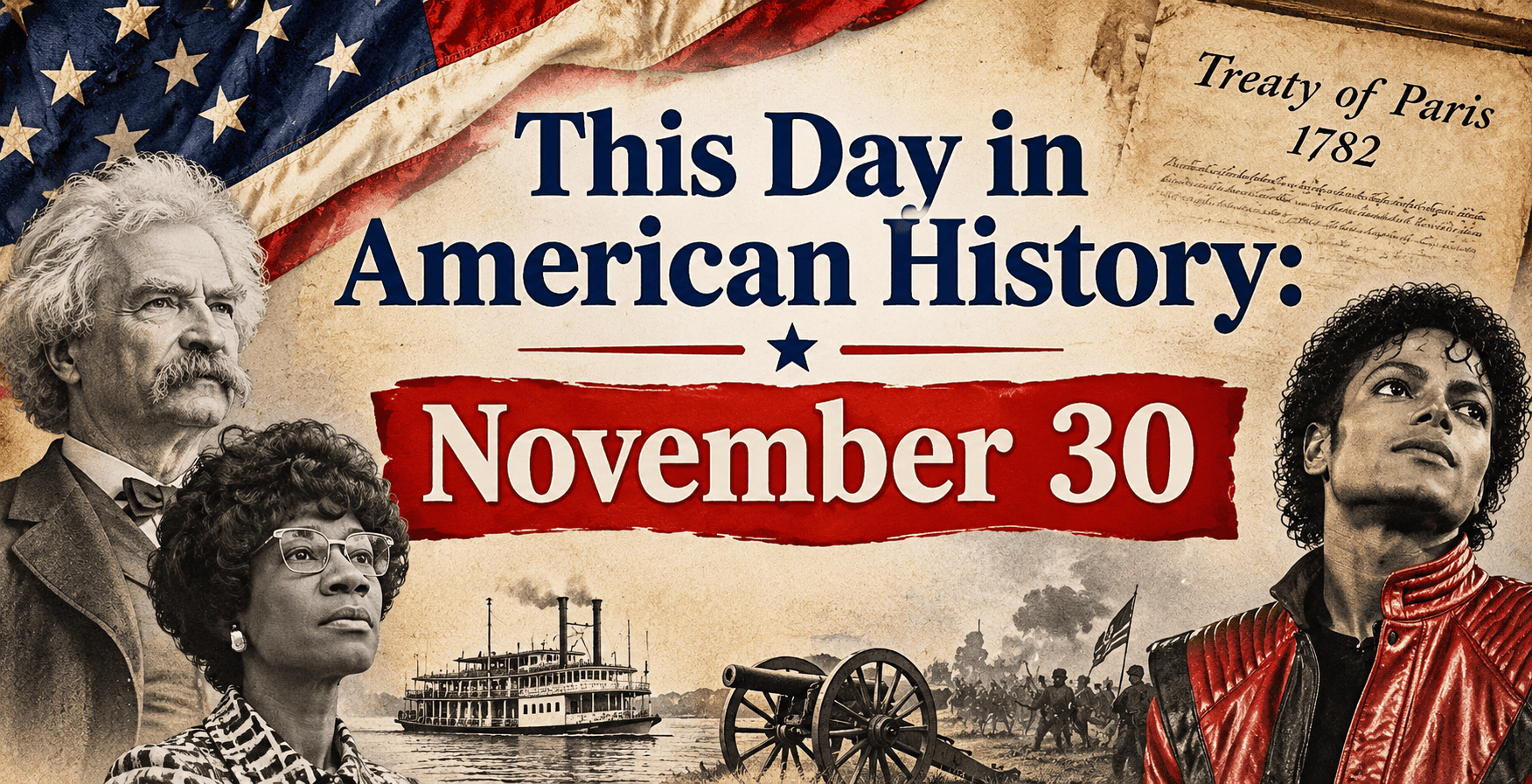
American history is filled with defining moments that have shaped the nation’s identity, culture, government, and place in the world. Every date on the calendar carries stories of courage, innovation, tragedy, triumph, and transformation.
November 30 is no exception. From the birth of one of America’s most celebrated authors to groundbreaking achievements in technology, important political developments, and unforgettable moments in entertainment, this day holds a fascinating place in the American story.
On November 30, Americans can reflect on events that changed how people communicate, how the country approaches leadership, and how generations remember their cultural heritage.
In this edition of This Day in American History, we explore the historical events, famous birthdays, cultural milestones, and interesting facts associated with November 30.
November 30, 1782 – America Takes a Major Step Toward Independence
One of the most significant events in American history occurred on November 30, 1782, when representatives of the United States and Great Britain signed preliminary peace agreements in Paris.
After years of fighting during the American Revolutionary War, the two nations were moving toward a settlement that would formally recognize the independence of the United States.
American representatives Benjamin Franklin, John Adams, and John Jay helped negotiate the agreement. The preliminary terms addressed several important issues, including American independence, national boundaries, fishing rights, and outstanding debts.
Although the agreement was not the final peace treaty, it represented a major diplomatic victory for the young nation.
The Treaty of Paris, signed on September 3, 1783, formally ended the Revolutionary War and recognized American independence.
Why It Matters: November 30, 1782, marked an essential step in America’s transition from rebellious colonies to an independent nation. The negotiations helped establish the foundation for the United States as a recognized member of the international community.
Office of the Historian+1
November 30, 1803 – Louisiana Transfers From Spain to France
On November 30, 1803, Spain formally transferred control of Louisiana to France, setting the stage for one of the largest territorial expansions in American history.
France, under Napoleon Bonaparte, had already agreed to sell the Louisiana Territory to the United States earlier that year.
President Thomas Jefferson recognized the enormous opportunity presented by the purchase. The territory included vast lands extending west of the Mississippi River, offering new opportunities for settlement, commerce, agriculture, and exploration.
The formal transfer from France to the United States followed on December 20, 1803, in New Orleans.
The Louisiana Purchase nearly doubled the size of the United States and significantly influenced the nation’s westward expansion.
However, the expansion also brought devastating consequences for Native American nations whose homelands were included in the territory without their consent.
Why It Matters: The events surrounding November 30, 1803, helped make possible a territorial expansion that fundamentally transformed America’s geography, economy, and future development.
Bay News 9+1
November 30, 1835 – Mark Twain Is Born
On November 30, 1835, Samuel Langhorne Clemens, better known as Mark Twain, was born in Florida, Missouri.
Twain would become one of America’s most influential and celebrated writers.
Growing up along the Mississippi River, he developed a fascination with riverboats, small-town life, human behavior, and the colorful personalities of nineteenth-century America.
These experiences later inspired some of his most famous literary works.
Among his best-known books are:
-
The Adventures of Tom Sawyer
-
Adventures of Huckleberry Finn
-
The Prince and the Pauper
-
Life on the Mississippi
-
A Connecticut Yankee in King Arthur’s Court
Twain became famous for his humor, sharp social criticism, memorable characters, and observations about American society.
His writing explored subjects such as freedom, morality, prejudice, childhood, and the contradictions of human nature.
His influence extended beyond literature. Twain helped establish a distinctly American storytelling voice, one that embraced everyday speech and ordinary people rather than relying exclusively on formal literary traditions.
Why It Matters: Mark Twain’s birthday celebrates an author whose works helped define American literature and continue to encourage readers to question injustice, challenge assumptions, and appreciate the power of storytelling.
Library of Congress+1
November 30, 1864 – The Battle of Franklin During the Civil War
On November 30, 1864, Union and Confederate forces fought the Battle of Franklin in Tennessee.
The battle occurred during the final stages of the American Civil War as Confederate General John Bell Hood attempted to challenge Union forces operating in Tennessee.
Hood ordered a major frontal assault against entrenched Union positions commanded by Major General John M. Schofield.
The attack resulted in devastating Confederate casualties.
Thousands of soldiers were killed, wounded, or captured during the fighting, and several Confederate generals lost their lives.
Although Union forces withdrew toward Nashville after the battle, the Confederate army suffered losses that seriously weakened its ability to continue the campaign.
The Battle of Franklin remains one of the Civil War’s most destructive engagements.
It also demonstrates the enormous human cost of the conflict, which divided families, communities, and the nation.
Why It Matters: The Battle of Franklin contributed to the weakening of Confederate military power in Tennessee and helped prepare the way for the Union’s victory in the Nashville campaign.
HISTORY
November 30, 1876 – Thanksgiving College Football Makes History
On November 30, 1876, Yale and Princeton faced each other in a college football game in Hoboken, New Jersey.
The game became an important milestone in the development of Thanksgiving football traditions.
Yale defeated Princeton by a score of 2–0 under the scoring rules of the era.
Although football was still developing into the sport Americans recognize today, college rivalries were already attracting considerable public interest.
Thanksgiving football eventually became an enduring American tradition.
Over the following decades, college and professional football games became closely associated with the holiday, bringing families and communities together around a shared sporting experience.
Why It Matters: This historic matchup helped establish the connection between Thanksgiving and American football, a tradition that continues to influence holiday celebrations across the country.
HISTORY
November 30, 1924 – Shirley Chisholm Is Born
On November 30, 1924, Shirley Anita St. Hill Chisholm was born in Brooklyn, New York.
She would become one of the most influential political figures in American history.
In 1968, Chisholm made history by becoming the first Black woman elected to the United States Congress.
Representing a district in Brooklyn, she advocated for education, civil rights, economic opportunity, women’s equality, and policies supporting disadvantaged communities.
In 1972, Chisholm pursued the Democratic presidential nomination, becoming the first Black woman to seek a major political party’s presidential nomination.
Her campaign challenged longstanding barriers in American politics and encouraged greater participation by women and minority communities.
Chisholm was known for her independence, determination, and willingness to challenge political expectations.
Why It Matters: Shirley Chisholm’s life demonstrated how determined leadership could expand opportunities for Americans who had historically been excluded from positions of political power.
HISTORY
November 30, 1954 – A Meteorite Strikes an Alabama Woman
One of the most unusual events in American history occurred on November 30, 1954, in Sylacauga, Alabama.
Ann Hodges was resting on her couch when a meteorite crashed through the roof of her home.
The space rock struck a radio cabinet before hitting her body, leaving her with a painful bruise.
The meteorite weighed approximately 8.5 pounds.
The incident became famous because it was the first widely documented modern case of a person being injured by a meteorite.
Although meteorites frequently enter Earth’s atmosphere, the likelihood of one striking a person is extraordinarily small.
The unusual accident attracted national attention and became a memorable story in the history of astronomy.
Why It Matters: The Sylacauga meteorite incident remains a remarkable example of how events occurring far beyond Earth can unexpectedly intersect with everyday human life.
HISTORY
November 30, 1965 – Ralph Nader Publishes Unsafe at Any Speed
On November 30, 1965, consumer advocate Ralph Nader published his groundbreaking book Unsafe at Any Speed: The Designed-In Dangers of the American Automobile.
The book examined automobile safety problems and criticized manufacturers for placing insufficient emphasis on protecting drivers and passengers.
Nader raised concerns about vehicle design, engineering decisions, and the automotive industry’s approach to consumer safety.
His investigation helped bring national attention to the dangers associated with automobile accidents and preventable injuries.
The book contributed to a growing movement demanding stronger federal vehicle safety standards.
In 1966, Congress passed the National Traffic and Motor Vehicle Safety Act, establishing a federal framework for regulating automobile safety.
Over time, improvements in vehicle design, crash testing, seat belts, and other protective technologies helped make American roads safer.
Why It Matters: The publication demonstrated how investigative research and consumer advocacy could influence national legislation and encourage industries to take greater responsibility for public safety.
Ralph Nader+1
November 30, 1982 – Michael Jackson Releases Thriller
On November 30, 1982, Michael Jackson released his landmark album Thriller.
The album became one of the most influential recordings in American music history and helped transform the global entertainment industry.
Produced by Quincy Jones, Thriller combined pop, rock, funk, rhythm and blues, and dance music.
Its famous songs included:
-
“Billie Jean”
-
“Beat It”
-
“Thriller”
-
“Wanna Be Startin’ Somethin’”
-
“Human Nature”
-
“P.Y.T. (Pretty Young Thing)”
The album’s popularity was fueled by Jackson’s distinctive vocal performances, groundbreaking music videos, and innovative choreography.
The music video for “Thriller” became a cultural phenomenon, demonstrating that music videos could be elaborate cinematic productions rather than simple promotional performances.
The album also helped expand the influence of music television and opened additional opportunities for Black performers in mainstream pop entertainment.
Why It Matters: Thriller changed expectations for popular music, music videos, and global entertainment. It remains among the best-selling albums in recorded music history.
New Haven Register+1
November 30, 1999 – The Seattle WTO Protests Capture National Attention
On November 30, 1999, large demonstrations took place in Seattle, Washington, as the World Trade Organization prepared to hold an important ministerial conference.
Thousands of protesters gathered to express concerns about globalization, international trade policies, labor rights, environmental protection, and corporate influence.
The demonstrations brought together labor unions, environmental activists, students, and numerous advocacy organizations.
While many participants demonstrated peacefully, confrontations, property damage, and clashes with police also occurred.
The protests disrupted the conference and drew international media attention.
The events became widely associated with the growing movement questioning how global trade agreements affected workers, developing nations, and the environment.
Why It Matters: The Seattle demonstrations marked a defining moment in modern American activism and brought debates about globalization and corporate accountability into mainstream public discussion.
World History Project
Famous Americans Born on November 30
November 30 is also the birthday of several notable Americans who contributed to literature, politics, entertainment, and sports.
| Year | Famous American | Known for |
|---|---|---|
| 1835 | Mark Twain | Influential American novelist and humorist |
| 1924 | Shirley Chisholm | First Black woman elected to Congress |
| 1929 | Dick Clark | Television personality and American Bandstand host |
| 1957 | Robert Guillaume | Award-winning actor known for Benson |
| 1962 | Bo Jackson | Professional baseball and football star |
| 1965 | Ben Stiller | Actor, comedian, director, and producer |
| 1978 | Clay Aiken | Singer and television personality |
These individuals reflect the diverse talents and contributions that have influenced American society.
Interesting Facts About November 30 in American History
Beyond the major historical events, November 30 offers several interesting connections to American culture and national development.
A day connected to American independence: The preliminary peace agreement of 1782 helped establish the diplomatic foundation for the formal end of the Revolutionary War.
A literary legend’s birthday: Mark Twain’s works remain essential to discussions of American literature, social criticism, and cultural identity.
An important Civil War anniversary: The Battle of Franklin serves as a reminder of the sacrifices made during one of America’s most difficult historical periods.
A milestone in consumer protection: Ralph Nader’s influential book helped change public expectations about automobile safety.
An unforgettable musical anniversary: The release of Michael Jackson’s Thriller marked a turning point in modern popular entertainment.
A remarkable scientific event: The meteorite that struck Ann Hodges remains one of the most extraordinary recorded encounters between a person and a falling space rock.
How November 30 Reflects the American Experience
Looking at these events together reveals several recurring themes in American history.
The Pursuit of Independence and Freedom
The peace negotiations of 1782 demonstrate the determination of America’s founders to establish an independent nation.
The Civil War reminds us that maintaining and redefining that nation’s ideals required painful sacrifices.
Throughout American history, questions about freedom, citizenship, representation, and equality have remained central to the country’s development.
The Power of Individual Voices
Mark Twain influenced American culture through literature.
Shirley Chisholm challenged political barriers through public service.
Ralph Nader helped inspire changes in consumer safety through research and advocacy.
Each demonstrates that individuals can influence national conversations and encourage lasting reforms.
The Importance of Cultural Innovation
American history is not defined solely by wars, elections, and government decisions.
Literature, music, entertainment, sports, and scientific discoveries also shape the nation’s identity.
From Twain’s storytelling to Jackson’s musical achievements, November 30 highlights the creativity that has helped American culture reach audiences around the world.
Remembering the Human Cost of History
Historical anniversaries provide opportunities to remember the people behind major events.
The Battle of Franklin was more than a military engagement. It involved thousands of individuals whose lives and families were forever changed.
Likewise, westward expansion created opportunities for some Americans while producing displacement and suffering for Indigenous communities.
Understanding history requires acknowledging both achievements and consequences.
Frequently Asked Questions About November 30 in American History
What is the most important historical event that happened on November 30?
One of the most significant events was the signing of preliminary peace articles between the United States and Great Britain on November 30, 1782. The agreement helped establish the terms that would eventually bring the American Revolutionary War to a formal conclusion.
Which famous American author was born on November 30?
Mark Twain, whose real name was Samuel Langhorne Clemens, was born on November 30, 1835, in Florida, Missouri. He became one of America’s most celebrated literary figures.
What Civil War battle happened on November 30?
The Battle of Franklin occurred in Tennessee on November 30, 1864. It resulted in devastating Confederate losses and became an important event in the final phase of the Civil War.
What famous album was released on November 30, 1982?
Michael Jackson released Thriller on November 30, 1982. The album became a worldwide cultural phenomenon and transformed popular music and music video production.
What unusual event happened on November 30, 1954?
Ann Hodges of Alabama was injured when a meteorite crashed through the roof of her home and struck her while she was resting on a couch.
Why is November 30 important in American history?
November 30 is associated with major events involving American independence, territorial expansion, the Civil War, literature, civil rights, consumer safety, popular culture, and political activism.
Final Thoughts: Remembering November 30 in American History
November 30 reminds us that American history is not a single story but a collection of countless experiences, struggles, achievements, and turning points.
The diplomatic negotiations of 1782 helped secure the future of an independent nation. The Battle of Franklin demonstrated the terrible cost of national division. Mark Twain gave generations of readers stories that challenged and entertained them. Shirley Chisholm expanded possibilities for political representation, while Ralph Nader helped transform consumer protection.
And through music, sports, and unexpected scientific events, November 30 also reveals the creativity and surprises that make history so fascinating.
Every historical anniversary offers an opportunity to understand where America has been, recognize the people who helped shape its development, and consider the lessons that remain relevant today.
History is more than remembering dates. It is understanding the decisions, sacrifices, discoveries, and individuals that helped create the world we live in.
As we remember November 30, we celebrate the achievements, acknowledge the hardships, and preserve the stories that continue to define the American experience.


Leave a Reply