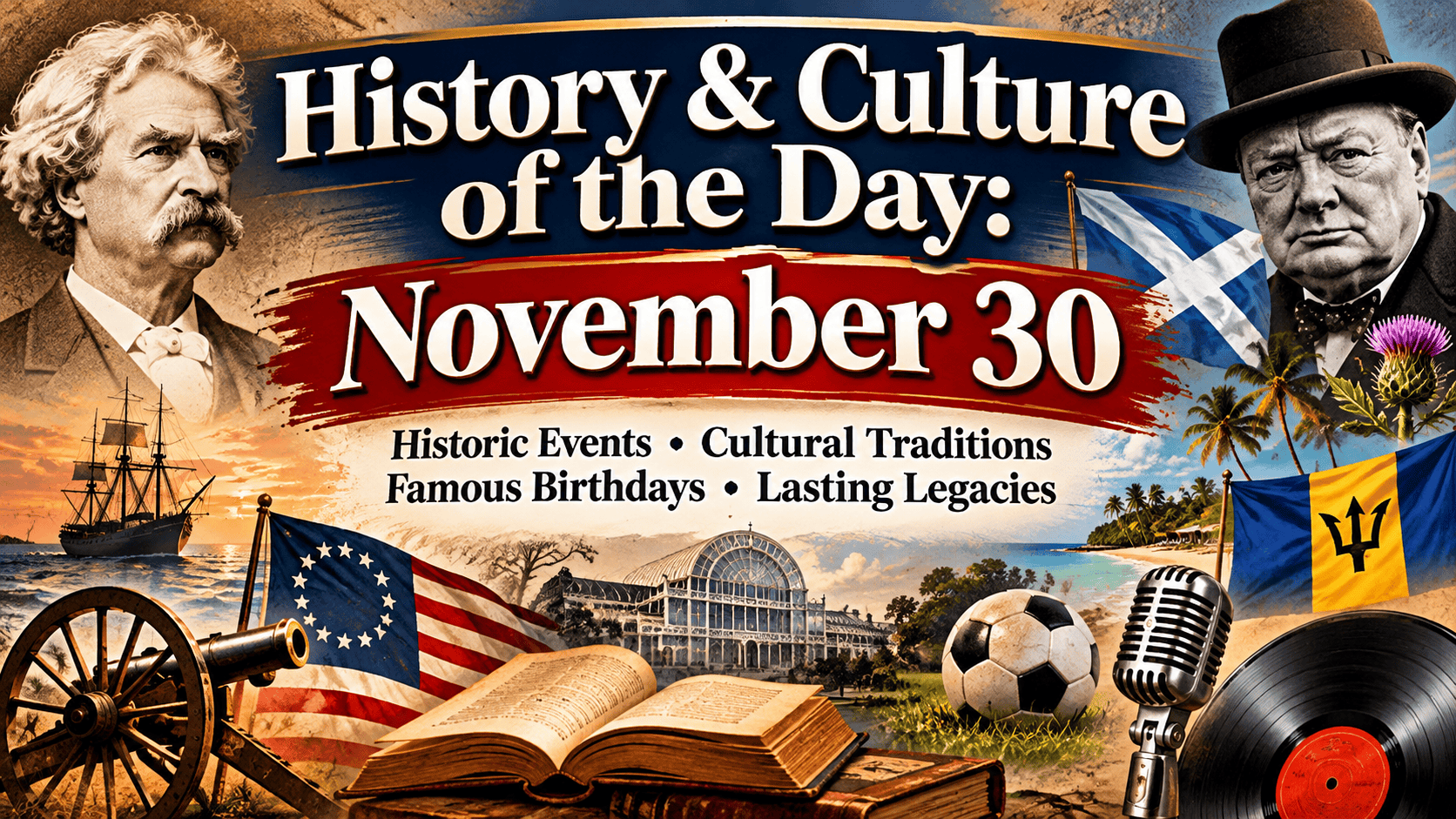
November 30 is a day filled with fascinating history, cultural celebrations, remarkable achievements, and events that helped shape the world we know today. From the traditions of Scotland to important moments in American history, this date offers an opportunity to explore how the past continues to influence modern society.
Throughout history, November 30 has witnessed political milestones, scientific discoveries, artistic achievements, and cultural transformations. It is also a day associated with national identity, religious traditions, influential historical figures, and the preservation of cultural heritage.
As November comes to an end and December approaches, November 30 reminds us that history is more than a collection of dates. It is the story of people, traditions, struggles, accomplishments, and ideas passed from one generation to the next.
The Historical Significance of November 30
November 30 holds a special place in world history because of its connection to national independence movements, religious observances, scientific achievements, and influential cultural figures.
One of the most recognizable celebrations associated with this date is St. Andrew’s Day, Scotland’s national day. However, November 30 also marks significant events involving American literature, European politics, space exploration, and international relations.
Exploring these historical moments helps us understand how individual events can influence entire generations.
Major Historical Events That Happened on November 30
1782 – Preliminary Peace Agreement Helps End the American Revolutionary War
On November 30, 1782, representatives of the United States and Great Britain signed preliminary articles of peace in Paris.
These negotiations represented a major step toward formally ending the American Revolutionary War and securing recognition of American independence.
The agreement established important principles that would later become part of the Treaty of Paris, signed on September 3, 1783.
For the young United States, the negotiations represented more than the conclusion of a military struggle. They marked the beginning of a new chapter in which the nation could develop its government, economy, and international relationships.
The agreement remains one of the most important diplomatic milestones in early American history.
1835 – American Author Mark Twain Is Born
November 30, 1835, marks the birth of Samuel Langhorne Clemens, better known by his pen name, Mark Twain.
Born in Florida, Missouri, Twain became one of America’s most celebrated writers, humorists, and social commentators.
His most famous literary works include The Adventures of Tom Sawyer and Adventures of Huckleberry Finn.
Through humor, memorable characters, and realistic depictions of American life, Twain explored important subjects such as childhood, freedom, race, morality, and social injustice.
His writing helped establish a distinctly American literary voice, and his influence continues to be felt in classrooms, libraries, and popular culture.
1864 – The Battle of Franklin During the American Civil War
On November 30, 1864, Union and Confederate forces fought the Battle of Franklin in Tennessee.
The battle became one of the most devastating engagements of the American Civil War, particularly for Confederate forces under General John Bell Hood.
Confederate troops launched repeated attacks against fortified Union positions, suffering enormous casualties.
The battle weakened the Confederate Army of Tennessee and contributed to the failure of its campaign.
Today, the Battle of Franklin is remembered as a powerful example of the human cost of war and the sacrifices made during one of the most difficult periods in American history.
1872 – The First Official International Soccer Match
On November 30, 1872, Scotland and England competed in what is widely recognized as the first official international association football match.
The historic game took place in Partick, near Glasgow, Scotland, and ended in a scoreless draw.
Although neither team scored, the match helped establish international soccer as an organized sporting tradition.
Today, soccer is one of the world’s most popular sports, connecting communities across continents and cultures.
That first international competition helped lay the foundation for future tournaments, international rivalries, and eventually the FIFA World Cup.
1936 – London’s Crystal Palace Is Destroyed by Fire
On November 30, 1936, a devastating fire destroyed the Crystal Palace in London.
Originally constructed for the Great Exhibition of 1851, the Crystal Palace was an extraordinary architectural achievement made primarily of iron and glass.
The building symbolized Victorian Britain’s industrial progress, technological innovation, and international cultural exchange.
Its destruction marked the loss of one of the nineteenth century’s most recognizable structures.
Although the original building disappeared, its influence remains visible in modern architecture and exhibition design.
1939 – The Winter War Begins
On November 30, 1939, the Soviet Union invaded Finland, beginning the conflict known as the Winter War.
Despite being heavily outnumbered, Finnish forces mounted a determined defense against Soviet troops.
The conflict attracted international attention and became an important chapter in the early history of World War II.
Although Finland eventually surrendered territory under a peace agreement in March 1940, the country’s resistance became a lasting symbol of national determination.
The Winter War continues to hold an important place in Finnish history and national identity.
1954 – A Meteorite Strikes a Woman in Alabama
One of the most unusual events associated with November 30 occurred in 1954.
Ann Hodges was resting inside her home near Sylacauga, Alabama, when a meteorite crashed through the roof, struck a radio cabinet, and hit her.
She survived with bruising.
The incident became famous because it is the first well-documented case of a person being injured by a meteorite.
The event remains an extraordinary reminder of the relationship between Earth and the wider universe.
1966 – Barbados Gains Independence
On November 30, 1966, Barbados officially gained independence from the United Kingdom.
The event represented a major milestone in the Caribbean nation’s political and cultural development.
Independence allowed Barbados to establish its own national government while continuing to preserve and celebrate its distinctive heritage.
Barbadian culture reflects a rich combination of African, British, and Caribbean influences expressed through music, cuisine, language, festivals, and community traditions.
November 30 continues to hold special significance in Barbados as a day of national remembrance and celebration.
1982 – Michael Jackson Releases Thriller
On November 30, 1982, Michael Jackson released his groundbreaking album Thriller.
The album transformed popular music and became one of the most commercially successful recordings in history.
Featuring songs such as Billie Jean, Beat It, and Thriller, the record combined pop, rock, funk, and rhythm and blues.
Its innovative music videos helped change how artists used television and visual storytelling to promote music.
The album’s influence extended beyond record sales, shaping fashion, dance, entertainment, and global popular culture.
Thriller remains a defining cultural achievement of the 1980s.
Cultural Celebrations and Traditions on November 30
St. Andrew’s Day – Scotland’s National Day
One of the most important cultural celebrations held on November 30 is St. Andrew’s Day.
St. Andrew is recognized as the patron saint of Scotland, and his feast day has become an occasion to celebrate Scottish heritage and national identity.
Traditional celebrations may include Scottish music, dancing, storytelling, cultural festivals, and meals featuring traditional foods.
The Scottish flag, known as the Saltire, features a white diagonal cross on a blue background and is associated with St. Andrew.
For Scottish communities around the world, November 30 provides an opportunity to honor their ancestry and preserve cultural traditions.
Bonifacio Day in the Philippines
November 30 is also Bonifacio Day in the Philippines, commemorating the birth of revolutionary leader Andrés Bonifacio in 1863.
Bonifacio was a central figure in the Philippine struggle for independence from Spanish colonial rule.
He helped establish the Katipunan, a revolutionary organization dedicated to achieving independence.
His leadership and commitment to national freedom made him an enduring symbol of Filipino patriotism.
Bonifacio Day honors the sacrifices of those who fought for independence and encourages reflection on national identity, courage, and civic responsibility.
Barbados Independence Celebrations
November 30 is traditionally associated with independence celebrations in Barbados.
The country’s independence anniversary is an opportunity to recognize Barbadian history, achievements, and cultural heritage.
Celebrations have included parades, ceremonies, performances, and community gatherings.
Since Barbados became a republic on November 30, 2021, the date has also acquired additional significance in the nation’s constitutional history.
These observances demonstrate how national celebrations help communities remember the past while looking toward the future.
Famous People Born on November 30
Throughout history, November 30 has been the birthday of influential writers, political leaders, entertainers, and artists.
Jonathan Swift (1667–1745)
Jonathan Swift was an Anglo-Irish writer and satirist best known for Gulliver’s Travels.
His writing used humor, fantasy, and criticism to examine politics, human behavior, and society.
His work remains an important part of English-language literary history.
Mark Twain (1835–1910)
Mark Twain became one of America’s most influential authors.
His stories captured the humor, contradictions, and complexities of nineteenth-century American society.
His legacy continues through literature, education, and American cultural history.
Winston Churchill (1874–1965)
Winston Churchill was born on November 30, 1874.
He became Britain’s prime minister during World War II and is remembered for his wartime leadership and speeches.
Churchill also received the Nobel Prize in Literature in 1953 for his historical and biographical writing and oratory.
L. M. Montgomery (1874–1942)
Canadian author Lucy Maud Montgomery was born on November 30, 1874.
She is best known for writing Anne of Green Gables, a beloved novel that has inspired generations of readers.
Her stories celebrate imagination, friendship, resilience, and the beauty of everyday life.
Shirley Chisholm (1924–2005)
Shirley Chisholm was born on November 30, 1924.
In 1968, she became the first Black woman elected to the United States Congress.
She later became the first Black candidate to seek a major party’s nomination for president of the United States.
Her political career helped challenge barriers involving race, gender, and representation in American government.
Dick Clark (1929–2012)
American television personality Dick Clark was born on November 30, 1929.
He became famous for hosting American Bandstand, a television program that helped introduce popular music and emerging performers to generations of viewers.
He was also closely associated with televised New Year’s Eve celebrations.
His career helped shape American television and music culture.
Ridley Scott (1937–)
British filmmaker Ridley Scott was born on November 30, 1937.
He is known for directing influential films including Alien, Blade Runner, and Gladiator.
His distinctive visual style has had a lasting impact on science fiction and historical filmmaking.
Notable Deaths on November 30
November 30 also marks the passing of several important cultural and historical figures.
Oscar Wilde – 1900
Irish playwright, novelist, and poet Oscar Wilde died on November 30, 1900.
He is remembered for works including The Picture of Dorian Gray and The Importance of Being Earnest.
His wit, literary style, and exploration of social expectations continue to influence literature and theater.
James Baldwin – 1987
American writer and civil rights intellectual James Baldwin died on November 30, 1987.
His essays and novels examined race, identity, social injustice, and the complexities of American life.
His writing remains influential in discussions about equality, literature, and human rights.
Paul Walker – 2013
American actor Paul Walker died on November 30, 2013, following a car accident.
He was best known for his role in the Fast & Furious film franchise.
Beyond acting, Walker was involved in humanitarian efforts, including disaster relief work.
His death brought widespread tributes from fans and colleagues.
George H. W. Bush – 2018
George H. W. Bush, the 41st president of the United States, died on November 30, 2018.
His presidency included major international developments, including the end of the Cold War and the Persian Gulf War.
He is also remembered for his earlier service as vice president, director of the Central Intelligence Agency, and ambassador to the United Nations.
November 30 and the Evolution of Popular Culture
November 30 offers an interesting perspective on the ways entertainment and communication have developed.
The release of Michael Jackson’s Thriller in 1982 demonstrates how music can influence global culture beyond the recording industry.
The careers of people born on November 30, including Mark Twain, Dick Clark, and Ridley Scott, also illustrate the changing forms of storytelling.
Twain helped shape American literature through novels and humor.
Clark connected audiences with popular music through television.
Scott expanded cinematic storytelling through memorable visual worlds.
Although these figures worked in different eras and creative fields, each contributed to the ways people experience entertainment, ideas, and cultural identity.
Their achievements remind us that culture is constantly evolving while building upon earlier traditions.
Interesting Facts About November 30
Several fascinating details make November 30 particularly memorable.
-
November 30 is the 334th day of the year in a common year and the 335th day in a leap year.
-
Only 31 days remain in the calendar year after November 30.
-
Scotland celebrates its patron saint, St. Andrew, on this date.
-
Mark Twain was born shortly after an appearance of Halley’s Comet in 1835 and died during its next return in 1910.
-
The first official international soccer match took place on November 30, 1872.
-
The 1954 Hodges meteorite incident remains one of the most remarkable documented encounters between a human and a falling space rock.
-
November 30 marks the anniversary of the release of Michael Jackson’s Thriller.
-
Barbados became independent on November 30, 1966, and transitioned to a republic on the same date in 2021.
These facts show how one date can connect science, literature, sports, national history, and entertainment.
Why Learning About History and Culture Matters
History and culture help explain who we are, where we came from, and how societies developed.
Learning about the events of November 30 encourages us to look beyond familiar historical narratives and explore the experiences of people from different countries, backgrounds, and generations.
The American struggle for independence illustrates the importance of political self-determination.
Scotland’s St. Andrew’s Day demonstrates how traditions help preserve cultural identity.
Barbados Independence Day reflects the significance of national sovereignty and the continuing influence of colonial history.
The achievements of writers, artists, and musicians remind us that cultural expression can influence society just as profoundly as political events.
Understanding these connections helps build a broader appreciation for the world and the people who shaped it.
How to Observe History & Culture of the Day on November 30
November 30 offers several meaningful ways to explore history and cultural heritage.
Consider reading a novel by Mark Twain or L. M. Montgomery to experience literary traditions from another era.
Learn about Scottish history and the cultural significance of St. Andrew’s Day.
Explore the history of Barbados and the Caribbean independence movements.
Watch a documentary about the American Revolutionary War, the Civil War, or the Winter War.
Listen to Michael Jackson’s Thriller and consider how popular music has changed since the 1980s.
You can also explore your own family’s history, record a personal story, or learn about traditions that previous generations passed down.
History becomes especially meaningful when we connect major world events with the experiences of ordinary people.
Final Thoughts: Remembering November 30 Through History and Culture
November 30 represents a remarkable collection of historical moments, cultural traditions, and influential lives.
From the negotiations that helped secure American independence to Scotland’s celebration of St. Andrew’s Day, the events associated with this date demonstrate the diversity of human experience.
The birth of literary figures such as Mark Twain and Winston Churchill, the independence of Barbados, and the release of Michael Jackson’s Thriller reveal how politics, literature, national identity, and entertainment contribute to our shared history.
Some events remind us of humanity’s achievements. Others reveal the costs of conflict, the importance of freedom, and the struggles that shaped modern nations.
Together, they tell a larger story about resilience, creativity, discovery, and cultural heritage.
History is not simply about remembering what happened. It is about understanding why those events mattered and how their influence continues today.
As November 30 comes to a close, it offers an opportunity to appreciate the generations who came before us, celebrate the traditions that connect us, and recognize the lasting impact of history on our everyday lives.

Leave a Reply