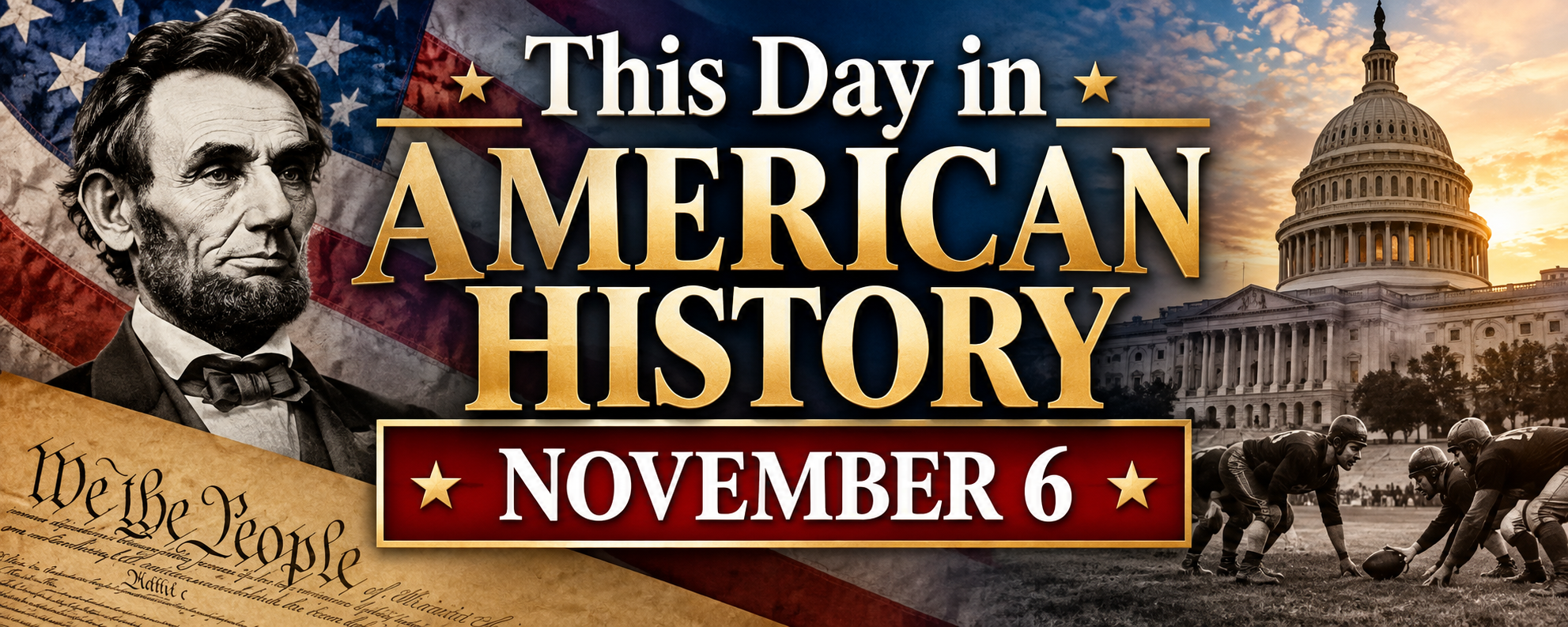
American history is filled with remarkable moments that have shaped the nation’s identity, influenced its leadership, and changed the course of society. Every date on the calendar carries stories of courage, innovation, political change, and the determination of individuals who helped build the United States.
November 6 holds a special place in American history, particularly because of its connections to presidential elections, the Civil War, scientific achievements, and important milestones in American culture.
From Abraham Lincoln’s historic election in 1860 to major developments in American politics and technology, November 6 reminds us how decisions made on a single day can influence generations.
Let’s explore the significant events, influential people, and historical milestones associated with November 6.
November 6, 1860 – Abraham Lincoln Is Elected President
One of the most consequential events in American history occurred on November 6, 1860, when Abraham Lincoln was elected the 16th president of the United States.
Lincoln, representing the newly established Republican Party, defeated a divided field of opponents that included Stephen A. Douglas, John C. Breckinridge, and John Bell.
His victory came during a period of intense national disagreement over slavery and its expansion into western territories.
Why Lincoln’s election mattered
Lincoln’s election transformed American politics and intensified tensions between Northern and Southern states.
Although Lincoln opposed the expansion of slavery, many Southern political leaders feared his presidency would threaten the institution’s future.
Within weeks of his election, Southern states began taking steps toward secession. South Carolina became the first state to secede in December 1860.
By April 1861, the American Civil War had begun.
Lincoln would ultimately lead the Union through the conflict and issue the Emancipation Proclamation, making his presidency one of the most significant in American history.
Historical significance: Lincoln’s election marked a turning point in the struggle over slavery, national unity, and the future of the United States.
November 6, 1861 – Jefferson Davis Is Elected President of the Confederacy
Exactly one year after Lincoln’s election, another significant political event occurred.
On November 6, 1861, Jefferson Davis was elected to a six-year term as president of the Confederate States of America.
Davis had previously served as a United States senator from Mississippi and as secretary of war under President Franklin Pierce.
When Southern states seceded from the Union, Davis became the provisional president of the Confederacy in February 1861.
His November election confirmed his leadership of the breakaway government.
A nation divided
The election took place during the first year of the American Civil War.
While Lincoln fought to preserve the Union, Davis led the Confederacy, whose formation was fundamentally tied to the preservation of slavery.
The two governments represented opposing visions of the nation’s future.
The war would continue until 1865, leaving hundreds of thousands dead and transforming the United States.
Historical significance: Davis’s election demonstrated how deeply divided the country had become and how political disagreements over slavery had escalated into armed conflict.
November 6, 1869 – The First College Football Game Is Played
November 6 also marks an important milestone in American sports history.
On November 6, 1869, Rutgers University and Princeton University, then known as the College of New Jersey, played what is widely recognized as the first intercollegiate football game in American history.
The game took place in New Brunswick, New Jersey.
Rutgers defeated Princeton by a score of 6–4.
However, the game looked very different from modern American football.
How the first football game was different
Players used a round ball, and the rules resembled soccer more than the American football played today.
The game did not feature modern touchdowns, forward passes, helmets, or protective equipment.
Instead, players attempted to move the ball toward their opponent’s goal using their feet and coordinated team movements.
Despite these differences, the contest helped establish the tradition of organized intercollegiate football.
The growth of college football
Over the following decades, American football evolved into a distinct sport.
Universities developed competitive programs, rules became more standardized, and football became an important part of campus culture.
Today, college football attracts millions of viewers and generates enormous enthusiasm across the United States.
Historical significance: The Rutgers-Princeton game laid an important foundation for one of America’s most popular sporting traditions.
November 6, 1888 – Benjamin Harrison Wins the Presidential Election
On November 6, 1888, Republican Benjamin Harrison defeated incumbent Democratic President Grover Cleveland in the Electoral College.
The election was particularly noteworthy because Harrison won the presidency despite receiving fewer popular votes than Cleveland.
Harrison secured 233 electoral votes compared with Cleveland’s 168.
Why the election was important
The election highlighted the distinction between the popular vote and the Electoral College, a feature of the American presidential election system that continues to generate discussion.
Harrison became the 23rd president of the United States.
His administration would oversee important developments in federal economic policy, including the Sherman Antitrust Act of 1890.
Interestingly, Cleveland returned to the presidency after defeating Harrison in 1892, becoming the first American president to serve two nonconsecutive terms.
Historical significance: The 1888 election remains an important example of how the Electoral College can produce a different winner from the national popular vote.
November 6, 1900 – William McKinley Wins Reelection
On November 6, 1900, President William McKinley won a second term by defeating Democratic challenger William Jennings Bryan.
McKinley’s running mate was Theodore Roosevelt, the governor of New York and a popular national figure following his military service during the Spanish-American War.
America enters a new century
The election occurred during a period of economic growth, industrial expansion, and increasing American involvement in international affairs.
The United States had recently emerged from the Spanish-American War with a larger overseas presence.
Debates about imperialism, economic policy, and America’s role in the world played important roles in the campaign.
McKinley’s second term would be tragically short.
In September 1901, he was assassinated, and Theodore Roosevelt became president.
Roosevelt would go on to become one of the most influential leaders of the Progressive Era.
Historical significance: The 1900 election helped set the stage for Theodore Roosevelt’s presidency and America’s growing influence on the world stage.
November 6, 1928 – Herbert Hoover Is Elected President
On November 6, 1928, Republican Herbert Hoover defeated Democratic nominee Al Smith to become the 31st president of the United States.
Hoover entered the election with a reputation as an accomplished engineer, humanitarian, and government administrator.
During the 1920s, the American economy had experienced considerable growth, and many voters associated Republican leadership with prosperity.
Prosperity before the Great Depression
Hoover’s election came near the end of the economic boom commonly associated with the Roaring Twenties.
However, less than a year after he took office, the stock market crashed in October 1929.
The crash contributed to the economic crisis that developed into the Great Depression.
Millions of Americans eventually faced unemployment, poverty, and financial uncertainty.
Although the causes of the Great Depression were complex and extended beyond any single administration, Hoover’s presidency became closely associated with the nation’s economic struggles.
Historical significance: Hoover’s election reminds us how quickly economic conditions can change and how unexpected crises can define a presidency.
November 6, 1935 – Edwin Armstrong Demonstrates FM Radio
On November 6, 1935, American engineer and inventor Edwin Howard Armstrong gave a public demonstration of frequency-modulated radio technology in New York City.
His work represented a major improvement in radio broadcasting.
Before FM technology became widespread, AM radio signals were especially vulnerable to static and electrical interference.
Armstrong’s frequency-modulation system offered the potential for clearer, higher-quality sound.
How FM radio changed communication
FM technology eventually transformed how Americans listened to music, news, and entertainment.
Its improved audio quality made it particularly valuable for music broadcasting.
Although FM radio took years to achieve widespread commercial adoption, Armstrong’s innovation helped establish the foundation for modern FM broadcasting.
Historical significance: Armstrong’s demonstration showed how scientific innovation could improve everyday communication and entertainment.
November 6, 1947 – Meet the Press Makes Its Television Debut
On November 6, 1947, the television news program Meet the Press made its debut on NBC.
The program became one of the most enduring institutions in American political journalism.
Created during the early years of television, it provided a forum for journalists to question political leaders, government officials, and influential public figures.
A new era of political journalism
Before television became the dominant source of news, Americans relied heavily on newspapers and radio.
Programs such as Meet the Press helped introduce a new approach to political coverage by allowing audiences to watch interviews and discussions involving national leaders.
Over the decades, the program became associated with major political debates, presidential campaigns, and discussions about public policy.
Its longevity demonstrates the continuing importance of political journalism in American democracy.
Historical significance: The program helped shape the relationship between television, journalism, and American politics.
November 6, 1956 – Dwight D. Eisenhower Wins Reelection
On November 6, 1956, President Dwight D. Eisenhower won a second term in office, defeating Democratic challenger Adlai Stevenson.
Eisenhower had become a national hero through his leadership of Allied forces during World War II.
His popularity remained strong throughout much of his first presidential term.
America during the 1950s
Eisenhower’s presidency occurred during a period of major social, economic, and international developments.
The United States was experiencing suburban expansion, growing automobile ownership, and the continuing influence of the Cold War.
The civil rights movement was also gaining momentum.
In 1956, the Montgomery bus boycott had drawn national attention to racial segregation and the struggle for equal rights.
Eisenhower’s second term would include major events such as the Little Rock school integration crisis and the creation of NASA in 1958.
Historical significance: Eisenhower’s reelection reflected public confidence in his leadership during an era of prosperity, international tension, and social change.
November 6, 1977 – The Kelly Barnes Dam Disaster in Georgia
November 6 is also remembered for a devastating tragedy.
On November 6, 1977, the Kelly Barnes Dam near Toccoa, Georgia, failed following heavy rainfall.
The collapse released a massive volume of water that rushed downstream toward Toccoa Falls College.
The flood killed 39 people and caused extensive destruction.
Lessons from the disaster
The tragedy raised serious questions about dam maintenance, structural safety, and emergency preparedness.
Communities across the country were reminded of the importance of inspecting aging infrastructure and preparing for natural disasters.
The victims are remembered as part of the history of Toccoa Falls College and the surrounding community.
Historical significance: The disaster remains a reminder that infrastructure safety and disaster preparedness can mean the difference between life and death.
November 6, 1984 – Ronald Reagan Wins a Landslide Reelection
On November 6, 1984, President Ronald Reagan won reelection in one of the largest Electoral College victories in modern American history.
Reagan defeated Democratic challenger Walter Mondale, carrying 49 of the 50 states.
Mondale won Minnesota and the District of Columbia.
Why Reagan’s victory was significant
The election followed an economic recovery from the recession of the early 1980s.
Reagan’s campaign emphasized economic improvement, national optimism, and American strength.
His reelection demonstrated the strength of his political appeal among a broad coalition of voters.
Reagan’s second term would include major developments in U.S.-Soviet relations, including diplomatic negotiations with Soviet leader Mikhail Gorbachev.
Those negotiations contributed to changes in the Cold War relationship between the two superpowers.
Historical significance: Reagan’s 1984 victory remains one of the most decisive presidential reelections in American history.
November 6, 1986 – The Immigration Reform and Control Act Becomes Law
On November 6, 1986, President Ronald Reagan signed the Immigration Reform and Control Act.
The legislation represented a major change in American immigration policy.
It established a legalization program for certain undocumented immigrants who met eligibility requirements, while also introducing penalties for employers who knowingly hired unauthorized workers.
The lasting impact
The law attempted to address several challenges simultaneously: the status of long-term undocumented residents, unauthorized employment, and enforcement of immigration rules.
Millions of people eventually obtained legal status through the law’s legalization provisions.
However, immigration remained a major subject of national debate in the decades that followed.
Historical significance: The 1986 legislation became a landmark in the history of American immigration policy and continues to influence discussions about immigration reform.
November 6, 2012 – Barack Obama Wins a Second Presidential Term
On November 6, 2012, President Barack Obama defeated Republican challenger Mitt Romney to win reelection.
Obama, who had become the first Black president of the United States in 2008, secured another four years in office.
The election occurred during a period of continued economic recovery following the Great Recession.
Major issues in the 2012 election
The campaign focused on economic growth, employment, healthcare, taxes, and the federal government’s role in American society.
Obama’s first term had included passage of the Affordable Care Act, while his second term would bring additional debates over healthcare, immigration, foreign policy, and civil rights.
His reelection marked another important chapter in the nation’s political and social history.
Historical significance: Obama’s 2012 victory extended a historic presidency and reflected the evolving demographics and political priorities of the American electorate.
Famous Americans Born on November 6
November 6 is also the birthday of several notable individuals who made contributions to American sports, entertainment, journalism, and culture.
James Naismith – Born November 6, 1861
James Naismith, the inventor of basketball, was born in Canada on November 6, 1861.
He created the game in 1891 while teaching physical education in Springfield, Massachusetts.
His invention would grow into one of the world’s most popular sports.
Sally Field – Born November 6, 1946
Sally Field is an Academy Award-winning American actress known for her performances in Norma Rae, Places in the Heart, Steel Magnolias, and Forrest Gump.
Her career has spanned television, film, and theater.
Maria Shriver – Born November 6, 1955
Maria Shriver is an American journalist, author, and former First Lady of California.
She is known for her journalism, advocacy, and work addressing women’s issues and Alzheimer’s disease.
Ethan Hawke – Born November 6, 1970
Ethan Hawke is an American actor, writer, and filmmaker known for movies including Dead Poets Society, Training Day, and the Before film trilogy.
Emma Stone – Born November 6, 1988
Emma Stone is an Academy Award-winning actress known for films including La La Land, The Favourite, and Poor Things.
Her performances have made her one of the most recognizable actors of her generation.
Interesting Facts About November 6 in American History
November 6 has an unusual number of connections to American presidential elections.
-
Abraham Lincoln was elected president on November 6, 1860.
-
Benjamin Harrison won the Electoral College on November 6, 1888.
-
William McKinley won reelection on November 6, 1900.
-
Herbert Hoover was elected president on November 6, 1928.
-
Dwight D. Eisenhower won reelection on November 6, 1956.
-
Ronald Reagan won reelection on November 6, 1984.
-
Barack Obama won reelection on November 6, 2012.
These repeated election milestones are partly explained by the American election calendar, which places federal Election Day on the Tuesday following the first Monday in November.
Another remarkable coincidence is that Abraham Lincoln was elected president on November 6, 1860, while Jefferson Davis was elected Confederate president on the same date exactly one year later.
November 6 also connects two major American sports traditions: the birth of basketball inventor James Naismith in 1861 and the first intercollegiate football game in 1869.
What Can We Learn From November 6 in American History?
History is more than a collection of dates, elections, and famous names. It provides lessons about leadership, progress, conflict, responsibility, and the consequences of human decisions.
The events of November 6 illustrate several important themes.
Leadership can change the direction of a nation. Abraham Lincoln’s election helped define one of the most difficult periods in American history. Later presidential elections shaped the nation’s economic policies, international relationships, and social priorities.
Innovation can transform everyday life. Edwin Armstrong’s work on FM radio and the development of organized college sports demonstrate how ideas can grow into lasting parts of American culture.
Tragedies can reveal the need for change. The Kelly Barnes Dam disaster demonstrated the importance of public safety, responsible engineering, and emergency planning.
Democracy is an ongoing process. The many presidential elections held on November 6 remind us that elections are opportunities for Americans to influence their government’s direction.
These lessons remain relevant because the challenges faced by earlier generations often resemble questions Americans continue to confront today.
Why Remembering American History Matters
Understanding American history helps us appreciate how the country developed and recognize the sacrifices, achievements, and struggles that shaped its identity.
Some historical moments represent progress and achievement. Others remind us of painful divisions, devastating losses, and mistakes that should not be forgotten.
Both deserve attention.
Remembering the Civil War helps us understand the consequences of slavery and national division. Studying presidential elections teaches us about democratic institutions and political change. Exploring technological innovations reminds us of the creativity and determination that have influenced American life.
History also encourages critical thinking.
By examining the decisions people made in the past, we can better understand how those choices affected their communities and future generations.
The purpose of studying history is not simply to memorize what happened. It is to understand why events occurred, how they changed society, and what they can teach us today.
Final Thoughts: November 6 – A Day of Leadership, Innovation, and Change
November 6 has witnessed some of the most significant moments in American political, cultural, and technological history.
From Abraham Lincoln’s election in 1860 to the development of college football, the introduction of FM radio, and major presidential victories, this date offers a fascinating look at the nation’s evolution.
It also reminds us that American history includes both triumph and tragedy.
Every generation inherits the consequences of decisions made before it, and every generation has an opportunity to shape what comes next.
By remembering the events of November 6, we gain a deeper appreciation for the people, ideas, and experiences that helped create the America we know today.
History is not just about remembering yesterday. It is about understanding today and making better decisions for tomorrow.
A Question for Readers
Of all the historical events that occurred on November 6, which do you believe had the greatest impact on the United States, and why?


Leave a Reply