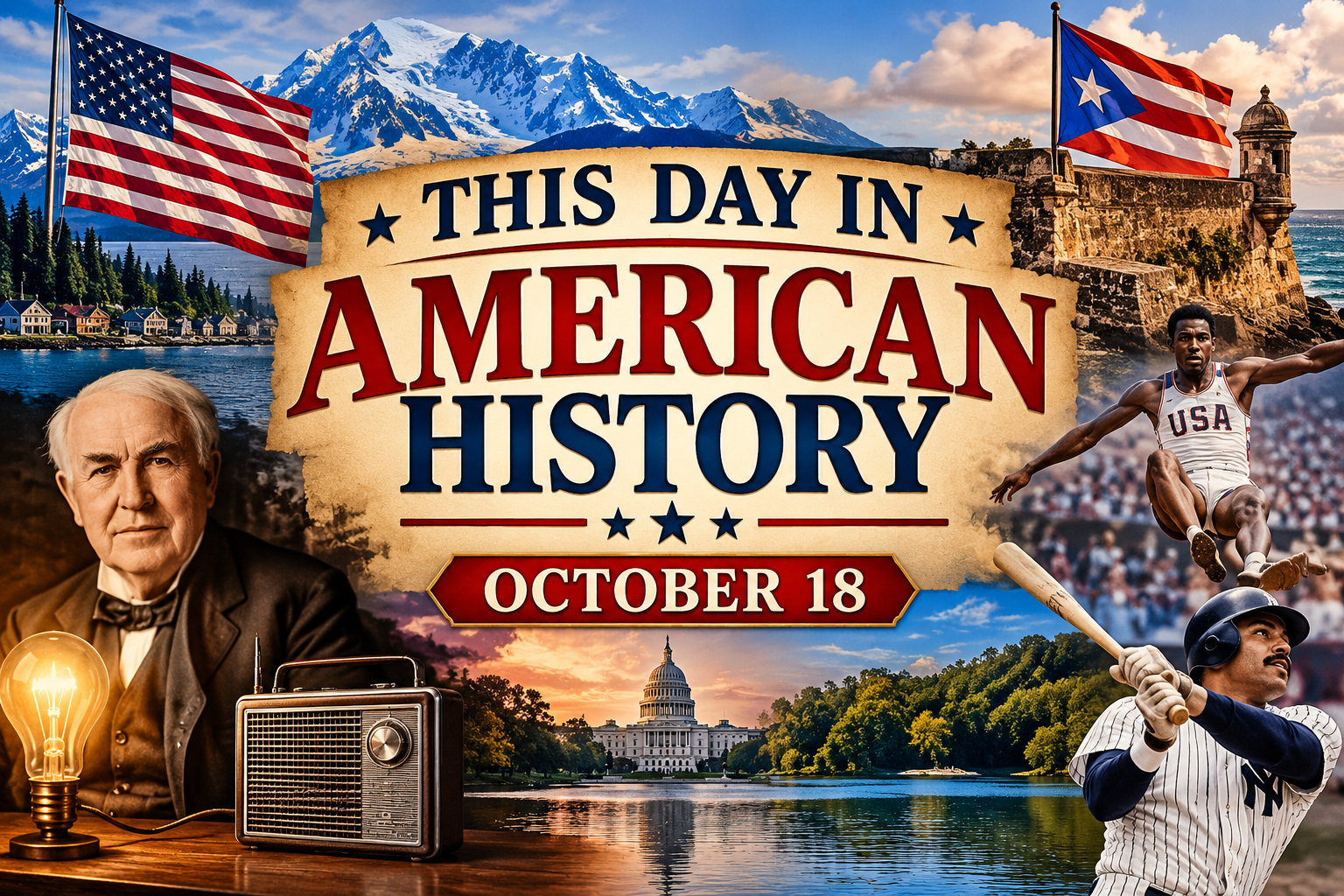
Every date on the calendar carries pieces of America’s story, but October 18 has witnessed several moments that helped shape the nation’s territory, technology, laws, sports, and place in the world.
Perhaps the most significant event connected to this date occurred in 1867, when the United States formally took possession of Alaska from Russia. But October 18 also marks the beginning of American sovereignty in Puerto Rico, the death of one of America’s most famous inventors, an important environmental milestone, and one of the most memorable performances in World Series history.
Here is a look back at some of the notable events that happened on October 18 in American history.
1867 – The United States Takes Possession of Alaska
On October 18, 1867, one of the largest territorial transfers in American history became official.
The United States formally took possession of Alaska from the Russian Empire during a ceremony in Sitka. Earlier that year, Secretary of State William H. Seward had negotiated the purchase of Alaska for $7.2 million. The treaty was signed in March, approved by the Senate in April, and the territory was formally transferred on October 18.
During the ceremony, the Russian flag was lowered and the American flag was raised at what is now known as Castle Hill in Sitka. American and Russian representatives participated in the formal transfer.
At the time, not everyone believed buying Alaska was a wise decision.
The enormous territory was remote and largely unfamiliar to most Americans. Critics questioned why the United States should spend millions of dollars acquiring such distant land.
The purchase would eventually prove enormously important.
Alaska contained significant natural resources and became strategically important because of its location between North America and Asia. Gold discoveries also increased interest in the region during the late nineteenth century.
Alaska eventually became the 49th state on January 3, 1959.
Today, October 18 is celebrated in Alaska as Alaska Day, commemorating the 1867 transfer.
The event is an extraordinary reminder that the borders of the United States did not appear overnight. They developed through purchases, treaties, wars, settlements, diplomacy, and expansion over generations.
1898 – American Sovereignty Begins in Puerto Rico
Another major territorial event occurred exactly 31 years later.
On October 18, 1898, the last Spanish troops departed Puerto Rico and American authority over the island began following the Spanish-American War.
American troops had landed in Puerto Rico on July 25, 1898. Military operations continued for roughly three weeks before hostilities ended. On October 18, the American flag flew over public buildings as centuries of Spanish colonial rule came to an end and U.S. sovereignty began.
The transition would permanently change the relationship between Puerto Rico and the United States.
Congress established a civilian government through the Foraker Act of 1900, and Puerto Rico’s political relationship with the United States continued to evolve during the twentieth century.
Puerto Rico remains a U.S. territory today.
The events of October 18, 1898 therefore represent more than a military transition. They marked the beginning of a political relationship between Puerto Rico and the United States that has continued for more than a century.
1931 – Thomas Edison Dies
October 18 also marks the death of one of the most famous inventors in American history.
On October 18, 1931, Thomas Alva Edison died at his home in West Orange, New Jersey. He was 84 years old.
Edison had become internationally famous for his work involving electricity, recorded sound, motion pictures, batteries, and numerous other technologies.
He is often associated with the electric light bulb, although the history of electric lighting involved many inventors and researchers. Edison’s major contribution was helping develop a commercially practical incandescent lighting system along with the electrical infrastructure needed to make widespread electric lighting possible.
His laboratory also produced the phonograph, one of the earliest technologies capable of recording and reproducing sound.
That invention changed entertainment forever.
For the first time, voices and music could be recorded and heard again long after the original performance had ended.
Edison and his associates also contributed to the development of early motion-picture technology.
By the time of his death, Edison had accumulated 1,093 U.S. patents, reflecting the enormous range of his inventive work.
His career also helped popularize a new model of invention.
Rather than relying entirely on a single inventor working alone, Edison created laboratories where teams of researchers, machinists, engineers, and assistants could work together on technological problems.
That approach foreshadowed the industrial research laboratories that would become common during the twentieth century.
1954 – The Transistor Radio Arrives
October 18 also played a role in another technological revolution.
In 1954, the Regency TR-1, widely recognized as the first commercially produced transistor radio, was introduced.
The device represented a major step toward portable consumer electronics.
Before transistor technology became widespread, radios commonly relied on vacuum tubes. These devices could be relatively large, fragile, and power hungry.
Transistors made it possible to build electronics that were smaller and more portable.
The transistor radio helped transform how Americans consumed entertainment.
Instead of gathering around a radio in the living room, people could carry music and broadcasts with them.
Teenagers especially embraced portable radios, helping connect the emerging technology with the rapidly growing popularity of rock ‘n’ roll.
In hindsight, the transistor radio can also be viewed as an early ancestor of the portable electronics that eventually produced cassette players, portable CD players, MP3 players, smartphones, and wireless devices.
A small radio helped introduce Americans to an increasingly mobile technological world.
1968 – Bob Beamon Makes Olympic History
Sports history also remembers October 18.
During the 1968 Summer Olympics in Mexico City, American athlete Bob Beamon produced one of the most extraordinary performances in track-and-field history.
Beamon jumped 8.90 meters — 29 feet, 2½ inches — in the long jump.
His performance shattered the existing world record by an astonishing margin.
The jump was so extraordinary that it became one of the defining moments of the 1968 Olympics.
Beamon’s world record remained unbeaten for nearly 23 years.
Even decades later, his performance remains one of the most famous achievements in Olympic track and field.
The phrase “Beamonesque” even entered sports vocabulary as a way of describing an achievement so extraordinary that it dramatically exceeds expectations.
October 18, 1968 demonstrated how a few seconds of athletic competition can create a moment remembered for generations.
1972 – Congress Enacts the Clean Water Act Over Nixon’s Veto
On October 18, 1972, the United States reached an important milestone in environmental policy.
Congress overrode President Richard Nixon’s veto of legislation commonly known as the Clean Water Act, allowing the measure to become law.
During the decades leading up to the law, pollution had become a highly visible national problem.
Industrial waste, sewage, chemicals, and other pollutants were entering American waterways.
Public concern about environmental damage increased dramatically during the 1960s and early 1970s, helping produce a new era of federal environmental regulation.
The Clean Water Act established a broad federal framework for regulating pollutant discharges into waters of the United States and improving water quality.
The law has been amended and interpreted many times since 1972, and debates continue over the appropriate reach of federal water regulation.
Regardless of those continuing policy debates, October 18, 1972 stands as an important date in the development of modern American environmental law.
1977 – Reggie Jackson Becomes “Mr. October”
October 18 also produced one of the greatest individual performances in baseball history.
On October 18, 1977, Reggie Jackson stepped to the plate for the New York Yankees during Game 6 of the World Series against the Los Angeles Dodgers.
What happened next became baseball legend.
Jackson hit three home runs on three consecutive pitches from three different pitchers.
The Yankees defeated the Dodgers 8–4, winning the World Series.
Jackson’s postseason performances helped cement his famous nickname:
“Mr. October.”
The achievement remains one of the most recognizable moments in World Series history.
Baseball has produced countless memorable postseason performances, but few have combined the stakes, drama, and individual dominance displayed by Jackson that night.
Three swings helped create a nickname that followed him for the rest of his career.
October 18 and America’s Changing Story
Looking across these events reveals something interesting about American history.
October 18 connects several completely different chapters of the nation’s development.
In 1867, the American flag rose over Alaska.
In 1898, American sovereignty began in Puerto Rico.
In 1931, the life of Thomas Edison came to an end after decades of technological innovation.
In 1954, portable transistor radios signaled another transformation in technology.
In 1968, Bob Beamon stunned the sporting world.
In 1972, Congress enacted landmark federal water-pollution legislation over a presidential veto.
And in 1977, Reggie Jackson delivered one of baseball’s most unforgettable World Series performances.
History is rarely one continuous story. It is millions of individual moments that eventually become connected when we look backward.
Some involve presidents, treaties, and governments.
Others involve inventors working in laboratories.
Some happen in Congress.
Others happen on baseball fields or Olympic tracks.
Together, they tell the much larger story of how America has changed.
The Lasting Importance of the Alaska Purchase
Of all the American events associated with October 18, the transfer of Alaska in 1867 stands out because its consequences continue to shape the country geographically and strategically.
The United States paid Russia $7.2 million for an enormous territory.
At first, many Americans questioned the purchase.
But history changed the way the acquisition was viewed.
Gold, fisheries, minerals, oil, and other resources increased Alaska’s economic importance. Its geographic position also became strategically significant, particularly during World War II and the Cold War.
What once seemed impossibly distant became an important part of the United States.
The story provides an interesting lesson about history itself.
People living through major events rarely know exactly how important those events will eventually become.
Decisions that appear questionable in one generation can look completely different decades later.
Remembering October 18
History is not simply a collection of dates that students memorize in school.
Dates provide markers that help us understand how individual events connect across generations.
October 18 connects territorial expansion, international conflict, invention, environmental policy, athletics, and America’s national pastime.
It reminds us that the country we know today was shaped through countless decisions and moments—some carefully planned and others completely unexpected.
From the raising of the American flag in Alaska in 1867 to Reggie Jackson’s three-home-run performance 110 years later, October 18 has earned an interesting place on America’s historical calendar.
And tomorrow will bring another collection of stories worth remembering.
Which October 18 event do you think had the greatest long-term impact on American history?