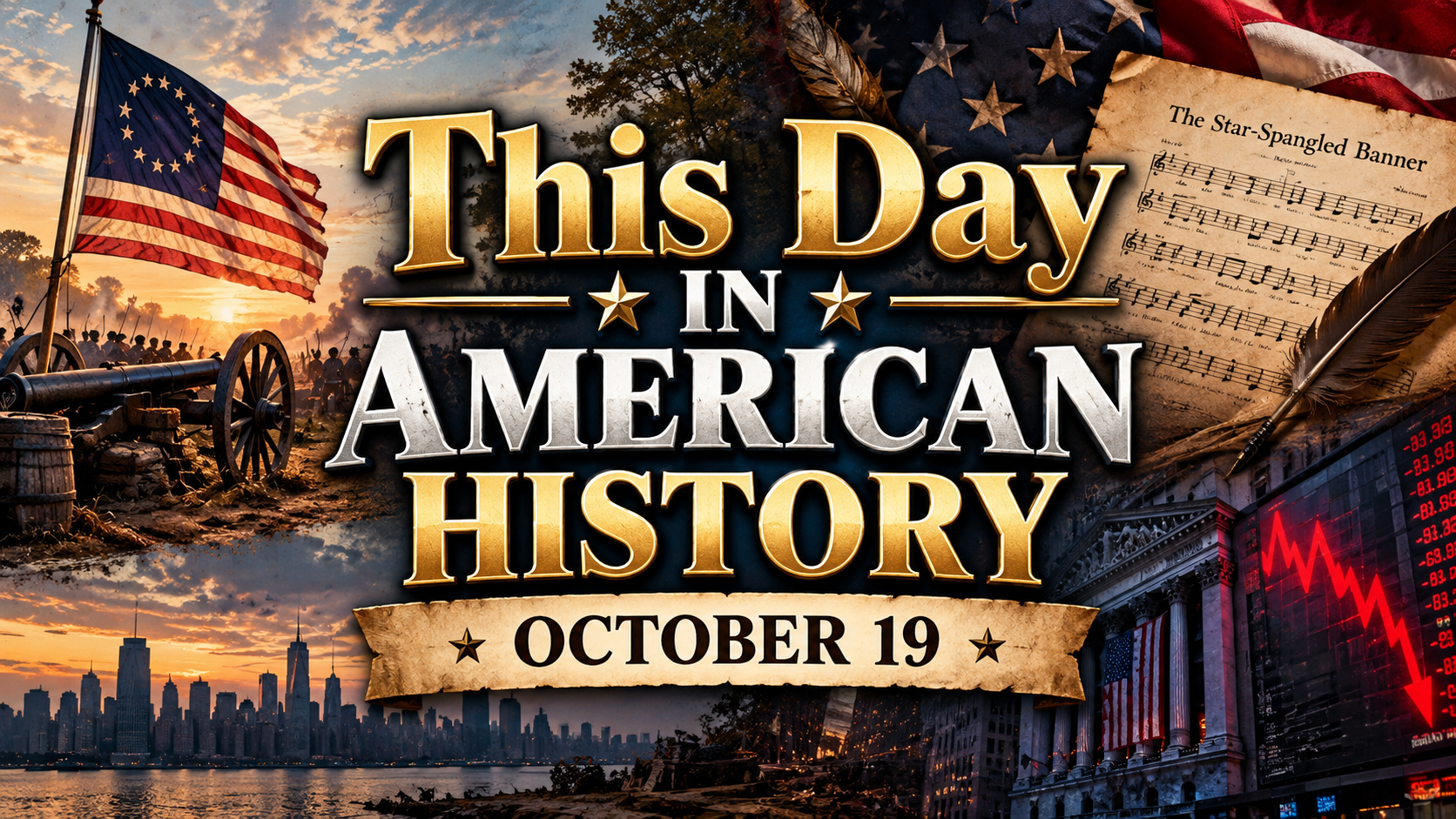
October 19 has witnessed some remarkable moments in American history. From the surrender at Yorktown that effectively ended major fighting in the American Revolution to the worst one-day percentage decline in the history of the Dow Jones Industrial Average, this date connects the nation’s founding era with its cultural, political, and economic development.
Here is a look back at some of the events that helped make October 19 an important day in American history.
1781 — The British Surrender at Yorktown
The most historically significant American event associated with October 19 occurred in 1781, during the American Revolutionary War.
After weeks of fighting and siege operations at Yorktown, Virginia, British forces under Lieutenant General Charles Cornwallis were trapped by a combined American and French force.
General George Washington commanded the American forces, while French troops and naval forces played an essential role in preventing Cornwallis from escaping or receiving reinforcements.
Cornwallis sought a cease-fire on October 17. Negotiations continued the following day, and on October 19, 1781, the surrender ceremony took place.
According to the National Park Service, most of Cornwallis’s army marched out of Yorktown between lines of American and French soldiers before reaching what became known as Surrender Field, where the British laid down their weapons.
It was an extraordinary moment.
After years of war, sacrifice, uncertainty, and setbacks, Washington and the Continental Army had achieved the victory they desperately needed.
Why Yorktown Was So Important
The surrender at Yorktown did not immediately produce a formal peace treaty. The Treaty of Paris, which formally ended the Revolutionary War and recognized American independence, would not be signed until 1783.
But Yorktown effectively ended major combat.
The U.S. Capitol Visitor Center describes the victory as the event that essentially ended the Revolutionary War. Cornwallis had been trapped between American and French land forces and French naval forces, leaving his army with little chance of escape.
The National Park Service similarly identifies Yorktown as the site of the last major battle of the Revolutionary War and notes that Cornwallis’s surrender effectively ended the war and helped ensure American independence.
For George Washington, the victory represented the culmination of years of perseverance.
The American Revolution had never been an easy or certain struggle. Washington’s army had suffered defeats, shortages, brutal winters, desertions, and periods when the entire revolutionary cause appeared to be in danger.
Yet the Continental Army survived.
At Yorktown, years of persistence finally produced a decisive result.
The French Contribution to Victory
Yorktown is also an important reminder that the American Revolution was not won by the colonists alone.
France provided critical military and naval assistance.
French soldiers fought alongside American troops, while the French fleet helped prevent British naval forces from rescuing or reinforcing Cornwallis.
The victory demonstrated the importance of alliances.
Washington’s leadership and the determination of American soldiers were essential, but French military involvement dramatically strengthened the campaign.
When the British troops marched toward Surrender Field on October 19, they passed between the allied armies—Americans on one side and French troops on the other.
It was a powerful visual representation of the alliance that had helped defeat Britain at Yorktown.
A British Rescue Force Was Already on Its Way
One of the fascinating details of the Yorktown story is how close British reinforcements came to being involved.
On the same day that Cornwallis’s troops surrendered, a British relief force under General Henry Clinton sailed from New York toward Virginia.
It was too late.
According to the National Park Service, Clinton and the British Navy arrived off the Virginia coast five days later, discovered that Cornwallis had already surrendered, and returned to New York.
History can sometimes turn on timing.
Had significant reinforcements arrived earlier, the Yorktown campaign might have unfolded differently.
Instead, October 19 became one of the defining dates of the American Revolution.
1814 — “The Star-Spangled Banner” Is Performed on Stage
October 19 also has an interesting connection to another symbol of American history.
Just a few weeks earlier, during the War of 1812, attorney and poet Francis Scott Key had witnessed the British bombardment of Fort McHenry in Baltimore.
When Key saw the American flag still flying over the fort on the morning of September 14, 1814, he wrote the poem originally titled “Defence of Fort M’Henry.”
The words were soon paired with the melody of an existing song and became known as “The Star-Spangled Banner.”
According to the National Park Service, a performer named Mr. Harding is credited with formally singing the new lyrics before a seated audience at Baltimore’s Holliday Street Theatre on October 19, 1814.
The Library of Congress also notes that around October 19, the words and music were likely joined together in print for the first time in a Baltimore sheet-music edition published by Thomas Carr.
At the time, of course, nobody in that theater could have known just how important the song would eventually become.
More than a century later, President Herbert Hoover signed legislation on March 3, 1931, officially making “The Star-Spangled Banner” the national anthem of the United States.
That gives October 19 an interesting connection to two powerful symbols of the nation’s history: the victory that helped secure American independence and the song that eventually became the national anthem.
1987 — Black Monday Shakes Wall Street
More than two centuries after Yorktown, October 19 became associated with a very different kind of crisis.
On October 19, 1987, the American stock market suffered one of the most dramatic crashes in its history.
The day became known as Black Monday.
The Dow Jones Industrial Average plunged 22.6% in a single trading session, which remains the largest one-day percentage decline in the Dow’s history.
The speed and magnitude of the decline shocked investors.
Markets around the world were also experiencing severe declines, creating what Federal Reserve History describes as the first contemporary global financial crisis.
For Americans watching financial news, the images were alarming: traders crowded onto exchange floors, prices plunged, and investors struggled to understand what was happening.
The crash raised serious questions about the growing role of computerized trading, market structure, liquidity, and the ability of financial institutions to handle extreme volatility.
Changes After Black Monday
Although Black Monday was devastating for investors, it also produced reforms designed to make financial markets better able to respond to sudden crashes.
Among the most important changes were marketwide circuit breakers.
Circuit breakers can temporarily halt trading when stock prices decline by unusually large amounts. The idea is to create a pause during periods of extreme volatility rather than allowing panic-driven selling to continue without interruption.
Federal Reserve History notes that regulators overhauled aspects of trade-clearing systems after the crash and developed circuit-breaker rules allowing exchanges to temporarily halt trading following exceptionally large declines.
Black Monday therefore became more than a story about a historic market collapse.
It helped change the rules governing modern financial markets.
October 19 Across Three Different Eras
What makes October 19 particularly interesting is the enormous variety of American history connected to the date.
In 1781, soldiers stood on a Virginia battlefield and watched British forces surrender at Yorktown.
In 1814, Americans in a Baltimore theater heard a patriotic song that would eventually become their country’s national anthem.
And in 1987, Americans watched one of the most dramatic financial collapses Wall Street had ever experienced.
These events occurred in completely different eras, yet each tells us something about the development of the United States.
Yorktown represents the struggle to establish an independent nation.
“The Star-Spangled Banner” represents the growth of national identity and symbolism.
Black Monday represents the challenges that came with America’s development into a modern economic and financial power.
Remembering October 19
History is more than a collection of dates.
Every date represents people making decisions without knowing exactly how history would remember them.
The soldiers standing at Yorktown could not know exactly what the new United States would eventually become.
The audience listening to “The Star-Spangled Banner” in Baltimore could not know that generations of Americans would someday stand for that same song before sporting events, ceremonies, and national occasions.
And the traders watching stock prices collapse in 1987 could not know exactly how the crisis would reshape financial-market safeguards.
That is one reason looking back at history matters.
It reminds us that the events we now view as established history were once uncertain moments experienced by ordinary people in real time.
This Day in American History
October 19, 1781: British forces surrender at Yorktown, effectively bringing major combat in the American Revolutionary War to an end.
October 19, 1814: “The Star-Spangled Banner” receives an early public stage performance in Baltimore, just weeks after Francis Scott Key wrote the words that would eventually become America’s national anthem.
October 19, 1987: Black Monday sends the Dow Jones Industrial Average plunging 22.6%, the largest single-day percentage decline in its history.
Three moments separated by generations—one connected to America’s independence, another to its national anthem, and another to its modern financial system.
That is the remarkable thing about exploring This Day in American History. A single date can take us from Revolutionary War battlefields to nineteenth-century theaters to the heart of modern Wall Street.
Which October 19 event do you think had the greatest long-term impact on American history?


Leave a Reply