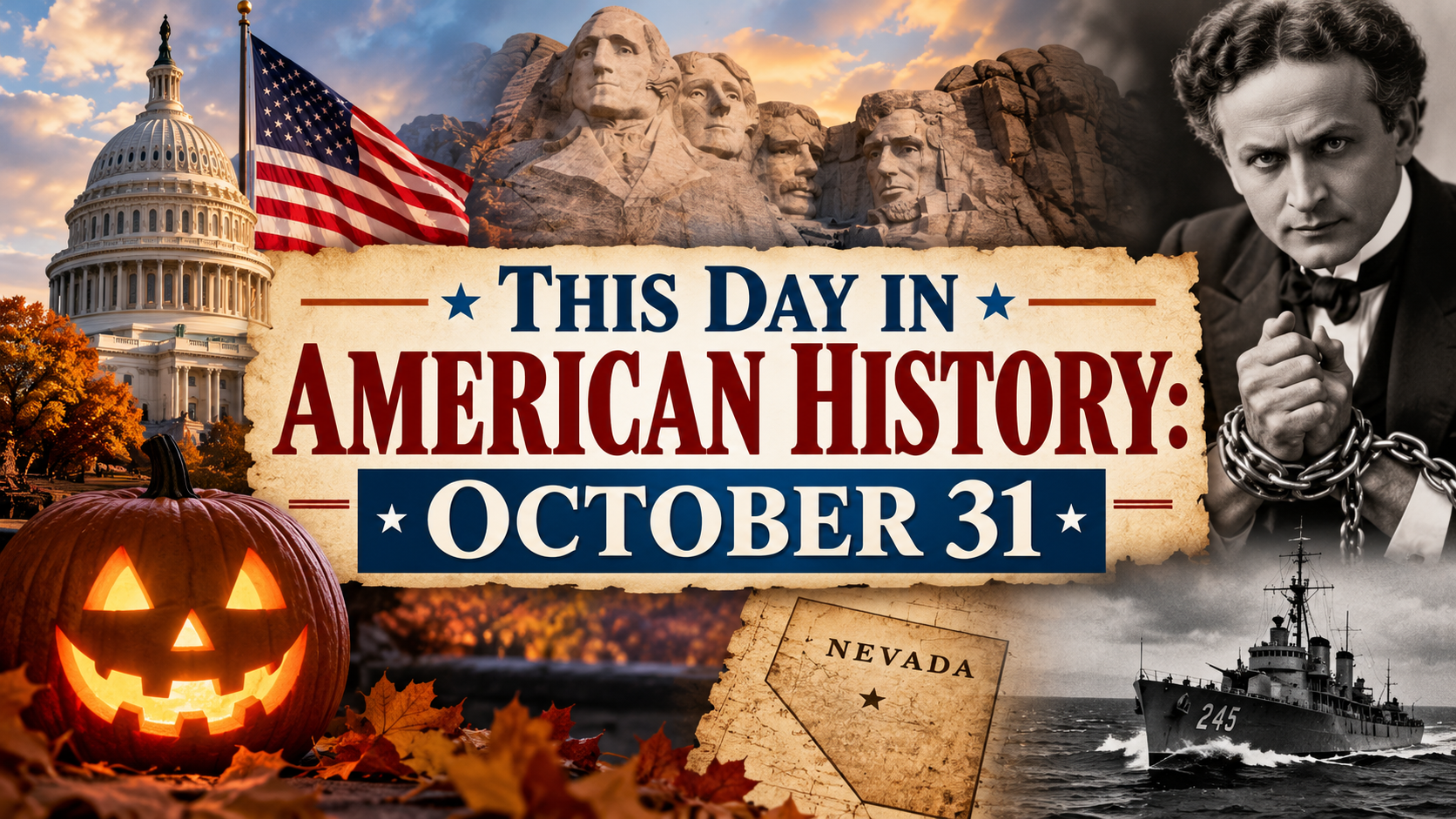
October 31 is a date filled with fascinating moments in American history. While millions of Americans recognize the day as Halloween, with costumes, candy, haunted houses, and spooky celebrations, October 31 also marks important developments in politics, entertainment, transportation, civil rights, and American culture.
From the completion of Mount Rushmore to the death of a legendary magician, this date reminds us that history is made through both extraordinary achievements and moments that change how Americans live.
Let’s explore the important events, famous birthdays, historical milestones, and fascinating facts associated with October 31.
1. 1864 – Nevada Becomes the 36th State
On October 31, 1864, Nevada officially entered the United States as the 36th state.
Its admission occurred during the American Civil War, when President Abraham Lincoln was seeking reelection and the Union was fighting to preserve the nation.
Nevada’s admission strengthened the Union politically and reflected the country’s continuing westward expansion.
Although Nevada had a relatively small population at the time, its mineral wealth, especially silver, made it economically significant.
The state eventually earned the nickname “Battle Born State” because it joined the Union during the Civil War.
Today, Nevada is known for Las Vegas, Reno, Lake Tahoe, vast desert landscapes, and its mining heritage.
Historical Significance: Nevada’s statehood demonstrated that the United States continued to grow even during one of its most difficult national crises.
2. 1926 – Harry Houdini Dies on Halloween
One of the world’s most famous illusionists and escape artists, Harry Houdini, died on October 31, 1926, in Detroit, Michigan.
Born Erik Weisz in Budapest in 1874, Houdini became internationally famous for performing seemingly impossible escapes.
His acts included escaping from handcuffs, locked containers, straitjackets, and water-filled chambers.
Houdini’s performances captivated audiences because they combined physical endurance, illusion, and extraordinary showmanship.
He also became known for exposing fraudulent spiritualists who claimed they could communicate with the dead.
Houdini died from peritonitis caused by a ruptured appendix at age 52.
His death on Halloween created a lasting connection between the famous magician and the holiday associated with mystery and the supernatural.
Historical Significance: Houdini helped transform stage magic into a major form of popular entertainment, influencing generations of performers.
3. 1941 – Mount Rushmore Is Declared Complete
On October 31, 1941, work on Mount Rushmore National Memorial officially came to an end.
The massive monument, located in the Black Hills of South Dakota, features the faces of four American presidents:
- George Washington
- Thomas Jefferson
- Theodore Roosevelt
- Abraham Lincoln
Sculptor Gutzon Borglum began the project in 1927. After his death in March 1941, his son Lincoln Borglum supervised the final work.
The monument was designed to represent important periods in American history, including the nation’s founding, expansion, development, and preservation.
Each presidential face measures approximately 60 feet tall.
The project required years of dangerous work by hundreds of laborers who used dynamite, drills, and specialized climbing equipment.
Mount Rushmore became one of the most recognizable landmarks in the United States.
However, the monument also carries a complicated history because it was carved into the Black Hills, land sacred to the Lakota people and central to longstanding disputes over treaty rights.
Historical Significance: Mount Rushmore became a major national symbol while also reflecting the complicated history of westward expansion and Native American land rights.
4. 1941 – The USS Reuben James Is Sunk During World War II
On October 31, 1941, the American destroyer USS Reuben James was torpedoed and sunk by a German submarine in the North Atlantic.
The attack occurred more than a month before the United States officially entered World War II.
The ship had been escorting a convoy near Iceland when a German U-boat launched its attack.
More than 100 American sailors lost their lives.
The sinking intensified tensions between the United States and Nazi Germany, demonstrating how deeply America was already involved in the Atlantic conflict.
Although the United States had not formally declared war, American naval vessels were helping protect shipments traveling across the ocean.
Historical Significance: The destruction of the USS Reuben James was an early warning of the growing danger facing American forces before the country’s formal entry into World War II.
5. 1950 – President Harry Truman Survives an Assassination Attempt
On October 31, 1950, two Puerto Rican nationalists, Oscar Collazo and Griselio Torresola, attempted to assassinate President Harry S. Truman.
The attack occurred at Blair House in Washington, D.C., where Truman was living while the White House underwent renovations.
The attackers approached Blair House and exchanged gunfire with security officers.
White House Police officer Leslie Coffelt was mortally wounded but managed to shoot and kill Torresola.
Collazo was wounded and captured.
President Truman was unharmed.
The assassination attempt drew national attention to the Puerto Rican nationalist movement and the political tensions surrounding Puerto Rico’s relationship with the United States.
Historical Significance: The attack demonstrated the dangers faced by American presidents and reinforced the importance of presidential security.
6. 1950 – Earl Lloyd Breaks the NBA’s Color Barrier
On October 31, 1950, Earl Lloyd became the first African American to play in a regular-season NBA game.
Lloyd made history when he took the court for the Washington Capitols against the Rochester Royals.
His appearance represented an important milestone in the integration of professional basketball.
At the time, racial segregation and discrimination remained widespread throughout American society.
African American athletes faced barriers to professional opportunities, accommodations, and equal treatment.
Lloyd’s achievement helped open doors for future generations of Black basketball players.
He later won an NBA championship with the Syracuse Nationals in 1955 and was inducted into the Basketball Hall of Fame in 2003.
Historical Significance: Earl Lloyd’s debut helped change professional basketball and contributed to the broader struggle for racial equality in American sports.
7. 1952 – The United States Prepares for Its First Hydrogen Bomb Test
On October 31, 1952, in the Marshall Islands, the United States was preparing for a historic nuclear test that would take place the following day.
On November 1, the United States detonated Ivy Mike, its first full-scale thermonuclear device.
The explosion was dramatically more powerful than the atomic bombs used during World War II.
The test demonstrated a new level of destructive capability and marked a major escalation in the nuclear arms race between the United States and the Soviet Union.
The development of hydrogen weapons raised serious questions about global security, environmental consequences, and the future of warfare.
Historical Significance: The preparations surrounding the Ivy Mike test reflected the rapidly escalating nuclear competition of the Cold War.
8. 1963 – A Deadly Explosion Strikes the Indiana State Fairgrounds
On October 31, 1963, a devastating explosion occurred at the Indiana State Fairgrounds Coliseum in Indianapolis.
The disaster happened during an ice-skating exhibition attended by thousands of spectators.
A propane gas explosion tore through the building, killing 81 people and injuring hundreds more.
Families who had gathered for an evening of entertainment suddenly found themselves in the middle of a tragedy.
Emergency responders rushed to rescue survivors and transport the injured to nearby hospitals.
Investigations identified serious problems involving propane storage and handling.
The tragedy contributed to greater attention to public-assembly safety and the handling of hazardous materials.
Historical Significance: The disaster became one of Indiana’s deadliest public-event tragedies and demonstrated the importance of safety regulations at entertainment venues.
9. 1968 – President Lyndon B. Johnson Announces a Bombing Halt in North Vietnam
On October 31, 1968, President Lyndon B. Johnson announced that the United States would halt bombing attacks against North Vietnam.
The decision came during the Vietnam War, one of the most controversial conflicts in American history.
Johnson hoped the bombing halt would create conditions for meaningful peace negotiations.
The announcement occurred just days before the 1968 presidential election.
Although the decision represented an important diplomatic development, it did not end the war.
American troops remained involved in Vietnam for several more years, and the conflict continued to divide the nation.
Historical Significance: The bombing halt marked an important moment in America’s efforts to negotiate an end to the Vietnam War.
10. 1993 – Actor River Phoenix Dies at Age 23
On October 31, 1993, American actor River Phoenix died at age 23 after collapsing outside the Viper Room nightclub in West Hollywood, California.
Phoenix was considered one of Hollywood’s most promising young performers.
He gained recognition for his roles in films including Stand by Me, Running on Empty, and My Own Private Idaho.
His performances demonstrated emotional depth and maturity beyond his years.
His death from acute drug intoxication shocked fans and the entertainment industry.
Phoenix’s passing also renewed public discussion about substance use, addiction, and the pressures associated with fame.
Historical Significance: River Phoenix’s death remains a memorable tragedy in American entertainment history and a reminder of the dangers of substance misuse.
11. 1994 – American Eagle Flight 4184 Crashes in Indiana
On October 31, 1994, American Eagle Flight 4184 crashed near Roselawn, Indiana, killing all 68 people aboard.
The aircraft was traveling from Indianapolis to Chicago when it encountered severe icing conditions.
Investigators determined that ice accumulation contributed to a loss of control.
The tragedy led to changes in aviation safety practices, pilot training, and the understanding of aircraft icing hazards.
The crash remains an important event in the history of American commercial aviation.
Historical Significance: Lessons learned from Flight 4184 helped improve aviation safety and highlighted the dangers of severe icing conditions.
12. 1999 – EgyptAir Flight 990 Crashes Off the American Coast
On October 31, 1999, EgyptAir Flight 990 crashed into the Atlantic Ocean south of Nantucket, Massachusetts.
The aircraft was traveling from New York to Cairo.
All 217 passengers and crew members died.
The tragedy led to an extensive investigation involving American and Egyptian aviation authorities.
The two countries reached different conclusions about the cause of the crash, creating controversy surrounding the investigation.
The United States National Transportation Safety Board concluded that the aircraft’s descent resulted from deliberate flight-control inputs by the relief first officer. Egyptian authorities disputed that interpretation.
Historical Significance: The disaster became one of the most closely examined aviation tragedies of the late 1990s.
13. 2005 – Samuel Alito Is Nominated to the Supreme Court
On October 31, 2005, President George W. Bush nominated Judge Samuel Alito to serve on the United States Supreme Court.
Alito was nominated to replace retiring Justice Sandra Day O’Connor.
His nomination followed the withdrawal of Harriet Miers, Bush’s previous nominee for the position.
The selection sparked significant national debate over constitutional interpretation, judicial philosophy, and the future direction of the Supreme Court.
Alito was confirmed by the Senate in January 2006.
Historical Significance: The nomination became an important moment in the evolution of the Supreme Court and its approach to major constitutional questions.
Halloween and Its Place in American History
October 31 is best known throughout the United States as Halloween.
However, the holiday’s history stretches back centuries before it became a major American celebration.
Halloween developed through a combination of ancient Celtic traditions, Christian observances, and customs brought to North America by immigrants.
The ancient Celtic festival of Samhain marked the transition from the harvest season into winter.
Over time, customs associated with the evening before All Saints’ Day became part of Halloween celebrations.
During the nineteenth century, Irish and Scottish immigrants helped popularize Halloween traditions in the United States.
Communities gradually developed celebrations involving costumes, storytelling, parties, and neighborhood gatherings.
By the twentieth century, Halloween had become an increasingly popular American holiday.
Trick-or-treating became especially widespread during the decades following World War II.
Today, Halloween celebrations include costume parties, haunted attractions, pumpkin carving, seasonal decorations, and community festivals.
Although Halloween is often associated with frightening imagery, the holiday also reflects America’s ability to combine cultural traditions from different parts of the world.
Famous Americans Born on October 31
1926 – Michael Landon
Michael Landon was an American actor, writer, director, and producer remembered for Bonanza, Little House on the Prairie, and Highway to Heaven.
His television work often explored family relationships, compassion, and personal struggles.
1931 – Dan Rather
Dan Rather is an American journalist and longtime CBS News anchor who covered major national events, including the Vietnam War, presidential elections, and significant moments in American political history.
1947 – Deidre Hall
Deidre Hall is an American actress best known for portraying Dr. Marlena Evans on the long-running daytime television drama Days of Our Lives.
1976 – Piper Perabo
Piper Perabo is an American actress recognized for her roles in Coyote Ugly, Covert Affairs, and other film and television productions.
Interesting Facts About October 31 in American History
October 31 has several interesting historical connections beyond Halloween.
- Nevada’s Birthday: Nevada became a state on Halloween in 1864, and its admission is commemorated through Nevada Day.
- A Magician’s Final Escape: Harry Houdini’s death on Halloween contributed to the enduring mystery surrounding his life and career.
- Presidential History: October 31 witnessed an assassination attempt against President Truman and a major Vietnam War announcement by President Johnson.
- Civil Rights in Sports: Earl Lloyd made basketball history on October 31, 1950, becoming the first Black player to appear in an NBA game.
- An American Landmark: Mount Rushmore’s construction officially ended on Halloween in 1941.
- World War II History: The sinking of the USS Reuben James demonstrated the growing dangers Americans faced before Pearl Harbor.
These events show how a single calendar date can connect vastly different chapters of American history.
Why October 31 Matters in American History
When people think of October 31, they usually imagine Halloween decorations, carved pumpkins, costumes, and candy.
Yet the date represents much more than a holiday.
It marks moments of national expansion, artistic achievement, political conflict, military sacrifice, racial progress, and technological development.
Nevada’s admission to the Union reminds us of America’s growth during the Civil War.
Mount Rushmore represents the nation’s efforts to commemorate its presidential history, while also encouraging discussion about whose history is remembered.
Earl Lloyd’s NBA debut reflects the importance of breaking racial barriers and expanding opportunities.
The USS Reuben James reminds us of the sacrifices made by American service members.
The tragedies involving River Phoenix and commercial aviation remind us that history also includes painful lessons about human vulnerability and public safety.
Together, these stories demonstrate that American history is not simply a collection of dates and famous names.
It is the story of people, choices, challenges, achievements, and consequences that continue to influence our lives.
Final Thoughts
October 31 holds a unique place in American history.
While Halloween brings excitement, imagination, and celebration to communities across the country, the date also commemorates events that shaped the nation’s identity.
From Nevada joining the Union in 1864 to the completion of Mount Rushmore in 1941, October 31 offers an opportunity to remember the achievements and struggles of earlier generations.
It is also a day to reflect on the courage of those who challenged barriers, the sacrifices of those who served their country, and the lessons learned from national tragedies.
Every day has a story worth remembering, and October 31 is no exception.
Which October 31 event in American history surprised you the most, and why do you think it deserves to be remembered?



Leave a Reply