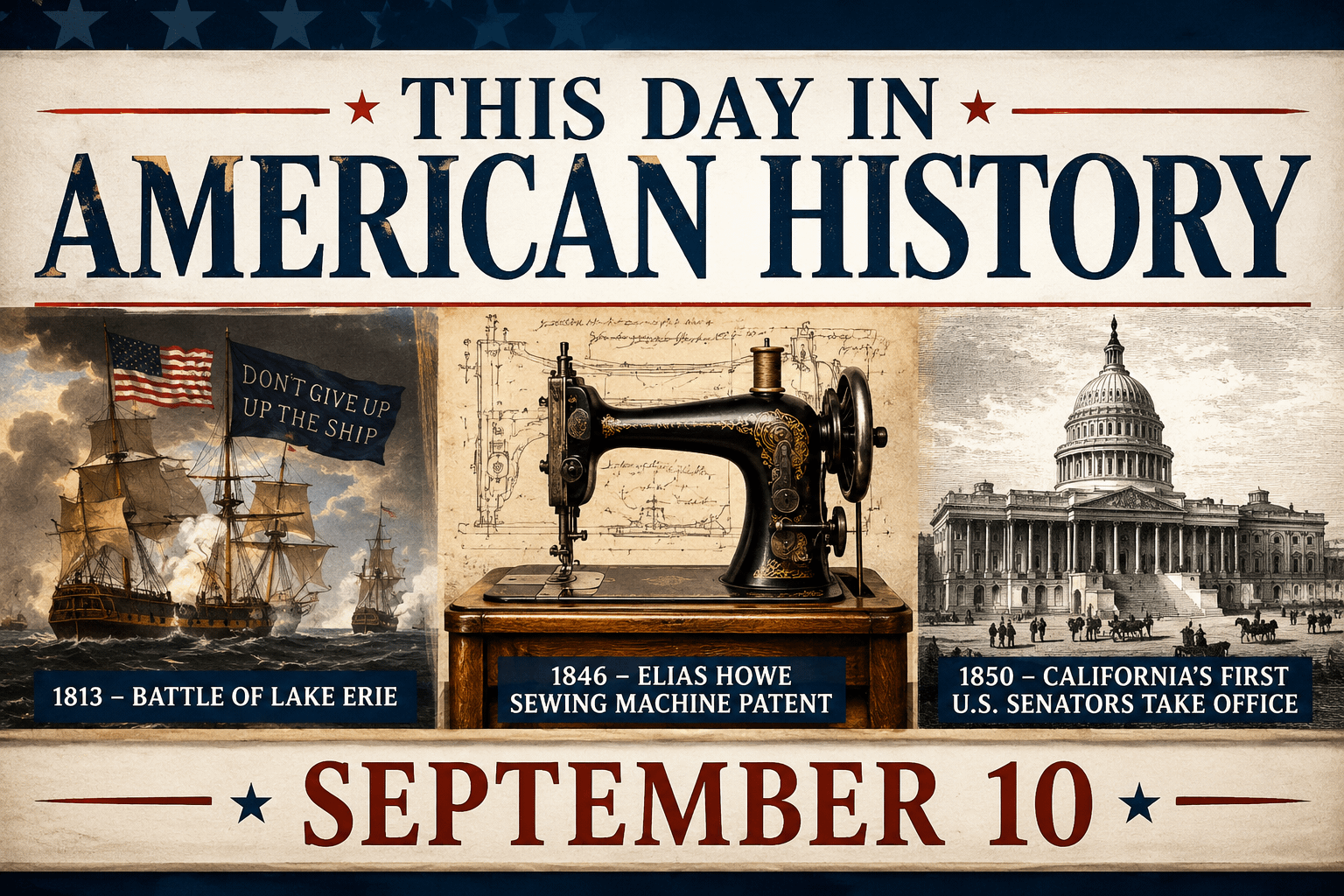
September 10 has witnessed moments of courage, innovation, political change, and military victory throughout American history. From a decisive naval battle during the War of 1812 to an invention that helped transform American manufacturing, the events connected to this date remind us that history is often shaped by people willing to take risks, solve problems, and persevere when the outcome is uncertain.
One of the most important events associated with September 10 occurred on the waters of Lake Erie in 1813, when Commodore Oliver Hazard Perry and his sailors fought a battle that would become one of the most celebrated American naval victories of the War of 1812.
Decades later, September 10 would become significant in the history of American innovation when Elias Howe received a patent for improvements to the sewing machine. The date also marked an important milestone for the newly admitted state of California when its first two U.S. senators officially took their seats.
Together, these events offer a fascinating look at America’s military history, technological development, and political growth.
1813 – The Battle of Lake Erie
On September 10, 1813, American and British naval forces met on Lake Erie during the War of 1812.
The conflict between the United States and Great Britain had begun the previous year. Control of the Great Lakes was strategically important because the waterways served as vital transportation and supply routes.
Whoever controlled Lake Erie could move troops and supplies more effectively throughout the region.
The United States placed Master Commandant Oliver Hazard Perry in charge of building and commanding an American naval force on Lake Erie. Perry was only 28 years old, but he would soon become one of the best-known naval heroes of his generation.
On the morning of September 10, Perry’s squadron encountered a British fleet commanded by Captain Robert Heriot Barclay.
According to the U.S. Naval History and Heritage Command, Perry’s force consisted of nine vessels facing six British warships.
The battle would be fierce.
“Don’t Give Up the Ship”
One of the most memorable symbols of the Battle of Lake Erie was the flag flying aboard Perry’s flagship, the Lawrence.
The banner carried the words:
“Don’t Give Up the Ship.”
The phrase honored Captain James Lawrence, an American naval officer who had been mortally wounded earlier in the War of 1812.
Perry adopted Lawrence’s words as a battle cry.
As cannon fire erupted across Lake Erie, the Lawrence became the focus of intense British fire.
The ship suffered devastating damage and heavy casualties.
Eventually, Perry realized that his flagship could no longer effectively continue the fight.
But he refused to surrender.
Instead, Perry transferred from the heavily damaged Lawrence to another American vessel, the Niagara.
That decision helped change the course of the battle.
Perry Turns the Battle Around
After reaching the Niagara, Perry took command and moved aggressively against the British fleet.
The American ships broke through the British line and unleashed devastating broadsides.
The British vessels had already suffered significant damage, and Perry’s renewed attack overwhelmed them.
The British squadron surrendered.
The United States had won control of Lake Erie.
The Naval History and Heritage Command describes the Battle of Lake Erie as a major American naval victory that helped reverse the course of the campaign in the Northwest and forced the British to abandon Detroit.
The victory also produced one of the most famous messages in American military history.
After the battle, Perry sent a message to Major General William Henry Harrison announcing the victory.
He wrote:
“We have met the enemy and they are ours.”
Those words became permanently associated with Perry and the Battle of Lake Erie.
Why the Battle of Lake Erie Mattered
The victory was much more than a symbolic achievement.
Control of Lake Erie gave American forces an important strategic advantage.
British forces could no longer depend upon the lake as a secure supply route. The loss contributed to the British withdrawal from Detroit and helped American forces regain momentum in the region.
General William Henry Harrison’s army later pursued retreating British and Native American forces into Canada.
On October 5, 1813, Harrison’s forces won the Battle of the Thames, another significant American victory.
The Lake Erie victory had helped make that campaign possible.
Perry became a national hero, and his reputation became permanently connected with American naval history.
Today, his famous battle flag and the words “Don’t Give Up the Ship” remain powerful symbols of determination and perseverance.
1846 – Elias Howe Receives a Sewing Machine Patent
September 10 also marks an important day in the history of American invention.
On September 10, 1846, inventor Elias Howe Jr. received U.S. Patent No. 4,750 for improvements to the sewing machine.
The development may not sound as dramatic as a naval battle, but its long-term influence on American life was enormous.
Before mechanized sewing became widespread, producing clothing required tremendous amounts of manual labor.
Garments were largely sewn by hand.
A skilled person could work for hours completing stitches that a machine would eventually accomplish far more quickly.
Howe spent years trying to develop a practical method of mechanizing the sewing process.
According to the Smithsonian’s National Museum of American History, Howe worked as a journeyman machinist while attempting to solve the problem. His family’s financial struggles also influenced his work; his wife earned money sewing by hand, giving Howe a firsthand view of how labor-intensive sewing could be.
In 1845, Howe built an early sewing machine and later developed an improved version.
His machine used an eye-pointed needle and a second thread carried by a shuttle to create a lockstitch.
On September 10, 1846, his invention received its American patent.
Changing the Way America Made Clothing
Howe’s machine was not the first attempt to mechanize sewing, nor would it immediately dominate the marketplace.
Other inventors were also developing sewing machines.
What followed was a complicated period of innovation, competition, patent disputes, and lawsuits.
Howe eventually defended his patent rights and collected royalties from manufacturers using technology covered by his patent.
The Smithsonian notes that in 1856, Howe and several major sewing-machine companies became part of an arrangement known as the Sewing Machine Combination, sometimes described as an early patent pool in American industry.
The broader development of practical sewing machines helped transform clothing production.
Tasks that once required long hours of hand stitching could increasingly be completed mechanically.
The technology contributed to the growth of garment manufacturing while also bringing sewing machines into American homes.
Eventually, the sewing machine became one of the most recognizable household and industrial inventions of the nineteenth century.
The September 10 patent issued to Elias Howe therefore represents more than the story of one inventor.
It represents America’s rapidly changing industrial landscape.
1850 – California’s First U.S. Senators Take Office
September 10 also played an important role in California’s early political history.
California officially entered the Union as the 31st state on September 9, 1850, as part of the political agreements associated with the Compromise of 1850.
Just one day later, on September 10, California’s first two United States senators presented their credentials and took the oath of office.
They were John C. Frémont and William M. Gwin.
According to the U.S. Senate’s historical records, both men were from San Francisco. After taking the oath, they drew lots to determine their Senate class assignments.
It was an important step in California’s transition from a rapidly developing western territory into full participation in the federal government.
California’s Rapid Rise
California’s admission to the Union was extraordinary because of how rapidly the region had changed.
The discovery of gold at Sutter’s Mill in 1848 triggered the California Gold Rush.
Thousands upon thousands of people headed west hoping to find opportunity.
Settlements expanded.
San Francisco grew dramatically.
Businesses opened to serve miners and newcomers.
Transportation routes developed.
The population increased rapidly enough that California soon sought statehood.
But California’s admission became tangled in the growing national argument over slavery.
The country was becoming increasingly divided between free states and slave states, and adding another state threatened to disrupt the political balance.
The Compromise of 1850 attempted to address several of these disputes.
California entered the Union as a free state.
Its arrival gave the United States a major Pacific state and further demonstrated how quickly the nation’s center of population and economic ambition was moving westward.
When Frémont and Gwin took their Senate oaths on September 10, California formally gained its first representation in one of the most powerful institutions of the federal government.
John C. Frémont’s Larger Role in American History
John C. Frémont would become an especially notable figure in American political history.
Known for his western expeditions, Frémont became closely associated with American expansion into the West.
Only a few years after becoming one of California’s first senators, he reached another historical milestone.
In 1856, Frémont became the first presidential nominee of the newly formed Republican Party.
He ultimately lost the election to Democrat James Buchanan, but his campaign demonstrated the rapid rise of the Republican Party during the growing national conflict over slavery.
Within a few years, Abraham Lincoln would become the party’s presidential nominee and win the election of 1860.
September 10 and the Growth of America
When we look at these September 10 events together, a larger story begins to emerge.
The Battle of Lake Erie in 1813 represents America’s struggle to defend itself and establish control over its territory during the nation’s early years.
The sewing-machine patent issued to Elias Howe in 1846 represents the technological and industrial transformation that was changing how Americans worked and produced goods.
The arrival of California’s first senators in 1850 represents America’s enormous westward expansion and the increasingly complicated political questions that expansion created.
These stories are very different.
One happened aboard wooden warships surrounded by cannon smoke.
Another happened through years of experimentation by a struggling inventor.
Another unfolded inside the halls of the United States Senate.
Yet each helped shape the country.
The Power of Determination
There is also a shared theme running through much of September 10’s American history: perseverance.
Oliver Hazard Perry watched his flagship become nearly destroyed but refused to surrender.
Elias Howe struggled financially while spending years developing an invention that he believed could change the way people worked.
California’s rapid transformation showed how quickly the boundaries, population, and political identity of the United States were changing during the nineteenth century.
History rarely moves forward in a straight line.
Progress often comes through failure, uncertainty, conflict, experimentation, and persistence.
Sometimes the people who eventually make history have no way of knowing how important their actions will become.
Remembering September 10
September 10 reminds us that American history is made up of far more than presidents, elections, and famous speeches.
It is also the history of sailors fighting aboard damaged ships.
It is the history of inventors working in shops and experimenting with machines.
It is the history of states entering the Union and sending representatives thousands of miles away to Washington.
It is the history of ordinary decisions that eventually produce extraordinary consequences.
More than two centuries after the Battle of Lake Erie, Oliver Hazard Perry’s determination remains part of American naval tradition.
More than a century and a half after Elias Howe received his patent, mechanized sewing is so ordinary that it can be difficult to appreciate how revolutionary the technology once seemed.
And California, whose first senators took their oaths on September 10, 1850, would grow into the most populous state in the nation and become enormously influential in American culture, agriculture, technology, entertainment, and commerce.
That is what makes studying a single day in history so fascinating.
One date can connect warships, inventors, politicians, industrial change, western expansion, and the continuing development of the United States.
On September 10, we remember the people who fought, invented, represented, persevered, and helped write another chapter in the American story.
Which September 10 event do you think had the greatest long-term impact on the United States: the Battle of Lake Erie, Elias Howe’s sewing-machine patent, or California gaining its first representation in the U.S. Senate?
Leave a Reply