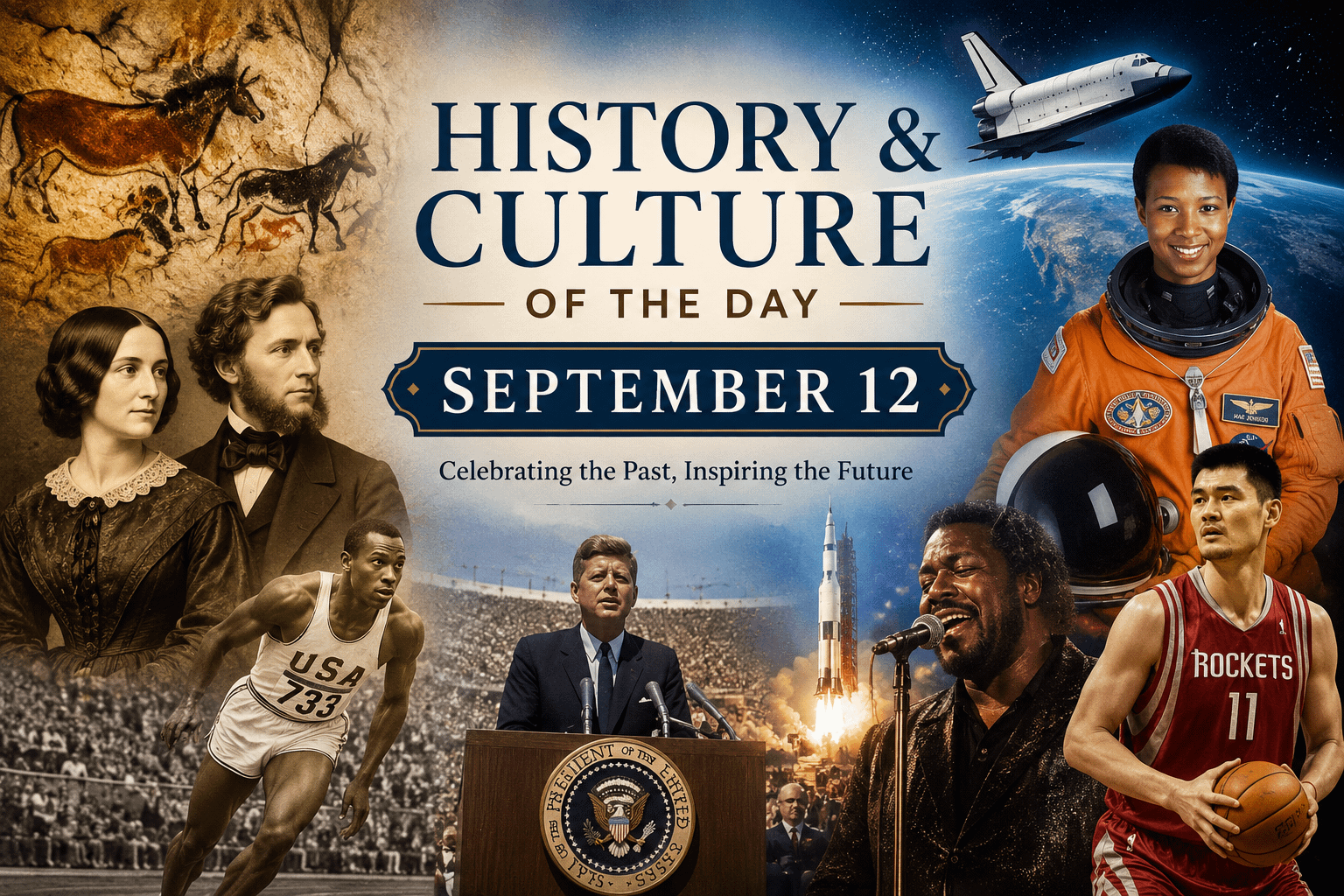
September 12 is a date filled with moments that remind us how human beings have always been driven to create, explore, compete, love, and push beyond established boundaries.
On this day, a remarkable prehistoric discovery opened a window into humanity’s artistic past. Two celebrated poets took a dramatic step in one of literature’s most famous romances. Future Olympic legend Jesse Owens was born. John F. Kennedy delivered one of the defining speeches of the Space Age. Singer Barry White entered the world and eventually helped create a soundtrack for romance. And decades later, Dr. Mae Jemison made history by becoming the first Black woman to travel into space.
From paintings created thousands of years ago to astronauts orbiting hundreds of miles above Earth, September 12 connects some very different chapters of the human story.
Here is a look at the history and culture that make September 12 a fascinating day to remember.
1846 – Elizabeth Barrett and Robert Browning Eloped
One of the great literary love stories reached a dramatic turning point on September 12, 1846, when poets Elizabeth Barrett and Robert Browning secretly married and eloped.
Elizabeth Barrett was already an accomplished and respected poet. Her work had gained considerable attention, but her personal life was complicated by the controlling influence of her father.
Then Robert Browning entered her life.
Their relationship began through correspondence after Browning admired Barrett’s poetry. Letters turned into meetings, and the connection between the two writers deepened.
Because Barrett’s father strongly opposed his children marrying, the couple decided to marry secretly.
Their relationship would become one of the most famous romances in literary history.
Their story is especially memorable because words were at the center of their relationship. These were two people whose lives revolved around language, poetry and expression, and their personal correspondence provides an extraordinary glimpse into their growing affection.
Elizabeth Barrett Browning would eventually produce some of the most recognizable romantic poetry in the English language.
Their marriage also allowed Elizabeth to establish a life away from her father’s control. The couple settled in Italy, where she continued writing and became involved with political and social issues of her era.
September 12 therefore holds a special place in literary history—not simply as a date connected with two famous poets, but as a reminder that some of literature’s greatest love stories happened beyond the pages of books.
1913 – Jesse Owens Was Born
James Cleveland “Jesse” Owens was born on September 12, 1913, in Oakville, Alabama.
He would grow into one of the most celebrated athletes of the 20th century.
Owens became internationally famous at the 1936 Olympic Games in Berlin, where he won four gold medals in track and field.
His accomplishments were extraordinary under any circumstances, but the political environment surrounding those Olympics gave his victories even greater historical significance.
Nazi Germany attempted to use the Games as an international showcase for Adolf Hitler’s regime and its racist ideology. Owens, a Black American athlete, became one of the Games’ biggest stars.
He won gold in the 100 meters, 200 meters, long jump and 4-by-100-meter relay.
His performance demonstrated something far more powerful than propaganda.
Excellence could not be confined by racial ideology.
Owens returned home as an international sports hero, although he still lived in an America deeply affected by racial discrimination and segregation.
That contradiction is an important part of his story.
A man celebrated around the world for representing the United States could still encounter racial barriers within his own country.
Over time, Owens became remembered not only as a legendary athlete but as a cultural figure whose achievements transcended sports.
His September 12 birthday gives us an opportunity to remember the ability of sports to challenge assumptions, cross cultural boundaries and inspire generations.
1940 – The Lascaux Cave Paintings Were Discovered
One of the most extraordinary archaeological discoveries of the 20th century occurred on September 12, 1940, near Montignac in southwestern France.
The Lascaux cave paintings were discovered.
Inside the cave system were remarkable prehistoric images, many depicting animals such as horses, deer and wild cattle.
The paintings date back thousands of years to the Upper Paleolithic period and are among the world’s most famous examples of prehistoric art.
Their discovery transformed understanding of early human artistic ability.
It can be tempting to imagine prehistoric people primarily through the lens of survival—finding food, building shelter, avoiding predators and adapting to difficult environments.
Lascaux tells a richer story.
Human beings were also observing.
They were imagining.
They were communicating.
And they were creating art.
The sophistication of the paintings demonstrates that artistic expression has extraordinarily deep roots in human culture.
Long before museums, galleries, books, photography, movies or digital media existed, people were finding ways to preserve images and ideas.
The walls of Lascaux became a canvas across thousands of years.
That is one reason the discovery remains culturally important.
Technology changes.
Civilizations rise and fall.
Languages evolve.
But the desire to create appears to be one of humanity’s most enduring characteristics.
1944 – Barry White Was Born
September 12 also marks the birthday of one of the most recognizable voices in popular music.
Barry White was born on September 12, 1944, in Galveston, Texas.
His deep, unmistakable voice would eventually become associated with soul, R&B, disco and especially romantic music.
White developed a successful career as a singer, songwriter, arranger and producer. His lush orchestral arrangements combined with his distinctive vocals helped create a musical style that listeners could identify almost immediately.
During the 1970s, he became particularly associated with the era’s soul and disco sound.
Songs such as “Can’t Get Enough of Your Love, Babe” helped establish his reputation as one of popular music’s great romantic performers.
His influence extended beyond individual hits.
Barry White became a cultural personality.
His voice was so distinctive that it became instantly recognizable across generations, appearing throughout popular culture in television, movies and comedy.
Music has always played an important role in the way people experience emotion.
Certain songs become connected with relationships, celebrations, heartbreaks and memories.
Barry White built an extraordinary career around that connection.
His September 12 birthday represents another chapter in the day’s remarkable cultural history.
1953 – John F. Kennedy Married Jacqueline Bouvier
On September 12, 1953, future U.S. President John F. Kennedy married Jacqueline Bouvier in Newport, Rhode Island.
At the time, Kennedy was serving as a U.S. senator from Massachusetts.
Seven years later, he would win the presidency.
Jacqueline Kennedy would become one of the most influential first ladies in American history, admired for her fashion, interest in the arts and efforts to preserve the historical character of the White House.
The Kennedy family quickly became a major presence in American popular culture.
Their youth, style and public image helped create a fascination that extended far beyond politics.
The marriage therefore became part of a larger cultural story surrounding the Kennedy era.
Interestingly, September 12 would become significant in John F. Kennedy’s life for another reason nine years later.
That moment would help define his presidency.
1962 – President Kennedy Challenged America to Reach the Moon
On September 12, 1962, President John F. Kennedy stood before a crowd at Rice University in Houston, Texas, and delivered one of the most memorable speeches of the Space Age.
America was competing with the Soviet Union in the rapidly developing space race.
The challenge was enormous.
Kennedy had previously committed the United States to landing a person on the Moon before the decade ended. At Rice University, he strongly reaffirmed that goal before an audience of approximately 40,000 people.
The speech became famous for Kennedy’s explanation of why difficult challenges were worth attempting.
He argued that reaching the Moon mattered precisely because the task was difficult.
The speech transformed a technical and political objective into something larger.
It became a statement about ambition.
Exploration.
Innovation.
Courage.
And human possibility.
The idea of sending astronauts approximately a quarter-million miles from Earth sounded almost impossible.
NASA still had enormous technological challenges ahead.
Rockets had to become more powerful.
Spacecraft had to become more sophisticated.
Astronauts needed to learn how to operate safely in space.
Engineers needed to solve problems that had never existed before.
Thousands of people across government, universities and private industry would eventually contribute to the effort.
Seven years after Kennedy’s Rice University speech, Apollo 11 astronauts Neil Armstrong and Buzz Aldrin walked on the Moon.
Kennedy did not live to see that achievement.
But the challenge he articulated on September 12, 1962, became permanently connected with one of humanity’s greatest technological accomplishments.
The speech remains relevant because its message extends beyond space exploration.
Some goals are worth pursuing not because they are guaranteed to succeed, but because pursuing them forces people to discover what they are capable of accomplishing.
1980 – Basketball Star Yao Ming Was Born
Another major figure in international sports was born on September 12, 1980.
Yao Ming was born in Shanghai, China.
At 7 feet 6 inches tall, Yao eventually became one of the most recognizable basketball players in the world.
He played professionally in China before joining the Houston Rockets in the NBA.
His arrival generated enormous international attention.
Yao wasn’t simply another talented basketball player entering the NBA. He represented an important bridge between American professional basketball and a rapidly growing basketball audience in China.
Millions of fans followed his career.
His presence helped expand the international reach of the sport and demonstrated how dramatically basketball had evolved from an American game into a truly global cultural phenomenon.
Sports frequently create connections that politics and geography cannot.
Fans thousands of miles apart can celebrate the same players, debate the same games and experience the same unforgettable moments.
Yao Ming’s career became part of that global transformation.
1992 – Mae Jemison Became the First Black Woman in Space
Thirty years after Kennedy’s famous Rice University address, September 12 produced another major milestone in space history.
On September 12, 1992, Space Shuttle Endeavour launched on mission STS-47.
Among the seven crew members was Dr. Mae C. Jemison.
With that launch, Jemison became the first Black woman to travel into space.
Her background was already remarkable.
Jemison was a physician and engineer who had also served as a Peace Corps medical officer in Sierra Leone and Liberia before being selected by NASA as an astronaut candidate in 1987.
STS-47 was a joint American-Japanese Spacelab mission focused on materials science and life-science research.
Jemison served as a science mission specialist and participated in scientific experiments during the flight.
NASA’s records show the mission launched aboard Endeavour on September 12, 1992, and lasted nearly eight days.
Her achievement carried enormous cultural significance.
For generations, women and people of color had been underrepresented in many areas of science and engineering.
Jemison’s journey provided a powerful and highly visible example of barriers being broken.
There was also an interesting connection between science fiction and reality.
Jemison has spoken about being inspired by Nichelle Nichols, who portrayed Lieutenant Uhura on “Star Trek.” Nichols herself later worked with NASA efforts encouraging women and minorities to apply to the astronaut program.
The connection demonstrates how culture and science can influence each other.
A fictional character can inspire a child.
That child can become a scientist.
That scientist can become an astronaut.
And that astronaut can inspire another generation.
History doesn’t always move in a straight line.
Sometimes imagination comes first.
September 12 and Humanity’s Desire to Explore
There is an interesting connection running through several of September 12’s historical events.
It is exploration.
The people who created the Lascaux cave paintings explored artistic expression thousands of years before modern civilization.
Elizabeth Barrett Browning and Robert Browning explored the power of language, poetry and love.
Jesse Owens explored the limits of human athletic performance.
Barry White explored emotion through music.
John F. Kennedy challenged a nation to explore another world.
Mae Jemison physically left Earth and traveled into space.
Even though these stories occurred in completely different eras, each demonstrates something fundamental about human culture.
We rarely remain satisfied with where we are.
We create.
We question.
We compete.
We imagine.
We travel.
We discover.
And occasionally we accomplish something that previous generations would have considered impossible.
The Cultural Importance of September 12
History isn’t simply a collection of dates.
It is the accumulated story of human choices.
Someone decided to paint an animal on a cave wall.
Someone decided to write a poem.
Someone trained for a race.
Someone composed a song.
Someone challenged a nation to reach the Moon.
Someone climbed aboard a spacecraft and broke a barrier.
Each action eventually became part of history.
That is what makes September 12 such an interesting date.
Its stories stretch from prehistoric caves to outer space.
Few combinations could illustrate the journey of human civilization more dramatically.
Thousands of years ago, people looked at animals around them and painted their images on stone walls.
By the 20th century, humans were building machines capable of escaping Earth’s atmosphere.
And through all those centuries, art, music, literature, competition, curiosity and imagination remained central parts of human life.
Remembering September 12
September 12 reminds us that history and culture are constantly intertwined.
The greatest scientific achievement can become part of popular culture.
An athlete can become a symbol of social change.
A singer can create music that becomes connected with millions of personal memories.
A poet’s relationship can become a literary legend.
A prehistoric painting can survive long enough to communicate across thousands of years.
And one astronaut can change the way countless young people imagine their own possibilities.
The people responsible for these moments probably could not fully understand how their actions would eventually be remembered.
That is another fascinating part of history.
We recognize important moments more clearly when looking backward.
But every generation is creating tomorrow’s history right now.
September 12 gives us an extraordinary timeline—from ancient artistic expression to the exploration of space—and reminds us just how far humanity has traveled while continuing to ask the same timeless question:
What might we discover if we are willing to go a little farther than anyone has gone before?
Leave a Reply