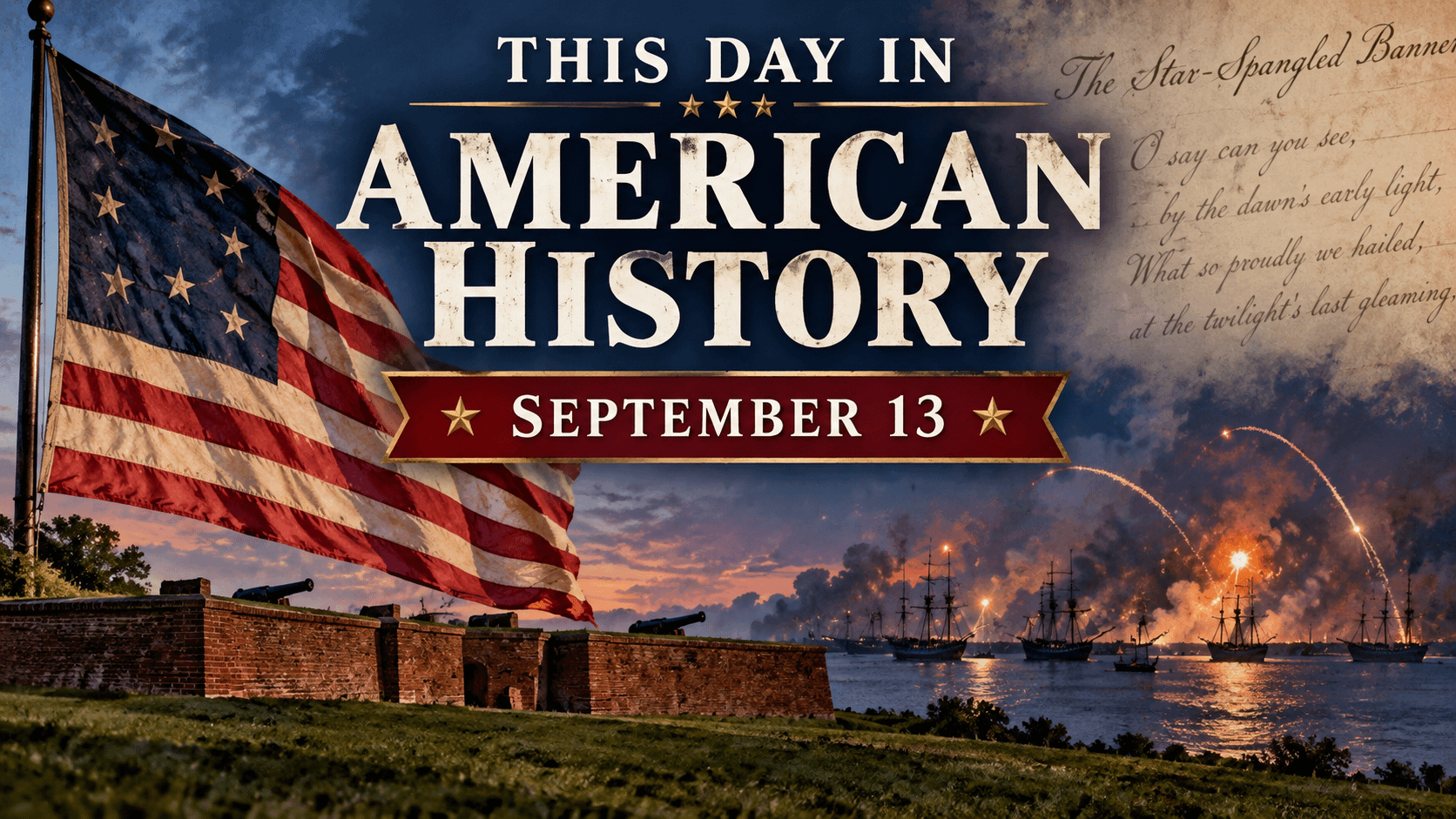
September 13 holds a special place in American history. It was on this date that one of the most dramatic battles of the War of 1812 unfolded, creating the scene that would inspire the words of the United States national anthem.
From British warships firing rockets and exploding shells toward Fort McHenry in 1814 to major legislation signed nearly two centuries later, September 13 has witnessed moments connected to American identity, resilience, law, security, and national recovery.
Here is a look back at some of the important events connected to September 13 in American history.
1814 – The Bombardment of Fort McHenry Begins
The defining American historical event associated with September 13 occurred during the War of 1812.
On the morning of September 13, 1814, British naval forces began an intense bombardment of Fort McHenry, which guarded the entrance to Baltimore Harbor.
Baltimore was an important American port and commercial center. After British forces had invaded Washington and burned important government buildings only weeks earlier, Baltimore became their next major target.
American defenders knew that losing Fort McHenry could leave Baltimore vulnerable.
The British fleet began bombarding the fort at approximately 6:30 in the morning. Rockets and mortar shells rained toward the American defenses during an attack that continued for roughly 25 hours.
Inside Fort McHenry, approximately 1,000 defenders under the command of Major George Armistead endured the attack.
The British possessed weapons capable of firing from distances that initially placed much of their fleet beyond the effective range of the fort’s cannons.
American forces nevertheless refused to surrender.
Throughout September 13 and into the night, British rockets streaked across the sky while exploding shells illuminated Baltimore Harbor.
Those terrifying sights would soon become some of the most recognizable words in American history.
Francis Scott Key Watches the Battle
Among those witnessing the bombardment was a 35-year-old American lawyer named Francis Scott Key.
Key had traveled with American prisoner-exchange agent John Stuart Skinner to negotiate the release of Dr. William Beanes, who was being held by the British.
The Americans succeeded in securing Beanes’ release, but because Key and his companions had learned information about the planned attack on Baltimore, they were not immediately permitted to return to shore.
As a result, Key found himself watching the attack from a vessel in Baltimore Harbor.
From his position several miles away, he could see rockets and exploding shells over Fort McHenry.
Throughout the night, an enormous question remained:
Had the fort surrendered?
As long as the American flag remained above Fort McHenry, Key knew the defenders were still holding their position.
But darkness, smoke and bad weather made it difficult to determine what was happening.
The battle continued through the night.
The Rockets’ Red Glare
Today, millions of Americans recognize the phrase about the rockets’ red glare from “The Star-Spangled Banner.”
Those words weren’t simply poetic imagery.
They described something Key had actually witnessed.
British forces used Congreve rockets during their attack on Fort McHenry, while mortar vessels fired explosive shells high into the air.
The flashes from those weapons helped Key determine during the darkness that the battle was continuing.
The Smithsonian notes that the rockets and bombs described in the national anthem reflect the real weapons being used against Fort McHenry on the night of September 13, 1814.
Every explosion meant the American defenders were still under attack.
Yet Fort McHenry did not surrender.
A Massive American Flag Waited at Fort McHenry
The flag associated with the battle had been created before the British attack.
Major George Armistead wanted an American flag large enough that approaching forces would have no trouble recognizing who controlled Fort McHenry.
Baltimore flagmaker Mary Pickersgill and others created the enormous garrison flag.
It measured approximately 30 feet by 42 feet.
The flag contained 15 stars and 15 stripes, representing the states recognized under the flag design used at the time.
Because heavy rain accompanied much of the bombardment, a smaller storm flag was flown during the battle.
But the enormous garrison flag would soon have its historic moment.
September 14 – The Flag Was Still There
Although the bombardment began on September 13, the moment that completed the story occurred the following morning.
By dawn on September 14, British forces had failed to force Fort McHenry into surrender.
The bombardment ended, and the British fleet began withdrawing.
At Fort McHenry, the smaller storm flag was lowered and the enormous garrison flag was raised.
From his distant position, Francis Scott Key saw the American flag flying above the fort.
Baltimore had survived.
The fort had held.
The British had failed to capture the city.
For Key, the sight was overwhelming.
The Library of Congress describes how Key saw the American flag still flying after the nightlong bombardment, inspiring the words that became “The Star-Spangled Banner.”
The Birth of “The Star-Spangled Banner”
Inspired by what he had witnessed, Key began writing words describing the experience.
His poem was originally titled “Defence of Fort M’Henry.”
Its opening asked whether the American flag could still be seen after the violent night of battle.
The imagery reflected the uncertainty Key had experienced aboard the vessel.
Could he see the flag?
Had Fort McHenry survived?
Was Baltimore still in American hands?
The answer came with the morning light.
Yes.
The flag was still there.
Key’s words were eventually set to the melody of a popular tune of the era, and the song became increasingly associated with American patriotism.
More than a century later, in 1931, Congress officially recognized “The Star-Spangled Banner” as the national anthem of the United States.
What began as one man’s description of a terrifying night in Baltimore had become part of America’s national identity.
Why the Battle of Baltimore Mattered
The importance of the defense of Baltimore extended far beyond the creation of the national anthem.
Only weeks earlier, Americans had experienced the humiliation of seeing British troops enter Washington.
The British burned several public buildings, including the Capitol and the President’s House, later known as the White House.
Baltimore presented another opportunity for Britain to deliver a devastating blow.
But American defenses were considerably stronger.
Thousands of defenders had prepared positions around the city while Fort McHenry protected the harbor.
British troops encountered American resistance on land at the Battle of North Point on September 12. The following day, the naval assault against Fort McHenry began.
Neither effort succeeded in capturing Baltimore.
The National Park Service describes the bombardment of Fort McHenry on September 13–14 as one of the longest bombardments in North American history.
The British eventually abandoned their attempt to capture the city.
For Americans who had recently watched their capital attacked, the successful defense of Baltimore provided an important boost in morale.
The Original Star-Spangled Banner Survives
The flag that inspired Francis Scott Key survived as well.
Today, the original Star-Spangled Banner is preserved by the Smithsonian’s National Museum of American History in Washington, D.C.
Its age, enormous size and fragile fibers require careful conservation.
More than two centuries after the Battle of Baltimore, Americans can still see the actual flag connected to the creation of their national anthem.
Few historical artifacts provide such a direct connection between a famous piece of American music and the event that inspired it.
The anthem isn’t merely describing an imaginary battlefield.
The flag existed.
The fort exists.
The battle happened.
And the enormous banner that Key saw over Fort McHenry remains part of America’s national collection.
1994 – The Violence Against Women Act Is Signed
Another major event in American history occurred on September 13, 1994, exactly 180 years after the bombardment of Fort McHenry began.
President Bill Clinton signed the Violence Against Women Act, commonly known as VAWA, as part of broader federal crime legislation.
The law represented a major change in the federal government’s approach to domestic violence, sexual assault and stalking.
It strengthened federal criminal provisions, supported victim services and provided funding to communities working to address violence and assist survivors.
The U.S. Department of Justice notes that the legislation was signed on September 13, 1994, and helped establish a more coordinated national response to domestic violence, sexual assault and stalking.
VAWA has subsequently been reauthorized and modified over the years, becoming an important part of federal policy surrounding violence prevention and victim assistance.
2001 – America Begins Reopening Its Skies After September 11
September 13 also carries significance in the aftermath of one of America’s darkest days.
Following the terrorist attacks of September 11, 2001, civilian air traffic across the United States was brought to an extraordinary halt.
Thousands of aircraft had been grounded as the nation attempted to understand what had happened and authorities reassessed aviation security.
On September 13, 2001, most U.S. airports began reopening and limited commercial air travel started returning.
The reopening occurred under dramatically heightened security procedures and on a case-by-case basis.
Travel was far from normal.
Passengers faced new restrictions, delays and uncertainty as the aviation system attempted to restart after an unprecedented nationwide grounding.
The changes that followed September 11 would ultimately transform airport security and the experience of flying in the United States.
September 13 therefore became one of the first days in America’s difficult effort to resume ordinary life after the attacks.
A Date Connected to American Resilience
When looking across the history of September 13, one theme appears repeatedly:
resilience.
In 1814, American soldiers inside Fort McHenry endured hours of bombardment while refusing to surrender.
Their defense helped save Baltimore and inspired the words that became the national anthem.
In 1994, federal legislation attempted to strengthen America’s response to domestic violence, sexual assault and stalking.
In 2001, Americans began the difficult process of reopening the nation’s aviation system only two days after terrorist attacks had shocked the country.
These events occurred in completely different eras and circumstances, but each reflects moments when Americans faced serious challenges and responded to them.
The Lasting Meaning of September 13, 1814
Of all the events connected to this date, however, the bombardment of Fort McHenry remains the most iconic.
Imagine standing aboard a vessel in Baltimore Harbor on that September night.
The sky flashes.
Rockets streak overhead.
Explosions illuminate the darkness.
Rain falls.
Smoke hangs over the harbor.
Somewhere in the distance stands Fort McHenry.
Francis Scott Key could not know exactly what was happening inside the fort. He could only watch and wait.
Then morning arrived.
Through the early light, he could see an American flag.
That single sight answered the question he had been asking throughout the night.
The fort had survived.
Baltimore had survived.
And the flag was still there.
More than two centuries later, Americans continue singing about that night.
At sporting events, military ceremonies, schools, national celebrations and countless public gatherings, the opening notes of “The Star-Spangled Banner” bring people back—whether they realize it or not—to September 13, 1814.
They return to Fort McHenry.
They return to the rockets illuminating Baltimore Harbor.
They return to Francis Scott Key searching through the darkness for a flag.
Remembering September 13
History often becomes easier to understand when we remember that famous events were once uncertain moments experienced by real people.
The defenders of Fort McHenry did not know they were creating the story behind America’s future national anthem.
Francis Scott Key did not know that generations of Americans would eventually stand for the words he was inspired to write.
They were simply living through an uncertain night.
That is part of what makes September 13 such a fascinating day in American history.
A battle became a poem.
A poem became a song.
And a song became a national anthem.
The flag that survived the bombardment became one of America’s most treasured historical artifacts, while the words inspired by its survival became familiar to generations.
If you had the opportunity to witness one moment from September 13 in American history firsthand, which event would you choose and why?
Leave a Reply