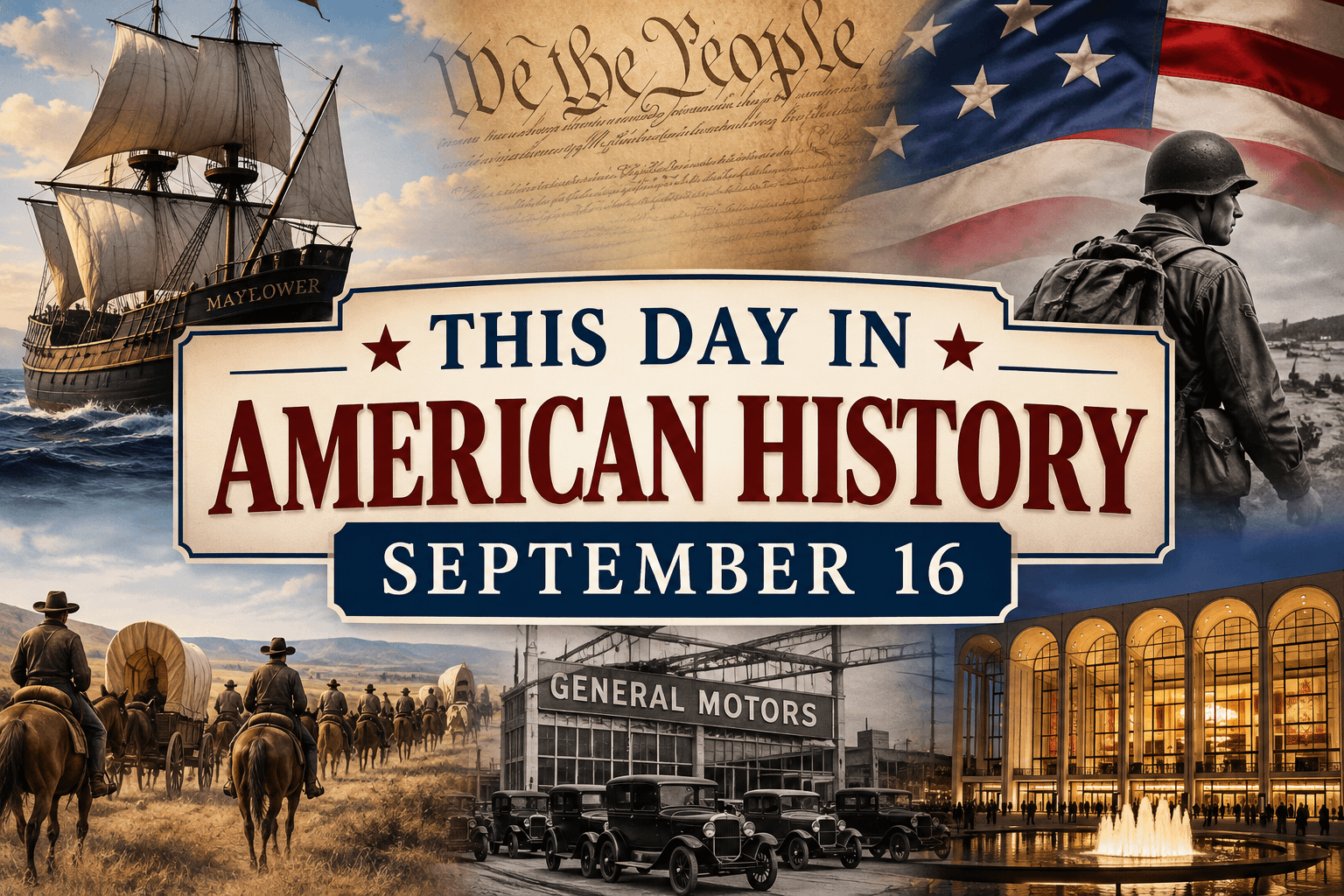
September 16 has witnessed events that helped shape the United States long before it became an independent nation and continued to influence its politics, military, business, culture, and national identity for centuries afterward.
From the voyage of the Mayflower and the settlement of the American West to the creation of General Motors, America’s first peacetime military draft, and the difficult effort to heal the divisions left by the Vietnam War, September 16 offers a fascinating look at the forces that have shaped the country.
Here are some of the most important moments connected to September 16 in American history.
1620 – The Mayflower Begins Its Historic Journey to America
On September 16, 1620, according to the modern Gregorian calendar, the Mayflower departed Plymouth, England, carrying approximately 102 passengers on a voyage across the Atlantic Ocean.
Few voyages would become more closely associated with the story of early America.
The passengers were a mixture of religious Separatists, often referred to today as Pilgrims, and other colonists seeking economic opportunities or a new beginning in the English colonies.
Their destination was originally farther south, in territory associated with the Virginia colony. Difficult weather and navigational circumstances eventually brought the Mayflower to the coast of what is now Massachusetts.
The Atlantic crossing was miserable.
Passengers spent weeks crowded into the ship while dealing with storms, seasickness, cold temperatures, poor sanitation, limited food, and uncertainty about what awaited them.
After more than two months at sea, the travelers finally reached Cape Cod.
Before establishing their settlement, a group of male passengers signed what became known as the Mayflower Compact. The agreement established a basic framework for governing the community and is often remembered as an early example of self-government in colonial America.
The settlers eventually established Plymouth Colony.
Their survival was far from guaranteed. Disease, exposure, malnutrition, and harsh winter conditions killed many of the settlers during their first months in America.
The familiar story of Plymouth also cannot be told without recognizing the Native peoples who had lived in the region for generations. Interactions between European settlers and Indigenous nations would become an enormously important—and frequently tragic—part of American history.
The Mayflower’s departure on September 16 therefore represents much more than the beginning of one voyage.
It became part of the larger story of European colonization, religious freedom, immigration, self-government, conflict, survival, and the complicated origins of what eventually became the United States.
1810 – Mexico’s Fight for Independence Begins
Although this event occurred in Mexico, what happened on September 16, 1810 would eventually have enormous consequences for the United States.
Early that morning, Catholic priest Miguel Hidalgo y Costilla called people in the town of Dolores to rise against Spanish rule.
The event became known as the Grito de Dolores, or Cry of Dolores.
Hidalgo’s call helped launch the Mexican War of Independence.
The struggle continued for more than a decade before Mexico achieved independence from Spain in 1821. September 16 is now celebrated as Mexican Independence Day.
Mexico’s independence ultimately changed the political map of North America.
At the time Mexico became independent, its territory extended far beyond the borders of modern Mexico and included enormous areas that are now part of the United States.
California, Nevada, Utah, most of Arizona and New Mexico, and portions of several other present-day states were once Mexican territory.
Texas also belonged to Mexico before the Texas Revolution.
Growing tensions between Mexico and the United States eventually contributed to the Mexican-American War from 1846 to 1848. The conflict ended with the Treaty of Guadalupe Hidalgo and dramatically expanded U.S. territory.
For that reason, Mexico’s independence movement is also an important chapter in the story of America’s westward expansion and the development of the modern United States.
1893 – The Largest Land Run in American History
On September 16, 1893, more than 100,000 settlers gathered along the boundaries of the Cherokee Outlet in present-day Oklahoma.
At noon, the race began.
Settlers rushed into the territory on horseback, in wagons, on bicycles, and even on foot, hoping to claim available land.
The event became known as the Cherokee Strip Land Run and was the largest land run in American history.
More than six million acres were opened for settlement.
For settlers hoping to own land, the event represented opportunity and the possibility of building a new life.
But there was another side to the story.
The territory had been connected to the Cherokee Nation, and the federal government’s acquisition and opening of Indigenous lands reflected the broader displacement of Native American peoples that accompanied U.S. westward expansion.
Land runs have often been portrayed romantically as examples of frontier adventure.
The complete history is considerably more complicated.
America’s expansion westward created farms, towns, businesses, railroads, and new states, but it also came at an enormous cost to Native American communities whose lands and sovereignty were repeatedly reduced.
The September 16 land run demonstrates how a single historical event can represent opportunity for one group while representing profound loss for another.
1908 – General Motors Is Founded
American history isn’t shaped only by presidents, wars, and political movements.
Business and technology have transformed the country as well.
On September 16, 1908, General Motors was founded, beginning the development of what would become one of the largest automobile companies in the world.
The automobile was still relatively new, but Americans were quickly discovering how dramatically cars could change everyday life.
Automobiles eventually transformed where people lived, where they worked, how they traveled, and how American cities and suburbs were designed.
GM grew by bringing multiple automobile brands together under one corporate organization.
During the following decades, automobiles became deeply connected to American culture.
Cars represented transportation, independence, economic opportunity, personal freedom, and sometimes social status.
The automobile industry also created enormous numbers of manufacturing jobs.
Detroit became synonymous with American car production, and the industry’s factories helped make the Midwest one of the country’s great manufacturing centers.
During World War II, America’s automobile manufacturing capacity became an important part of the nation’s industrial war effort as factories shifted toward producing military equipment and supplies.
After the war, rising automobile ownership helped fuel suburban expansion and construction of the interstate highway system.
Few industries have influenced the physical landscape of the United States as profoundly as the automobile industry.
The founding of General Motors on September 16, 1908 therefore represents an important milestone in America’s transformation into an industrial and automotive powerhouse.
1940 – America Establishes Its First Peacetime Draft
On September 16, 1940, President Franklin D. Roosevelt signed the Selective Training and Service Act.
The legislation created the first peacetime military draft in United States history.
The timing was critical.
World War II had already begun in Europe.
Nazi Germany had invaded Poland in September 1939, and by 1940 German forces had conquered or occupied large portions of Europe.
France had fallen.
Britain was fighting for survival.
The United States had not yet formally entered the war, and many Americans remained strongly opposed to becoming involved in another European conflict.
But American leaders increasingly believed the country needed to prepare for the possibility of war.
Under the new law, millions of American men became subject to military registration.
According to the National Park Service, more than 16 million men were registered within roughly a month of the law taking effect.
The decision represented a dramatic change in American military policy.
The United States was beginning to build the manpower and industrial capacity necessary for a massive national defense effort even before officially entering World War II.
That preparation became crucial little more than a year later.
On December 7, 1941, Japan attacked Pearl Harbor.
The following day, the United States declared war on Japan. Germany and Italy soon declared war on the United States, bringing America fully into World War II.
Millions of Americans would eventually serve in uniform.
The Selective Training and Service Act signed on September 16, 1940 helped lay the groundwork for that enormous mobilization.
1940 – Sam Rayburn Becomes Speaker of the House
September 16, 1940 also marked an important moment in congressional history when Sam Rayburn of Texas was elected Speaker of the U.S. House of Representatives.
Rayburn would become one of the most influential congressional leaders of the 20th century.
Known for his ability to work behind the scenes and build relationships across political divisions, Rayburn served as Speaker for a total of more than 17 years across three separate periods.
His leadership spanned some of America’s most consequential years, including World War II, the early Cold War, the Korean War, and the beginning of the modern civil rights era.
His unusually long tenure made him one of the defining figures in congressional history.
1966 – The Metropolitan Opera Opens at Lincoln Center
September 16 also holds an important place in American cultural history.
On September 16, 1966, the Metropolitan Opera opened its new home at Lincoln Center in New York City.
Lincoln Center became one of America’s most prominent performing arts complexes, bringing together major institutions dedicated to music, theater, dance, and opera.
The opening reflected the continuing growth of New York City as one of the world’s great cultural capitals.
American history is often told through wars, elections, laws, and economic changes, but art and culture are also fundamental parts of the country’s identity.
The opening of the Metropolitan Opera’s Lincoln Center home represented America’s growing influence in the international performing arts.
1974 – President Gerald Ford Offers Conditional Clemency to Vietnam-Era Draft Evaders
One of the most politically sensitive events to occur on September 16 came in 1974.
The Vietnam War had left the United States deeply divided.
Millions of Americans had served in the military, tens of thousands of American service members had died, and countless families had been changed forever.
At the same time, thousands of young Americans had resisted the draft or deserted from military service.
Some fled to countries such as Canada rather than participate in the war.
After becoming president following Richard Nixon’s resignation, President Gerald Ford faced the difficult question of what should happen to those Americans.
On September 16, 1974, Ford announced a clemency program for Vietnam-era draft evaders and military deserters.
Under the program, eligible individuals could return and work toward clemency by reaffirming allegiance to the United States and completing a period of alternative public service, potentially lasting as long as two years.
Ford presented the program as part of an effort to heal the nation’s divisions.
The policy was controversial.
Some Americans believed those who had refused military service should face punishment, particularly out of respect for those who had served and sacrificed.
Others believed Ford’s program did not go far enough and called for unconditional amnesty.
The debate demonstrated how deeply the Vietnam War continued to divide the country even after America’s direct military involvement had ended.
A few years later, President Jimmy Carter took a different approach.
On his first full day as president in January 1977, Carter granted a pardon to most Vietnam-era draft evaders, although the action did not generally extend to military deserters.
The contrasting approaches of Ford and Carter reflected America’s continuing struggle to reconcile after one of the most divisive periods in modern American history.
Why September 16 Matters in American History
Looking across the centuries, September 16 reveals several recurring themes in the American story.
There is exploration and settlement.
There is immigration and the search for a new beginning.
There is expansion across the continent.
There is the complicated and painful history of Native American displacement.
There is industrial growth.
There is military preparation.
There is political leadership.
There is cultural achievement.
And there is the difficult challenge of bringing a divided country back together.
The Mayflower’s journey helped create one of America’s most enduring origin stories.
Mexico’s independence movement helped reshape North America and eventually influenced the borders of the United States.
The Cherokee Strip Land Run became a dramatic symbol of westward settlement while also illustrating the enormous losses suffered by Native peoples.
The creation of General Motors helped usher America deeper into the automobile age.
The Selective Training and Service Act prepared the country for a global conflict that would transform the United States into a military and economic superpower.
And Gerald Ford’s Vietnam-era clemency program demonstrated just how difficult national reconciliation can be after years of political and social division.
History rarely fits neatly into categories of triumph or tragedy.
Often, it contains both.
Understanding events like those that occurred on September 16 means looking beyond famous names and dates and considering how decisions made generations ago continue to influence the country today.
That is one of the reasons studying history remains important.
Every generation inherits a country shaped by the decisions, sacrifices, conflicts, successes, and failures of those who came before.
September 16 is another reminder that America’s story was not created in a single moment.
It has been built—sometimes painfully—one day at a time.
Which September 16 event do you think had the greatest impact on the United States, and why?
Leave a Reply